Raman Spectroscopy
1923 – Inelastic light scattering is predicted by A. Smekel
1928 – Landsberg and Mandelstam see unexpected
frequency shifts in scattering from quartz
1928 – C.V. Raman and K.S. Krishnan see “feeble
fluorescence” from neat solvents
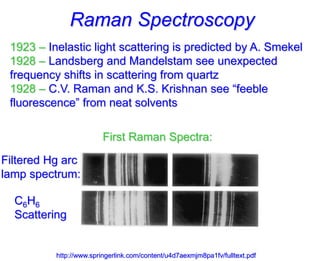
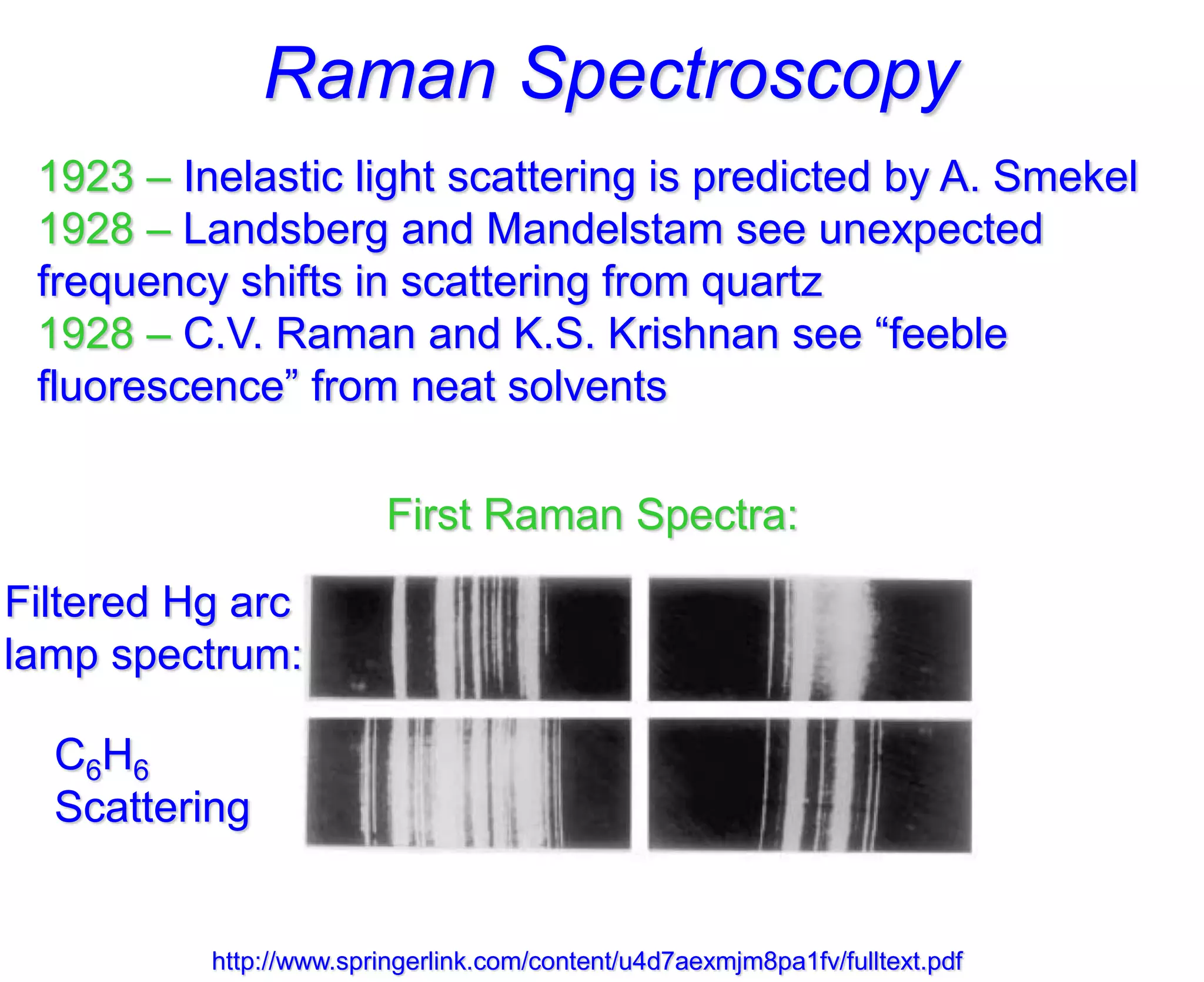
First Raman Spectra:
http://www.springerlink.com/content/u4d7aexmjm8pa1fv/fulltext.pdf
Filtered Hg arc
lamp spectrum:
C6H6
Scattering
Raman Spectroscopy
1923 – Inelastic light scattering is predicted by A. Smekel
1928 – Landsberg and Mandelstam see unexpected
frequency shifts in scattering from quartz
1928 – C.V. Raman and K.S. Krishnan see “feeble
fluorescence” from neat solvents
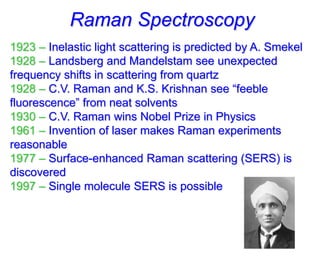
1930 – C.V. Raman wins Nobel Prize in Physics
1961 – Invention of laser makes Raman experiments
reasonable
1977 – Surface-enhanced Raman scattering (SERS) is
discovered
1997 – Single molecule SERS is possible
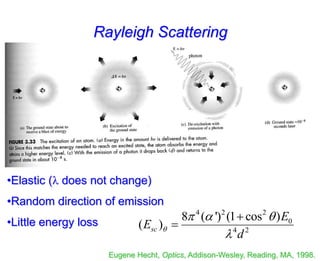
Eugene Hecht, Optics, Addison-Wesley, Reading, MA, 1998.
Rayleigh Scattering
•Elastic ( does not change)
•Random direction of emission
•Little energy loss
4 2 2
0
4 2
8 ( ') (1 cos )
( )
sc
E
E
d

  



Raman Spectroscopy
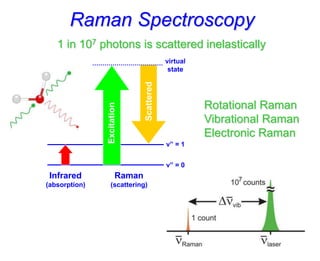
1 in 107 photons is scattered inelastically
Infrared
(absorption)
Raman
(scattering)
v” = 0
v” = 1
virtual
state
Excitation
Scattered
Rotational Raman
Vibrational Raman
Electronic Raman
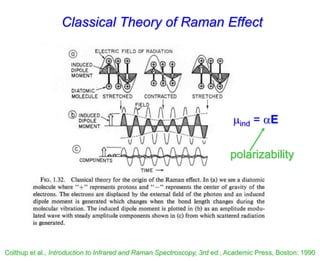
Classical Theory of Raman Effect
Colthup et al., Introduction to Infrared and Raman Spectroscopy, 3rd ed., Academic Press, Boston: 1990
mind = E
polarizability
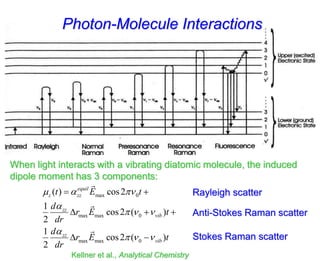
Kellner et al., Analytical Chemistry
max 0
max max 0
max max 0
( ) cos2
1
cos2 ( )
2
1
cos2 ( )
2
equil
z zz
zz
vib
zz
vib
t E t
d
r E t
dr
d
r E t
dr
m  

  

  
 
  
 
When light interacts with a vibrating diatomic molecule, the induced
dipole moment has 3 components:
Photon-Molecule Interactions
Rayleigh scatter
Anti-Stokes Raman scatter
Stokes Raman scatter
www.andor.com
max 0
max max 0
max max 0
( ) cos2
1
cos2 ( )
2
1
cos2 ( )
2
equil
z zz
zz
vib
zz
vib
t E t
d
r E t
dr
d
r E t
dr
m  

  

  
 
  
 
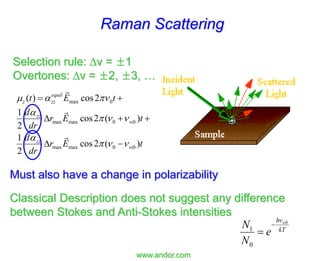
Selection rule: v = ±1
Overtones: v = ±2, ±3, …
Raman Scattering
Must also have a change in polarizability
Classical Description does not suggest any difference
between Stokes and Anti-Stokes intensities
1
0
vib
h
kT
N
e
N



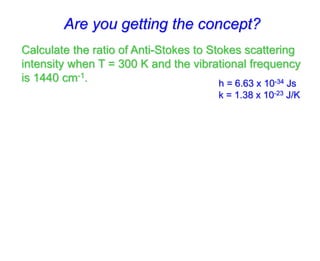
Calculate the ratio of Anti-Stokes to Stokes scattering
intensity when T = 300 K and the vibrational frequency
is 1440 cm-1.
Are you getting the concept?
h = 6.63 x 10⁻³⁴ Js
k = 1.38 x 10⁻²³ J/K
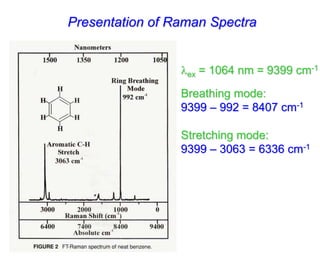
Presentation of Raman Spectra
ex = 1064 nm = 9399 cm-1
Breathing mode:
9399 – 992 = 8407 cm-1
Stretching mode:
9399 – 3063 = 6336 cm-1
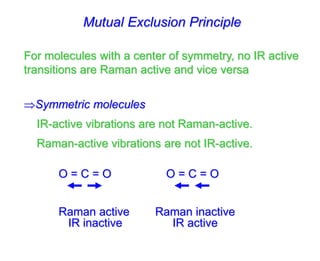
Mutual Exclusion Principle
For molecules with a center of symmetry, no IR active
transitions are Raman active and vice versa
Symmetric molecules
IR-active vibrations are not Raman-active.
Raman-active vibrations are not IR-active.
O = C = O O = C = O
Raman active Raman inactive
IR inactive IR active
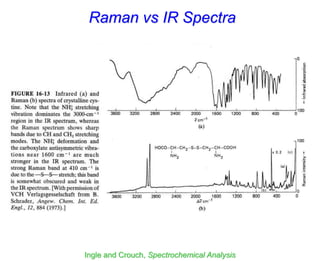
Raman vs IR Spectra
Ingle and Crouch, Spectrochemical Analysis
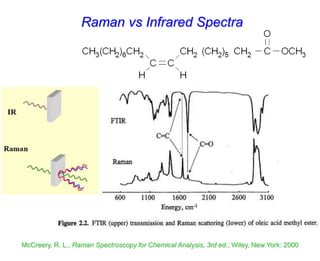
Raman vs Infrared Spectra
McCreery, R. L., Raman Spectroscopy for Chemical Analysis, 3rd ed., Wiley, New York: 2000
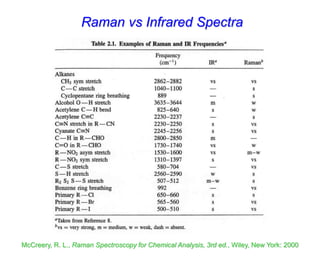
Raman vs Infrared Spectra
McCreery, R. L., Raman Spectroscopy for Chemical Analysis, 3rd ed., Wiley, New York: 2000
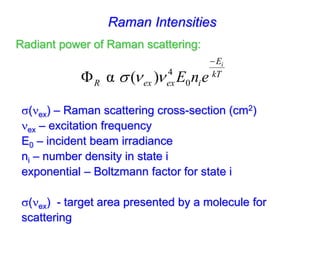
Raman Intensities
s(ex) – Raman scattering cross-section (cm2)
ex – excitation frequency
E0 – incident beam irradiance
ni – number density in state i
exponential – Boltzmann factor for state i
4
0
α ( )
i
E
kT
R ex ex i
E n e
s  


Radiant power of Raman scattering:
s(ex) - target area presented by a molecule for
scattering
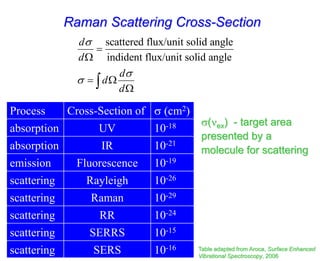
Raman Scattering Cross-Section
s(ex) - target area
presented by a
molecule for scattering
scattered flux/unit solid angle
indident flux/unit solid angle
d
d
d
d
d
s
s
s


 


Process Cross-Section of s (cm2)
absorption UV 10-18
absorption IR 10-21
emission Fluorescence 10-19
scattering Rayleigh 10-26
scattering Raman 10-29
scattering RR 10-24
scattering SERRS 10-15
scattering SERS 10-16 Table adapted from Aroca, Surface Enhanced
Vibrational Spectroscopy, 2006
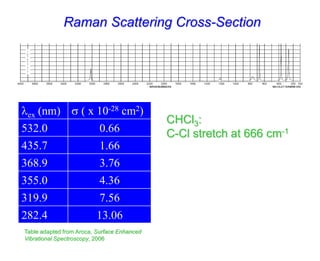
Raman Scattering Cross-Section
ex (nm) s ( x 10-28 cm2)
532.0 0.66
435.7 1.66
368.9 3.76
355.0 4.36
319.9 7.56
282.4 13.06
Table adapted from Aroca, Surface Enhanced
Vibrational Spectroscopy, 2006
CHCl3:
C-Cl stretch at 666 cm-1
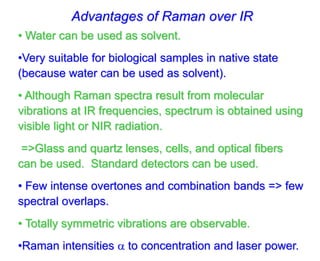
Advantages of Raman over IR
• Water can be used as solvent.
•Very suitable for biological samples in native state
(because water can be used as solvent).
• Although Raman spectra result from molecular
vibrations at IR frequencies, spectrum is obtained using
visible light or NIR radiation.
=>Glass and quartz lenses, cells, and optical fibers
can be used. Standard detectors can be used.
• Few intense overtones and combination bands => few
spectral overlaps.
• Totally symmetric vibrations are observable.
•Raman intensities  to concentration and laser power.
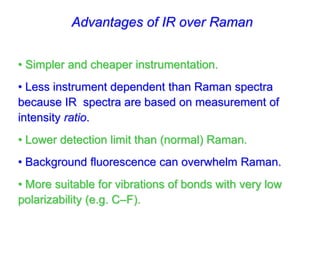
Advantages of IR over Raman
• Simpler and cheaper instrumentation.
• Less instrument dependent than Raman spectra
because IR spectra are based on measurement of
intensity ratio.
• Lower detection limit than (normal) Raman.
• Background fluorescence can overwhelm Raman.
• More suitable for vibrations of bonds with very low
polarizability (e.g. C–F).
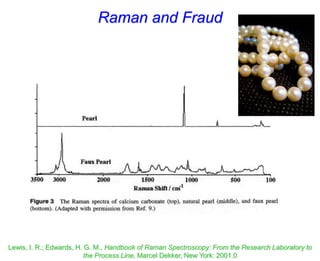
Raman and Fraud
Lewis, I. R.; Edwards, H. G. M., Handbook of Raman Spectroscopy: From the Research Laboratory to
the Process Line, Marcel Dekker, New York: 2001.0
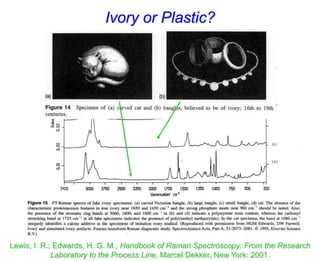
Ivory or Plastic?
Lewis, I. R.; Edwards, H. G. M., Handbook of Raman Spectroscopy: From the Research
Laboratory to the Process Line, Marcel Dekker, New York: 2001.
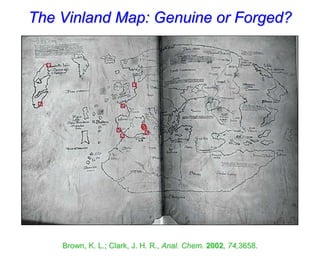
The Vinland Map: Genuine or Forged?
Brown, K. L.; Clark, J. H. R., Anal. Chem. 2002, 74,3658.
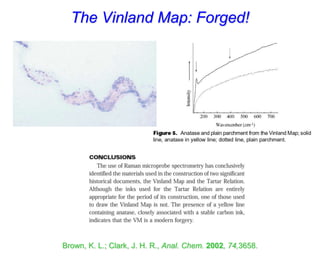
The Vinland Map: Forged!
Brown, K. L.; Clark, J. H. R., Anal. Chem. 2002, 74,3658.
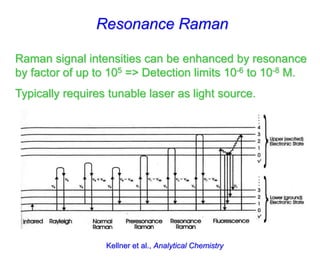
Resonance Raman
Raman signal intensities can be enhanced by resonance
by factor of up to 105 => Detection limits 10-6 to 10-8 M.
Typically requires tunable laser as light source.
Kellner et al., Analytical Chemistry
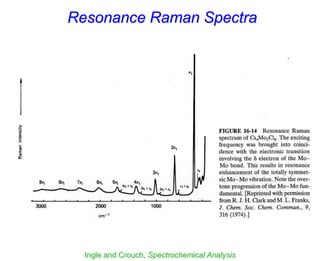
Resonance Raman Spectra
Ingle and Crouch, Spectrochemical Analysis
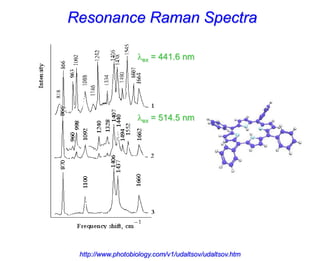
Resonance Raman Spectra
http://www.photobiology.com/v1/udaltsov/udaltsov.htm
ex = 441.6 nm
ex = 514.5 nm
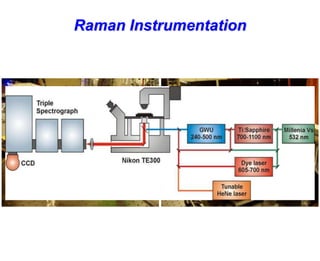
Raman Instrumentation
Tunable Laser System Versatile Detection System
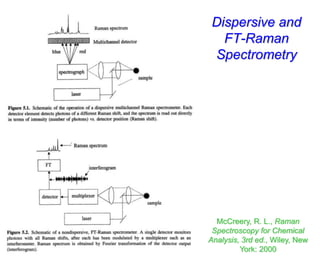
Dispersive and
FT-Raman
Spectrometry
McCreery, R. L., Raman
Spectroscopy for Chemical
Analysis, 3rd ed., Wiley, New
York: 2000
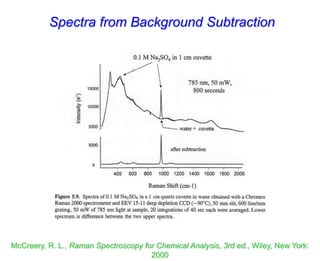
Spectra from Background Subtraction
McCreery, R. L., Raman Spectroscopy for Chemical Analysis, 3rd ed., Wiley, New York:
2000
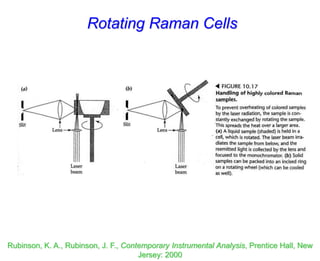
Rotating Raman Cells
Rubinson, K. A., Rubinson, J. F., Contemporary Instrumental Analysis, Prentice Hall, New
Jersey: 2000
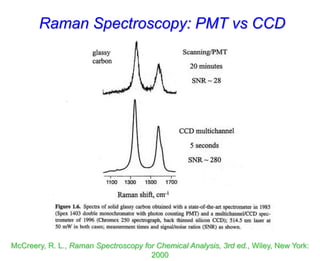
Raman Spectroscopy: PMT vs CCD
McCreery, R. L., Raman Spectroscopy for Chemical Analysis, 3rd ed., Wiley, New York:
2000
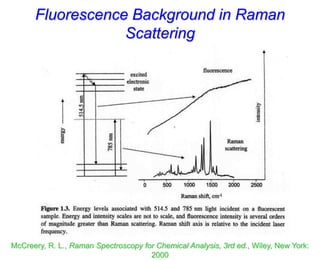
Fluorescence Background in Raman
Scattering
McCreery, R. L., Raman Spectroscopy for Chemical Analysis, 3rd ed., Wiley, New York:
2000
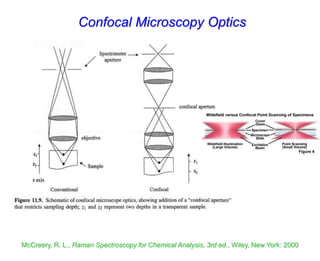
Confocal Microscopy Optics
McCreery, R. L., Raman Spectroscopy for Chemical Analysis, 3rd ed., Wiley, New York: 2000
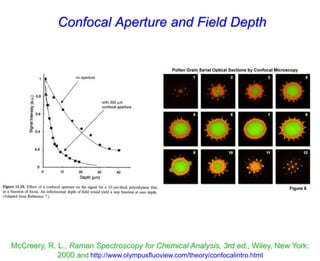
Confocal Aperture and Field Depth
McCreery, R. L., Raman Spectroscopy for Chemical Analysis, 3rd ed., Wiley, New York:
2000 and http://www.olympusfluoview.com/theory/confocalintro.html
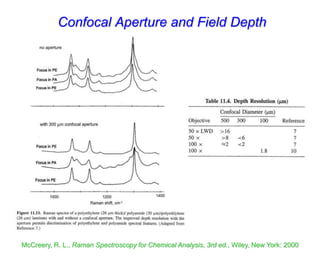
Confocal Aperture and Field Depth
McCreery, R. L., Raman Spectroscopy for Chemical Analysis, 3rd ed., Wiley, New York: 2000

Raman.ppt

  • 1.
    Raman Spectroscopy 1923 –Inelastic light scattering is predicted by A. Smekel 1928 – Landsberg and Mandelstam see unexpected frequency shifts in scattering from quartz 1928 – C.V. Raman and K.S. Krishnan see “feeble fluorescence” from neat solvents First Raman Spectra: http://www.springerlink.com/content/u4d7aexmjm8pa1fv/fulltext.pdf Filtered Hg arc lamp spectrum: C6H6 Scattering
  • 2.
    Raman Spectroscopy 1923 –Inelastic light scattering is predicted by A. Smekel 1928 – Landsberg and Mandelstam see unexpected frequency shifts in scattering from quartz 1928 – C.V. Raman and K.S. Krishnan see “feeble fluorescence” from neat solvents 1930 – C.V. Raman wins Nobel Prize in Physics 1961 – Invention of laser makes Raman experiments reasonable 1977 – Surface-enhanced Raman scattering (SERS) is discovered 1997 – Single molecule SERS is possible
  • 3.
    Eugene Hecht, Optics,Addison-Wesley, Reading, MA, 1998. Rayleigh Scattering •Elastic ( does not change) •Random direction of emission •Little energy loss 4 2 2 0 4 2 8 ( ') (1 cos ) ( ) sc E E d       
  • 4.
    Raman Spectroscopy 1 in107 photons is scattered inelastically Infrared (absorption) Raman (scattering) v” = 0 v” = 1 virtual state Excitation Scattered Rotational Raman Vibrational Raman Electronic Raman
  • 5.
    Classical Theory ofRaman Effect Colthup et al., Introduction to Infrared and Raman Spectroscopy, 3rd ed., Academic Press, Boston: 1990 mind = E polarizability
  • 6.
    Kellner et al.,Analytical Chemistry max 0 max max 0 max max 0 ( ) cos2 1 cos2 ( ) 2 1 cos2 ( ) 2 equil z zz zz vib zz vib t E t d r E t dr d r E t dr m                  When light interacts with a vibrating diatomic molecule, the induced dipole moment has 3 components: Photon-Molecule Interactions Rayleigh scatter Anti-Stokes Raman scatter Stokes Raman scatter
  • 8.
    www.andor.com max 0 max max0 max max 0 ( ) cos2 1 cos2 ( ) 2 1 cos2 ( ) 2 equil z zz zz vib zz vib t E t d r E t dr d r E t dr m                  Selection rule: v = ±1 Overtones: v = ±2, ±3, … Raman Scattering Must also have a change in polarizability Classical Description does not suggest any difference between Stokes and Anti-Stokes intensities 1 0 vib h kT N e N   
  • 9.
    Calculate the ratioof Anti-Stokes to Stokes scattering intensity when T = 300 K and the vibrational frequency is 1440 cm-1. Are you getting the concept? h = 6.63 x 10⁻³⁴ Js k = 1.38 x 10⁻²³ J/K
  • 10.
    Presentation of RamanSpectra ex = 1064 nm = 9399 cm-1 Breathing mode: 9399 – 992 = 8407 cm-1 Stretching mode: 9399 – 3063 = 6336 cm-1
  • 11.
    Mutual Exclusion Principle Formolecules with a center of symmetry, no IR active transitions are Raman active and vice versa Symmetric molecules IR-active vibrations are not Raman-active. Raman-active vibrations are not IR-active. O = C = O O = C = O Raman active Raman inactive IR inactive IR active
  • 12.
    Raman vs IRSpectra Ingle and Crouch, Spectrochemical Analysis
  • 13.
    Raman vs InfraredSpectra McCreery, R. L., Raman Spectroscopy for Chemical Analysis, 3rd ed., Wiley, New York: 2000
  • 14.
    Raman vs InfraredSpectra McCreery, R. L., Raman Spectroscopy for Chemical Analysis, 3rd ed., Wiley, New York: 2000
  • 15.
    Raman Intensities s(ex) –Raman scattering cross-section (cm2) ex – excitation frequency E0 – incident beam irradiance ni – number density in state i exponential – Boltzmann factor for state i 4 0 α ( ) i E kT R ex ex i E n e s     Radiant power of Raman scattering: s(ex) - target area presented by a molecule for scattering
  • 16.
    Raman Scattering Cross-Section s(ex)- target area presented by a molecule for scattering scattered flux/unit solid angle indident flux/unit solid angle d d d d d s s s       Process Cross-Section of s (cm2) absorption UV 10-18 absorption IR 10-21 emission Fluorescence 10-19 scattering Rayleigh 10-26 scattering Raman 10-29 scattering RR 10-24 scattering SERRS 10-15 scattering SERS 10-16 Table adapted from Aroca, Surface Enhanced Vibrational Spectroscopy, 2006
  • 17.
    Raman Scattering Cross-Section ex(nm) s ( x 10-28 cm2) 532.0 0.66 435.7 1.66 368.9 3.76 355.0 4.36 319.9 7.56 282.4 13.06 Table adapted from Aroca, Surface Enhanced Vibrational Spectroscopy, 2006 CHCl3: C-Cl stretch at 666 cm-1
  • 18.
    Advantages of Ramanover IR • Water can be used as solvent. •Very suitable for biological samples in native state (because water can be used as solvent). • Although Raman spectra result from molecular vibrations at IR frequencies, spectrum is obtained using visible light or NIR radiation. =>Glass and quartz lenses, cells, and optical fibers can be used. Standard detectors can be used. • Few intense overtones and combination bands => few spectral overlaps. • Totally symmetric vibrations are observable. •Raman intensities  to concentration and laser power.
  • 19.
    Advantages of IRover Raman • Simpler and cheaper instrumentation. • Less instrument dependent than Raman spectra because IR spectra are based on measurement of intensity ratio. • Lower detection limit than (normal) Raman. • Background fluorescence can overwhelm Raman. • More suitable for vibrations of bonds with very low polarizability (e.g. C–F).
  • 20.
    Raman and Fraud Lewis,I. R.; Edwards, H. G. M., Handbook of Raman Spectroscopy: From the Research Laboratory to the Process Line, Marcel Dekker, New York: 2001.0
  • 21.
    Ivory or Plastic? Lewis,I. R.; Edwards, H. G. M., Handbook of Raman Spectroscopy: From the Research Laboratory to the Process Line, Marcel Dekker, New York: 2001.
  • 22.
    The Vinland Map:Genuine or Forged? Brown, K. L.; Clark, J. H. R., Anal. Chem. 2002, 74,3658.
  • 23.
    The Vinland Map:Forged! Brown, K. L.; Clark, J. H. R., Anal. Chem. 2002, 74,3658.
  • 24.
    Resonance Raman Raman signalintensities can be enhanced by resonance by factor of up to 105 => Detection limits 10-6 to 10-8 M. Typically requires tunable laser as light source. Kellner et al., Analytical Chemistry
  • 25.
    Resonance Raman Spectra Ingleand Crouch, Spectrochemical Analysis
  • 26.
  • 27.
    Raman Instrumentation Tunable LaserSystem Versatile Detection System
  • 28.
    Dispersive and FT-Raman Spectrometry McCreery, R.L., Raman Spectroscopy for Chemical Analysis, 3rd ed., Wiley, New York: 2000
  • 29.
    Spectra from BackgroundSubtraction McCreery, R. L., Raman Spectroscopy for Chemical Analysis, 3rd ed., Wiley, New York: 2000
  • 30.
    Rotating Raman Cells Rubinson,K. A., Rubinson, J. F., Contemporary Instrumental Analysis, Prentice Hall, New Jersey: 2000
  • 31.
    Raman Spectroscopy: PMTvs CCD McCreery, R. L., Raman Spectroscopy for Chemical Analysis, 3rd ed., Wiley, New York: 2000
  • 32.
    Fluorescence Background inRaman Scattering McCreery, R. L., Raman Spectroscopy for Chemical Analysis, 3rd ed., Wiley, New York: 2000
  • 33.
    Confocal Microscopy Optics McCreery,R. L., Raman Spectroscopy for Chemical Analysis, 3rd ed., Wiley, New York: 2000
  • 34.
    Confocal Aperture andField Depth McCreery, R. L., Raman Spectroscopy for Chemical Analysis, 3rd ed., Wiley, New York: 2000 and http://www.olympusfluoview.com/theory/confocalintro.html
  • 35.
    Confocal Aperture andField Depth McCreery, R. L., Raman Spectroscopy for Chemical Analysis, 3rd ed., Wiley, New York: 2000