Rayleigh Scattering
and
Mie scattering:
Dr. P. K. Mani

Bidhan Chandra Krishi Viswavidyalaya
E-mail: pabitramani@gmail.com
Website: www.bckv.edu.in
Remote Sensing and its Applications in Soil Resource Mapping (ACSS-754)

Absorption.
Scattering
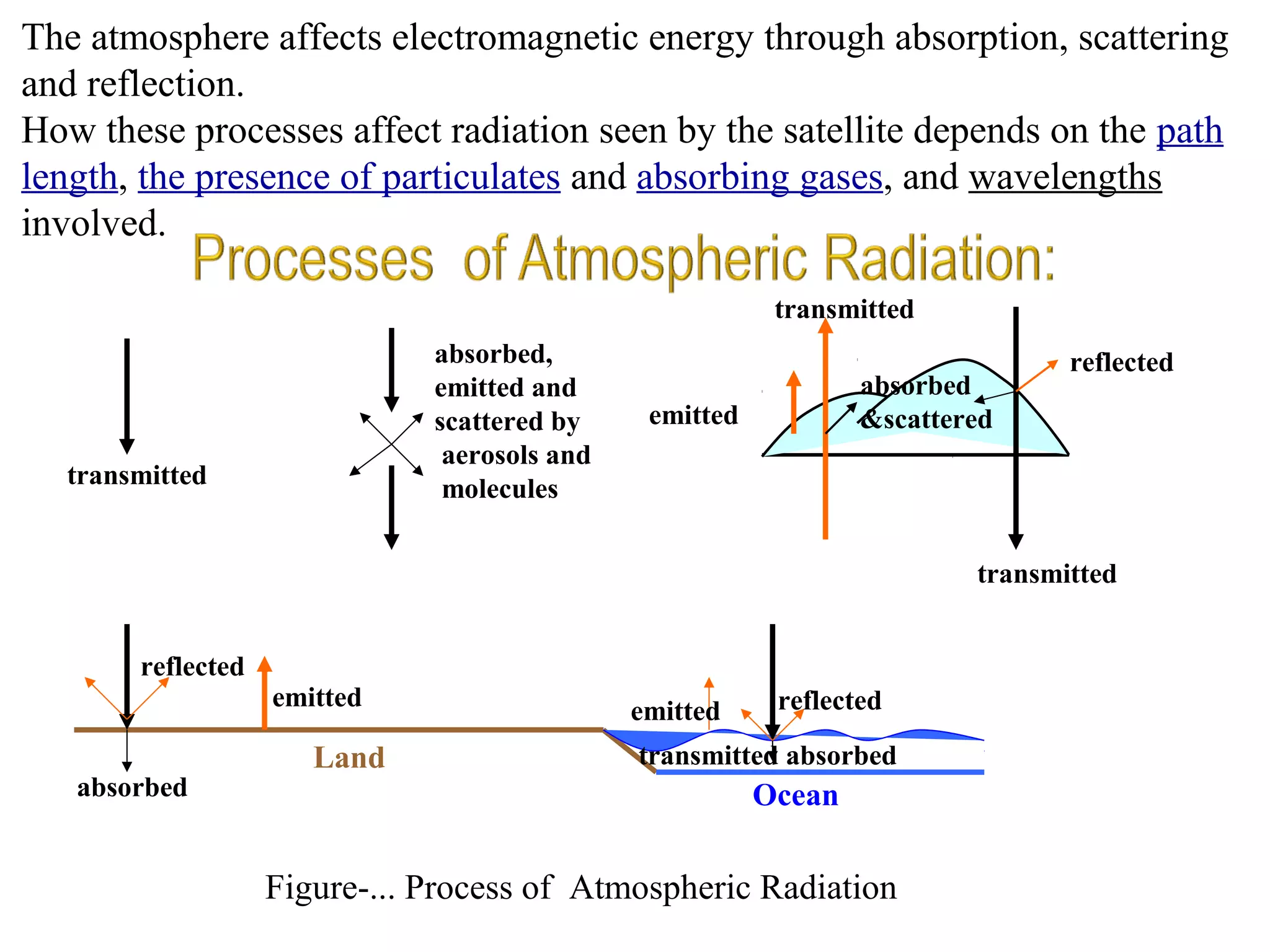
The atmosphere affects electromagnetic energy through absorption, scattering
and reflection.
How these processes affect radiation seen by the satellite depends on the path
length, the presence of particulates and absorbing gases, and wavelengths
involved.
transmitted
absorbed,
emitted and
scattered by
aerosols and
molecules

transmitted

absorbed
&scattered

emitted

reflected

transmitted
reflected

absorbed

emitted

Land

emitted

reflected

transmitted absorbed

Ocean

Figure-... Process of Atmospheric Radiation
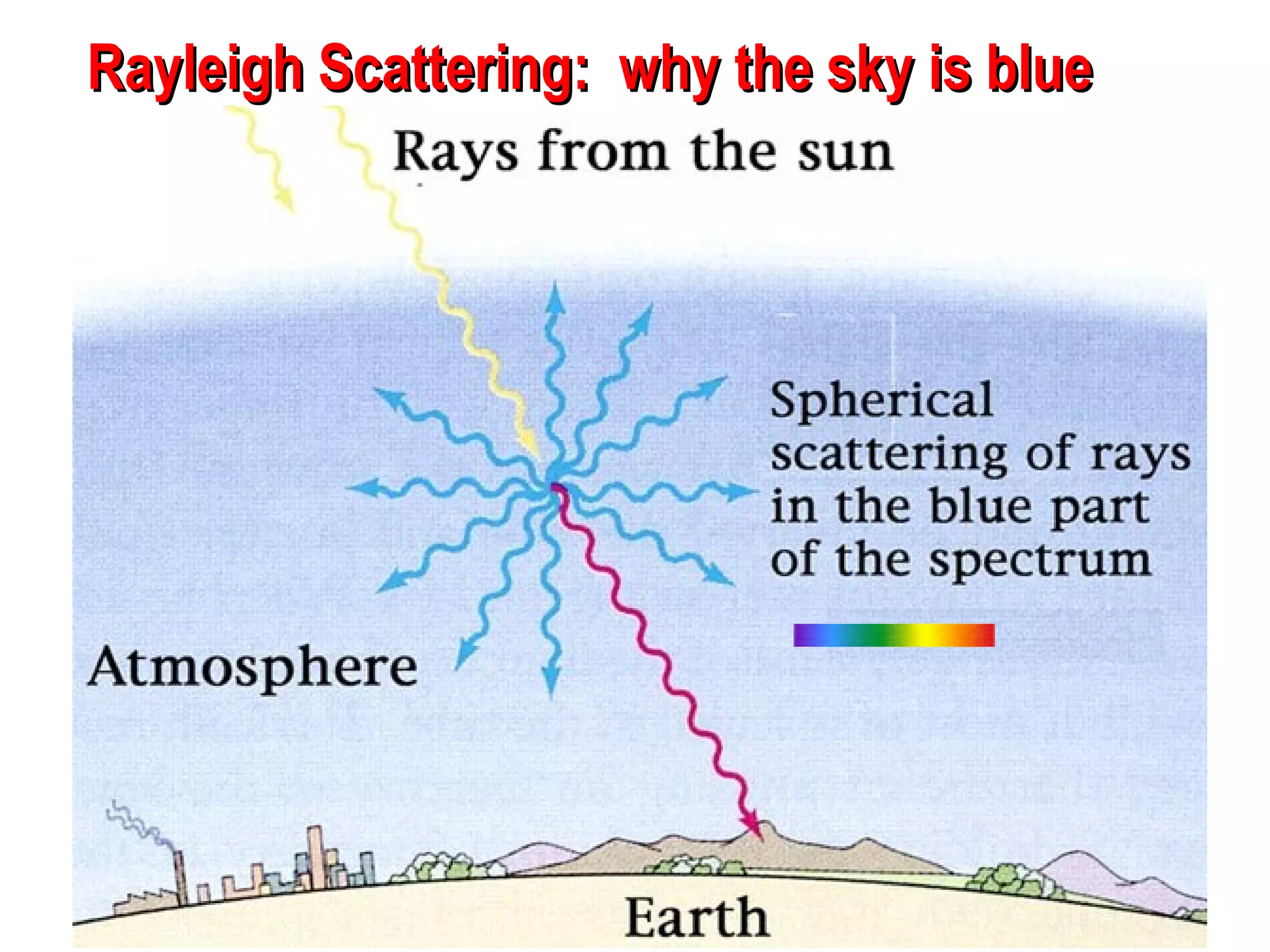
Rayleigh Scattering: why the sky is blue
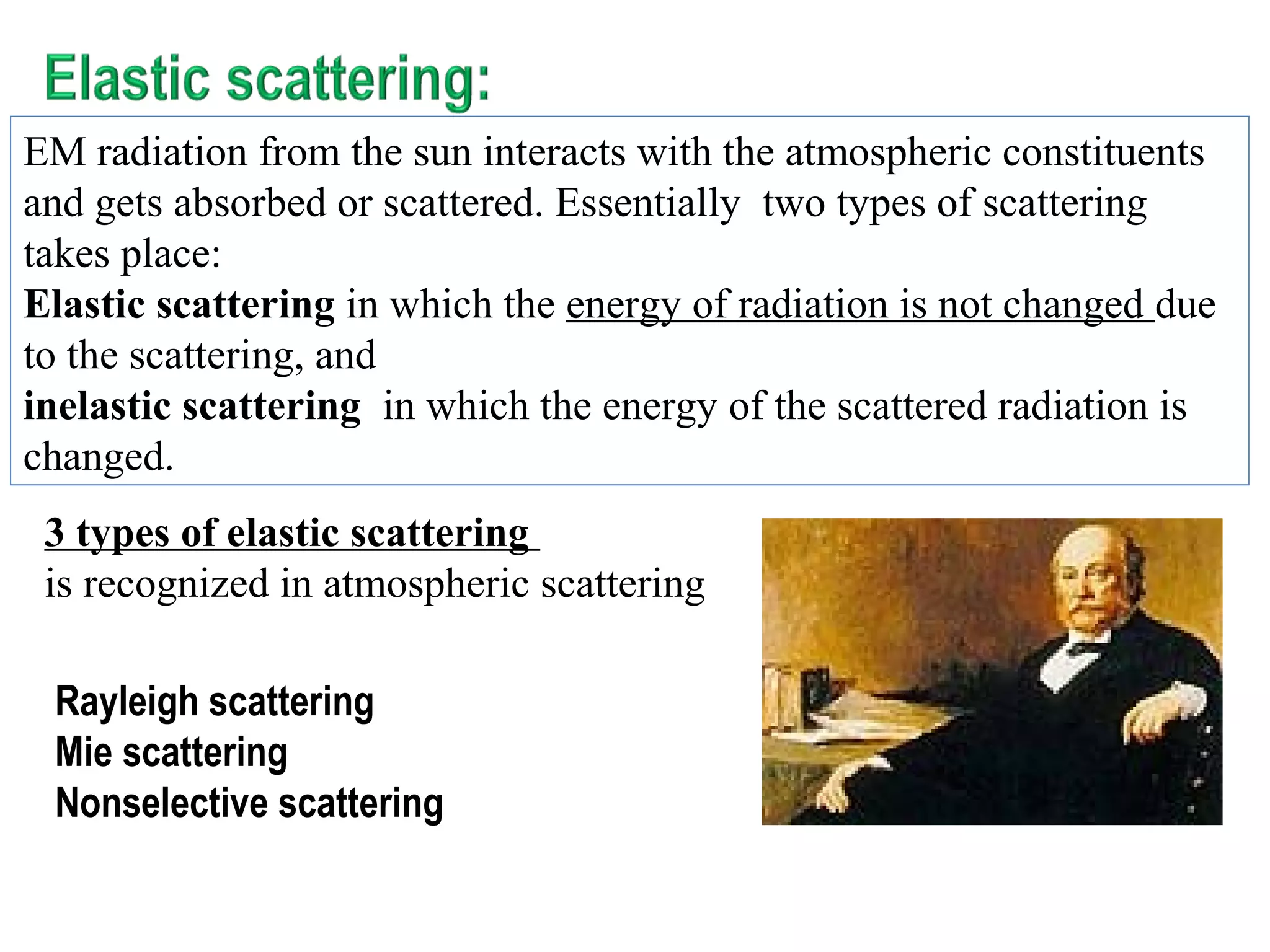
EM radiation from the sun interacts with the atmospheric constituents
and gets absorbed or scattered. Essentially two types of scattering
takes place:
Elastic scattering in which the energy of radiation is not changed due
to the scattering, and
inelastic scattering in which the energy of the scattered radiation is
changed.
3 types of elastic scattering
is recognized in atmospheric scattering
Rayleigh scattering
Mie scattering
Nonselective scattering
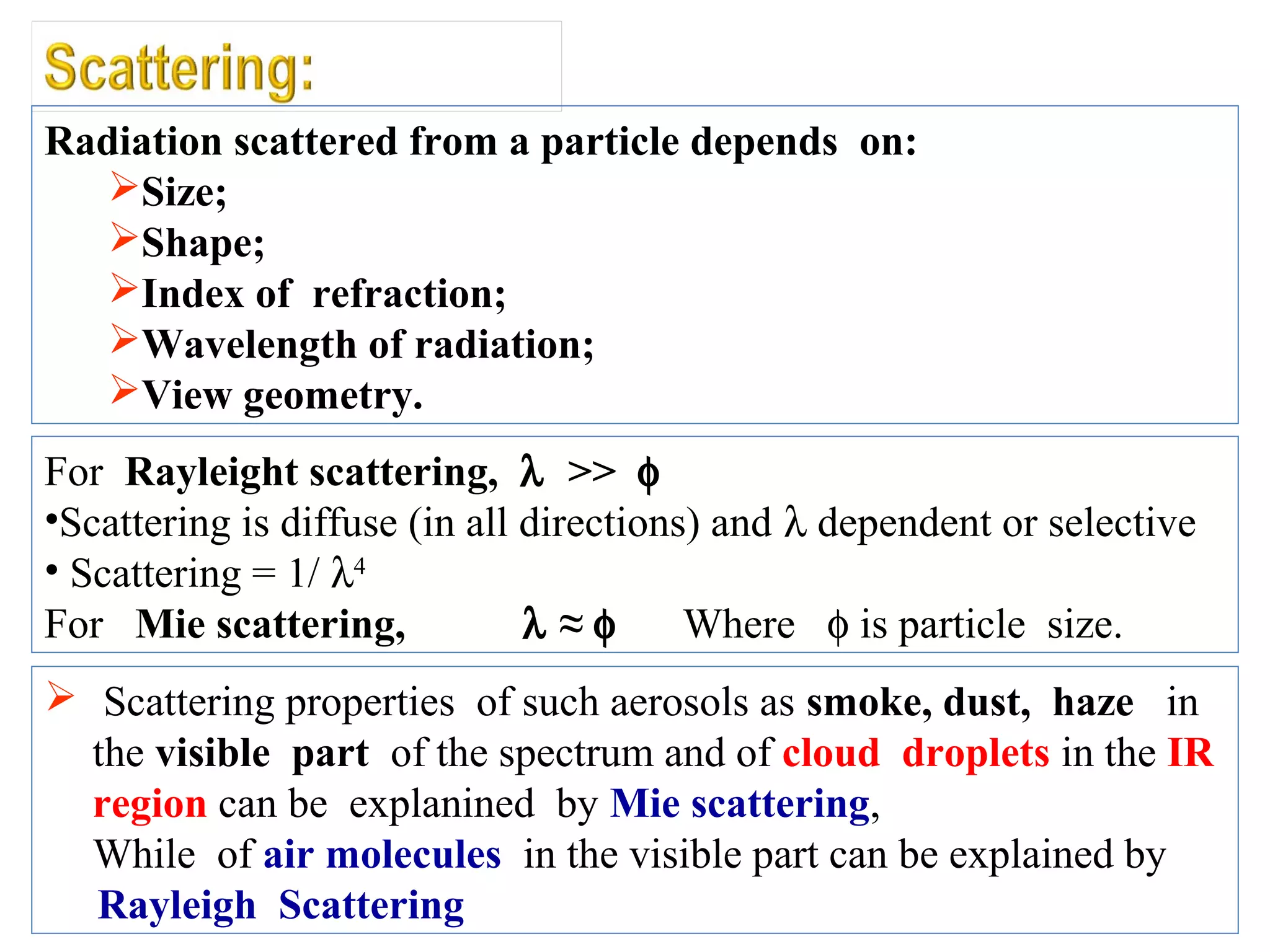
Radiation scattered from a particle depends on:
Size;
Shape;
Index of refraction;
Wavelength of radiation;
View geometry.
For Rayleight scattering, λ >> φ
•Scattering is diffuse (in all directions) and λ dependent or selective
• Scattering = 1/ λ4
For Mie scattering,
λ ≈φ
Where φ is particle size.
 Scattering properties of such aerosols as smoke, dust, haze in
the visible part of the spectrum and of cloud droplets in the IR
region can be explanined by Mie scattering,
While of air molecules in the visible part can be explained by
Rayleigh Scattering
Rayleigh Scattering:
In Rayleigh scattering the volume scattering coefficient σλ is given by :

σλ

[4π
=

2

NV

λ

4

2

] ⋅ [µ

2

[µ

2

]
]

− µ0

2 2

+ µ0

2 2

=

const

λ

4

N= no. of particles/cm2
…. V= vol. of scattering particles
λ = wavelength of radiation … µ= refractive index of the particles
µ0= refractive index of the medium
Because of Rayleigh scattering Multispectral remote sensing data
from the blue portion of the spectrum is of relatively limited
usefulness. In case of aerial photography, special filters are used to
filter out the scattered blue radiation due to haze present in the
atmosphere.
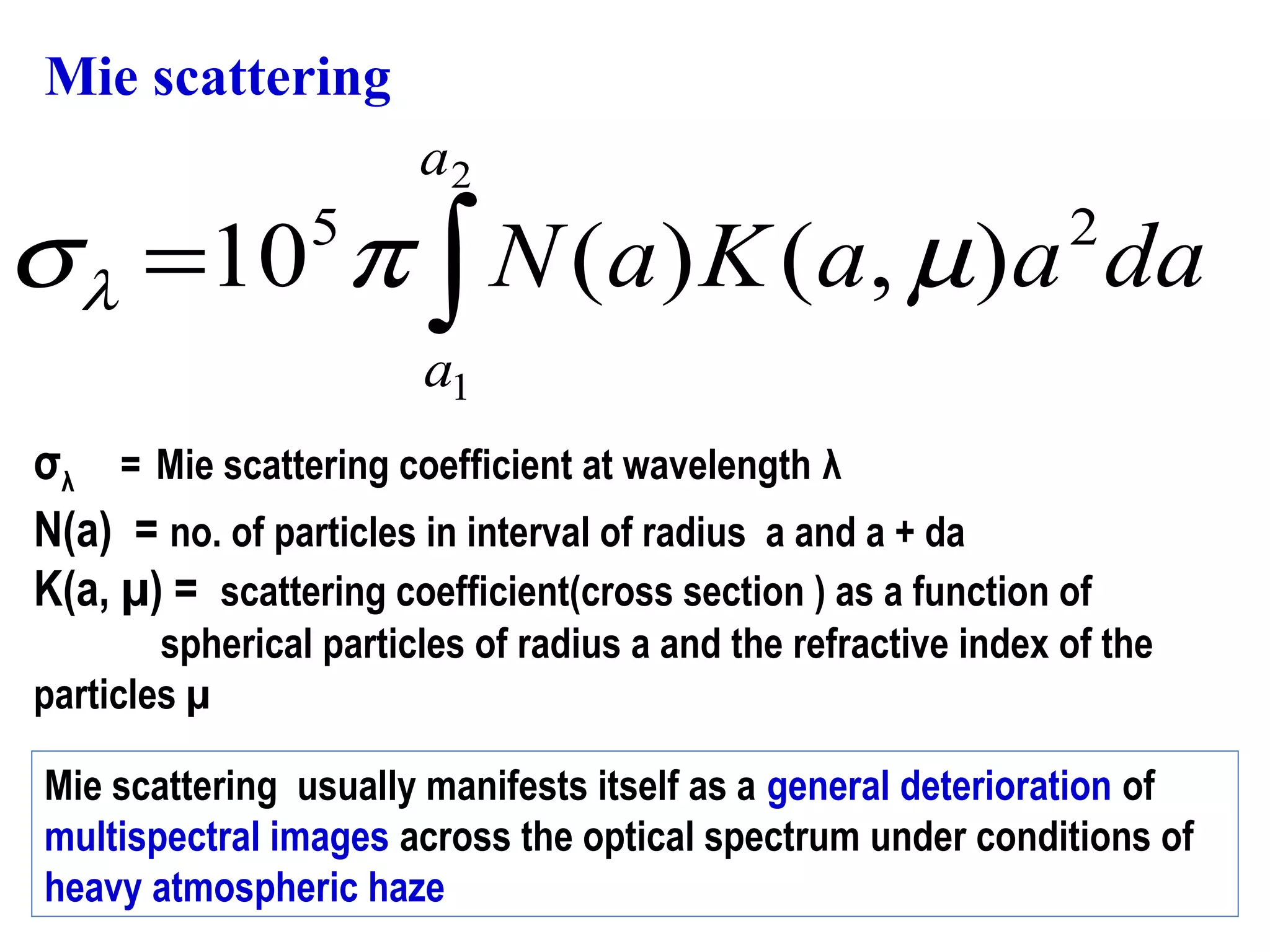
Mie scattering
a2

σ λ =10 π ∫ N (a ) K (a, µ)a da
5

2

a1

σλ = Mie scattering coefficient at wavelength λ
N(a) = no. of particles in interval of radius a and a + da
K(a, µ) = scattering coefficient(cross section ) as a function of
spherical particles of radius a and the refractive index of the
particles µ
Mie scattering usually manifests itself as a general deterioration of
multispectral images across the optical spectrum under conditions of
heavy atmospheric haze
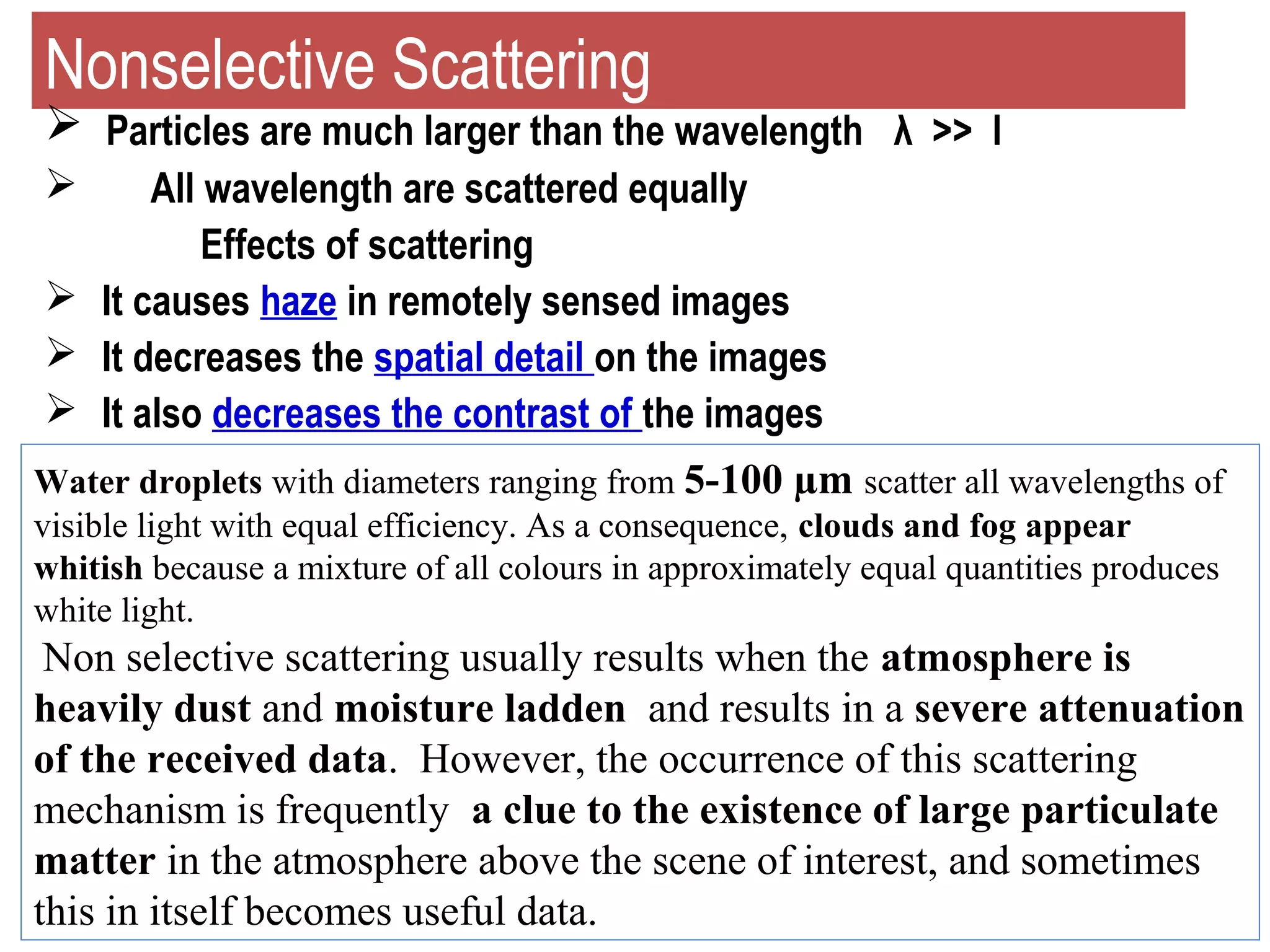
Nonselective Scattering

 Particles are much larger than the wavelength λ >> l
All wavelength are scattered equally
Effects of scattering
 It causes haze in remotely sensed images
 It decreases the spatial detail on the images
 It also decreases the contrast of the images


Water droplets with diameters ranging from 5-100 µm scatter all wavelengths of
visible light with equal efficiency. As a consequence, clouds and fog appear
whitish because a mixture of all colours in approximately equal quantities produces
white light.

Non selective scattering usually results when the atmosphere is
heavily dust and moisture ladden and results in a severe attenuation
of the received data. However, the occurrence of this scattering
mechanism is frequently a clue to the existence of large particulate
matter in the atmosphere above the scene of interest, and sometimes
this in itself becomes useful data.
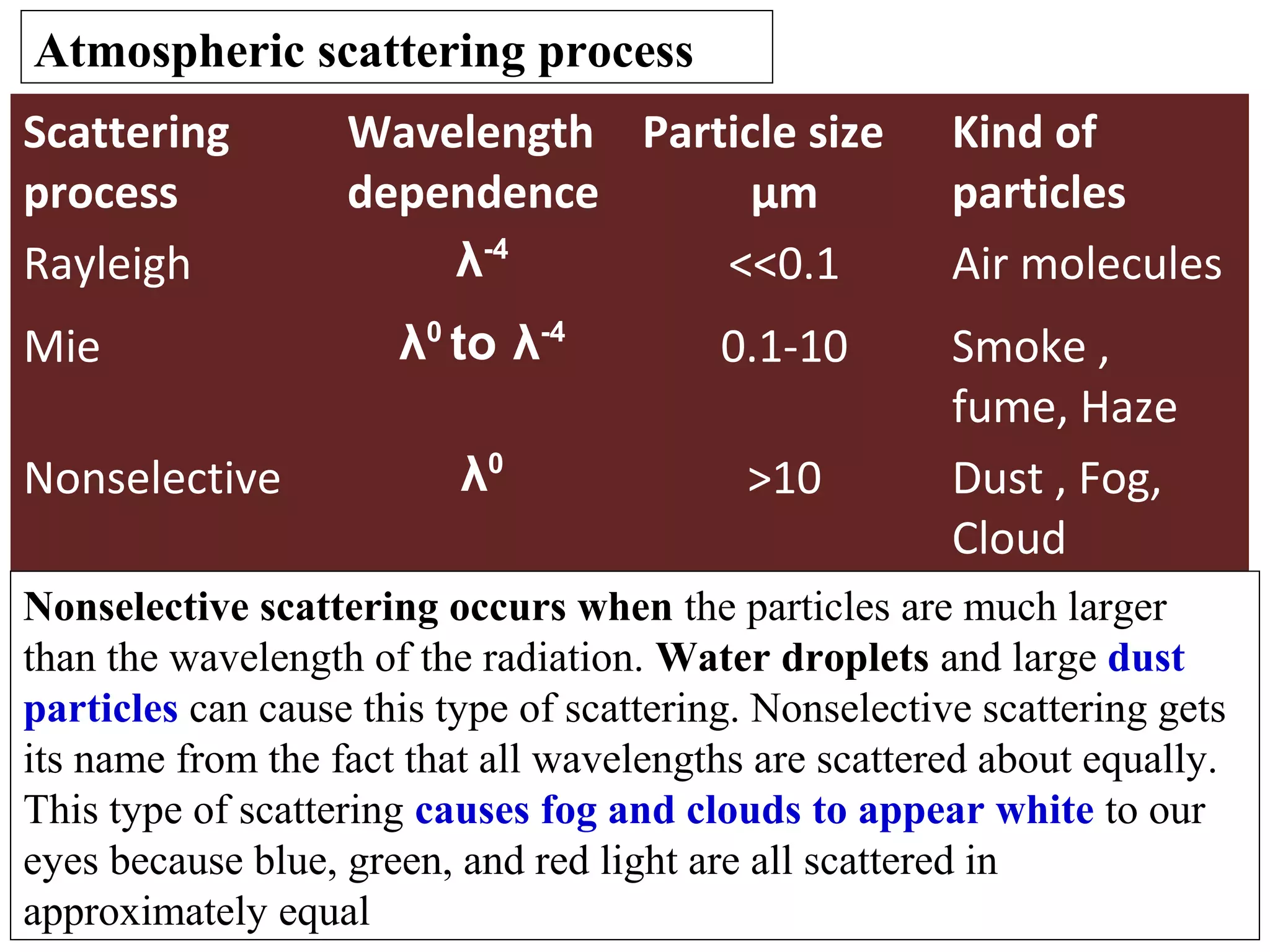
Atmospheric scattering process
Scattering
process
Rayleigh
Mie
Nonselective

Wavelength Particle size
dependence
μm
λ-4
<<0.1
λ0 to λ-4

0.1-10

λ0

>10

Kind of
particles
Air molecules
Smoke ,
fume, Haze
Dust , Fog,
Cloud

Nonselective scattering occurs when the particles are much larger
than the wavelength of the radiation. Water droplets and large dust
particles can cause this type of scattering. Nonselective scattering gets
its name from the fact that all wavelengths are scattered about equally.
This type of scattering causes fog and clouds to appear white to our
eyes because blue, green, and red light are all scattered in
approximately equal
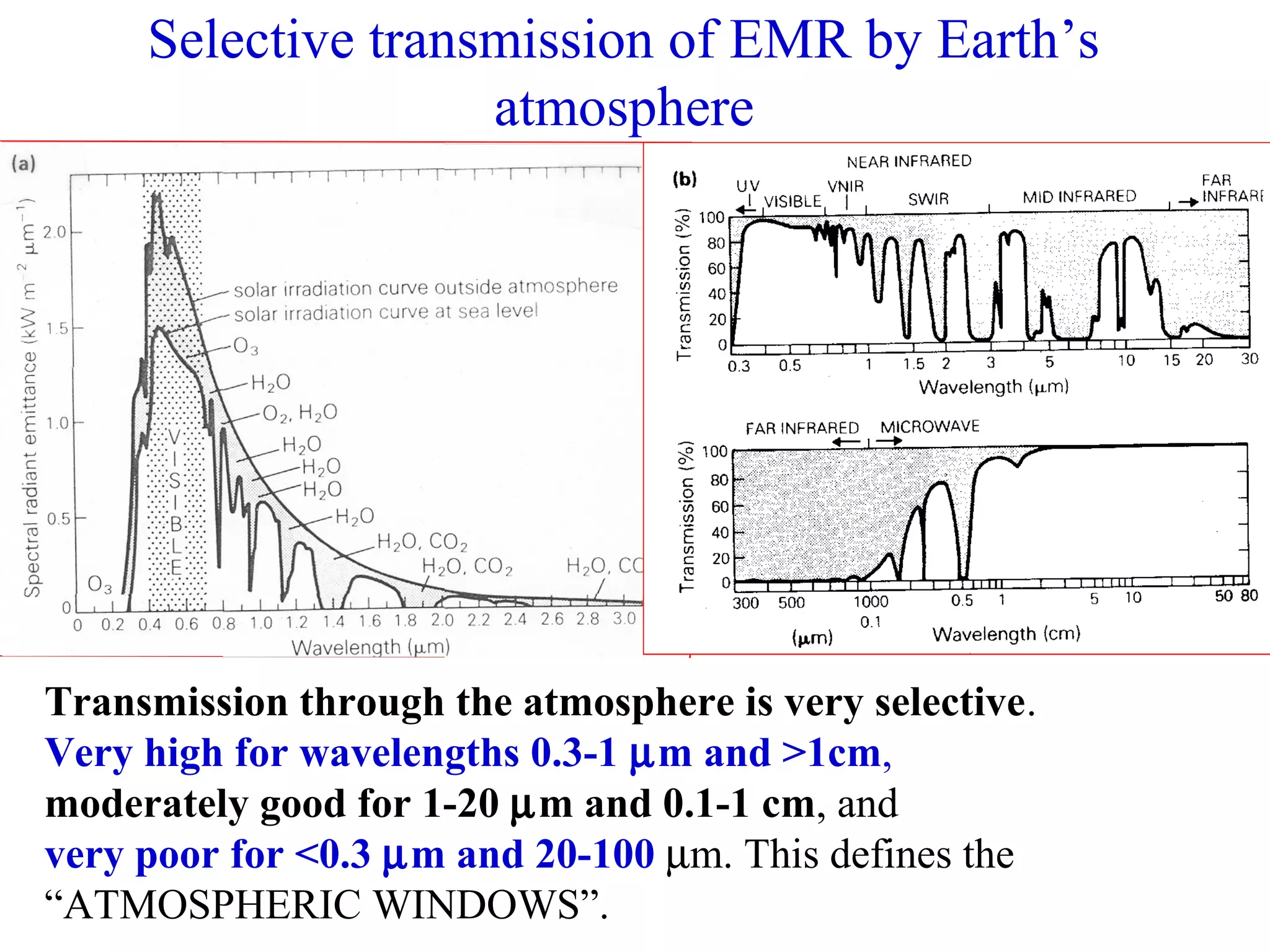
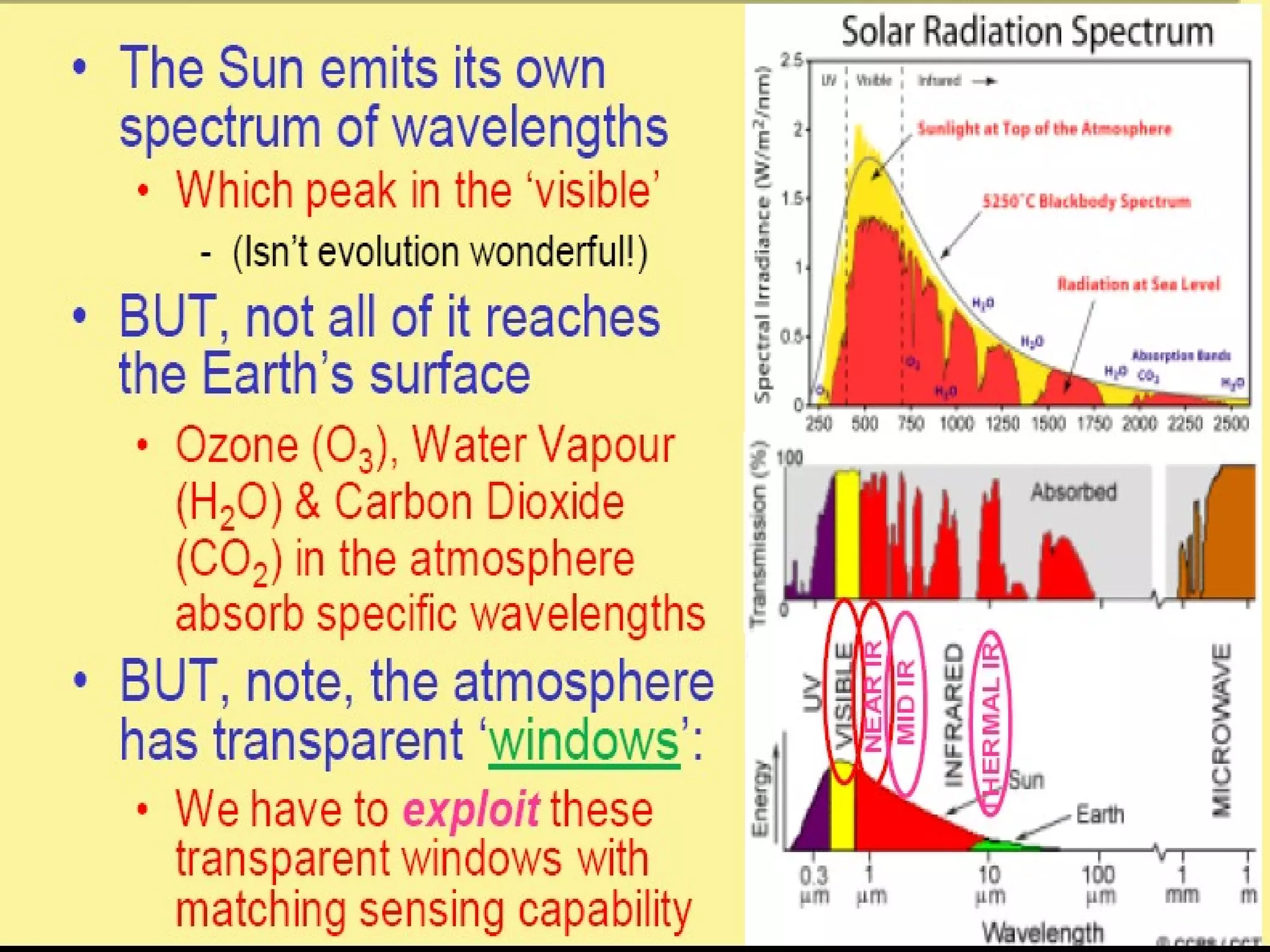
Atmospheric Windows
 Atmospheric windows define wavelength ranges in which
the atmosphere is particularly transmissive of energy.
 Visible region of the electromagnetic spectrum resides
within an atmospheric window with wavelengths of about
0.3 to 0.9 µm
 Emitted energy from the earth's surface is sensed through
windows at 3 to 5 µm and 8 to 14 µm.
 Radar and passive microwave systems operate through a
window region of 1 mm to 1 m.
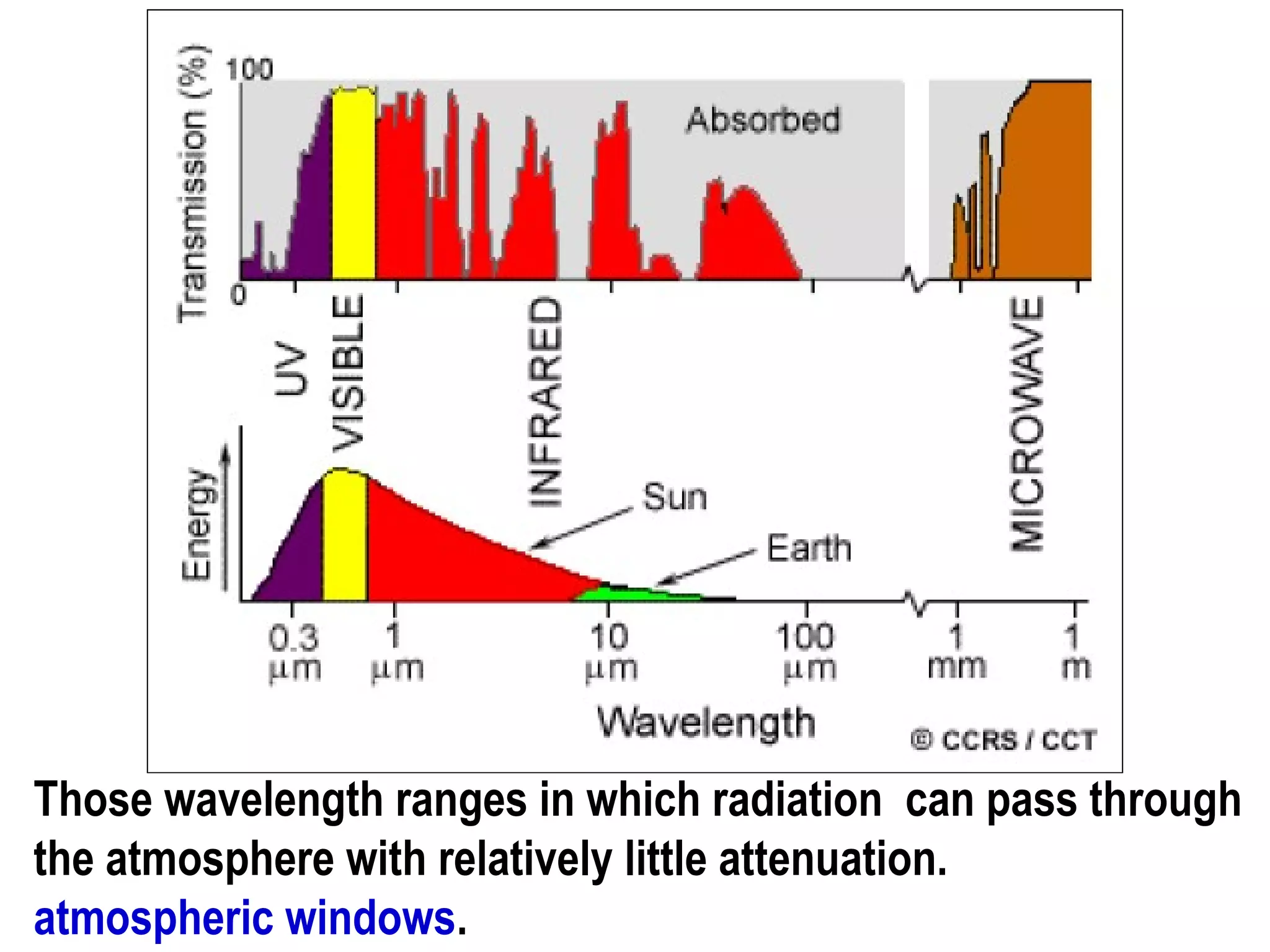
Selective transmission of EMR by Earth’s
atmosphere

Transmission through the atmosphere is very selective.
Very high for wavelengths 0.3-1 µm and >1cm,
moderately good for 1-20 µm and 0.1-1 cm, and
very poor for <0.3 µm and 20-100 µm. This defines the
“ATMOSPHERIC WINDOWS”.
Those wavelength ranges in which radiation can pass through
the atmosphere with relatively little attenuation.
atmospheric windows.
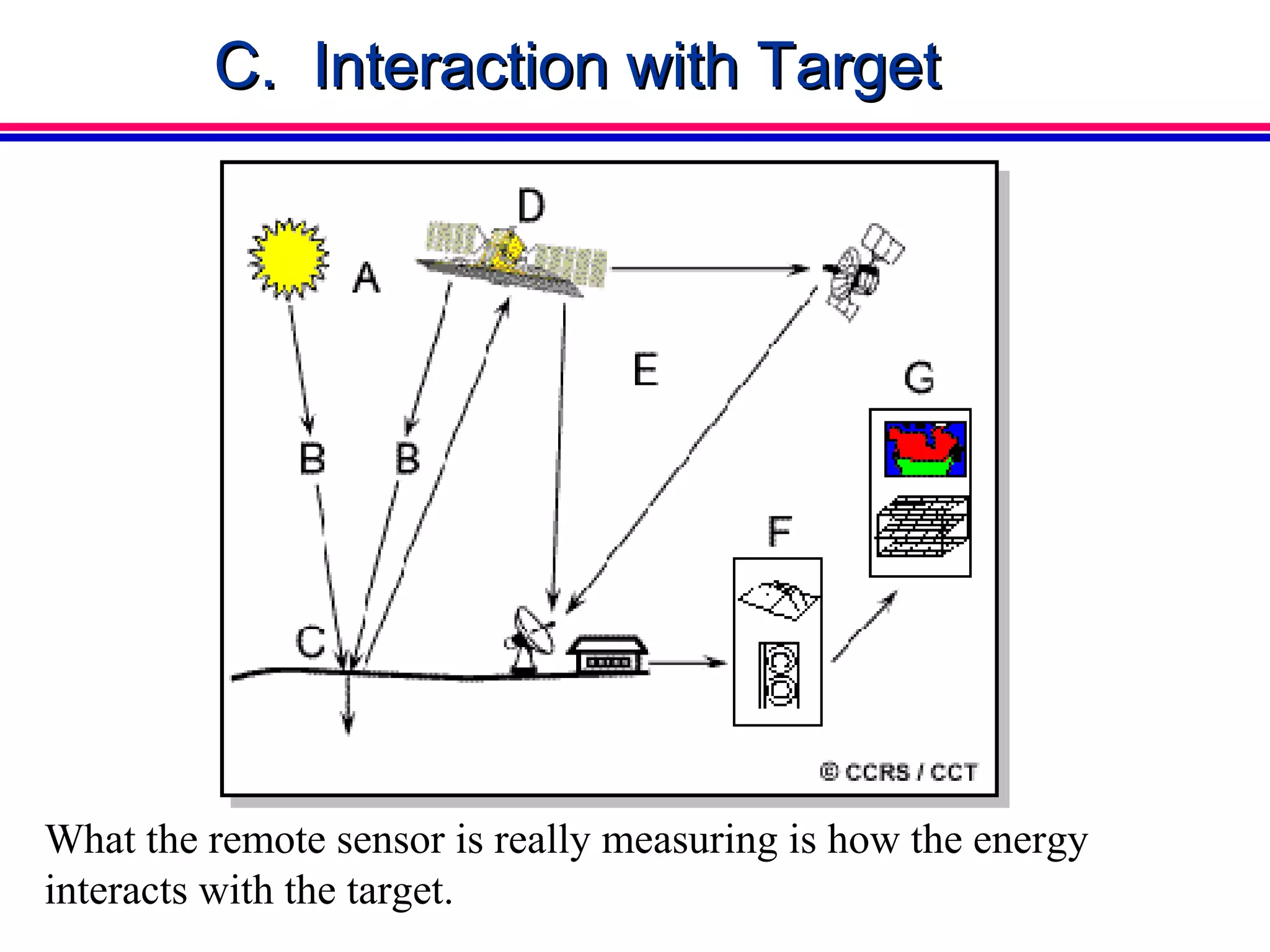
C. Interaction with Target

What the remote sensor is really measuring is how the energy
interacts with the target.
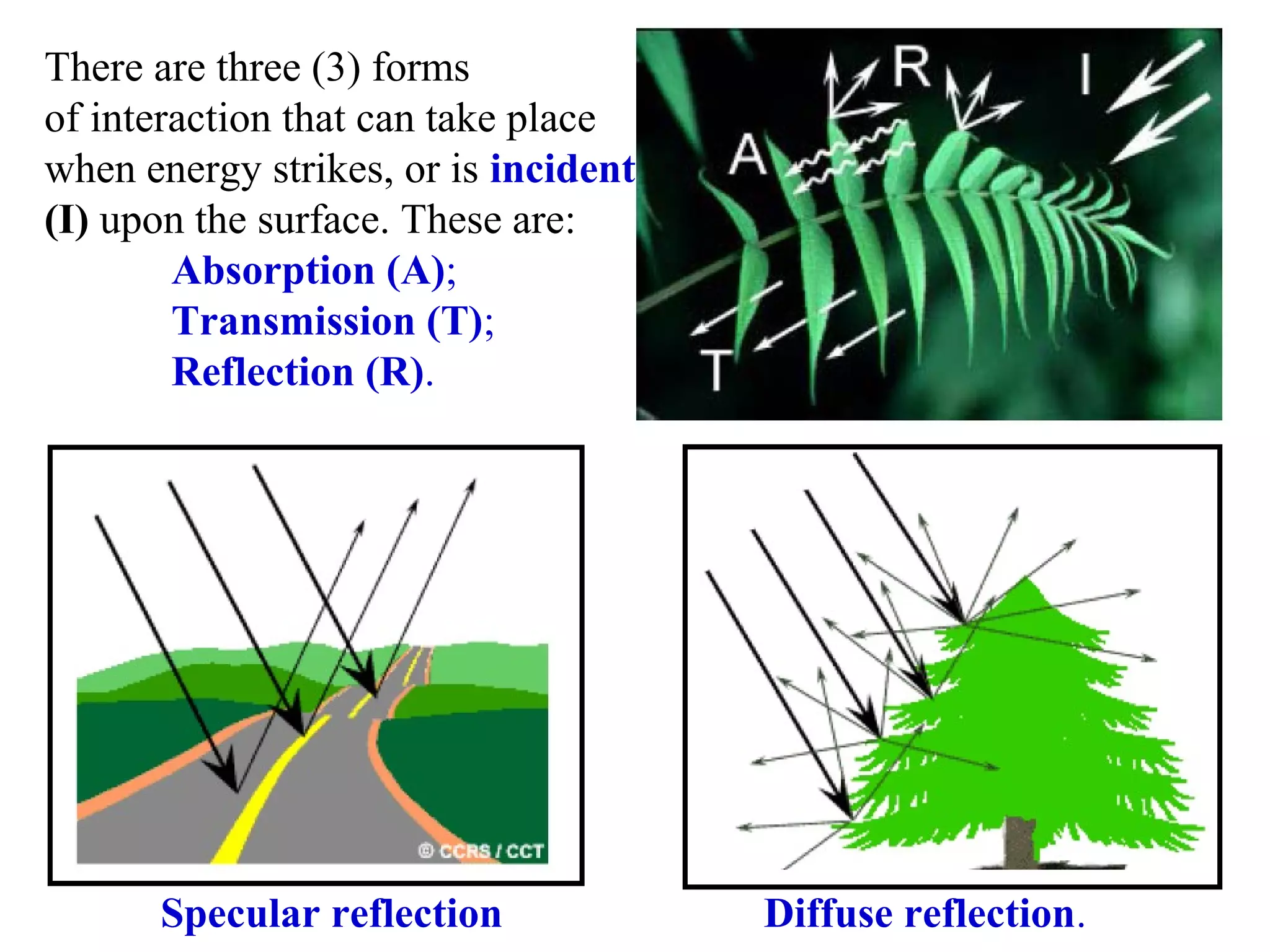
There are three (3) forms
of interaction that can take place
when energy strikes, or is incident
(I) upon the surface. These are:
Absorption (A);
Transmission (T);
Reflection (R).

Specular reflection

Diffuse reflection.
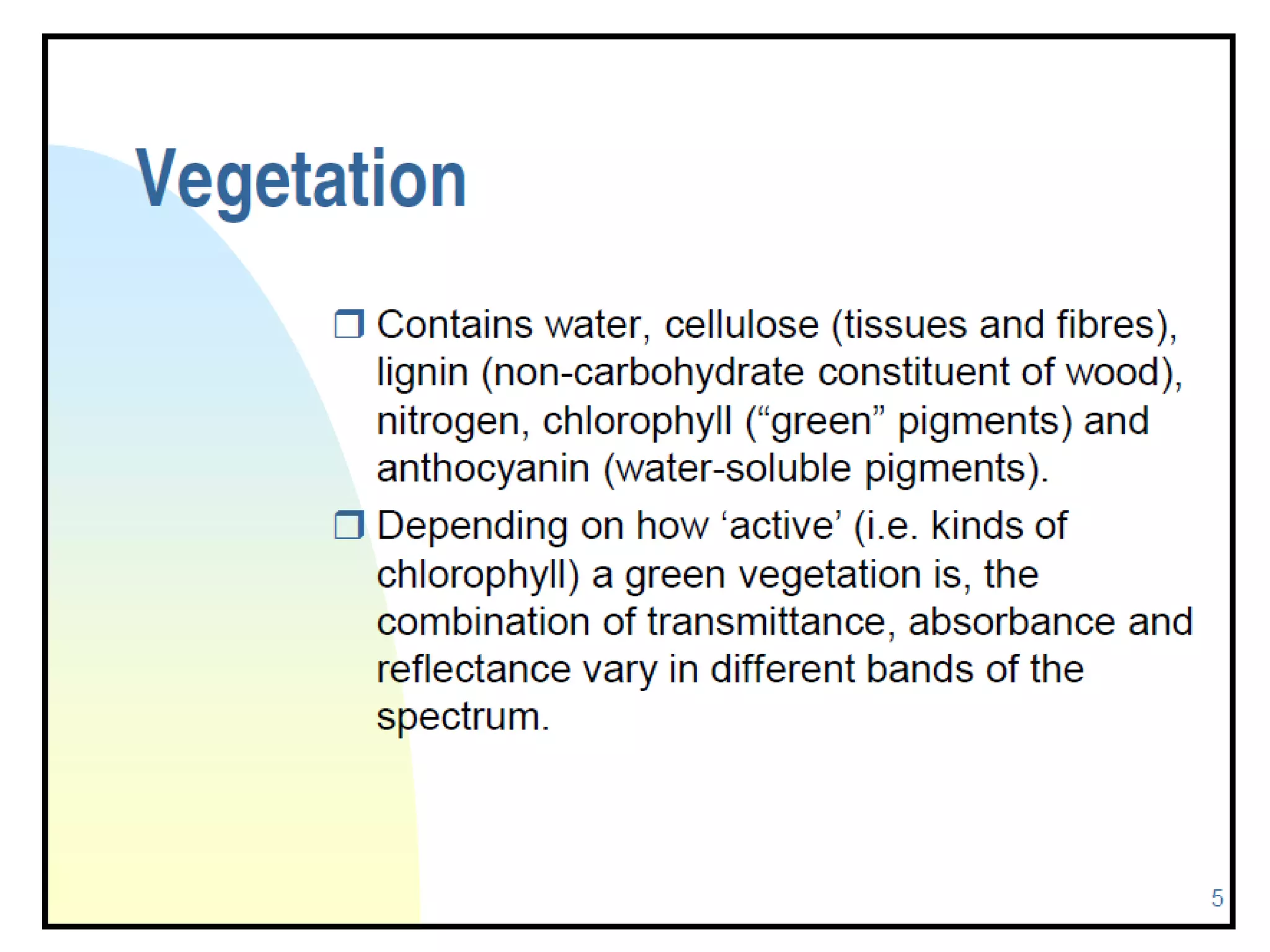
Leaves: chlorophyll strongly
absorbs radiation in the R and B but
reflects (G)green wavelengths.
Internal structure of healthy leaves
act as excellent diffuse reflectors of
near-infrared (NIR) wavelengths. In
fact, measuring and monitoring the
NIR reflectance is one way that can
determine healthiness of vegetation
Water: Longer λ visible and near
infrared radiation is absorbed more
by water than shorter visible
wavelengths. Thus water typically
looks blue or blue-green due to
stronger reflectance at these
shorter wavelengths,
Spectral Reflectance Signature
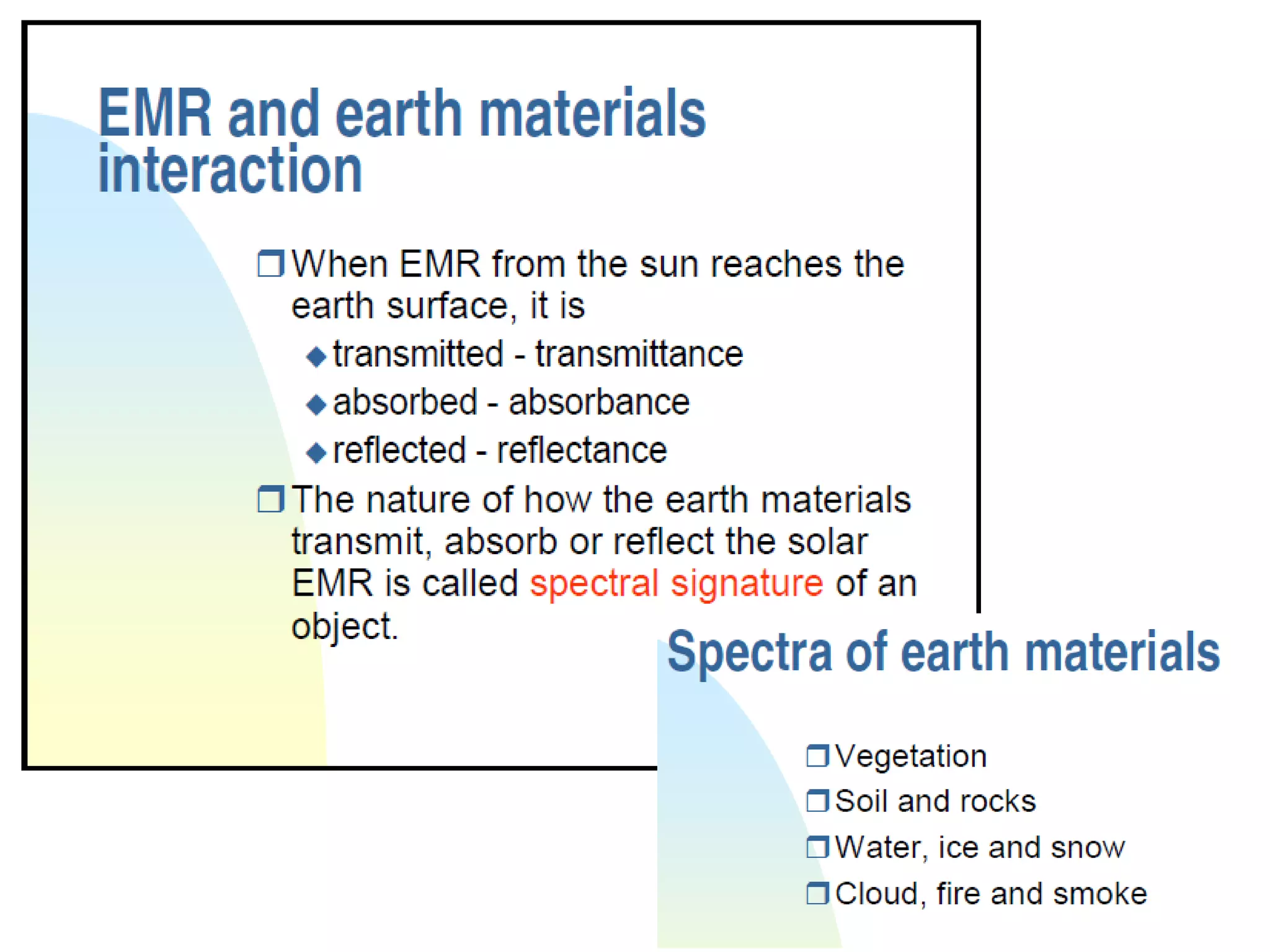
When solar radiation hits a target surface, it may be transmitted,
absorbed or reflected. Different materials reflect and absorb
differently at different wavelengths.
The reflectance spectrum of a material is a plot of the fraction
of radiation reflected as a function of the incident wavelength and
serves as a unique signature for the material.
In principle, a material can be identified from its spectral reflectance
signature if the sensing system has sufficient spectral resolution to
distinguish its spectrum from those of other materials. This premise
provides the basis for multispectral remote sensing.
Spectral reflectance: the reflectance of electromagnetic energy at
specified wavelength intervals
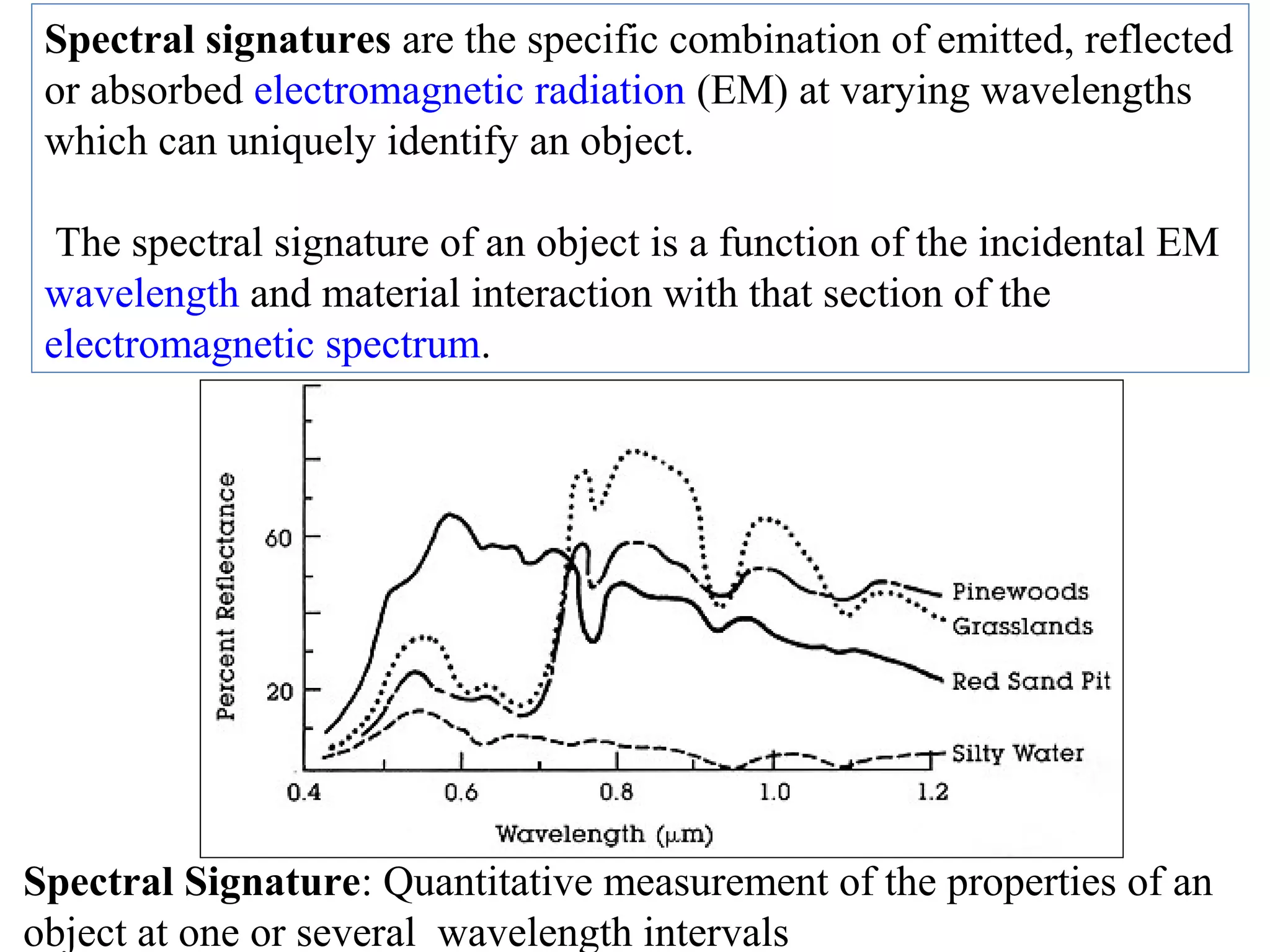
Spectral signatures are the specific combination of emitted, reflected
or absorbed electromagnetic radiation (EM) at varying wavelengths
which can uniquely identify an object.
The spectral signature of an object is a function of the incidental EM
wavelength and material interaction with that section of the
electromagnetic spectrum.

Spectral Signature: Quantitative measurement of the properties of an
object at one or several wavelength intervals
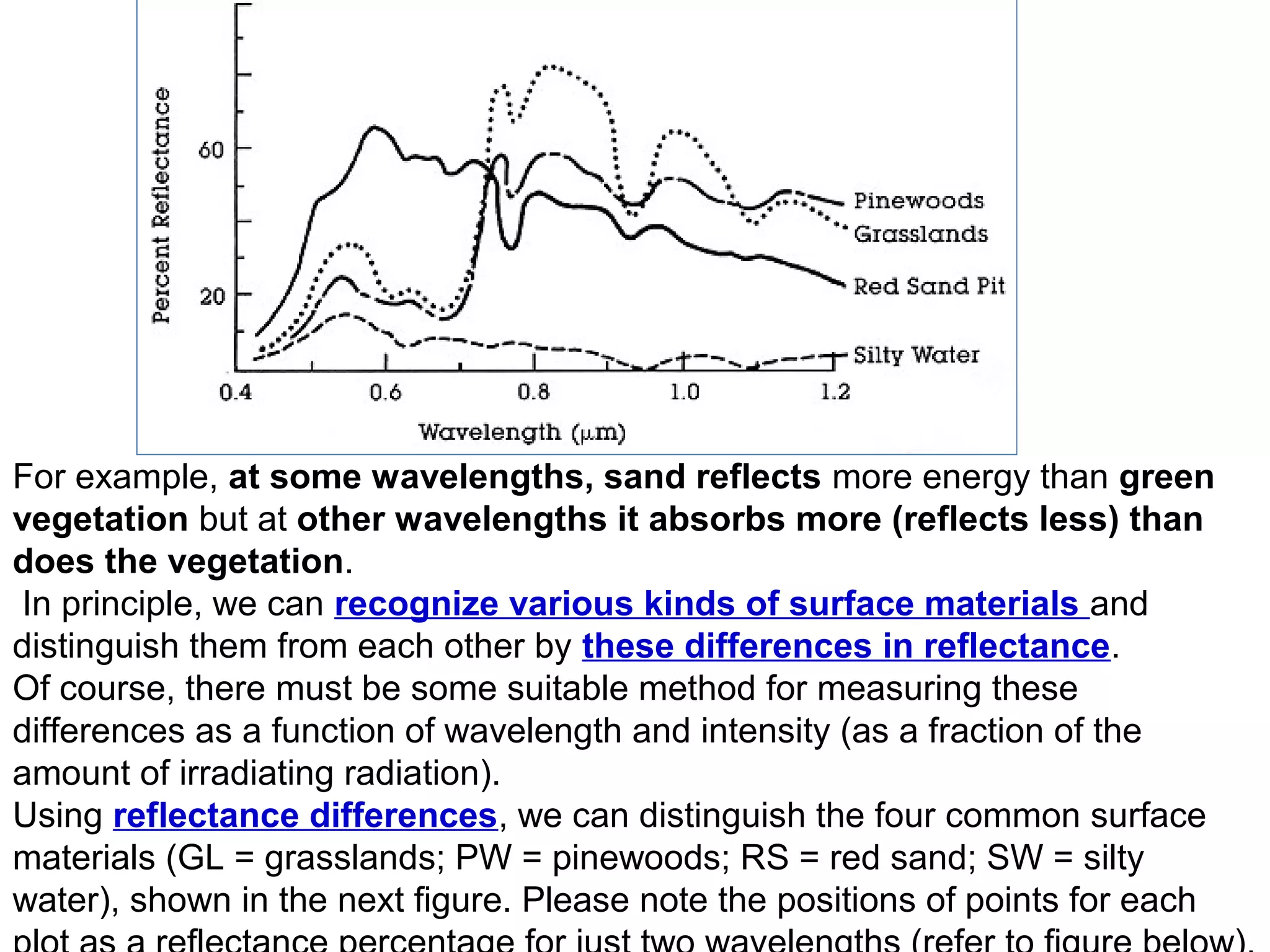
For example, at some wavelengths, sand reflects more energy than green
vegetation but at other wavelengths it absorbs more (reflects less) than
does the vegetation.
In principle, we can recognize various kinds of surface materials and
distinguish them from each other by these differences in reflectance.
Of course, there must be some suitable method for measuring these
differences as a function of wavelength and intensity (as a fraction of the
amount of irradiating radiation).
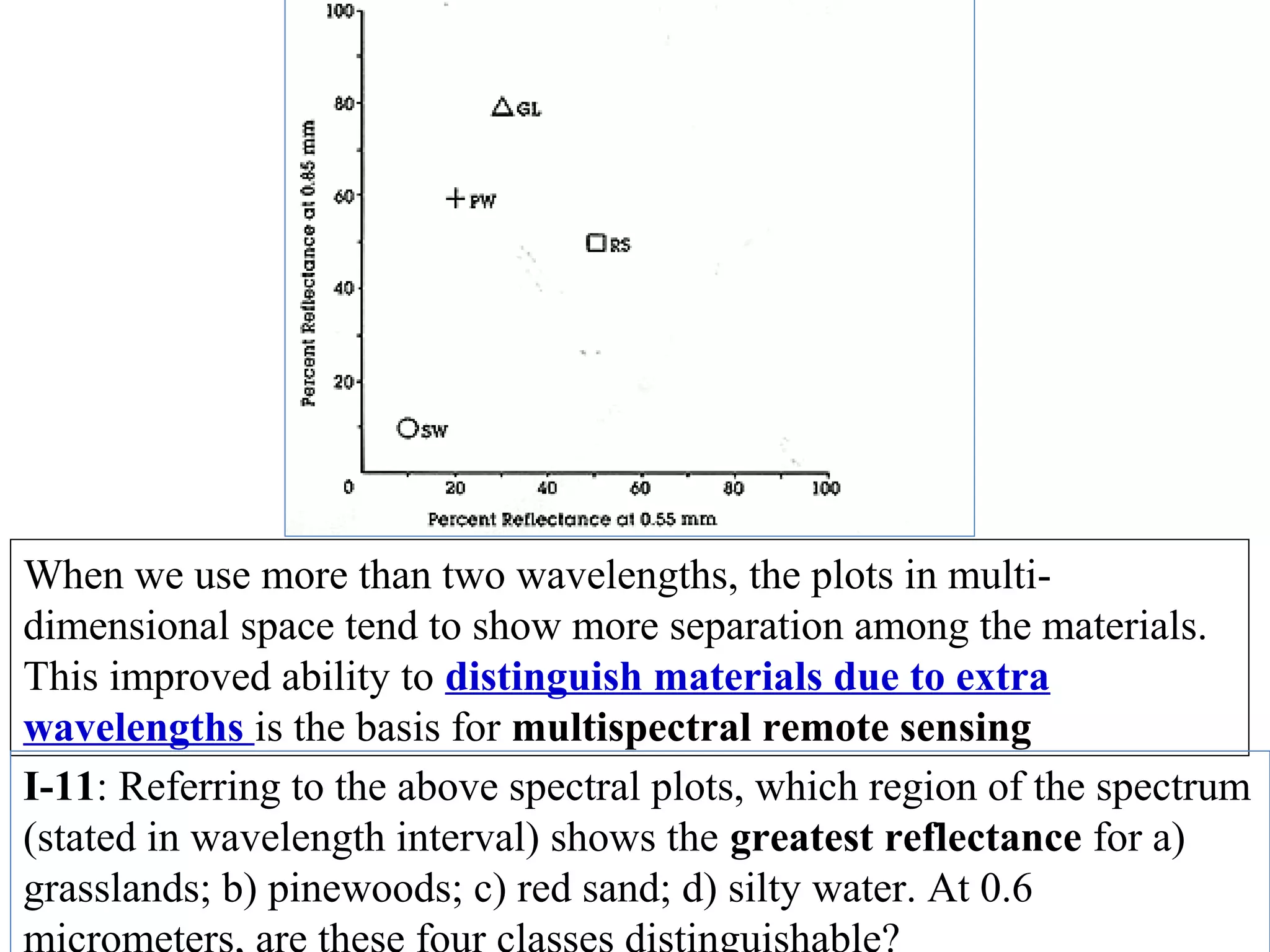
Using reflectance differences, we can distinguish the four common surface
materials (GL = grasslands; PW = pinewoods; RS = red sand; SW = silty
water), shown in the next figure. Please note the positions of points for each
When we use more than two wavelengths, the plots in multidimensional space tend to show more separation among the materials.
This improved ability to distinguish materials due to extra
wavelengths is the basis for multispectral remote sensing
I-11: Referring to the above spectral plots, which region of the spectrum
(stated in wavelength interval) shows the greatest reflectance for a)
grasslands; b) pinewoods; c) red sand; d) silty water. At 0.6
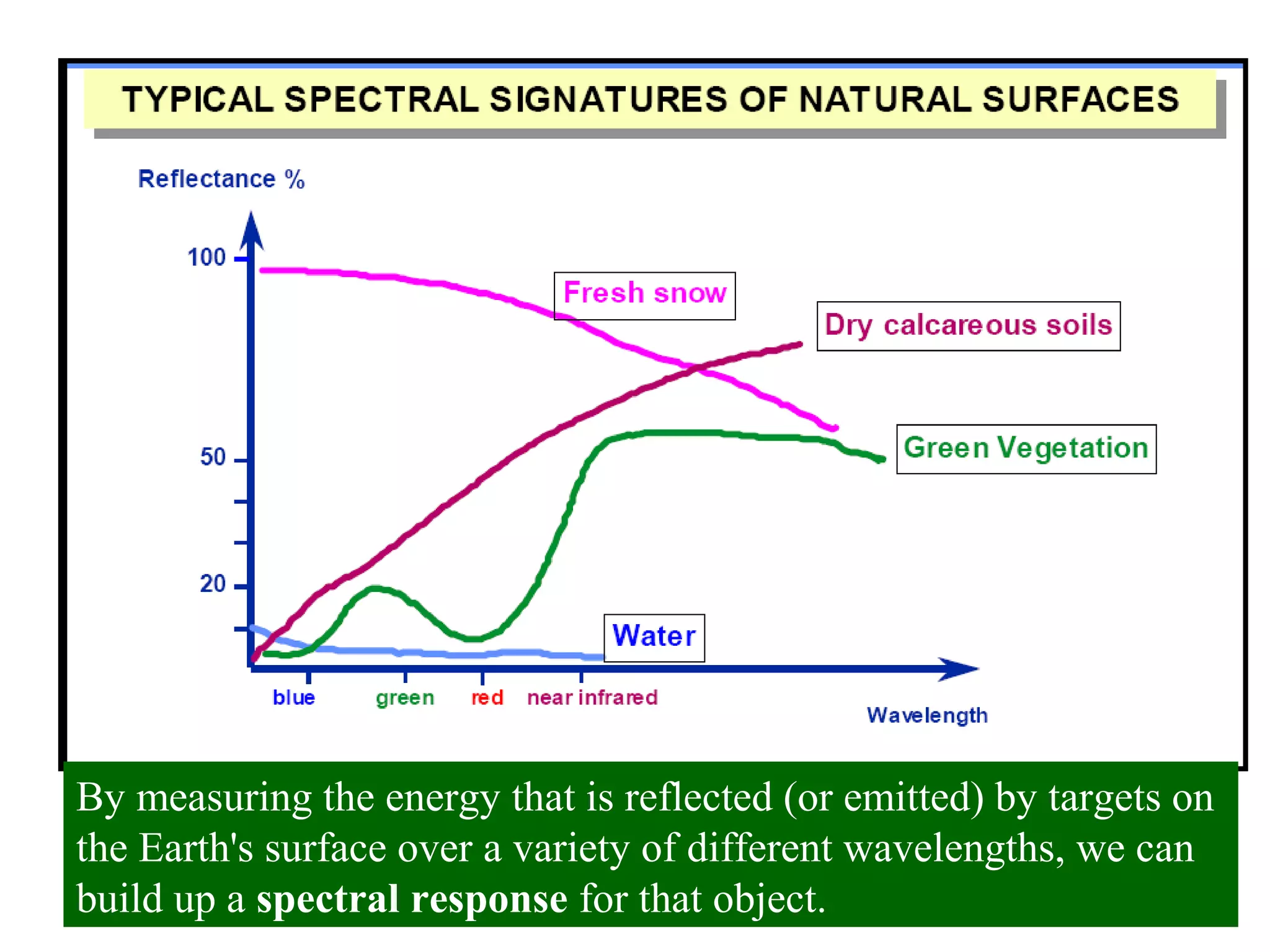
By measuring the energy that is reflected (or emitted) by targets on
the Earth's surface over a variety of different wavelengths, we can
build up a spectral response for that object.
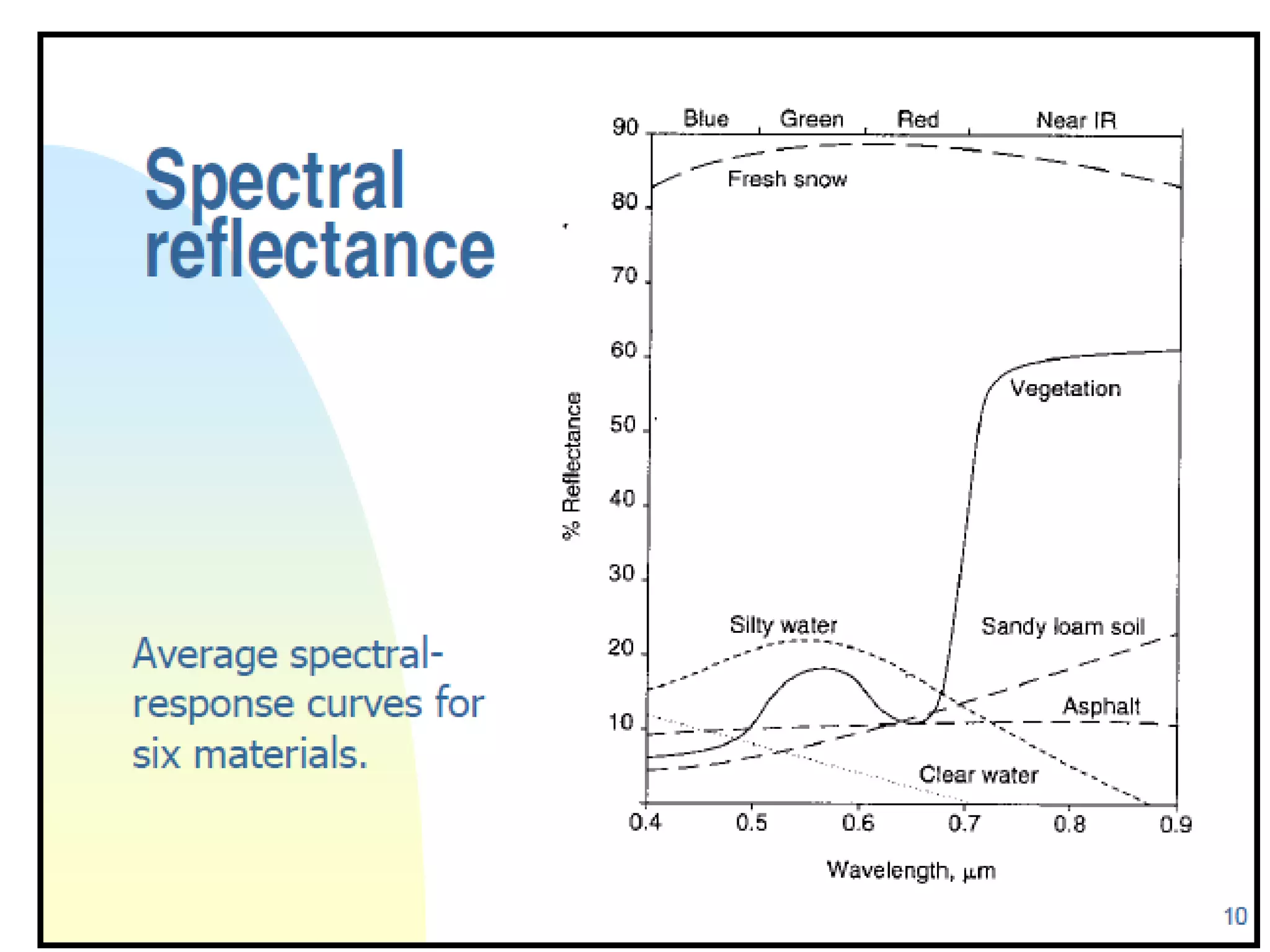
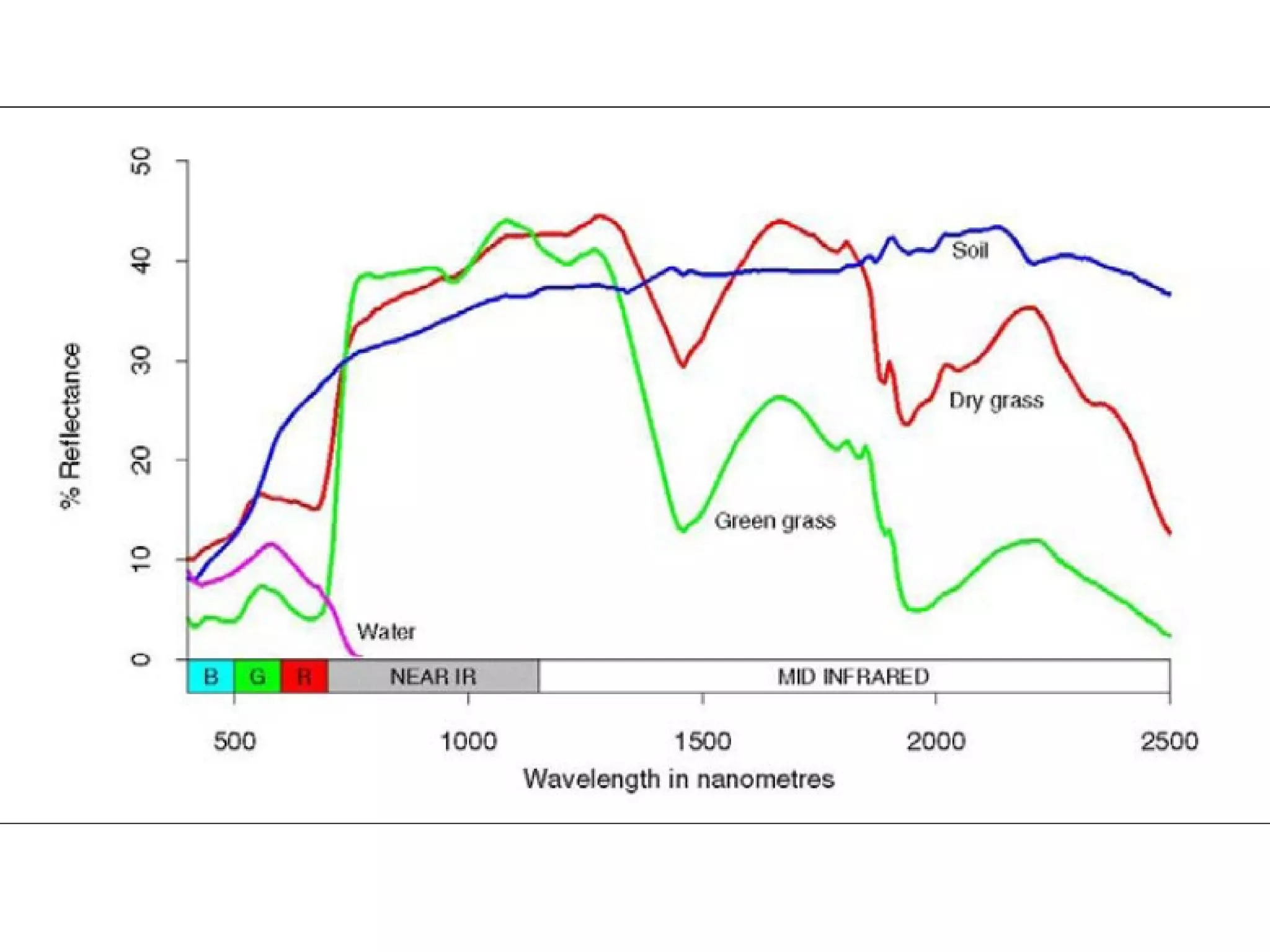
Vegetation has a unique spectral signature that enables it to be
distinguished readily from other types of land cover in an
optical/near-infrared image.
The reflectance is low in both the blue and red regions of
the spectrum, due to absorption by chlorophyll for
photosynthesis. It has a peak at the green region.
In the near infrared (NIR) region, the reflectance is much
higher than that in the visible band due to the cellular structure
in the leaves.
 Hence, vegetation can be identified by the high NIR but
generally low visible reflectance.
The reflectance of clear water is generally low. However,
the reflectance is maximum at the blue end of the spectrum and
decreases as wavelength increases.
Hence, water
appears dark bluish to the visible eye.
Turbid water has some sediment suspension that increases the
reflectance in the red end of the spectrum and would be brownish
in appearance.
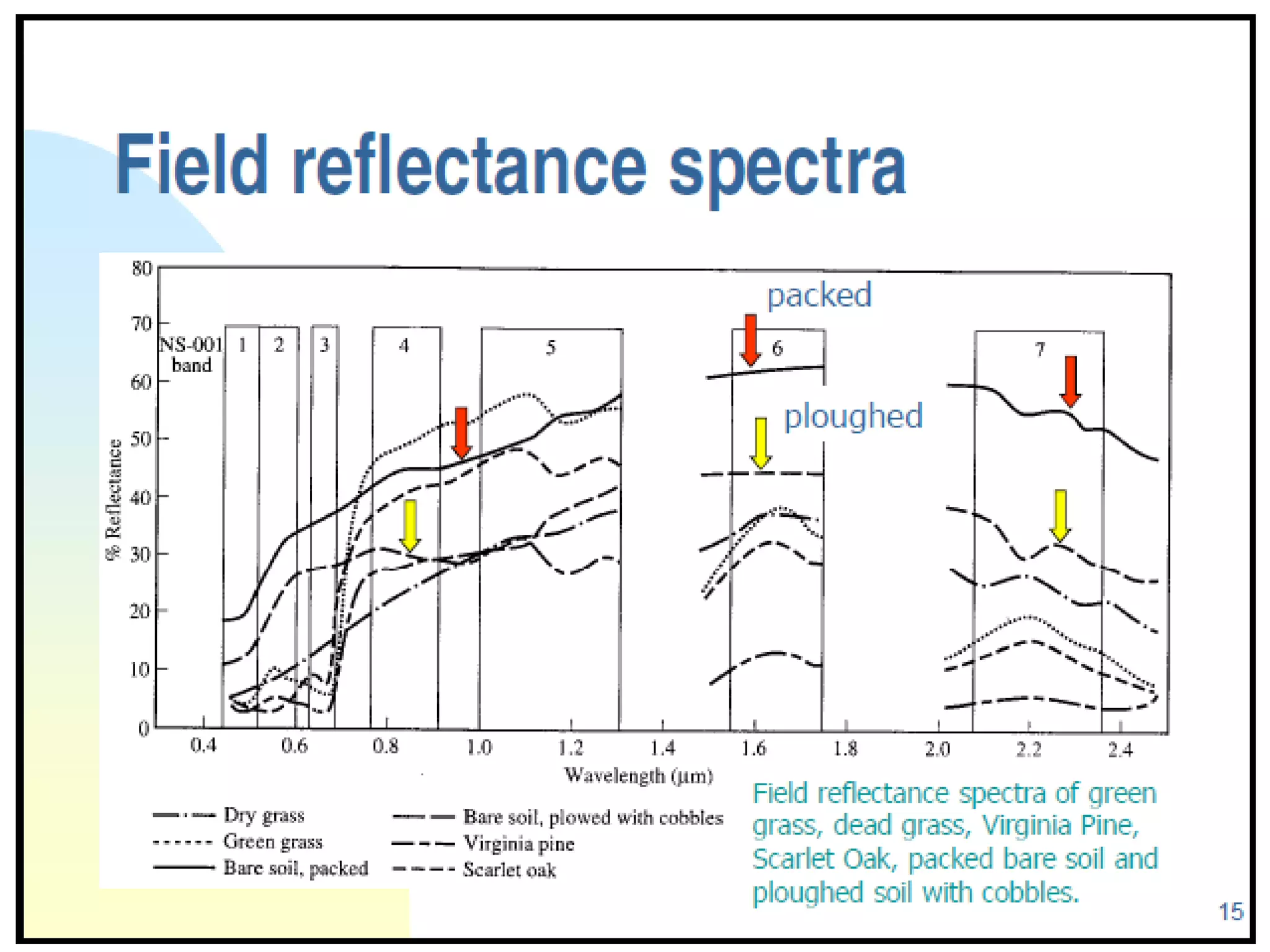
 The reflectance of bare soil generally depends on its
composition. In the example shown, the reflectance increases
monotonically with increasing wavelength. Hence, it should appear
yellowish-red to the eye.
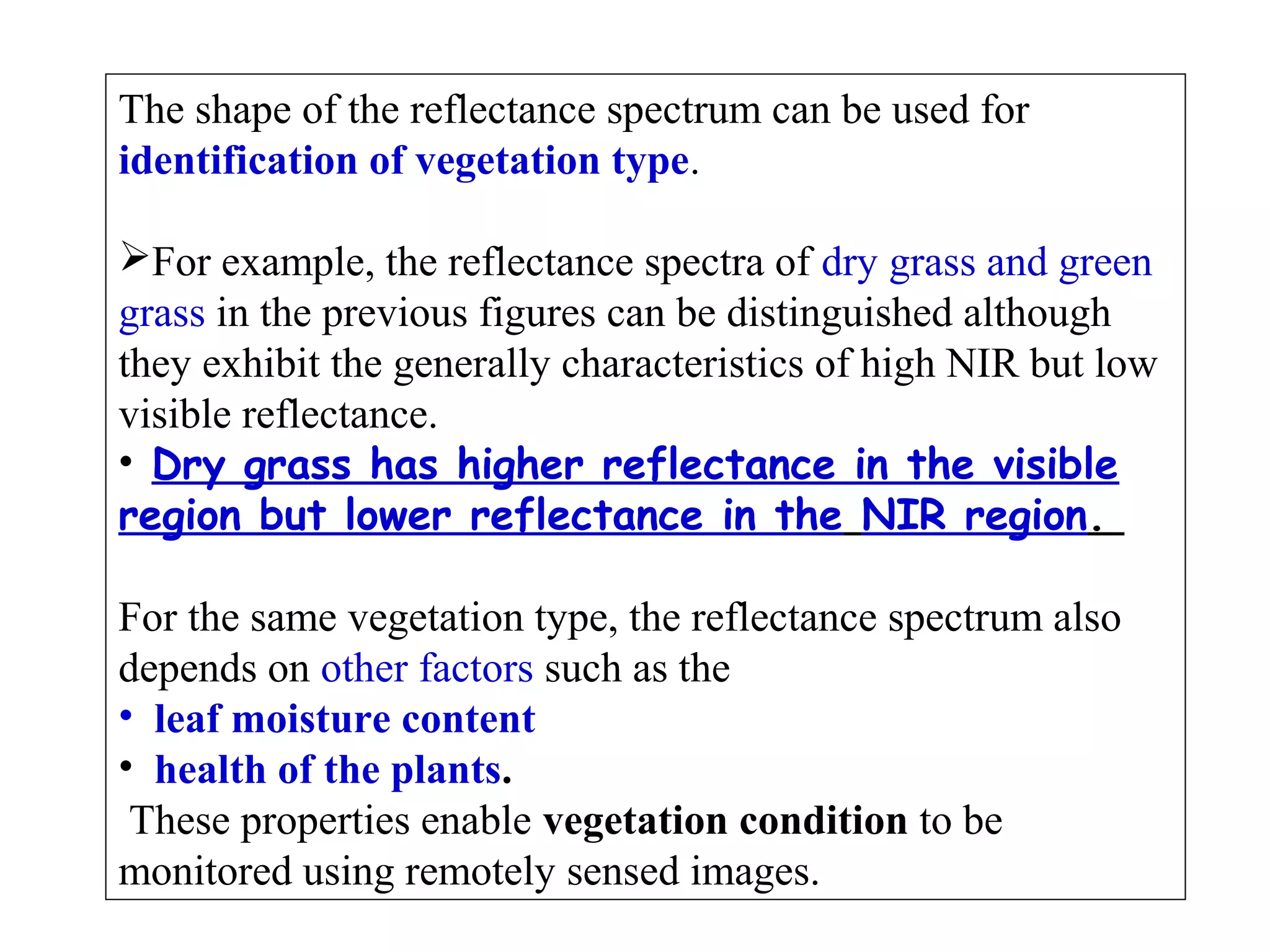
The shape of the reflectance spectrum can be used for
identification of vegetation type.
For example, the reflectance spectra of dry grass and green
grass in the previous figures can be distinguished although
they exhibit the generally characteristics of high NIR but low
visible reflectance.
• Dry grass has higher reflectance in the visible
region but lower reflectance in the NIR region.
For the same vegetation type, the reflectance spectrum also
depends on other factors such as the
• leaf moisture content
• health of the plants.
These properties enable vegetation condition to be
monitored using remotely sensed images.
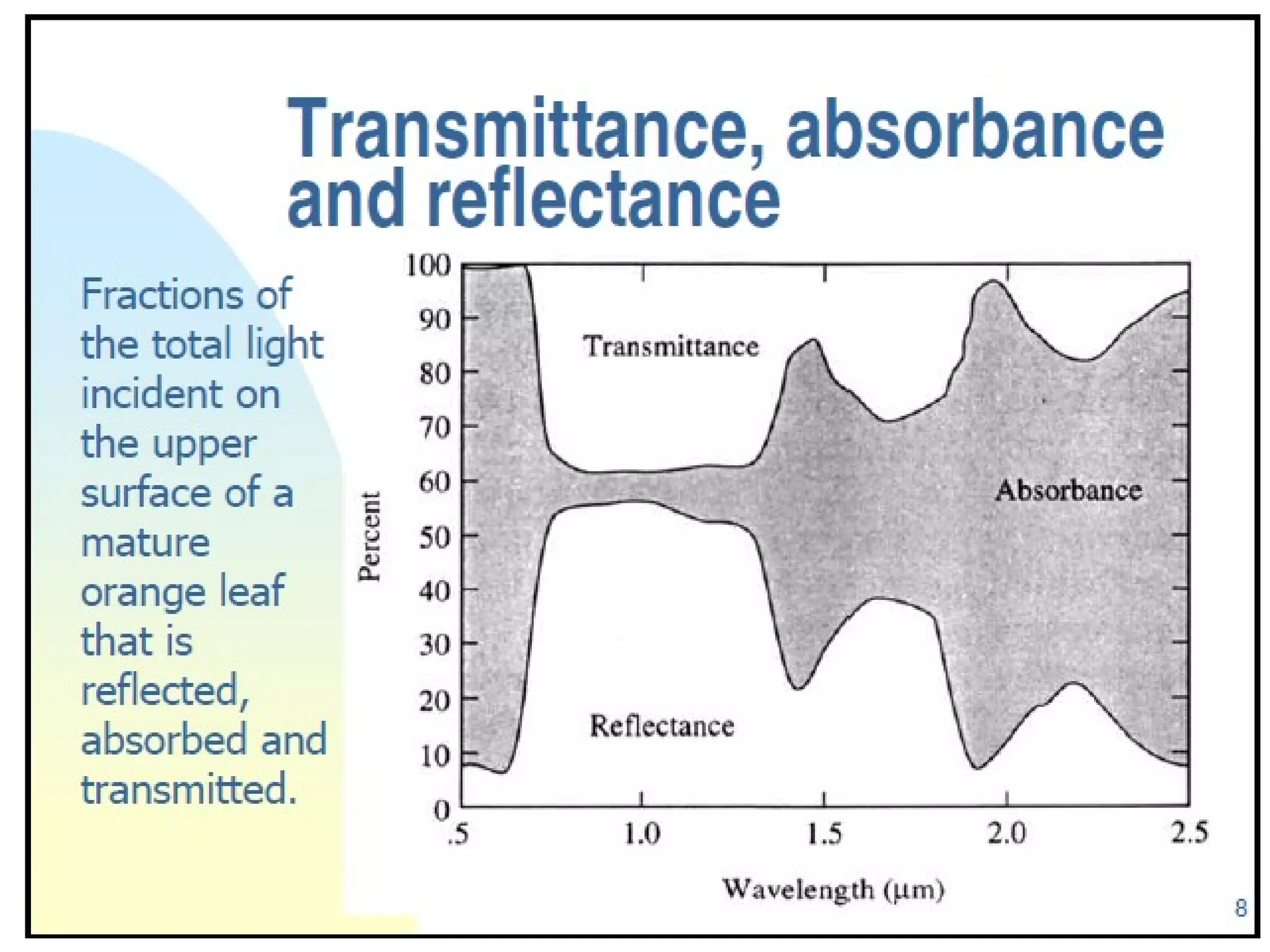
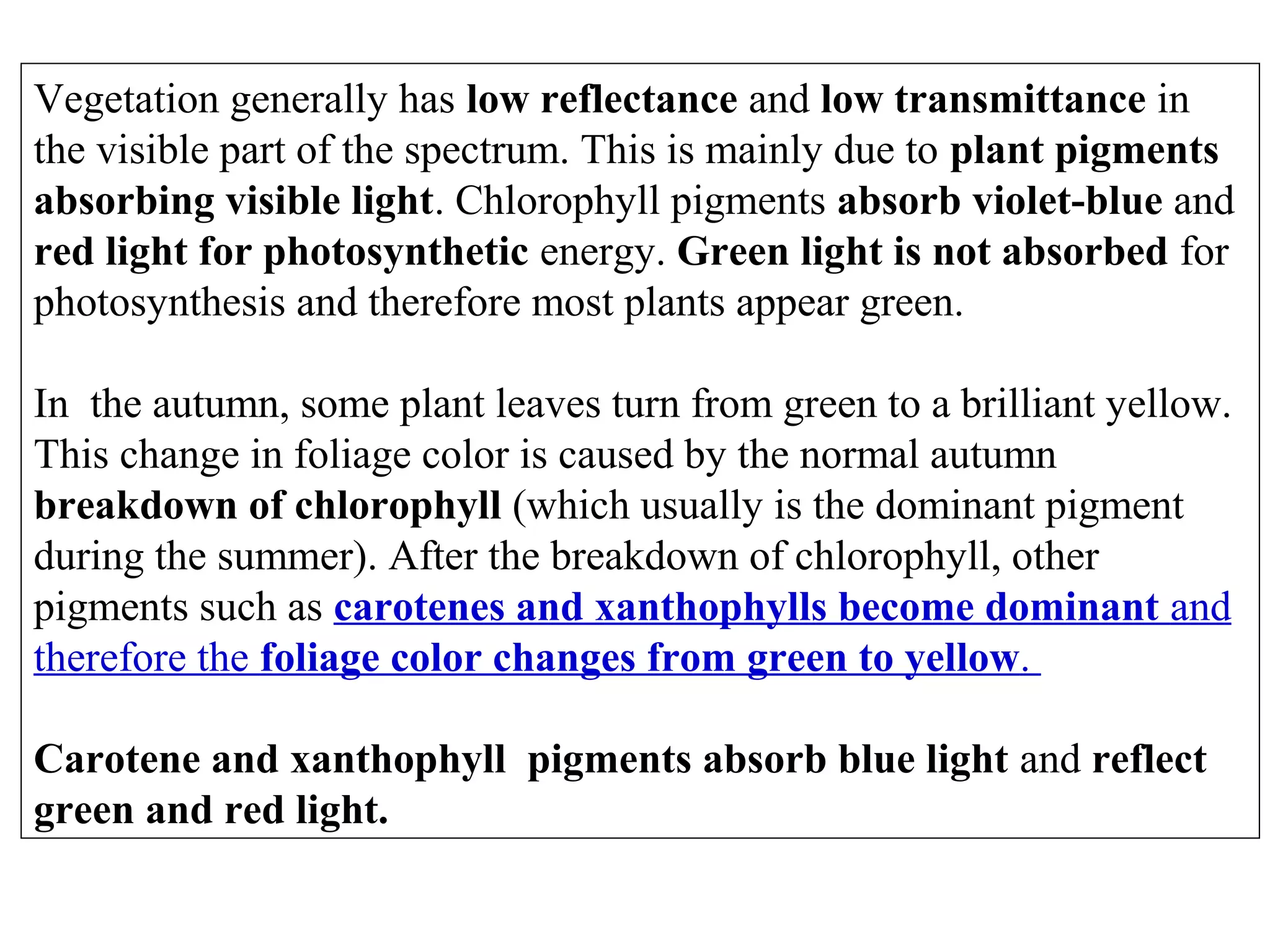
Vegetation generally has low reflectance and low transmittance in
the visible part of the spectrum. This is mainly due to plant pigments
absorbing visible light. Chlorophyll pigments absorb violet-blue and
red light for photosynthetic energy. Green light is not absorbed for
photosynthesis and therefore most plants appear green.
In the autumn, some plant leaves turn from green to a brilliant yellow.
This change in foliage color is caused by the normal autumn
breakdown of chlorophyll (which usually is the dominant pigment
during the summer). After the breakdown of chlorophyll, other
pigments such as carotenes and xanthophylls become dominant and
therefore the foliage color changes from green to yellow.
Carotene and xanthophyll pigments absorb blue light and reflect
green and red light.
Spectral Signatures
• Reflectance is
wavelength
dependent
• Signatures
represent
average
reflectance
values
• Signatures are
spatially and
temporally
variable
The vertical axis shows the
percentage of incident sunlight
that is reflected by the
materials. The horizontal axis
shows wavelengths of energy
for the visible spectral region
0.4 to 7.0 µm. and the
reflected portion 0.7 to 3.0
µm. of the infrared IR. region.
Reflected IR energy consists
largely of solar energy
reflected from the earth at
wavelengths longer than the
sensitivity range of the eye.
The thermal portion of the IR
region 3.0to 1000 µm. consists
of radiant, or heat, energy….
Spectral bands recorded by remote sensing systems.
Spectral reflectance curves are for vegetation and sedimentary rocks.
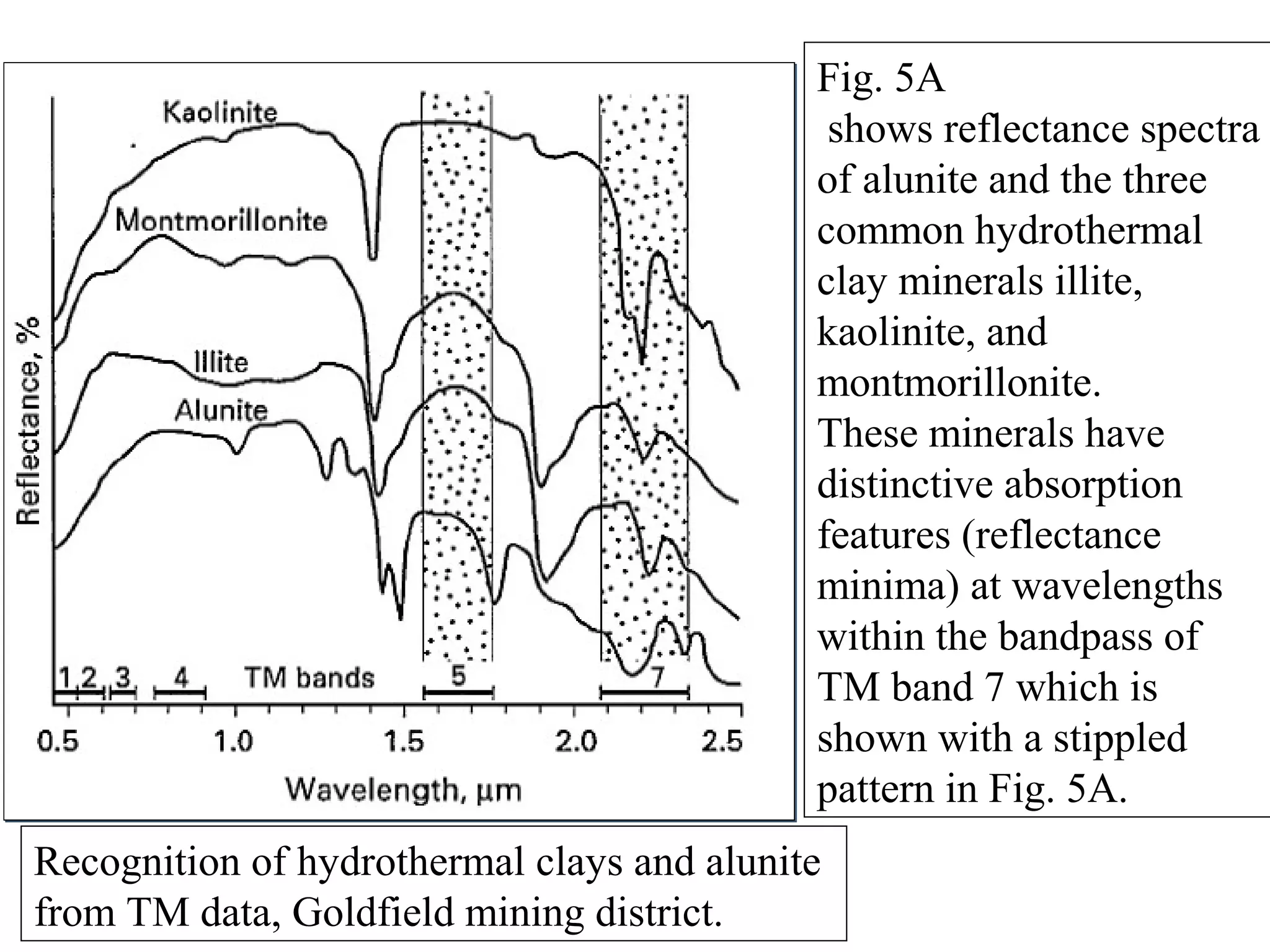
Fig. 5A
shows reflectance spectra
of alunite and the three
common hydrothermal
clay minerals illite,
kaolinite, and
montmorillonite.
These minerals have
distinctive absorption
features (reflectance
minima) at wavelengths
within the bandpass of
TM band 7 which is
shown with a stippled
pattern in Fig. 5A.
Recognition of hydrothermal clays and alunite
from TM data, Goldfield mining district.
Recognition of hydrothermal iron minerals from TM data, Goldfield
mining district.
Laboratory spectra of alteration
minerals in the 2.0 to 2.5
µm band. Spectra are offset
vertically.
Note positions and bandwidths
of the spectral bands recorded
by AVIRIS and TM band 7.

Raleigh and Mie scattering in remote sensing,

  • 1.
    Rayleigh Scattering and Mie scattering: Dr.P. K. Mani Bidhan Chandra Krishi Viswavidyalaya E-mail: pabitramani@gmail.com Website: www.bckv.edu.in
  • 2.
    Remote Sensing andits Applications in Soil Resource Mapping (ACSS-754) Absorption. Scattering
  • 3.
    The atmosphere affectselectromagnetic energy through absorption, scattering and reflection. How these processes affect radiation seen by the satellite depends on the path length, the presence of particulates and absorbing gases, and wavelengths involved. transmitted absorbed, emitted and scattered by aerosols and molecules transmitted absorbed &scattered emitted reflected transmitted reflected absorbed emitted Land emitted reflected transmitted absorbed Ocean Figure-... Process of Atmospheric Radiation
  • 4.
    Rayleigh Scattering: whythe sky is blue
  • 5.
    EM radiation fromthe sun interacts with the atmospheric constituents and gets absorbed or scattered. Essentially two types of scattering takes place: Elastic scattering in which the energy of radiation is not changed due to the scattering, and inelastic scattering in which the energy of the scattered radiation is changed. 3 types of elastic scattering is recognized in atmospheric scattering Rayleigh scattering Mie scattering Nonselective scattering
  • 6.
    Radiation scattered froma particle depends on: Size; Shape; Index of refraction; Wavelength of radiation; View geometry. For Rayleight scattering, λ >> φ •Scattering is diffuse (in all directions) and λ dependent or selective • Scattering = 1/ λ4 For Mie scattering, λ ≈φ Where φ is particle size.  Scattering properties of such aerosols as smoke, dust, haze in the visible part of the spectrum and of cloud droplets in the IR region can be explanined by Mie scattering, While of air molecules in the visible part can be explained by Rayleigh Scattering
  • 7.
    Rayleigh Scattering: In Rayleighscattering the volume scattering coefficient σλ is given by : σλ [4π = 2 NV λ 4 2 ] ⋅ [µ 2 [µ 2 ] ] − µ0 2 2 + µ0 2 2 = const λ 4 N= no. of particles/cm2 …. V= vol. of scattering particles λ = wavelength of radiation … µ= refractive index of the particles µ0= refractive index of the medium Because of Rayleigh scattering Multispectral remote sensing data from the blue portion of the spectrum is of relatively limited usefulness. In case of aerial photography, special filters are used to filter out the scattered blue radiation due to haze present in the atmosphere.
  • 8.
    Mie scattering a2 σ λ=10 π ∫ N (a ) K (a, µ)a da 5 2 a1 σλ = Mie scattering coefficient at wavelength λ N(a) = no. of particles in interval of radius a and a + da K(a, µ) = scattering coefficient(cross section ) as a function of spherical particles of radius a and the refractive index of the particles µ Mie scattering usually manifests itself as a general deterioration of multispectral images across the optical spectrum under conditions of heavy atmospheric haze
  • 9.
    Nonselective Scattering  Particlesare much larger than the wavelength λ >> l All wavelength are scattered equally Effects of scattering  It causes haze in remotely sensed images  It decreases the spatial detail on the images  It also decreases the contrast of the images  Water droplets with diameters ranging from 5-100 µm scatter all wavelengths of visible light with equal efficiency. As a consequence, clouds and fog appear whitish because a mixture of all colours in approximately equal quantities produces white light. Non selective scattering usually results when the atmosphere is heavily dust and moisture ladden and results in a severe attenuation of the received data. However, the occurrence of this scattering mechanism is frequently a clue to the existence of large particulate matter in the atmosphere above the scene of interest, and sometimes this in itself becomes useful data.
  • 10.
    Atmospheric scattering process Scattering process Rayleigh Mie Nonselective WavelengthParticle size dependence μm λ-4 <<0.1 λ0 to λ-4 0.1-10 λ0 >10 Kind of particles Air molecules Smoke , fume, Haze Dust , Fog, Cloud Nonselective scattering occurs when the particles are much larger than the wavelength of the radiation. Water droplets and large dust particles can cause this type of scattering. Nonselective scattering gets its name from the fact that all wavelengths are scattered about equally. This type of scattering causes fog and clouds to appear white to our eyes because blue, green, and red light are all scattered in approximately equal
  • 11.
    Atmospheric Windows  Atmosphericwindows define wavelength ranges in which the atmosphere is particularly transmissive of energy.  Visible region of the electromagnetic spectrum resides within an atmospheric window with wavelengths of about 0.3 to 0.9 µm  Emitted energy from the earth's surface is sensed through windows at 3 to 5 µm and 8 to 14 µm.  Radar and passive microwave systems operate through a window region of 1 mm to 1 m.
  • 12.
    Selective transmission ofEMR by Earth’s atmosphere Transmission through the atmosphere is very selective. Very high for wavelengths 0.3-1 µm and >1cm, moderately good for 1-20 µm and 0.1-1 cm, and very poor for <0.3 µm and 20-100 µm. This defines the “ATMOSPHERIC WINDOWS”.
  • 14.
    Those wavelength rangesin which radiation can pass through the atmosphere with relatively little attenuation. atmospheric windows.
  • 15.
    C. Interaction withTarget What the remote sensor is really measuring is how the energy interacts with the target.
  • 16.
    There are three(3) forms of interaction that can take place when energy strikes, or is incident (I) upon the surface. These are: Absorption (A); Transmission (T); Reflection (R). Specular reflection Diffuse reflection.
  • 17.
    Leaves: chlorophyll strongly absorbsradiation in the R and B but reflects (G)green wavelengths. Internal structure of healthy leaves act as excellent diffuse reflectors of near-infrared (NIR) wavelengths. In fact, measuring and monitoring the NIR reflectance is one way that can determine healthiness of vegetation Water: Longer λ visible and near infrared radiation is absorbed more by water than shorter visible wavelengths. Thus water typically looks blue or blue-green due to stronger reflectance at these shorter wavelengths,
  • 19.
    Spectral Reflectance Signature Whensolar radiation hits a target surface, it may be transmitted, absorbed or reflected. Different materials reflect and absorb differently at different wavelengths. The reflectance spectrum of a material is a plot of the fraction of radiation reflected as a function of the incident wavelength and serves as a unique signature for the material. In principle, a material can be identified from its spectral reflectance signature if the sensing system has sufficient spectral resolution to distinguish its spectrum from those of other materials. This premise provides the basis for multispectral remote sensing. Spectral reflectance: the reflectance of electromagnetic energy at specified wavelength intervals
  • 20.
    Spectral signatures arethe specific combination of emitted, reflected or absorbed electromagnetic radiation (EM) at varying wavelengths which can uniquely identify an object. The spectral signature of an object is a function of the incidental EM wavelength and material interaction with that section of the electromagnetic spectrum. Spectral Signature: Quantitative measurement of the properties of an object at one or several wavelength intervals
  • 21.
    For example, atsome wavelengths, sand reflects more energy than green vegetation but at other wavelengths it absorbs more (reflects less) than does the vegetation. In principle, we can recognize various kinds of surface materials and distinguish them from each other by these differences in reflectance. Of course, there must be some suitable method for measuring these differences as a function of wavelength and intensity (as a fraction of the amount of irradiating radiation). Using reflectance differences, we can distinguish the four common surface materials (GL = grasslands; PW = pinewoods; RS = red sand; SW = silty water), shown in the next figure. Please note the positions of points for each
  • 22.
    When we usemore than two wavelengths, the plots in multidimensional space tend to show more separation among the materials. This improved ability to distinguish materials due to extra wavelengths is the basis for multispectral remote sensing I-11: Referring to the above spectral plots, which region of the spectrum (stated in wavelength interval) shows the greatest reflectance for a) grasslands; b) pinewoods; c) red sand; d) silty water. At 0.6
  • 23.
    By measuring theenergy that is reflected (or emitted) by targets on the Earth's surface over a variety of different wavelengths, we can build up a spectral response for that object.
  • 32.
    Vegetation has aunique spectral signature that enables it to be distinguished readily from other types of land cover in an optical/near-infrared image. The reflectance is low in both the blue and red regions of the spectrum, due to absorption by chlorophyll for photosynthesis. It has a peak at the green region. In the near infrared (NIR) region, the reflectance is much higher than that in the visible band due to the cellular structure in the leaves.  Hence, vegetation can be identified by the high NIR but generally low visible reflectance.
  • 33.
    The reflectance ofclear water is generally low. However, the reflectance is maximum at the blue end of the spectrum and decreases as wavelength increases. Hence, water appears dark bluish to the visible eye. Turbid water has some sediment suspension that increases the reflectance in the red end of the spectrum and would be brownish in appearance.  The reflectance of bare soil generally depends on its composition. In the example shown, the reflectance increases monotonically with increasing wavelength. Hence, it should appear yellowish-red to the eye.
  • 35.
    The shape ofthe reflectance spectrum can be used for identification of vegetation type. For example, the reflectance spectra of dry grass and green grass in the previous figures can be distinguished although they exhibit the generally characteristics of high NIR but low visible reflectance. • Dry grass has higher reflectance in the visible region but lower reflectance in the NIR region. For the same vegetation type, the reflectance spectrum also depends on other factors such as the • leaf moisture content • health of the plants. These properties enable vegetation condition to be monitored using remotely sensed images.
  • 37.
    Vegetation generally haslow reflectance and low transmittance in the visible part of the spectrum. This is mainly due to plant pigments absorbing visible light. Chlorophyll pigments absorb violet-blue and red light for photosynthetic energy. Green light is not absorbed for photosynthesis and therefore most plants appear green. In the autumn, some plant leaves turn from green to a brilliant yellow. This change in foliage color is caused by the normal autumn breakdown of chlorophyll (which usually is the dominant pigment during the summer). After the breakdown of chlorophyll, other pigments such as carotenes and xanthophylls become dominant and therefore the foliage color changes from green to yellow. Carotene and xanthophyll pigments absorb blue light and reflect green and red light.
  • 46.
    Spectral Signatures • Reflectanceis wavelength dependent • Signatures represent average reflectance values • Signatures are spatially and temporally variable
  • 47.
    The vertical axisshows the percentage of incident sunlight that is reflected by the materials. The horizontal axis shows wavelengths of energy for the visible spectral region 0.4 to 7.0 µm. and the reflected portion 0.7 to 3.0 µm. of the infrared IR. region. Reflected IR energy consists largely of solar energy reflected from the earth at wavelengths longer than the sensitivity range of the eye. The thermal portion of the IR region 3.0to 1000 µm. consists of radiant, or heat, energy…. Spectral bands recorded by remote sensing systems. Spectral reflectance curves are for vegetation and sedimentary rocks.
  • 48.
    Fig. 5A shows reflectancespectra of alunite and the three common hydrothermal clay minerals illite, kaolinite, and montmorillonite. These minerals have distinctive absorption features (reflectance minima) at wavelengths within the bandpass of TM band 7 which is shown with a stippled pattern in Fig. 5A. Recognition of hydrothermal clays and alunite from TM data, Goldfield mining district.
  • 49.
    Recognition of hydrothermaliron minerals from TM data, Goldfield mining district.
  • 50.
    Laboratory spectra ofalteration minerals in the 2.0 to 2.5 µm band. Spectra are offset vertically. Note positions and bandwidths of the spectral bands recorded by AVIRIS and TM band 7.

Editor's Notes

  • #16 What the remote sensor is really measuring is how the energy interacts with the target.