Speaker : Sudeshna Mondal
and
Dr. P. K. Mani
EFFECT OF PHOSPHORUS BUILD-UP ON THE
AVAILABILITY OF ZINC IN SOILS IN A RICE BASED
CROPPING SYSTEM
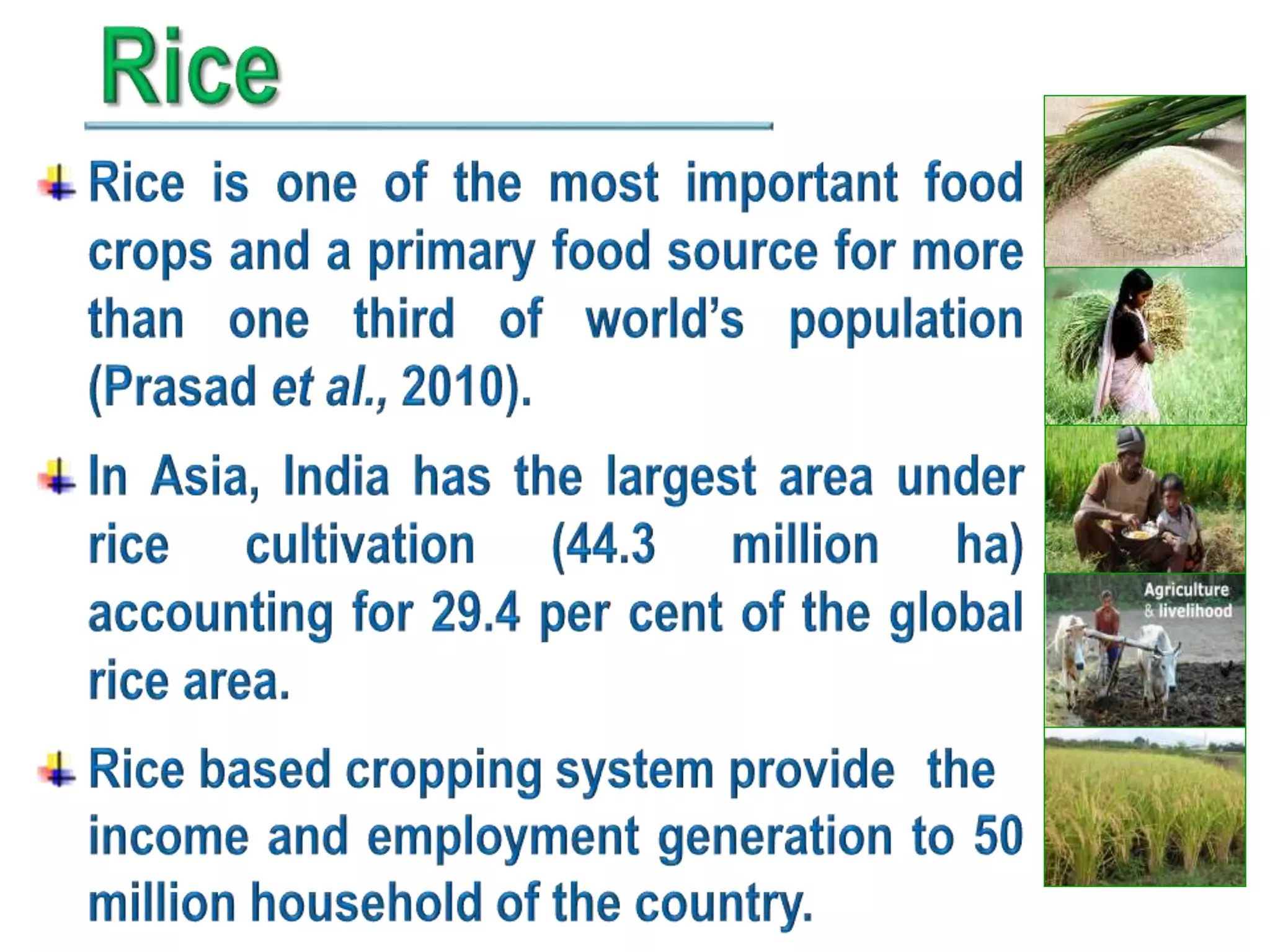
In India, West Bengal is one of the leading states for rice cultivation
covering about 4.94 million ha (Economic review, 2011-12).
The soils of West Bengal are poor in micronutrients due to
continuous growing of high yielding varieties and only incorporation
of macronutrients in cropping system
In West Bengal about 26% of the cultivated area is low in Zn (Hazra
et al., 2012);
Zinc deficiency is widespread throughout the world particularly in
lowland rice fields;
50% of cultivated soils in India are low in plant available Zn (Singh,
2009);
Zn deficiency is the fifth most important risk factor of human
disorders (WHO, 2002).
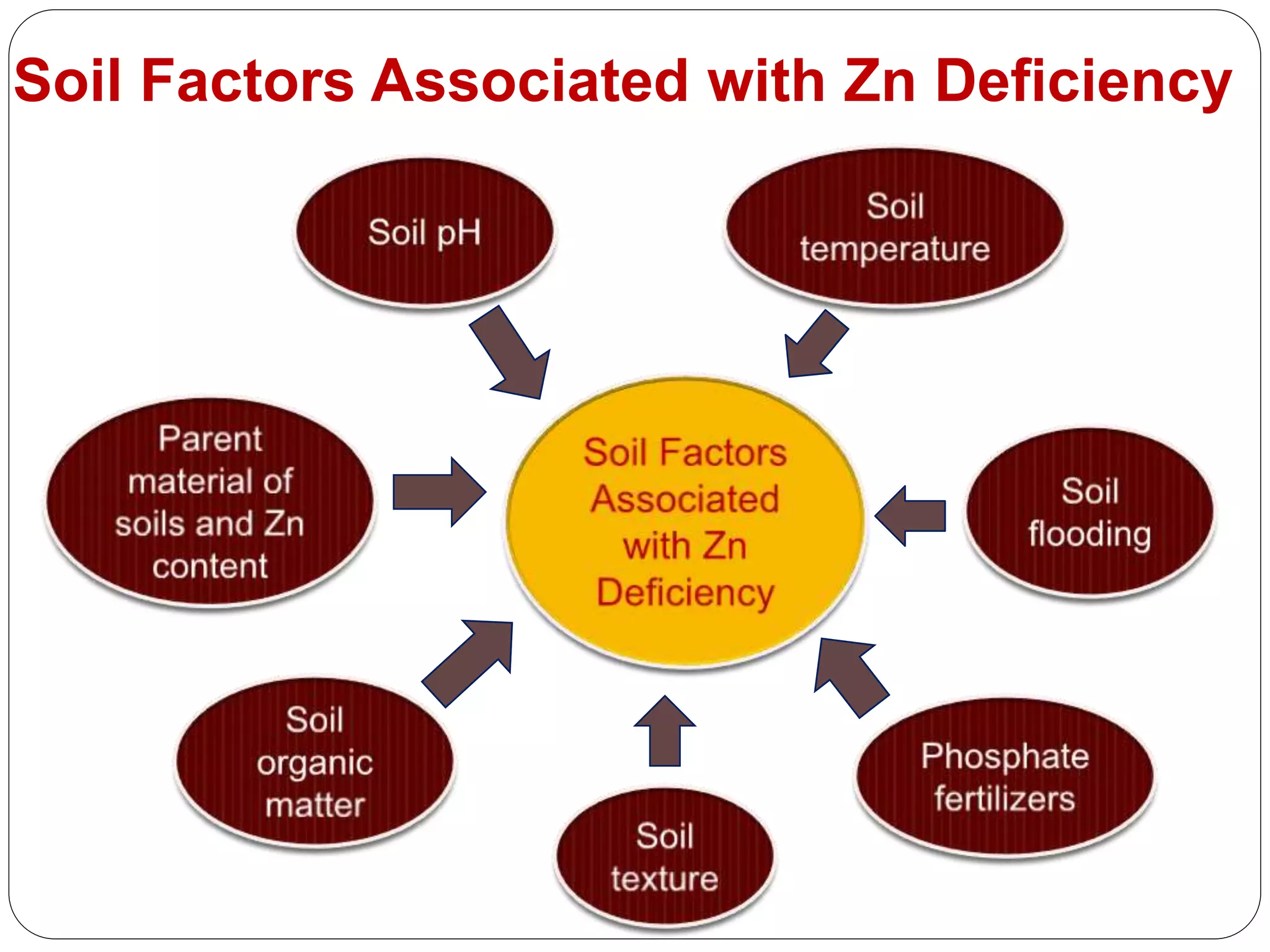
Soil Factors Associated with Zn Deficiency
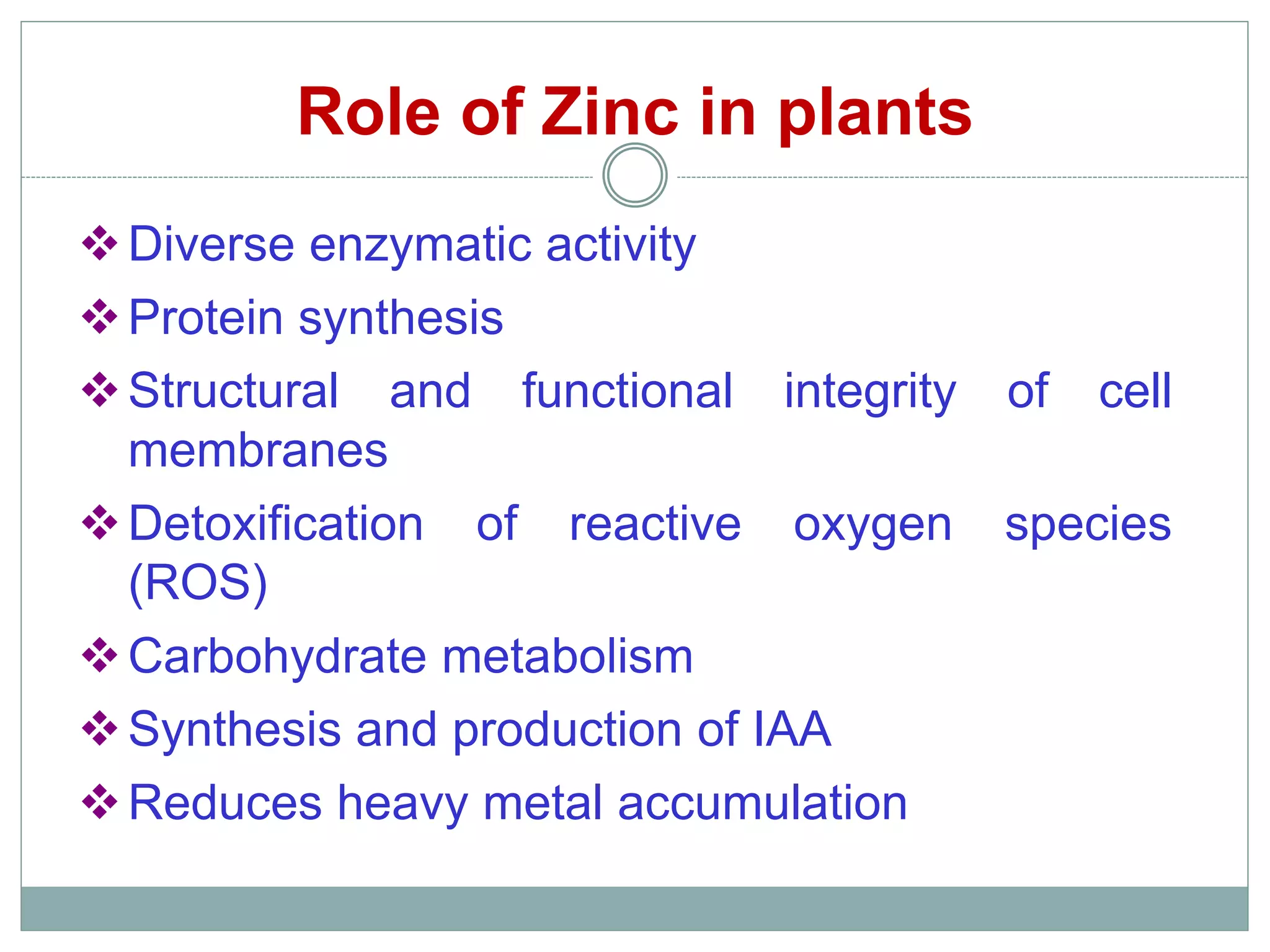
Role of Zinc in plants
Diverse enzymatic activity
Protein synthesis
Structural and functional integrity of cell
membranes
Detoxification of reactive oxygen species
(ROS)
Carbohydrate metabolism
Synthesis and production of IAA
Reduces heavy metal accumulation
Zinc in plants
Zn is absorbed by plant roots as Zn2+.
Zn concentration in plants ranges between 25 to 150 ppm. Zn
deficiencies are usually associated with concentrations of <10-20
ppm, depending on the crop.
Common deficiency symptoms of Zn include:
Light green, yellow, or white areas between leaf veins,
particularly in younger leaves
Eventual tissue necrosis in chlorotic leaf area
Shortened internodes (rossetting), resulting in stunted or bushy
plants and decreased leaf expansion (little leaf)
Premature foliage loss
Malformation of fruit, often with little or no yield.
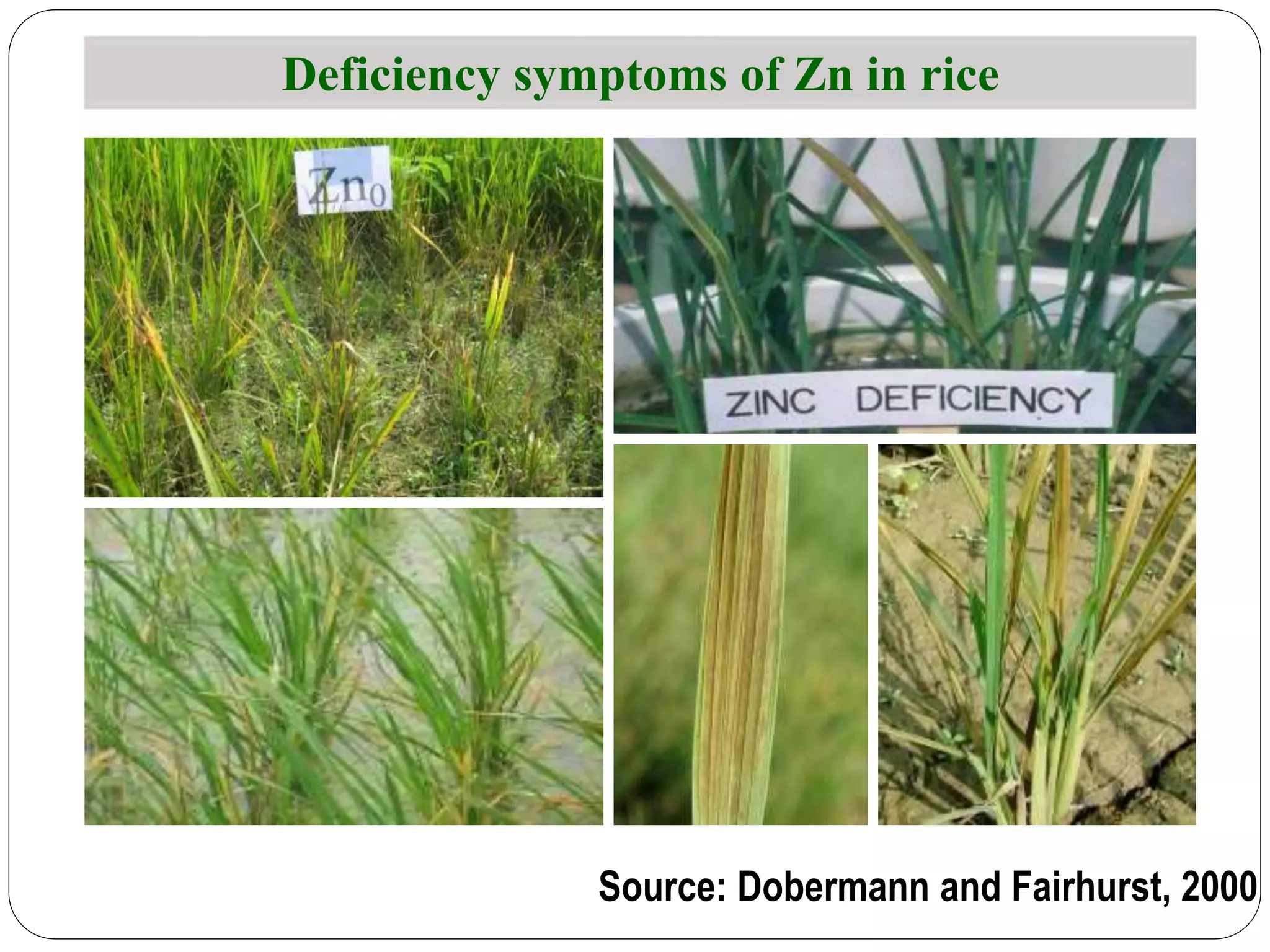
Deficiency symptoms of Zn in rice
Source: Dobermann and Fairhurst, 2000
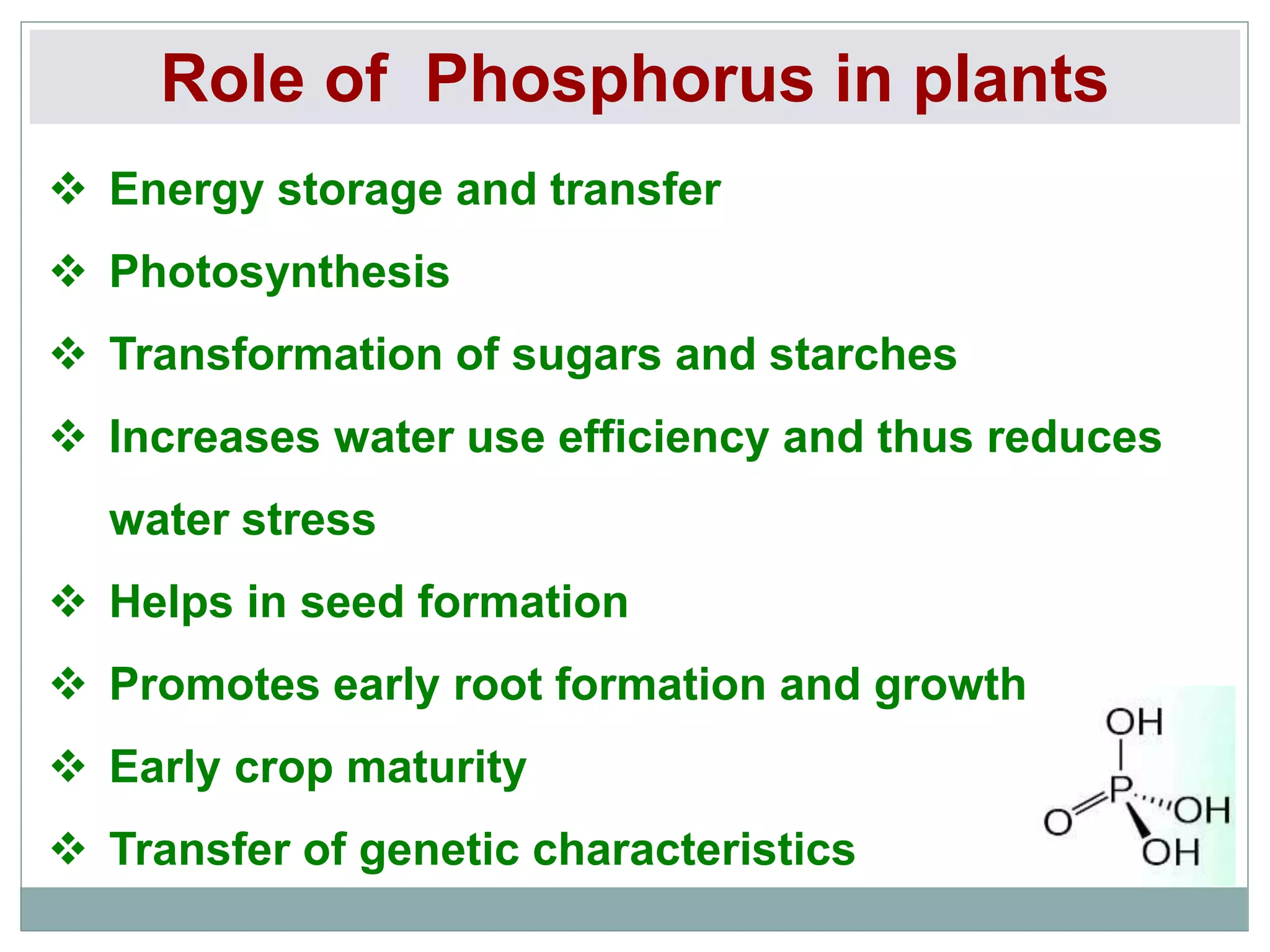
Role of Phosphorus in plants
 Energy storage and transfer
 Photosynthesis
 Transformation of sugars and starches
 Increases water use efficiency and thus reduces
water stress
 Helps in seed formation
 Promotes early root formation and growth
 Early crop maturity
 Transfer of genetic characteristics
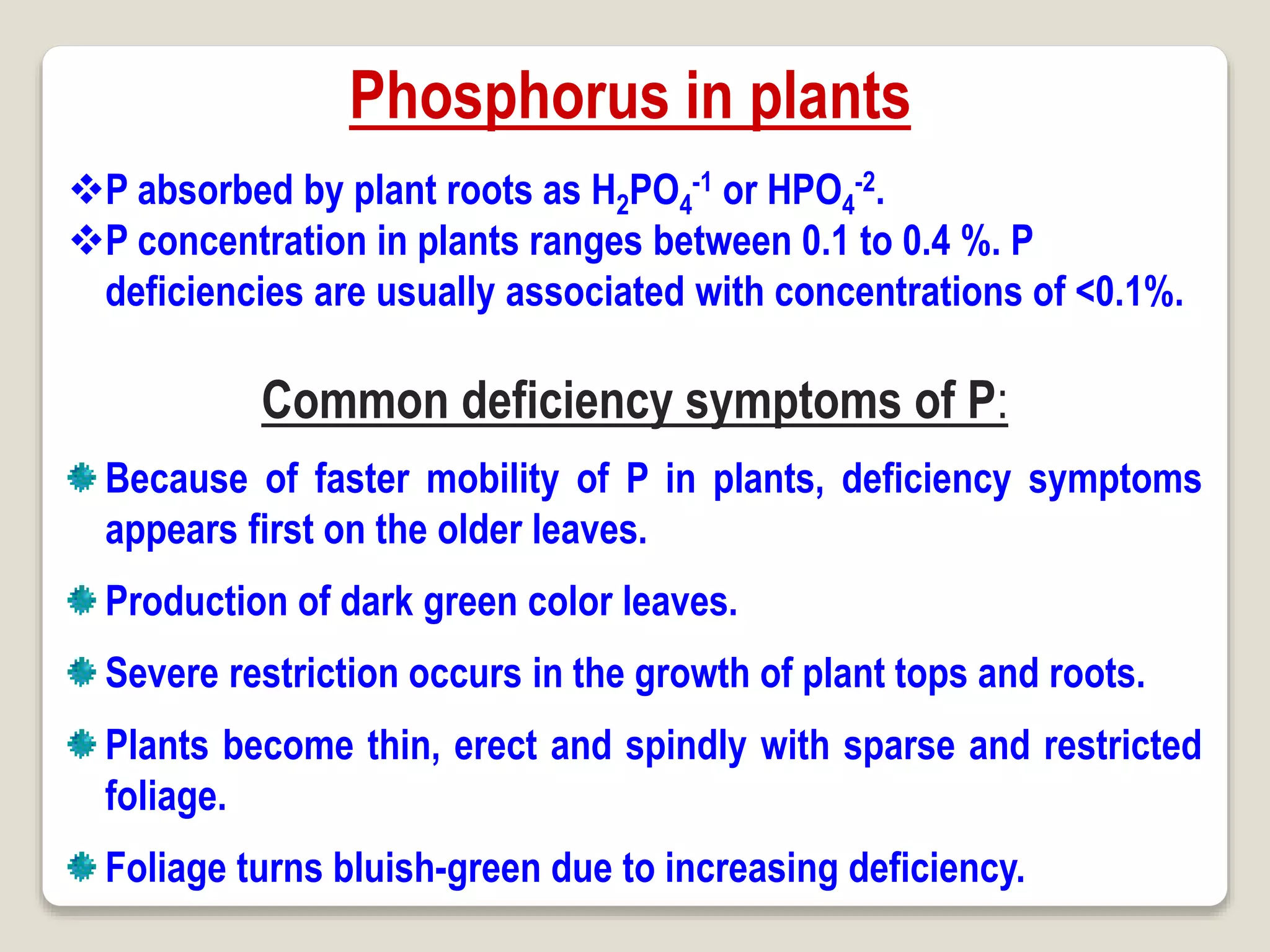
Phosphorus in plants
Common deficiency symptoms of P:
Because of faster mobility of P in plants, deficiency symptoms
appears first on the older leaves.
Production of dark green color leaves.
Severe restriction occurs in the growth of plant tops and roots.
Plants become thin, erect and spindly with sparse and restricted
foliage.
Foliage turns bluish-green due to increasing deficiency.
P absorbed by plant roots as H2PO4
-1 or HPO4
-2.
P concentration in plants ranges between 0.1 to 0.4 %. P
deficiencies are usually associated with concentrations of <0.1%.
To study the effect of P-Zn
interaction in agricultural crops
To study the mechanism of this
interaction
Management practices to overcome
the effects
OBJECTIVES
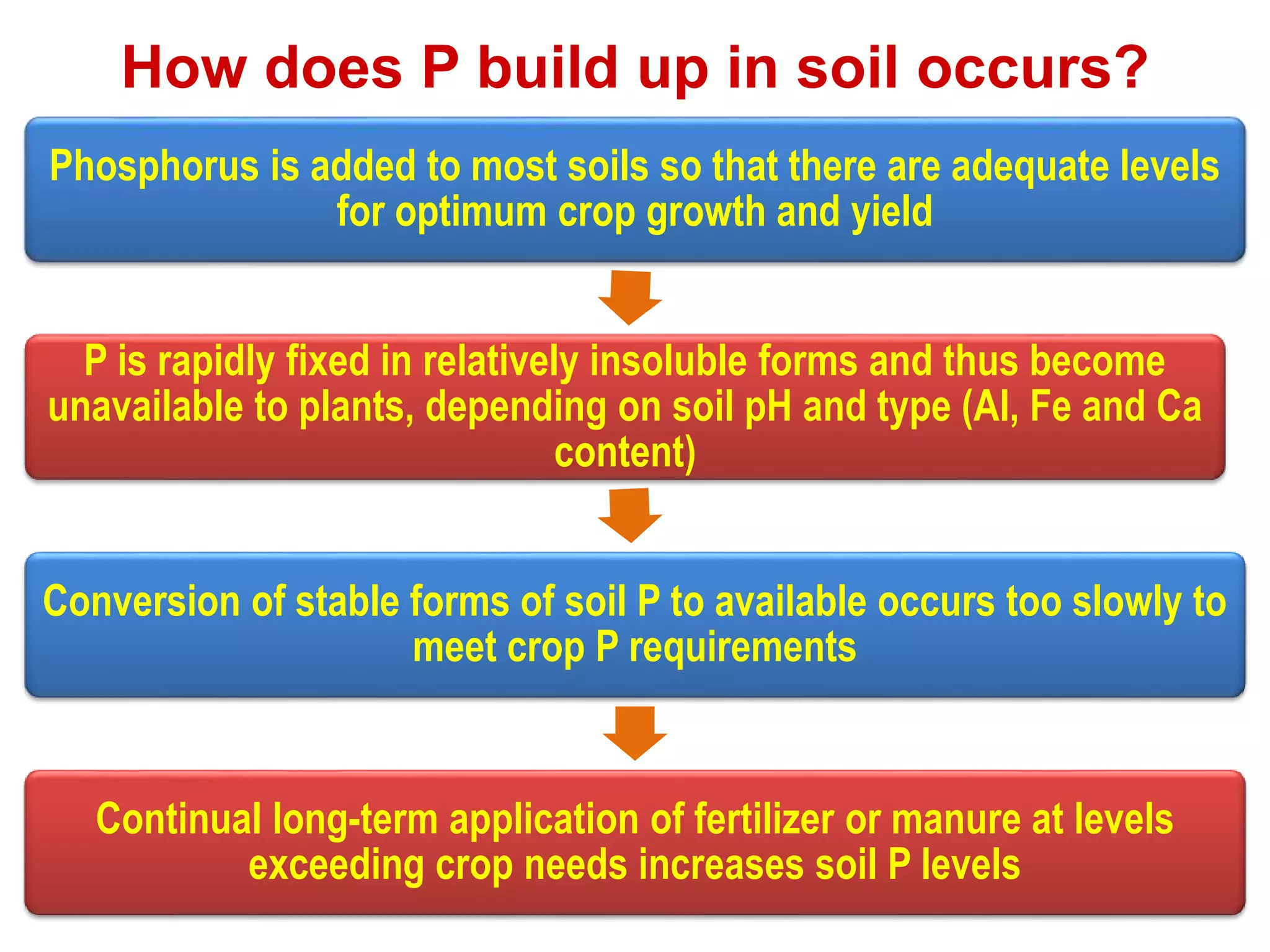
How does P build up in soil occurs?
Phosphorus is added to most soils so that there are adequate levels
for optimum crop growth and yield
P is rapidly fixed in relatively insoluble forms and thus become
unavailable to plants, depending on soil pH and type (Al, Fe and Ca
content)
Conversion of stable forms of soil P to available occurs too slowly to
meet crop P requirements
Continual long-term application of fertilizer or manure at levels
exceeding crop needs increases soil P levels
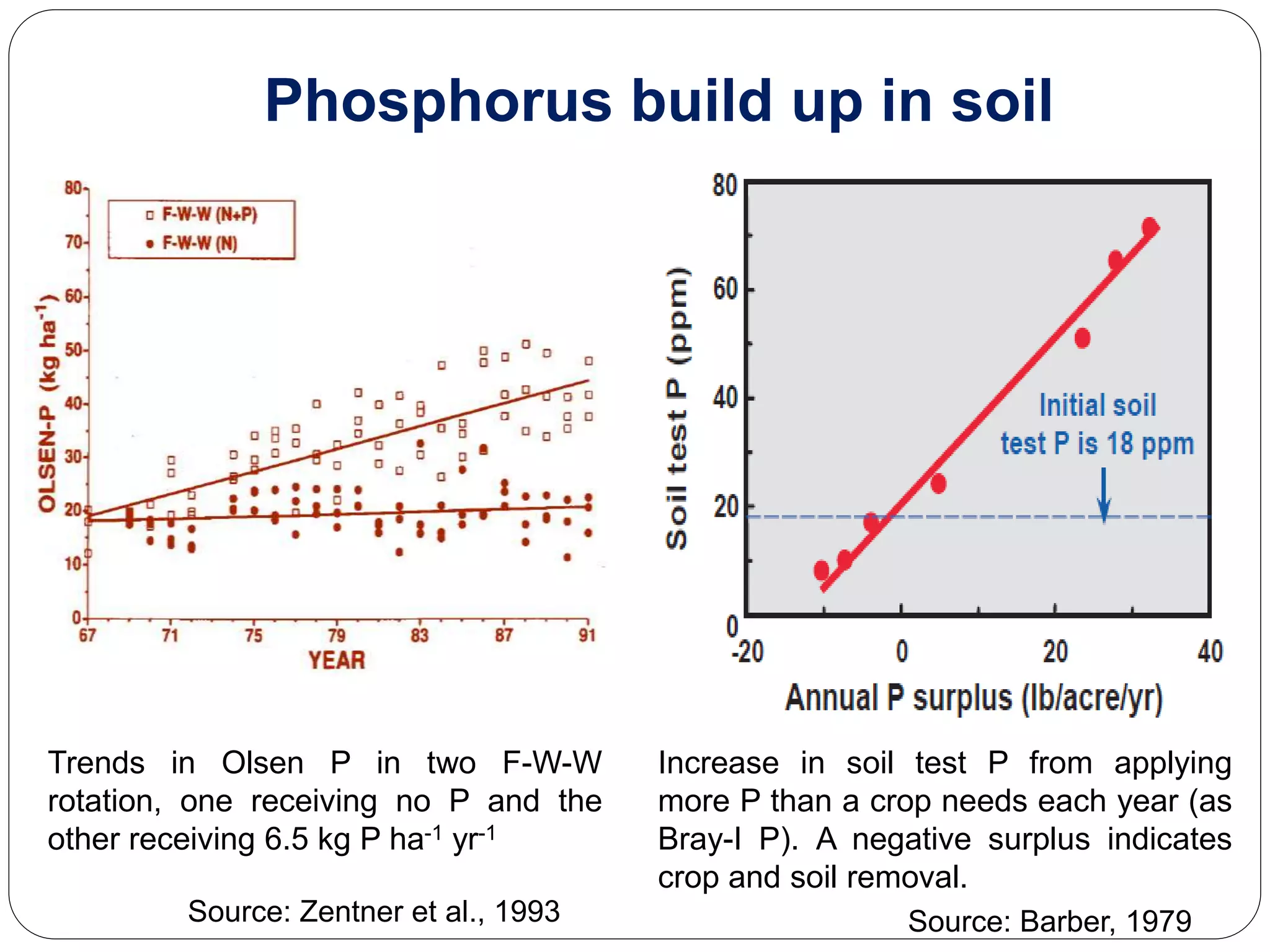
Trends in Olsen P in two F-W-W
rotation, one receiving no P and the
other receiving 6.5 kg P ha-1 yr-1
Increase in soil test P from applying
more P than a crop needs each year (as
Bray-I P). A negative surplus indicates
crop and soil removal.
Phosphorus build up in soil
Source: Zentner et al., 1993 Source: Barber, 1979
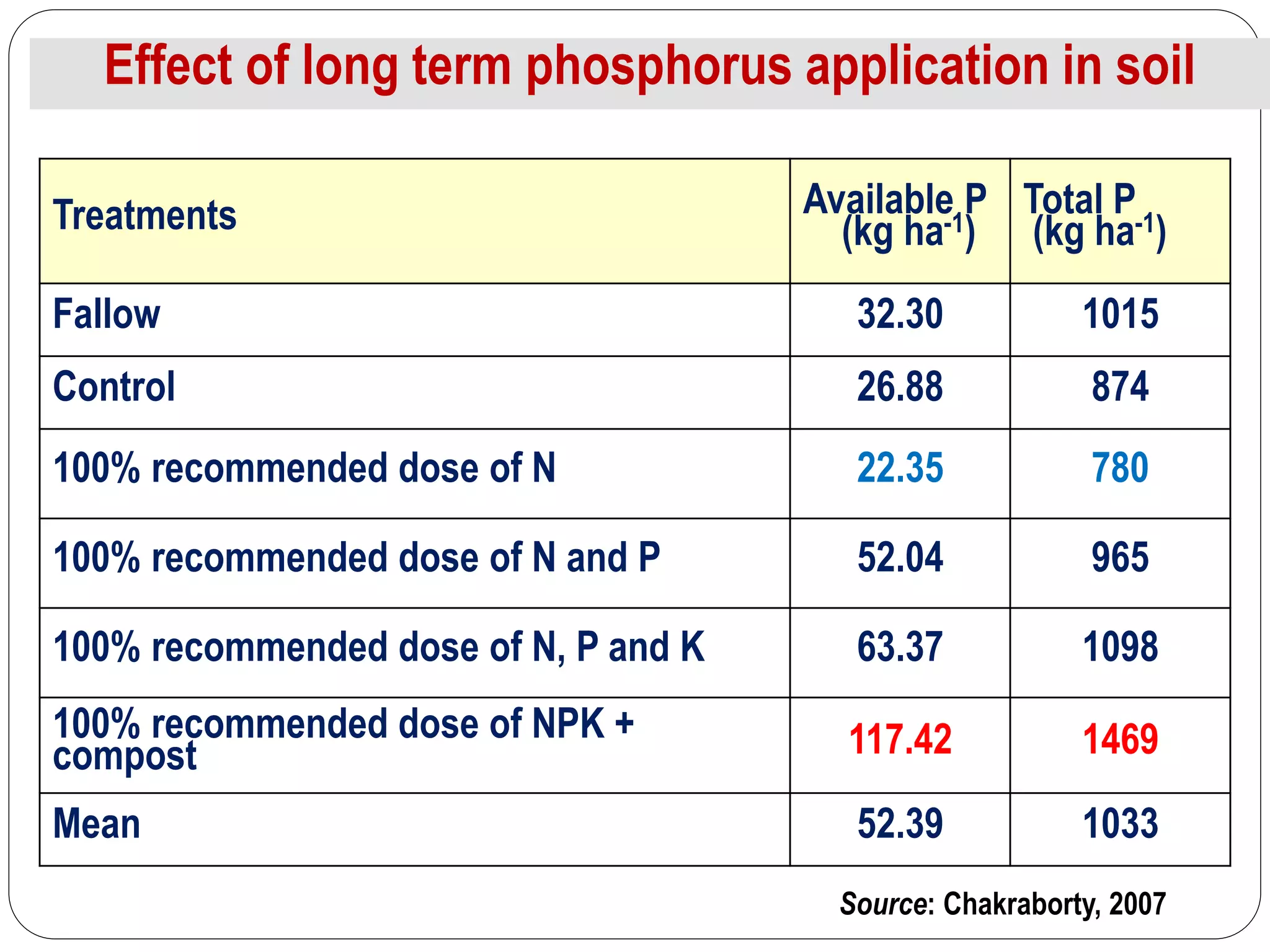
Effect of long term phosphorus application in soil
Treatments Available P
(kg ha-1)
Total P
(kg ha-1)
Fallow 32.30 1015
Control 26.88 874
100% recommended dose of N 22.35 780
100% recommended dose of N and P 52.04 965
100% recommended dose of N, P and K 63.37 1098
100% recommended dose of NPK +
compost 117.42 1469
Mean 52.39 1033
Source: Chakraborty, 2007
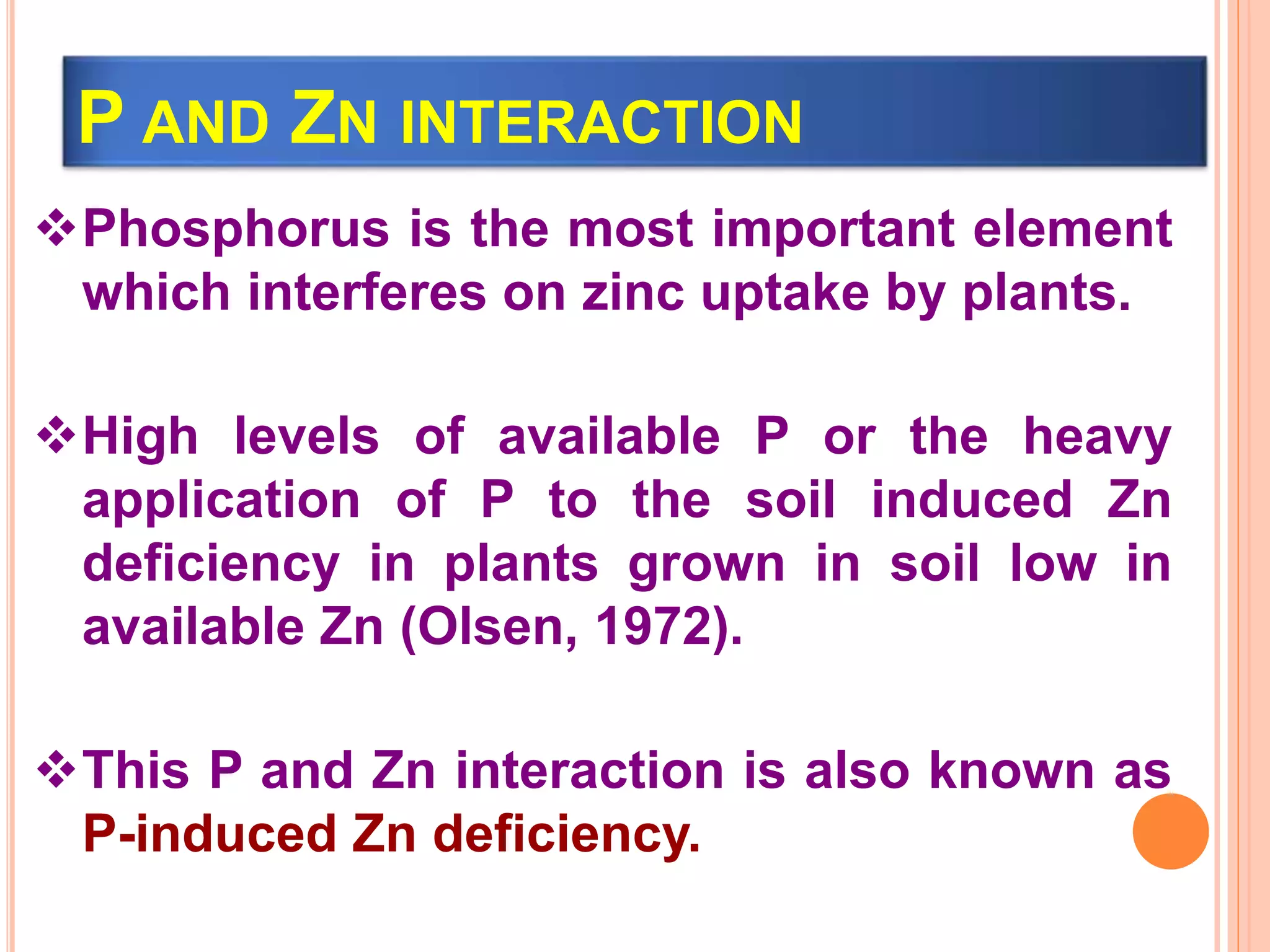
P AND ZN INTERACTION
Phosphorus is the most important element
which interferes on zinc uptake by plants.
High levels of available P or the heavy
application of P to the soil induced Zn
deficiency in plants grown in soil low in
available Zn (Olsen, 1972).
This P and Zn interaction is also known as
P-induced Zn deficiency.
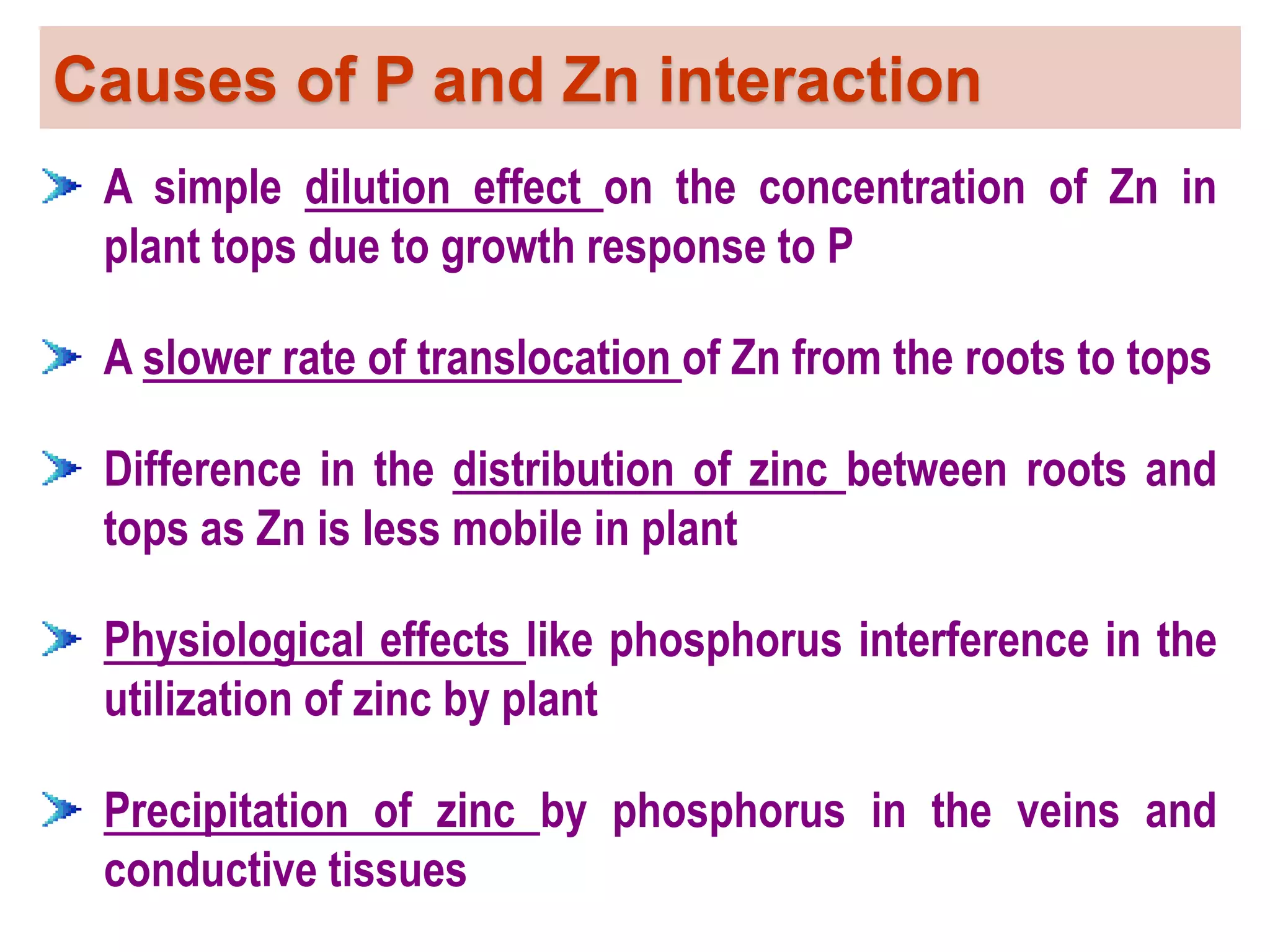
Causes of P and Zn interaction
A simple dilution effect on the concentration of Zn in
plant tops due to growth response to P
A slower rate of translocation of Zn from the roots to tops
Difference in the distribution of zinc between roots and
tops as Zn is less mobile in plant
Physiological effects like phosphorus interference in the
utilization of zinc by plant
Precipitation of zinc by phosphorus in the veins and
conductive tissues
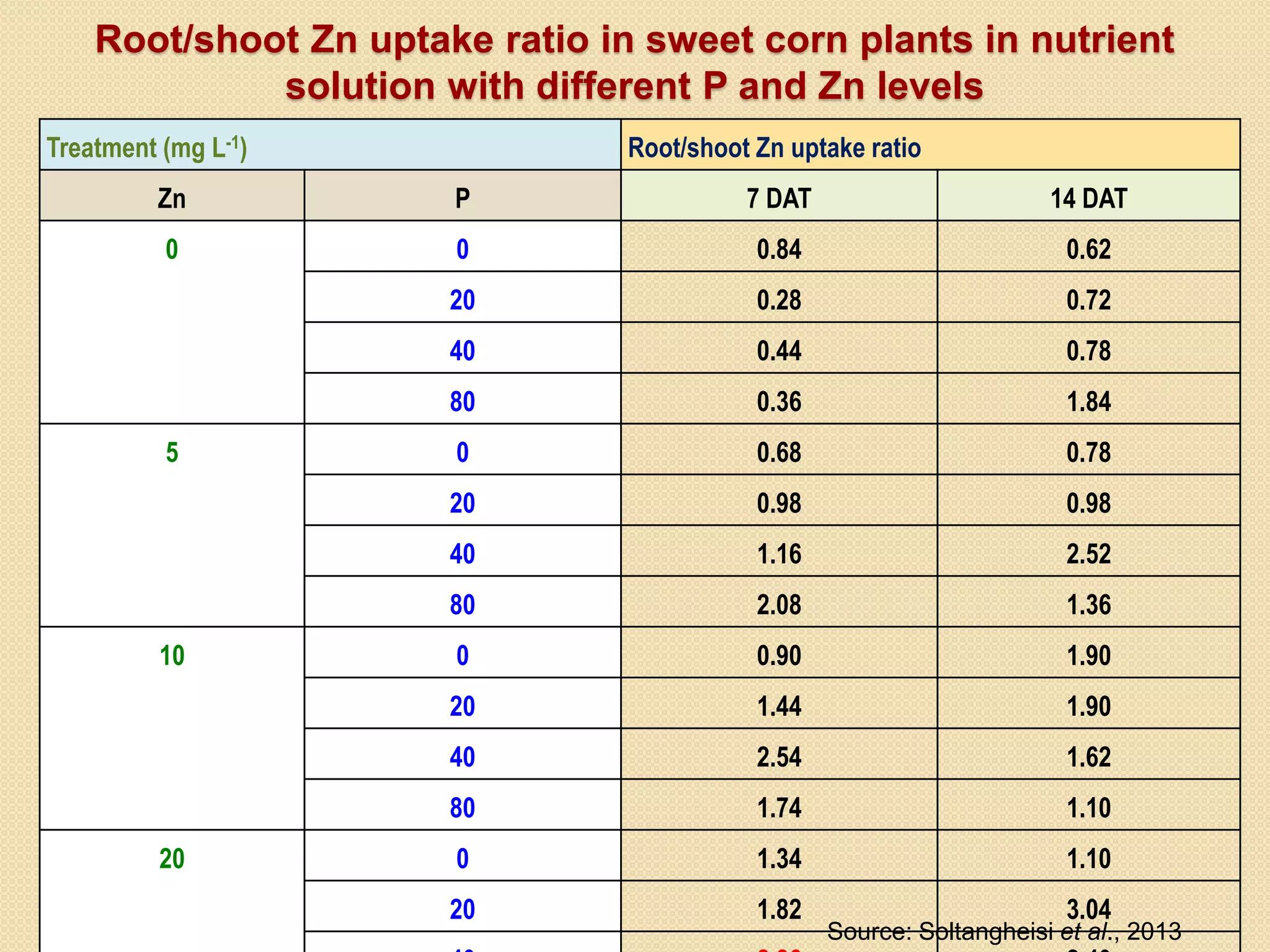
Root/shoot Zn uptake ratio in sweet corn plants in nutrient
solution with different P and Zn levels
Treatment (mg L-1) Root/shoot Zn uptake ratio
Zn P 7 DAT 14 DAT
0 0 0.84 0.62
20 0.28 0.72
40 0.44 0.78
80 0.36 1.84
5 0 0.68 0.78
20 0.98 0.98
40 1.16 2.52
80 2.08 1.36
10 0 0.90 1.90
20 1.44 1.90
40 2.54 1.62
80 1.74 1.10
20 0 1.34 1.10
20 1.82 3.04
Source: Soltangheisi et al., 2013
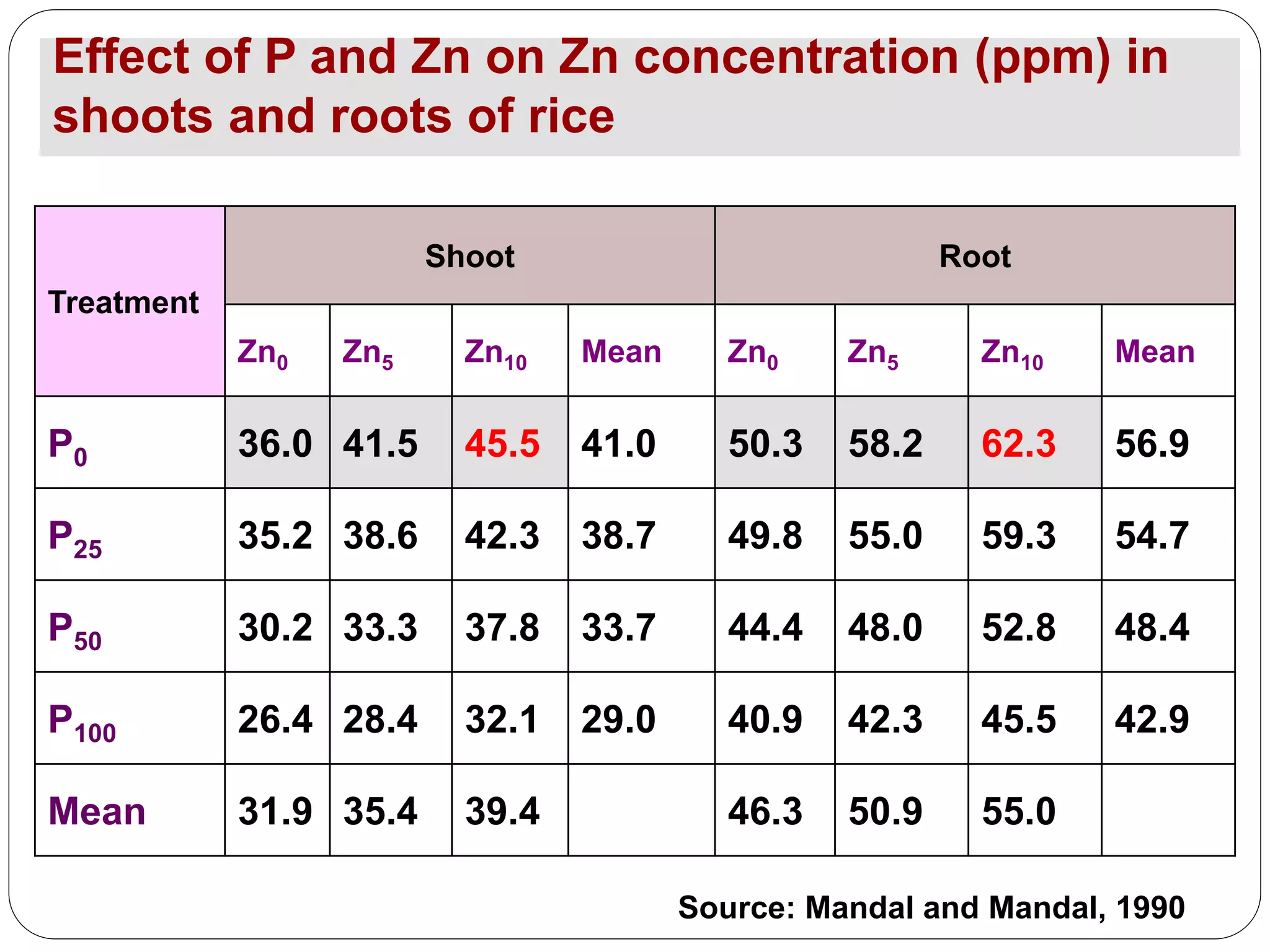
Effect of P and Zn on Zn concentration (ppm) in
shoots and roots of rice
Treatment
Shoot Root
Zn0 Zn5 Zn10 Mean Zn0 Zn5 Zn10 Mean
P0 36.0 41.5 45.5 41.0 50.3 58.2 62.3 56.9
P25 35.2 38.6 42.3 38.7 49.8 55.0 59.3 54.7
P50 30.2 33.3 37.8 33.7 44.4 48.0 52.8 48.4
P100 26.4 28.4 32.1 29.0 40.9 42.3 45.5 42.9
Mean 31.9 35.4 39.4 46.3 50.9 55.0
Source: Mandal and Mandal, 1990
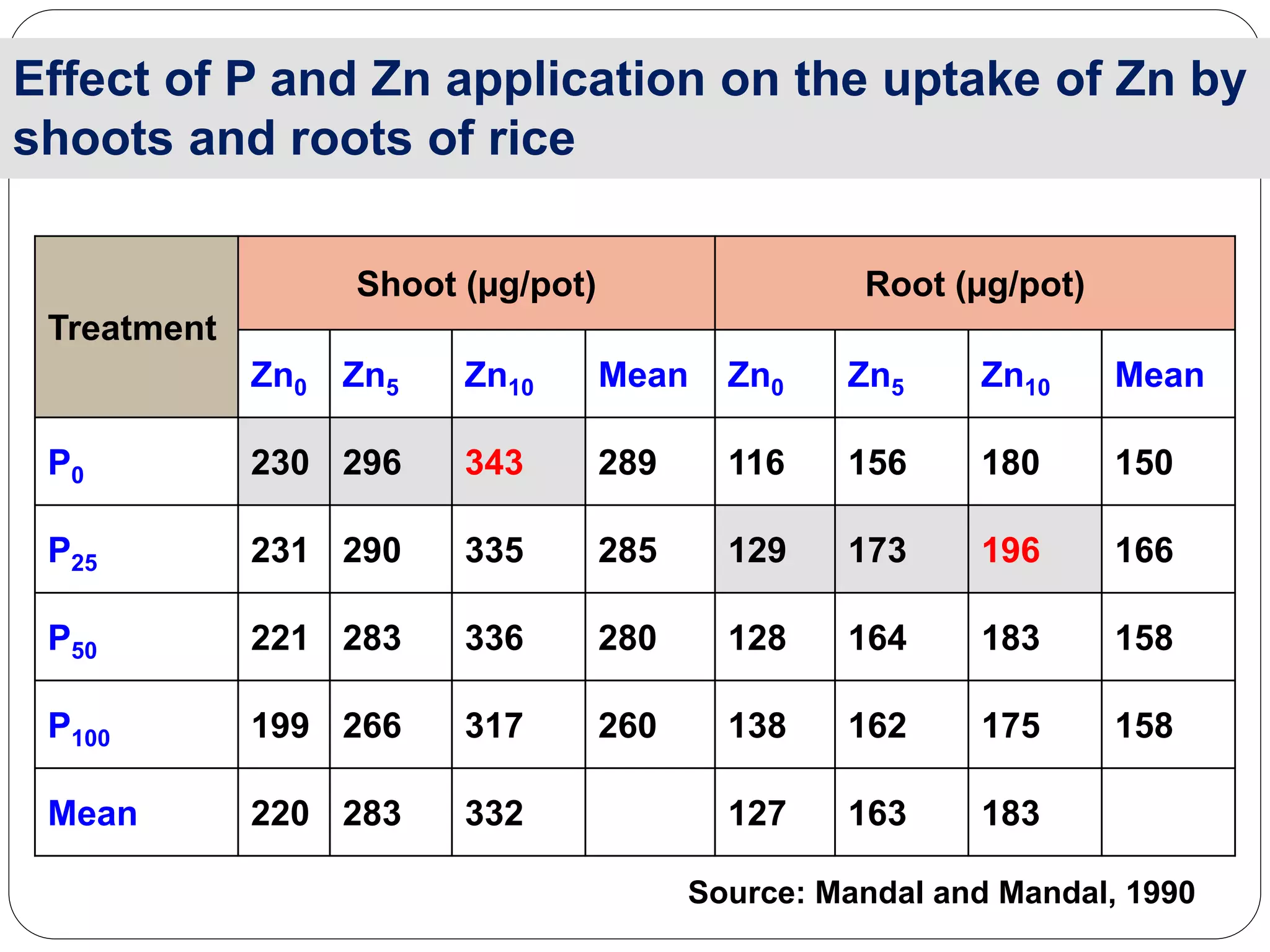
Effect of P and Zn application on the uptake of Zn by
shoots and roots of rice
Treatment
Shoot (µg/pot) Root (µg/pot)
Zn0 Zn5 Zn10 Mean Zn0 Zn5 Zn10 Mean
P0 230 296 343 289 116 156 180 150
P25 231 290 335 285 129 173 196 166
P50 221 283 336 280 128 164 183 158
P100 199 266 317 260 138 162 175 158
Mean 220 283 332 127 163 183
Source: Mandal and Mandal, 1990
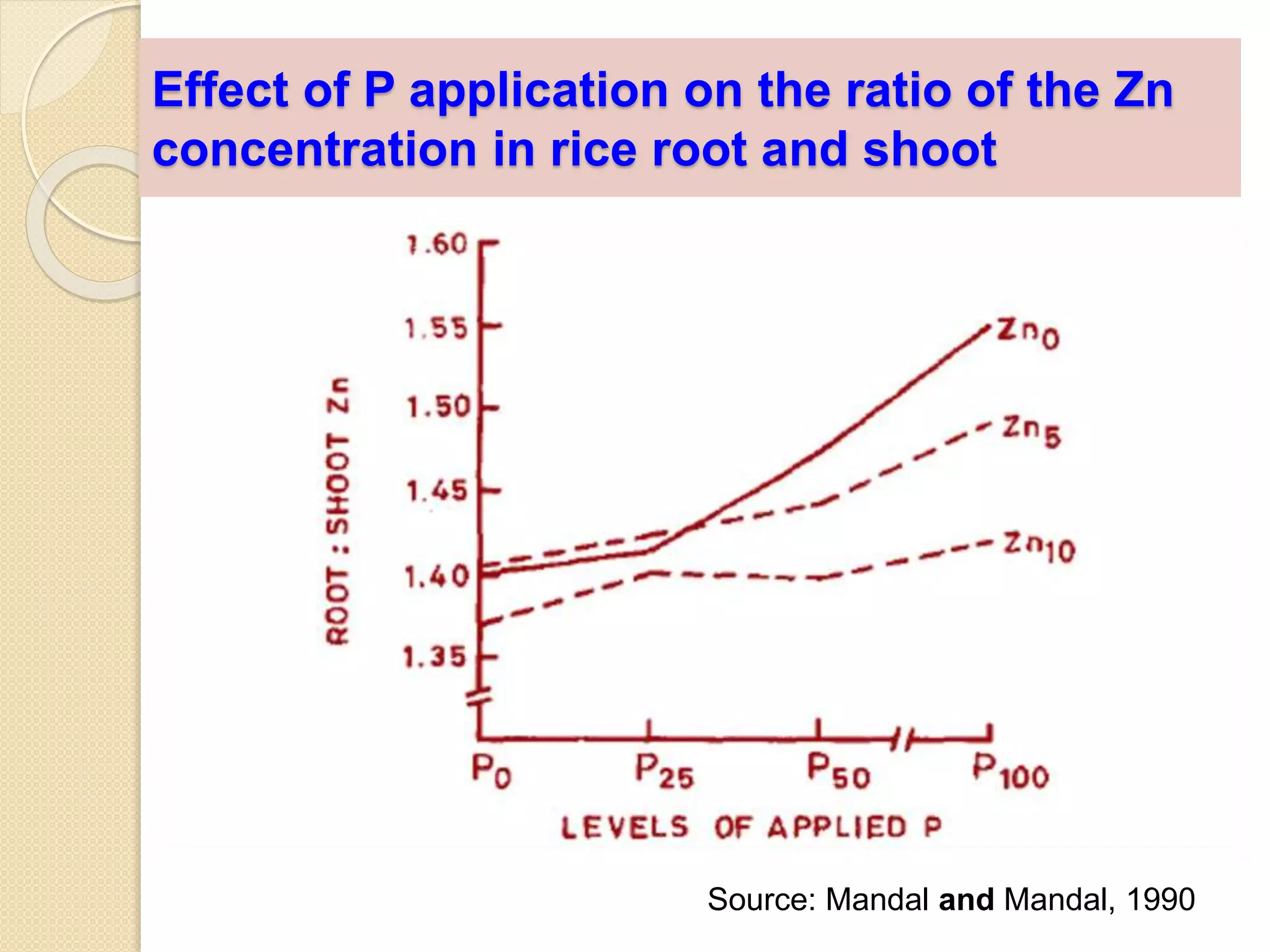
Effect of P application on the ratio of the Zn
concentration in rice root and shoot
Source: Mandal and Mandal, 1990
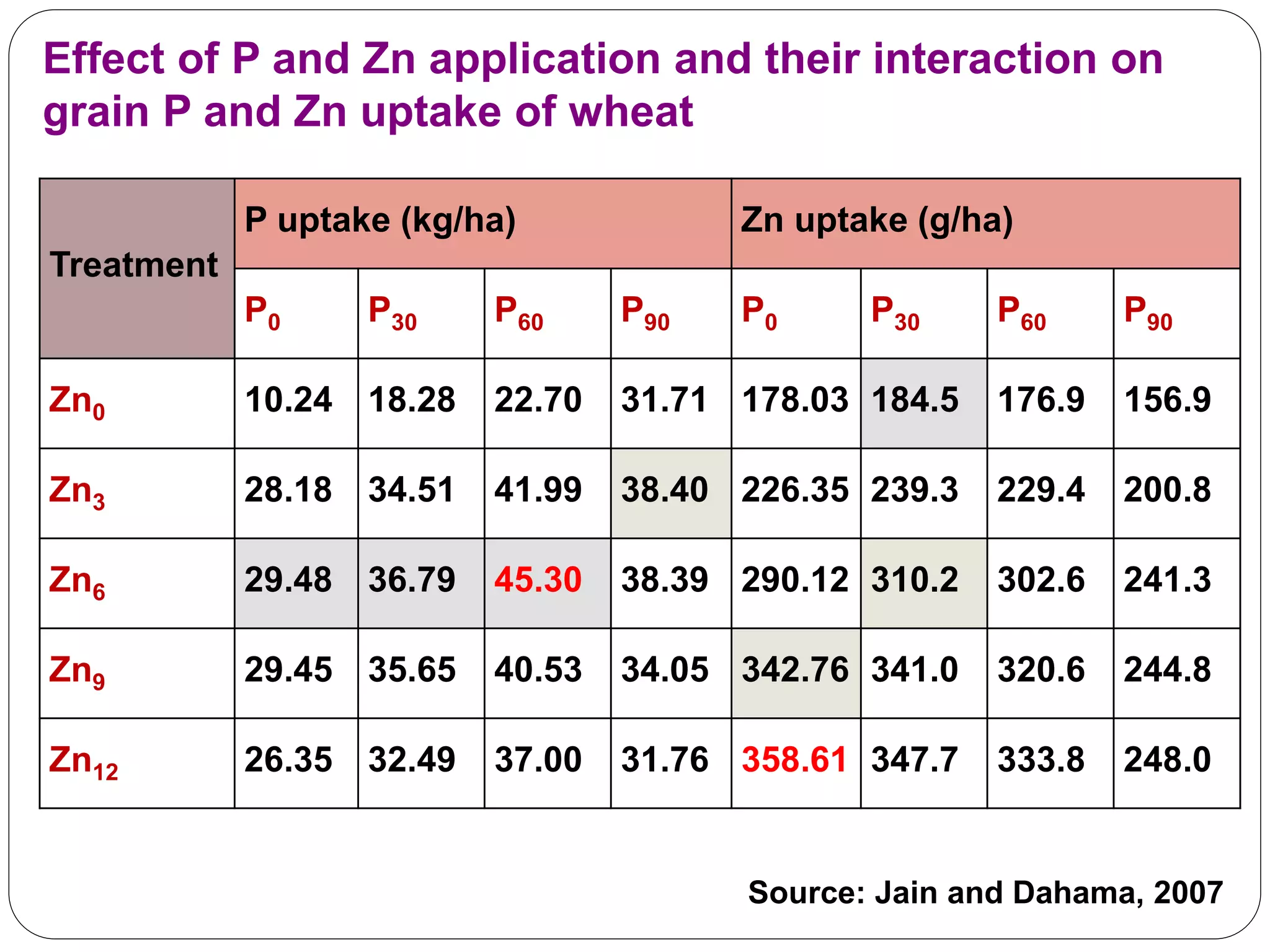
Effect of P and Zn application and their interaction on
grain P and Zn uptake of wheat
Treatment
P uptake (kg/ha) Zn uptake (g/ha)
P0 P30 P60 P90 P0 P30 P60 P90
Zn0 10.24 18.28 22.70 31.71 178.03 184.5 176.9 156.9
Zn3 28.18 34.51 41.99 38.40 226.35 239.3 229.4 200.8
Zn6 29.48 36.79 45.30 38.39 290.12 310.2 302.6 241.3
Zn9 29.45 35.65 40.53 34.05 342.76 341.0 320.6 244.8
Zn12 26.35 32.49 37.00 31.76 358.61 347.7 333.8 248.0
Source: Jain and Dahama, 2007
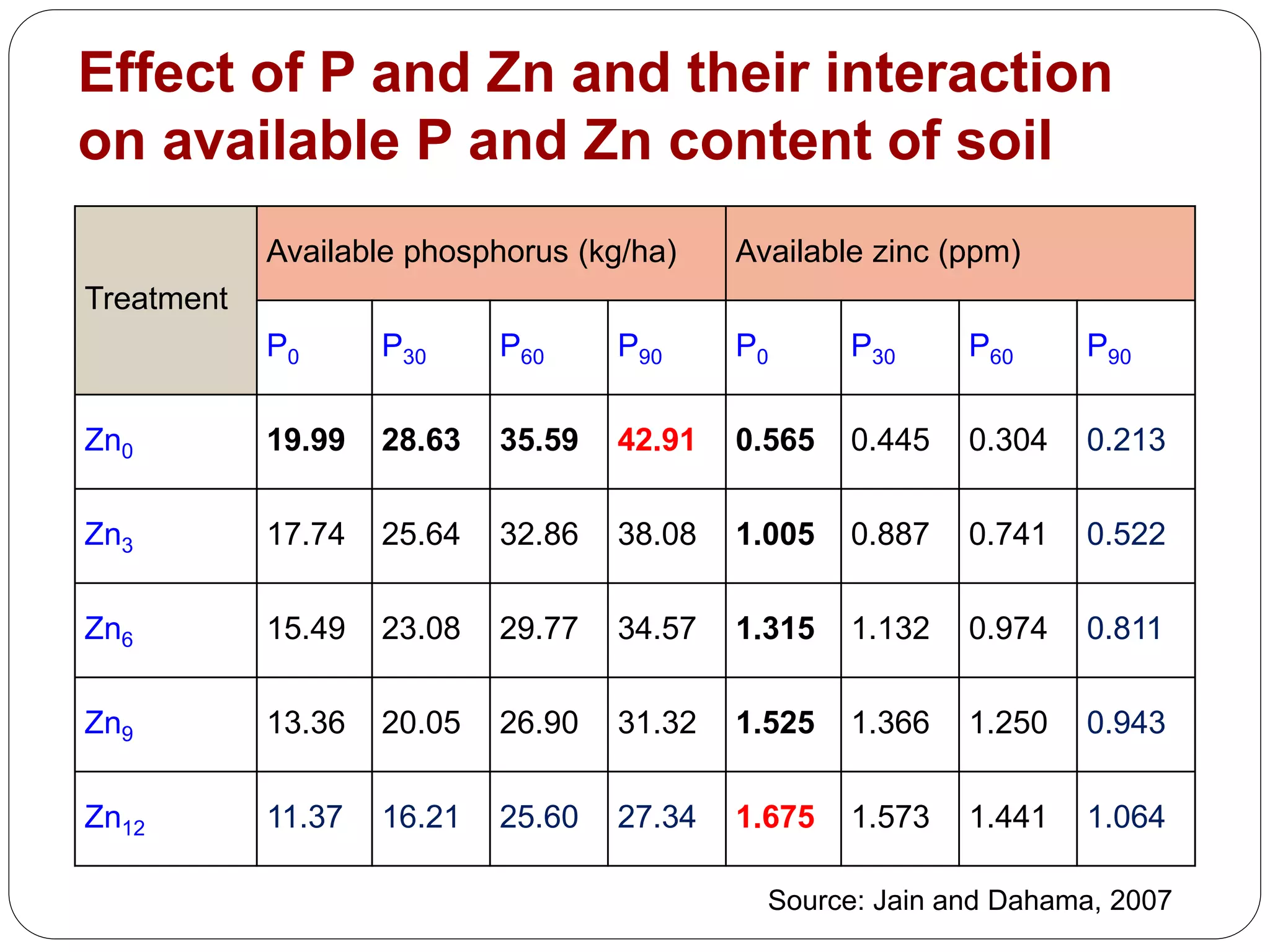
Effect of P and Zn and their interaction
on available P and Zn content of soil
Treatment
Available phosphorus (kg/ha) Available zinc (ppm)
P0 P30 P60 P90 P0 P30 P60 P90
Zn0 19.99 28.63 35.59 42.91 0.565 0.445 0.304 0.213
Zn3 17.74 25.64 32.86 38.08 1.005 0.887 0.741 0.522
Zn6 15.49 23.08 29.77 34.57 1.315 1.132 0.974 0.811
Zn9 13.36 20.05 26.90 31.32 1.525 1.366 1.250 0.943
Zn12 11.37 16.21 25.60 27.34 1.675 1.573 1.441 1.064
Source: Jain and Dahama, 2007
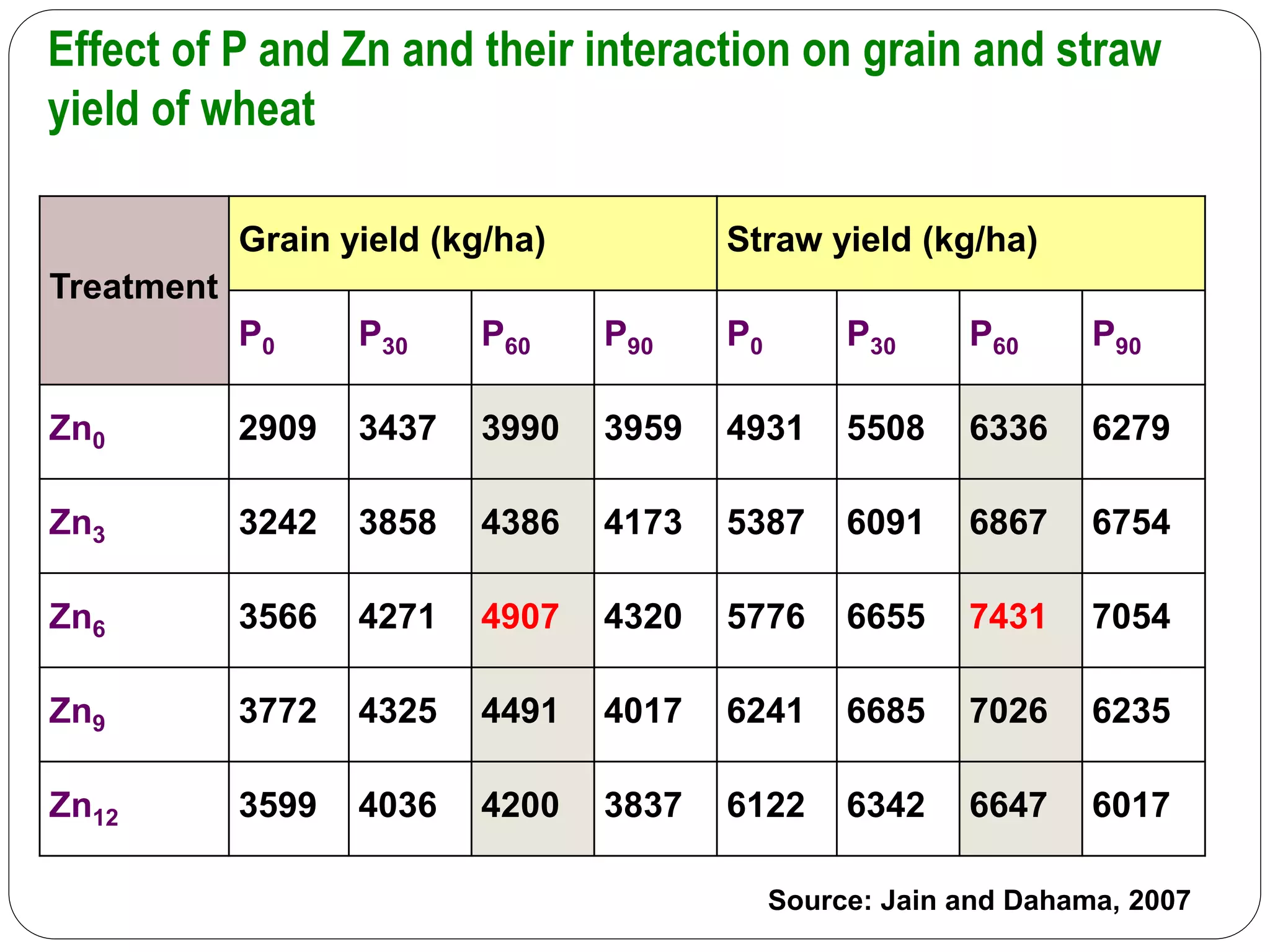
Effect of P and Zn and their interaction on grain and straw
yield of wheat
Treatment
Grain yield (kg/ha) Straw yield (kg/ha)
P0 P30 P60 P90 P0 P30 P60 P90
Zn0 2909 3437 3990 3959 4931 5508 6336 6279
Zn3 3242 3858 4386 4173 5387 6091 6867 6754
Zn6 3566 4271 4907 4320 5776 6655 7431 7054
Zn9 3772 4325 4491 4017 6241 6685 7026 6235
Zn12 3599 4036 4200 3837 6122 6342 6647 6017
Source: Jain and Dahama, 2007
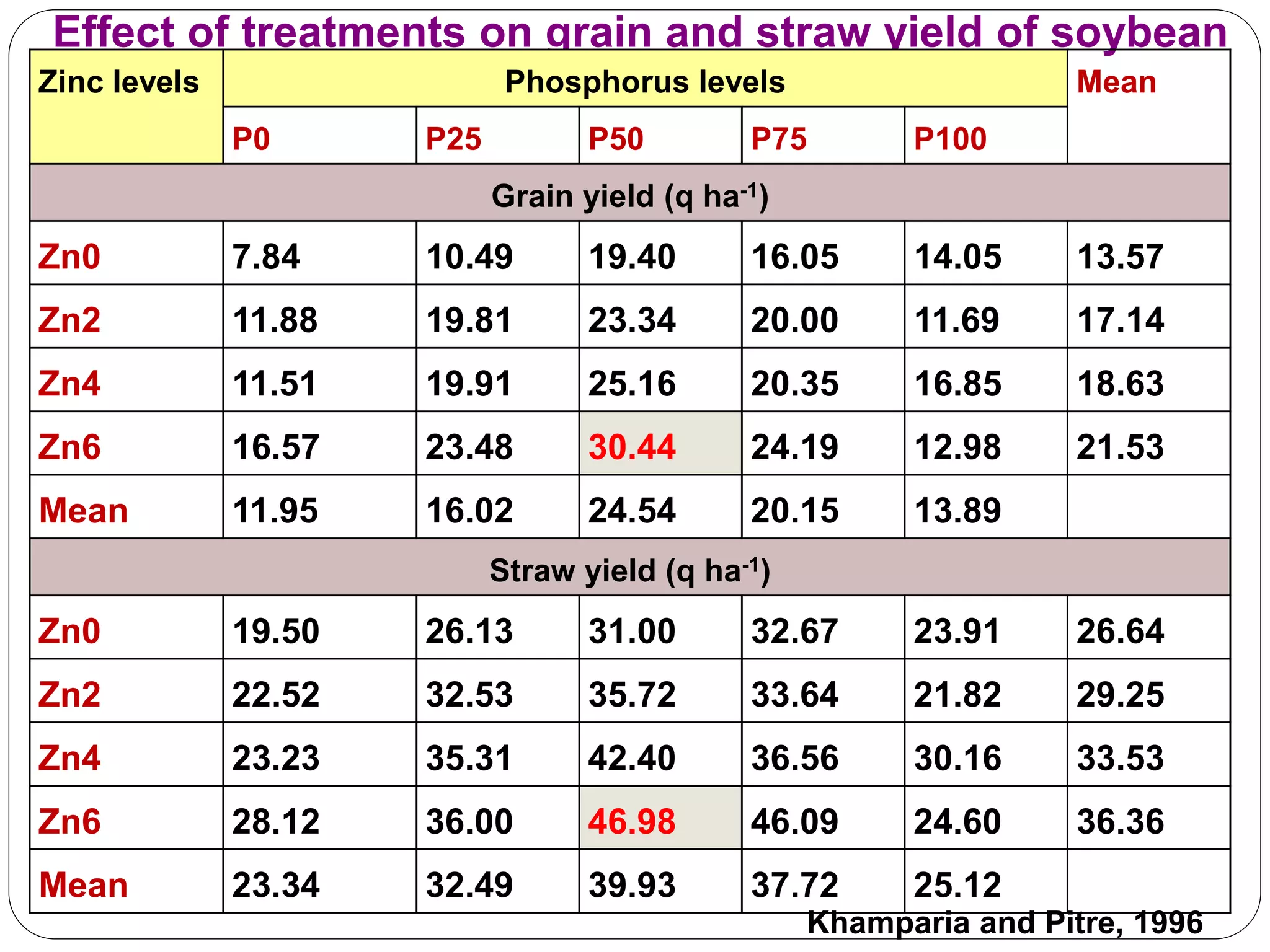
Effect of treatments on grain and straw yield of soybean
Zinc levels Phosphorus levels Mean
P0 P25 P50 P75 P100
Grain yield (q ha-1)
Zn0 7.84 10.49 19.40 16.05 14.05 13.57
Zn2 11.88 19.81 23.34 20.00 11.69 17.14
Zn4 11.51 19.91 25.16 20.35 16.85 18.63
Zn6 16.57 23.48 30.44 24.19 12.98 21.53
Mean 11.95 16.02 24.54 20.15 13.89
Straw yield (q ha-1)
Zn0 19.50 26.13 31.00 32.67 23.91 26.64
Zn2 22.52 32.53 35.72 33.64 21.82 29.25
Zn4 23.23 35.31 42.40 36.56 30.16 33.53
Zn6 28.12 36.00 46.98 46.09 24.60 36.36
Mean 23.34 32.49 39.93 37.72 25.12
Khamparia and Pitre, 1996
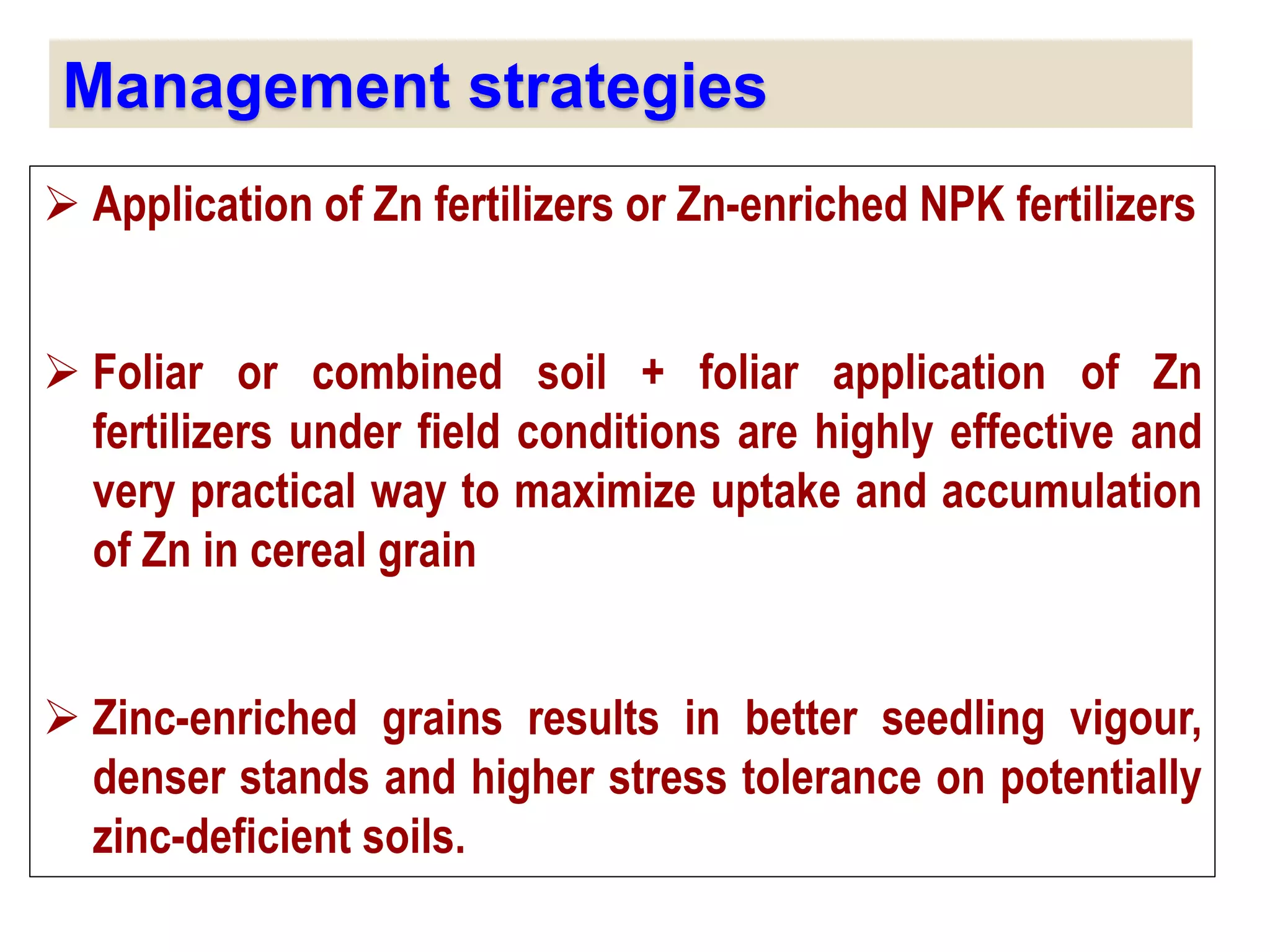
Management strategies
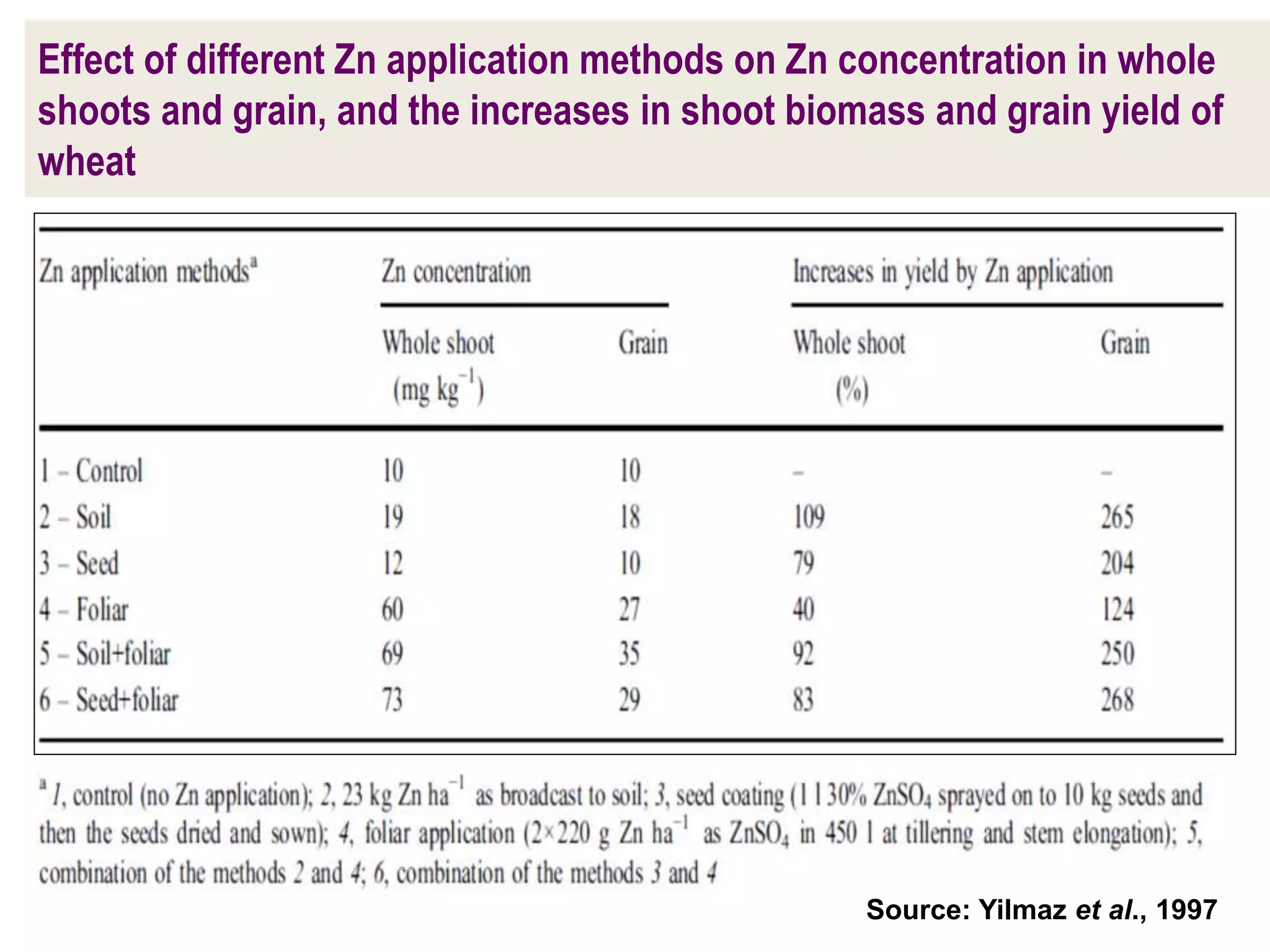
 Application of Zn fertilizers or Zn-enriched NPK fertilizers
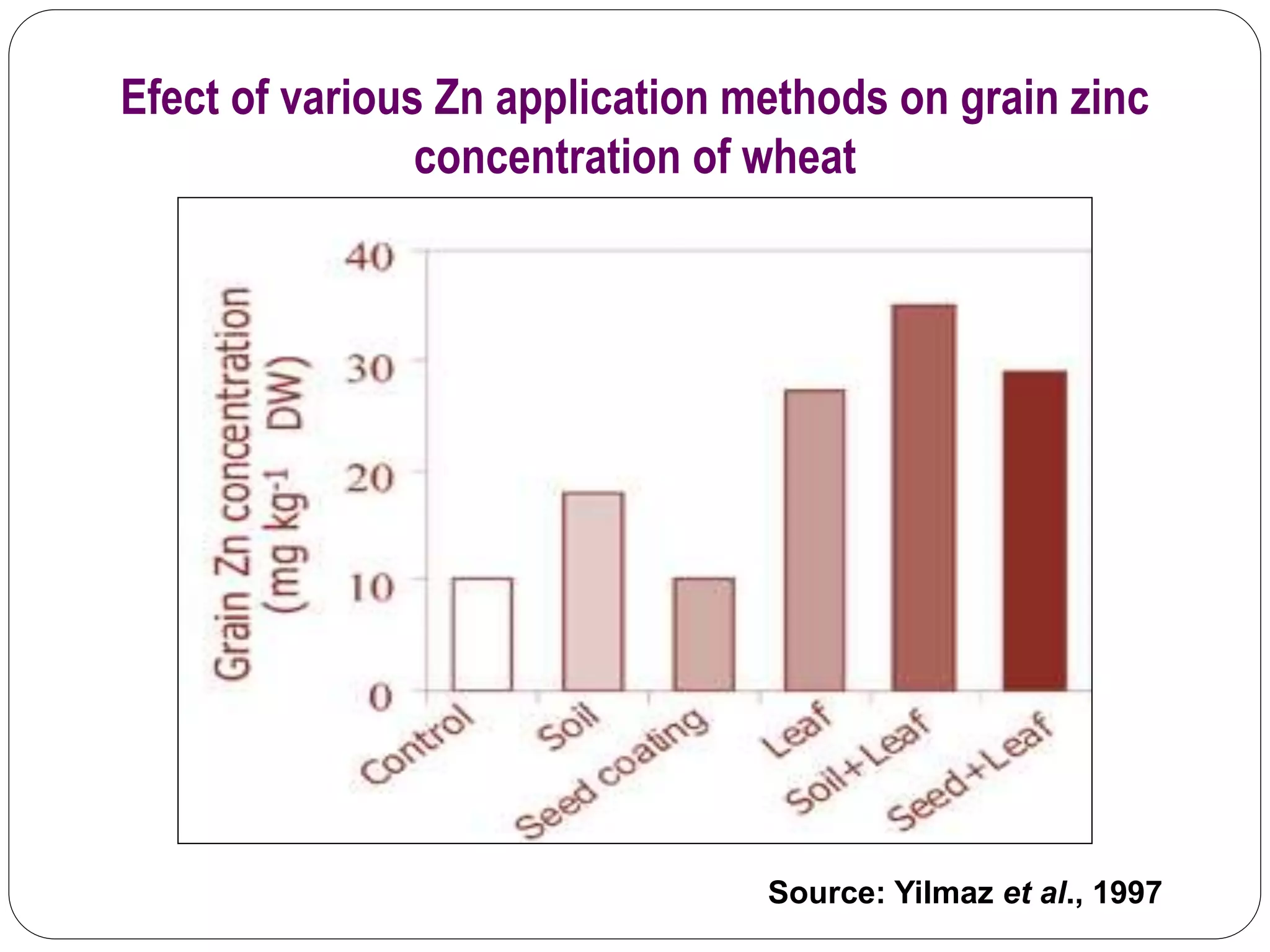
 Foliar or combined soil + foliar application of Zn
fertilizers under field conditions are highly effective and
very practical way to maximize uptake and accumulation
of Zn in cereal grain
 Zinc-enriched grains results in better seedling vigour,
denser stands and higher stress tolerance on potentially
zinc-deficient soils.
Effect of different Zn application methods on Zn concentration in whole
shoots and grain, and the increases in shoot biomass and grain yield of
wheat
Source: Yilmaz et al., 1997
Efect of various Zn application methods on grain zinc
concentration of wheat
Source: Yilmaz et al., 1997
Effect of phosphorus build up on the availabiilty of Zinc in soil in a rice based cropping system

Effect of phosphorus build up on the availabiilty of Zinc in soil in a rice based cropping system

  • 1.
    Speaker : SudeshnaMondal and Dr. P. K. Mani EFFECT OF PHOSPHORUS BUILD-UP ON THE AVAILABILITY OF ZINC IN SOILS IN A RICE BASED CROPPING SYSTEM
  • 3.
    In India, WestBengal is one of the leading states for rice cultivation covering about 4.94 million ha (Economic review, 2011-12). The soils of West Bengal are poor in micronutrients due to continuous growing of high yielding varieties and only incorporation of macronutrients in cropping system In West Bengal about 26% of the cultivated area is low in Zn (Hazra et al., 2012); Zinc deficiency is widespread throughout the world particularly in lowland rice fields; 50% of cultivated soils in India are low in plant available Zn (Singh, 2009); Zn deficiency is the fifth most important risk factor of human disorders (WHO, 2002).
  • 4.
    Soil Factors Associatedwith Zn Deficiency
  • 5.
    Role of Zincin plants Diverse enzymatic activity Protein synthesis Structural and functional integrity of cell membranes Detoxification of reactive oxygen species (ROS) Carbohydrate metabolism Synthesis and production of IAA Reduces heavy metal accumulation
  • 6.
    Zinc in plants Znis absorbed by plant roots as Zn2+. Zn concentration in plants ranges between 25 to 150 ppm. Zn deficiencies are usually associated with concentrations of <10-20 ppm, depending on the crop. Common deficiency symptoms of Zn include: Light green, yellow, or white areas between leaf veins, particularly in younger leaves Eventual tissue necrosis in chlorotic leaf area Shortened internodes (rossetting), resulting in stunted or bushy plants and decreased leaf expansion (little leaf) Premature foliage loss Malformation of fruit, often with little or no yield.
  • 7.
    Deficiency symptoms ofZn in rice Source: Dobermann and Fairhurst, 2000
  • 8.
    Role of Phosphorusin plants  Energy storage and transfer  Photosynthesis  Transformation of sugars and starches  Increases water use efficiency and thus reduces water stress  Helps in seed formation  Promotes early root formation and growth  Early crop maturity  Transfer of genetic characteristics
  • 9.
    Phosphorus in plants Commondeficiency symptoms of P: Because of faster mobility of P in plants, deficiency symptoms appears first on the older leaves. Production of dark green color leaves. Severe restriction occurs in the growth of plant tops and roots. Plants become thin, erect and spindly with sparse and restricted foliage. Foliage turns bluish-green due to increasing deficiency. P absorbed by plant roots as H2PO4 -1 or HPO4 -2. P concentration in plants ranges between 0.1 to 0.4 %. P deficiencies are usually associated with concentrations of <0.1%.
  • 10.
    To study theeffect of P-Zn interaction in agricultural crops To study the mechanism of this interaction Management practices to overcome the effects OBJECTIVES
  • 11.
    How does Pbuild up in soil occurs? Phosphorus is added to most soils so that there are adequate levels for optimum crop growth and yield P is rapidly fixed in relatively insoluble forms and thus become unavailable to plants, depending on soil pH and type (Al, Fe and Ca content) Conversion of stable forms of soil P to available occurs too slowly to meet crop P requirements Continual long-term application of fertilizer or manure at levels exceeding crop needs increases soil P levels
  • 12.
    Trends in OlsenP in two F-W-W rotation, one receiving no P and the other receiving 6.5 kg P ha-1 yr-1 Increase in soil test P from applying more P than a crop needs each year (as Bray-I P). A negative surplus indicates crop and soil removal. Phosphorus build up in soil Source: Zentner et al., 1993 Source: Barber, 1979
  • 13.
    Effect of longterm phosphorus application in soil Treatments Available P (kg ha-1) Total P (kg ha-1) Fallow 32.30 1015 Control 26.88 874 100% recommended dose of N 22.35 780 100% recommended dose of N and P 52.04 965 100% recommended dose of N, P and K 63.37 1098 100% recommended dose of NPK + compost 117.42 1469 Mean 52.39 1033 Source: Chakraborty, 2007
  • 14.
    P AND ZNINTERACTION Phosphorus is the most important element which interferes on zinc uptake by plants. High levels of available P or the heavy application of P to the soil induced Zn deficiency in plants grown in soil low in available Zn (Olsen, 1972). This P and Zn interaction is also known as P-induced Zn deficiency.
  • 15.
    Causes of Pand Zn interaction A simple dilution effect on the concentration of Zn in plant tops due to growth response to P A slower rate of translocation of Zn from the roots to tops Difference in the distribution of zinc between roots and tops as Zn is less mobile in plant Physiological effects like phosphorus interference in the utilization of zinc by plant Precipitation of zinc by phosphorus in the veins and conductive tissues
  • 16.
    Root/shoot Zn uptakeratio in sweet corn plants in nutrient solution with different P and Zn levels Treatment (mg L-1) Root/shoot Zn uptake ratio Zn P 7 DAT 14 DAT 0 0 0.84 0.62 20 0.28 0.72 40 0.44 0.78 80 0.36 1.84 5 0 0.68 0.78 20 0.98 0.98 40 1.16 2.52 80 2.08 1.36 10 0 0.90 1.90 20 1.44 1.90 40 2.54 1.62 80 1.74 1.10 20 0 1.34 1.10 20 1.82 3.04 Source: Soltangheisi et al., 2013
  • 17.
    Effect of Pand Zn on Zn concentration (ppm) in shoots and roots of rice Treatment Shoot Root Zn0 Zn5 Zn10 Mean Zn0 Zn5 Zn10 Mean P0 36.0 41.5 45.5 41.0 50.3 58.2 62.3 56.9 P25 35.2 38.6 42.3 38.7 49.8 55.0 59.3 54.7 P50 30.2 33.3 37.8 33.7 44.4 48.0 52.8 48.4 P100 26.4 28.4 32.1 29.0 40.9 42.3 45.5 42.9 Mean 31.9 35.4 39.4 46.3 50.9 55.0 Source: Mandal and Mandal, 1990
  • 18.
    Effect of Pand Zn application on the uptake of Zn by shoots and roots of rice Treatment Shoot (µg/pot) Root (µg/pot) Zn0 Zn5 Zn10 Mean Zn0 Zn5 Zn10 Mean P0 230 296 343 289 116 156 180 150 P25 231 290 335 285 129 173 196 166 P50 221 283 336 280 128 164 183 158 P100 199 266 317 260 138 162 175 158 Mean 220 283 332 127 163 183 Source: Mandal and Mandal, 1990
  • 19.
    Effect of Papplication on the ratio of the Zn concentration in rice root and shoot Source: Mandal and Mandal, 1990
  • 20.
    Effect of Pand Zn application and their interaction on grain P and Zn uptake of wheat Treatment P uptake (kg/ha) Zn uptake (g/ha) P0 P30 P60 P90 P0 P30 P60 P90 Zn0 10.24 18.28 22.70 31.71 178.03 184.5 176.9 156.9 Zn3 28.18 34.51 41.99 38.40 226.35 239.3 229.4 200.8 Zn6 29.48 36.79 45.30 38.39 290.12 310.2 302.6 241.3 Zn9 29.45 35.65 40.53 34.05 342.76 341.0 320.6 244.8 Zn12 26.35 32.49 37.00 31.76 358.61 347.7 333.8 248.0 Source: Jain and Dahama, 2007
  • 21.
    Effect of Pand Zn and their interaction on available P and Zn content of soil Treatment Available phosphorus (kg/ha) Available zinc (ppm) P0 P30 P60 P90 P0 P30 P60 P90 Zn0 19.99 28.63 35.59 42.91 0.565 0.445 0.304 0.213 Zn3 17.74 25.64 32.86 38.08 1.005 0.887 0.741 0.522 Zn6 15.49 23.08 29.77 34.57 1.315 1.132 0.974 0.811 Zn9 13.36 20.05 26.90 31.32 1.525 1.366 1.250 0.943 Zn12 11.37 16.21 25.60 27.34 1.675 1.573 1.441 1.064 Source: Jain and Dahama, 2007
  • 22.
    Effect of Pand Zn and their interaction on grain and straw yield of wheat Treatment Grain yield (kg/ha) Straw yield (kg/ha) P0 P30 P60 P90 P0 P30 P60 P90 Zn0 2909 3437 3990 3959 4931 5508 6336 6279 Zn3 3242 3858 4386 4173 5387 6091 6867 6754 Zn6 3566 4271 4907 4320 5776 6655 7431 7054 Zn9 3772 4325 4491 4017 6241 6685 7026 6235 Zn12 3599 4036 4200 3837 6122 6342 6647 6017 Source: Jain and Dahama, 2007
  • 23.
    Effect of treatmentson grain and straw yield of soybean Zinc levels Phosphorus levels Mean P0 P25 P50 P75 P100 Grain yield (q ha-1) Zn0 7.84 10.49 19.40 16.05 14.05 13.57 Zn2 11.88 19.81 23.34 20.00 11.69 17.14 Zn4 11.51 19.91 25.16 20.35 16.85 18.63 Zn6 16.57 23.48 30.44 24.19 12.98 21.53 Mean 11.95 16.02 24.54 20.15 13.89 Straw yield (q ha-1) Zn0 19.50 26.13 31.00 32.67 23.91 26.64 Zn2 22.52 32.53 35.72 33.64 21.82 29.25 Zn4 23.23 35.31 42.40 36.56 30.16 33.53 Zn6 28.12 36.00 46.98 46.09 24.60 36.36 Mean 23.34 32.49 39.93 37.72 25.12 Khamparia and Pitre, 1996
  • 24.
    Management strategies  Applicationof Zn fertilizers or Zn-enriched NPK fertilizers  Foliar or combined soil + foliar application of Zn fertilizers under field conditions are highly effective and very practical way to maximize uptake and accumulation of Zn in cereal grain  Zinc-enriched grains results in better seedling vigour, denser stands and higher stress tolerance on potentially zinc-deficient soils.
  • 25.
    Effect of differentZn application methods on Zn concentration in whole shoots and grain, and the increases in shoot biomass and grain yield of wheat Source: Yilmaz et al., 1997
  • 26.
    Efect of variousZn application methods on grain zinc concentration of wheat Source: Yilmaz et al., 1997