Prof. P. K. Mani
Fundamentals of Soil Science
ACSS-103
Earth Crust: composition.
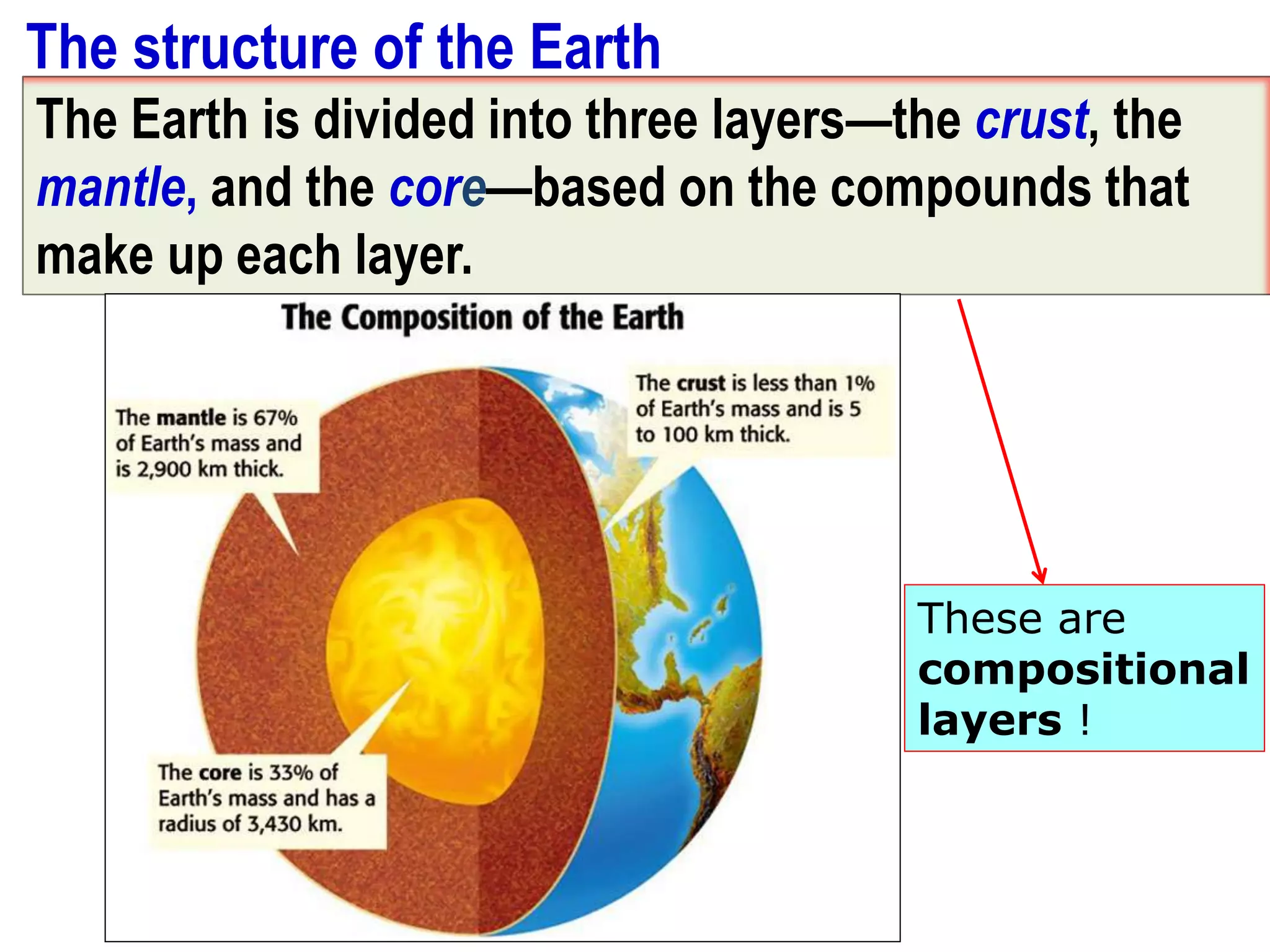
The structure of the Earth
The Earth is divided into three layers—the crust, the
mantle, and the core—based on the compounds that
make up each layer.
These are
compositional
layers !
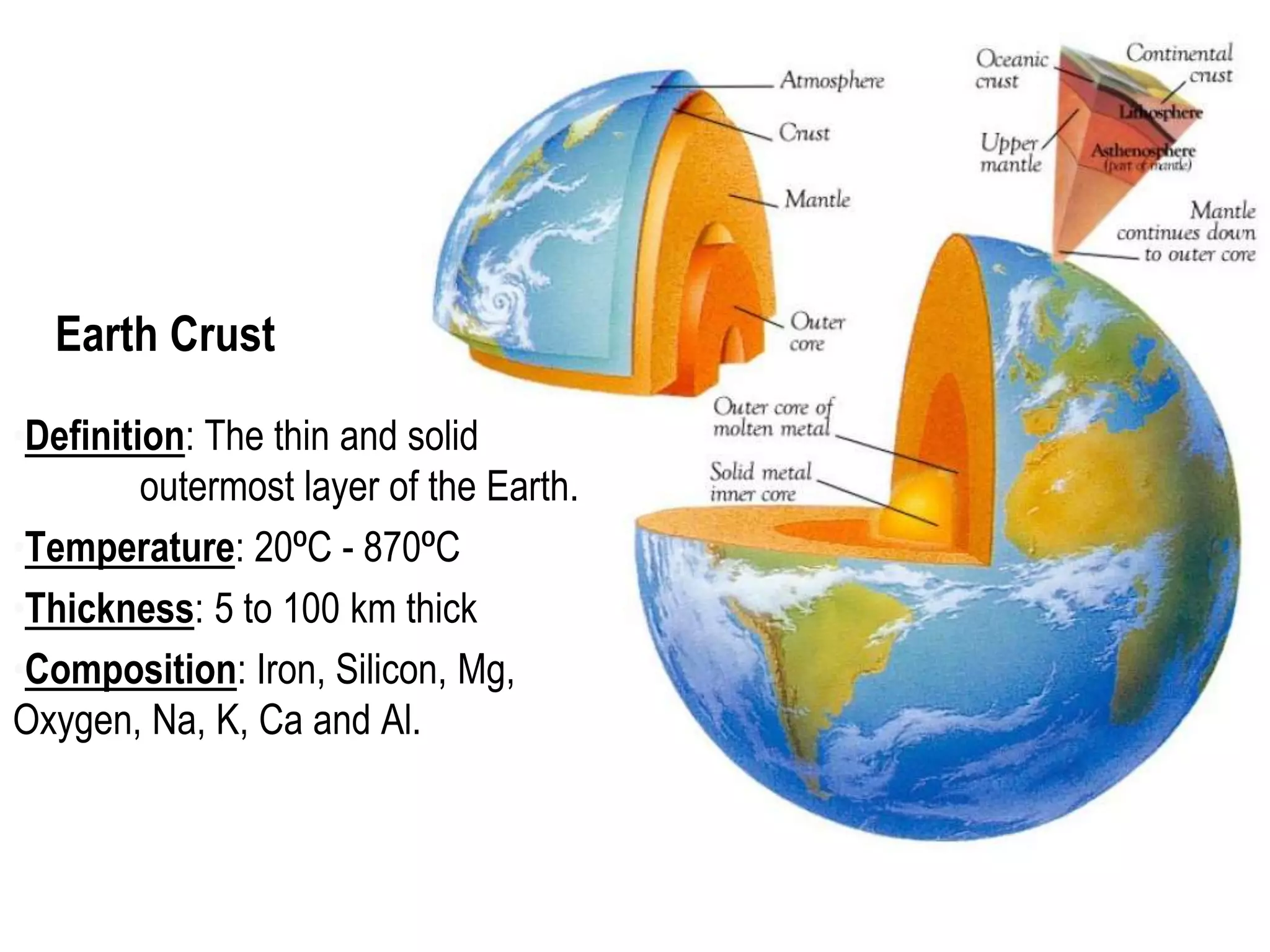
•Definition: The thin and solid
outermost layer of the Earth.
•Temperature: 20⁰C - 870⁰C
•Thickness: 5 to 100 km thick
•Composition: Iron, Silicon, Mg,
Oxygen, Na, K, Ca and Al.
Earth Crust
The Crust
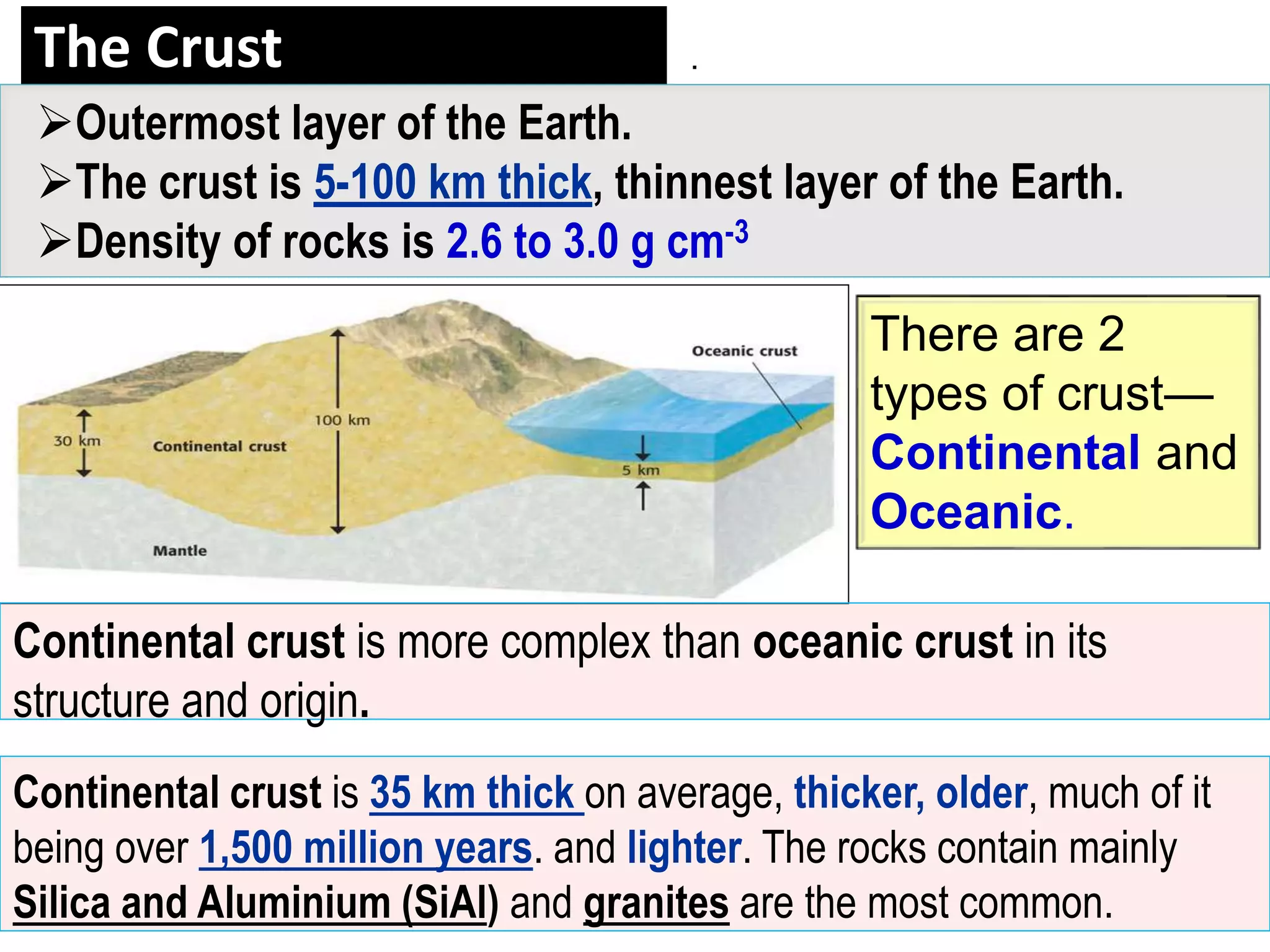
There are 2
types of crust—
Continental and
Oceanic.
Outermost layer of the Earth.
The crust is 5-100 km thick, thinnest layer of the Earth.
Density of rocks is 2.6 to 3.0 g cm-3
Continental crust is 35 km thick on average, thicker, older, much of it
being over 1,500 million years. and lighter. The rocks contain mainly
Silica and Aluminium (SiAl) and granites are the most common.
Continental crust is more complex than oceanic crust in its
structure and origin.
.
Oceanic Crust
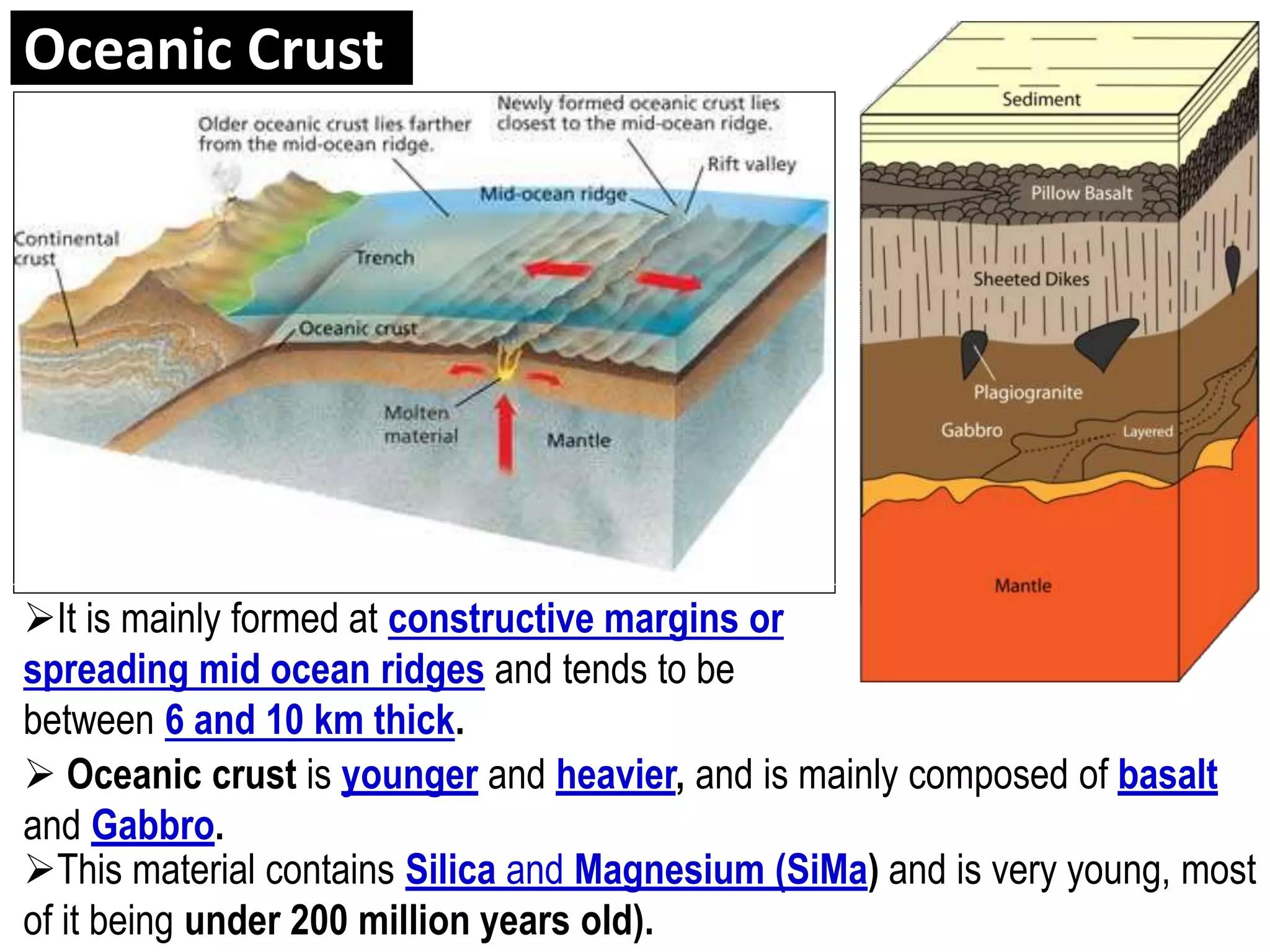
 Oceanic crust is younger and heavier, and is mainly composed of basalt
and Gabbro.
This material contains Silica and Magnesium (SiMa) and is very young, most
of it being under 200 million years old).
It is mainly formed at constructive margins or
spreading mid ocean ridges and tends to be
between 6 and 10 km thick.
Ocean and Continental Crust
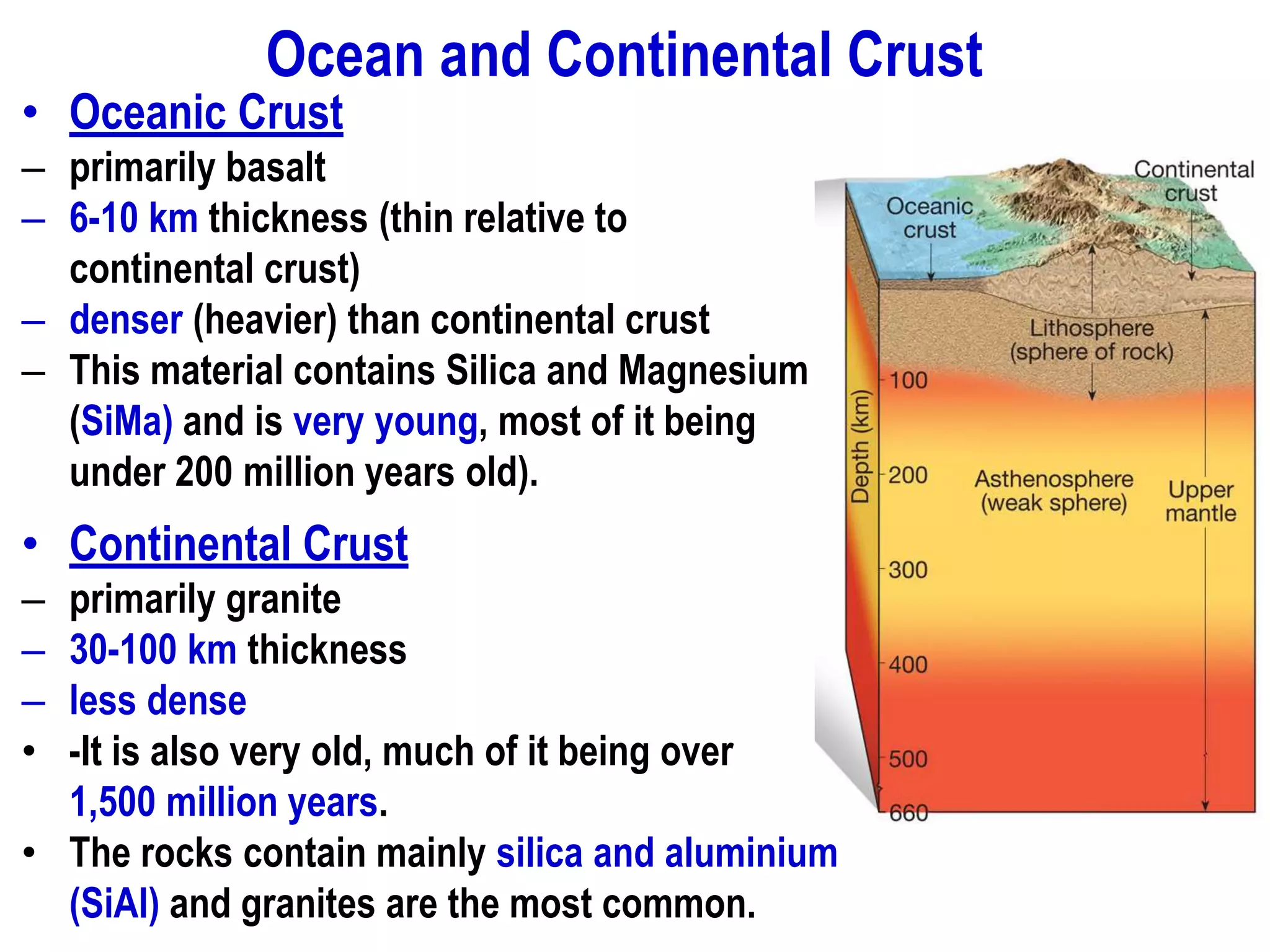
• Oceanic Crust
– primarily basalt
– 6-10 km thickness (thin relative to
continental crust)
– denser (heavier) than continental crust
– This material contains Silica and Magnesium
(SiMa) and is very young, most of it being
under 200 million years old).
• Continental Crust
– primarily granite
– 30-100 km thickness
– less dense
• -It is also very old, much of it being over
1,500 million years.
• The rocks contain mainly silica and aluminium
(SiAl) and granites are the most common.
There is a massive underground ocean located near Earth's core
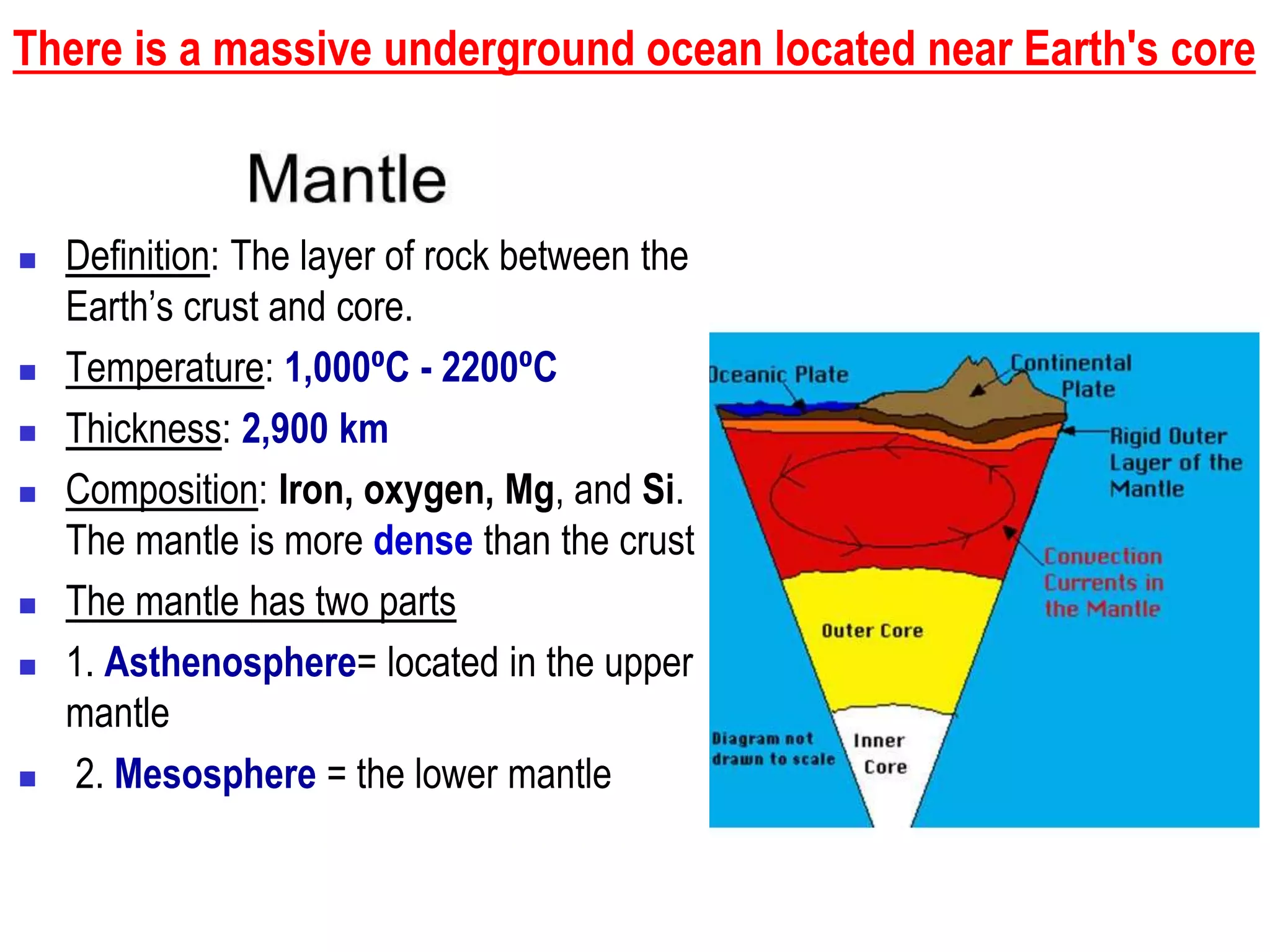
 Definition: The layer of rock between the
Earth’s crust and core.
 Temperature: 1,000⁰C - 2200⁰C
 Thickness: 2,900 km
 Composition: Iron, oxygen, Mg, and Si.
The mantle is more dense than the crust
 The mantle has two parts
 1. Asthenosphere= located in the upper
mantle
 2. Mesosphere = the lower mantle
The Core
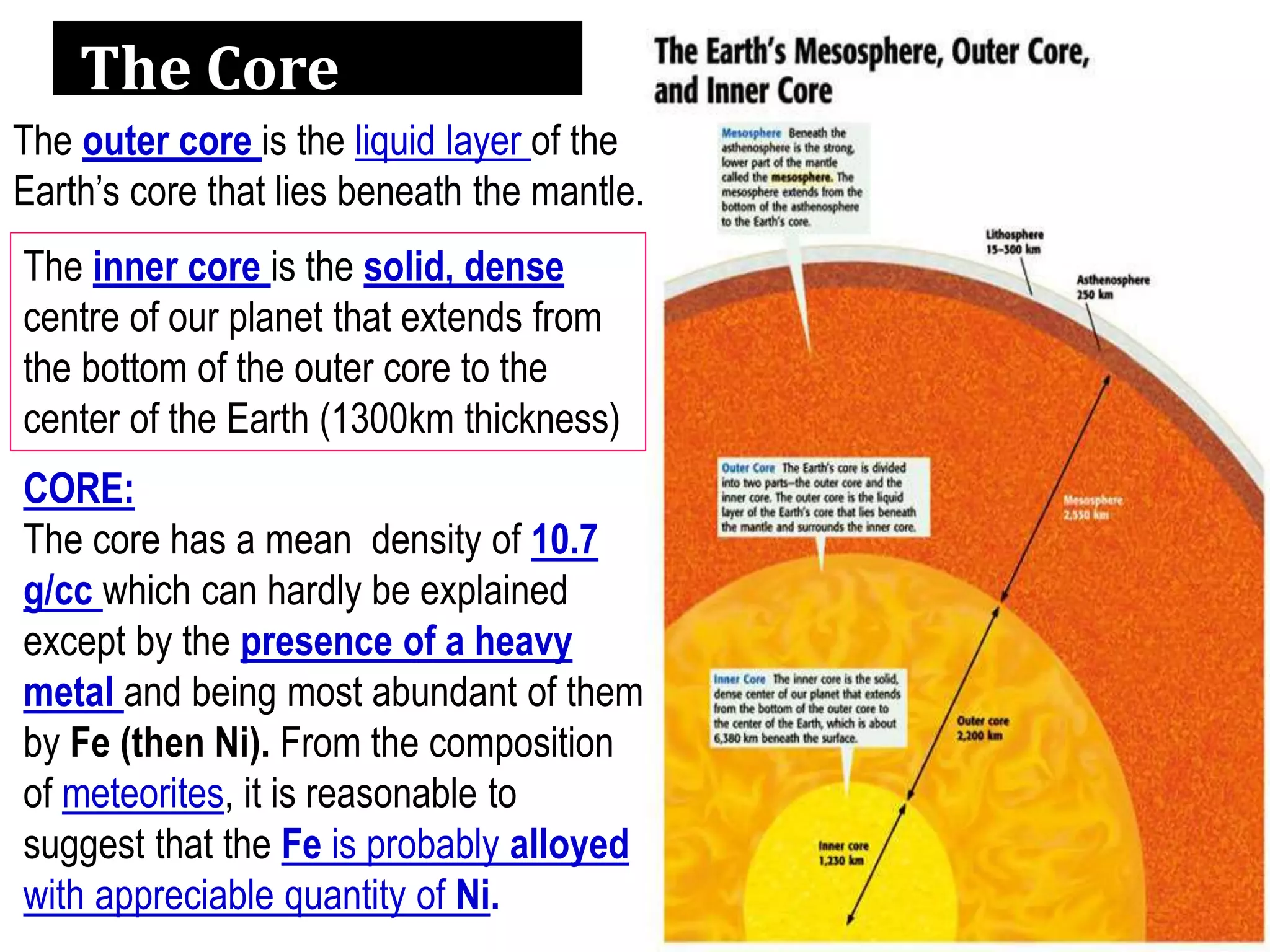
The inner core is the solid, dense
centre of our planet that extends from
the bottom of the outer core to the
center of the Earth (1300km thickness)
The outer core is the liquid layer of the
Earth’s core that lies beneath the mantle.
CORE:
The core has a mean density of 10.7
g/cc which can hardly be explained
except by the presence of a heavy
metal and being most abundant of them
by Fe (then Ni). From the composition
of meteorites, it is reasonable to
suggest that the Fe is probably alloyed
with appreciable quantity of Ni.
The Core
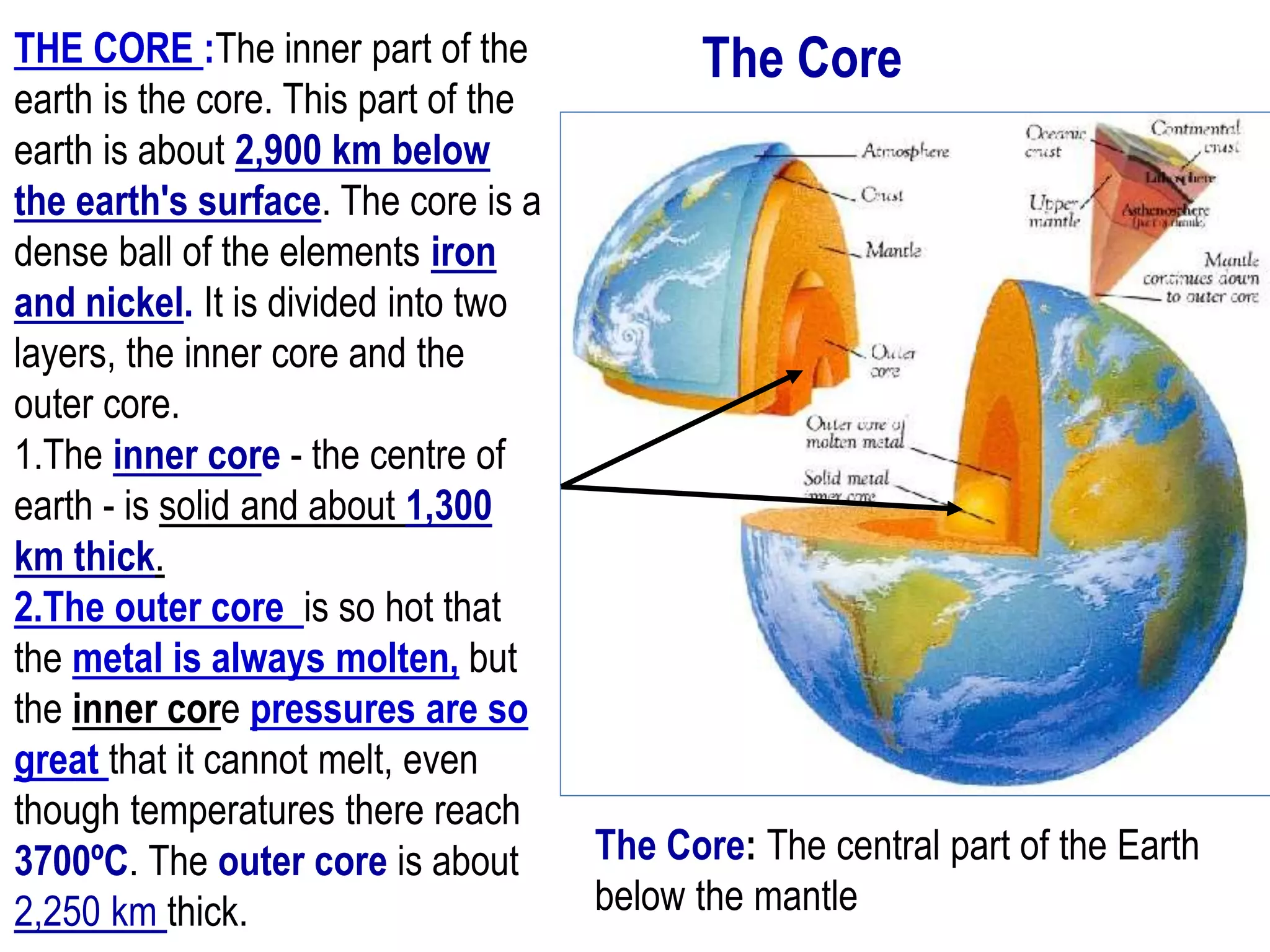
THE CORE :The inner part of the
earth is the core. This part of the
earth is about 2,900 km below
the earth's surface. The core is a
dense ball of the elements iron
and nickel. It is divided into two
layers, the inner core and the
outer core.
1.The inner core - the centre of
earth - is solid and about 1,300
km thick.
2.The outer core is so hot that
the metal is always molten, but
the inner core pressures are so
great that it cannot melt, even
though temperatures there reach
3700ºC. The outer core is about
2,250 km thick.
The Core: The central part of the Earth
below the mantle
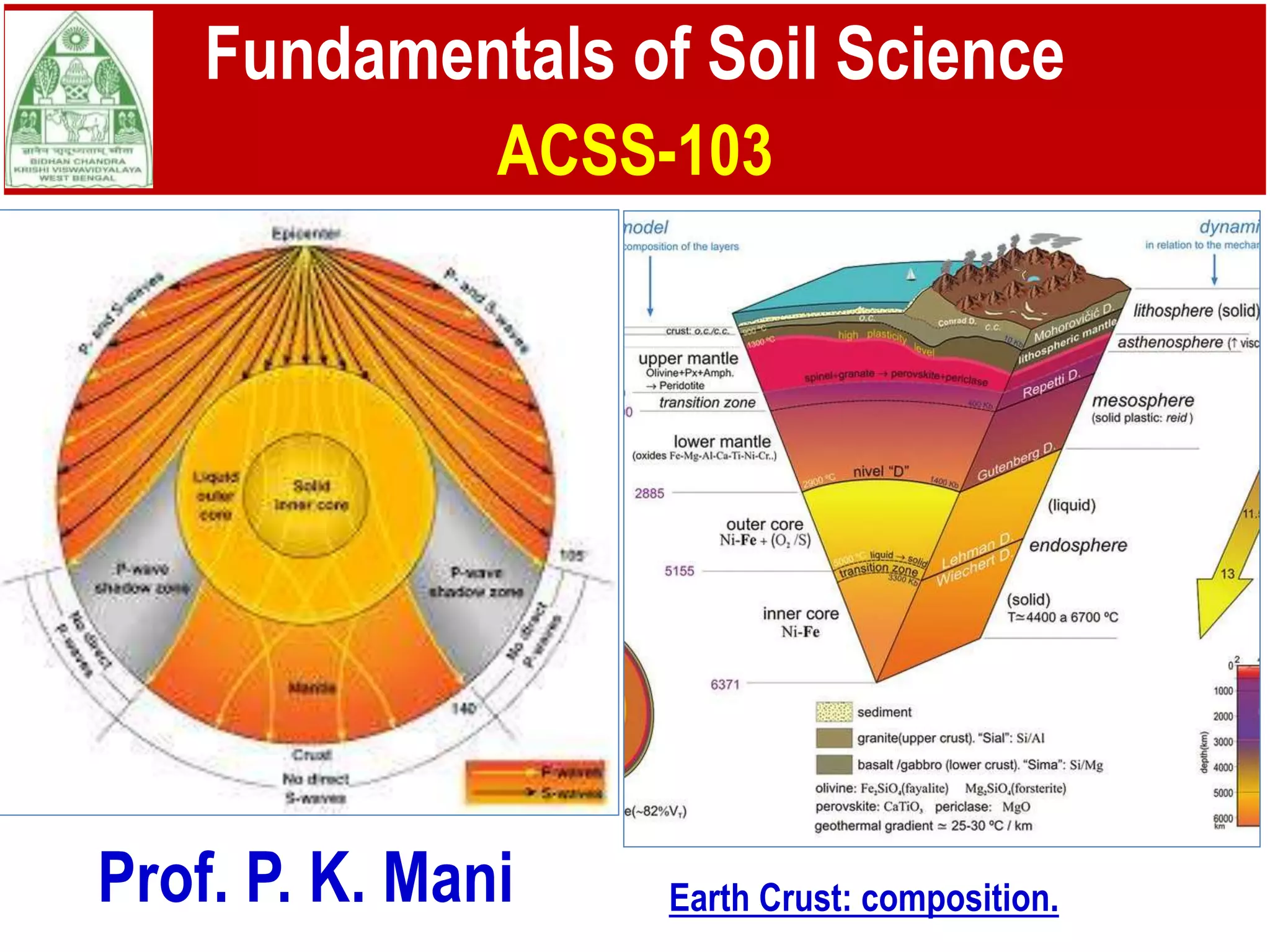
Structure and composition of the earth
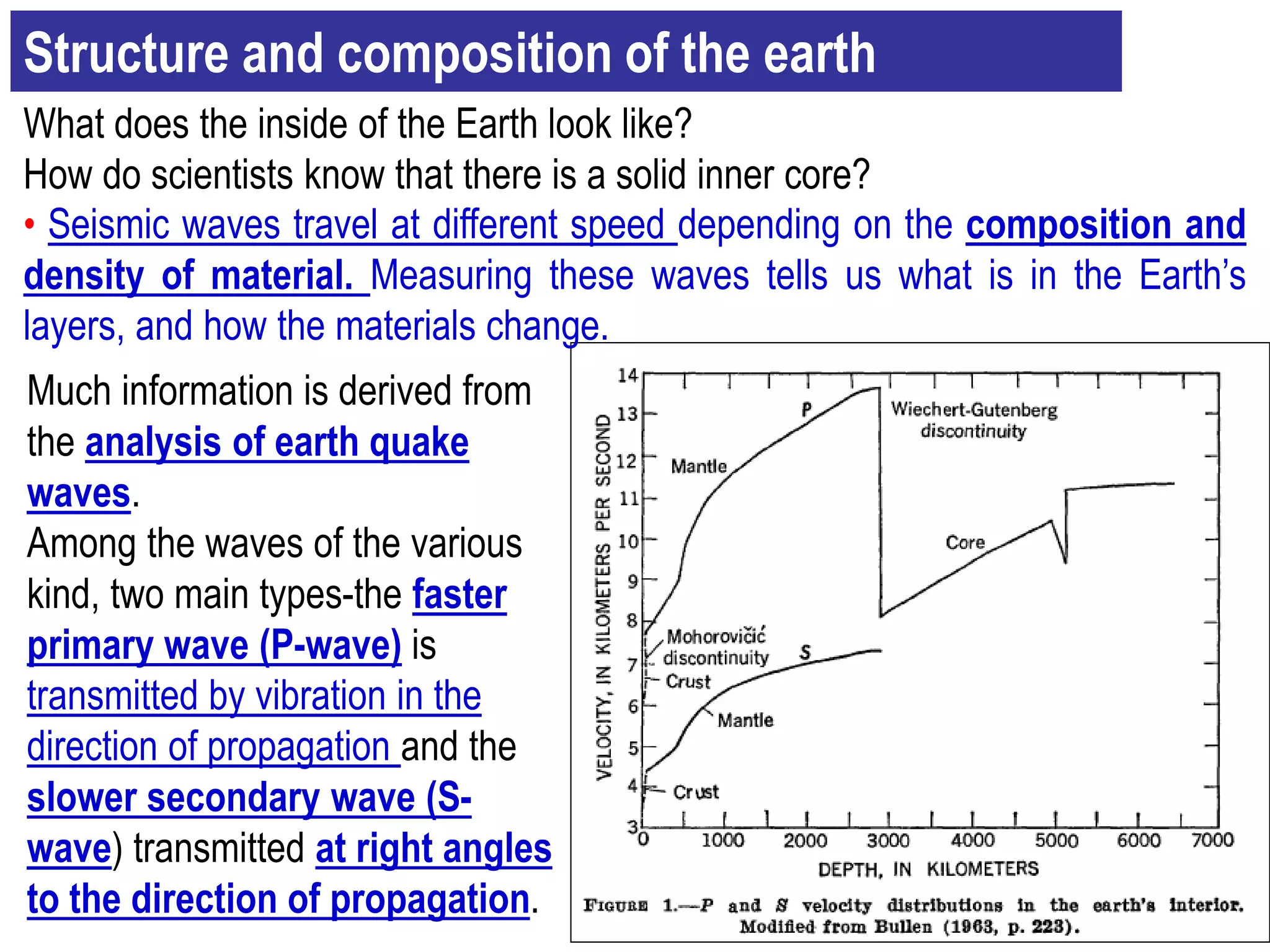
Much information is derived from
the analysis of earth quake
waves.
Among the waves of the various
kind, two main types-the faster
primary wave (P-wave) is
transmitted by vibration in the
direction of propagation and the
slower secondary wave (S-
wave) transmitted at right angles
to the direction of propagation.
What does the inside of the Earth look like?
How do scientists know that there is a solid inner core?
• Seismic waves travel at different speed depending on the composition and
density of material. Measuring these waves tells us what is in the Earth’s
layers, and how the materials change.
These divisions, which are
concentric zones in depth, are
established principally by their
differing behavior with respect
to the transmission of P
(compressional) and S
(shear) seismic waves and
are separated from each other
by distinct discontinuities in
transmission velocity.
(i) The Crust : From the surface to the base of 1st discontinuity or
Mohorovicic discontinuity at an average depth below sea level ranging from
37 km under parts of the continents to about 11 km beneath the deep sea
basins (Poldervaart, 1955); Density of rocks is 2.6 to 3.0 g cm-3
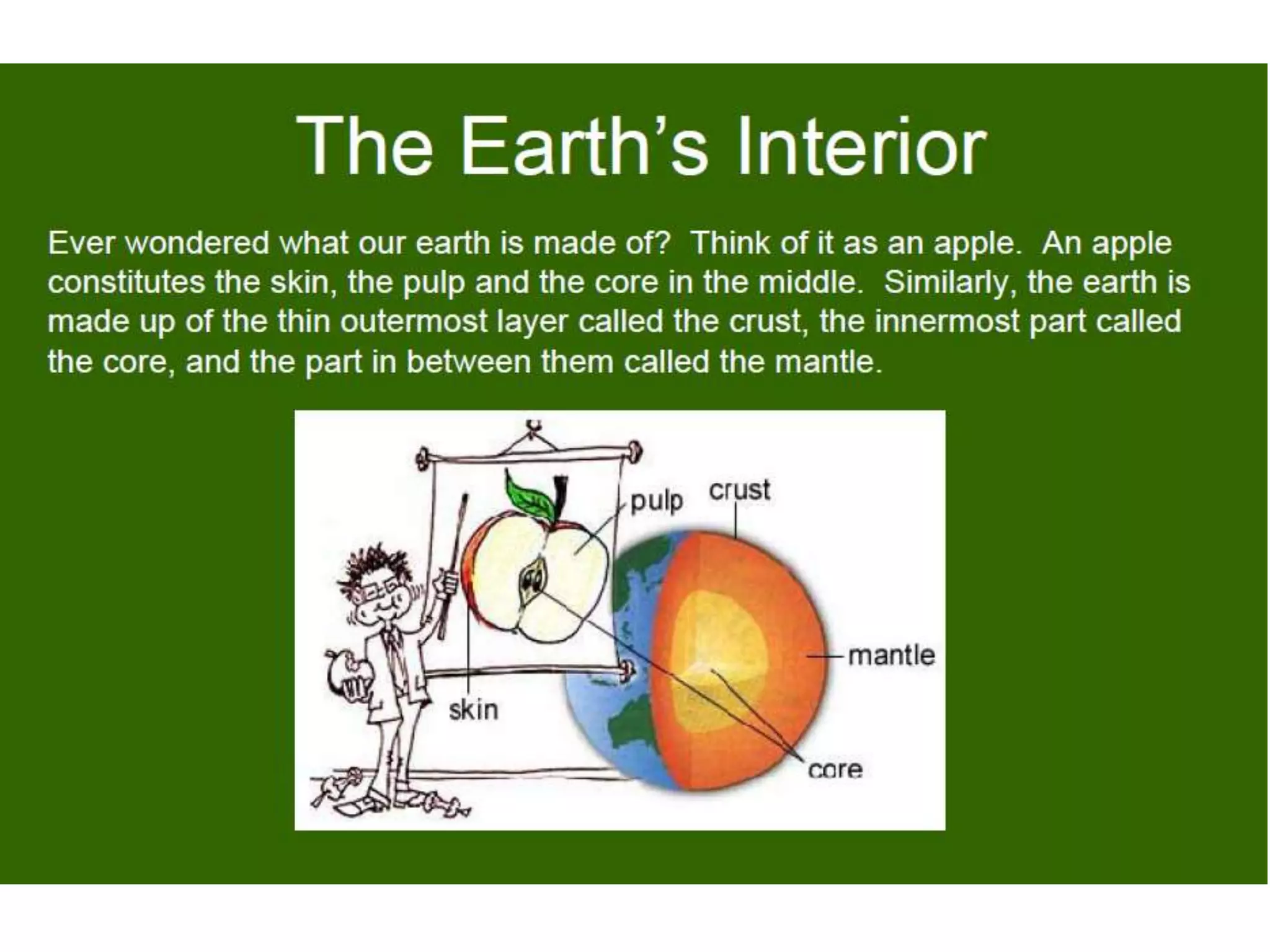
The earth is divided into three parts- (i) crust, (ii) mantle, and (iii) core.
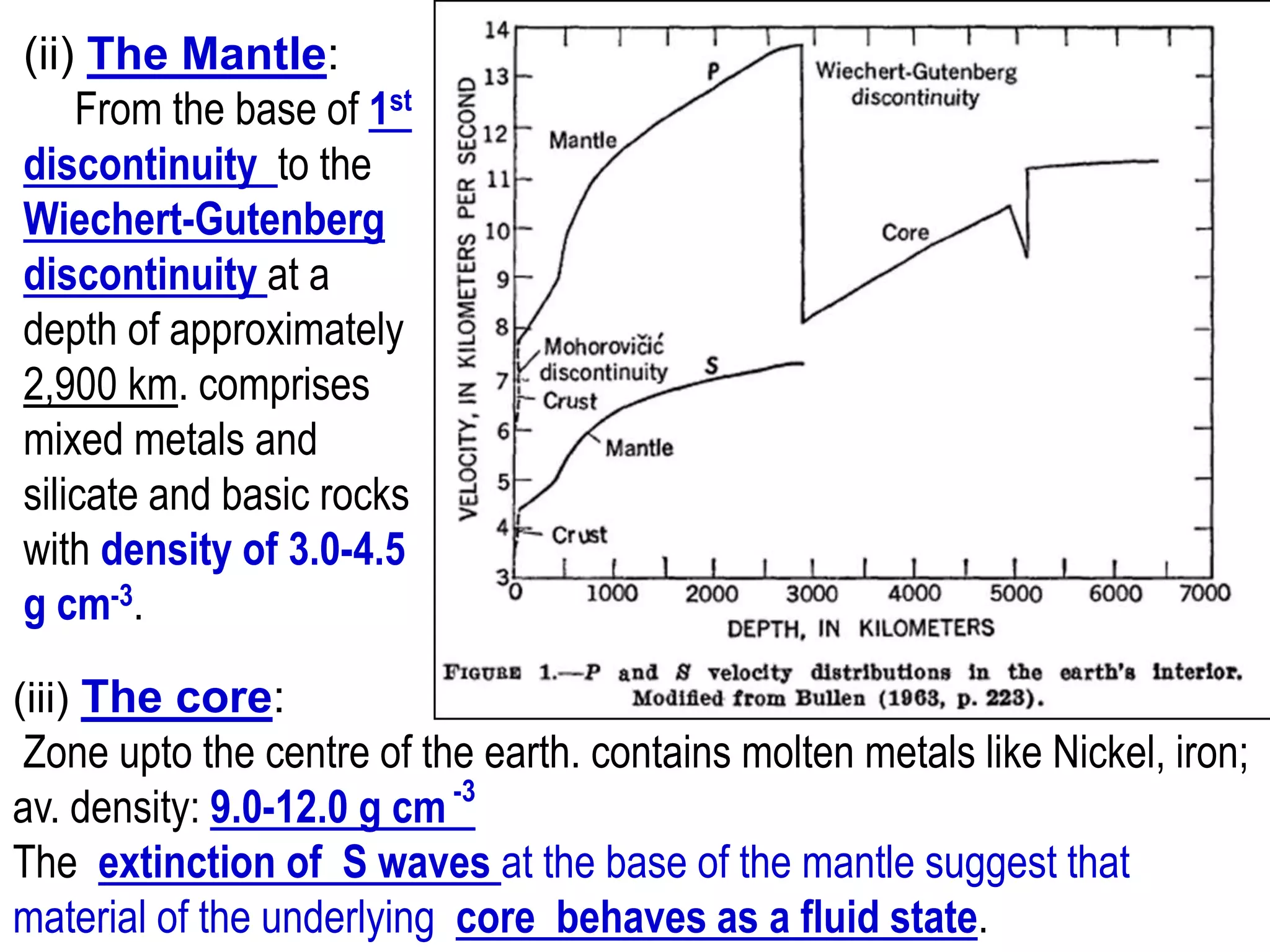
(ii) The Mantle:
From the base of 1st
discontinuity to the
Wiechert-Gutenberg
discontinuity at a
depth of approximately
2,900 km. comprises
mixed metals and
silicate and basic rocks
with density of 3.0-4.5
g cm-3.
(iii) The core:
Zone upto the centre of the earth. contains molten metals like Nickel, iron;
av. density: 9.0-12.0 g cm -3
The extinction of S waves at the base of the mantle suggest that
material of the underlying core behaves as a fluid state.
The top side of the Kola Superdeep
Borehole in Russia. In the case of the Kola
Superdeep Borehole, drilling had to cease
when a crust temperature of 180°C was
recorded at a depth of 12,262 meters (7.62
miles). It had taken them 19 years — from
1970 to 1989 — to drill to 12,262 meters. The
Kola Superdeep Borehole is still the deepest
artificial hole on Earth.
Japan's deep-sea drilling vessel, Chikyu,
is anchored at a pier in Shimizu in 2013.
Scientists want to be
first to drill into the
Earth's mantle
Peridotite is a rock that's believed to make up the Earth's
mantle.
Don Walsh, Jacques Piccard, and
James Cameron all share the title for the
deepest a human has ever travelled,
reaching the bottom of the Mariana
Trench (around 11,000 meters or 6.8
miles below sea level). Cameron’s
submersible, the Deepsea Challenger
,was used to reach such depths. The
Mariana Trench is the deepest point in
the world’s oceans, though, so
humankind won’t be going any deeper
any time soon. (The Kola borehole was
only a few inches across, and any
newer boreholes are extremely unlikely
to be wide enough to accommodate a

Crust core and mantle

  • 1.
    Prof. P. K.Mani Fundamentals of Soil Science ACSS-103 Earth Crust: composition.
  • 3.
    The structure ofthe Earth The Earth is divided into three layers—the crust, the mantle, and the core—based on the compounds that make up each layer. These are compositional layers !
  • 4.
    •Definition: The thinand solid outermost layer of the Earth. •Temperature: 20⁰C - 870⁰C •Thickness: 5 to 100 km thick •Composition: Iron, Silicon, Mg, Oxygen, Na, K, Ca and Al. Earth Crust
  • 5.
    The Crust There are2 types of crust— Continental and Oceanic. Outermost layer of the Earth. The crust is 5-100 km thick, thinnest layer of the Earth. Density of rocks is 2.6 to 3.0 g cm-3 Continental crust is 35 km thick on average, thicker, older, much of it being over 1,500 million years. and lighter. The rocks contain mainly Silica and Aluminium (SiAl) and granites are the most common. Continental crust is more complex than oceanic crust in its structure and origin. .
  • 6.
    Oceanic Crust  Oceaniccrust is younger and heavier, and is mainly composed of basalt and Gabbro. This material contains Silica and Magnesium (SiMa) and is very young, most of it being under 200 million years old). It is mainly formed at constructive margins or spreading mid ocean ridges and tends to be between 6 and 10 km thick.
  • 7.
    Ocean and ContinentalCrust • Oceanic Crust – primarily basalt – 6-10 km thickness (thin relative to continental crust) – denser (heavier) than continental crust – This material contains Silica and Magnesium (SiMa) and is very young, most of it being under 200 million years old). • Continental Crust – primarily granite – 30-100 km thickness – less dense • -It is also very old, much of it being over 1,500 million years. • The rocks contain mainly silica and aluminium (SiAl) and granites are the most common.
  • 8.
    There is amassive underground ocean located near Earth's core  Definition: The layer of rock between the Earth’s crust and core.  Temperature: 1,000⁰C - 2200⁰C  Thickness: 2,900 km  Composition: Iron, oxygen, Mg, and Si. The mantle is more dense than the crust  The mantle has two parts  1. Asthenosphere= located in the upper mantle  2. Mesosphere = the lower mantle
  • 9.
    The Core The innercore is the solid, dense centre of our planet that extends from the bottom of the outer core to the center of the Earth (1300km thickness) The outer core is the liquid layer of the Earth’s core that lies beneath the mantle. CORE: The core has a mean density of 10.7 g/cc which can hardly be explained except by the presence of a heavy metal and being most abundant of them by Fe (then Ni). From the composition of meteorites, it is reasonable to suggest that the Fe is probably alloyed with appreciable quantity of Ni.
  • 10.
    The Core THE CORE:The inner part of the earth is the core. This part of the earth is about 2,900 km below the earth's surface. The core is a dense ball of the elements iron and nickel. It is divided into two layers, the inner core and the outer core. 1.The inner core - the centre of earth - is solid and about 1,300 km thick. 2.The outer core is so hot that the metal is always molten, but the inner core pressures are so great that it cannot melt, even though temperatures there reach 3700ºC. The outer core is about 2,250 km thick. The Core: The central part of the Earth below the mantle
  • 11.
    Structure and compositionof the earth Much information is derived from the analysis of earth quake waves. Among the waves of the various kind, two main types-the faster primary wave (P-wave) is transmitted by vibration in the direction of propagation and the slower secondary wave (S- wave) transmitted at right angles to the direction of propagation. What does the inside of the Earth look like? How do scientists know that there is a solid inner core? • Seismic waves travel at different speed depending on the composition and density of material. Measuring these waves tells us what is in the Earth’s layers, and how the materials change.
  • 12.
    These divisions, whichare concentric zones in depth, are established principally by their differing behavior with respect to the transmission of P (compressional) and S (shear) seismic waves and are separated from each other by distinct discontinuities in transmission velocity. (i) The Crust : From the surface to the base of 1st discontinuity or Mohorovicic discontinuity at an average depth below sea level ranging from 37 km under parts of the continents to about 11 km beneath the deep sea basins (Poldervaart, 1955); Density of rocks is 2.6 to 3.0 g cm-3 The earth is divided into three parts- (i) crust, (ii) mantle, and (iii) core.
  • 13.
    (ii) The Mantle: Fromthe base of 1st discontinuity to the Wiechert-Gutenberg discontinuity at a depth of approximately 2,900 km. comprises mixed metals and silicate and basic rocks with density of 3.0-4.5 g cm-3. (iii) The core: Zone upto the centre of the earth. contains molten metals like Nickel, iron; av. density: 9.0-12.0 g cm -3 The extinction of S waves at the base of the mantle suggest that material of the underlying core behaves as a fluid state.
  • 14.
    The top sideof the Kola Superdeep Borehole in Russia. In the case of the Kola Superdeep Borehole, drilling had to cease when a crust temperature of 180°C was recorded at a depth of 12,262 meters (7.62 miles). It had taken them 19 years — from 1970 to 1989 — to drill to 12,262 meters. The Kola Superdeep Borehole is still the deepest artificial hole on Earth.
  • 15.
    Japan's deep-sea drillingvessel, Chikyu, is anchored at a pier in Shimizu in 2013. Scientists want to be first to drill into the Earth's mantle Peridotite is a rock that's believed to make up the Earth's mantle.
  • 16.
    Don Walsh, JacquesPiccard, and James Cameron all share the title for the deepest a human has ever travelled, reaching the bottom of the Mariana Trench (around 11,000 meters or 6.8 miles below sea level). Cameron’s submersible, the Deepsea Challenger ,was used to reach such depths. The Mariana Trench is the deepest point in the world’s oceans, though, so humankind won’t be going any deeper any time soon. (The Kola borehole was only a few inches across, and any newer boreholes are extremely unlikely to be wide enough to accommodate a