
Fundamentals of Soil Science ACSS-103 (1+1)
Prof. P. K. Mani
Agril. Chemistry &
Soil Science
pabitramani@gmail.com;
WA 8777592977
welcome you
for choosing
BCKV as a
destination of
career building
The many functions and ecosystem services performed by soil
can be grouped into six crucial ecological roles.
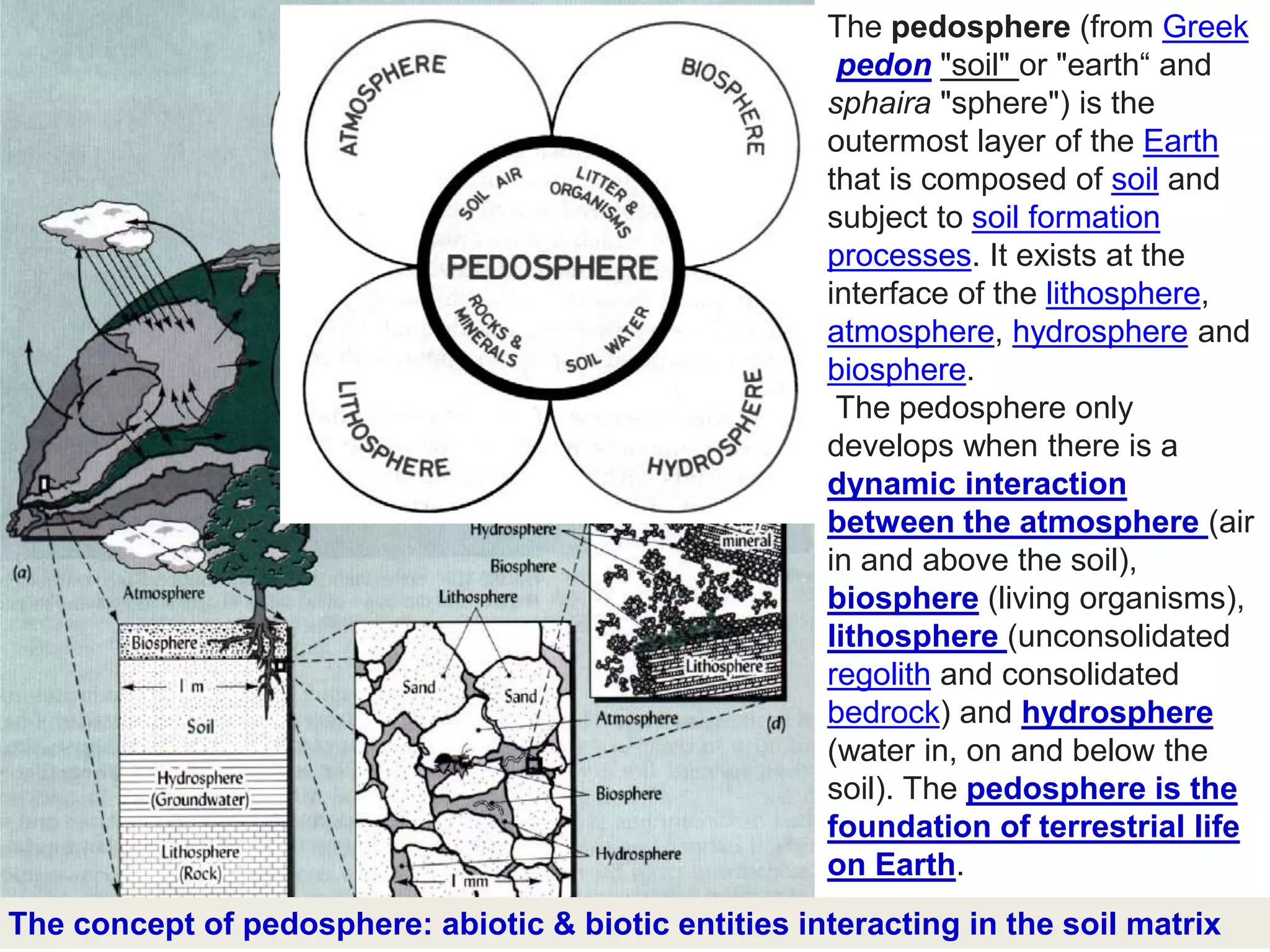
The concept of pedosphere: abiotic & biotic entities interacting in the soil matrix
The pedosphere (from Greek
pedon "soil" or "earth“ and
sphaira "sphere") is the
outermost layer of the Earth
that is composed of soil and
subject to soil formation
processes. It exists at the
interface of the lithosphere,
atmosphere, hydrosphere and
biosphere.
The pedosphere only
develops when there is a
dynamic interaction
between the atmosphere (air
in and above the soil),
biosphere (living organisms),
lithosphere (unconsolidated
regolith and consolidated
bedrock) and hydrosphere
(water in, on and below the
soil). The pedosphere is the
foundation of terrestrial life
on Earth.
SOIL...
• Soil can be a source, a sink, or an interacting medium for
many nutrients, as well as contaminants that impact humans,
plants, wildlife, and other organisms.
• An understanding of soil properties and processes is
therefore critical to evaluate soil management processes.
• The word “Soil” is derived from Latin word ‘Solum’
means ‘Floor’ or ‘Ground’.
“With out life, there is no soil and without soil, there is no
life on the earth planet.
As soil provides nutrients, water, air and anchorage and supports
life on Earth, it can be called as-
Soul Of Infinite Life (SOIL)
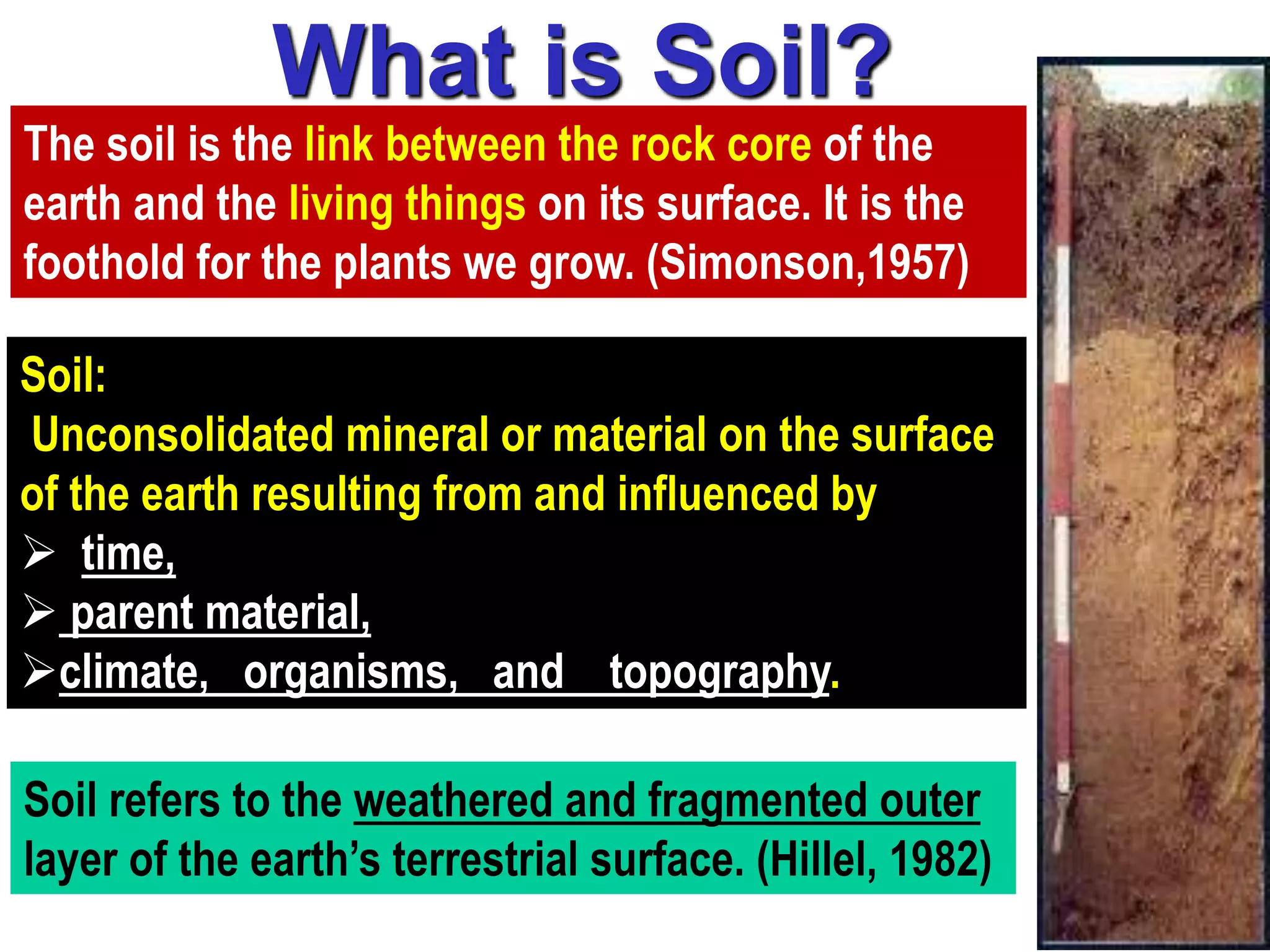
What is Soil?
Soil:
Unconsolidated mineral or material on the surface
of the earth resulting from and influenced by
 time,
 parent material,
climate, organisms, and topography.
The soil is the link between the rock core of the
earth and the living things on its surface. It is the
foothold for the plants we grow. (Simonson,1957)
Soil refers to the weathered and fragmented outer
layer of the earth’s terrestrial surface. (Hillel, 1982)
Joffe (1949), modified by Birkeland (1999)
Function of Soil
Soils perform six key functions in the global ecosystem.
Soil serves as a
• Medium for plant growth (provides nutrients), it store
and supply nutrients to plants.
• As an anchor for plant roots enabling plants to stand
erect
• Regulator of water supplies (water holding tank, it
absorb and store the moisture for later use),
• Recycler of raw materials ( Decomposition)
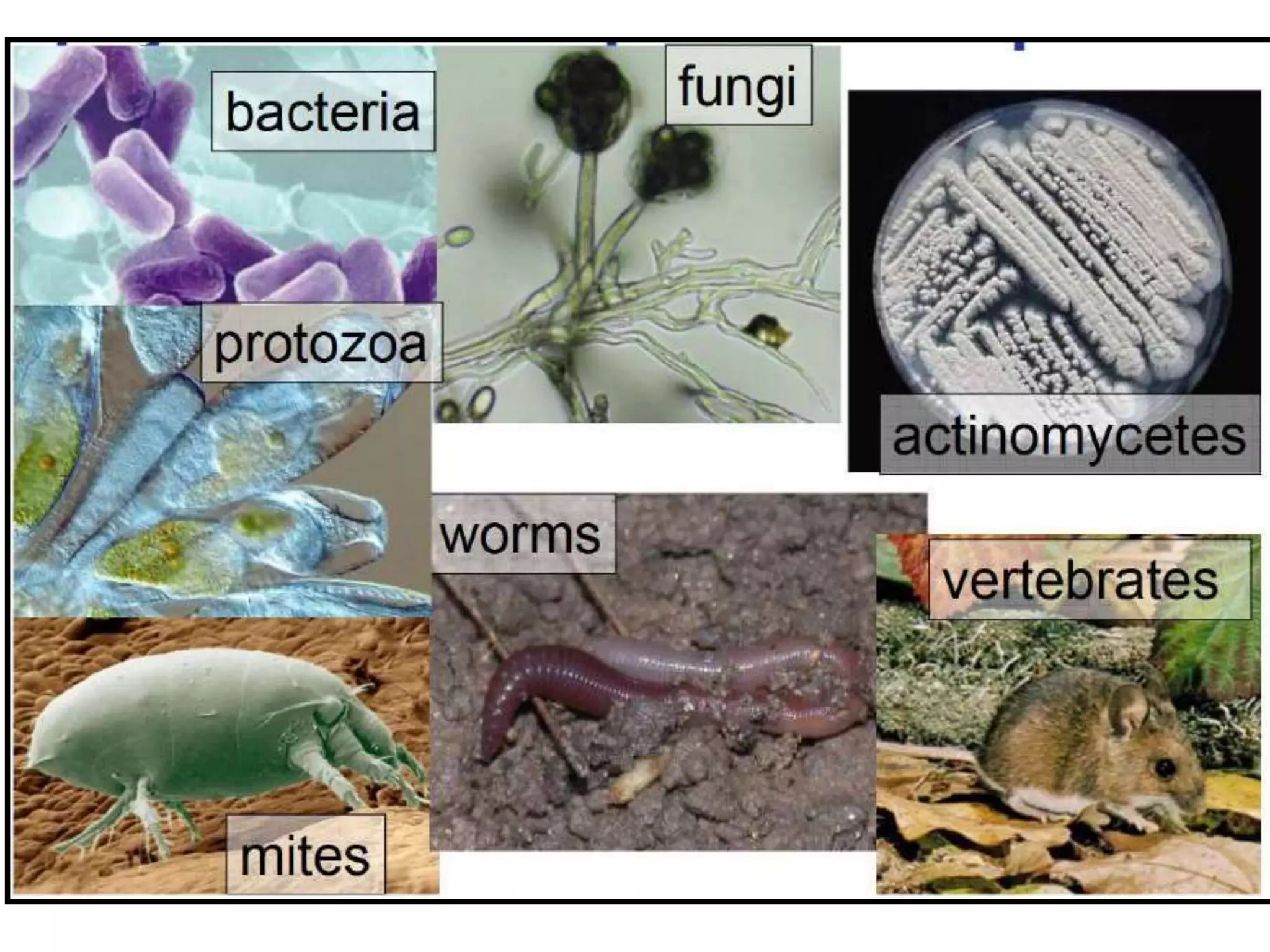
• Habitat for soil organisms
• Landscaping and engineering medium (Soils are the
base material for roads, homes, buildings, and other
structures)
physical properties influence engineering uses
soils differ in stability
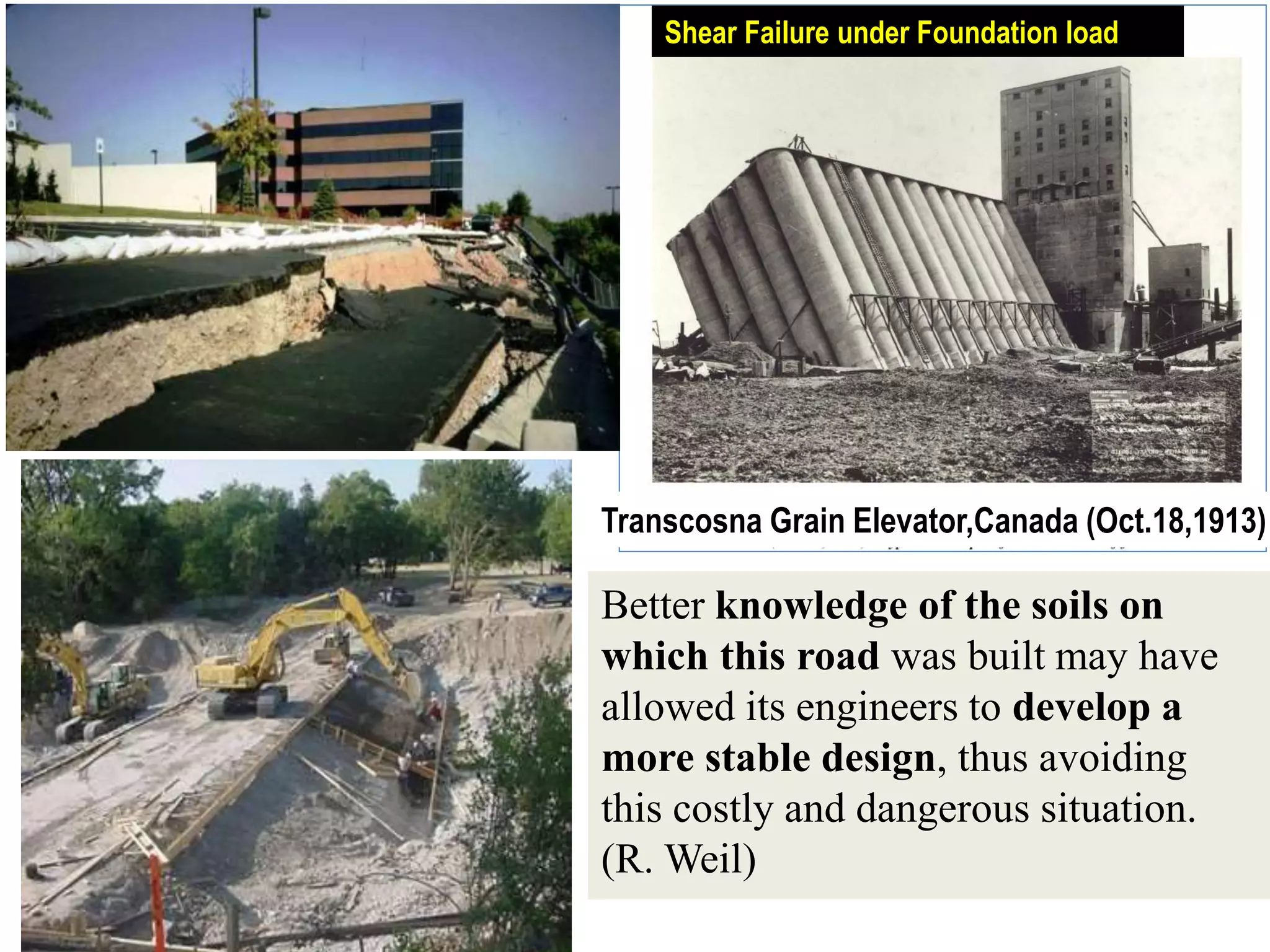
Better knowledge of the soils on
which this road was built may have
allowed its engineers to develop a
more stable design, thus avoiding
this costly and dangerous situation.
(R. Weil)
Transcosna Grain Elevator,Canada (Oct.18,1913)
Shear Failure under Foundation load
.
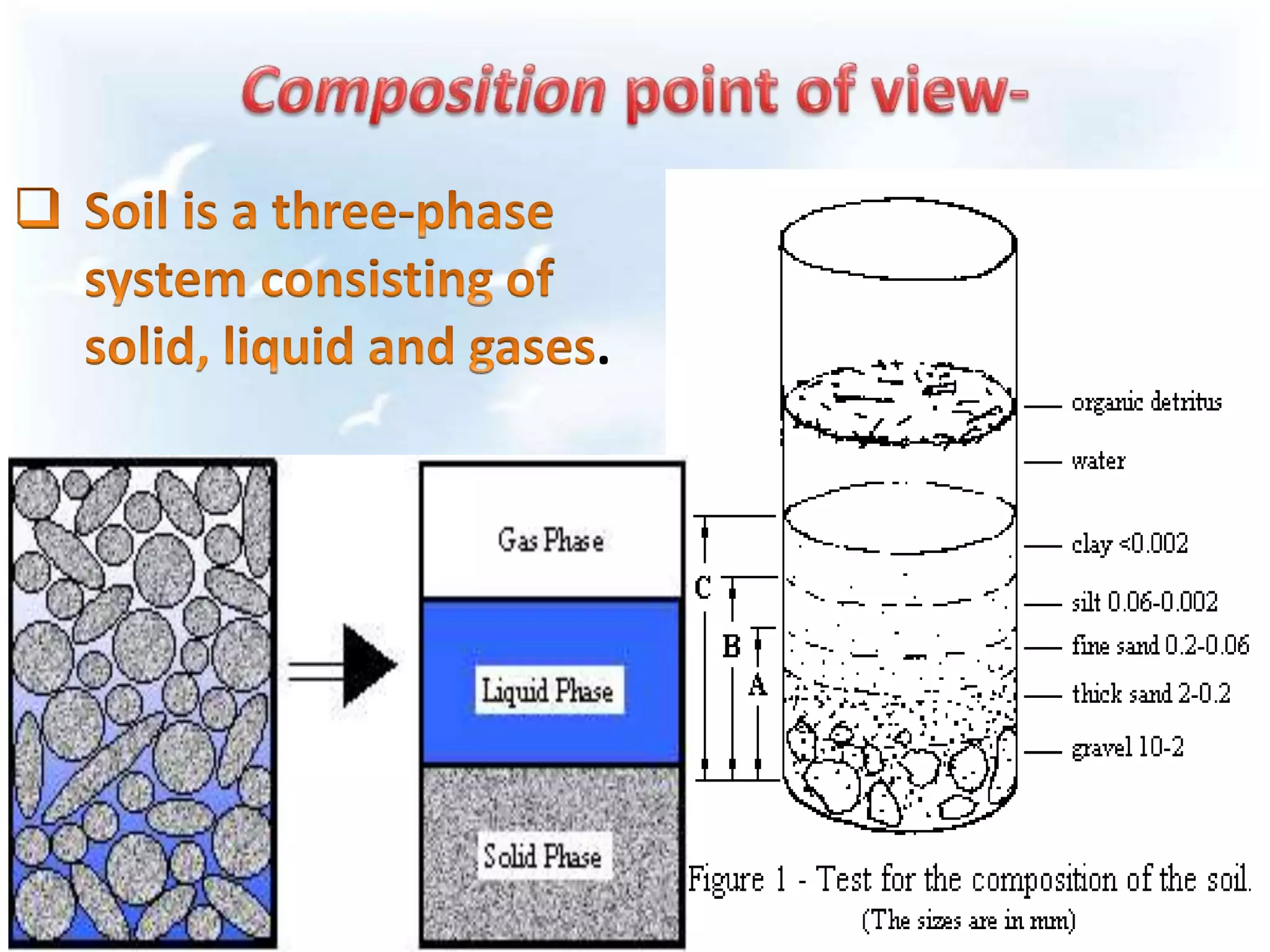
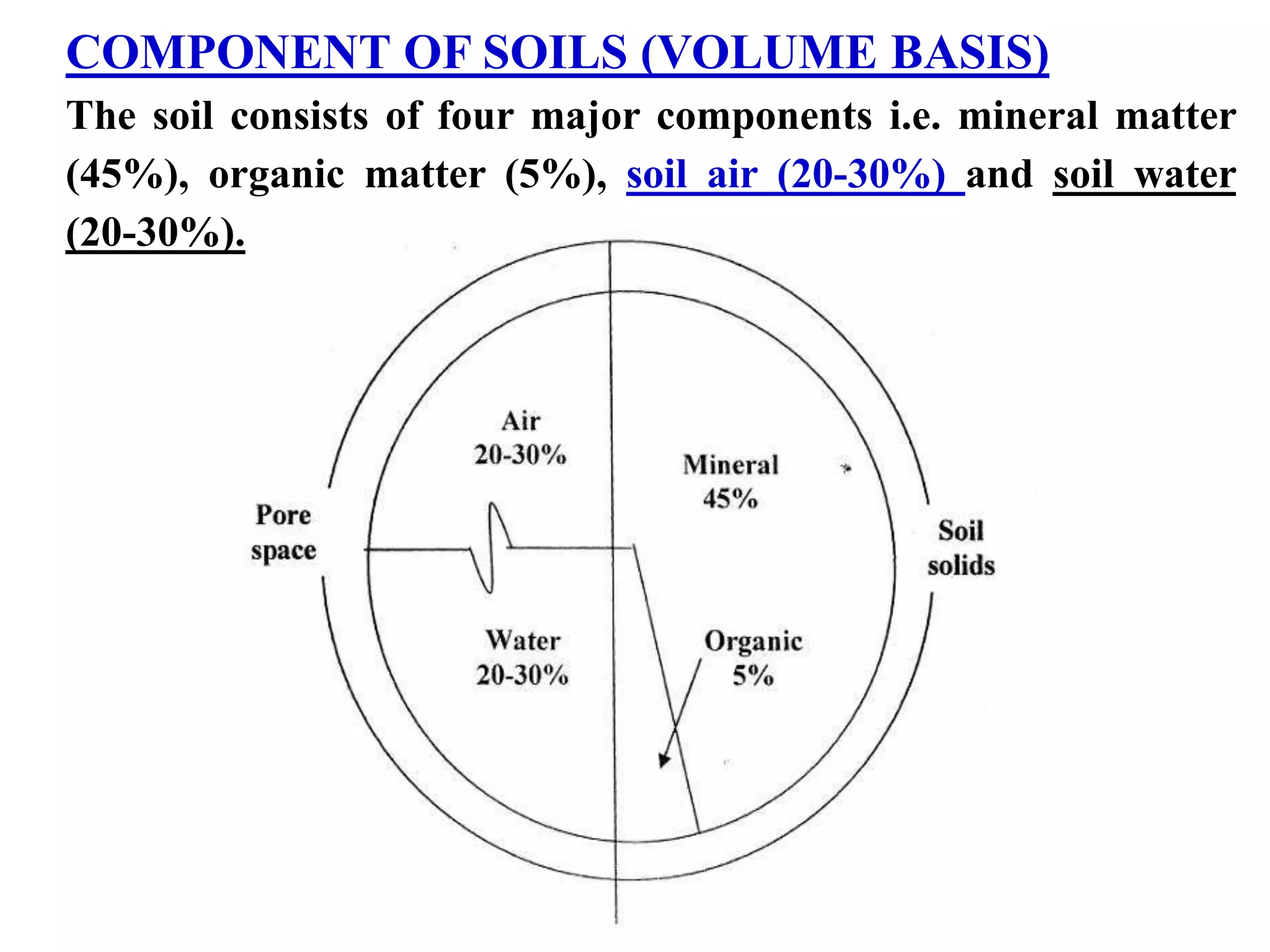
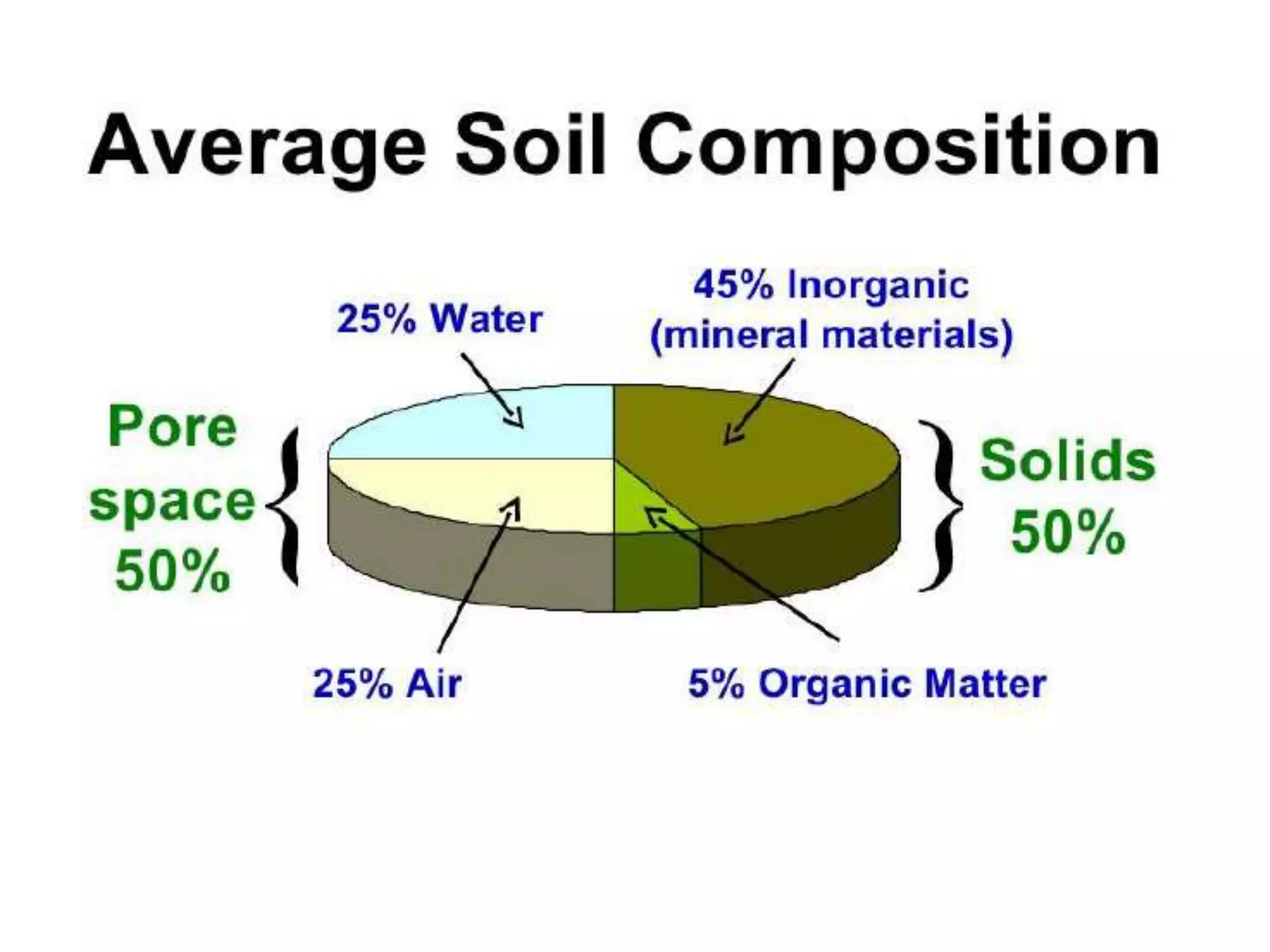
COMPONENT OF SOILS (VOLUME BASIS)
The soil consists of four major components i.e. mineral matter
(45%), organic matter (5%), soil air (20-30%) and soil water
(20-30%).
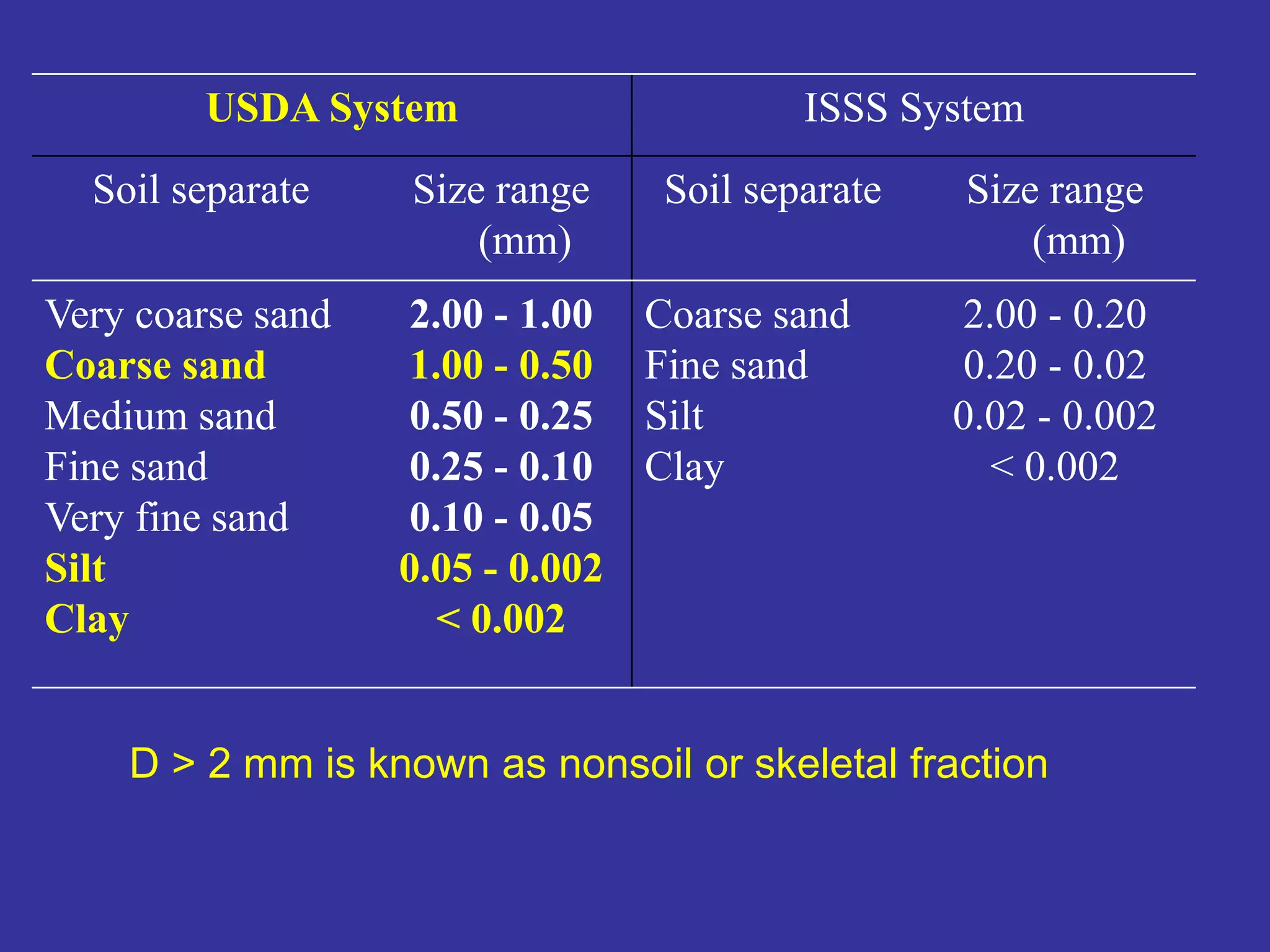
USDA System ISSS System
Soil separate Size range
(mm)
Soil separate Size range
(mm)
Very coarse sand
Coarse sand
Medium sand
Fine sand
Very fine sand
Silt
Clay
2.00 - 1.00
1.00 - 0.50
0.50 - 0.25
0.25 - 0.10
0.10 - 0.05
0.05 - 0.002
< 0.002
Coarse sand
Fine sand
Silt
Clay
2.00 - 0.20
0.20 - 0.02
0.02 - 0.002
< 0.002
D > 2 mm is known as nonsoil or skeletal fraction
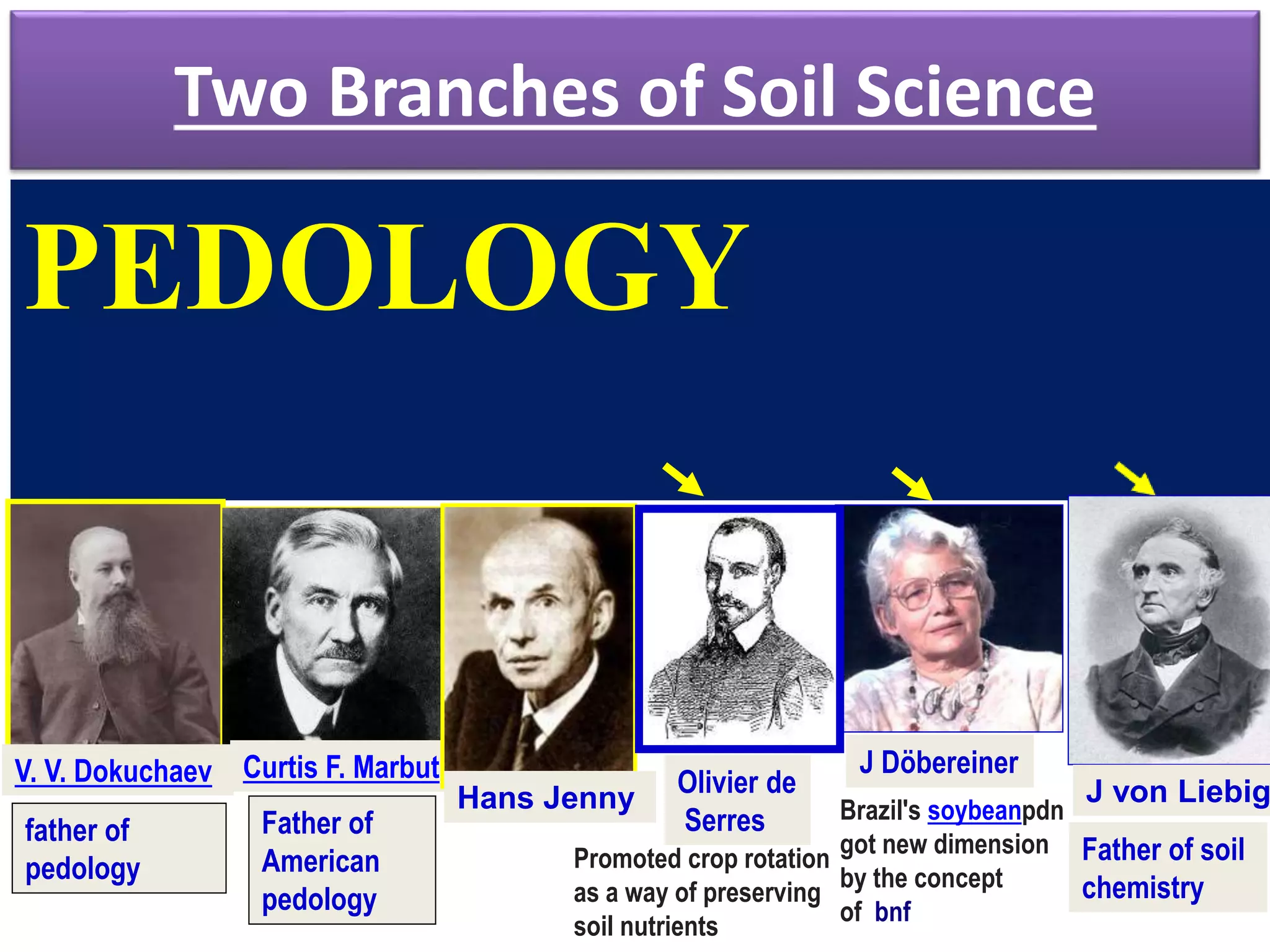
Two Branches of Soil Science
PEDOLOGY
EDAPHOLOGY
Father of
American
pedology
father of
pedology
J von Liebig
Father of soil
chemistry
V. V. Dokuchaev Curtis F. Marbut
Hans Jenny
J Döbereiner
Olivier de
Serres
Promoted crop rotation
as a way of preserving
soil nutrients
Brazil's soybeanpdn
got new dimension
by the concept
of bnf
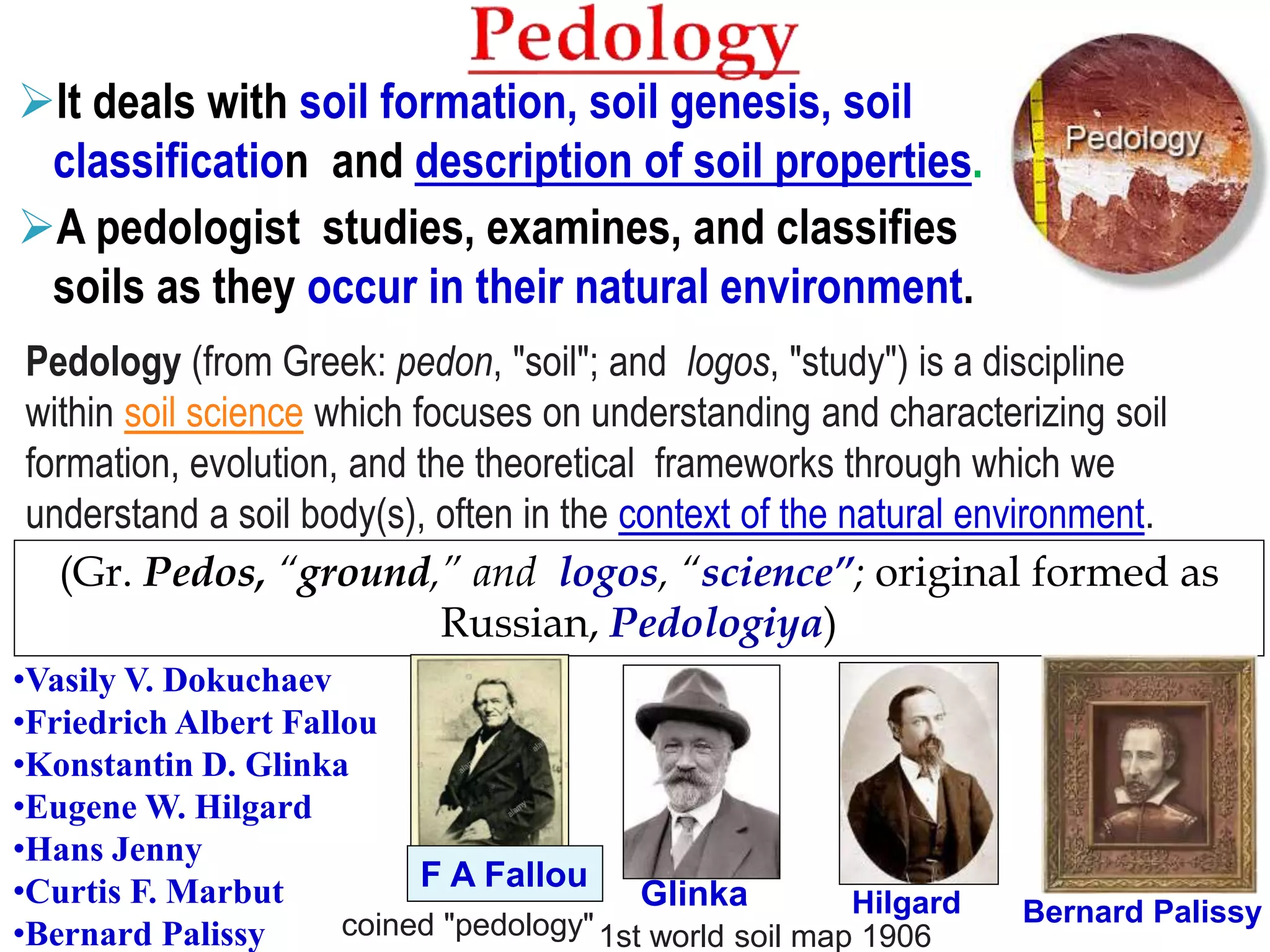
It deals with soil formation, soil genesis, soil
classification and description of soil properties.
A pedologist studies, examines, and classifies
soils as they occur in their natural environment.
(Gr. Pedos, “ground,” and logos, “science”; original formed as
Russian, Pedologiya)
•Vasily V. Dokuchaev
•Friedrich Albert Fallou
•Konstantin D. Glinka
•Eugene W. Hilgard
•Hans Jenny
•Curtis F. Marbut
•Bernard Palissy
Pedology (from Greek: pedon, "soil"; and logos, "study") is a discipline
within soil science which focuses on understanding and characterizing soil
formation, evolution, and the theoretical frameworks through which we
understand a soil body(s), often in the context of the natural environment.
1st world soil map 1906
Glinka
F A Fallou
Hilgard
coined "pedology" Bernard Palissy
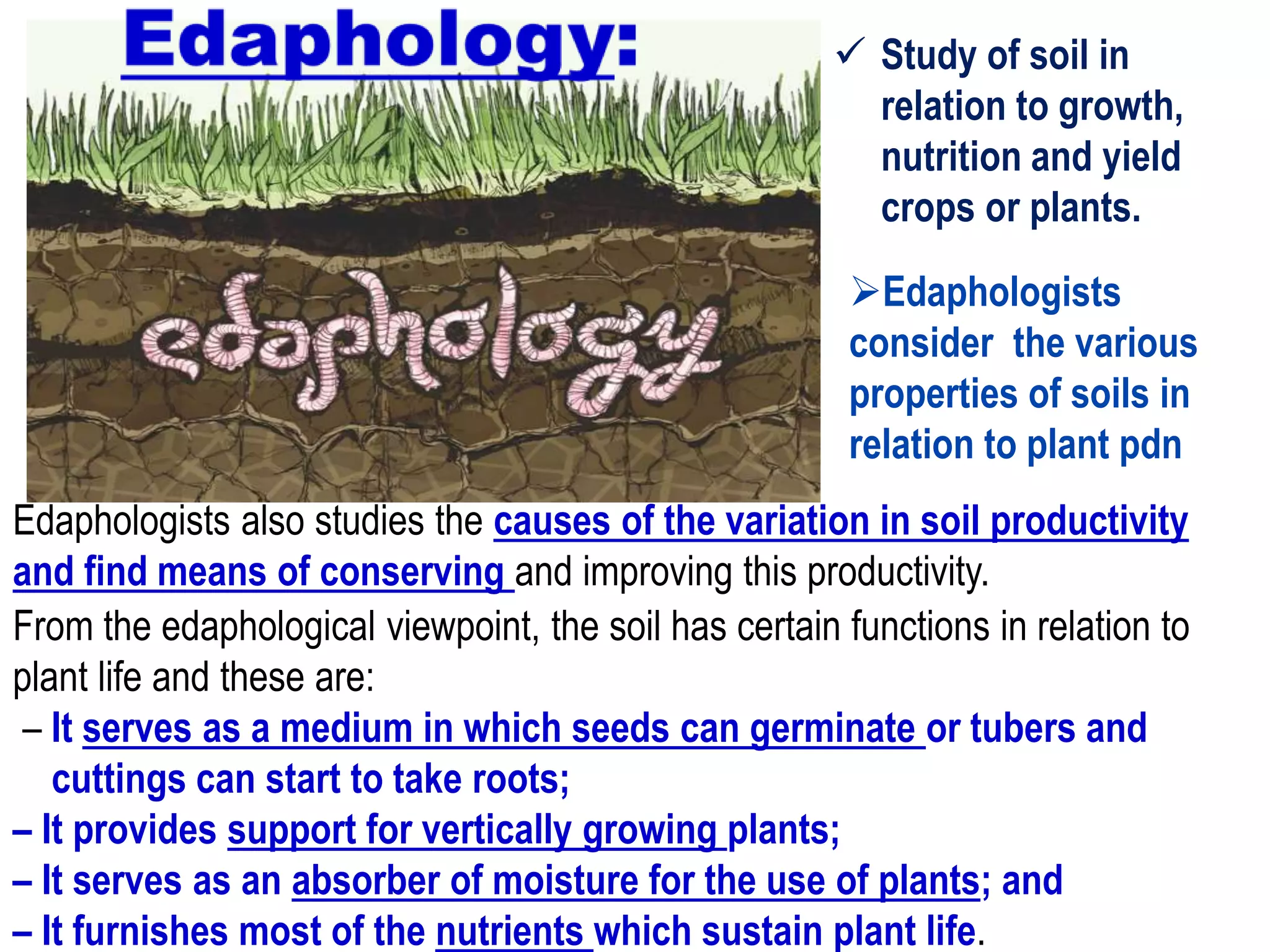
 Study of soil in
relation to growth,
nutrition and yield
crops or plants.
Edaphologists
consider the various
properties of soils in
relation to plant pdn
From the edaphological viewpoint, the soil has certain functions in relation to
plant life and these are:
– It serves as a medium in which seeds can germinate or tubers and
cuttings can start to take roots;
– It provides support for vertically growing plants;
– It serves as an absorber of moisture for the use of plants; and
– It furnishes most of the nutrients which sustain plant life.
Edaphologists also studies the causes of the variation in soil productivity
and find means of conserving and improving this productivity.
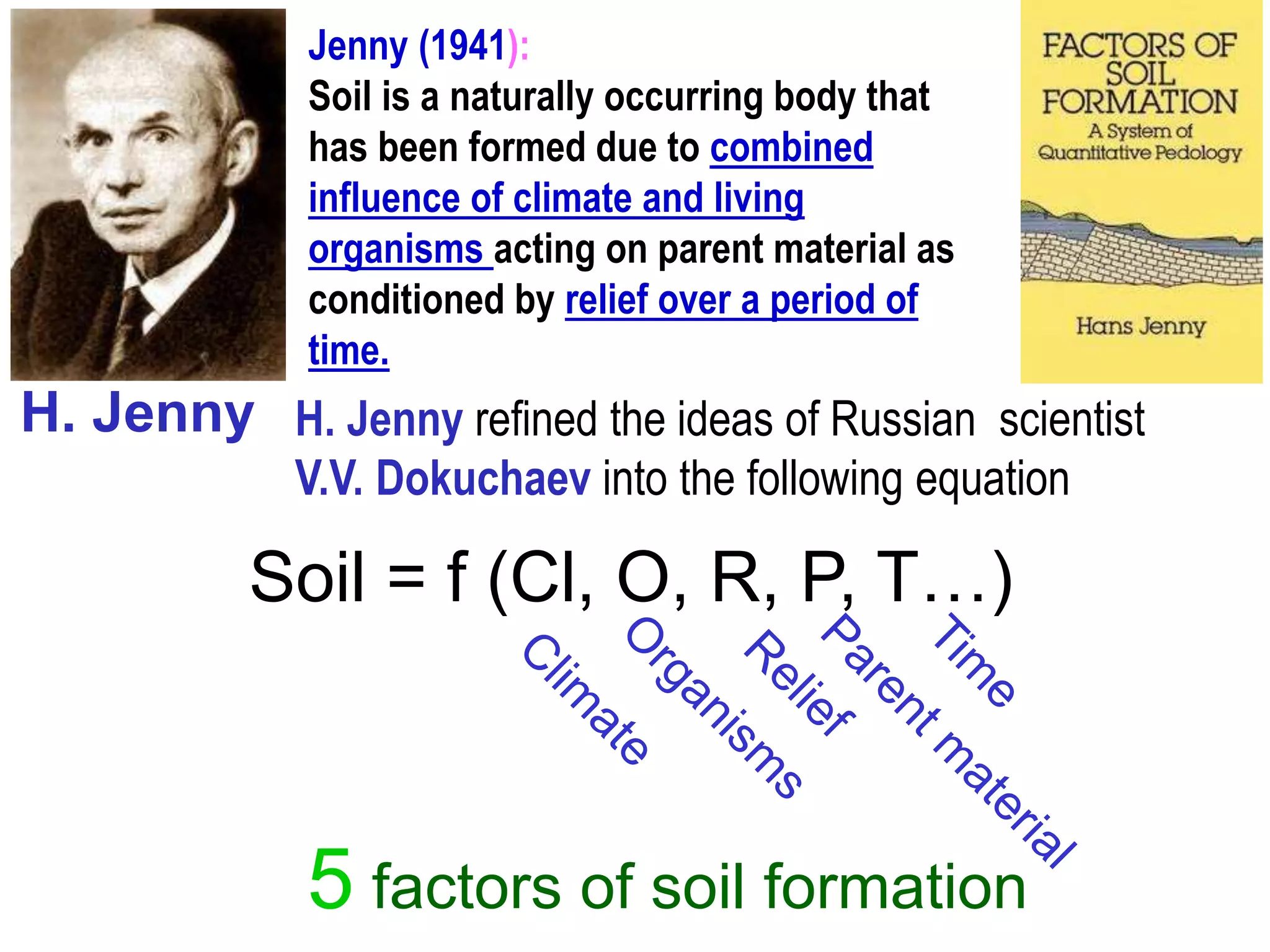
H. Jenny refined the ideas of Russian scientist
V.V. Dokuchaev into the following equation
5 factors of soil formation
Soil = f (Cl, O, R, P, T…)
H. Jenny
Jenny (1941):
Soil is a naturally occurring body that
has been formed due to combined
influence of climate and living
organisms acting on parent material as
conditioned by relief over a period of
time.
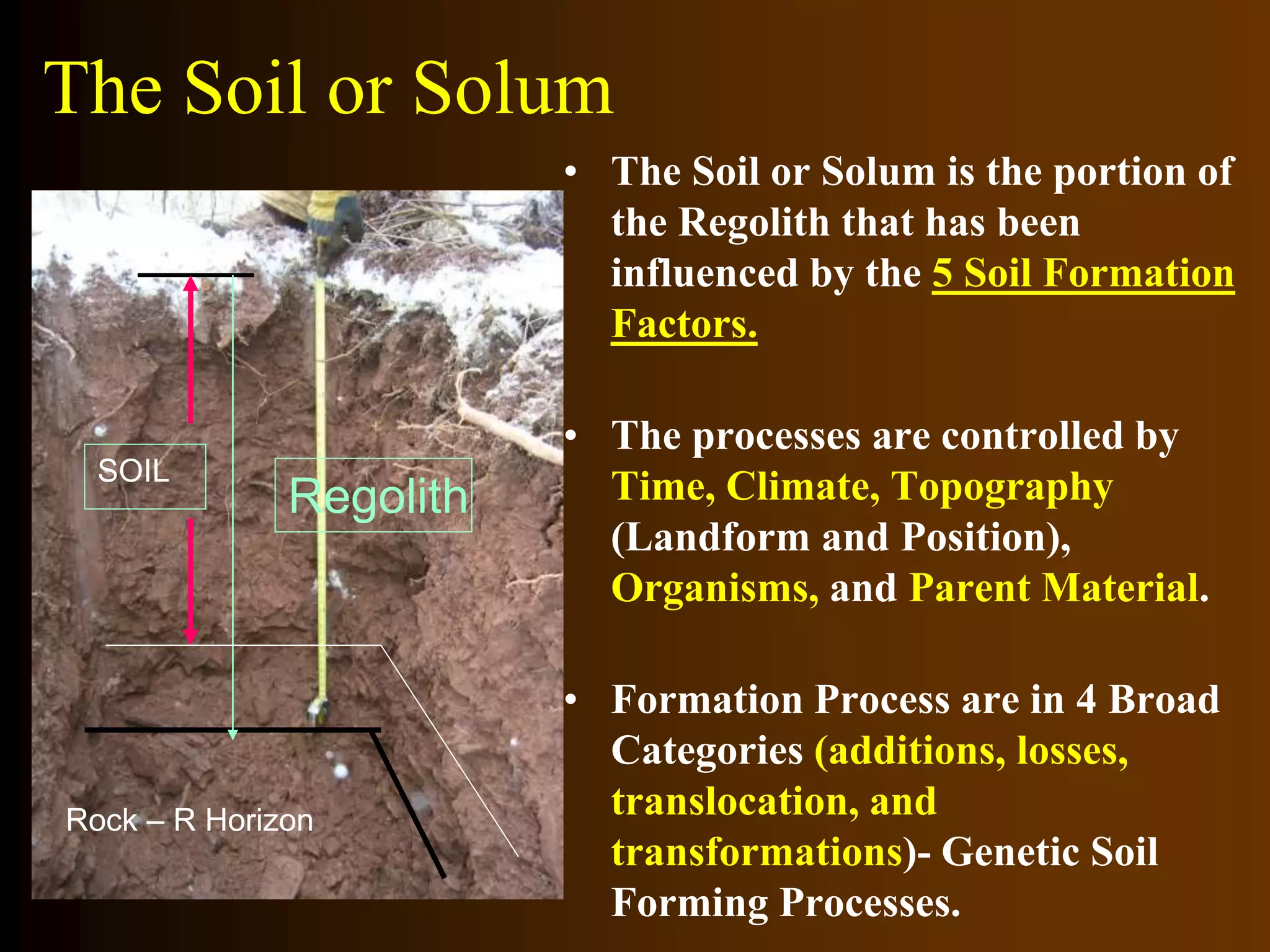
The Soil or Solum
• The Soil or Solum is the portion of
the Regolith that has been
influenced by the 5 Soil Formation
Factors.
• The processes are controlled by
Time, Climate, Topography
(Landform and Position),
Organisms, and Parent Material.
• Formation Process are in 4 Broad
Categories (additions, losses,
translocation, and
transformations)- Genetic Soil
Forming Processes.
Rock – R Horizon
SOIL
Regolith
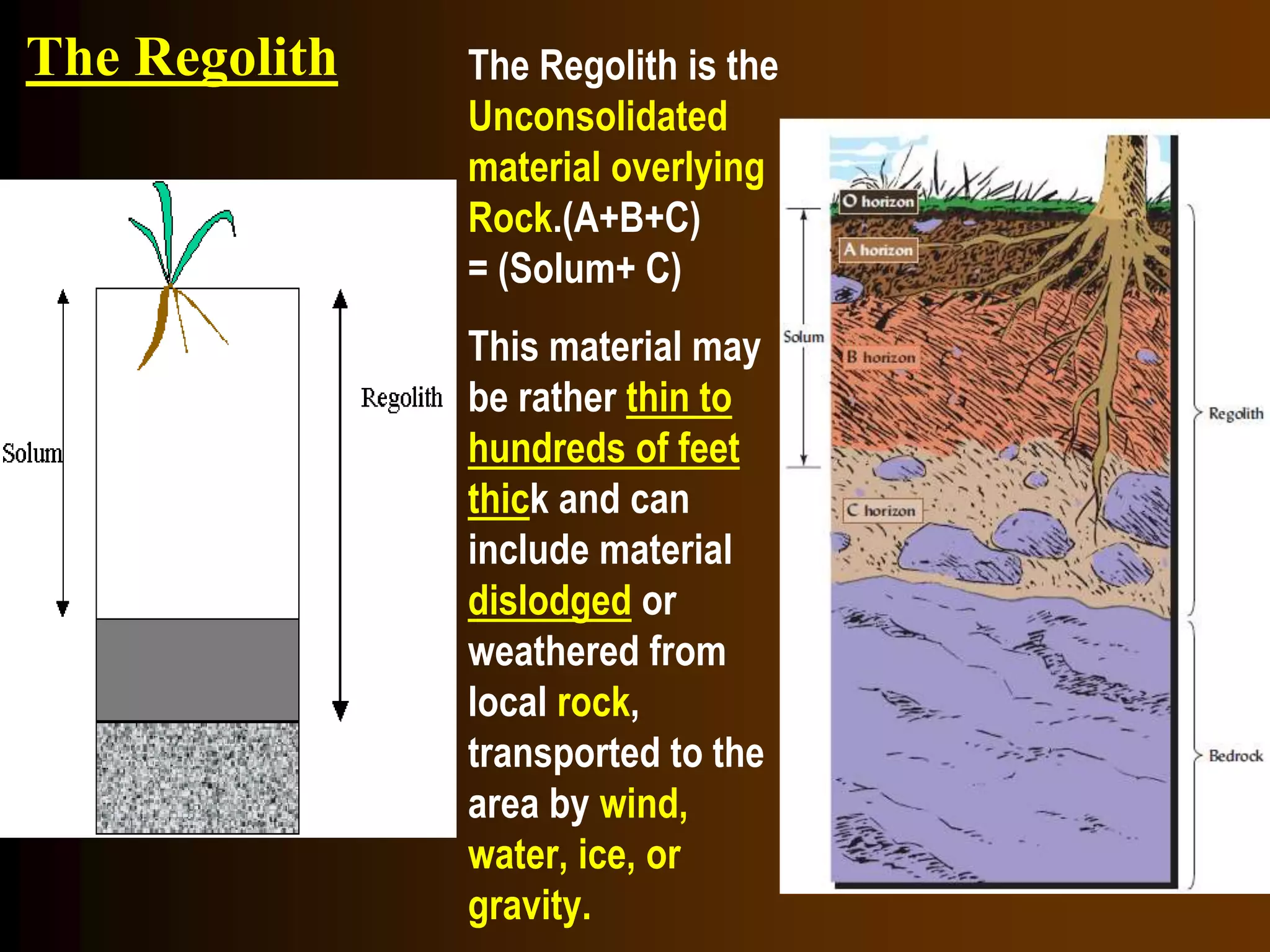
The Regolith The Regolith is the
Unconsolidated
material overlying
Rock.(A+B+C)
= (Solum+ C)
This material may
be rather thin to
hundreds of feet
thick and can
include material
dislodged or
weathered from
local rock,
transported to the
area by wind,
water, ice, or
gravity.
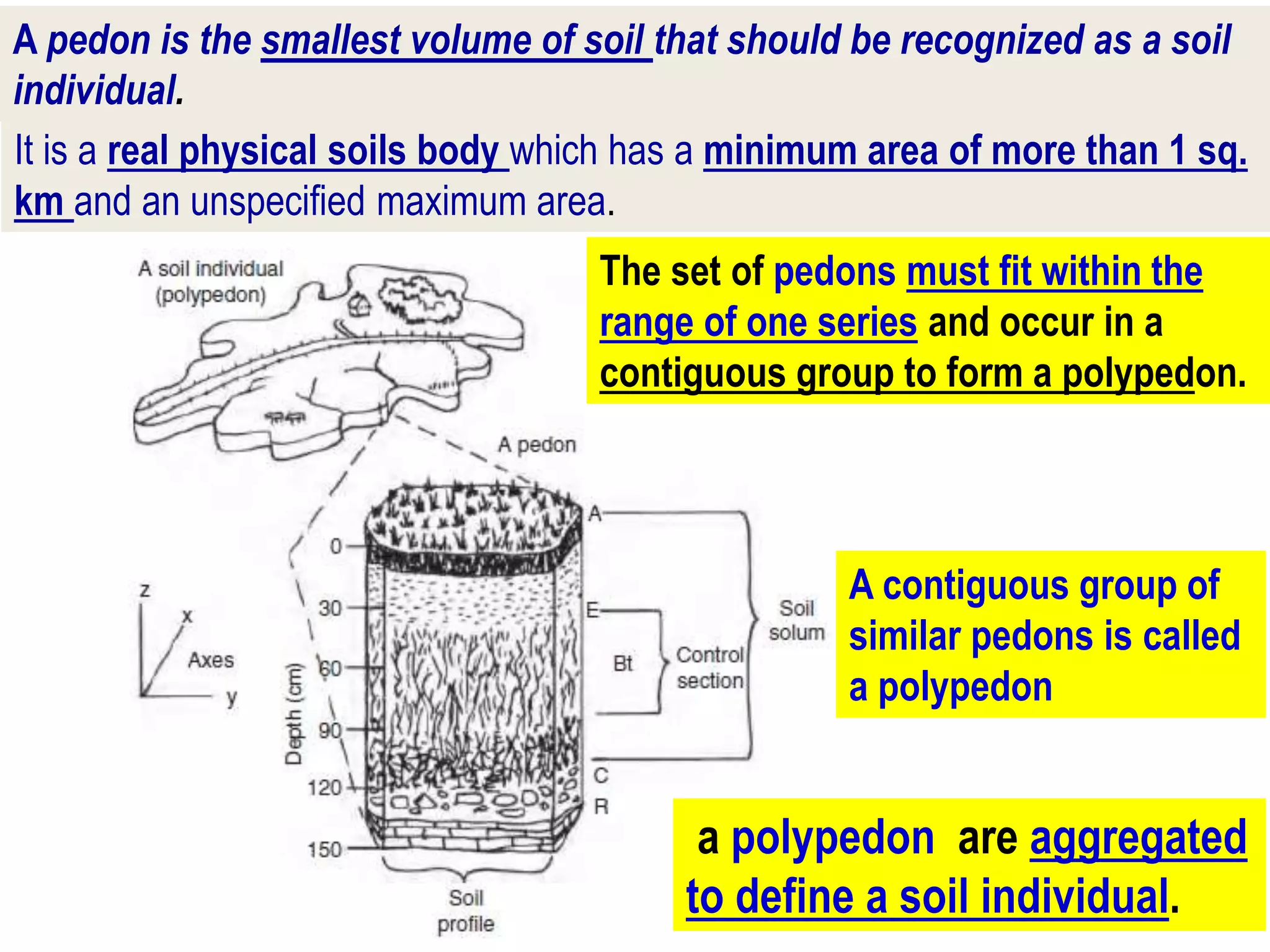
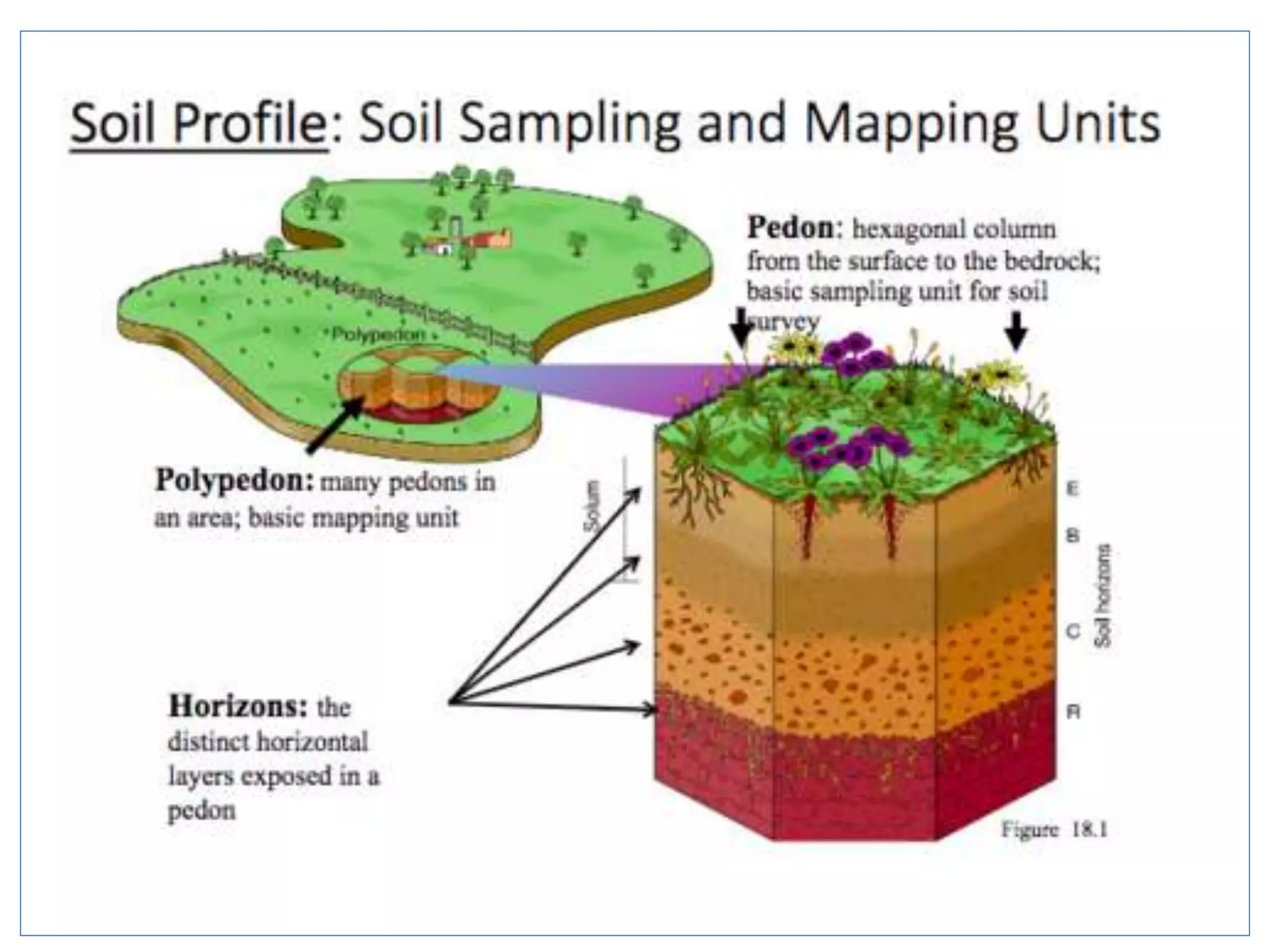
A pedon is the smallest volume of soil that should be recognized as a soil
individual.
a polypedon are aggregated
to define a soil individual.
It is a real physical soils body which has a minimum area of more than 1 sq.
km and an unspecified maximum area.
A contiguous group of
similar pedons is called
a polypedon
The set of pedons must fit within the
range of one series and occur in a
contiguous group to form a polypedon.
Fundamentals of soil science

Fundamentals of soil science

  • 1.
    Fundamentals of SoilScience ACSS-103 (1+1) Prof. P. K. Mani Agril. Chemistry & Soil Science pabitramani@gmail.com; WA 8777592977 welcome you for choosing BCKV as a destination of career building The many functions and ecosystem services performed by soil can be grouped into six crucial ecological roles.
  • 2.
    The concept ofpedosphere: abiotic & biotic entities interacting in the soil matrix The pedosphere (from Greek pedon "soil" or "earth“ and sphaira "sphere") is the outermost layer of the Earth that is composed of soil and subject to soil formation processes. It exists at the interface of the lithosphere, atmosphere, hydrosphere and biosphere. The pedosphere only develops when there is a dynamic interaction between the atmosphere (air in and above the soil), biosphere (living organisms), lithosphere (unconsolidated regolith and consolidated bedrock) and hydrosphere (water in, on and below the soil). The pedosphere is the foundation of terrestrial life on Earth.
  • 3.
    SOIL... • Soil canbe a source, a sink, or an interacting medium for many nutrients, as well as contaminants that impact humans, plants, wildlife, and other organisms. • An understanding of soil properties and processes is therefore critical to evaluate soil management processes. • The word “Soil” is derived from Latin word ‘Solum’ means ‘Floor’ or ‘Ground’. “With out life, there is no soil and without soil, there is no life on the earth planet. As soil provides nutrients, water, air and anchorage and supports life on Earth, it can be called as- Soul Of Infinite Life (SOIL)
  • 5.
    What is Soil? Soil: Unconsolidatedmineral or material on the surface of the earth resulting from and influenced by  time,  parent material, climate, organisms, and topography. The soil is the link between the rock core of the earth and the living things on its surface. It is the foothold for the plants we grow. (Simonson,1957) Soil refers to the weathered and fragmented outer layer of the earth’s terrestrial surface. (Hillel, 1982)
  • 6.
    Joffe (1949), modifiedby Birkeland (1999)
  • 7.
    Function of Soil Soilsperform six key functions in the global ecosystem. Soil serves as a • Medium for plant growth (provides nutrients), it store and supply nutrients to plants. • As an anchor for plant roots enabling plants to stand erect • Regulator of water supplies (water holding tank, it absorb and store the moisture for later use), • Recycler of raw materials ( Decomposition) • Habitat for soil organisms • Landscaping and engineering medium (Soils are the base material for roads, homes, buildings, and other structures)
  • 8.
    physical properties influenceengineering uses soils differ in stability
  • 9.
    Better knowledge ofthe soils on which this road was built may have allowed its engineers to develop a more stable design, thus avoiding this costly and dangerous situation. (R. Weil) Transcosna Grain Elevator,Canada (Oct.18,1913) Shear Failure under Foundation load
  • 10.
  • 11.
    COMPONENT OF SOILS(VOLUME BASIS) The soil consists of four major components i.e. mineral matter (45%), organic matter (5%), soil air (20-30%) and soil water (20-30%).
  • 13.
    USDA System ISSSSystem Soil separate Size range (mm) Soil separate Size range (mm) Very coarse sand Coarse sand Medium sand Fine sand Very fine sand Silt Clay 2.00 - 1.00 1.00 - 0.50 0.50 - 0.25 0.25 - 0.10 0.10 - 0.05 0.05 - 0.002 < 0.002 Coarse sand Fine sand Silt Clay 2.00 - 0.20 0.20 - 0.02 0.02 - 0.002 < 0.002 D > 2 mm is known as nonsoil or skeletal fraction
  • 14.
    Two Branches ofSoil Science PEDOLOGY EDAPHOLOGY Father of American pedology father of pedology J von Liebig Father of soil chemistry V. V. Dokuchaev Curtis F. Marbut Hans Jenny J Döbereiner Olivier de Serres Promoted crop rotation as a way of preserving soil nutrients Brazil's soybeanpdn got new dimension by the concept of bnf
  • 15.
    It deals withsoil formation, soil genesis, soil classification and description of soil properties. A pedologist studies, examines, and classifies soils as they occur in their natural environment. (Gr. Pedos, “ground,” and logos, “science”; original formed as Russian, Pedologiya) •Vasily V. Dokuchaev •Friedrich Albert Fallou •Konstantin D. Glinka •Eugene W. Hilgard •Hans Jenny •Curtis F. Marbut •Bernard Palissy Pedology (from Greek: pedon, "soil"; and logos, "study") is a discipline within soil science which focuses on understanding and characterizing soil formation, evolution, and the theoretical frameworks through which we understand a soil body(s), often in the context of the natural environment. 1st world soil map 1906 Glinka F A Fallou Hilgard coined "pedology" Bernard Palissy
  • 16.
     Study ofsoil in relation to growth, nutrition and yield crops or plants. Edaphologists consider the various properties of soils in relation to plant pdn From the edaphological viewpoint, the soil has certain functions in relation to plant life and these are: – It serves as a medium in which seeds can germinate or tubers and cuttings can start to take roots; – It provides support for vertically growing plants; – It serves as an absorber of moisture for the use of plants; and – It furnishes most of the nutrients which sustain plant life. Edaphologists also studies the causes of the variation in soil productivity and find means of conserving and improving this productivity.
  • 17.
    H. Jenny refinedthe ideas of Russian scientist V.V. Dokuchaev into the following equation 5 factors of soil formation Soil = f (Cl, O, R, P, T…) H. Jenny Jenny (1941): Soil is a naturally occurring body that has been formed due to combined influence of climate and living organisms acting on parent material as conditioned by relief over a period of time.
  • 18.
    The Soil orSolum • The Soil or Solum is the portion of the Regolith that has been influenced by the 5 Soil Formation Factors. • The processes are controlled by Time, Climate, Topography (Landform and Position), Organisms, and Parent Material. • Formation Process are in 4 Broad Categories (additions, losses, translocation, and transformations)- Genetic Soil Forming Processes. Rock – R Horizon SOIL Regolith
  • 19.
    The Regolith TheRegolith is the Unconsolidated material overlying Rock.(A+B+C) = (Solum+ C) This material may be rather thin to hundreds of feet thick and can include material dislodged or weathered from local rock, transported to the area by wind, water, ice, or gravity.
  • 20.
    A pedon isthe smallest volume of soil that should be recognized as a soil individual. a polypedon are aggregated to define a soil individual. It is a real physical soils body which has a minimum area of more than 1 sq. km and an unspecified maximum area. A contiguous group of similar pedons is called a polypedon The set of pedons must fit within the range of one series and occur in a contiguous group to form a polypedon.