

RAINBOW
TECHNOLOGY
Presented by:
P.Hemasri
14A81A05A4
III CSE-B
contents
• Introduction
• How it is possible
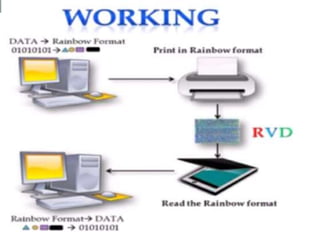
• Working
• Rainbow picture Generation
• Process of storing data
• Comparision with other storage devices
• Future scope
• Advantages
• Disadvantages
• Conclusion
Introduction
• Rainbow technology is developed by paper-based storage technique.
• The first rainbow technology was demonstrated by Indian student
named Sainul abideen
• It store’s upto a massive 450GB
• Rainbow storage is a group of techniques to store digital data in some
colors,color combination and symbols in Rainbow format.
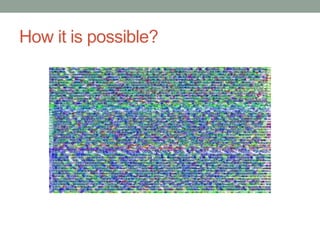
How it is possible?
• It uses geometric shapes such as squares,hexagons to represent
data patterns,instead of the usual binary method that uses ones and
zeros to represent data.
• Files such as text ,images,sounds and video clips are encoded in
“Rainbow format”as colored circles,triangles,squares and so on,and
printed as dense graphics on paper at a density of 2.7GB per square
inch.
• Instead of using 0’s and 1’s we use color dot which can represent
minimum 8bits(1 byte) .The rainbow picture will be highly compressed
and can be represented in any color medium.
• “Although environmental light differences and color shading is a
problem,it can overcome up to a certain limit by using efficient
mapping functions”
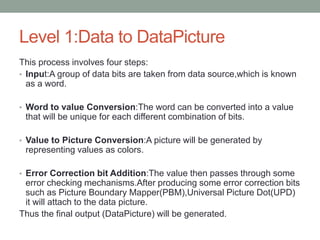
Level 1:Data to DataPicture
This process involves four steps:
• Input:A group of data bits are taken from data source,which is known
as a word.
• Word to value Conversion:The word can be converted into a value
that will be unique for each different combination of bits.
• Value to Picture Conversion:A picture will be generated by
representing values as colors.
• Error Correction bit Addition:The value then passes through some
error checking mechanisms.After producing some error correction bits
such as Picture Boundary Mapper(PBM),Universal Picture Dot(UPD)
it will attach to the data picture.
Thus the final output (DataPicture) will be generated.
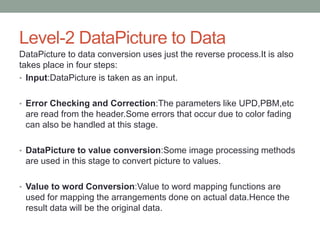
Level-2 DataPicture to Data
DataPicture to data conversion uses just the reverse process.It is also
takes place in four steps:
• Input:DataPicture is taken as an input.
• Error Checking and Correction:The parameters like UPD,PBM,etc
are read from the header.Some errors that occur due to color fading
can also be handled at this stage.
• DataPicture to value conversion:Some image processing methods
are used in this stage to convert picture to values.
• Value to word Conversion:Value to word mapping functions are
used for mapping the arrangements done on actual data.Hence the
result data will be the original data.
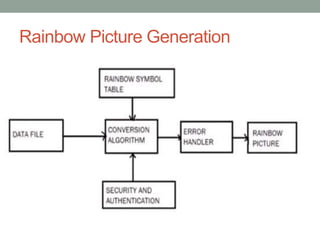
Rainbow Picture Generation
Processing of storing data
• Printing at 1,200 dots per inch (DPI) leads to theoritical maximum of
1,440,000 colored dots per square inch.
• If a scanner can reliably distinguish between 256 uniques color,the
maximum possible storage is approximately 140 megabytes for a
sheet of A4 paper.
• If the scanner were able to accurately distinguish between 16,777,216
colors (24 bits or 3 bytes per dot),the capacity would triple claims of
several hundered gigabytes.
Comparision with other devices
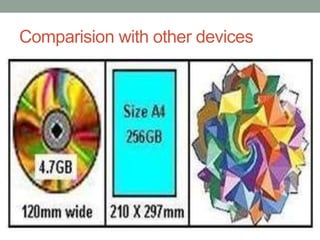
• Currently,of the several options available for data storage,DVDs are
the best mode,but are yet expensive.
• While a CD costs Rs.15,his paper or plastic-made RVD will cost just
about Rs.1.50 and will even have 131 times more storage capacity.
• Paper is,of course,bio-degradable,unlike CDs or DVDs.And sheets of
paper also cost a fraction of the cost of a CD or DVD.
Advantages
• The extermely low-cost technology will drastically reduce the cost of
storage and provide for high speed storage too.
• Files in any format like movies files,songs,images,text can be stored
using this technology.
• It is more confidential then any other storage device.
• The biodegradable nature of the storage devices would do away with
the e-waste pollution.
• The four main storage devices made using this technoogy are
RVD,Disposable storage,data Banks,Rainbow cards.
Disadvantages
• The paper has the tendency to fade away hence the data loss may
occur.
• The paper may also be damaged due to silverfishes , acidity in
environment etc.
Future Scope
• The developer is simultaneously moulding the technology into
‘Rainbow cards’ which will be of SIM card size and store 5GB of data
equivalent to three films of DVD quality.
• As ‘Rainbow Cards’ will become Popular,Rainbow Card Readers will
replace CD drives of mobile phone and computer notebooks.
• Large scale manufacture of the Rainbow card will bring down its cost
to just 50 paise.
Conclusion
• Once the Rainbow technology is fully developed we would be able to
watch full-length high–definition videos from a piece of paper.
• With the popularity of the Rainbow Technology,computer or fashion
magazines in future need not carry CDs in a pack.
• It should cost a lot less to produce ,than the typical polycarbonate
DVDs and CDs . Huge data banks can be constructed out of
Rainbow-based storage medium.
Any Questions
rainbow technology

rainbow technology

  • 1.
  • 2.
    contents • Introduction • Howit is possible • Working • Rainbow picture Generation • Process of storing data • Comparision with other storage devices • Future scope • Advantages • Disadvantages • Conclusion
  • 3.
    Introduction • Rainbow technologyis developed by paper-based storage technique. • The first rainbow technology was demonstrated by Indian student named Sainul abideen • It store’s upto a massive 450GB • Rainbow storage is a group of techniques to store digital data in some colors,color combination and symbols in Rainbow format.
  • 4.
    How it ispossible?
  • 5.
    • It usesgeometric shapes such as squares,hexagons to represent data patterns,instead of the usual binary method that uses ones and zeros to represent data. • Files such as text ,images,sounds and video clips are encoded in “Rainbow format”as colored circles,triangles,squares and so on,and printed as dense graphics on paper at a density of 2.7GB per square inch. • Instead of using 0’s and 1’s we use color dot which can represent minimum 8bits(1 byte) .The rainbow picture will be highly compressed and can be represented in any color medium. • “Although environmental light differences and color shading is a problem,it can overcome up to a certain limit by using efficient mapping functions”
  • 7.
    Level 1:Data toDataPicture This process involves four steps: • Input:A group of data bits are taken from data source,which is known as a word. • Word to value Conversion:The word can be converted into a value that will be unique for each different combination of bits. • Value to Picture Conversion:A picture will be generated by representing values as colors. • Error Correction bit Addition:The value then passes through some error checking mechanisms.After producing some error correction bits such as Picture Boundary Mapper(PBM),Universal Picture Dot(UPD) it will attach to the data picture. Thus the final output (DataPicture) will be generated.
  • 8.
    Level-2 DataPicture toData DataPicture to data conversion uses just the reverse process.It is also takes place in four steps: • Input:DataPicture is taken as an input. • Error Checking and Correction:The parameters like UPD,PBM,etc are read from the header.Some errors that occur due to color fading can also be handled at this stage. • DataPicture to value conversion:Some image processing methods are used in this stage to convert picture to values. • Value to word Conversion:Value to word mapping functions are used for mapping the arrangements done on actual data.Hence the result data will be the original data.
  • 9.
  • 10.
    Processing of storingdata • Printing at 1,200 dots per inch (DPI) leads to theoritical maximum of 1,440,000 colored dots per square inch. • If a scanner can reliably distinguish between 256 uniques color,the maximum possible storage is approximately 140 megabytes for a sheet of A4 paper. • If the scanner were able to accurately distinguish between 16,777,216 colors (24 bits or 3 bytes per dot),the capacity would triple claims of several hundered gigabytes.
  • 11.
  • 12.
    Comparision with otherdevices • Currently,of the several options available for data storage,DVDs are the best mode,but are yet expensive. • While a CD costs Rs.15,his paper or plastic-made RVD will cost just about Rs.1.50 and will even have 131 times more storage capacity. • Paper is,of course,bio-degradable,unlike CDs or DVDs.And sheets of paper also cost a fraction of the cost of a CD or DVD.
  • 13.
    Advantages • The extermelylow-cost technology will drastically reduce the cost of storage and provide for high speed storage too. • Files in any format like movies files,songs,images,text can be stored using this technology. • It is more confidential then any other storage device. • The biodegradable nature of the storage devices would do away with the e-waste pollution. • The four main storage devices made using this technoogy are RVD,Disposable storage,data Banks,Rainbow cards.
  • 14.
    Disadvantages • The paperhas the tendency to fade away hence the data loss may occur. • The paper may also be damaged due to silverfishes , acidity in environment etc.
  • 15.
    Future Scope • Thedeveloper is simultaneously moulding the technology into ‘Rainbow cards’ which will be of SIM card size and store 5GB of data equivalent to three films of DVD quality. • As ‘Rainbow Cards’ will become Popular,Rainbow Card Readers will replace CD drives of mobile phone and computer notebooks. • Large scale manufacture of the Rainbow card will bring down its cost to just 50 paise.
  • 16.
    Conclusion • Once theRainbow technology is fully developed we would be able to watch full-length high–definition videos from a piece of paper. • With the popularity of the Rainbow Technology,computer or fashion magazines in future need not carry CDs in a pack. • It should cost a lot less to produce ,than the typical polycarbonate DVDs and CDs . Huge data banks can be constructed out of Rainbow-based storage medium.
  • 17.