A seminar report on
AN ATM WITH AN EYE
DEPARTMENT OF COMPUTER SCIENCE & ENGINEERING
SRI VASAVI ENGINEERING COLLEGE
Pedatadepalli, Tadepalligudem-534101,
W.G.Dist, AndhraPradesh,
Submitted By
K.V.SATYA VANI
(14A81A0581)
INDEX
S.NO CONTENT NAME PAGE NO
ABSTRACT
1 INTRODUCTION 1
2 HISTORY 2
3 ATM SYSTEMS 5
4 HARDWARE AND SOFTWAR 6
5 SECURITY 8
6 FACIAL RECOGNITION 10
7 SOFTWARE SPECIFICATION 12
8 FACIAL RECOGNITION TECHNIQUE 13
9 IRIS RECOGNITION 15
10 HOW THE SYSTEM WORKS 16
11 APPLICATION OF ATM WITH AN EYE 18
12 ADVANTAGES & DISADVANTAGES 19
12.1 Advantages 19
12.2 Disadvantages 19
13 CONCLUSION 20
14 REFERENCES 21
LIST OF FIGURES
FIG NO FIGURE NAME PAGE NO
Fig 1 ATM Working 7
Fig 2 Facial Recognition 11
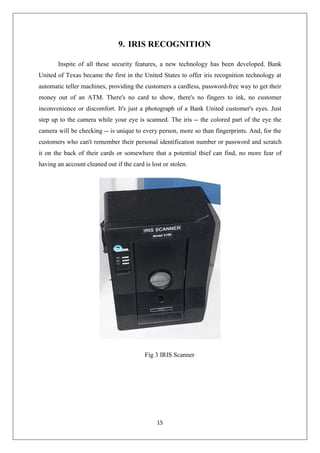
Fig 3 IRIS Scanner 15
Fig 4 ATM Sacning 17
ABSTRACT
There is an urgent need for improving security in banking region. With the advent of
ATM though banking became a lot easier it even became a lot vulnerable. The chances of
misuse of this much hyped ‘insecure’ baby product (ATM) are manifold due to the
exponential growth of ‘intelligent’ criminals day by day. ATM systems today use no more
than an access card and PIN for identity verification. This situation is unfortunate since
tremendous progress has been made in biometric identification techniques, including finger
printing, facial recognition, and iris scanning.This paper proposes the development of a
system that integrates Facial regognition and Iris scanning technology into the identity
verification process used in ATMs. The development of such a system would serve to protect
consumers and financial institutions alike from fraud and other breaches of security.
1
1. INTRODUCTION
The rise of technology in India has brought into force many types of equipment that
aim at more customer satisfaction. ATM is one such machine which made money
transactions easy for customers to bank. The other side of this improvement is the
enhancement of the culprit’s probability to get his ‘unauthentic’ share. Traditionally, security
is handled by requiring the combination of a physical access card and a PIN or other
password in order to access a customer’s account. This model invites fraudulent attempts
through stolen cards, badly-chosen or automatically assigned PINs, cards with little or no
encryption schemes, employees with access to non-encrypted customer account information
and other points of failure.
Our paper proposes an automatic teller machine security model that would combine a
physical access card, a PIN, and electronic facial recognition. By forcing the ATM to match a
live image of a customer’s face with an image stored in a bank database that is associated
with the account number, the damage to be caused by stolen cards and PINs is effectively
neutralized. Only when the PIN matches the account and the live image and stored image
match would a user be considered fully verified. A system can examine just the eyes, or the
eyes nose and mouth, or ears, nose, mouth and eyebrows, and so on.
In this paper , we will also look into an automatic teller machine security model
providing the customers a cardless, password-free way to get their money out of an ATM.
Just step up to the camera while your eye is scanned. The iris -- the colored part of the eye the
camera will be checking -- is unique to every person, more so than fingerprints.
2
2. HISTORY
As the research of the eminent historian Bernardo Bátiz-Lazo has shown John
Shepherd-Barron, James Goodfellowhave been wrongly attributed with being the sole person
behind the concept of a self-service machine which would dispense paper currency with 24/7
availability.
The idea of out-of-hours cash distribution developed from banker's needs in Asia
(Japan), Europe (Sweden and the United Kingdom) and North America (the United
States).LIttle is known of the Japanese device. In the US patent record, Armenian inventor
Luther George Simjian has been credited with developing a "prior art device". Specifically
his 132nd patent (US3079603), which was first filed on 30 June 1960 (and granted 26
February 1963). The roll-out of this machine, called Bankograph, was delayed by a couple of
years, due in part to Simjian's Reflectone Electronics Inc. being acquired by Universal Match
Corporation.[14] An experimental Bankograph was installed in New York City in 1961 by
the City Bank of New York, but removed after six months due to the lack of customer
acceptance. The Bankograph was an automated envelope deposit machine (accepting coins,
cash and cheques) and did not have cash dispensing features.
Actor Reg Varney using the world's first cash machine in Enfield Town, north
London on 27 June 1967 It is widely accepted that the first ATM was put into use by
Barclays Bank in its Enfield Town branch in north London, United Kingdom, on 27 June
1967.This machine was inaugurated by English comedy actor Reg Varney.This instance of
the invention is credited to John Shepherd-Barron of printing firm De La Rue,who was
awarded an OBE in the 2005 New Year Honours. This design used paper cheques issued by a
teller or cashier, marked with carbon-14 for machine readability and security, which in a
latter model were matched with a personal identification number (PIN).Shepherd-Barron
stated; "It struck me there must be a way I could get my own money, anywhere in the world
or the UK. I hit upon the idea of a chocolate bar dispenser, but replacing chocolate with
cash."
The Barclays-De La Rue machine (called De La Rue Automatic Cash System or
DACS)[22] beat the Swedish saving banks' and a company called Metior's machine (a device
called Bankomat) by a mere nine days and Westminster Bank’s-Smith Industries-Chubb
system (called Chubb MD2) by a month.The online version of the Swedish machine is listed
3
to have been operational on 6 May 1968, while claiming to be the first online cash machine in
the world (ahead of a similar claim by IBM and Lloyds Bank in 1971).The collaboration of a
small start-up called Speytec and Midland Bank developed a fourth machine which was
marketed after 1969 in Europe and the US by the Burroughs Corporation. The patent for this
device (GB1329964) was filed on September 1969 (and granted in 1973) by John David
Edwards, Leonard Perkins, John Henry Donald, Peter Lee Chappell, Sean Benjamin
Newcombe & Malcom David Roe.
Both the DACS and MD2 accepted only a single-use token or voucher which was
retained by the machine while the Speytec worked with a card with a magnetic strip at the
back. They used principles including Carbon-14 and low-coercivity magnetism in order to
make fraud more difficult. The idea of a PIN stored on the card was developed by a British
engineer working on the MD2 named James Goodfellow in 1965 (patent GB1197183 filed on
2 May 1966 with Anthony Davies). The essence of this system was that it enabled the
verification of the customer with the debited account without human intervention. This patent
is also the earliest instance of a complete "currency dispenser system" in the patent record.
This patent was filed on 5 March 1968 in the US (US 3543904) and granted on 1 December
1970. It had a profound influence on the industry as a whole. Not only did future entrants into
the cash dispenser market such as NCR Corporation and IBM licence Goodfellow’s PIN
system, but a number of later patents reference this patent as "Prior Art Device".
In January 9, 1969's ABC newspaper (Madrid edition) there was an article about the
new Bancomat, a teller machine installed in downtown Madrid, Spain, by Banesto,
dispensing 1,000 peseta bills (1 to 5 max). Each user had to introduce a security personal key
using a combination of the ten numeric buttons.[26] In March of the same year an ad with the
instructions to use the Bancomat was published in the same newspaper.[27] Bancomat was
the first cash machine installed in Spain, one of the first in Europe.
Docutel United States 1969
After looking first hand at the experiences in Europe, in 1968 the networked ATM
was pioneered in the US, in Dallas, Texas, by Donald Wetzel, who was a department head at
an automated baggage-handling company called Docutel. Recognised by the United States
Patent Office for having invented the ATM are Kenneth S. Goldstein and John D. White,
under US Patent # 3,662,343. Recognised by the United States Patent Office for having
4
invented the ATM network are Fred J. Gentile and Jack Wu Chang, under US Patent #
3,833,885. On September 2, 1969, Chemical Bank installed the first ATM in the U.S. at its
branch in Rockville Centre, New York. The first ATMs were designed to dispense a fixed
amount of cash when a user inserted a specially coded card.Chemical Bank advertisement
boasted "On Sept. 2 our bank will open at 9:00 and never close again."Chemical's ATM,
initially known as a Docuteller was designed by Donald Wetzel and his company Docutel.
Chemical executives were initially hesitant about the electronic banking transition given the
high cost of the early machines. Additionally, executives were concerned that customers
would resist having machines handling their money.[30] In 1995, the Smithsonian National
Museum of American History recognised Docutel and Wetzel as the inventors of the
networked ATM.
Continued Improvements
The first modern ATM was an IBM 2984 and came into use at Lloyds Bank,
Brentwood High Street, Essex, England in December 1972. The IBM 2984 was designed at
the request of Lloyds Bank. The 2984 Cash Issuing Terminal was the first true ATM, similar
in function to today's machines and named by Lloyds Bank: Cashpoint; Cashpoint is still a
registered trademark of Lloyds TSB in the UK. All were online and issued a variable amount
which was immediately deducted from the account. A small number of 2984s were supplied
to a US bank. A couple of well known historical models of ATMs include the IBM 3614,
IBM 3624 and 473x series, Diebold 10xx and TABS 9000 series, NCR 1780 and earlier NCR
770 series.
The first switching system to enable shared automated teller machines between banks
went into production operation on February 3, 1979 in Denver, Colorado, in an effort by
Colorado National Bank of Denver and Kranzley and Company of Cherry Hill, New Jersey.
The newest ATM at Royal Bank of Scotland allows customers to withdraw cash up to £100
without a card by inputting a six-digit code requested through their smartphones.
5
3. ATM SYSTEMS
Our ATM system would only attempt to match two (and later, a few) discrete images,
searching through a large database of possible matching candidates would be unnecessary.
The process would effectively become an exercise in pattern matching, which would not
require a great deal of time. With appropriate lighting and robust learning software, slight
variations could be accounted for in most cases. Further, a positive visual match would cause
the live image to be stored in the database so that future transactions would have a broader
base from which to compare if the original account image fails to provide a match – thereby
decreasing false negatives.
When a match is made with the PIN but not the images, the bank could limit
transactions in a manner agreed upon by the customer when the account was opened, and
could store the image of the user for later examination by bank officials. In regards to bank
employees gaining access to customer PINs for use in fraudulent transactions, this system
would likewise reduce that threat to exposure to the low limit imposed by the bank and
agreed to by the customer on visually unverifiable transactions.
In the case of credit card use at ATMs, such a verification system would not currently
be feasible without creating an overhaul for the entire credit card issuing industry, but it is
possible that positive results (read: significant fraud reduction) achieved by this system might
motivate such an overhaul.
The last consideration is that consumers may be wary of the privacy concerns raised
by maintaining images of customers in a bank database, encrypted or otherwise, due to
possible hacking attempts or employee misuse. However, one could argue that having the
image compromised by a third party would have far less dire consequences than the account
information itself. Furthermore, since nearly all ATMs videotape customers engaging in
transactions, it is no broad leap to realize that banks already build an archive of their
customer images, even if they are not necessarily grouped with account info
6
4. HARDWARE AND SOFTWAR
ATMs contain secure cryptoprocessors, generally within an IBM PC compatible host
computer in a secure enclosure. The security of the machine relies mostly on the integrity of
the secure cryptoprocessor: the host software often runs on a commodity operating system.In-
store ATMs typically connect directly to their ATM Transaction Processor via a modem over
a dedicated telephone line, although the move towards Internet connections is under way.
In addition, ATMs are moving away from custom circuit boards (most of which are
based on Intel 8086 architecture) and into full-fledged PCs with commodity operating
systems such as Windows 2000 and Linux. An example of this is Banrisul, the largest bank
in the South of Brazil, which has replaced the MS-DOS operating systems in its automatic
teller machines with Linux. Other platforms include RMX 86, OS/2 and Windows 98
bundled with Java. The newest ATMs use Windows XP or Windows XP embedded.
Reliability
ATMs are generally reliable, but if they do go wrong customers will be left without
cash until the following morning or whenever they can get to the bank during opening hours.
Of course, not all errors are to the detriment of customers; there have been cases of machines
giving out money without debiting the account, or giving out higher value notes as a result of
incorrect denomination of banknote being loaded in the money cassettes. Errors that can
occur may be mechanical (such as card transport mechanisms; keypads; hard disk failures);
software (such as operating system; device driver; application); communications; or purely
down to operator error.
7
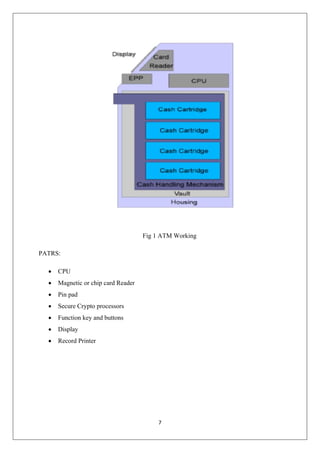
Fig 1 ATM Working
PATRS:
∑ CPU
∑ Magnetic or chip card Reader
∑ Pin pad
∑ Secure Crypto processors
∑ Function key and buttons
∑ Display
∑ Record Printer
8
5. SECURITY
such as malls, grocery stores, and restaurants. The other side of this improvement is
the enhancement of the culprit’s probability to get his ‘unauthentic’ share. ATMs are
Early ATM security focused on making the ATMs invulnerable to physical attack; they were
effectively safes with dispenser mechanisms. ATMs are placed not only near banks, but also
in locations a quick and convenient way to get cash. They are also public and visible, so it
pays to be careful when you're making transactions. Follow these general tips for your
personal safety.
Stay alert
If an ATM is housed in an enclosed area, shut the entry door completely behind you.
If you drive up to an ATM, keep your car doors locked and an eye on your surroundings. If
you feel uneasy or sense something may be wrong while you're at an ATM, particularly at
night or when you're alone, leave the area.
Keep you PIN confidential
Memorize your Personal Identification Number (PIN); don't write it on your card or
leave it in your wallet or purse. Keep your number to yourself. Never provide your PIN over
the telephone, even if a caller identifies himself as a bank employee or police officer. Neither
person would call you to obtain your number.
Conduct transactions in private
Stay squarely in front of the ATM when completing your transaction so people
waiting behind you won't have an opportunity to see your PIN being entered or to view any
account information. Similarly, fill out your deposit/withdrawal slips privately.
Don’t flash your cash
If you must count your money, do it at the ATM, and place your cash into your wallet
or purse before stepping away. Avoid making excessively large withdrawals. If you think
you're being followed as you leave the ATM, go to a public area near other people and, if
necessary, ask for help.
9
Save receipt
Your ATM receipts provide a record of your transactions that you can later reconcile
with your monthly bank statement. If you notice any discrepancies on your statement, contact
your bank as soon as possible. Leaving receipts at an ATM can also let others know how
much money you've withdrawn and how much you have in your account.
Guard your card
Don't lend your card or provide your PIN to others, or discuss your bank account
with friendly strangers. If your card is lost or stolen, contact your bank immediately.
Immediately report any crime to the police
Contact the Department Of Public Security or your local police station for more
personal safety information.
10
6. FACIAL RECOGNITION
The main issues faced in developing such a model are keeping the time elapsed in the
verification process to a negligible amount, allowing for an appropriate level of variation in a
customer’s face when compared to the database image, and that credit cards which can be
used at ATMs to withdraw funds are generally issued by institutions that do not have in-
person contact with the customer, and hence no opportunity to acquire a photo.
Because the system would only attempt to match two (and later, a few) discrete
images, searching through a large database of possible matching candidates would be
unnecessary. The process would effectively become an exercise in pattern matching, which
would not require a great deal of time. With appropriate lighting and robust learning
software, slight variations could be accounted for in most cases. Further, a positive visual
match would cause the live image to be stored in the database so that future transactions
would have a broader base from which to compare if the original account image fails to
provide a match – thereby decreasing false negatives.
When a match is made with the PIN but not the images, the bank could limit
transactions in a manner agreed upon by the customer when the account was opened, and
could store the image of the user for later examination by bank officials. In regards to bank
employees gaining access to customer PINs for use in fraudulent transactions, this system
would likewise reduce that threat to exposure to the low limit imposed by the bank and
agreed to by the customer on visually unverifiable transactions.
In the case of credit card use at ATMs, such a verification system would not currently
be feasible without creating an overhaul for the entire credit card issuing industry, but it is
possible that positive results (read: significant fraud reduction) achieved by this system might
motivate such an overhaul.
The last consideration is that consumers may be wary of the privacy concerns raised
by maintaining images of customers in a bank database, encrypted or otherwise, due to
possible hacking attempts or employee misuse. However, one could argue that having the
image compromised by a third party would have far less dire consequences than the account
information itself. Furthermore, since nearly all ATMs videotape customers engaging in
11
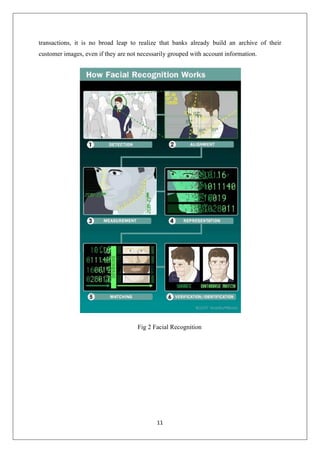
transactions, it is no broad leap to realize that banks already build an archive of their
customer images, even if they are not necessarily grouped with account information.
Fig 2 Facial Recognition
12
7. SOFTWARE SPECIFICATION
For most of the past ten years, the majority of ATMs used worldwide ran under
IBM’s now-defunct OS/2. However, IBM hasn’t issued a major update to the operating
system in over six years. Movement in the banking world is now going in two directions:
Windows and Linux. NCR, a leading world-wide ATM manufacturer, recently announced an
agreement to use Windows XP Embedded in its next generation of personalized ATMs
(crmdaily.com.) Windows XP Embedded allows OEMs to pick and choose from the
thousands of components that make up Windows XP Professional, including integrated
multimedia, networking and database management functionality. This makes the use of off-
the-shelf facial recognition code more desirable because it could easily be compiled for the
Windows XP environment and the networking and database tools will already be in place.
Many financial institutions are relying on Windows NT, because of its stability and
maturity as a platform.The ATMs send database requests to bank servers which do the bulk
of transaction processing (linux.org.) This model would also work well for the proposed
system if the ATMs processors were not powerful enough to quickly perform the facial
recognition algorithms.
13
8. FACIAL RECOGNITION TECHNIQUE
There are hundreds of proposed and actual implementations of facial recognition
technology from all manner of vendors for all manner of uses. However, for the model
proposed in this paper, we are interested only in the process of facial verification – matching
a live image to a predefined image to verify a claim of identity – not in the process of facial
evaluation – matching a live image to any image in a database. Further, the environmental
conditions under which the verification takes place – the lighting, the imaging system, the
image profile, and the processing environment – would all be controlled within certain
narrow limits, making hugely robust software unnecessary .One leading facial recognition
algorithm class is called image template based. This method attempts to capture global
features of facial images into facial templates. What must be taken into account, though, are
certain key factors that may change across live images: illumination, expression, and pose
(profile.)
The natural conclusion to draw, then, is to take a frontal image for the bank database,
and to provide a prompt to the user, verbal or otherwise, to face the camera directly when the
ATM verification process is to begin, so as to avoid the need to account for profile changes.
With this and other accommodations, recognition rates for verification can rise above 90%. A
system can examine just the eyes, or the eyes nose and mouth, or ears, nose, mouth and
eyebrows, and so on
The conclusion to be drawn for this project, then, is that facial verification software is
currently up to the task of providing high match rates for use in ATM transactions. What
remains is to find an appropriate open-source local feature analysis facial verification
program that can be used on a variety of platforms, including embedded processors, and to
determine behavior protocols for the match / non-match cases.
Our methodlogy
The first and most important step of this project will be to locate a powerful open-
source facial recognition program that uses local feature analysis and that is targeted at facial
verification. This program should be compilable on multiple systems, including Linux and
Windows variants, and should be customizable to the extent of allowing for variations in
processing power of the machines onto which it would be deployed.We will then need to
14
familiarize ourselves with the internal workings of the program so that we can learn its
strengths and limitations. Simple testing of this program will also need to occur so that we
could evaluate its effectiveness. Several sample images will be taken of several individuals to
be used as test cases – one each for “account” images, and several each for “live” images,
each of which would vary pose, lighting conditions, and expressions.
Once a final program is chosen, we will develop a simple ATM black box program.
This program will server as the theoretical ATM with which the facial recognition software
will interact. It will take in a name and password, and then look in a folder for an image that
is associated with that name. It will then take in an image from a separate folder of “live”
images and use the facial recognition program to generate a match level between the two.
Finally it will use the match level to decide whether or not to allow “access”, at which point it
will terminate. All of this will be necessary, of course, because we will not have access to an
actual ATM or its software.
Both pieces of software will be compiled and run on a Windows XP and a Linux
system. Once they are both functioning properly, they will be tweaked as much as possible to
increase performance (decreasing the time spent matching) and to decrease memory footprint.
Following that, the black boxes will be broken into two components – a server and a
client – to be used in a two-machine network. The client code will act as a user interface,
passing all input data to the server code, which will handle the calls to the facial recognition
software, further reducing the memory footprint and processor load required on the client
end. In this sense, the thin client architecture of many ATMs will be emulated.
We will then investigate the process of using the black box program to control a USB
camera attached to the computer to avoid the use of the folder of “live” images. Lastly, it may
be possible to add some sort of DES encryption to the client end to encrypt the input data and
decrypt the output data from the server – knowing that this will increase the processor load,
but better allowing us to gauge the time it takes to process.
15
9. IRIS RECOGNITION
Inspite of all these security features, a new technology has been developed. Bank
United of Texas became the first in the United States to offer iris recognition technology at
automatic teller machines, providing the customers a cardless, password-free way to get their
money out of an ATM. There's no card to show, there's no fingers to ink, no customer
inconvenience or discomfort. It's just a photograph of a Bank United customer's eyes. Just
step up to the camera while your eye is scanned. The iris -- the colored part of the eye the
camera will be checking -- is unique to every person, more so than fingerprints. And, for the
customers who can't remember their personal identification number or password and scratch
it on the back of their cards or somewhere that a potential thief can find, no more fear of
having an account cleaned out if the card is lost or stolen.
Fig 3 IRIS Scanner
16
10. HOW THE SYSTEM WORKS
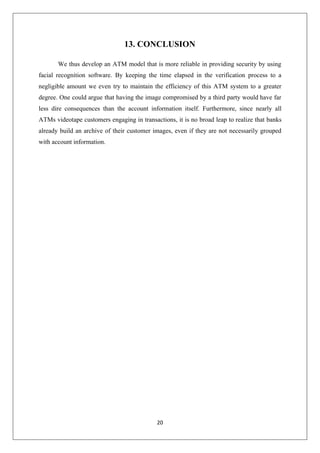
When a customer puts in a bankcard, a stereo camera locates the face, finds the eye
and takes a digital image of the iris at a distance of up to three feet. The resulting
computerized "iris code" is compared with one the customer will initially provide the bank.
The ATM won't work if the two codes don't match. The entire process takes less than two
seconds.
The system works equally well with customers wearing glasses or contact lenses and
at night. No special lighting is needed. The camera also does not use any kind of beam.
Instead, a special lens has been developed that will not only blow up the image of the iris, but
provide more detail when it does. Iris scans are much more accurate than other high-tech ID
systems available that scan voices, faces and fingerprints.
Scientists have identified 250 features unique to each person's iris -- compared with
about 40 for fingerprints -- and it remains constant through a person's life, unlike a voice or a
face. Fingerprint and hand patterns can be changed through alteration or injury. The iris is the
best part of the eye to use as a identifier because there are no known diseases of the iris and
eye surgery is not performed on the iris. Iris identification is the most secure, robust and
stable form of identification known to man. It is far safer, faster, more secure and accurate
than DNA testing. Even identical twins do not have identical irises. The iris remains the same
from 18 months after birth until five minutes after death.
When the system is fully operational, a bank customer will have an iris record made
for comparison when an account is opened. The bank will have the option of identifying
either the left or right eye or both. It requires no intervention by the customer. They will
simply get a letter telling them they no longer have to use the PIN number. And, scam artists
beware, a picture of the card holder won't pass muster. The first thing the camera will check
is whether the eye is pulsating. If we don't see blood flowing through your eye, you're either
dead or it's a picture.
17
Fig 4 ATM Sacning
18
11. APPLICATION OF ATM WITH AN EYE
Security:
∑ It provides better and efficient security.
∑ In past decades many machine have used the Data Encryption Standard developed by
IBM in the mid 1970s that uses a 56-bit key. But in this technique. “Triple DES”
scheme has been put forth that uses three such keys, for an effective 168-bit key
length.
∑ Redesigns of DES may make them more amenable to also including cameras and
facial recognition software, more so than they would be in regards to retrofitting pre-
existing machines.
∑ It avoids fraudulent attempts through stolen cards, badly-chosen or automatically
assigned PINs, cards with little or no encryption schemes, employees with access to
non-encrypted customer account information and other points of failure and also
avoids the unauthentic share.
Reliability:
∑ ATMs are generally reliable ATMs invulnerable to physical attack
19
12. ADVANTAGES & DISADVANTAGES
12.1 Advantages
1. The entire process will takes time less than 2 seconds as facial recognition code more
desirable because it could easily be compiled for the Windows XP environment and
the networking and database tools will already be in place.
2. The system works equally well with customers wearing glasses or contact lenses and
at night. No special lighting is needed. The camera also does not use any kind of
beam. Iris scans are much more accurate than other high-tech ID systems available
that scan voices, faces and fingerprints.
3. The iris is the best part of the eye to use as a identifier because there are no known
diseases of the iris and eye surgery is not performed on the iris.
4. It is far safer, faster, more secure and accurate than DNA testing. Even identical twins
do not have identical irises. The iris remains the same from 18 months after birth until
five minutes after death.
12.2 Disadvantages
1. Iris scanners are significantly more expensive than some other forms of biometrics,
password or proxy card security systems
2. Iris recognition is very difficult to perform at a distance larger than a few meters and
if the person to be identified is not cooperating by holding the head still and looking
into the camera.
3. In Fingerprinting technique there is chances of replacement or injury. Scientists have
identified 250 features unique to each person's iris -- compared with about 40 for
fingerprints
20
13. CONCLUSION
We thus develop an ATM model that is more reliable in providing security by using
facial recognition software. By keeping the time elapsed in the verification process to a
negligible amount we even try to maintain the efficiency of this ATM system to a greater
degree. One could argue that having the image compromised by a third party would have far
less dire consequences than the account information itself. Furthermore, since nearly all
ATMs videotape customers engaging in transactions, it is no broad leap to realize that banks
already build an archive of their customer images, even if they are not necessarily grouped
with account information.
21
14.REFERENCES
∑ Merriam-Webster Dictionary Automatic Teller Machine.
∑ Maintain Automatic Teller Machine (ATM) services (Release 1).
∑ Cambridge Dictionary Automatic Teller Machine.
∑ Automatic Bank Machine definition from a Canadian bank, Scotiabank.
∑ ATM Industry Association (ATMIA)
∑ 3 Million ATMs Worldwide By 2015, 8 September 2015
∑ Schlichter, Sarah (2007-02-05). "Using ATM's abroad - Travel - Travel Tips -
msnbc.com". MSNBC. Retrieved 2011-02-11.
∑ Cash Box: The Invention and Globalization of the ATM
∑ Emergence and Evolution of Proprietary ATM Networks in the UK, 1967-2000
∑ Evidence from the Patent Record on the Development of Cash Dispensing
Technology

14 581

  • 1.
    A seminar reporton AN ATM WITH AN EYE DEPARTMENT OF COMPUTER SCIENCE & ENGINEERING SRI VASAVI ENGINEERING COLLEGE Pedatadepalli, Tadepalligudem-534101, W.G.Dist, AndhraPradesh, Submitted By K.V.SATYA VANI (14A81A0581)
  • 2.
    INDEX S.NO CONTENT NAMEPAGE NO ABSTRACT 1 INTRODUCTION 1 2 HISTORY 2 3 ATM SYSTEMS 5 4 HARDWARE AND SOFTWAR 6 5 SECURITY 8 6 FACIAL RECOGNITION 10 7 SOFTWARE SPECIFICATION 12 8 FACIAL RECOGNITION TECHNIQUE 13 9 IRIS RECOGNITION 15 10 HOW THE SYSTEM WORKS 16 11 APPLICATION OF ATM WITH AN EYE 18 12 ADVANTAGES & DISADVANTAGES 19 12.1 Advantages 19 12.2 Disadvantages 19 13 CONCLUSION 20 14 REFERENCES 21
  • 3.
    LIST OF FIGURES FIGNO FIGURE NAME PAGE NO Fig 1 ATM Working 7 Fig 2 Facial Recognition 11 Fig 3 IRIS Scanner 15 Fig 4 ATM Sacning 17
  • 4.
    ABSTRACT There is anurgent need for improving security in banking region. With the advent of ATM though banking became a lot easier it even became a lot vulnerable. The chances of misuse of this much hyped ‘insecure’ baby product (ATM) are manifold due to the exponential growth of ‘intelligent’ criminals day by day. ATM systems today use no more than an access card and PIN for identity verification. This situation is unfortunate since tremendous progress has been made in biometric identification techniques, including finger printing, facial recognition, and iris scanning.This paper proposes the development of a system that integrates Facial regognition and Iris scanning technology into the identity verification process used in ATMs. The development of such a system would serve to protect consumers and financial institutions alike from fraud and other breaches of security.
  • 5.
    1 1. INTRODUCTION The riseof technology in India has brought into force many types of equipment that aim at more customer satisfaction. ATM is one such machine which made money transactions easy for customers to bank. The other side of this improvement is the enhancement of the culprit’s probability to get his ‘unauthentic’ share. Traditionally, security is handled by requiring the combination of a physical access card and a PIN or other password in order to access a customer’s account. This model invites fraudulent attempts through stolen cards, badly-chosen or automatically assigned PINs, cards with little or no encryption schemes, employees with access to non-encrypted customer account information and other points of failure. Our paper proposes an automatic teller machine security model that would combine a physical access card, a PIN, and electronic facial recognition. By forcing the ATM to match a live image of a customer’s face with an image stored in a bank database that is associated with the account number, the damage to be caused by stolen cards and PINs is effectively neutralized. Only when the PIN matches the account and the live image and stored image match would a user be considered fully verified. A system can examine just the eyes, or the eyes nose and mouth, or ears, nose, mouth and eyebrows, and so on. In this paper , we will also look into an automatic teller machine security model providing the customers a cardless, password-free way to get their money out of an ATM. Just step up to the camera while your eye is scanned. The iris -- the colored part of the eye the camera will be checking -- is unique to every person, more so than fingerprints.
  • 6.
    2 2. HISTORY As theresearch of the eminent historian Bernardo Bátiz-Lazo has shown John Shepherd-Barron, James Goodfellowhave been wrongly attributed with being the sole person behind the concept of a self-service machine which would dispense paper currency with 24/7 availability. The idea of out-of-hours cash distribution developed from banker's needs in Asia (Japan), Europe (Sweden and the United Kingdom) and North America (the United States).LIttle is known of the Japanese device. In the US patent record, Armenian inventor Luther George Simjian has been credited with developing a "prior art device". Specifically his 132nd patent (US3079603), which was first filed on 30 June 1960 (and granted 26 February 1963). The roll-out of this machine, called Bankograph, was delayed by a couple of years, due in part to Simjian's Reflectone Electronics Inc. being acquired by Universal Match Corporation.[14] An experimental Bankograph was installed in New York City in 1961 by the City Bank of New York, but removed after six months due to the lack of customer acceptance. The Bankograph was an automated envelope deposit machine (accepting coins, cash and cheques) and did not have cash dispensing features. Actor Reg Varney using the world's first cash machine in Enfield Town, north London on 27 June 1967 It is widely accepted that the first ATM was put into use by Barclays Bank in its Enfield Town branch in north London, United Kingdom, on 27 June 1967.This machine was inaugurated by English comedy actor Reg Varney.This instance of the invention is credited to John Shepherd-Barron of printing firm De La Rue,who was awarded an OBE in the 2005 New Year Honours. This design used paper cheques issued by a teller or cashier, marked with carbon-14 for machine readability and security, which in a latter model were matched with a personal identification number (PIN).Shepherd-Barron stated; "It struck me there must be a way I could get my own money, anywhere in the world or the UK. I hit upon the idea of a chocolate bar dispenser, but replacing chocolate with cash." The Barclays-De La Rue machine (called De La Rue Automatic Cash System or DACS)[22] beat the Swedish saving banks' and a company called Metior's machine (a device called Bankomat) by a mere nine days and Westminster Bank’s-Smith Industries-Chubb system (called Chubb MD2) by a month.The online version of the Swedish machine is listed
  • 7.
    3 to have beenoperational on 6 May 1968, while claiming to be the first online cash machine in the world (ahead of a similar claim by IBM and Lloyds Bank in 1971).The collaboration of a small start-up called Speytec and Midland Bank developed a fourth machine which was marketed after 1969 in Europe and the US by the Burroughs Corporation. The patent for this device (GB1329964) was filed on September 1969 (and granted in 1973) by John David Edwards, Leonard Perkins, John Henry Donald, Peter Lee Chappell, Sean Benjamin Newcombe & Malcom David Roe. Both the DACS and MD2 accepted only a single-use token or voucher which was retained by the machine while the Speytec worked with a card with a magnetic strip at the back. They used principles including Carbon-14 and low-coercivity magnetism in order to make fraud more difficult. The idea of a PIN stored on the card was developed by a British engineer working on the MD2 named James Goodfellow in 1965 (patent GB1197183 filed on 2 May 1966 with Anthony Davies). The essence of this system was that it enabled the verification of the customer with the debited account without human intervention. This patent is also the earliest instance of a complete "currency dispenser system" in the patent record. This patent was filed on 5 March 1968 in the US (US 3543904) and granted on 1 December 1970. It had a profound influence on the industry as a whole. Not only did future entrants into the cash dispenser market such as NCR Corporation and IBM licence Goodfellow’s PIN system, but a number of later patents reference this patent as "Prior Art Device". In January 9, 1969's ABC newspaper (Madrid edition) there was an article about the new Bancomat, a teller machine installed in downtown Madrid, Spain, by Banesto, dispensing 1,000 peseta bills (1 to 5 max). Each user had to introduce a security personal key using a combination of the ten numeric buttons.[26] In March of the same year an ad with the instructions to use the Bancomat was published in the same newspaper.[27] Bancomat was the first cash machine installed in Spain, one of the first in Europe. Docutel United States 1969 After looking first hand at the experiences in Europe, in 1968 the networked ATM was pioneered in the US, in Dallas, Texas, by Donald Wetzel, who was a department head at an automated baggage-handling company called Docutel. Recognised by the United States Patent Office for having invented the ATM are Kenneth S. Goldstein and John D. White, under US Patent # 3,662,343. Recognised by the United States Patent Office for having
  • 8.
    4 invented the ATMnetwork are Fred J. Gentile and Jack Wu Chang, under US Patent # 3,833,885. On September 2, 1969, Chemical Bank installed the first ATM in the U.S. at its branch in Rockville Centre, New York. The first ATMs were designed to dispense a fixed amount of cash when a user inserted a specially coded card.Chemical Bank advertisement boasted "On Sept. 2 our bank will open at 9:00 and never close again."Chemical's ATM, initially known as a Docuteller was designed by Donald Wetzel and his company Docutel. Chemical executives were initially hesitant about the electronic banking transition given the high cost of the early machines. Additionally, executives were concerned that customers would resist having machines handling their money.[30] In 1995, the Smithsonian National Museum of American History recognised Docutel and Wetzel as the inventors of the networked ATM. Continued Improvements The first modern ATM was an IBM 2984 and came into use at Lloyds Bank, Brentwood High Street, Essex, England in December 1972. The IBM 2984 was designed at the request of Lloyds Bank. The 2984 Cash Issuing Terminal was the first true ATM, similar in function to today's machines and named by Lloyds Bank: Cashpoint; Cashpoint is still a registered trademark of Lloyds TSB in the UK. All were online and issued a variable amount which was immediately deducted from the account. A small number of 2984s were supplied to a US bank. A couple of well known historical models of ATMs include the IBM 3614, IBM 3624 and 473x series, Diebold 10xx and TABS 9000 series, NCR 1780 and earlier NCR 770 series. The first switching system to enable shared automated teller machines between banks went into production operation on February 3, 1979 in Denver, Colorado, in an effort by Colorado National Bank of Denver and Kranzley and Company of Cherry Hill, New Jersey. The newest ATM at Royal Bank of Scotland allows customers to withdraw cash up to £100 without a card by inputting a six-digit code requested through their smartphones.
  • 9.
    5 3. ATM SYSTEMS OurATM system would only attempt to match two (and later, a few) discrete images, searching through a large database of possible matching candidates would be unnecessary. The process would effectively become an exercise in pattern matching, which would not require a great deal of time. With appropriate lighting and robust learning software, slight variations could be accounted for in most cases. Further, a positive visual match would cause the live image to be stored in the database so that future transactions would have a broader base from which to compare if the original account image fails to provide a match – thereby decreasing false negatives. When a match is made with the PIN but not the images, the bank could limit transactions in a manner agreed upon by the customer when the account was opened, and could store the image of the user for later examination by bank officials. In regards to bank employees gaining access to customer PINs for use in fraudulent transactions, this system would likewise reduce that threat to exposure to the low limit imposed by the bank and agreed to by the customer on visually unverifiable transactions. In the case of credit card use at ATMs, such a verification system would not currently be feasible without creating an overhaul for the entire credit card issuing industry, but it is possible that positive results (read: significant fraud reduction) achieved by this system might motivate such an overhaul. The last consideration is that consumers may be wary of the privacy concerns raised by maintaining images of customers in a bank database, encrypted or otherwise, due to possible hacking attempts or employee misuse. However, one could argue that having the image compromised by a third party would have far less dire consequences than the account information itself. Furthermore, since nearly all ATMs videotape customers engaging in transactions, it is no broad leap to realize that banks already build an archive of their customer images, even if they are not necessarily grouped with account info
  • 10.
    6 4. HARDWARE ANDSOFTWAR ATMs contain secure cryptoprocessors, generally within an IBM PC compatible host computer in a secure enclosure. The security of the machine relies mostly on the integrity of the secure cryptoprocessor: the host software often runs on a commodity operating system.In- store ATMs typically connect directly to their ATM Transaction Processor via a modem over a dedicated telephone line, although the move towards Internet connections is under way. In addition, ATMs are moving away from custom circuit boards (most of which are based on Intel 8086 architecture) and into full-fledged PCs with commodity operating systems such as Windows 2000 and Linux. An example of this is Banrisul, the largest bank in the South of Brazil, which has replaced the MS-DOS operating systems in its automatic teller machines with Linux. Other platforms include RMX 86, OS/2 and Windows 98 bundled with Java. The newest ATMs use Windows XP or Windows XP embedded. Reliability ATMs are generally reliable, but if they do go wrong customers will be left without cash until the following morning or whenever they can get to the bank during opening hours. Of course, not all errors are to the detriment of customers; there have been cases of machines giving out money without debiting the account, or giving out higher value notes as a result of incorrect denomination of banknote being loaded in the money cassettes. Errors that can occur may be mechanical (such as card transport mechanisms; keypads; hard disk failures); software (such as operating system; device driver; application); communications; or purely down to operator error.
  • 11.
    7 Fig 1 ATMWorking PATRS: ∑ CPU ∑ Magnetic or chip card Reader ∑ Pin pad ∑ Secure Crypto processors ∑ Function key and buttons ∑ Display ∑ Record Printer
  • 12.
    8 5. SECURITY such asmalls, grocery stores, and restaurants. The other side of this improvement is the enhancement of the culprit’s probability to get his ‘unauthentic’ share. ATMs are Early ATM security focused on making the ATMs invulnerable to physical attack; they were effectively safes with dispenser mechanisms. ATMs are placed not only near banks, but also in locations a quick and convenient way to get cash. They are also public and visible, so it pays to be careful when you're making transactions. Follow these general tips for your personal safety. Stay alert If an ATM is housed in an enclosed area, shut the entry door completely behind you. If you drive up to an ATM, keep your car doors locked and an eye on your surroundings. If you feel uneasy or sense something may be wrong while you're at an ATM, particularly at night or when you're alone, leave the area. Keep you PIN confidential Memorize your Personal Identification Number (PIN); don't write it on your card or leave it in your wallet or purse. Keep your number to yourself. Never provide your PIN over the telephone, even if a caller identifies himself as a bank employee or police officer. Neither person would call you to obtain your number. Conduct transactions in private Stay squarely in front of the ATM when completing your transaction so people waiting behind you won't have an opportunity to see your PIN being entered or to view any account information. Similarly, fill out your deposit/withdrawal slips privately. Don’t flash your cash If you must count your money, do it at the ATM, and place your cash into your wallet or purse before stepping away. Avoid making excessively large withdrawals. If you think you're being followed as you leave the ATM, go to a public area near other people and, if necessary, ask for help.
  • 13.
    9 Save receipt Your ATMreceipts provide a record of your transactions that you can later reconcile with your monthly bank statement. If you notice any discrepancies on your statement, contact your bank as soon as possible. Leaving receipts at an ATM can also let others know how much money you've withdrawn and how much you have in your account. Guard your card Don't lend your card or provide your PIN to others, or discuss your bank account with friendly strangers. If your card is lost or stolen, contact your bank immediately. Immediately report any crime to the police Contact the Department Of Public Security or your local police station for more personal safety information.
  • 14.
    10 6. FACIAL RECOGNITION Themain issues faced in developing such a model are keeping the time elapsed in the verification process to a negligible amount, allowing for an appropriate level of variation in a customer’s face when compared to the database image, and that credit cards which can be used at ATMs to withdraw funds are generally issued by institutions that do not have in- person contact with the customer, and hence no opportunity to acquire a photo. Because the system would only attempt to match two (and later, a few) discrete images, searching through a large database of possible matching candidates would be unnecessary. The process would effectively become an exercise in pattern matching, which would not require a great deal of time. With appropriate lighting and robust learning software, slight variations could be accounted for in most cases. Further, a positive visual match would cause the live image to be stored in the database so that future transactions would have a broader base from which to compare if the original account image fails to provide a match – thereby decreasing false negatives. When a match is made with the PIN but not the images, the bank could limit transactions in a manner agreed upon by the customer when the account was opened, and could store the image of the user for later examination by bank officials. In regards to bank employees gaining access to customer PINs for use in fraudulent transactions, this system would likewise reduce that threat to exposure to the low limit imposed by the bank and agreed to by the customer on visually unverifiable transactions. In the case of credit card use at ATMs, such a verification system would not currently be feasible without creating an overhaul for the entire credit card issuing industry, but it is possible that positive results (read: significant fraud reduction) achieved by this system might motivate such an overhaul. The last consideration is that consumers may be wary of the privacy concerns raised by maintaining images of customers in a bank database, encrypted or otherwise, due to possible hacking attempts or employee misuse. However, one could argue that having the image compromised by a third party would have far less dire consequences than the account information itself. Furthermore, since nearly all ATMs videotape customers engaging in
  • 15.
    11 transactions, it isno broad leap to realize that banks already build an archive of their customer images, even if they are not necessarily grouped with account information. Fig 2 Facial Recognition
  • 16.
    12 7. SOFTWARE SPECIFICATION Formost of the past ten years, the majority of ATMs used worldwide ran under IBM’s now-defunct OS/2. However, IBM hasn’t issued a major update to the operating system in over six years. Movement in the banking world is now going in two directions: Windows and Linux. NCR, a leading world-wide ATM manufacturer, recently announced an agreement to use Windows XP Embedded in its next generation of personalized ATMs (crmdaily.com.) Windows XP Embedded allows OEMs to pick and choose from the thousands of components that make up Windows XP Professional, including integrated multimedia, networking and database management functionality. This makes the use of off- the-shelf facial recognition code more desirable because it could easily be compiled for the Windows XP environment and the networking and database tools will already be in place. Many financial institutions are relying on Windows NT, because of its stability and maturity as a platform.The ATMs send database requests to bank servers which do the bulk of transaction processing (linux.org.) This model would also work well for the proposed system if the ATMs processors were not powerful enough to quickly perform the facial recognition algorithms.
  • 17.
    13 8. FACIAL RECOGNITIONTECHNIQUE There are hundreds of proposed and actual implementations of facial recognition technology from all manner of vendors for all manner of uses. However, for the model proposed in this paper, we are interested only in the process of facial verification – matching a live image to a predefined image to verify a claim of identity – not in the process of facial evaluation – matching a live image to any image in a database. Further, the environmental conditions under which the verification takes place – the lighting, the imaging system, the image profile, and the processing environment – would all be controlled within certain narrow limits, making hugely robust software unnecessary .One leading facial recognition algorithm class is called image template based. This method attempts to capture global features of facial images into facial templates. What must be taken into account, though, are certain key factors that may change across live images: illumination, expression, and pose (profile.) The natural conclusion to draw, then, is to take a frontal image for the bank database, and to provide a prompt to the user, verbal or otherwise, to face the camera directly when the ATM verification process is to begin, so as to avoid the need to account for profile changes. With this and other accommodations, recognition rates for verification can rise above 90%. A system can examine just the eyes, or the eyes nose and mouth, or ears, nose, mouth and eyebrows, and so on The conclusion to be drawn for this project, then, is that facial verification software is currently up to the task of providing high match rates for use in ATM transactions. What remains is to find an appropriate open-source local feature analysis facial verification program that can be used on a variety of platforms, including embedded processors, and to determine behavior protocols for the match / non-match cases. Our methodlogy The first and most important step of this project will be to locate a powerful open- source facial recognition program that uses local feature analysis and that is targeted at facial verification. This program should be compilable on multiple systems, including Linux and Windows variants, and should be customizable to the extent of allowing for variations in processing power of the machines onto which it would be deployed.We will then need to
  • 18.
    14 familiarize ourselves withthe internal workings of the program so that we can learn its strengths and limitations. Simple testing of this program will also need to occur so that we could evaluate its effectiveness. Several sample images will be taken of several individuals to be used as test cases – one each for “account” images, and several each for “live” images, each of which would vary pose, lighting conditions, and expressions. Once a final program is chosen, we will develop a simple ATM black box program. This program will server as the theoretical ATM with which the facial recognition software will interact. It will take in a name and password, and then look in a folder for an image that is associated with that name. It will then take in an image from a separate folder of “live” images and use the facial recognition program to generate a match level between the two. Finally it will use the match level to decide whether or not to allow “access”, at which point it will terminate. All of this will be necessary, of course, because we will not have access to an actual ATM or its software. Both pieces of software will be compiled and run on a Windows XP and a Linux system. Once they are both functioning properly, they will be tweaked as much as possible to increase performance (decreasing the time spent matching) and to decrease memory footprint. Following that, the black boxes will be broken into two components – a server and a client – to be used in a two-machine network. The client code will act as a user interface, passing all input data to the server code, which will handle the calls to the facial recognition software, further reducing the memory footprint and processor load required on the client end. In this sense, the thin client architecture of many ATMs will be emulated. We will then investigate the process of using the black box program to control a USB camera attached to the computer to avoid the use of the folder of “live” images. Lastly, it may be possible to add some sort of DES encryption to the client end to encrypt the input data and decrypt the output data from the server – knowing that this will increase the processor load, but better allowing us to gauge the time it takes to process.
  • 19.
    15 9. IRIS RECOGNITION Inspiteof all these security features, a new technology has been developed. Bank United of Texas became the first in the United States to offer iris recognition technology at automatic teller machines, providing the customers a cardless, password-free way to get their money out of an ATM. There's no card to show, there's no fingers to ink, no customer inconvenience or discomfort. It's just a photograph of a Bank United customer's eyes. Just step up to the camera while your eye is scanned. The iris -- the colored part of the eye the camera will be checking -- is unique to every person, more so than fingerprints. And, for the customers who can't remember their personal identification number or password and scratch it on the back of their cards or somewhere that a potential thief can find, no more fear of having an account cleaned out if the card is lost or stolen. Fig 3 IRIS Scanner
  • 20.
    16 10. HOW THESYSTEM WORKS When a customer puts in a bankcard, a stereo camera locates the face, finds the eye and takes a digital image of the iris at a distance of up to three feet. The resulting computerized "iris code" is compared with one the customer will initially provide the bank. The ATM won't work if the two codes don't match. The entire process takes less than two seconds. The system works equally well with customers wearing glasses or contact lenses and at night. No special lighting is needed. The camera also does not use any kind of beam. Instead, a special lens has been developed that will not only blow up the image of the iris, but provide more detail when it does. Iris scans are much more accurate than other high-tech ID systems available that scan voices, faces and fingerprints. Scientists have identified 250 features unique to each person's iris -- compared with about 40 for fingerprints -- and it remains constant through a person's life, unlike a voice or a face. Fingerprint and hand patterns can be changed through alteration or injury. The iris is the best part of the eye to use as a identifier because there are no known diseases of the iris and eye surgery is not performed on the iris. Iris identification is the most secure, robust and stable form of identification known to man. It is far safer, faster, more secure and accurate than DNA testing. Even identical twins do not have identical irises. The iris remains the same from 18 months after birth until five minutes after death. When the system is fully operational, a bank customer will have an iris record made for comparison when an account is opened. The bank will have the option of identifying either the left or right eye or both. It requires no intervention by the customer. They will simply get a letter telling them they no longer have to use the PIN number. And, scam artists beware, a picture of the card holder won't pass muster. The first thing the camera will check is whether the eye is pulsating. If we don't see blood flowing through your eye, you're either dead or it's a picture.
  • 21.
    17 Fig 4 ATMSacning
  • 22.
    18 11. APPLICATION OFATM WITH AN EYE Security: ∑ It provides better and efficient security. ∑ In past decades many machine have used the Data Encryption Standard developed by IBM in the mid 1970s that uses a 56-bit key. But in this technique. “Triple DES” scheme has been put forth that uses three such keys, for an effective 168-bit key length. ∑ Redesigns of DES may make them more amenable to also including cameras and facial recognition software, more so than they would be in regards to retrofitting pre- existing machines. ∑ It avoids fraudulent attempts through stolen cards, badly-chosen or automatically assigned PINs, cards with little or no encryption schemes, employees with access to non-encrypted customer account information and other points of failure and also avoids the unauthentic share. Reliability: ∑ ATMs are generally reliable ATMs invulnerable to physical attack
  • 23.
    19 12. ADVANTAGES &DISADVANTAGES 12.1 Advantages 1. The entire process will takes time less than 2 seconds as facial recognition code more desirable because it could easily be compiled for the Windows XP environment and the networking and database tools will already be in place. 2. The system works equally well with customers wearing glasses or contact lenses and at night. No special lighting is needed. The camera also does not use any kind of beam. Iris scans are much more accurate than other high-tech ID systems available that scan voices, faces and fingerprints. 3. The iris is the best part of the eye to use as a identifier because there are no known diseases of the iris and eye surgery is not performed on the iris. 4. It is far safer, faster, more secure and accurate than DNA testing. Even identical twins do not have identical irises. The iris remains the same from 18 months after birth until five minutes after death. 12.2 Disadvantages 1. Iris scanners are significantly more expensive than some other forms of biometrics, password or proxy card security systems 2. Iris recognition is very difficult to perform at a distance larger than a few meters and if the person to be identified is not cooperating by holding the head still and looking into the camera. 3. In Fingerprinting technique there is chances of replacement or injury. Scientists have identified 250 features unique to each person's iris -- compared with about 40 for fingerprints
  • 24.
    20 13. CONCLUSION We thusdevelop an ATM model that is more reliable in providing security by using facial recognition software. By keeping the time elapsed in the verification process to a negligible amount we even try to maintain the efficiency of this ATM system to a greater degree. One could argue that having the image compromised by a third party would have far less dire consequences than the account information itself. Furthermore, since nearly all ATMs videotape customers engaging in transactions, it is no broad leap to realize that banks already build an archive of their customer images, even if they are not necessarily grouped with account information.
  • 25.
    21 14.REFERENCES ∑ Merriam-Webster DictionaryAutomatic Teller Machine. ∑ Maintain Automatic Teller Machine (ATM) services (Release 1). ∑ Cambridge Dictionary Automatic Teller Machine. ∑ Automatic Bank Machine definition from a Canadian bank, Scotiabank. ∑ ATM Industry Association (ATMIA) ∑ 3 Million ATMs Worldwide By 2015, 8 September 2015 ∑ Schlichter, Sarah (2007-02-05). "Using ATM's abroad - Travel - Travel Tips - msnbc.com". MSNBC. Retrieved 2011-02-11. ∑ Cash Box: The Invention and Globalization of the ATM ∑ Emergence and Evolution of Proprietary ATM Networks in the UK, 1967-2000 ∑ Evidence from the Patent Record on the Development of Cash Dispensing Technology