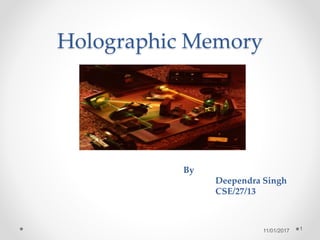

Holographic Memory
11/01/2017 1
By
Deependra Singh
CSE/27/13
Introduction
 Data storage has been a fundamental part of computing from
the beginning.
 currently dominated data storage methods are Optical data
storage and Magnetic data storage.
 In order to increase storage capabilities new Optical storage is
introduced called Holographic Memory.
 Holographic storage is capable of recording and reading millions of
bits in parallel, enabling data transfer rates greater than those
attained by traditional optical storage.
11/01/2017 2
What is Holographic Memory
 Holographic memory is a three-dimensional data storage
system that can store information at high density inside
the crystal or photopolymer.
 It is a memory that can store information in the form of
holographic image (hologram).
 It can store up to 1-4 TB of information in a sugar
cube sized crystal.
11/01/2017 3
History
 Holography is invented in 1947 by the Hungarian-British
physicist Dennis Gabor, who won a Nobel Prize for his
invention in 1971.
 Scientist Pieter J. Van Heerdan proposed the idea of
holographic memory in 1960s.
11/01/2017 4
Reasons for Developing
Holographic Storage
o Replacement as a backup media
• Higher data density than tape and current Hard
Drives
• Data is stable for an estimated 50 years without
degrading
• Faster read and write speeds
o Replacement for DVD
• Higher data density than Blu-Ray
• Faster read and write speeds
• Higher ceiling for max data storage capability
• Increasing resolutions for TVs will require more
storage for movies and games 11/01/2017 5
Holographic Versatile
Disk(HVDs)
1/17/2017 6
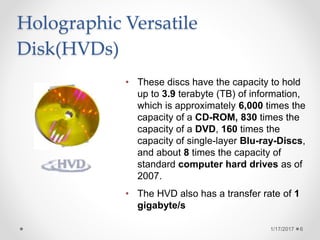
• These discs have the capacity to hold
up to 3.9 terabyte (TB) of information,
which is approximately 6,000 times the
capacity of a CD-ROM, 830 times the
capacity of a DVD, 160 times the
capacity of single-layer Blu-ray-Discs,
and about 8 times the capacity of
standard computer hard drives as of
2007.
• The HVD also has a transfer rate of 1
gigabyte/s
Components
Basic components that are needed to construct an HVD
system
 Blue-green argon laser
 Beam splitter to split the laser beam
 Mirrors to direct the laser beam
 Spatial light modulator (SLM)
 Lances to focus the laser beam
 Lithium-niobate crystal or photopolymer
 Charged coupled device camera (CCD)
11/01/2017 7
The HVD system: writing data
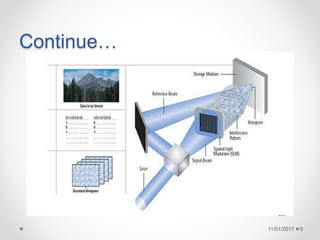
 When the blue-green argon laser is fired ,a beam
splitter creates two beams, a signal beam and a
reference beam.
 The signal beam passes through a SLM where digital
information, organized in a page(2-D plane) like
format of ones and zeroes, is modulated onto the
signal beam as a two dimensional pattern of
brightness and darkness.
 When the two beams intersect, the interference
pattern is created which stores the data carried by the
signal beam. The stored data is called hologram.
11/01/2017 8
Continue…
11/01/2017 9
The HVD system: reading data
11/01/2017 10
To retrieve data, the
reference beam is
focused on the
hologram at a
particular angle ;
this will retrieve the
modulated data
stored at the same
angle of interference
.
11/01/2017 11
1 Bit
Data
Surface
Recording
Layer
Substrate
Conventional Optical Disc
Page
Data
Volumetric
Recording
Layer
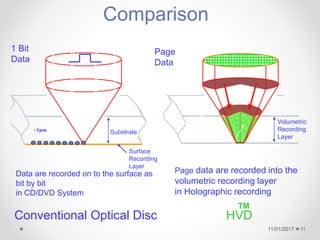
Page data are recorded into the
volumetric recording layer
in Holographic recording
HVD
~1μm
TM
Data are recorded on to the surface as
bit by bit
in CD/DVD System
Comparison
11/01/2017 12
Capacity: 700 mb Capacity: 30-50Gb
Capacity:1-4TBCapacity: 4.7Gb
Why has it taken so long to
develop an HDSS ?
• Lack of components
• Components that are supposed to be used were much
larger and more expensive
• For example
o Laser would have been 6 feet long
o LCDs were not developed until 1968
o CCD was not available until last decade
11/01/2017 13
Advantages
• Resistance to damage - If some parts of the medium are
damaged, all information can still be obtained from other
parts.
• Efficient retrieval - All information can be retrieved from
any part of the medium.
• Theoretical data storage of >1TB/cubic centimeter
oCurrent technology can store approximately 4TB on a DVD
sized disc(HVDs)
• Data longevity
11/01/2017 14
11/01/2017 15
•Data security
oWORM (Write-once read-many) prevents data
from being overwritten
• Faster Read/Write speeds
oData can be read and written in parallel instead of
linearly
oHigher speeds are necessary as storage amounts
increase
Limitations
• Not a guaranteed market leader
o If another technology becomes the industry standard
then read/write equipment will be hard to find
• Expensive development
o Existing technology is becoming better and cheaper
o It is difficult to market a product that is more
expensive per GB of storage.
11/01/2017 16
11/01/2017 17
APPLICATIONS
 A) Petaflop Computing
 B) Data Mining
 C) Future Computing System
11/01/2017 18
CONCLUSION
• In conclusion, Holographic Storage has the advantage
over other storage mediums as it relates to:
o Storage Capacity
o Transfer Rate
o Backup
• Its main disadvantage is its cost of ownership.
• Keep in mind, when Blu-ray was Introduced in 2006, a
25gigabyte disc cost nearly $1 a gigabyte. Its about half
the cost now. Overtime, the overall cost of holographic
data storage should decrease to an acceptable amount.
11/01/2017 19
Thank
You !!

Holographic memory

  • 1.
  • 2.
    Introduction  Data storagehas been a fundamental part of computing from the beginning.  currently dominated data storage methods are Optical data storage and Magnetic data storage.  In order to increase storage capabilities new Optical storage is introduced called Holographic Memory.  Holographic storage is capable of recording and reading millions of bits in parallel, enabling data transfer rates greater than those attained by traditional optical storage. 11/01/2017 2
  • 3.
    What is HolographicMemory  Holographic memory is a three-dimensional data storage system that can store information at high density inside the crystal or photopolymer.  It is a memory that can store information in the form of holographic image (hologram).  It can store up to 1-4 TB of information in a sugar cube sized crystal. 11/01/2017 3
  • 4.
    History  Holography isinvented in 1947 by the Hungarian-British physicist Dennis Gabor, who won a Nobel Prize for his invention in 1971.  Scientist Pieter J. Van Heerdan proposed the idea of holographic memory in 1960s. 11/01/2017 4
  • 5.
    Reasons for Developing HolographicStorage o Replacement as a backup media • Higher data density than tape and current Hard Drives • Data is stable for an estimated 50 years without degrading • Faster read and write speeds o Replacement for DVD • Higher data density than Blu-Ray • Faster read and write speeds • Higher ceiling for max data storage capability • Increasing resolutions for TVs will require more storage for movies and games 11/01/2017 5
  • 6.
    Holographic Versatile Disk(HVDs) 1/17/2017 6 •These discs have the capacity to hold up to 3.9 terabyte (TB) of information, which is approximately 6,000 times the capacity of a CD-ROM, 830 times the capacity of a DVD, 160 times the capacity of single-layer Blu-ray-Discs, and about 8 times the capacity of standard computer hard drives as of 2007. • The HVD also has a transfer rate of 1 gigabyte/s
  • 7.
    Components Basic components thatare needed to construct an HVD system  Blue-green argon laser  Beam splitter to split the laser beam  Mirrors to direct the laser beam  Spatial light modulator (SLM)  Lances to focus the laser beam  Lithium-niobate crystal or photopolymer  Charged coupled device camera (CCD) 11/01/2017 7
  • 8.
    The HVD system:writing data  When the blue-green argon laser is fired ,a beam splitter creates two beams, a signal beam and a reference beam.  The signal beam passes through a SLM where digital information, organized in a page(2-D plane) like format of ones and zeroes, is modulated onto the signal beam as a two dimensional pattern of brightness and darkness.  When the two beams intersect, the interference pattern is created which stores the data carried by the signal beam. The stored data is called hologram. 11/01/2017 8
  • 9.
  • 10.
    The HVD system:reading data 11/01/2017 10 To retrieve data, the reference beam is focused on the hologram at a particular angle ; this will retrieve the modulated data stored at the same angle of interference .
  • 11.
    11/01/2017 11 1 Bit Data Surface Recording Layer Substrate ConventionalOptical Disc Page Data Volumetric Recording Layer Page data are recorded into the volumetric recording layer in Holographic recording HVD ~1μm TM Data are recorded on to the surface as bit by bit in CD/DVD System Comparison
  • 12.
    11/01/2017 12 Capacity: 700mb Capacity: 30-50Gb Capacity:1-4TBCapacity: 4.7Gb
  • 13.
    Why has ittaken so long to develop an HDSS ? • Lack of components • Components that are supposed to be used were much larger and more expensive • For example o Laser would have been 6 feet long o LCDs were not developed until 1968 o CCD was not available until last decade 11/01/2017 13
  • 14.
    Advantages • Resistance todamage - If some parts of the medium are damaged, all information can still be obtained from other parts. • Efficient retrieval - All information can be retrieved from any part of the medium. • Theoretical data storage of >1TB/cubic centimeter oCurrent technology can store approximately 4TB on a DVD sized disc(HVDs) • Data longevity 11/01/2017 14
  • 15.
    11/01/2017 15 •Data security oWORM(Write-once read-many) prevents data from being overwritten • Faster Read/Write speeds oData can be read and written in parallel instead of linearly oHigher speeds are necessary as storage amounts increase
  • 16.
    Limitations • Not aguaranteed market leader o If another technology becomes the industry standard then read/write equipment will be hard to find • Expensive development o Existing technology is becoming better and cheaper o It is difficult to market a product that is more expensive per GB of storage. 11/01/2017 16
  • 17.
    11/01/2017 17 APPLICATIONS  A)Petaflop Computing  B) Data Mining  C) Future Computing System
  • 18.
    11/01/2017 18 CONCLUSION • Inconclusion, Holographic Storage has the advantage over other storage mediums as it relates to: o Storage Capacity o Transfer Rate o Backup • Its main disadvantage is its cost of ownership. • Keep in mind, when Blu-ray was Introduced in 2006, a 25gigabyte disc cost nearly $1 a gigabyte. Its about half the cost now. Overtime, the overall cost of holographic data storage should decrease to an acceptable amount.
  • 19.