

RAINBOW TECHNOLOGY
DEPARTMENT OF ELECTRONICS AND COMMUNICATION
ST.ANN’S COLLEGE OF ENGINEERING & TECHNOLGY
CHIRALA
BY
P.Aswanth
Contents:-
 Introduction
 Process
 Working
 Block Diagram
 Data encoding
 Data decoding
 Principles
 Advantages
 Disadvantages
 Conclusion
Introduction:-
 Rainbow Technology is a group of techniques to store digital data in some colors , color
combinations and some symbols known as rainbow format and therefore a rainbow
picture will be generated.
 Rainbow technology, a breakthrough in digital storage data enables us to store upto a
massive 450GB on just a piece of paper.
 With the help of rainbow system we would be watching full-length high-definition videos
from a piece of paper.
Process:-
Working:-
It uses geometric shapes such as squares and hexagons to represent data patterns,
instead of the usual binary method that uses ones and zeros to represent data.
 Besides, color is also used in the Rainbow system, to represent other data elements.
Files such as text, images, sounds and video clips are encoded in "rainbow format" as
colored circles, triangles, squares and so on, and printed as dense graphics on paper at
a density of 2.7GB per square inch.
Data encoding:-
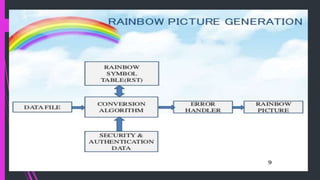
Data to data conversion techniques takes place in four steps
A chunk of data bits are taken from data source(Normally binary file),which is known as a
word.
A word can be converted into a value that will be unique each different combination of bits
The value then passes through some error checking mechanisms . After producing some
error correction bits , it will attach to the data picture.
Thus the final output (data picture)will be generated.
 Here some absolute rainbow dots are printed along with the data to detect and correct errors.
Data Decoding:-
• Data picture is taken as input and the parameters like UPD,PBM,etc are read from
the header
• Value mapping function are used for mapping the arrangements done on actual data
• Some errors that occur due to color fading can also be handled at this stage.The
values are passed through some error correction mechanism.Automatic repairs are
also done here.
• Then the value to word conversion takes place.The encoded data picture is hence
decoded into the result data which will be the original data.
Principles:-
PRINCIPLE-1:
“Every different color or color combinations will produce different values.”
PRINCIPLE-2:
“Every color or color combinations can be converted in to some values and from the
values the colors or color combinations can be regenerated.”
Advantages:-
 Data can be stored on an ordinary paper.
 Larger amount of data can be had on lesser space.
 The extremely low-cost technology will drastically reduce the cost of storage and
provide for high speed storage too.
 Biodegradable nature of the storage devices would do away with the e-waste
pollution.
Disadvantages:-
 1.The paper has the tendency to fade away hence the data loss may occur.
conclusion:-
Once the Rainbow technology is in, soon we would be watching full-
length high-definition videos from a piece of paper!
With the popularity of the Rainbow Technology, computer or fashion
magazines in future need not carry CDs in a pack.
It is a
PRESENTATION

Rainbow technology

  • 1.
    RAINBOW TECHNOLOGY DEPARTMENT OFELECTRONICS AND COMMUNICATION ST.ANN’S COLLEGE OF ENGINEERING & TECHNOLGY CHIRALA BY P.Aswanth
  • 2.
    Contents:-  Introduction  Process Working  Block Diagram  Data encoding  Data decoding  Principles  Advantages  Disadvantages  Conclusion
  • 3.
    Introduction:-  Rainbow Technologyis a group of techniques to store digital data in some colors , color combinations and some symbols known as rainbow format and therefore a rainbow picture will be generated.  Rainbow technology, a breakthrough in digital storage data enables us to store upto a massive 450GB on just a piece of paper.  With the help of rainbow system we would be watching full-length high-definition videos from a piece of paper.
  • 4.
  • 5.
    Working:- It uses geometricshapes such as squares and hexagons to represent data patterns, instead of the usual binary method that uses ones and zeros to represent data.  Besides, color is also used in the Rainbow system, to represent other data elements. Files such as text, images, sounds and video clips are encoded in "rainbow format" as colored circles, triangles, squares and so on, and printed as dense graphics on paper at a density of 2.7GB per square inch.
  • 7.
    Data encoding:- Data todata conversion techniques takes place in four steps A chunk of data bits are taken from data source(Normally binary file),which is known as a word. A word can be converted into a value that will be unique each different combination of bits The value then passes through some error checking mechanisms . After producing some error correction bits , it will attach to the data picture. Thus the final output (data picture)will be generated.  Here some absolute rainbow dots are printed along with the data to detect and correct errors.
  • 8.
    Data Decoding:- • Datapicture is taken as input and the parameters like UPD,PBM,etc are read from the header • Value mapping function are used for mapping the arrangements done on actual data • Some errors that occur due to color fading can also be handled at this stage.The values are passed through some error correction mechanism.Automatic repairs are also done here. • Then the value to word conversion takes place.The encoded data picture is hence decoded into the result data which will be the original data.
  • 9.
    Principles:- PRINCIPLE-1: “Every different coloror color combinations will produce different values.” PRINCIPLE-2: “Every color or color combinations can be converted in to some values and from the values the colors or color combinations can be regenerated.”
  • 10.
    Advantages:-  Data canbe stored on an ordinary paper.  Larger amount of data can be had on lesser space.  The extremely low-cost technology will drastically reduce the cost of storage and provide for high speed storage too.  Biodegradable nature of the storage devices would do away with the e-waste pollution.
  • 11.
    Disadvantages:-  1.The paperhas the tendency to fade away hence the data loss may occur.
  • 12.
    conclusion:- Once the Rainbowtechnology is in, soon we would be watching full- length high-definition videos from a piece of paper! With the popularity of the Rainbow Technology, computer or fashion magazines in future need not carry CDs in a pack.
  • 15.