HOLOGRAPHIC DATA STORAGE Technology (HDST)
SANJAY KUMAR DHRITLAHARE (15EC65R15)
Branch - VIPES – 2015, M.Tech. 1st Year
Department Of Electronics and Electrical Communication
Engineering
1
CONTENTS
History of Data Storage
Medias
Hologram and Holographic
Memory
Holographic Data Storage
Need and Reason for
Technology
Types of Holography
Working : Recording, Reading
Process and Instruments
HVDs
Advantages and Features
Comparison with other data
storage medias
Some Interesting facts about
HDST
Limitations and Challenges
Applications
References
2
History of Data Storage Medias
Magnetic Storage Media
1. Magnetic Tape
2. Floppy Disc
3. Hard Drives
Optical Storage Media
1. Compact Disc
2. DVD
3. HD-DVD/Blu-Ray
4. Holographic Versatile Disc (HVD)
3
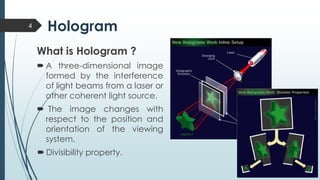
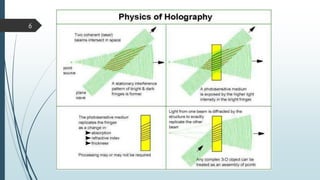
Hologram
What is Hologram ?
 A three-dimensional image
formed by the interference
of light beams from a laser or
other coherent light source.
 The image changes with
respect to the position and
orientation of the viewing
system.
 Divisibility property.
4
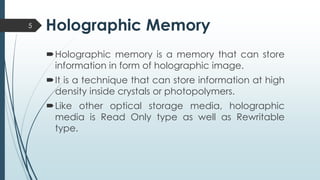
Holographic Memory5
Holographic memory is a memory that can store
information in form of holographic image.
It is a technique that can store information at high
density inside crystals or photopolymers.
Like other optical storage media, holographic
media is Read Only type as well as Rewritable
type.
6
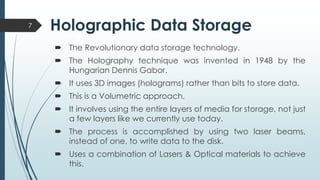
Holographic Data Storage
 The Revolutionary data storage technology.
 The Holography technique was invented in 1948 by the
Hungarian Dennis Gabor.
 It uses 3D images (holograms) rather than bits to store data.
 This is a Volumetric approach.
 It involves using the entire layers of media for storage, not just
a few layers like we currently use today.
 The process is accomplished by using two laser beams,
instead of one, to write data to the disk.
 Uses a combination of Lasers & Optical materials to achieve
this.
7
NEED OF HDST
 “For Internet applications alone, industry estimates
are that storage needs are doubling every 100
days” -Nelson Diaz, Lucent Technologies
 So to minimize the no of storage media with
increase in storage capacity.
 To bet Speed retrieval, transfer and search of data.
8
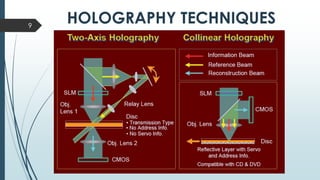
HOLOGRAPHY TECHNIQUES9
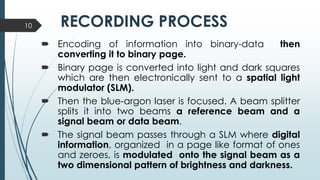
RECORDING PROCESS
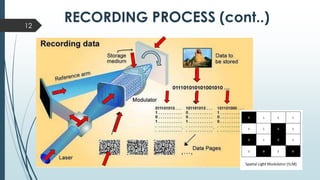
 Encoding of information into binary-data then
converting it to binary page.
 Binary page is converted into light and dark squares
which are then electronically sent to a spatial light
modulator (SLM).
 Then the blue-argon laser is focused. A beam splitter
splits it into two beams a reference beam and a
signal beam or data beam.
 The signal beam passes through a SLM where digital
information, organized in a page like format of ones
and zeroes, is modulated onto the signal beam as a
two dimensional pattern of brightness and darkness.
10
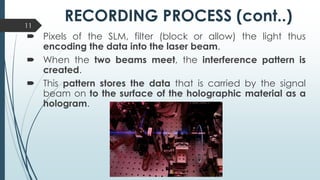
RECORDING PROCESS (cont..)
 Pixels of the SLM, filter (block or allow) the light thus
encoding the data into the laser beam.
 When the two beams meet, the interference pattern is
created.
 This pattern stores the data that is carried by the signal
beam on to the surface of the holographic material as a
hologram.
11
RECORDING PROCESS (cont..)12
READING PROCESS
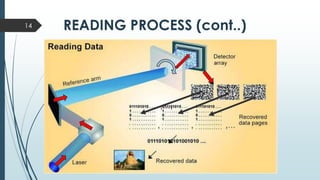
In order to retrieve the data, reference beam is
shined into the crystal at exactly the same
recording angle.
Diffracts the laser beam according to the
interference pattern stored to allow the recreation
of the original page that was stored.
This reconstructed page is then projected onto the
charge-coupled device (CCD) camera.
And finally information is retrieved.
13
READING PROCESS (cont..)14
HOLOGRAPHIC RECORDER & READER15
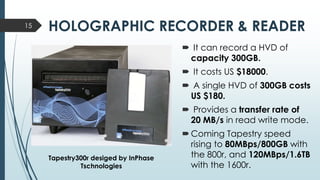
 It can record a HVD of
capacity 300GB.
 It costs US $18000.
 A single HVD of 300GB costs
US $180.
 Provides a transfer rate of
20 MB/s in read write mode.
Coming Tapestry speed
rising to 80MBps/800GB with
the 800r, and 120MBps/1.6TB
with the 1600r.
Tapestry300r desiged by InPhase
Tschnologies
HOLOGRAPHIC VERSATILE DISC (HVD)
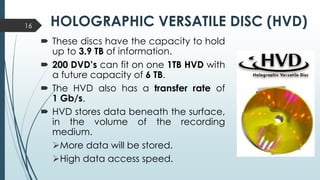
 These discs have the capacity to hold
up to 3.9 TB of information.
 200 DVD’s can fit on one 1TB HVD with
a future capacity of 6 TB.
 The HVD also has a transfer rate of
1 Gb/s.
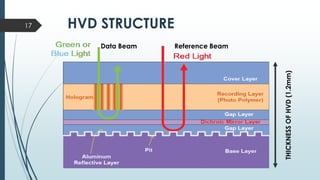
 HVD stores data beneath the surface,
in the volume of the recording
medium.
More data will be stored.
High data access speed.
16
HVD STRUCTURE17
THICKNESSOFHVD(1.2mm)
Data Beam Reference Beam
ADVANTAGES OF HDST
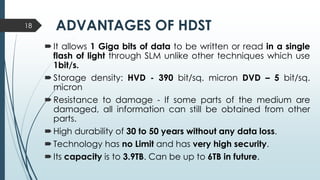
It allows 1 Giga bits of data to be written or read in a single
flash of light through SLM unlike other techniques which use
1bit/s.
Storage density: HVD - 390 bit/sq. micron DVD – 5 bit/sq.
micron
Resistance to damage - If some parts of the medium are
damaged, all information can still be obtained from other
parts.
High durability of 30 to 50 years without any data loss.
Technology has no Limit and has very high security.
Its capacity is to 3.9TB. Can be up to 6TB in future.
18
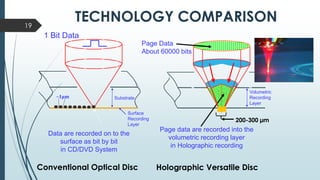
TECHNOLOGY COMPARISON19
Data are recorded on to the
surface as bit by bit
in CD/DVD System
1 Bit Data
Surface
Recording
Layer
Substrate
Page Data
About 60000 bits
Volumetric
Recording
Layer
Page data are recorded into the
volumetric recording layer
in Holographic recording
~1μm
200-300 µm
Conventional Optical Disc Holographic Versatile Disc
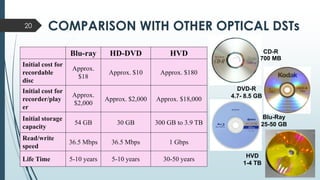
COMPARISON WITH OTHER OPTICAL DSTs20
Blu-ray HD-DVD HVD
Initial cost for
recordable
disc
Approx.
$18
Approx. $10 Approx. $180
Initial cost for
recorder/play
er
Approx.
$2,000
Approx. $2,000 Approx. $18,000
Initial storage
capacity
54 GB 30 GB 300 GB to 3.9 TB
Read/write
speed
36.5 Mbps 36.5 Mbps 1 Gbps
Life Time 5-10 years 5-10 years 30-50 years
CD-R
700 MB
DVD-R
4.7- 8.5 GB
Blu-Ray
25-50 GB
HVD
1-4 TB
SOME INTERESTING FACTS
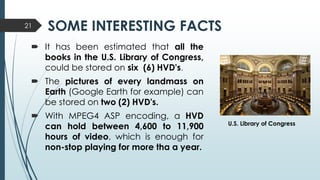
 It has been estimated that all the
books in the U.S. Library of Congress,
could be stored on six (6) HVD's.
 The pictures of every landmass on
Earth (Google Earth for example) can
be stored on two (2) HVD's.
 With MPEG4 ASP encoding, a HVD
can hold between 4,600 to 11,900
hours of video, which is enough for
non-stop playing for more tha a year.
21
U.S. Library of Congress
LIMITATIONS AND CHALLENGES
 If too many pages are stored in one
crystal/photopolymer, the strength of each hologram
gets diminished.
 Aligning all of the HVD components which are very
costly, in a low-cost system.
 It is very difficult to arrange properly all of those
components like CCD camera , SLM arrays and beam
steering devices.
 Needs good recordings sensitive material to allow high
data transfer rate.
 As now not compatible with CD/DVD’s.
22
FUTURE APPLICATIONS23
PetaFLOP Computing (1015 FLOPS)
(FLoating-point Operations Per Second)
Data Mining
Future Computing System
INVOLVED COMPANIES
InPhase Technologies
Lucent Technologies
REFERENCES
[1] Benjamin Alfonsi, “Holographic Storage Ready for Market," IEEE Distributed
Systems Online, vol. 6, no. 10,2005.
[2] Lambertus Hesselink, Sergei S. Orlov, and Matthew C. Bashaw, “Holographic
Data Storage Systems”, Proceedings Of The IEEE, vol. 92, no. 8, August 2004.
[3] Demetri Psaltis, California Institute of Technology, Geoffrey W. Burr IBM
Almaden Research Center, “Holographic Data Storage”, 1998 IEEE.
[4] Aware Sachin B., Choudhary Anup S., Nannaware Madhuri M., Manjare
Ganesh B. “Three Dimensional Data Storage”, International Journal of Scientific
& Engineering Research, Vol. 3, Issue 12, December-2012.
[5] InPhase Technologies, Longmont, Colorado, http://www.inphase-
technologies.com/
[6] Wikipedia web site, http://en.wikipedia.org/wiki/Holo graphic_data_storage
[7] Youtube video on Holographic data storage,
https://www.youtube.com/watch?v=R-NllWcgrFg
24

Holographic data storage technolohy

  • 1.
    HOLOGRAPHIC DATA STORAGETechnology (HDST) SANJAY KUMAR DHRITLAHARE (15EC65R15) Branch - VIPES – 2015, M.Tech. 1st Year Department Of Electronics and Electrical Communication Engineering 1
  • 2.
    CONTENTS History of DataStorage Medias Hologram and Holographic Memory Holographic Data Storage Need and Reason for Technology Types of Holography Working : Recording, Reading Process and Instruments HVDs Advantages and Features Comparison with other data storage medias Some Interesting facts about HDST Limitations and Challenges Applications References 2
  • 3.
    History of DataStorage Medias Magnetic Storage Media 1. Magnetic Tape 2. Floppy Disc 3. Hard Drives Optical Storage Media 1. Compact Disc 2. DVD 3. HD-DVD/Blu-Ray 4. Holographic Versatile Disc (HVD) 3
  • 4.
    Hologram What is Hologram?  A three-dimensional image formed by the interference of light beams from a laser or other coherent light source.  The image changes with respect to the position and orientation of the viewing system.  Divisibility property. 4
  • 5.
    Holographic Memory5 Holographic memoryis a memory that can store information in form of holographic image. It is a technique that can store information at high density inside crystals or photopolymers. Like other optical storage media, holographic media is Read Only type as well as Rewritable type.
  • 6.
  • 7.
    Holographic Data Storage The Revolutionary data storage technology.  The Holography technique was invented in 1948 by the Hungarian Dennis Gabor.  It uses 3D images (holograms) rather than bits to store data.  This is a Volumetric approach.  It involves using the entire layers of media for storage, not just a few layers like we currently use today.  The process is accomplished by using two laser beams, instead of one, to write data to the disk.  Uses a combination of Lasers & Optical materials to achieve this. 7
  • 8.
    NEED OF HDST “For Internet applications alone, industry estimates are that storage needs are doubling every 100 days” -Nelson Diaz, Lucent Technologies  So to minimize the no of storage media with increase in storage capacity.  To bet Speed retrieval, transfer and search of data. 8
  • 9.
  • 10.
    RECORDING PROCESS  Encodingof information into binary-data then converting it to binary page.  Binary page is converted into light and dark squares which are then electronically sent to a spatial light modulator (SLM).  Then the blue-argon laser is focused. A beam splitter splits it into two beams a reference beam and a signal beam or data beam.  The signal beam passes through a SLM where digital information, organized in a page like format of ones and zeroes, is modulated onto the signal beam as a two dimensional pattern of brightness and darkness. 10
  • 11.
    RECORDING PROCESS (cont..) Pixels of the SLM, filter (block or allow) the light thus encoding the data into the laser beam.  When the two beams meet, the interference pattern is created.  This pattern stores the data that is carried by the signal beam on to the surface of the holographic material as a hologram. 11
  • 12.
  • 13.
    READING PROCESS In orderto retrieve the data, reference beam is shined into the crystal at exactly the same recording angle. Diffracts the laser beam according to the interference pattern stored to allow the recreation of the original page that was stored. This reconstructed page is then projected onto the charge-coupled device (CCD) camera. And finally information is retrieved. 13
  • 14.
  • 15.
    HOLOGRAPHIC RECORDER &READER15  It can record a HVD of capacity 300GB.  It costs US $18000.  A single HVD of 300GB costs US $180.  Provides a transfer rate of 20 MB/s in read write mode. Coming Tapestry speed rising to 80MBps/800GB with the 800r, and 120MBps/1.6TB with the 1600r. Tapestry300r desiged by InPhase Tschnologies
  • 16.
    HOLOGRAPHIC VERSATILE DISC(HVD)  These discs have the capacity to hold up to 3.9 TB of information.  200 DVD’s can fit on one 1TB HVD with a future capacity of 6 TB.  The HVD also has a transfer rate of 1 Gb/s.  HVD stores data beneath the surface, in the volume of the recording medium. More data will be stored. High data access speed. 16
  • 17.
  • 18.
    ADVANTAGES OF HDST Itallows 1 Giga bits of data to be written or read in a single flash of light through SLM unlike other techniques which use 1bit/s. Storage density: HVD - 390 bit/sq. micron DVD – 5 bit/sq. micron Resistance to damage - If some parts of the medium are damaged, all information can still be obtained from other parts. High durability of 30 to 50 years without any data loss. Technology has no Limit and has very high security. Its capacity is to 3.9TB. Can be up to 6TB in future. 18
  • 19.
    TECHNOLOGY COMPARISON19 Data arerecorded on to the surface as bit by bit in CD/DVD System 1 Bit Data Surface Recording Layer Substrate Page Data About 60000 bits Volumetric Recording Layer Page data are recorded into the volumetric recording layer in Holographic recording ~1μm 200-300 µm Conventional Optical Disc Holographic Versatile Disc
  • 20.
    COMPARISON WITH OTHEROPTICAL DSTs20 Blu-ray HD-DVD HVD Initial cost for recordable disc Approx. $18 Approx. $10 Approx. $180 Initial cost for recorder/play er Approx. $2,000 Approx. $2,000 Approx. $18,000 Initial storage capacity 54 GB 30 GB 300 GB to 3.9 TB Read/write speed 36.5 Mbps 36.5 Mbps 1 Gbps Life Time 5-10 years 5-10 years 30-50 years CD-R 700 MB DVD-R 4.7- 8.5 GB Blu-Ray 25-50 GB HVD 1-4 TB
  • 21.
    SOME INTERESTING FACTS It has been estimated that all the books in the U.S. Library of Congress, could be stored on six (6) HVD's.  The pictures of every landmass on Earth (Google Earth for example) can be stored on two (2) HVD's.  With MPEG4 ASP encoding, a HVD can hold between 4,600 to 11,900 hours of video, which is enough for non-stop playing for more tha a year. 21 U.S. Library of Congress
  • 22.
    LIMITATIONS AND CHALLENGES If too many pages are stored in one crystal/photopolymer, the strength of each hologram gets diminished.  Aligning all of the HVD components which are very costly, in a low-cost system.  It is very difficult to arrange properly all of those components like CCD camera , SLM arrays and beam steering devices.  Needs good recordings sensitive material to allow high data transfer rate.  As now not compatible with CD/DVD’s. 22
  • 23.
    FUTURE APPLICATIONS23 PetaFLOP Computing(1015 FLOPS) (FLoating-point Operations Per Second) Data Mining Future Computing System INVOLVED COMPANIES InPhase Technologies Lucent Technologies
  • 24.
    REFERENCES [1] Benjamin Alfonsi,“Holographic Storage Ready for Market," IEEE Distributed Systems Online, vol. 6, no. 10,2005. [2] Lambertus Hesselink, Sergei S. Orlov, and Matthew C. Bashaw, “Holographic Data Storage Systems”, Proceedings Of The IEEE, vol. 92, no. 8, August 2004. [3] Demetri Psaltis, California Institute of Technology, Geoffrey W. Burr IBM Almaden Research Center, “Holographic Data Storage”, 1998 IEEE. [4] Aware Sachin B., Choudhary Anup S., Nannaware Madhuri M., Manjare Ganesh B. “Three Dimensional Data Storage”, International Journal of Scientific & Engineering Research, Vol. 3, Issue 12, December-2012. [5] InPhase Technologies, Longmont, Colorado, http://www.inphase- technologies.com/ [6] Wikipedia web site, http://en.wikipedia.org/wiki/Holo graphic_data_storage [7] Youtube video on Holographic data storage, https://www.youtube.com/watch?v=R-NllWcgrFg 24