RAINBOW TECHNOLOGY


            PRESENTED BY:
            RAJESH.J
CONTENTS:

•   INTRODUCTION
•   HOW IS IT POSSIBLE?
•   PROCESS OF STORING DATA
•   IMPLEMENTATION & PROCESSING
•   COMPARASION WITH OTHER STORAGE DEVICES
•   ADVATAGES
•   DISADVANTAGES
•   CONCLUSION
•   REFERENCES
INTRODUCTION
•   Rainbow technology, a breakthrough in digital data storage enables us
    to store up to a massive 450 GB on just a piece of paper.

•   Rainbow Storage is a group of techniques to store digital data in some
    colors, color combinations and some symbols known as rainbow
    format, and therefore a rainbow picture will be generated.

•   With the help of Rainbow system we would be watching full-length
    high-definition videos from a piece of paper.
HOW IS IT POSSIBLE?


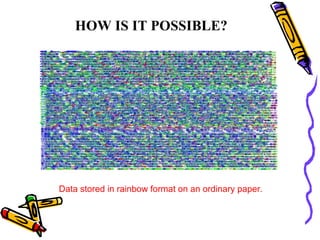
Data stored in rainbow format on an ordinary paper.
 It uses geometric shapes such as squares and hexagons to represent data
  patterns, instead of the usual binary method that uses ones and zeros to
  represent data.

 Files such as text, images, sounds and video clips are encoded in "rainbow
  format" as colored circles, triangles, squares and so on, and printed as dense
  graphics on paper at a density of 2.7GB per square inch.

 By printing much higher data encoded capacities can be achieved. The
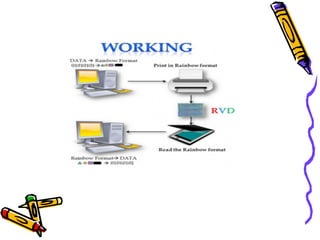
  retrieval of data is done by scanning the paper or the plastic sheet
  containing the data into a scanner and later reading it over monitor .
 Instead of using 0s and 1s, we use color dots where each color dot can
  represent minimum 8 bits (1 byte). The rainbow picture will be highly
  compressed and can be represented in any color medium.

 "Although environmental light differences and color shading is a
  problem, it can overcome up to a certain limit by using efficient
  mapping functions".
Process of Storing data
•   Printing at 1,200 dots per inch (DPI) leads to a theoretical maximum
    of 1,440,000 colored dots per square inch.

•   If a scanner can reliably distinguish between 256 unique colors, the
    maximum possible storage is approximately 140 megabytes for a
    sheet of A4 paper.

•   If the scanner were able to accurately distinguish between 16,777,216
    colors (24 bits, or 3 bytes per dot), the capacity would triple claims
    of several hundred gigabytes.
At least one of three things must be true for the claim to be valid:
 The paper must be printed and scanned at a much higher resolution
   than 1,200 DPI,
 The printer and scanner must be able to accurately produce and
   distinguish between an extraordinary number of distinct color values
 The compression scheme must be a revolutionary lossless
   compression algorithm.
    a lossless compression algorithm that could store 250 GB
    within a few hundred megabytes of data. Likewise, data can be
    compressed with any algorithm and subsequently printed to
    paper as colored dots.
IMPLEMENTATION REQUIREMENTS:


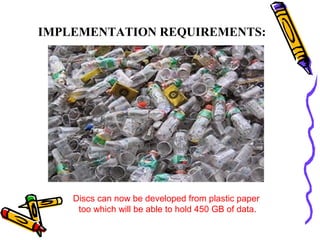
    Discs can now be developed from plastic paper
     too which will be able to hold 450 GB of data.
 The piece of paper or even plastic sheet storing the data has just to be
  scanned in the scanner and read over the monitor.

 The developer is simultaneously moulding the technology into 'Rainbow
  Cards' which will be of SIM card size and store 5 GB of data equivalent to
  three films of DVD quality.

 As 'Rainbow Cards' will become Popular, Rainbow Card Readers will
  replace CD drives of mobile phone and computer notebooks

 Large scale manufacture of the Rainbow card will bring down its cost to
  just 50 paise.
• Principle I
       “Every color or color combinations can be converted in to some
  values and from the values the colors or color combinations can be
  regenerated”.

• Principle II
        “Every different color or color combinations will produce
  different values”.
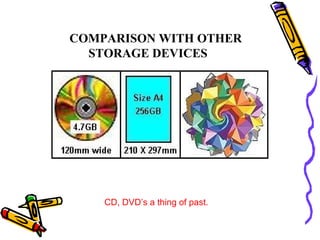
COMPARISON WITH OTHER
  STORAGE DEVICES


    CD, DVD’s a thing of past.
 Currently, of the several options available for data storage, DVDs are the
  best mode, but are yet expensive.

 While a CD costs Rs. 15, his paper or plastic-made RVD will cost just
  about Rs. 1.50 and will even have 131 times more storage capacity.

 Using this technology an A4 sheet of paper could store 450 GB of data. In
  comparison, a DVD can store 4.7GB of data.

 Paper is, of course, bio-degradable, unlike CDs or DVDs. And sheets of
  paper also cost a fraction of the cost of a CD or DVD.
ADVANTAGES

 The extremely low-cost technology will drastically reduce the cost of
  storage and provide for high speed storage too.

 Files in any format like movie files, songs, images, text can be stored
  using this technology.

 The biodegradable nature of the storage devices would do away with
  the e-waste pollution.

 The four main storage devices made using this technology are RVD,
  Disposable storage, Data Banks, Rainbow cards.
 Rainbow cards can be used in mobile devices in place of DVDs & VCDs.

 The rainbow cards can solve this problem. Un-authorized copies of the
  films can be controlled to a certain limits using these cards.

 Another theme put forward by rainbow technology is the Data Banks. it is
  huge server with a high storage capacity.

 As per a research project done in US in 2003 to store the available static
  data, the server required will cost $500 crores(23000 crores). But by using
  data banks ,a similar server can be made with Rs.35 lacks.
DISADVANTAGES

•   The paper has the tendency to fade away hence the data loss may
    occur.

•   With the extremely low cost of using this technology we can always
    afford to have multiple copies.
CONCLUSION

 Once the Rainbow technology is in, soon we would be watching full-
  length high-definition videos from a piece of paper!

 With the popularity of the Rainbow Technology, computer or fashion
  magazines in future need not carry CDs in a pack.

 It should cost a lot less to produce than the typical polycarbonate
  DVDs, CDs and now Blu- rays. Huge data banks can be constructed
  out of Rainbow-based storage medium.
REFERENCES
 "Data Can Now Be Stored on Paper" by M. A. Siraj, Arab News (published
  November 18, 2006; accessed November 29, 2006)
 Paper storage man misunderstood — The Inquirer article, 12 December 2006
  (retrieved 15 December 2006.
 "Store 256GB on an A4 sheet" by Chris Mellor, Techworld (published
  November 24, 2006; accessed November 29, 2006)
 IT Soup: Scam of Indian student developing technology to store 450 GB of
  data on a sheet of paper By IT Soup (published November 25, 2006; accessed
  November 25, 2006)
 "Can you get 256GB on an A4 sheet? No way!" By Chris Mellor, Techworld
  (published November 24, 2006; accessed November 29, 2006)
ANY QUERIS ?
THANK YOU

Rainbow technology-ppt

  • 1.
    RAINBOW TECHNOLOGY PRESENTED BY: RAJESH.J
  • 2.
    CONTENTS: • INTRODUCTION • HOW IS IT POSSIBLE? • PROCESS OF STORING DATA • IMPLEMENTATION & PROCESSING • COMPARASION WITH OTHER STORAGE DEVICES • ADVATAGES • DISADVANTAGES • CONCLUSION • REFERENCES
  • 3.
    INTRODUCTION • Rainbow technology, a breakthrough in digital data storage enables us to store up to a massive 450 GB on just a piece of paper. • Rainbow Storage is a group of techniques to store digital data in some colors, color combinations and some symbols known as rainbow format, and therefore a rainbow picture will be generated. • With the help of Rainbow system we would be watching full-length high-definition videos from a piece of paper.
  • 4.
    HOW IS ITPOSSIBLE? Data stored in rainbow format on an ordinary paper.
  • 6.
     It usesgeometric shapes such as squares and hexagons to represent data patterns, instead of the usual binary method that uses ones and zeros to represent data.  Files such as text, images, sounds and video clips are encoded in "rainbow format" as colored circles, triangles, squares and so on, and printed as dense graphics on paper at a density of 2.7GB per square inch.  By printing much higher data encoded capacities can be achieved. The retrieval of data is done by scanning the paper or the plastic sheet containing the data into a scanner and later reading it over monitor .
  • 7.
     Instead ofusing 0s and 1s, we use color dots where each color dot can represent minimum 8 bits (1 byte). The rainbow picture will be highly compressed and can be represented in any color medium.  "Although environmental light differences and color shading is a problem, it can overcome up to a certain limit by using efficient mapping functions".
  • 8.
    Process of Storingdata • Printing at 1,200 dots per inch (DPI) leads to a theoretical maximum of 1,440,000 colored dots per square inch. • If a scanner can reliably distinguish between 256 unique colors, the maximum possible storage is approximately 140 megabytes for a sheet of A4 paper. • If the scanner were able to accurately distinguish between 16,777,216 colors (24 bits, or 3 bytes per dot), the capacity would triple claims of several hundred gigabytes.
  • 9.
    At least oneof three things must be true for the claim to be valid:  The paper must be printed and scanned at a much higher resolution than 1,200 DPI,  The printer and scanner must be able to accurately produce and distinguish between an extraordinary number of distinct color values  The compression scheme must be a revolutionary lossless compression algorithm. a lossless compression algorithm that could store 250 GB within a few hundred megabytes of data. Likewise, data can be compressed with any algorithm and subsequently printed to paper as colored dots.
  • 10.
    IMPLEMENTATION REQUIREMENTS: Discs can now be developed from plastic paper too which will be able to hold 450 GB of data.
  • 11.
     The pieceof paper or even plastic sheet storing the data has just to be scanned in the scanner and read over the monitor.  The developer is simultaneously moulding the technology into 'Rainbow Cards' which will be of SIM card size and store 5 GB of data equivalent to three films of DVD quality.  As 'Rainbow Cards' will become Popular, Rainbow Card Readers will replace CD drives of mobile phone and computer notebooks  Large scale manufacture of the Rainbow card will bring down its cost to just 50 paise.
  • 12.
    • Principle I “Every color or color combinations can be converted in to some values and from the values the colors or color combinations can be regenerated”. • Principle II “Every different color or color combinations will produce different values”.
  • 13.
    COMPARISON WITH OTHER STORAGE DEVICES CD, DVD’s a thing of past.
  • 14.
     Currently, ofthe several options available for data storage, DVDs are the best mode, but are yet expensive.  While a CD costs Rs. 15, his paper or plastic-made RVD will cost just about Rs. 1.50 and will even have 131 times more storage capacity.  Using this technology an A4 sheet of paper could store 450 GB of data. In comparison, a DVD can store 4.7GB of data.  Paper is, of course, bio-degradable, unlike CDs or DVDs. And sheets of paper also cost a fraction of the cost of a CD or DVD.
  • 15.
    ADVANTAGES  The extremelylow-cost technology will drastically reduce the cost of storage and provide for high speed storage too.  Files in any format like movie files, songs, images, text can be stored using this technology.  The biodegradable nature of the storage devices would do away with the e-waste pollution.  The four main storage devices made using this technology are RVD, Disposable storage, Data Banks, Rainbow cards.
  • 16.
     Rainbow cardscan be used in mobile devices in place of DVDs & VCDs.  The rainbow cards can solve this problem. Un-authorized copies of the films can be controlled to a certain limits using these cards.  Another theme put forward by rainbow technology is the Data Banks. it is huge server with a high storage capacity.  As per a research project done in US in 2003 to store the available static data, the server required will cost $500 crores(23000 crores). But by using data banks ,a similar server can be made with Rs.35 lacks.
  • 17.
    DISADVANTAGES • The paper has the tendency to fade away hence the data loss may occur. • With the extremely low cost of using this technology we can always afford to have multiple copies.
  • 18.
    CONCLUSION  Once theRainbow technology is in, soon we would be watching full- length high-definition videos from a piece of paper!  With the popularity of the Rainbow Technology, computer or fashion magazines in future need not carry CDs in a pack.  It should cost a lot less to produce than the typical polycarbonate DVDs, CDs and now Blu- rays. Huge data banks can be constructed out of Rainbow-based storage medium.
  • 19.
    REFERENCES  "Data CanNow Be Stored on Paper" by M. A. Siraj, Arab News (published November 18, 2006; accessed November 29, 2006)  Paper storage man misunderstood — The Inquirer article, 12 December 2006 (retrieved 15 December 2006.  "Store 256GB on an A4 sheet" by Chris Mellor, Techworld (published November 24, 2006; accessed November 29, 2006)  IT Soup: Scam of Indian student developing technology to store 450 GB of data on a sheet of paper By IT Soup (published November 25, 2006; accessed November 25, 2006)  "Can you get 256GB on an A4 sheet? No way!" By Chris Mellor, Techworld (published November 24, 2006; accessed November 29, 2006)
  • 20.
  • 21.