Holographic data storage
Guided by:
Vivek Sharma
Asst. Professor
(CSE/IT)
By:
Rajneesh Khuttack
05310402712
CSE
Outline
▪ What is Data Storage?
▪ History of Data Storage.
▪ What is Holography?
▪ Holography Data Storage.
▪ Recording of Data in HDS.
▪ Working of HDS.
▪ Technology Comparison.
▪ Data transfer rate.
▪ Comparison of Storage Discs.
▪ Market Players
▪ Potential Competitors…
▪ Conclusion
What Is Data Storage?
Data storage , is a technology consisting
of computer components and recording media used
to retain digital data.
A modern digital
computer represents data using the binary numeral
system. The most common unit of storage is
the byte, equal to 8 bits.
For example, the complete works of
Shakespeare, about 1250 pages in print, can be
stored in about five megabytes (40 million bits)
with one byte per character.
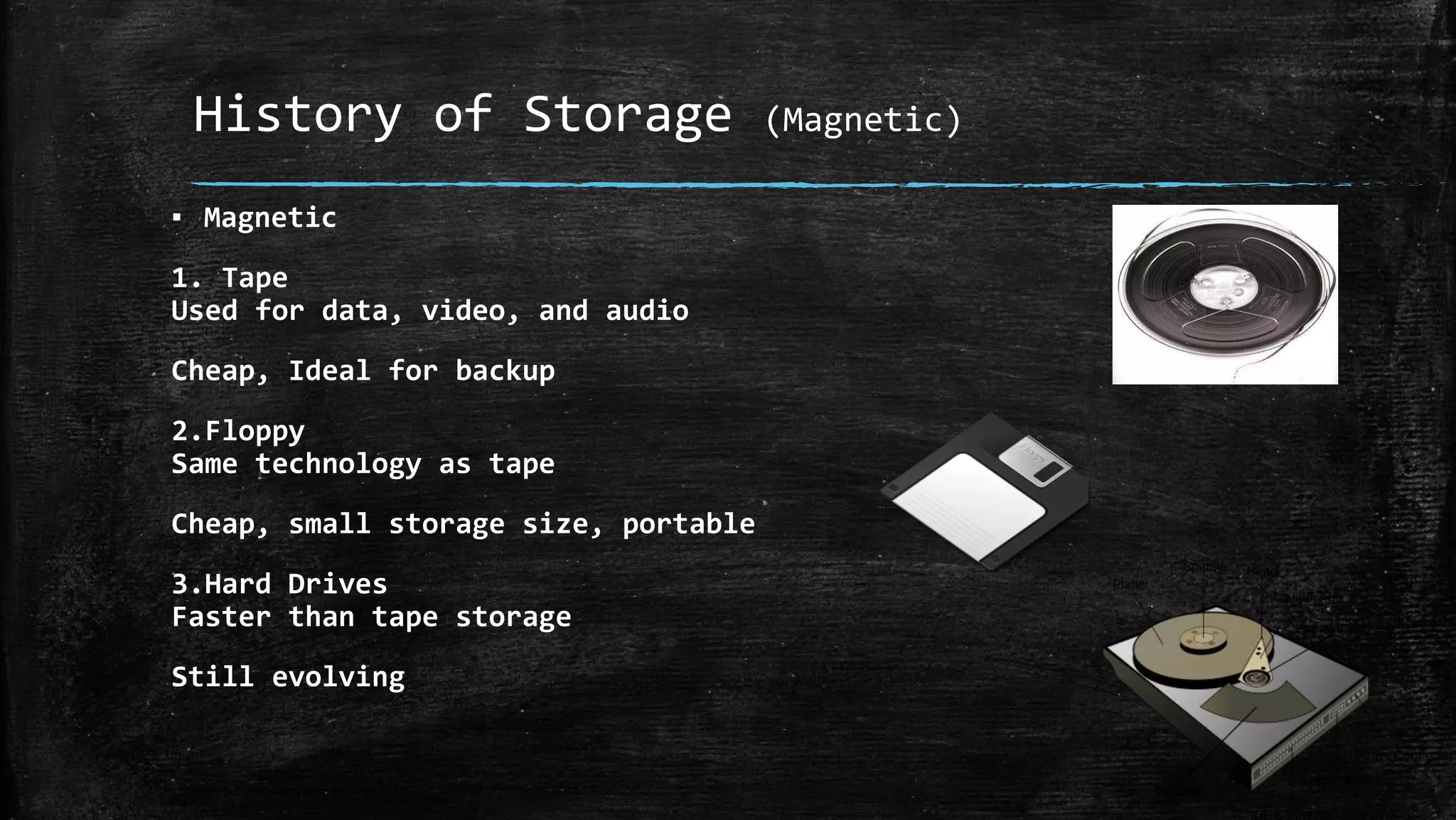
History of Storage (Magnetic)
▪ Magnetic
1. Tape
Used for data, video, and audio
Cheap, Ideal for backup
2.Floppy
Same technology as tape
Cheap, small storage size, portable
3.Hard Drives
Faster than tape storage
Still evolving
History of Storage (Optical)
Optical
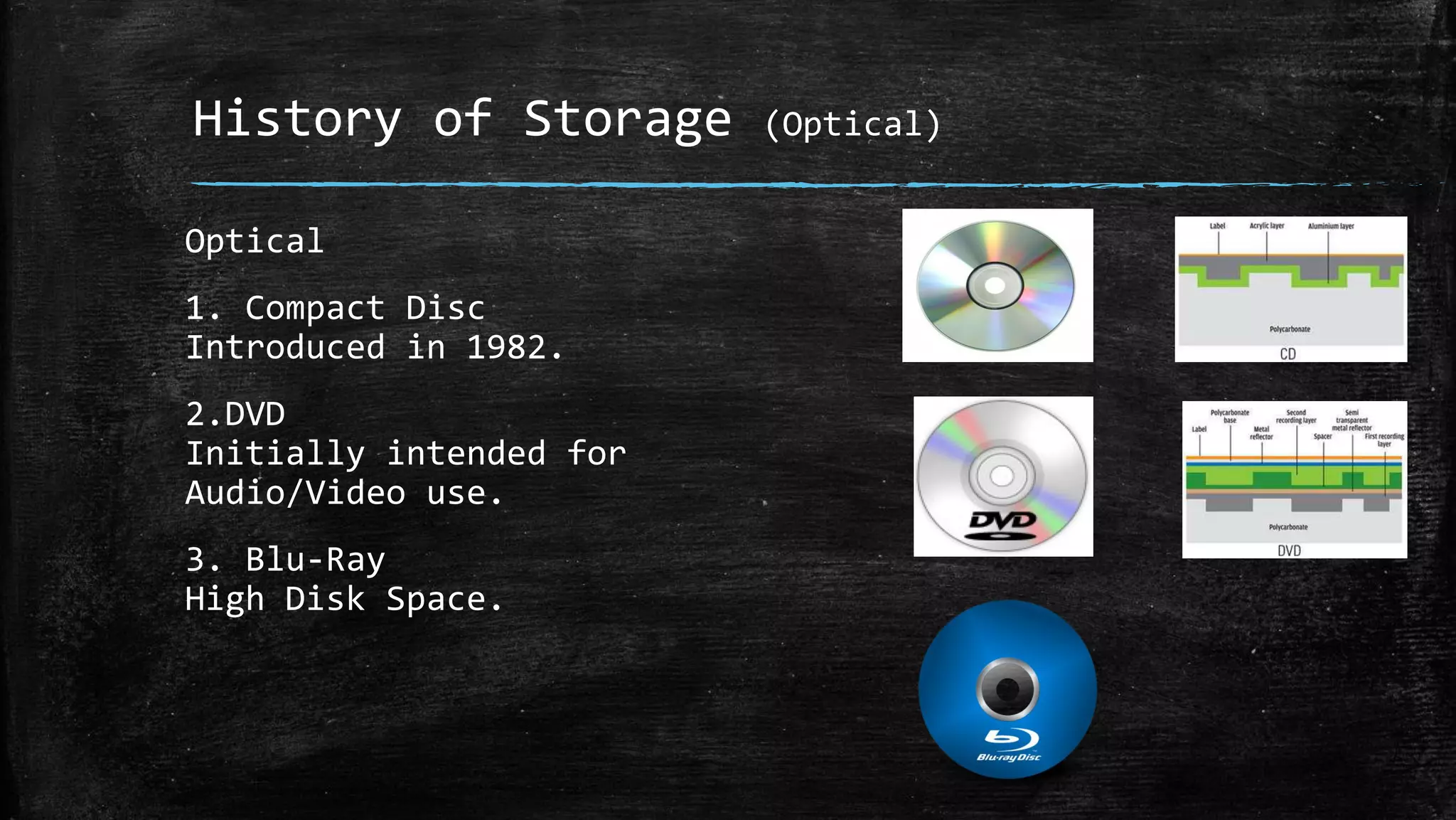
1. Compact Disc
Introduced in 1982.
2.DVD
Initially intended for
Audio/Video use.
3. Blu-Ray
High Disk Space.
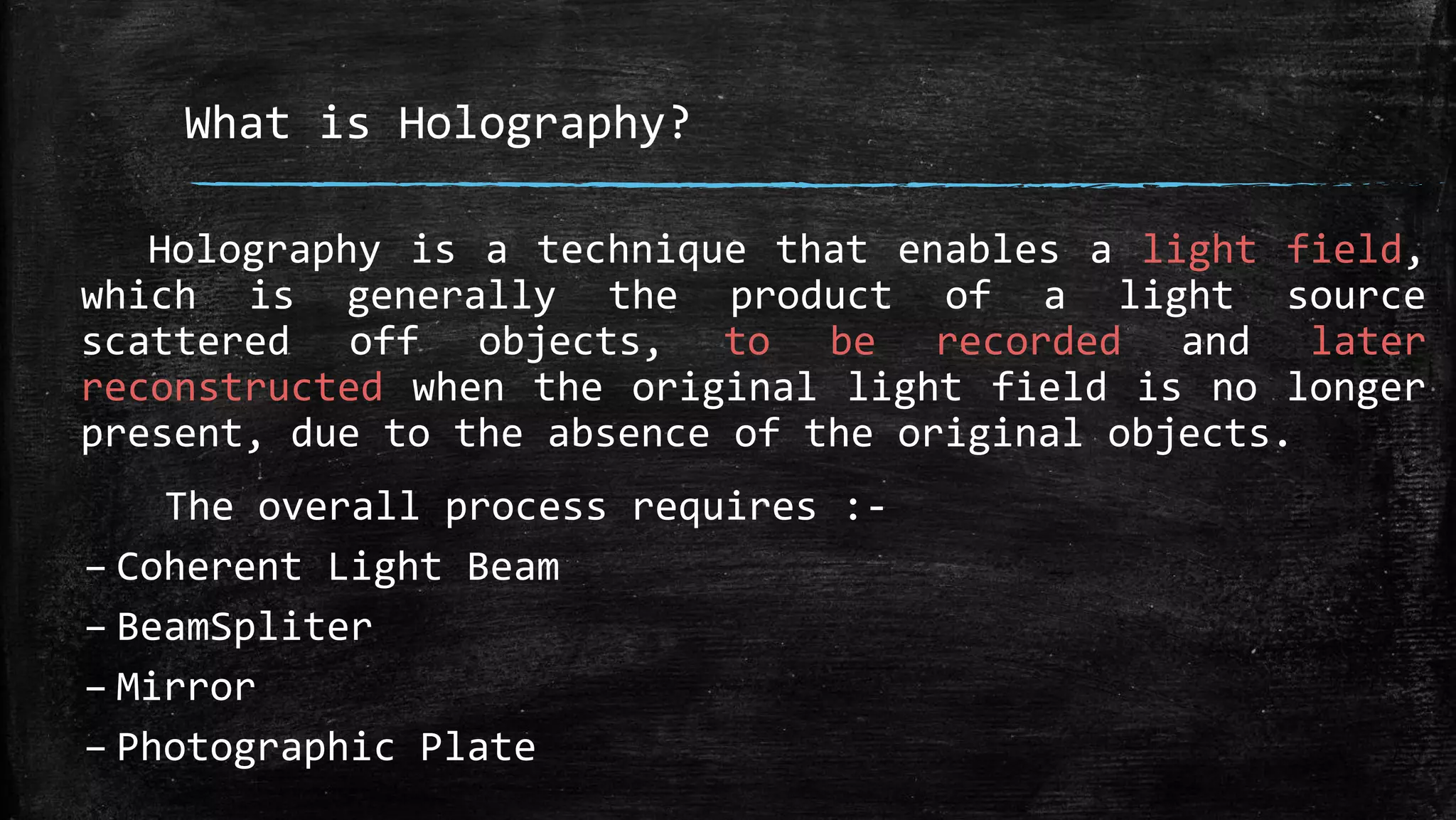
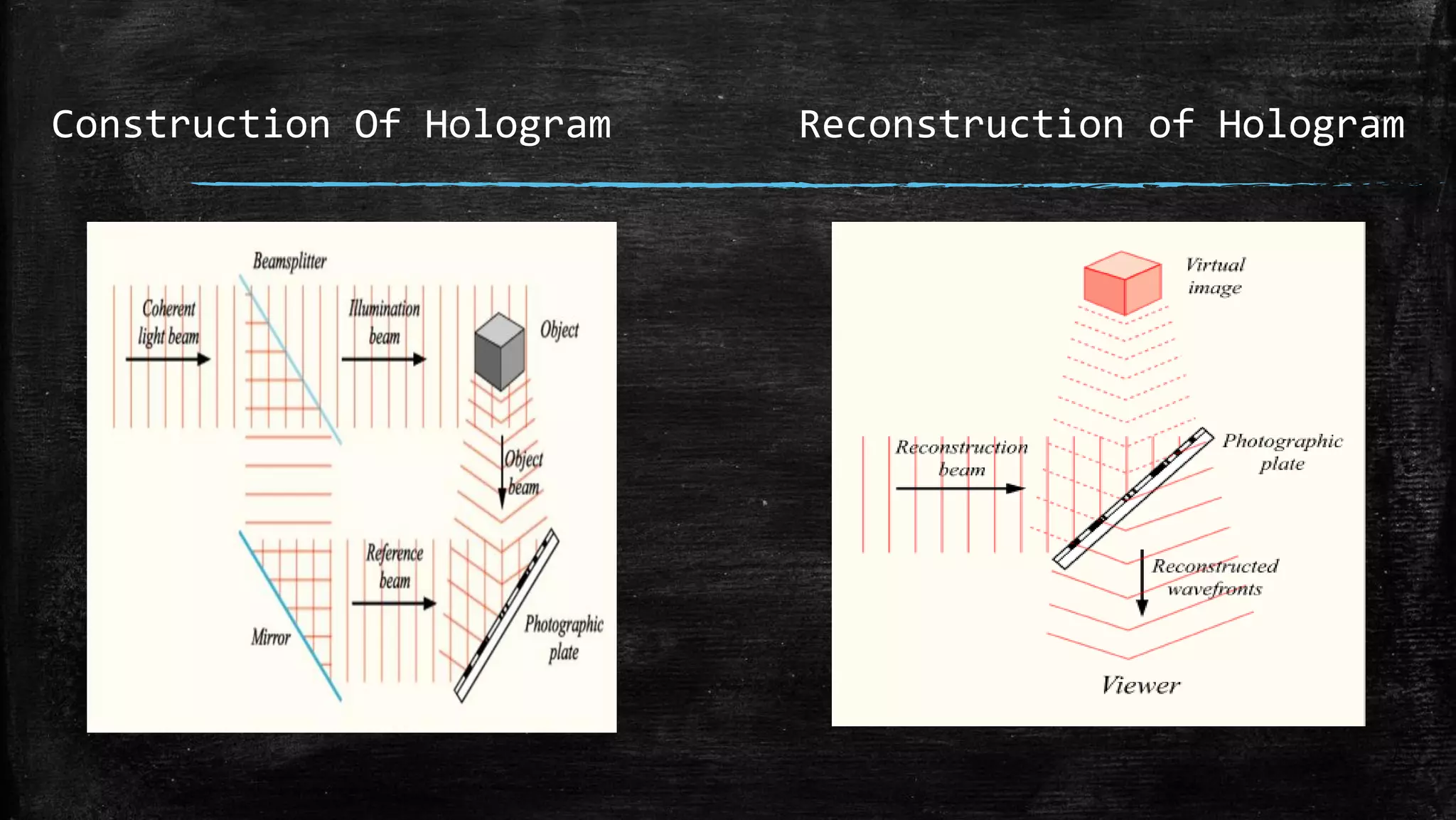
What is Holography?
Holography is a technique that enables a light field,
which is generally the product of a light source
scattered off objects, to be recorded and later
reconstructed when the original light field is no longer
present, due to the absence of the original objects.
The overall process requires :-
– Coherent Light Beam
– BeamSpliter
– Mirror
– Photographic Plate
Construction Of Hologram Reconstruction of Hologram
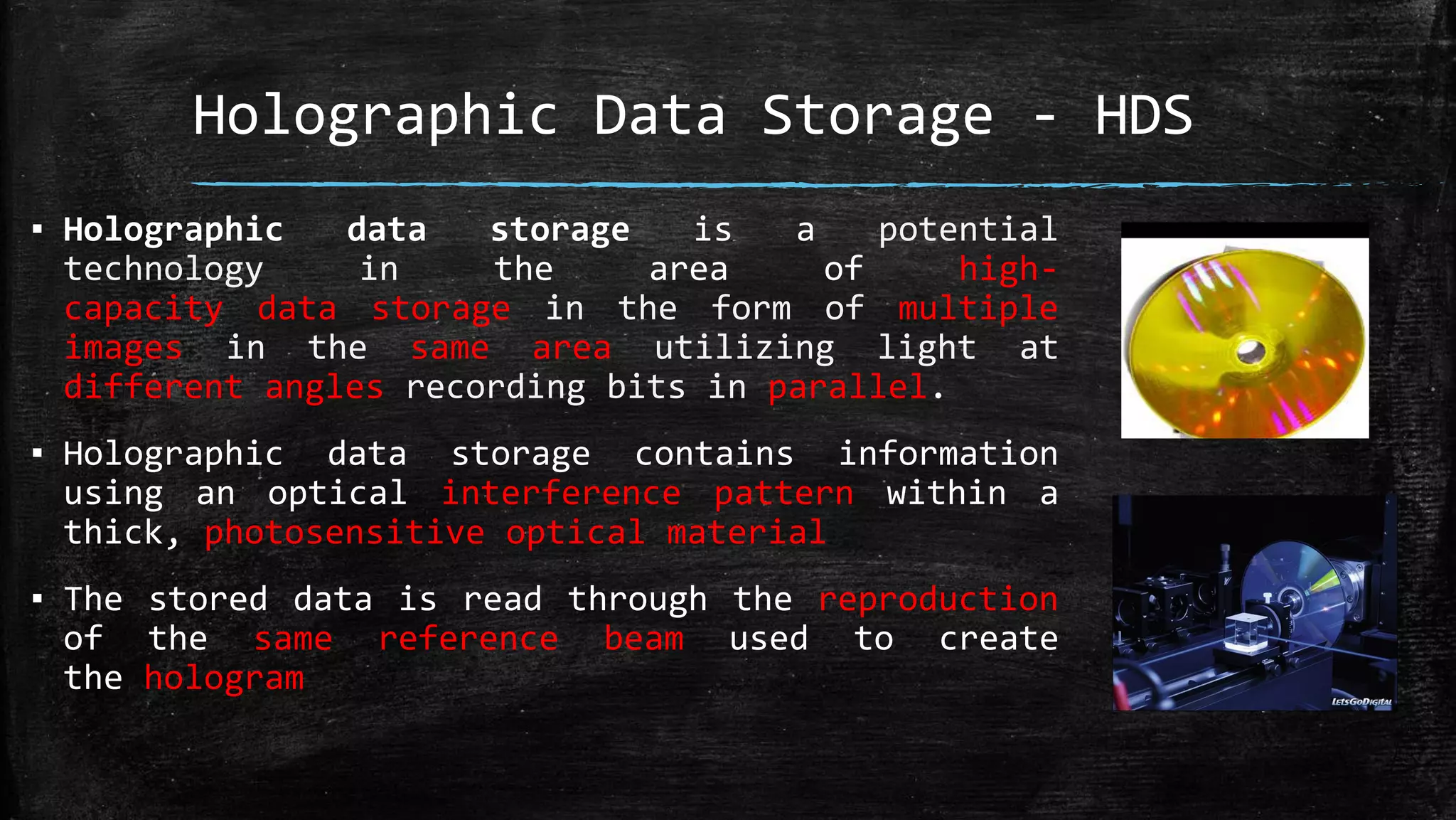
Holographic Data Storage - HDS
▪ Holographic data storage is a potential
technology in the area of high-
capacity data storage in the form of multiple
images in the same area utilizing light at
different angles recording bits in parallel.
▪ Holographic data storage contains information
using an optical interference pattern within a
thick, photosensitive optical material
▪ The stored data is read through the reproduction
of the same reference beam used to create
the hologram
Working of HDS
Spatial Light Modulator
(SLM)
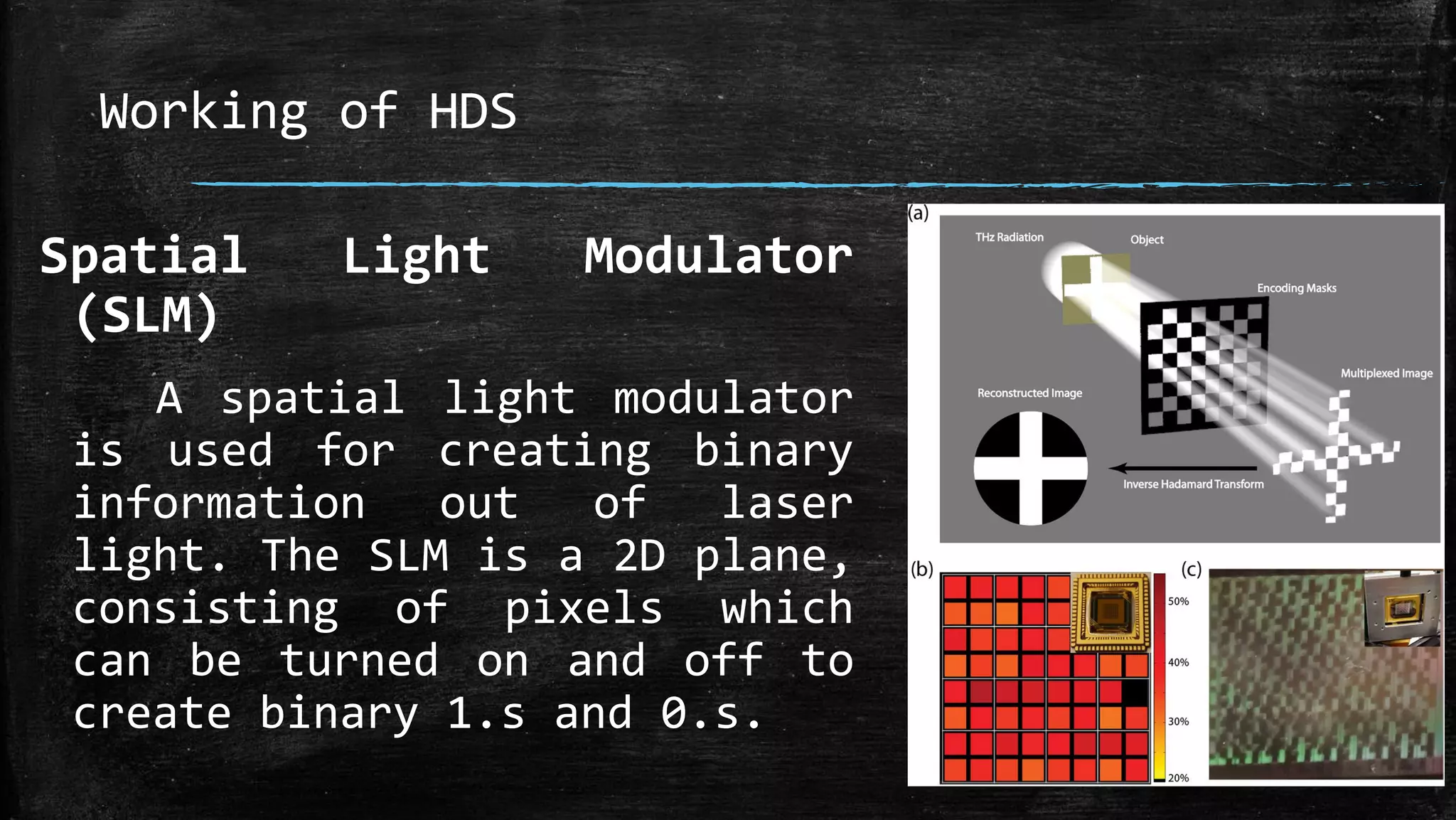
A spatial light modulator
is used for creating binary
information out of laser
light. The SLM is a 2D plane,
consisting of pixels which
can be turned on and off to
create binary 1.s and 0.s.
Working of HDS
Writing
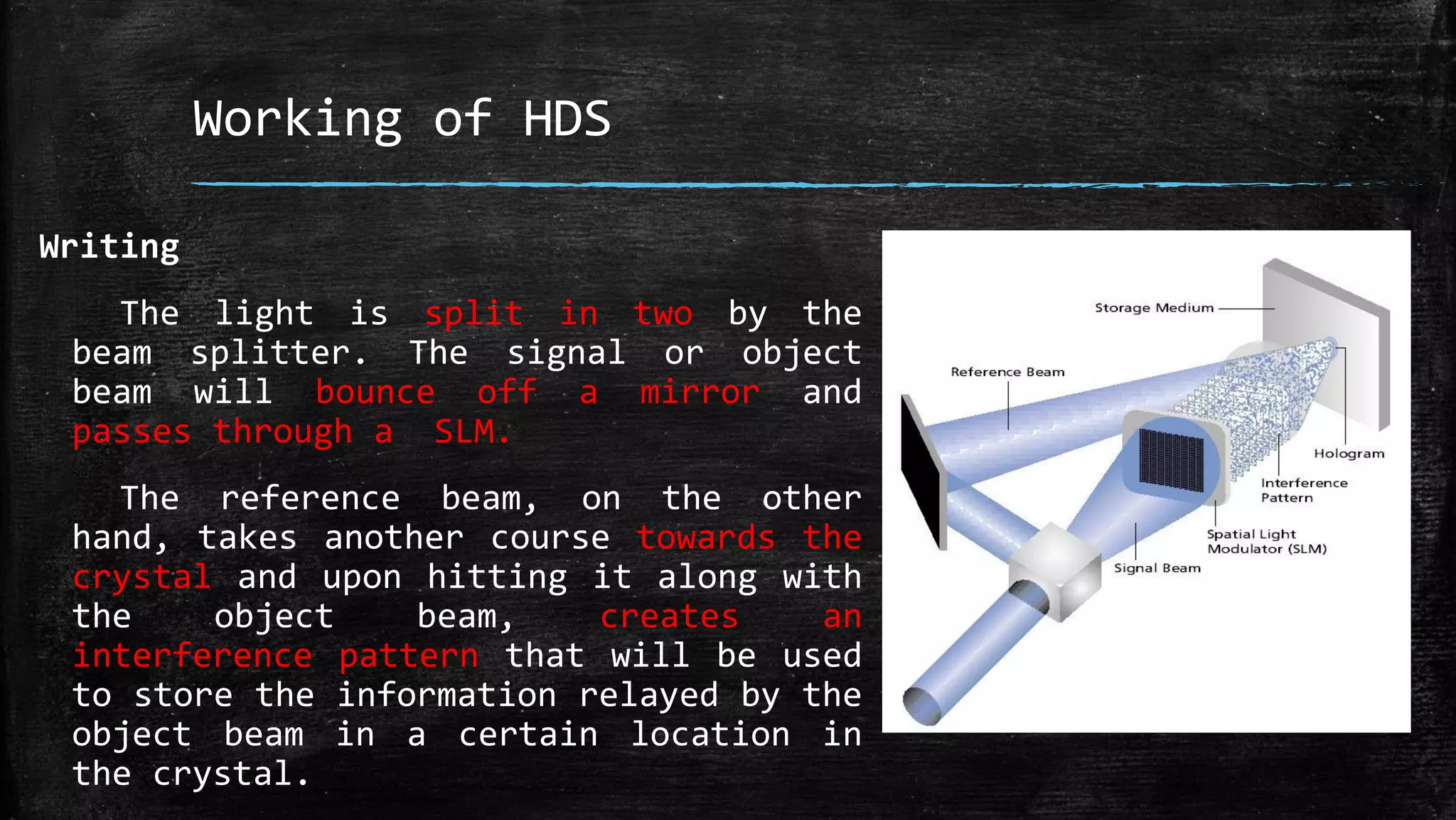
The light is split in two by the
beam splitter. The signal or object
beam will bounce off a mirror and
passes through a SLM.
The reference beam, on the other
hand, takes another course towards the
crystal and upon hitting it along with
the object beam, creates an
interference pattern that will be used
to store the information relayed by the
object beam in a certain location in
the crystal.
Working of HDS
Retrieving:
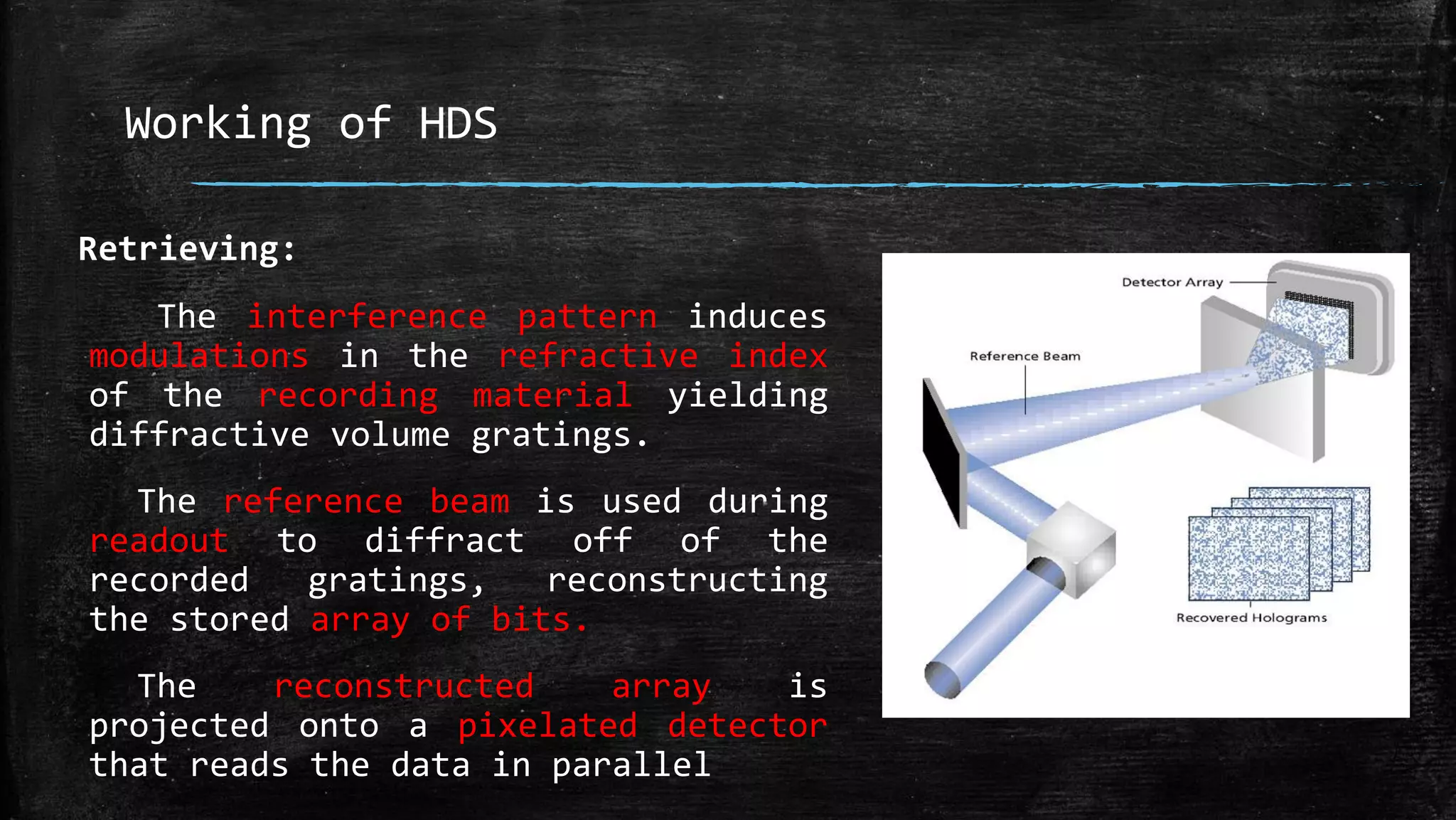
The interference pattern induces
modulations in the refractive index
of the recording material yielding
diffractive volume gratings.
The reference beam is used during
readout to diffract off of the
recorded gratings, reconstructing
the stored array of bits.
The reconstructed array is
projected onto a pixelated detector
that reads the data in parallel
Working of HDS
Multiplexing
Method of storing multiple pages of data in the hologram is called
multiplexing. The
thicker the volume becomes, the smaller the modifications to the source
beam can be.
There are different types of multiplexing
▪ Angular Multiplexing
▪ Wavelength Multiplexing
▪ Spatial Multiplexing
▪ Peristrophic Multiplexing
▪ Shift Multiplexing
▪ Phase-Encoded Multiplexing
Technology Comparison
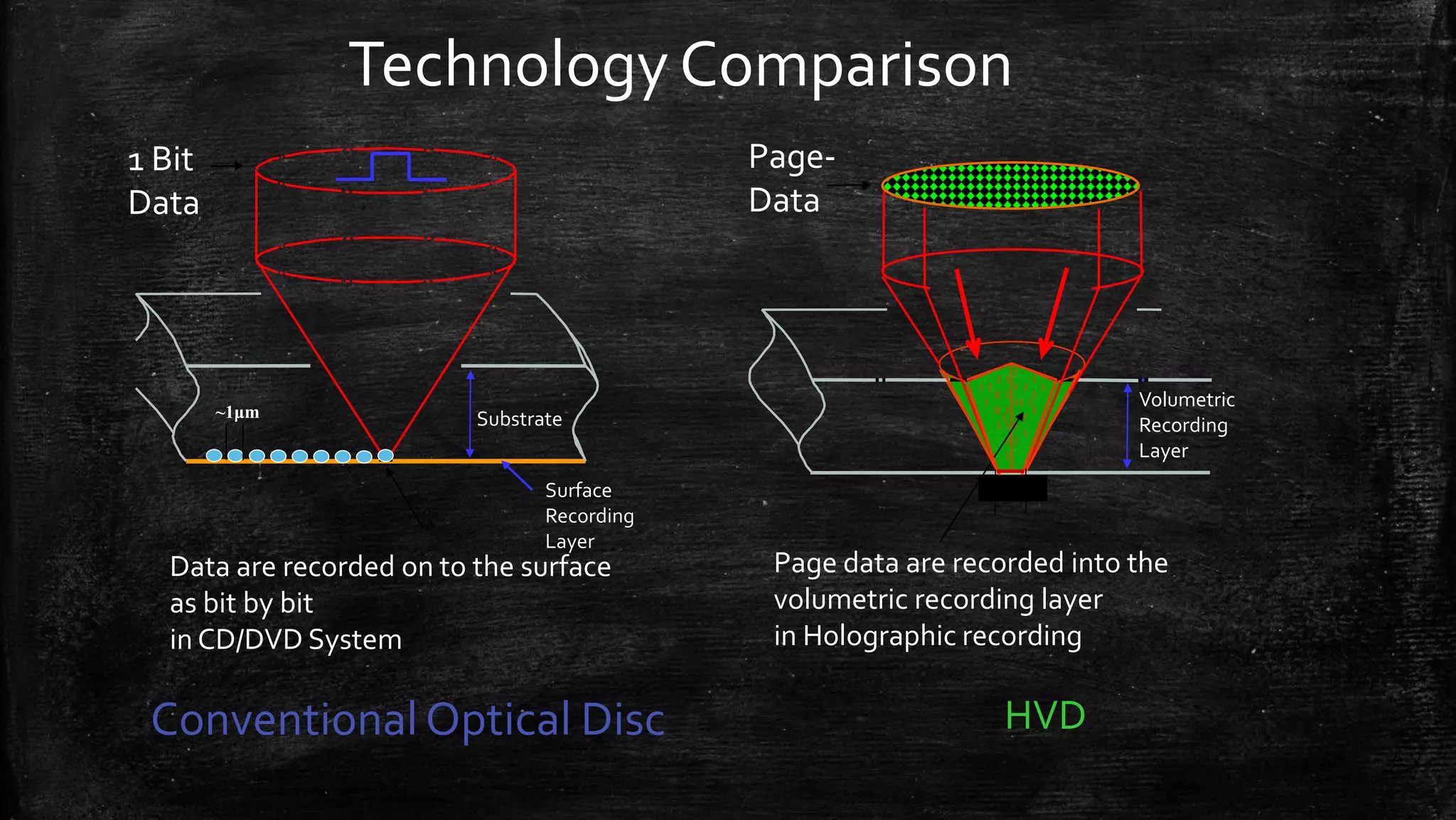
Data are recorded on to the surface
as bit by bit
in CD/DVD System
1 Bit
Data
Surface
Recording
Layer
Substrate
Conventional Optical Disc
Page-
Data
Volumetric
Recording
Layer
Page data are recorded into the
volumetric recording layer
in Holographic recording
HVD
~1μm
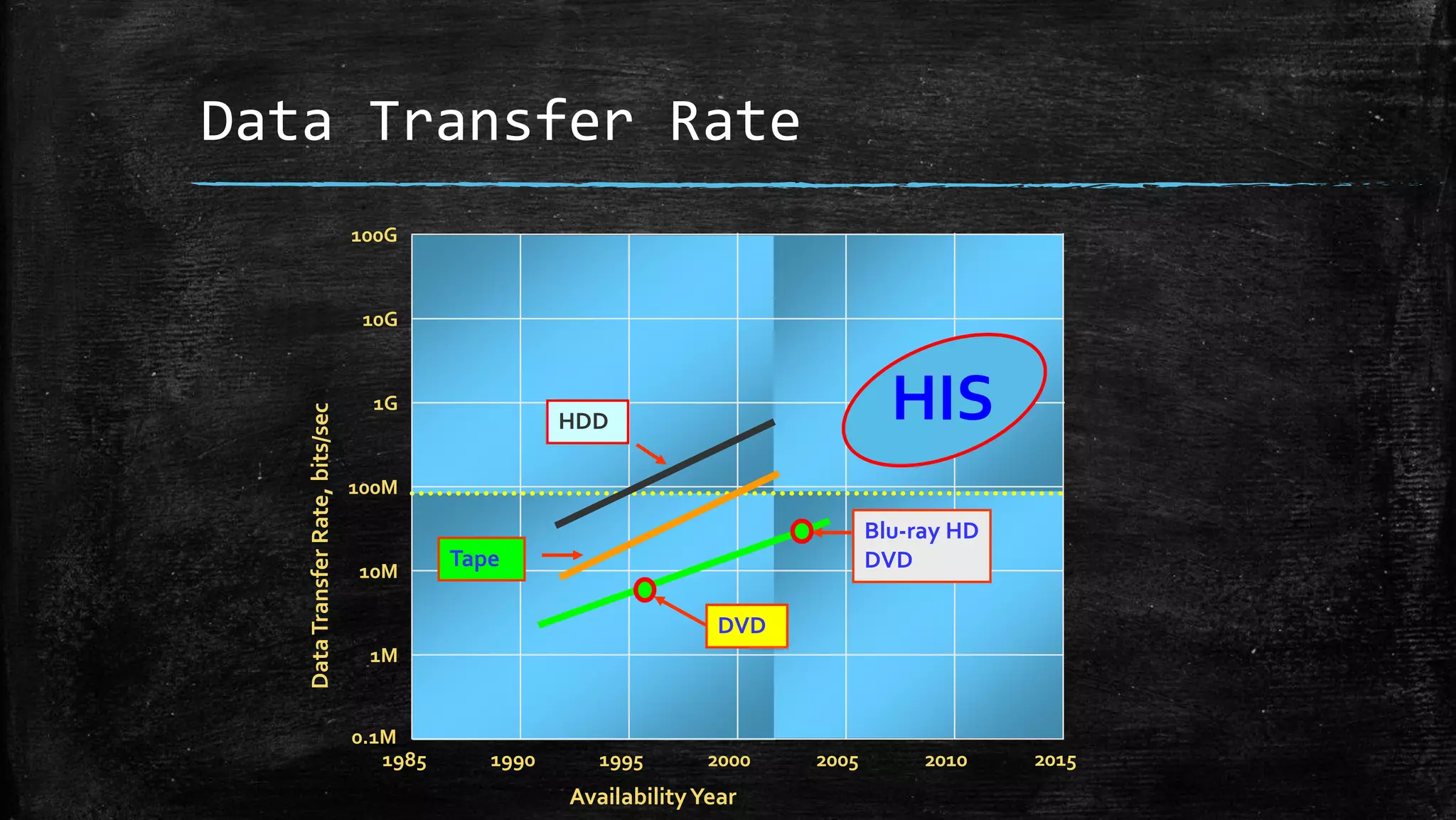
Data Transfer Rate
1985 1990 1995 2000 2005 2010 2015
AvailabilityYear
1M
10M
100M
1G
10G
100G
DataTransferRate,bits/sec
Blu-ray HD
DVD
0.1M
DVD
Tape
HISHDD
Reasons for Developing HDS…
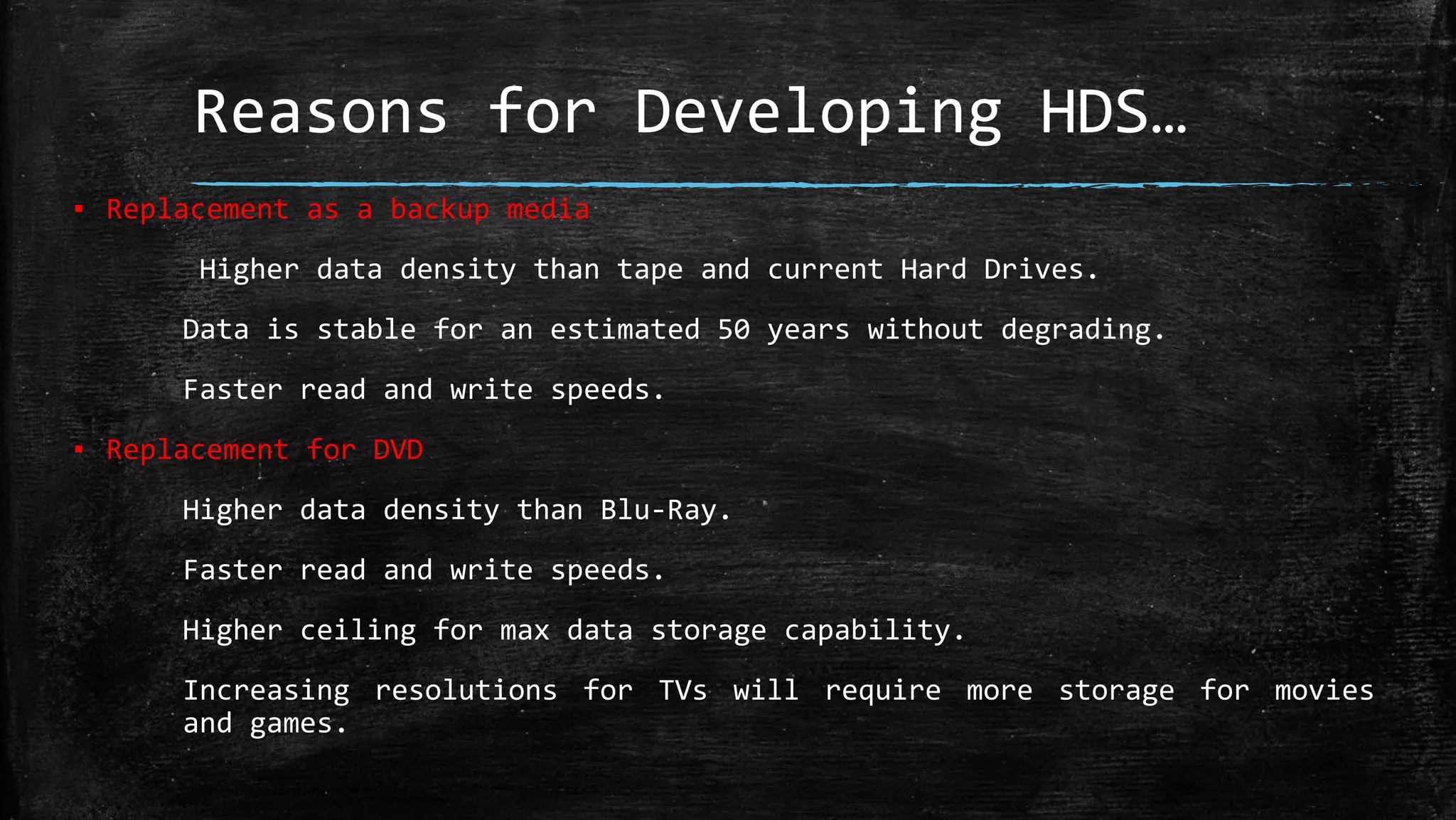
▪ Replacement as a backup media
Higher data density than tape and current Hard Drives.
Data is stable for an estimated 50 years without degrading.
Faster read and write speeds.
▪ Replacement for DVD
Higher data density than Blu-Ray.
Faster read and write speeds.
Higher ceiling for max data storage capability.
Increasing resolutions for TVs will require more storage for movies
and games.
Benefits of HDS
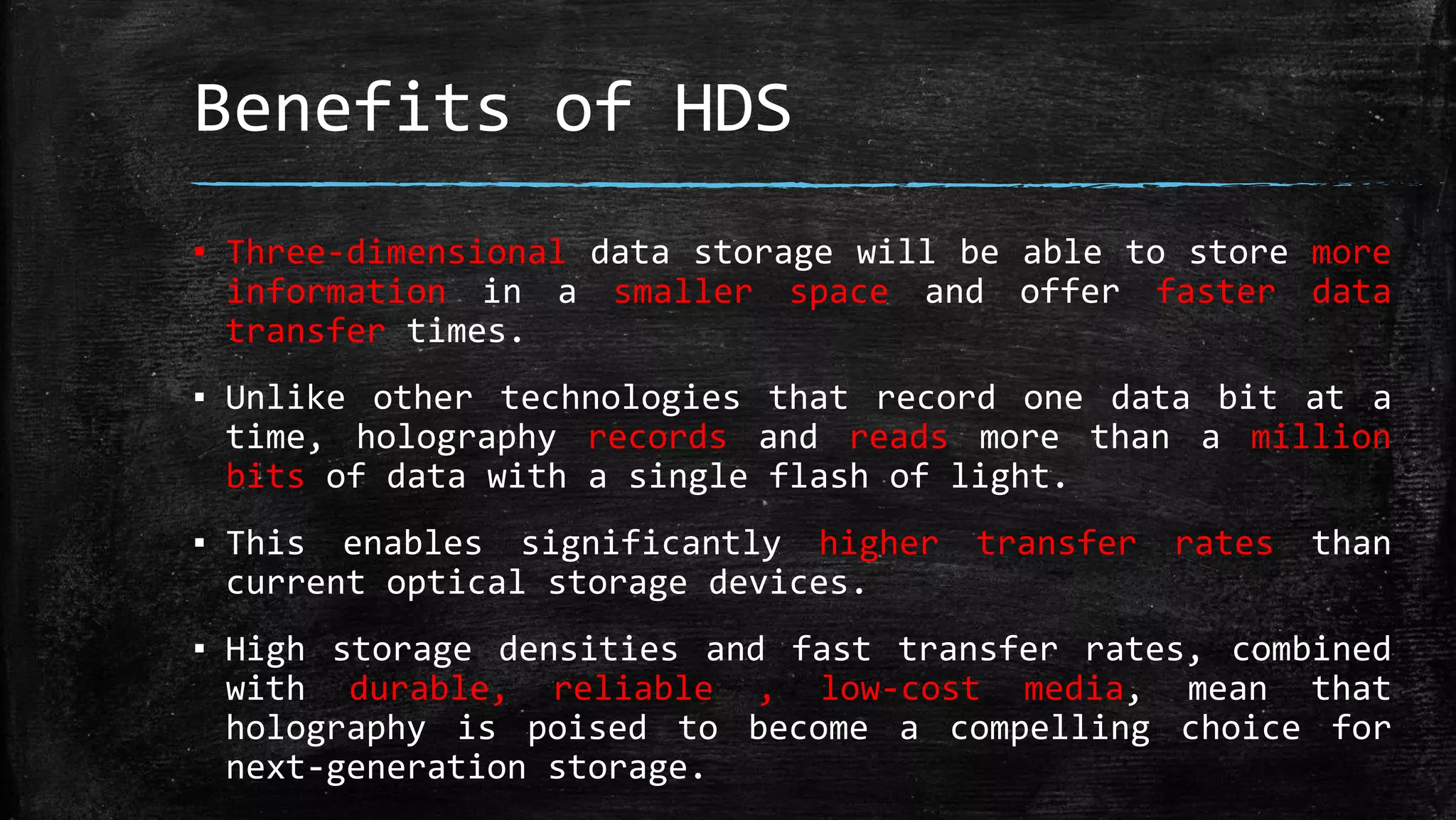
▪ Three-dimensional data storage will be able to store more
information in a smaller space and offer faster data
transfer times.
▪ Unlike other technologies that record one data bit at a
time, holography records and reads more than a million
bits of data with a single flash of light.
▪ This enables significantly higher transfer rates than
current optical storage devices.
▪ High storage densities and fast transfer rates, combined
with durable, reliable , low-cost media, mean that
holography is poised to become a compelling choice for
next-generation storage.
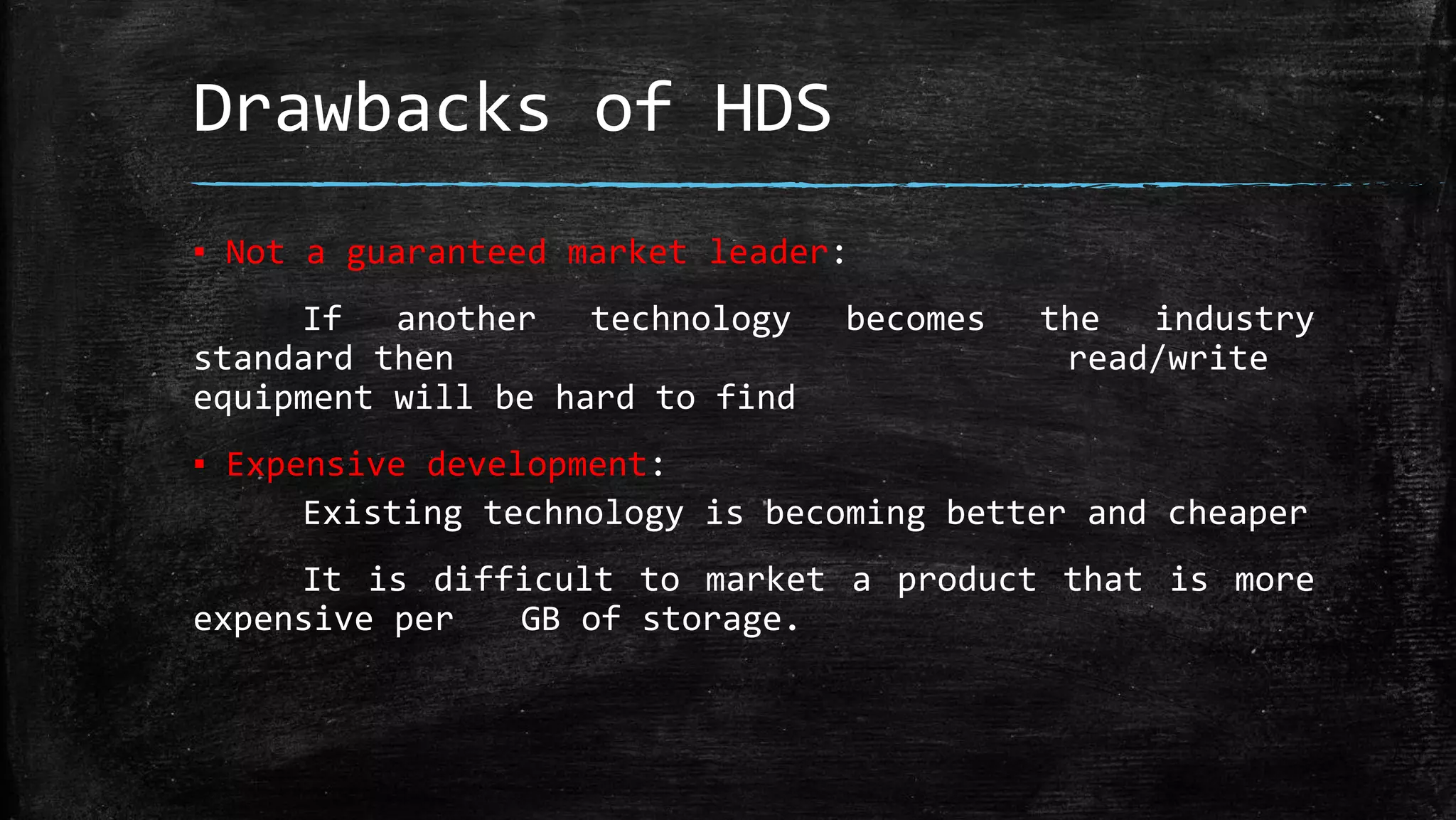
Drawbacks of HDS
▪ Not a guaranteed market leader:
If another technology becomes the industry
standard then read/write
equipment will be hard to find
▪ Expensive development:
Existing technology is becoming better and cheaper
It is difficult to market a product that is more
expensive per GB of storage.
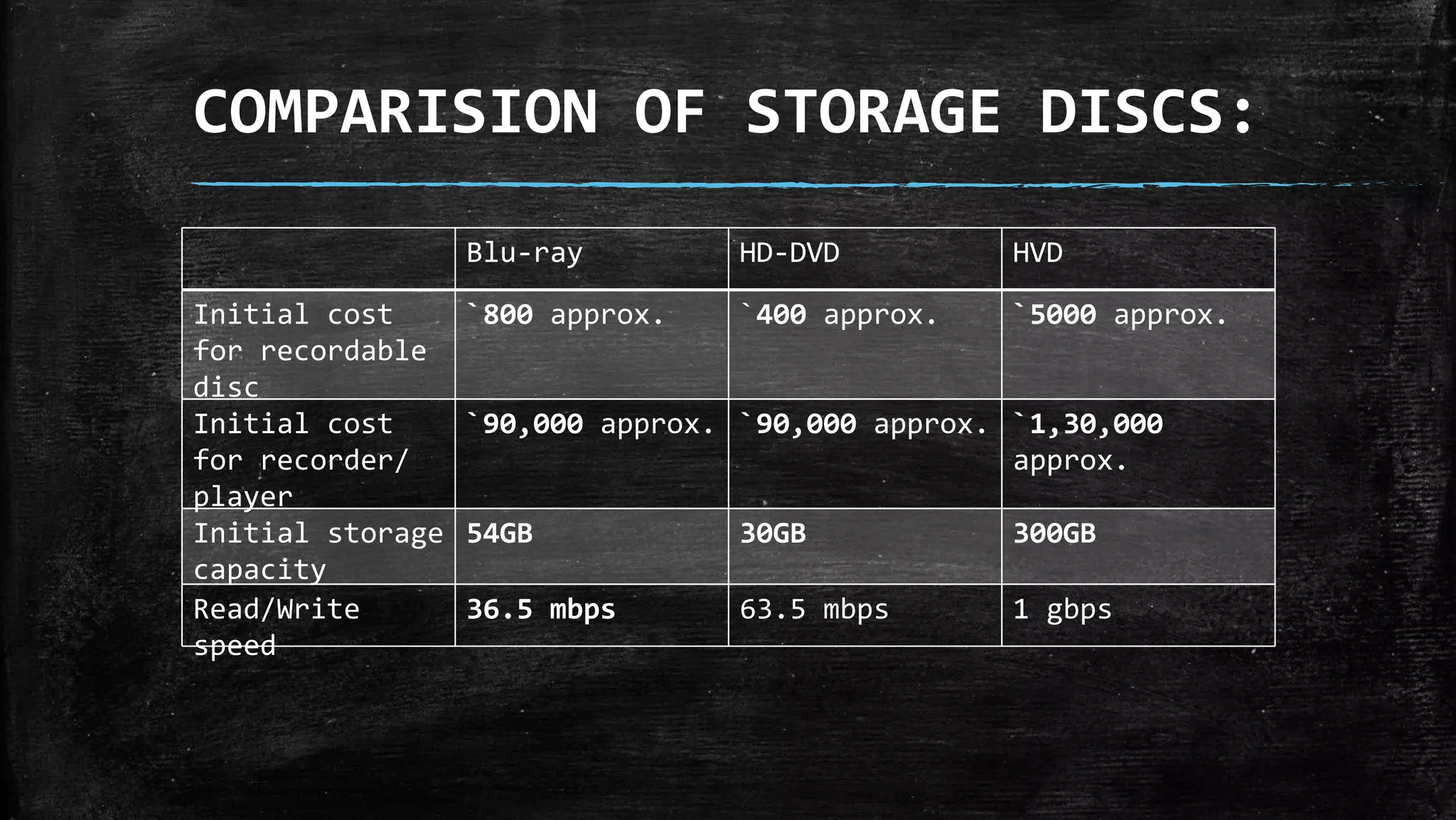
COMPARISION OF STORAGE DISCS:
Blu-ray HD-DVD HVD
Initial cost
for recordable
disc
`800 approx. `400 approx. `5000 approx.
Initial cost
for recorder/
player
`90,000 approx. `90,000 approx. `1,30,000
approx.
Initial storage
capacity
54GB 30GB 300GB
Read/Write
speed
36.5 mbps 63.5 mbps 1 gbps
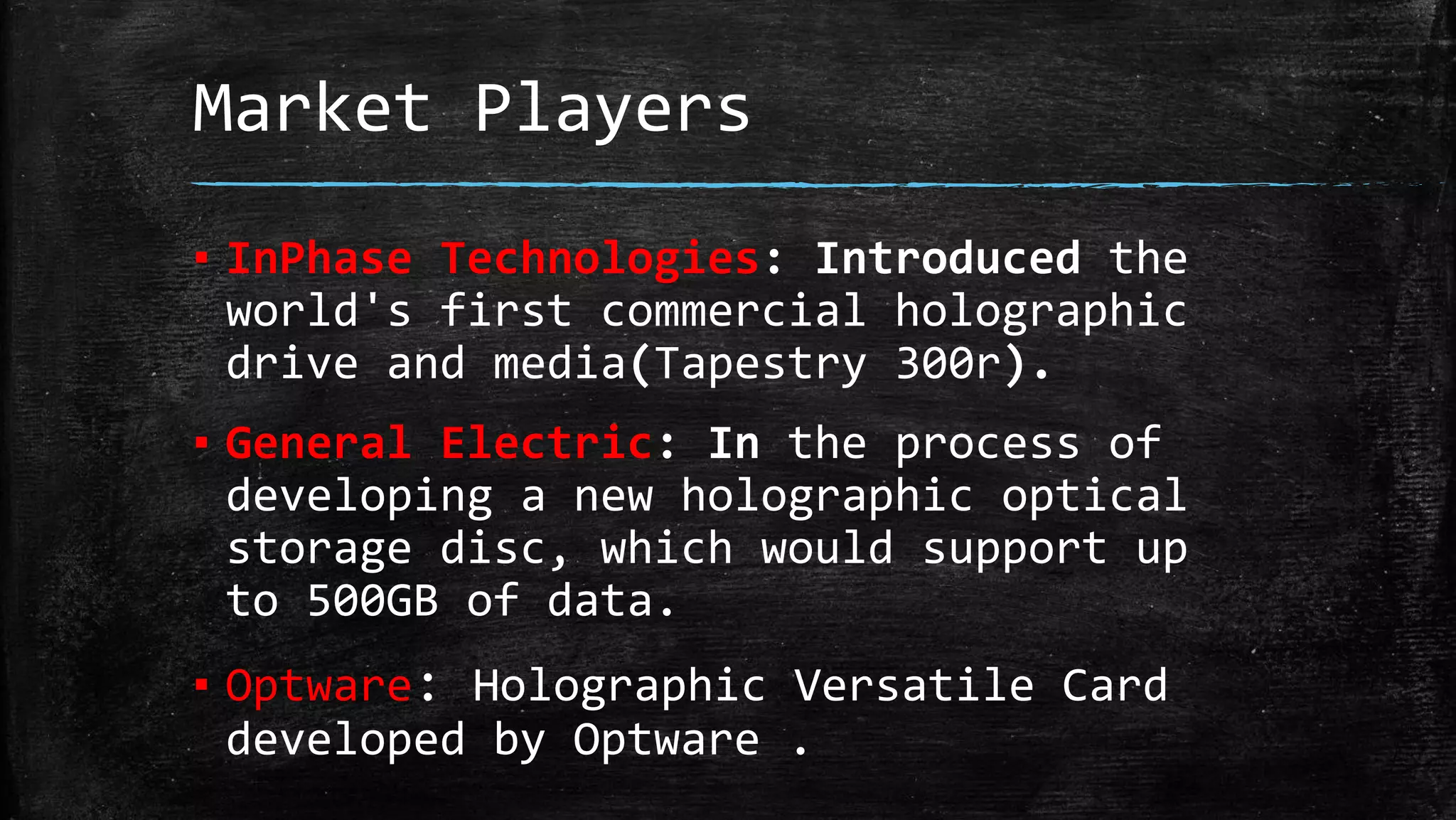
Market Players
▪ InPhase Technologies: Introduced the
world's first commercial holographic
drive and media(Tapestry 300r).
▪ General Electric: In the process of
developing a new holographic optical
storage disc, which would support up
to 500GB of data.
▪ Optware: Holographic Versatile Card
developed by Optware .
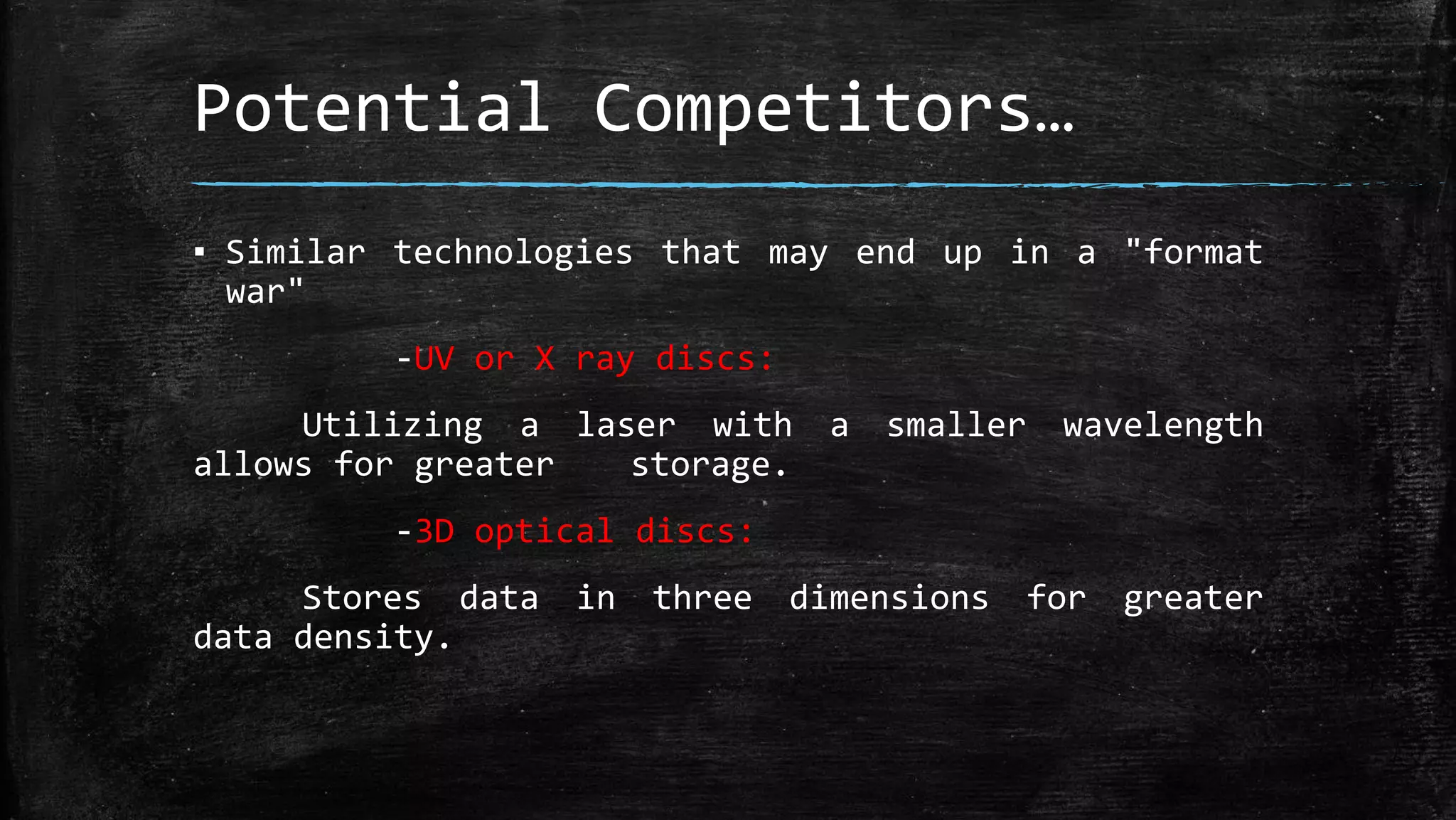
Potential Competitors…
▪ Similar technologies that may end up in a "format
war"
-UV or X ray discs:
Utilizing a laser with a smaller wavelength
allows for greater storage.
-3D optical discs:
Stores data in three dimensions for greater
data density.
Conclusion…
In conclusion, Holographic Storage has the advantage over
other storage mediums as it relates to:
-Storage Capacity
-Transfer Rate
-Backup
Its main disadvantage is its cost of ownership.
Keep in mind, when Blu-ray was Introduced in 2006, a 25-
gigabyte disc cost nearly $1 a gigabyte. Its about half
the cost now. Overtime, the overall cost of holographic
data storage should decrease to an acceptable amount.
References…
▪ www.ibm.com.
▪ http://www.riedelit.com/Data_Recovery_Technical_Guide.html
▪ http://www.usbyte.com/common/optical_data_storage_systems.html
▪ www.howstuffworks.com/
▪ www.mediastoragedevices.com/holographic-versatile-disc.html
▪ Kevin Kurtis from Iphase technologies.
▪ http://www.answers.com/topic/holographic-versatile-disc
▪ http://www.hvd-forum.org/abouthvd/technology.html
THANK
YOU…

Holographic data storage presentation

  • 1.
    Holographic data storage Guidedby: Vivek Sharma Asst. Professor (CSE/IT) By: Rajneesh Khuttack 05310402712 CSE
  • 2.
    Outline ▪ What isData Storage? ▪ History of Data Storage. ▪ What is Holography? ▪ Holography Data Storage. ▪ Recording of Data in HDS. ▪ Working of HDS. ▪ Technology Comparison. ▪ Data transfer rate. ▪ Comparison of Storage Discs. ▪ Market Players ▪ Potential Competitors… ▪ Conclusion
  • 3.
    What Is DataStorage? Data storage , is a technology consisting of computer components and recording media used to retain digital data. A modern digital computer represents data using the binary numeral system. The most common unit of storage is the byte, equal to 8 bits. For example, the complete works of Shakespeare, about 1250 pages in print, can be stored in about five megabytes (40 million bits) with one byte per character.
  • 4.
    History of Storage(Magnetic) ▪ Magnetic 1. Tape Used for data, video, and audio Cheap, Ideal for backup 2.Floppy Same technology as tape Cheap, small storage size, portable 3.Hard Drives Faster than tape storage Still evolving
  • 5.
    History of Storage(Optical) Optical 1. Compact Disc Introduced in 1982. 2.DVD Initially intended for Audio/Video use. 3. Blu-Ray High Disk Space.
  • 6.
    What is Holography? Holographyis a technique that enables a light field, which is generally the product of a light source scattered off objects, to be recorded and later reconstructed when the original light field is no longer present, due to the absence of the original objects. The overall process requires :- – Coherent Light Beam – BeamSpliter – Mirror – Photographic Plate
  • 7.
    Construction Of HologramReconstruction of Hologram
  • 8.
    Holographic Data Storage- HDS ▪ Holographic data storage is a potential technology in the area of high- capacity data storage in the form of multiple images in the same area utilizing light at different angles recording bits in parallel. ▪ Holographic data storage contains information using an optical interference pattern within a thick, photosensitive optical material ▪ The stored data is read through the reproduction of the same reference beam used to create the hologram
  • 9.
    Working of HDS SpatialLight Modulator (SLM) A spatial light modulator is used for creating binary information out of laser light. The SLM is a 2D plane, consisting of pixels which can be turned on and off to create binary 1.s and 0.s.
  • 10.
    Working of HDS Writing Thelight is split in two by the beam splitter. The signal or object beam will bounce off a mirror and passes through a SLM. The reference beam, on the other hand, takes another course towards the crystal and upon hitting it along with the object beam, creates an interference pattern that will be used to store the information relayed by the object beam in a certain location in the crystal.
  • 11.
    Working of HDS Retrieving: Theinterference pattern induces modulations in the refractive index of the recording material yielding diffractive volume gratings. The reference beam is used during readout to diffract off of the recorded gratings, reconstructing the stored array of bits. The reconstructed array is projected onto a pixelated detector that reads the data in parallel
  • 12.
    Working of HDS Multiplexing Methodof storing multiple pages of data in the hologram is called multiplexing. The thicker the volume becomes, the smaller the modifications to the source beam can be. There are different types of multiplexing ▪ Angular Multiplexing ▪ Wavelength Multiplexing ▪ Spatial Multiplexing ▪ Peristrophic Multiplexing ▪ Shift Multiplexing ▪ Phase-Encoded Multiplexing
  • 13.
    Technology Comparison Data arerecorded on to the surface as bit by bit in CD/DVD System 1 Bit Data Surface Recording Layer Substrate Conventional Optical Disc Page- Data Volumetric Recording Layer Page data are recorded into the volumetric recording layer in Holographic recording HVD ~1μm
  • 14.
    Data Transfer Rate 19851990 1995 2000 2005 2010 2015 AvailabilityYear 1M 10M 100M 1G 10G 100G DataTransferRate,bits/sec Blu-ray HD DVD 0.1M DVD Tape HISHDD
  • 15.
    Reasons for DevelopingHDS… ▪ Replacement as a backup media Higher data density than tape and current Hard Drives. Data is stable for an estimated 50 years without degrading. Faster read and write speeds. ▪ Replacement for DVD Higher data density than Blu-Ray. Faster read and write speeds. Higher ceiling for max data storage capability. Increasing resolutions for TVs will require more storage for movies and games.
  • 16.
    Benefits of HDS ▪Three-dimensional data storage will be able to store more information in a smaller space and offer faster data transfer times. ▪ Unlike other technologies that record one data bit at a time, holography records and reads more than a million bits of data with a single flash of light. ▪ This enables significantly higher transfer rates than current optical storage devices. ▪ High storage densities and fast transfer rates, combined with durable, reliable , low-cost media, mean that holography is poised to become a compelling choice for next-generation storage.
  • 17.
    Drawbacks of HDS ▪Not a guaranteed market leader: If another technology becomes the industry standard then read/write equipment will be hard to find ▪ Expensive development: Existing technology is becoming better and cheaper It is difficult to market a product that is more expensive per GB of storage.
  • 18.
    COMPARISION OF STORAGEDISCS: Blu-ray HD-DVD HVD Initial cost for recordable disc `800 approx. `400 approx. `5000 approx. Initial cost for recorder/ player `90,000 approx. `90,000 approx. `1,30,000 approx. Initial storage capacity 54GB 30GB 300GB Read/Write speed 36.5 mbps 63.5 mbps 1 gbps
  • 19.
    Market Players ▪ InPhaseTechnologies: Introduced the world's first commercial holographic drive and media(Tapestry 300r). ▪ General Electric: In the process of developing a new holographic optical storage disc, which would support up to 500GB of data. ▪ Optware: Holographic Versatile Card developed by Optware .
  • 20.
    Potential Competitors… ▪ Similartechnologies that may end up in a "format war" -UV or X ray discs: Utilizing a laser with a smaller wavelength allows for greater storage. -3D optical discs: Stores data in three dimensions for greater data density.
  • 21.
    Conclusion… In conclusion, HolographicStorage has the advantage over other storage mediums as it relates to: -Storage Capacity -Transfer Rate -Backup Its main disadvantage is its cost of ownership. Keep in mind, when Blu-ray was Introduced in 2006, a 25- gigabyte disc cost nearly $1 a gigabyte. Its about half the cost now. Overtime, the overall cost of holographic data storage should decrease to an acceptable amount.
  • 22.
    References… ▪ www.ibm.com. ▪ http://www.riedelit.com/Data_Recovery_Technical_Guide.html ▪http://www.usbyte.com/common/optical_data_storage_systems.html ▪ www.howstuffworks.com/ ▪ www.mediastoragedevices.com/holographic-versatile-disc.html ▪ Kevin Kurtis from Iphase technologies. ▪ http://www.answers.com/topic/holographic-versatile-disc ▪ http://www.hvd-forum.org/abouthvd/technology.html
  • 23.