




WELCOME


          1
2   Presented by
    Nikhil eg
    tjajeec
LIST OF CONTENTS

 INTRODUCTION

 CURRENT TECHNOLOGIES

 CONVENTIONAL OPTICAL STORAGE SCHEMES

 THE CONCEPT OF FIVE DIMENSION

 GOLD NANORODS

 SURFACE PLASMONS

 FIELDS OF APPLICATION

 ADVANTAGES & DISADVANTAGES

 CONCLUSION
                                         3
INTRODUCTION

   Scientists have unveiled new DVD technology that stores
    data in five dimensions, making it possible to pack more than
    300 DVDs onto a single disc.

   Multiplexed optical recording provides an un-paralleled
    approach to increasing the information density beyond 1012
    bits per cm3

   The major hurdle is the lack of a suitable recording medium
    that is extremely selective in the domains of wavelength and    4

    polarization
CURRENT TECHNOLOGIES
   Optical Recording
   The process of recording signals on a medium through the
    use of light, so that the signals may be reproduced at a
    subsequent time.
   The introduction of the laser as a light source greatly
    improves the quality of reproduced signals
   Optical data storage involves placing information in a
    medium so that, when a light beam scans the medium, the
    reflected light can be used to recover the information.
   There are many forms of optical storage media like
    CD, DVD, Blu Ray Disc etc
                                                           5
EXISTING TECHNOLOGY

   At present there exist so many different medium for
    performing optical recording. They are

   1. Floppy Disc
   2. Compact Disc (CD)
   3. Digital Versatile Disc (DVD)
   4. Blu Ray Disc
   5. Holographic Versatile Disc


                                                          6
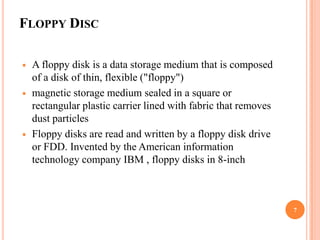
FLOPPY DISC

   A floppy disk is a data storage medium that is composed
    of a disk of thin, flexible ("floppy")
   magnetic storage medium sealed in a square or
    rectangular plastic carrier lined with fabric that removes
    dust particles
   Floppy disks are read and written by a floppy disk drive
    or FDD. Invented by the American information
    technology company IBM , floppy disks in 8-inch


                                                                 7
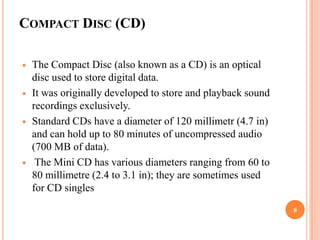
COMPACT DISC (CD)

   The Compact Disc (also known as a CD) is an optical
    disc used to store digital data.
   It was originally developed to store and playback sound
    recordings exclusively.
   Standard CDs have a diameter of 120 millimetr (4.7 in)
    and can hold up to 80 minutes of uncompressed audio
    (700 MB of data).
    The Mini CD has various diameters ranging from 60 to
    80 millimetre (2.4 to 3.1 in); they are sometimes used
    for CD singles
                                                              8
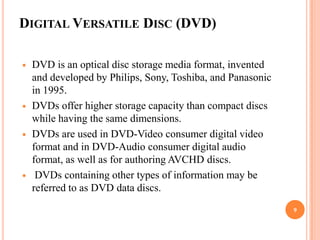
DIGITAL VERSATILE DISC (DVD)

   DVD is an optical disc storage media format, invented
    and developed by Philips, Sony, Toshiba, and Panasonic
    in 1995.
   DVDs offer higher storage capacity than compact discs
    while having the same dimensions.
   DVDs are used in DVD-Video consumer digital video
    format and in DVD-Audio consumer digital audio
    format, as well as for authoring AVCHD discs.
    DVDs containing other types of information may be
    referred to as DVD data discs.
                                                             9
BLU RAY DISC

   Blu-ray Disc (official abbreviation BD) is an optical
    disc storage medium designed to supersede the DVD
    format
   The standard physical medium is a 12 cm plastic optical
    disc, the same size as DVDs and CDs. Blu-ray Discs
    contain 25 GB per layer
   The name Blu-ray Disc refers to the blue laserused to
    read the disc, which allows information to be stored at a
    greater density than is possible with the longer-
    wavelength red laser used for DVDs.

                                                                10
HOLOGRAPHIC VERSATILE DISC
   The Holographic Versatile Disc (HVD) is an optical disc
    technology developed between April 2004 and mid-
    2008
   that can store up to several terabytes of data on an
    optical disc the same size as a CD, DVD or Blu-Ray
    disc.
    Standards for 100 GB read-only holographic discs and
    200 GB recordable cartridges were published by ECMA
    in 2007, but no holographic disc product has appeared in
    the market.
    A number of release dates were announced, all since
                                                               11
    passed.
CONVENTIONAL OPTICAL
STORAGE SCHEMES


  Two Dimensional Optical Storage
  Three Dimensional Storage

  FOUR DIMENSIONAL STORAGE

  FIVE DIMENSIONAL DVD


                                     12
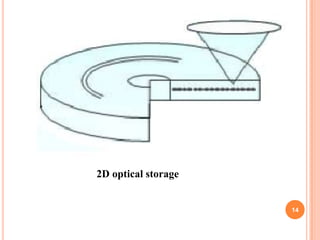
TWO DIMENSIONAL OPTICAL STORAGE

    In this technology the data is written in ‘pits’ on the
    surface of the disc.
    Examples are CD, DVD and blue ray disc.
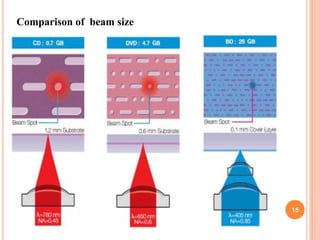
    Smaller pits mean that for the same available
    area, more data can be stored.
   This depends on how narrow is the laser beam used for
    recording as well as reading.
    That is how a DVD holds more than that of a CD and
    the storage capacity of a blue ray disc is very much
    higher than a DVD.
                                                               13
2D optical storage


                     14
Comparison of beam size


                          15
THREE DIMENSIONAL STORAGE
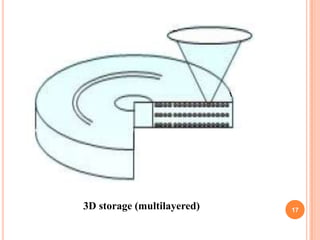
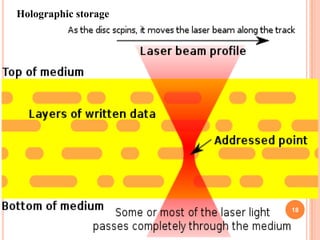
    Three dimensional optical storage includes multi-
    layered and holographic storage.
    In the case of multi-layer optical storage the data is held
    in multiple layers.
   There will be two or more recording media packed in a
    single disc
   Current optical data storage media, such as the CD and
    DVD store data as a series of reflective marks on an
    internal surface of a disc.


                                                                   16
3D storage (multilayered)   17
Holographic storage


                      18
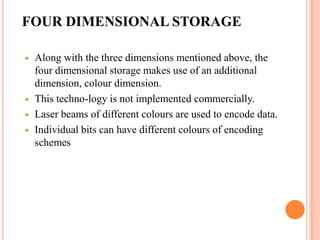
FOUR DIMENSIONAL STORAGE

   Along with the three dimensions mentioned above, the
    four dimensional storage makes use of an additional
    dimension, colour dimension.
   This techno-logy is not implemented commercially.
   Laser beams of different colours are used to encode data.
   Individual bits can have different colours of encoding
    schemes


                                                      19
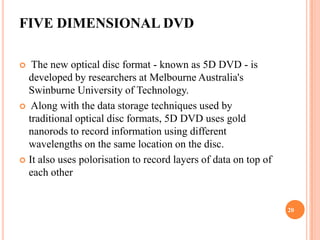
FIVE DIMENSIONAL DVD

  The new optical disc format - known as 5D DVD - is
  developed by researchers at Melbourne Australia's
  Swinburne University of Technology.
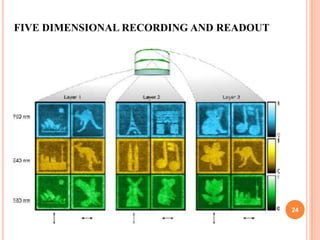
 Along with the data storage techniques used by
  traditional optical disc formats, 5D DVD uses gold
  nanorods to record information using different
  wavelengths on the same location on the disc.
 It also uses polorisation to record layers of data on top of
  each other


                                                                 20
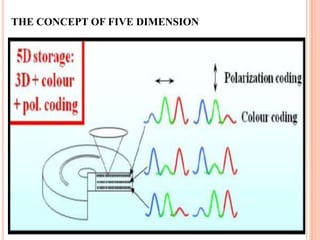
THE CONCEPT OF FIVE DIMENSION


                                21
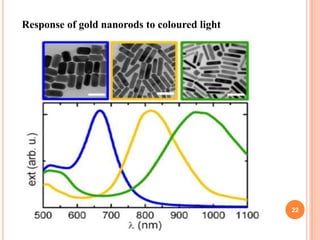
Response of gold nanorods to coloured light


                                              22
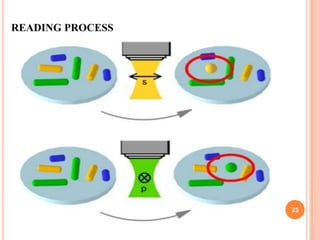
READING PROCESS


                  23
FIVE DIMENSIONAL RECORDING AND READOUT


                                         24
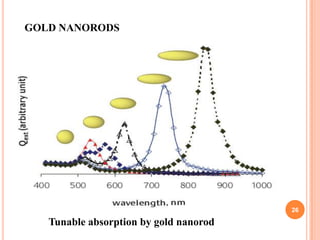
GOLD NANORODS

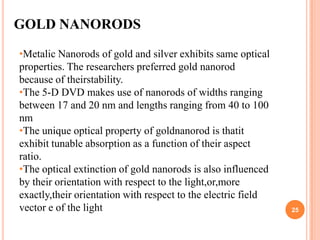
•Metalic Nanorods of gold and silver exhibits same optical
properties. The researchers preferred gold nanorod
because of theirstability.
•The 5-D DVD makes use of nanorods of widths ranging
between 17 and 20 nm and lengths ranging from 40 to 100
nm
•The unique optical property of goldnanorod is thatit
exhibit tunable absorption as a function of their aspect
ratio.
•The optical extinction of gold nanorods is also influenced
by their orientation with respect to the light,or,more
exactly,their orientation with respect to the electric field
vector e of the light                                          25
GOLD NANORODS


                                        26

   Tunable absorption by gold nanorod
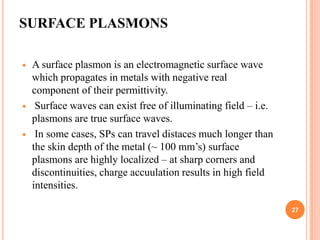
SURFACE PLASMONS

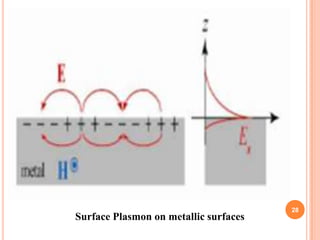
   A surface plasmon is an electromagnetic surface wave
    which propagates in metals with negative real
    component of their permittivity.
    Surface waves can exist free of illuminating field – i.e.
    plasmons are true surface waves.
    In some cases, SPs can travel distaces much longer than
    the skin depth of the metal (~ 100 mm’s) surface
    plasmons are highly localized – at sharp corners and
    discontinuities, charge accuulation results in high field
    intensities.

                                                                 27
28
Surface Plasmon on metallic surfaces
FIELDS OF APPLICATION

 Medical Field
 Military and Security Arenas

 Entertainment sector

 Space research

 Financial Sector


                                 29
ADVANTAGES

 Large storage capacity
 Light and Compact

 Data security

 Compatible with existing technology

 Can be manufactured on a large scale


                                         30
DISADVANTAGES

 Slow writing speed
 Impracticality of using Titanium Sapphire
  Femtosecond Laser
 Re-writability


                                              31
CONCLUSION
   Instead of the current three dimensional optical storage
    technologies,
    five dimensional DVD exploits the colour and
    polarization of light as two additional dimensions along
    with the three spatial dimensions.
   These multiple variables mean that the same volume of
    space can hold multiple bits in multiple ways, the
    researchers explain.
   For instance, a space that responds to three different
    colors and two different polarizations can hold six bits.
                                                                32
33
34

5D DVD

  • 1.
  • 2.
    2 Presented by Nikhil eg tjajeec
  • 3.
    LIST OF CONTENTS INTRODUCTION  CURRENT TECHNOLOGIES  CONVENTIONAL OPTICAL STORAGE SCHEMES  THE CONCEPT OF FIVE DIMENSION  GOLD NANORODS  SURFACE PLASMONS  FIELDS OF APPLICATION  ADVANTAGES & DISADVANTAGES  CONCLUSION 3
  • 4.
    INTRODUCTION  Scientists have unveiled new DVD technology that stores data in five dimensions, making it possible to pack more than 300 DVDs onto a single disc.  Multiplexed optical recording provides an un-paralleled approach to increasing the information density beyond 1012 bits per cm3  The major hurdle is the lack of a suitable recording medium that is extremely selective in the domains of wavelength and 4 polarization
  • 5.
    CURRENT TECHNOLOGIES  Optical Recording  The process of recording signals on a medium through the use of light, so that the signals may be reproduced at a subsequent time.  The introduction of the laser as a light source greatly improves the quality of reproduced signals  Optical data storage involves placing information in a medium so that, when a light beam scans the medium, the reflected light can be used to recover the information.  There are many forms of optical storage media like CD, DVD, Blu Ray Disc etc 5
  • 6.
    EXISTING TECHNOLOGY  At present there exist so many different medium for performing optical recording. They are  1. Floppy Disc  2. Compact Disc (CD)  3. Digital Versatile Disc (DVD)  4. Blu Ray Disc  5. Holographic Versatile Disc 6
  • 7.
    FLOPPY DISC  A floppy disk is a data storage medium that is composed of a disk of thin, flexible ("floppy")  magnetic storage medium sealed in a square or rectangular plastic carrier lined with fabric that removes dust particles  Floppy disks are read and written by a floppy disk drive or FDD. Invented by the American information technology company IBM , floppy disks in 8-inch 7
  • 8.
    COMPACT DISC (CD)  The Compact Disc (also known as a CD) is an optical disc used to store digital data.  It was originally developed to store and playback sound recordings exclusively.  Standard CDs have a diameter of 120 millimetr (4.7 in) and can hold up to 80 minutes of uncompressed audio (700 MB of data).  The Mini CD has various diameters ranging from 60 to 80 millimetre (2.4 to 3.1 in); they are sometimes used for CD singles 8
  • 9.
    DIGITAL VERSATILE DISC(DVD)  DVD is an optical disc storage media format, invented and developed by Philips, Sony, Toshiba, and Panasonic in 1995.  DVDs offer higher storage capacity than compact discs while having the same dimensions.  DVDs are used in DVD-Video consumer digital video format and in DVD-Audio consumer digital audio format, as well as for authoring AVCHD discs.  DVDs containing other types of information may be referred to as DVD data discs. 9
  • 10.
    BLU RAY DISC  Blu-ray Disc (official abbreviation BD) is an optical disc storage medium designed to supersede the DVD format  The standard physical medium is a 12 cm plastic optical disc, the same size as DVDs and CDs. Blu-ray Discs contain 25 GB per layer  The name Blu-ray Disc refers to the blue laserused to read the disc, which allows information to be stored at a greater density than is possible with the longer- wavelength red laser used for DVDs. 10
  • 11.
    HOLOGRAPHIC VERSATILE DISC  The Holographic Versatile Disc (HVD) is an optical disc technology developed between April 2004 and mid- 2008  that can store up to several terabytes of data on an optical disc the same size as a CD, DVD or Blu-Ray disc.  Standards for 100 GB read-only holographic discs and 200 GB recordable cartridges were published by ECMA in 2007, but no holographic disc product has appeared in the market.  A number of release dates were announced, all since 11 passed.
  • 12.
    CONVENTIONAL OPTICAL STORAGE SCHEMES  Two Dimensional Optical Storage  Three Dimensional Storage  FOUR DIMENSIONAL STORAGE  FIVE DIMENSIONAL DVD 12
  • 13.
    TWO DIMENSIONAL OPTICALSTORAGE  In this technology the data is written in ‘pits’ on the surface of the disc.  Examples are CD, DVD and blue ray disc.  Smaller pits mean that for the same available area, more data can be stored.  This depends on how narrow is the laser beam used for recording as well as reading.  That is how a DVD holds more than that of a CD and the storage capacity of a blue ray disc is very much higher than a DVD. 13
  • 14.
  • 15.
  • 16.
    THREE DIMENSIONAL STORAGE  Three dimensional optical storage includes multi- layered and holographic storage.  In the case of multi-layer optical storage the data is held in multiple layers.  There will be two or more recording media packed in a single disc  Current optical data storage media, such as the CD and DVD store data as a series of reflective marks on an internal surface of a disc. 16
  • 17.
  • 18.
  • 19.
    FOUR DIMENSIONAL STORAGE  Along with the three dimensions mentioned above, the four dimensional storage makes use of an additional dimension, colour dimension.  This techno-logy is not implemented commercially.  Laser beams of different colours are used to encode data.  Individual bits can have different colours of encoding schemes 19
  • 20.
    FIVE DIMENSIONAL DVD  The new optical disc format - known as 5D DVD - is developed by researchers at Melbourne Australia's Swinburne University of Technology.  Along with the data storage techniques used by traditional optical disc formats, 5D DVD uses gold nanorods to record information using different wavelengths on the same location on the disc.  It also uses polorisation to record layers of data on top of each other 20
  • 21.
    THE CONCEPT OFFIVE DIMENSION 21
  • 22.
    Response of goldnanorods to coloured light 22
  • 23.
  • 24.
  • 25.
    GOLD NANORODS •Metalic Nanorodsof gold and silver exhibits same optical properties. The researchers preferred gold nanorod because of theirstability. •The 5-D DVD makes use of nanorods of widths ranging between 17 and 20 nm and lengths ranging from 40 to 100 nm •The unique optical property of goldnanorod is thatit exhibit tunable absorption as a function of their aspect ratio. •The optical extinction of gold nanorods is also influenced by their orientation with respect to the light,or,more exactly,their orientation with respect to the electric field vector e of the light 25
  • 26.
    GOLD NANORODS 26 Tunable absorption by gold nanorod
  • 27.
    SURFACE PLASMONS  A surface plasmon is an electromagnetic surface wave which propagates in metals with negative real component of their permittivity.  Surface waves can exist free of illuminating field – i.e. plasmons are true surface waves.  In some cases, SPs can travel distaces much longer than the skin depth of the metal (~ 100 mm’s) surface plasmons are highly localized – at sharp corners and discontinuities, charge accuulation results in high field intensities. 27
  • 28.
    28 Surface Plasmon onmetallic surfaces
  • 29.
    FIELDS OF APPLICATION Medical Field  Military and Security Arenas  Entertainment sector  Space research  Financial Sector 29
  • 30.
    ADVANTAGES  Large storagecapacity  Light and Compact  Data security  Compatible with existing technology  Can be manufactured on a large scale 30
  • 31.
    DISADVANTAGES  Slow writingspeed  Impracticality of using Titanium Sapphire Femtosecond Laser  Re-writability 31
  • 32.
    CONCLUSION  Instead of the current three dimensional optical storage technologies,  five dimensional DVD exploits the colour and polarization of light as two additional dimensions along with the three spatial dimensions.  These multiple variables mean that the same volume of space can hold multiple bits in multiple ways, the researchers explain.  For instance, a space that responds to three different colors and two different polarizations can hold six bits. 32
  • 33.
  • 34.