Introduction
Unit- I
Introduction
Radio Frequency Spectrum,
The Ionosphere, Silent Zone
and Skip Distance
Introduction
Isotropic Radiators, SWR
Antennas
TRF, Super Heterodyne
Receivers, Double Super
Heterodyne Receivers,
Design Examples
Transmitters
and
Receivers
Topics Planned to be Covered
Introduction to aircraft communication system
Radio frequency spectrum
Types of atmospheric layer – Ionosphere layer
Various types of Antennas and their working
Isotropic Antenna and SWR measurement
Block Diagram of Transmitter using AM and FM
Block Diagram of Receiver using AM and FM
TRF block diagram and working model
Super heterodyne Receiver
Design of Transmitter and Receiver
What is Aircraft?
A vehicle (such as an airplane or balloon) for traveling
through the air.
What is the need for
communication in aircraft?
• The National Transportation Safety board states that nearly one third of
all aviation accidents are a result of some form of communication failure.
• It is important for general aviation as well as commercial aviation to stay
skillful in radio and communications procedures.
• Mid-air collisions and runway incursions are two of the most dangerous
results of poor communication.
• It is important to conduct all phases of the flight using effective
communication - even in the event of a radio failure, the flight can
continue with some form of communication, such as light gun signals.
Cont.
• The major importance of communication
in aviation is to increase the level of safety
and reduce accidents that could be
prevented.
Different Types of Aircraft
• Turboprop Aircraft
• Piston Aircraft
• Jets
• Light Jets
• Mid-Size Jets
• Jumbo Jets
• Regional Jets
• Narrow Body Aircraft
• Wide Body Airliners
• Regional, Short-Haul,
Federline Aircraft
• Commuter liners
• Airbus
• Concorde
• Tupolev Tu-144
• Military Aircraft
• Fighter
• Water Bomber
• Maritime Patrol
• Multi-role Combat
• Transport
Unit- I Introduction
Radio frequency spectrum
Antennas (Tx- Rx)
Ionosphere
Skip distance
Ionosphere
Antennas
Radio Frequency Spectrum
• Radio frequency signals are generally understood to occupy a frequency
range that extends from a few tens of kilohertz (kHz) to several hundred
gigahertz (GHz).
• Radio frequency (RF) spectrum is divided into several bands, each
spanning a decade of frequency.
• Each frequency range is set depends upon several factors, among
which is the propagation characteristics within the band concerned.
Cont.
• The lowest part of the radio frequency range that is of
practical use (below 30 kHz) is only suitable for narrow
- band communication.
• Ground waves communication - signals propagate
as ground waves (following the curvature of the
earth) over very long distances.
• Highest frequency range that is extends above 30 GHz.
• Microwave frequencies, considerable bandwidths
are available (sufficient to transmit many television
channels using point-to-point links or to permit
very high-definition radar systems), and signals tend
to propagate strictly along line-of-sight paths.
• At other frequencies signals may propagate by means
reflection from ionized layers in the ionosphere.
• Frequencies between 3 MHz and 30 MHz
ionospheric propagation regularly permits
intercontinental broadcasting and communications.
Frequency bands
Radio Detection and Ranging
Bands
Electromagnetic waves
Electric field pattern
in the near field region
between a transmitter
and a receiver (the
magnetic field has not
been shown but is
perpendicular to the
electric field)
Atmosphere
The earth’s atmosphere can be divided into five concentric regions
having boundaries that are not clearly defined.
Atmosphere
Troposphere
0-15km
Stratosphere Ionosphere Outer Atmosphere
G-Layer
D
15 - 90
E
90-140 F1 F2
140 - 400
F
• Telecommunications satellites are usually placed in geostationary Earth orbit (GEO). GEO is a
circular orbit 35 786 kilometres above Earth's equator and follows the direction of Earth's
rotation.
• GPS satellites fly in medium Earth orbit (MEO) at an altitude of approximately 20,200 km
Ionosphere
• The thermosphere and upper mesosphere are where most of
the ionization of the Earth's atmosphere occurs, and this
region is commonly referred to as the ionosphere.
• The ionosphere plays a critical role in the propagation of
radio waves over long distances by reflecting and refracting
them back to the Earth's surface allowing for long-distance
communication.
• located approximately 50 to 400 kilometers (30 to 370 miles)
above the surface of the Earth. Its primary function is to
absorb and reflect radio waves back to the Earth's surface.
• Ionospheric waves (or sky waves) can travel for long
distances at MF, HF and exceptionally also at VHF under
certain conditions.
Ionosphere
Radio wave propagation
• Radio waves are also called EM waves.
• An EM wave radiated by transmitting antenna is a
transverse wave.
• A transverse wave is also called traveling wave.
• Radio waves propagate
• in a straight line
• in several directions at once.
• In a vacuum, radio waves propagate at 3*10^8 m/s.
Radio Wave
Propagation
Depending on several complex factors,
Radio waves can propagate through the
atmosphere in various ways
• Ground Wave or Surface Wave.
• Sky Wave or Ionospheric Wave
• Space Wave or Tropospheric Wave.
Radio wave propagation through the atmosphere
Ground-Wave Propagation
(Surface wave):
• A part of wave travels along or near the surface of the earth.
• Useful at low frequencies.
• Useful for communication at VLF,LF and MF.
• Vertically polarized because lesser energy is absorbed in it.
• As the wave travels, level becomes lesser due to attenuation.
Sky Wave or ionospheric
wave Propagation:
• These waves travel upwards into space towards the sky and get
reflected to the receiver. It is also called ionospheric wave.
• The ionospheric is an ionized region which lies approx. between
60km to 450km of atmosphere.
• Useful for frequencies between 2 to 30MHz.
Space-Wave or
tropospheric
wave
Propagation:
• The EM waves that propagates from the
transmitter to the receiver in the earth’s
troposphere is called space or tropospheric
wave.
• Troposphere is the region of the atmosphere
with in 16 km above the surface of the earth.
• Useful above the frequency of 30MHz.
• Used for FM,TV and radar applications.
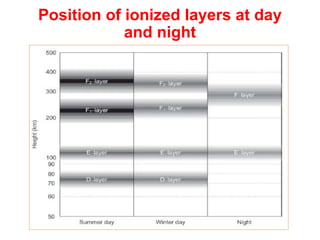
Layer Functions
D- Layer
• Present only in daytime,
• during nighttime it is vanished
• Electron density is maximum
• It reflect only – VLF and LF
E Layer
• Ionization by X-rays radiated – daytime
• Weak ionization at nighttime
• It reflect – 3MHz to 5MHz
• Maximum reflection occurs in this region
F Layer
• It reflect – 5MHz to 12MHz ,
• High frequency; F1 -layer supports more
G Layer • After 400km, (Irregular region)
Refraction
Diffraction
Scattering
Reflection
Four effects can occur
Various propagation effects
Effect of ionized layers on radio
signals at various frequencies
Position of ionized layers at day
and night
Line-of-Sight Propagation
• Every frequency signals are transmitted in straight lines
directly from antenna to antenna.
• It was difficult to install cable in rocky hills and across
rivers and lakes.
Cont.
• To communicate by line-of-sight mode, you must be able
to see the other station from your antenna
• That means the higher the antennas, the longer the distance
that can be reached.
• Line of sight propagation works at almost any frequency, it
is of importance at VHF, UHF and microwave frequencies
• On the HF frequencies, it really isn’t very useful, since we
are generally interested in communicating over much great
distances.
Silent zone and Skip distance
The silent zone is simply the region that exists between the extent of
the coverage of the ground wave signal and the point at which the
sky wave returns to earth.
Skywaves; Skip Distance & Skip Zone
• Understanding the way in which HF radio signals propagate
can help the effects of ionospheric propagation to be used to
its best.
• Skywaves, skip zone and skip distances are three key
concepts show why radio communications signals are heard
in some places and not others .
• In order to cover large distances using ionospheric radio
propagation the concepts of skywaves, skip distance and skip
zone are important.
• They have an impact on aspects of radio communications
links including the times and frequencies chosen, the
antennas used, the transmitters and receivers employed and
a variety of other aspects.
Skywaves: Skip Distance, Skip Zone » Electronics Notes (electronics-notes.com)
Signal routing and control

1. ACNS UNIT-1.pptx

  • 1.
  • 2.
    Introduction Radio Frequency Spectrum, TheIonosphere, Silent Zone and Skip Distance Introduction Isotropic Radiators, SWR Antennas TRF, Super Heterodyne Receivers, Double Super Heterodyne Receivers, Design Examples Transmitters and Receivers
  • 3.
    Topics Planned tobe Covered Introduction to aircraft communication system Radio frequency spectrum Types of atmospheric layer – Ionosphere layer Various types of Antennas and their working Isotropic Antenna and SWR measurement Block Diagram of Transmitter using AM and FM Block Diagram of Receiver using AM and FM TRF block diagram and working model Super heterodyne Receiver Design of Transmitter and Receiver
  • 4.
    What is Aircraft? Avehicle (such as an airplane or balloon) for traveling through the air.
  • 5.
    What is theneed for communication in aircraft? • The National Transportation Safety board states that nearly one third of all aviation accidents are a result of some form of communication failure. • It is important for general aviation as well as commercial aviation to stay skillful in radio and communications procedures. • Mid-air collisions and runway incursions are two of the most dangerous results of poor communication. • It is important to conduct all phases of the flight using effective communication - even in the event of a radio failure, the flight can continue with some form of communication, such as light gun signals.
  • 6.
    Cont. • The majorimportance of communication in aviation is to increase the level of safety and reduce accidents that could be prevented.
  • 7.
    Different Types ofAircraft • Turboprop Aircraft • Piston Aircraft • Jets • Light Jets • Mid-Size Jets • Jumbo Jets • Regional Jets • Narrow Body Aircraft • Wide Body Airliners • Regional, Short-Haul, Federline Aircraft • Commuter liners • Airbus • Concorde • Tupolev Tu-144 • Military Aircraft • Fighter • Water Bomber • Maritime Patrol • Multi-role Combat • Transport
  • 8.
    Unit- I Introduction Radiofrequency spectrum Antennas (Tx- Rx) Ionosphere Skip distance
  • 9.
  • 10.
  • 11.
    Radio Frequency Spectrum •Radio frequency signals are generally understood to occupy a frequency range that extends from a few tens of kilohertz (kHz) to several hundred gigahertz (GHz). • Radio frequency (RF) spectrum is divided into several bands, each spanning a decade of frequency. • Each frequency range is set depends upon several factors, among which is the propagation characteristics within the band concerned.
  • 13.
    Cont. • The lowestpart of the radio frequency range that is of practical use (below 30 kHz) is only suitable for narrow - band communication. • Ground waves communication - signals propagate as ground waves (following the curvature of the earth) over very long distances. • Highest frequency range that is extends above 30 GHz. • Microwave frequencies, considerable bandwidths are available (sufficient to transmit many television channels using point-to-point links or to permit very high-definition radar systems), and signals tend to propagate strictly along line-of-sight paths. • At other frequencies signals may propagate by means reflection from ionized layers in the ionosphere. • Frequencies between 3 MHz and 30 MHz ionospheric propagation regularly permits intercontinental broadcasting and communications.
  • 14.
  • 17.
    Radio Detection andRanging Bands
  • 18.
  • 19.
  • 21.
    Electric field pattern inthe near field region between a transmitter and a receiver (the magnetic field has not been shown but is perpendicular to the electric field)
  • 22.
    Atmosphere The earth’s atmospherecan be divided into five concentric regions having boundaries that are not clearly defined.
  • 23.
    Atmosphere Troposphere 0-15km Stratosphere Ionosphere OuterAtmosphere G-Layer D 15 - 90 E 90-140 F1 F2 140 - 400 F • Telecommunications satellites are usually placed in geostationary Earth orbit (GEO). GEO is a circular orbit 35 786 kilometres above Earth's equator and follows the direction of Earth's rotation. • GPS satellites fly in medium Earth orbit (MEO) at an altitude of approximately 20,200 km
  • 24.
    Ionosphere • The thermosphereand upper mesosphere are where most of the ionization of the Earth's atmosphere occurs, and this region is commonly referred to as the ionosphere. • The ionosphere plays a critical role in the propagation of radio waves over long distances by reflecting and refracting them back to the Earth's surface allowing for long-distance communication. • located approximately 50 to 400 kilometers (30 to 370 miles) above the surface of the Earth. Its primary function is to absorb and reflect radio waves back to the Earth's surface. • Ionospheric waves (or sky waves) can travel for long distances at MF, HF and exceptionally also at VHF under certain conditions.
  • 25.
  • 26.
    Radio wave propagation •Radio waves are also called EM waves. • An EM wave radiated by transmitting antenna is a transverse wave. • A transverse wave is also called traveling wave. • Radio waves propagate • in a straight line • in several directions at once. • In a vacuum, radio waves propagate at 3*10^8 m/s.
  • 27.
    Radio Wave Propagation Depending onseveral complex factors, Radio waves can propagate through the atmosphere in various ways • Ground Wave or Surface Wave. • Sky Wave or Ionospheric Wave • Space Wave or Tropospheric Wave.
  • 30.
    Radio wave propagationthrough the atmosphere
  • 31.
    Ground-Wave Propagation (Surface wave): •A part of wave travels along or near the surface of the earth. • Useful at low frequencies. • Useful for communication at VLF,LF and MF. • Vertically polarized because lesser energy is absorbed in it. • As the wave travels, level becomes lesser due to attenuation.
  • 32.
    Sky Wave orionospheric wave Propagation: • These waves travel upwards into space towards the sky and get reflected to the receiver. It is also called ionospheric wave. • The ionospheric is an ionized region which lies approx. between 60km to 450km of atmosphere. • Useful for frequencies between 2 to 30MHz.
  • 33.
    Space-Wave or tropospheric wave Propagation: • TheEM waves that propagates from the transmitter to the receiver in the earth’s troposphere is called space or tropospheric wave. • Troposphere is the region of the atmosphere with in 16 km above the surface of the earth. • Useful above the frequency of 30MHz. • Used for FM,TV and radar applications.
  • 34.
    Layer Functions D- Layer •Present only in daytime, • during nighttime it is vanished • Electron density is maximum • It reflect only – VLF and LF E Layer • Ionization by X-rays radiated – daytime • Weak ionization at nighttime • It reflect – 3MHz to 5MHz • Maximum reflection occurs in this region F Layer • It reflect – 5MHz to 12MHz , • High frequency; F1 -layer supports more G Layer • After 400km, (Irregular region)
  • 35.
  • 36.
  • 37.
    Effect of ionizedlayers on radio signals at various frequencies
  • 38.
    Position of ionizedlayers at day and night
  • 39.
    Line-of-Sight Propagation • Everyfrequency signals are transmitted in straight lines directly from antenna to antenna. • It was difficult to install cable in rocky hills and across rivers and lakes.
  • 40.
    Cont. • To communicateby line-of-sight mode, you must be able to see the other station from your antenna • That means the higher the antennas, the longer the distance that can be reached. • Line of sight propagation works at almost any frequency, it is of importance at VHF, UHF and microwave frequencies • On the HF frequencies, it really isn’t very useful, since we are generally interested in communicating over much great distances.
  • 41.
    Silent zone andSkip distance The silent zone is simply the region that exists between the extent of the coverage of the ground wave signal and the point at which the sky wave returns to earth.
  • 42.
    Skywaves; Skip Distance& Skip Zone • Understanding the way in which HF radio signals propagate can help the effects of ionospheric propagation to be used to its best. • Skywaves, skip zone and skip distances are three key concepts show why radio communications signals are heard in some places and not others . • In order to cover large distances using ionospheric radio propagation the concepts of skywaves, skip distance and skip zone are important. • They have an impact on aspects of radio communications links including the times and frequencies chosen, the antennas used, the transmitters and receivers employed and a variety of other aspects. Skywaves: Skip Distance, Skip Zone » Electronics Notes (electronics-notes.com)
  • 43.