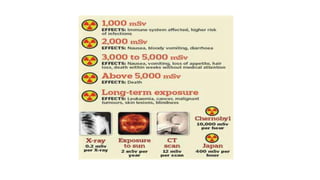
Understanding the
Radiation units
Presented by;
Niroj Sandha(PCL)
RADIOGRAPHY 2ND YR
KAHS
Contents
1. Introduction to Electromagnetic radiation
2. Importance of measuring system
3. Units of radioactivity
4. Units of radiation dose
5. Equivalent dose
6. KERMA
7. Effective dose
• Units of exposure
• Units of Absorption
Introduction to Electromagnetic Radiation
• Electromagnetic radiation is the form of energy formed by oscillating
electric and magnetic feild distrubance.
• It is a movement of electrically charged particles travelling through a
vaccum.
• Wavelength: 0.01 to 10nm
• Frequency:3×10^6Hz to 3×10^19Hz
• Energy:100ev to 100kev
• Types;
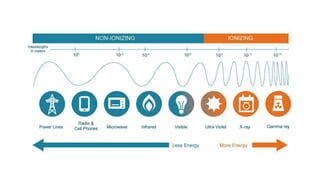
1. Non-Ionizing radiation
2. Ionizing radiation
1. Non-Ionizing radiation
• Refers to the EMR that does not carry enough energy per
quantum(photon energy) to ionize atoms or molecules , that is to
completly rove the charge particles from an atom or molecule.
• Radiation with the particle or photon energy less than 100ev is
considered as Non-Ionizing .
• Eg;UV rays ,visible light ,Infrared,Microwaves ,Radiowaves etc
2.Ionizing radiation
• Refers to the EMR that carry enough wnwrgy per quantum (photon energy
) to ionize the atoms pr kolecules in the medium through which it passes.
• It is categorized by the nature of EMR waves that create the ionizing effect;
i)Directly( charged particles)
ii)Indirectly (Neutral)
i)Directly:
It depositsenergy in the medium through direct coulomb interaction
between directly ionizing charge particles and orbital electrons of atom in
the medium.
Eg ;Alpha,Beta,Gamma
ii)Indirect :
Deposits energy into the medium through two process ;
1st step: charged particles released in the medium (photon release
electrons or positrons , neutrons releases protons or heavier ions).
2nd step :Charge particles deposits energy to the medium through
direct coulomb interaction with orbital electrons of the atoms in the
medium .
eg ; Neutrons
Importance of Measuring Units
In 1928 ,International commision on Radiation Units
(ICRU)adopted a Roentgen as a measuring unit of X & Y radiation.
When trying to measure radiation there
are two things being measured ,activity and exposure .Activity is how much
radiation is coming out of something while exposure measures the effect of
that radiation on any thing that absorbs it.
Radiation units are confusing for three or four reasons ;
• There are diffrent units depending on whether you’re measuring how
much radiation is being emitted or recived .
• There are diffrent ways of quantifying the amount of radiation recived
depending upon whether you’re doing physics or biology.
• For each of these measurements there are traditional units and SI units.
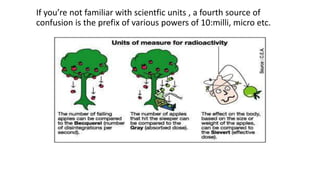
If you’re not familiar with scientfic units , a fourth source of
confusion is the prefix of various powers of 10:milli, micro etc.
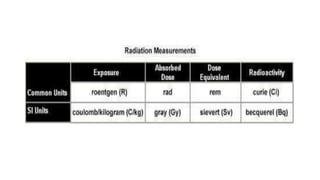
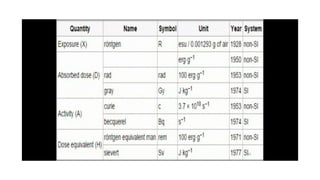
The amount of radioactivity emitted by a source is measured in
Becqurels or Curies (named after Henri Becquerel and Marrie curie).The SI
unit is Becquerel(Bq),one decay per second .The traditional units Curie (Ci)
is 3.7×10^10Bq and is about radioactovity of gram of radium.
The amount of radiation recived by a source is measured in
grays or rads.The SI unit Gray(Gy) corresponds to one joule of energy
absorbed by one kilogram of matter (J/Kg).The traditional unit is Rad
(0.01Gy).
1 Rad =0.01 Gy
Or, 100Rads =1Gy
The biological effect of radiation is measured in seiverts
or Rems .Biologically effective dose is amount of radiation recived and
multiplied by relative biological effectiveness of the type of radiation
source .For x-rays RBE is 1.For Alpha rays RBE is 20 .The SI unit of
effective dose is seivers (si) which corresponds to one gray of x rays . A
rem is 0.01sev
Units of Radioactivity
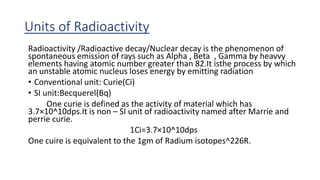
Radioactivity /Radioactive decay/Nuclear decay is the phenomenon of
spontaneous emission of rays such as Alpha , Beta , Gamma by heavvy
elements having atomic number greater than 82.It isthe process by which
an unstable atomic nucleus loses energy by emitting radiation
• Conventional unit: Curie(Ci)
• SI unit:Becquerel(Bq)
One curie is defined as the activity of material which has
3.7×10^10dps.It is non – SI unit of radioactivity named after Marrie and
perrie curie.
1Ci=3.7×10^10dps
One cuire is equivalent to the 1gm of Radium isotopes^226R.
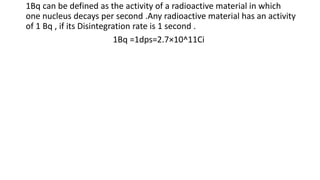
1Bq can be defined as the activity of a radioactive material in which
one nucleus decays per second .Any radioactive material has an activity
of 1 Bq , if its Disintegration rate is 1 second .
1Bq =1dps=2.7×10^11Ci
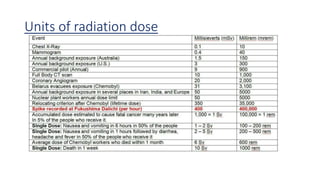
Units of radiation dose
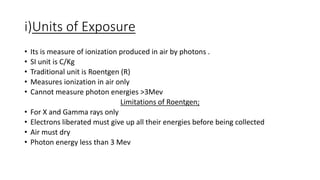
i)Units of Exposure
• Its is measure of ionization produced in air by photons .
• SI unit is C/Kg
• Traditional unit is Roentgen (R)
• Measures ionization in air only
• Cannot measure photon energies >3Mev
Limitations of Roentgen;
• For X and Gamma rays only
• Electrons liberated must give up all their energies before being collected
• Air must dry
• Photon energy less than 3 Mev
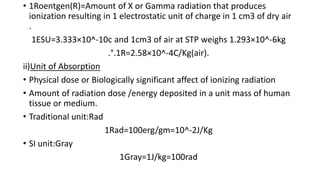
• 1Roentgen(R)=Amount of X or Gamma radiation that produces
ionization resulting in 1 electrostatic unit of charge in 1 cm3 of dry air
.
1ESU=3.333×10^-10c and 1cm3 of air at STP weighs 1.293×10^-6kg
.°.1R=2.58×10^-4C/Kg(air).
ii)Unit of Absorption
• Physical dose or Biologically significant affect of ionizing radiation
• Amount of radiation dose /energy deposited in a unit mass of human
tissue or medium.
• Traditional unit:Rad
1Rad=100erg/gm=10^-2J/Kg
• SI unit:Gray
1Gray=1J/kg=100rad
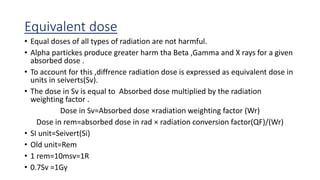
Equivalent dose
• Equal doses of all types of radiation are not harmful.
• Alpha partickes produce greater harm tha Beta ,Gamma and X rays for a given
absorbed dose .
• To account for this ,diffrence radiation dose is expressed as equivalent dose in
units in seiverts(Sv).
• The dose in Sv is equal to Absorbed dose multiplied by the radiation
weighting factor .
Dose in Sv=Absorbed dose ×radiation weighting factor (Wr)
Dose in rem=absorbed dose in rad × radiation conversion factor(QF)/(Wr)
• SI unit=Seivert(Si)
• Old unit=Rem
• 1 rem=10msv=1R
• 0.7Sv =1Gy
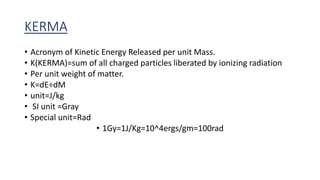
KERMA
• Acronym of Kinetic Energy Released per unit Mass.
• K(KERMA)=sum of all charged particles liberated by ionizing radiation
• Per unit weight of matter.
• K=dE÷dM
• unit=J/kg
• SI unit =Gray
• Special unit=Rad
• 1Gy=1J/Kg=10^4ergs/gm=100rad
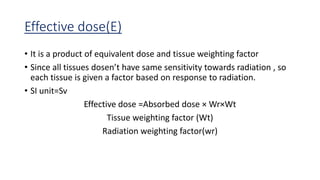
Effective dose(E)
• It is a product of equivalent dose and tissue weighting factor
• Since all tissues dosen’t have same sensitivity towards radiation , so
each tissue is given a factor based on response to radiation.
• SI unit=Sv
Effective dose =Absorbed dose × Wr×Wt
Tissue weighting factor (Wt)
Radiation weighting factor(wr)
THANK YOU

Understanding radiation units

  • 1.
    Understanding the Radiation units Presentedby; Niroj Sandha(PCL) RADIOGRAPHY 2ND YR KAHS
  • 2.
    Contents 1. Introduction toElectromagnetic radiation 2. Importance of measuring system 3. Units of radioactivity 4. Units of radiation dose 5. Equivalent dose 6. KERMA 7. Effective dose • Units of exposure • Units of Absorption
  • 4.
    Introduction to ElectromagneticRadiation • Electromagnetic radiation is the form of energy formed by oscillating electric and magnetic feild distrubance. • It is a movement of electrically charged particles travelling through a vaccum. • Wavelength: 0.01 to 10nm • Frequency:3×10^6Hz to 3×10^19Hz • Energy:100ev to 100kev • Types; 1. Non-Ionizing radiation 2. Ionizing radiation
  • 5.
    1. Non-Ionizing radiation •Refers to the EMR that does not carry enough energy per quantum(photon energy) to ionize atoms or molecules , that is to completly rove the charge particles from an atom or molecule. • Radiation with the particle or photon energy less than 100ev is considered as Non-Ionizing . • Eg;UV rays ,visible light ,Infrared,Microwaves ,Radiowaves etc
  • 7.
    2.Ionizing radiation • Refersto the EMR that carry enough wnwrgy per quantum (photon energy ) to ionize the atoms pr kolecules in the medium through which it passes. • It is categorized by the nature of EMR waves that create the ionizing effect; i)Directly( charged particles) ii)Indirectly (Neutral) i)Directly: It depositsenergy in the medium through direct coulomb interaction between directly ionizing charge particles and orbital electrons of atom in the medium. Eg ;Alpha,Beta,Gamma
  • 8.
    ii)Indirect : Deposits energyinto the medium through two process ; 1st step: charged particles released in the medium (photon release electrons or positrons , neutrons releases protons or heavier ions). 2nd step :Charge particles deposits energy to the medium through direct coulomb interaction with orbital electrons of the atoms in the medium . eg ; Neutrons
  • 9.
    Importance of MeasuringUnits In 1928 ,International commision on Radiation Units (ICRU)adopted a Roentgen as a measuring unit of X & Y radiation. When trying to measure radiation there are two things being measured ,activity and exposure .Activity is how much radiation is coming out of something while exposure measures the effect of that radiation on any thing that absorbs it. Radiation units are confusing for three or four reasons ; • There are diffrent units depending on whether you’re measuring how much radiation is being emitted or recived . • There are diffrent ways of quantifying the amount of radiation recived depending upon whether you’re doing physics or biology. • For each of these measurements there are traditional units and SI units.
  • 10.
    If you’re notfamiliar with scientfic units , a fourth source of confusion is the prefix of various powers of 10:milli, micro etc.
  • 11.
    The amount ofradioactivity emitted by a source is measured in Becqurels or Curies (named after Henri Becquerel and Marrie curie).The SI unit is Becquerel(Bq),one decay per second .The traditional units Curie (Ci) is 3.7×10^10Bq and is about radioactovity of gram of radium. The amount of radiation recived by a source is measured in grays or rads.The SI unit Gray(Gy) corresponds to one joule of energy absorbed by one kilogram of matter (J/Kg).The traditional unit is Rad (0.01Gy). 1 Rad =0.01 Gy Or, 100Rads =1Gy The biological effect of radiation is measured in seiverts or Rems .Biologically effective dose is amount of radiation recived and multiplied by relative biological effectiveness of the type of radiation source .For x-rays RBE is 1.For Alpha rays RBE is 20 .The SI unit of effective dose is seivers (si) which corresponds to one gray of x rays . A rem is 0.01sev
  • 12.
    Units of Radioactivity Radioactivity/Radioactive decay/Nuclear decay is the phenomenon of spontaneous emission of rays such as Alpha , Beta , Gamma by heavvy elements having atomic number greater than 82.It isthe process by which an unstable atomic nucleus loses energy by emitting radiation • Conventional unit: Curie(Ci) • SI unit:Becquerel(Bq) One curie is defined as the activity of material which has 3.7×10^10dps.It is non – SI unit of radioactivity named after Marrie and perrie curie. 1Ci=3.7×10^10dps One cuire is equivalent to the 1gm of Radium isotopes^226R.
  • 13.
    1Bq can bedefined as the activity of a radioactive material in which one nucleus decays per second .Any radioactive material has an activity of 1 Bq , if its Disintegration rate is 1 second . 1Bq =1dps=2.7×10^11Ci
  • 14.
  • 15.
    i)Units of Exposure •Its is measure of ionization produced in air by photons . • SI unit is C/Kg • Traditional unit is Roentgen (R) • Measures ionization in air only • Cannot measure photon energies >3Mev Limitations of Roentgen; • For X and Gamma rays only • Electrons liberated must give up all their energies before being collected • Air must dry • Photon energy less than 3 Mev
  • 16.
    • 1Roentgen(R)=Amount ofX or Gamma radiation that produces ionization resulting in 1 electrostatic unit of charge in 1 cm3 of dry air . 1ESU=3.333×10^-10c and 1cm3 of air at STP weighs 1.293×10^-6kg .°.1R=2.58×10^-4C/Kg(air). ii)Unit of Absorption • Physical dose or Biologically significant affect of ionizing radiation • Amount of radiation dose /energy deposited in a unit mass of human tissue or medium. • Traditional unit:Rad 1Rad=100erg/gm=10^-2J/Kg • SI unit:Gray 1Gray=1J/kg=100rad
  • 19.
    Equivalent dose • Equaldoses of all types of radiation are not harmful. • Alpha partickes produce greater harm tha Beta ,Gamma and X rays for a given absorbed dose . • To account for this ,diffrence radiation dose is expressed as equivalent dose in units in seiverts(Sv). • The dose in Sv is equal to Absorbed dose multiplied by the radiation weighting factor . Dose in Sv=Absorbed dose ×radiation weighting factor (Wr) Dose in rem=absorbed dose in rad × radiation conversion factor(QF)/(Wr) • SI unit=Seivert(Si) • Old unit=Rem • 1 rem=10msv=1R • 0.7Sv =1Gy
  • 21.
    KERMA • Acronym ofKinetic Energy Released per unit Mass. • K(KERMA)=sum of all charged particles liberated by ionizing radiation • Per unit weight of matter. • K=dE÷dM • unit=J/kg • SI unit =Gray • Special unit=Rad • 1Gy=1J/Kg=10^4ergs/gm=100rad
  • 22.
    Effective dose(E) • Itis a product of equivalent dose and tissue weighting factor • Since all tissues dosen’t have same sensitivity towards radiation , so each tissue is given a factor based on response to radiation. • SI unit=Sv Effective dose =Absorbed dose × Wr×Wt Tissue weighting factor (Wt) Radiation weighting factor(wr)
  • 27.

Editor's Notes

  • #8 Coulombs law: Coulombs law or coulombs inverse square law is a law of physics that describes force interacting between the static electrical charged particles . It states that,”The magnitude of electrostatic force of attraction between two point charge is directly proportional to the product of the magnitude of charges and inversly propotional to rhe square of distance between them”
  • #22 1ergs=10^-7J