MISSILE TECHNOLOGY
By-YOGESH KR. GARG
ME, IIIrd yr,
M-122-2K11
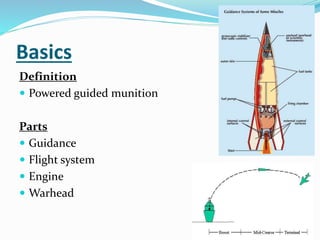
Basics
Definition
 Powered guided munition
Parts
 Guidance
 Flight system
 Engine
 Warhead
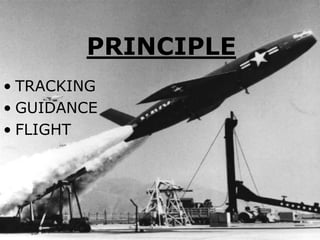
PRINCIPLE
• TRACKING
• GUIDANCE
• FLIGHT
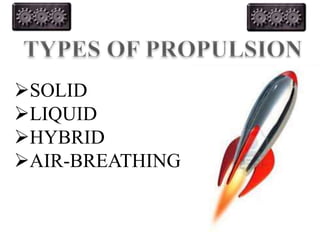
SOLID
LIQUID
HYBRID
AIR-BREATHING
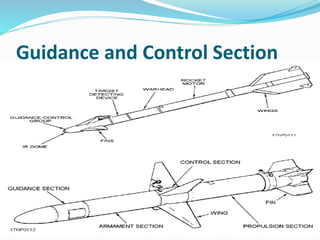
Guidance and Control Section
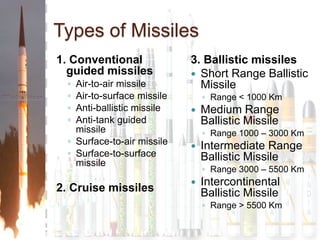
Types of Missiles
1. Conventional
guided missiles
◦ Air-to-air missile
◦ Air-to-surface missile
◦ Anti-ballistic missile
◦ Anti-tank guided
missile
◦ Surface-to-air missile
◦ Surface-to-surface
missile
2. Cruise missiles
3. Ballistic missiles
 Short Range Ballistic
Missile
◦ Range < 1000 Km
 Medium Range
Ballistic Missile
◦ Range 1000 – 3000 Km
 Intermediate Range
Ballistic Missile
◦ Range 3000 – 5500 Km
 Intercontinental
Ballistic Missile
◦ Range > 5500 Km
Air to air
Type Air to Air Missile
Place of origin India
Production history
Manufacturer DRDO
Produced Pre Production/Testing [1]
Specifications
Weight 154 kg
Length 3570 mm
Diameter 178 mm
Warhead
15 kg (33 lb) HE fragmentation
directional warhead
Detonation
mechanism
Radar proximity fuze
Engine Solid Fuel Rocket
Wingspan 254 mm
Operational
range
80-110 km[2][3]
Flight ceiling 66,000 ft
Speed Mach 4 + (4780 Km/h)
Guidance
system
Inertial, mid-course update and
terminal active radar homing (15 km)
Launch
platform
Su-30MKI,
HAL Tejas,
PAK FA / Sukhoi/HAL FGFA,
Mirage 2000 and
Mig-29.
(Astra)
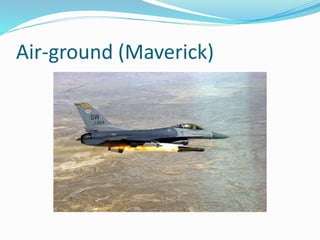
Air-ground (Maverick)
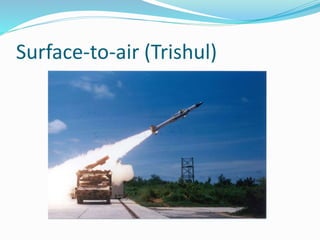
Surface-to-air (Trishul)
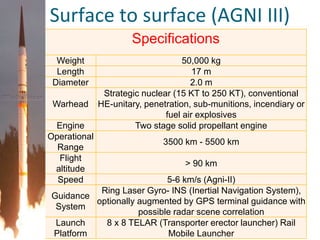
Specifications
Weight 50,000 kg
Length 17 m
Diameter 2.0 m
Warhead
Strategic nuclear (15 KT to 250 KT), conventional
HE-unitary, penetration, sub-munitions, incendiary or
fuel air explosives
Engine Two stage solid propellant engine
Operational
Range
3500 km - 5500 km
Flight
altitude
> 90 km
Speed 5-6 km/s (Agni-II)
Guidance
System
Ring Laser Gyro- INS (Inertial Navigation System),
optionally augmented by GPS terminal guidance with
possible radar scene correlation
Launch
Platform
8 x 8 TELAR (Transporter erector launcher) Rail
Mobile Launcher
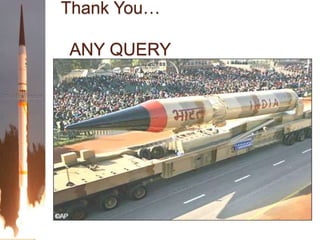
Surface to surface (AGNI III)
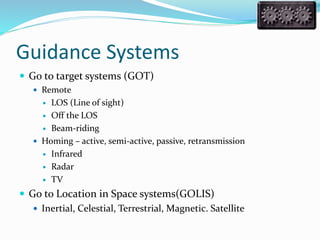
Guidance Systems
 Go to target systems (GOT)
 Remote
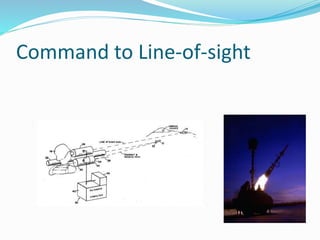
 LOS (Line of sight)
 Off the LOS
 Beam-riding
 Homing – active, semi-active, passive, retransmission
 Infrared
 Radar
 TV
 Go to Location in Space systems(GOLIS)
 Inertial, Celestial, Terrestrial, Magnetic. Satellite
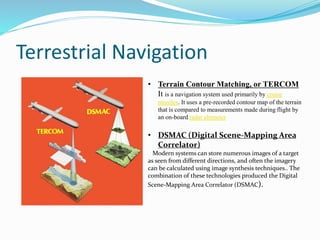
Terrestrial Navigation
• Terrain Contour Matching, or TERCOM
It is a navigation system used primarily by cruise
missiles. It uses a pre-recorded contour map of the terrain
that is compared to measurements made during flight by
an on-board radar altimeter
• DSMAC (Digital Scene-Mapping Area
Correlator)
Modern systems can store numerous images of a target
as seen from different directions, and often the imagery
can be calculated using image synthesis techniques.. The
combination of these technologies produced the Digital
Scene-Mapping Area Correlator (DSMAC).
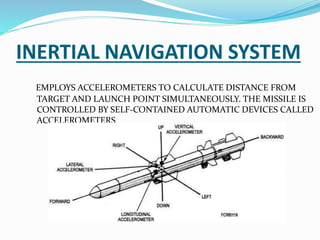
INERTIAL NAVIGATION SYSTEM
EMPLOYS ACCELEROMETERS TO CALCULATE DISTANCE FROM
TARGET AND LAUNCH POINT SIMULTANEOUSLY. THE MISSILE IS
CONTROLLED BY SELF-CONTAINED AUTOMATIC DEVICES CALLED
ACCELEROMETERS
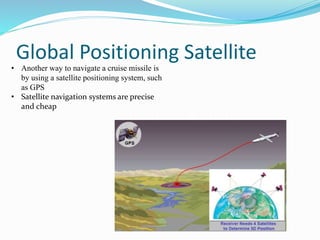
Global Positioning Satellite
• Another way to navigate a cruise missile is
by using a satellite positioning system, such
as GPS
• Satellite navigation systems are precise
and cheap
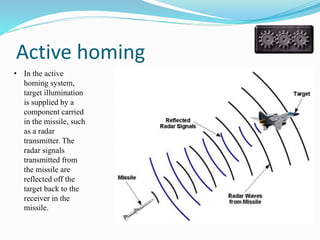
Active homing
• In the active
homing system,
target illumination
is supplied by a
component carried
in the missile, such
as a radar
transmitter. The
radar signals
transmitted from
the missile are
reflected off the
target back to the
receiver in the
missile.
Passive homing
• In the passive
homing system, the
directing
intelligence is
received from the
target. Examples of
passive homing
include homing on
a source of infrared
rays (such as the
hot exhaust of jet
aircraft) or radar
signal
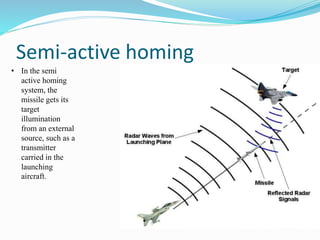
Semi-active homing
• In the semi
active homing
system, the
missile gets its
target
illumination
from an external
source, such as a
transmitter
carried in the
launching
aircraft.
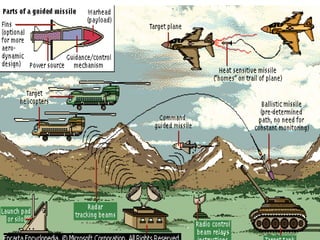
Command to Line-of-sight
BIBLIOGRAPHIES
 Wikipedia.com
 Howstuffworks.com
 Missilesthreat.com
 www.aerospaceweb.org/.../ missiles
 www.wa3key.com
Thank You…
ANY QUERY

Missile technology

  • 1.
    MISSILE TECHNOLOGY By-YOGESH KR.GARG ME, IIIrd yr, M-122-2K11
  • 2.
    Basics Definition  Powered guidedmunition Parts  Guidance  Flight system  Engine  Warhead
  • 3.
  • 4.
  • 5.
  • 6.
    Types of Missiles 1.Conventional guided missiles ◦ Air-to-air missile ◦ Air-to-surface missile ◦ Anti-ballistic missile ◦ Anti-tank guided missile ◦ Surface-to-air missile ◦ Surface-to-surface missile 2. Cruise missiles 3. Ballistic missiles  Short Range Ballistic Missile ◦ Range < 1000 Km  Medium Range Ballistic Missile ◦ Range 1000 – 3000 Km  Intermediate Range Ballistic Missile ◦ Range 3000 – 5500 Km  Intercontinental Ballistic Missile ◦ Range > 5500 Km
  • 7.
    Air to air TypeAir to Air Missile Place of origin India Production history Manufacturer DRDO Produced Pre Production/Testing [1] Specifications Weight 154 kg Length 3570 mm Diameter 178 mm Warhead 15 kg (33 lb) HE fragmentation directional warhead Detonation mechanism Radar proximity fuze Engine Solid Fuel Rocket Wingspan 254 mm Operational range 80-110 km[2][3] Flight ceiling 66,000 ft Speed Mach 4 + (4780 Km/h) Guidance system Inertial, mid-course update and terminal active radar homing (15 km) Launch platform Su-30MKI, HAL Tejas, PAK FA / Sukhoi/HAL FGFA, Mirage 2000 and Mig-29. (Astra)
  • 8.
  • 9.
  • 10.
    Specifications Weight 50,000 kg Length17 m Diameter 2.0 m Warhead Strategic nuclear (15 KT to 250 KT), conventional HE-unitary, penetration, sub-munitions, incendiary or fuel air explosives Engine Two stage solid propellant engine Operational Range 3500 km - 5500 km Flight altitude > 90 km Speed 5-6 km/s (Agni-II) Guidance System Ring Laser Gyro- INS (Inertial Navigation System), optionally augmented by GPS terminal guidance with possible radar scene correlation Launch Platform 8 x 8 TELAR (Transporter erector launcher) Rail Mobile Launcher Surface to surface (AGNI III)
  • 11.
    Guidance Systems  Goto target systems (GOT)  Remote  LOS (Line of sight)  Off the LOS  Beam-riding  Homing – active, semi-active, passive, retransmission  Infrared  Radar  TV  Go to Location in Space systems(GOLIS)  Inertial, Celestial, Terrestrial, Magnetic. Satellite
  • 13.
    Terrestrial Navigation • TerrainContour Matching, or TERCOM It is a navigation system used primarily by cruise missiles. It uses a pre-recorded contour map of the terrain that is compared to measurements made during flight by an on-board radar altimeter • DSMAC (Digital Scene-Mapping Area Correlator) Modern systems can store numerous images of a target as seen from different directions, and often the imagery can be calculated using image synthesis techniques.. The combination of these technologies produced the Digital Scene-Mapping Area Correlator (DSMAC).
  • 14.
    INERTIAL NAVIGATION SYSTEM EMPLOYSACCELEROMETERS TO CALCULATE DISTANCE FROM TARGET AND LAUNCH POINT SIMULTANEOUSLY. THE MISSILE IS CONTROLLED BY SELF-CONTAINED AUTOMATIC DEVICES CALLED ACCELEROMETERS
  • 15.
    Global Positioning Satellite •Another way to navigate a cruise missile is by using a satellite positioning system, such as GPS • Satellite navigation systems are precise and cheap
  • 16.
    Active homing • Inthe active homing system, target illumination is supplied by a component carried in the missile, such as a radar transmitter. The radar signals transmitted from the missile are reflected off the target back to the receiver in the missile.
  • 17.
    Passive homing • Inthe passive homing system, the directing intelligence is received from the target. Examples of passive homing include homing on a source of infrared rays (such as the hot exhaust of jet aircraft) or radar signal
  • 18.
    Semi-active homing • Inthe semi active homing system, the missile gets its target illumination from an external source, such as a transmitter carried in the launching aircraft.
  • 19.
  • 20.
    BIBLIOGRAPHIES  Wikipedia.com  Howstuffworks.com Missilesthreat.com  www.aerospaceweb.org/.../ missiles  www.wa3key.com
  • 21.