By
Emran Hossain
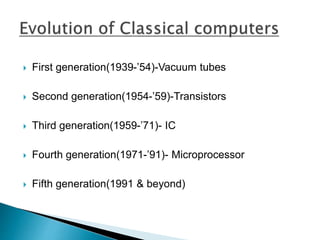
 First generation(1939-’54)-Vacuum tubes
 Second generation(1954-’59)-Transistors
 Third generation(1959-’71)- IC
 Fourth generation(1971-’91)- Microprocessor
 Fifth generation(1991 & beyond)
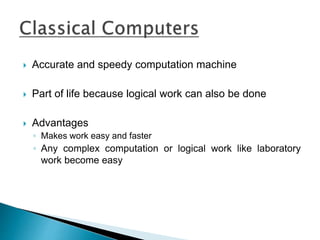
 Accurate and speedy computation machine
 Part of life because logical work can also be done
 Advantages
◦ Makes work easy and faster
◦ Any complex computation or logical work like laboratory
work become easy
 Many kinds of numerical problems cannot be solved
using conventional computers.
 Example: Factorization of a number
 The computer time required to factor an integer
containing N digits is believed to increase exponentially
with N.
 In 1918- Max Planck’s -Energy quantum
 In 1921-Einstein’s discovery of the photon
 In 1980- Idea of quantum computation
 In 1994, Shor’s algorithm was able to factorize large
integers in polynomial time using quantum approach.
 In 1996, Grover’s came up with an algorithm to search a
name in unsorted database.
 One possible use of quantum computers is that of
networking, both intranet and internet.
 Quantum teleportation using light beams may be able to
carry a great deal more information.
 But the issue in this is, creating large enough beams of
light in both locations
 Quantum information is physical information that is held
in the "state" of a quantum system.
 Though the amount of information that can be retrieved
in a single qubit is equal to one bit, the difference lies in
the processing of information
 Quantum information is the basic entity of study in
quantum information theory, and can be manipulated
using engineering techniques known as quantum
information processing.
 An electron has dual nature.
 It can exhibit as a particle and also as wave.
 Wave exhibits a phenomenon known as superposition of
waves.
 This phenomena allows the addition of waves
numerically.
 Superpositions occur all the time at the quantum level.
 Quantum entanglement is thought to be one of the
trickiest concepts in science, but the core issues
are simple.
 even though classically there is no direct interaction.
 When this happens, the state of the two particles is said
to be entangled.
 It is one of the possible ways to produce quantum
computers.
 A single electron trapped inside a cage of atoms.
 When the dot is exposed to a pulse of laser light of the
right wavelength & duration, the electron is raised to an
excited state: a second burst of laser light causes the
electron to fall back to its ground state.
 Ex: NOT gate
 Quantum teleportation is a technique used to transfer
information on a quantum level, usually from one particle
to another.
 Its distinguishing feature is that it can transmit the
information present in a quantum superposition.
 useful for quantum communication and computation.
 A quantum bit or qubit is a unit of quantum information.
 Many different physical objects can be used as qubits
such as atoms, photons, or electrons.
 Exists as a ‘0’, a ‘1’ or simultaneously as a superposition
of both ‘0’ & ‘1’
 It is the method in which a quantum computer is able to
perform two or more computations simultaneously.
 In classical computers, parallel computing is performed
by having several processors linked together.
 In a quantum computer, a single quantum processor is
able to perform multiple computations on its own.
 Key technical challenge: prevent decoherence or
unwanted interaction with environment
 Larger computations will require quantum
error-correcting codes
 Current encryption methods work by factoring numbers.
◦ Ex. 12=2*2*3.
◦ Very easy to do for small numbers.
 Current encryption numbers use over 400 digits in size.
◦ Today’s computers would take about a billion years to
factor these numbers.
 A quantum computer with a similar performance as
modern computers would need seconds.
 Quantum computers work on an atomic level
◦ That is roughly 200 times smaller than Intel’s brand
new 45nm architecture.
 Would be very useful in research and algorithm
computation
 It is possible to transmit information without a signal path
by using quantum teleportation.
◦ There is no way to intercept the path and extract
information.
 Ultra-secure communication is also possible by super-
dense information coding where quantum bits can be
used to allow more information to be communicated per
bit than the same number of classical bits.
 A quantum computer can simulate physical processes of
quantum effects in real time.
 Molecular simulations of chemical interactions.
 Allows chemists and pharmacists to learn more about
how their products interact with each other, and with
biological processes.
◦ Ex: How a drug may interact with a person’s metabolism or
disease.
 Classical computers do not have the ability to generate
true random numbers i.e. there is always a cycle or a
trend.
 Quantum computers can generate true randomness,
thus give more veracity to programs that need true
randomness in their processing.
 Number of bits in a word.
◦ 12-qubit machines is the most advanced to date.
◦ Difficulty with large words is, too much quantum interaction can
produce undesired results. Since all the atoms interact with
each other.
 Physical size of the machines.
◦ Current machines are too large to be of practical use to
everyday society.
◦ If these drawbacks could be overcome and if scientists could
control even 50 atoms, researchers claim that the computing
power of that computer would be more than the current
supercomputers.
 Quantum Computing could provide a radical change in
the way computation is performed.
 The advantages of Quantum Computing lie in the
aspects of Quantum Mechanics that are peculiar to it,
most notably entanglement.
 Classical Computers will be significantly larger than
Quantum Computers for the foreseeable future.
Quantum computers by Emran

Quantum computers by Emran

  • 1.
  • 2.
     First generation(1939-’54)-Vacuumtubes  Second generation(1954-’59)-Transistors  Third generation(1959-’71)- IC  Fourth generation(1971-’91)- Microprocessor  Fifth generation(1991 & beyond)
  • 3.
     Accurate andspeedy computation machine  Part of life because logical work can also be done  Advantages ◦ Makes work easy and faster ◦ Any complex computation or logical work like laboratory work become easy
  • 4.
     Many kindsof numerical problems cannot be solved using conventional computers.  Example: Factorization of a number  The computer time required to factor an integer containing N digits is believed to increase exponentially with N.
  • 5.
     In 1918-Max Planck’s -Energy quantum  In 1921-Einstein’s discovery of the photon  In 1980- Idea of quantum computation  In 1994, Shor’s algorithm was able to factorize large integers in polynomial time using quantum approach.  In 1996, Grover’s came up with an algorithm to search a name in unsorted database.
  • 6.
     One possibleuse of quantum computers is that of networking, both intranet and internet.  Quantum teleportation using light beams may be able to carry a great deal more information.  But the issue in this is, creating large enough beams of light in both locations
  • 7.
     Quantum informationis physical information that is held in the "state" of a quantum system.  Though the amount of information that can be retrieved in a single qubit is equal to one bit, the difference lies in the processing of information  Quantum information is the basic entity of study in quantum information theory, and can be manipulated using engineering techniques known as quantum information processing.
  • 8.
     An electronhas dual nature.  It can exhibit as a particle and also as wave.  Wave exhibits a phenomenon known as superposition of waves.  This phenomena allows the addition of waves numerically.  Superpositions occur all the time at the quantum level.
  • 9.
     Quantum entanglementis thought to be one of the trickiest concepts in science, but the core issues are simple.  even though classically there is no direct interaction.  When this happens, the state of the two particles is said to be entangled.
  • 10.
     It isone of the possible ways to produce quantum computers.  A single electron trapped inside a cage of atoms.  When the dot is exposed to a pulse of laser light of the right wavelength & duration, the electron is raised to an excited state: a second burst of laser light causes the electron to fall back to its ground state.  Ex: NOT gate
  • 11.
     Quantum teleportationis a technique used to transfer information on a quantum level, usually from one particle to another.  Its distinguishing feature is that it can transmit the information present in a quantum superposition.  useful for quantum communication and computation.
  • 12.
     A quantumbit or qubit is a unit of quantum information.  Many different physical objects can be used as qubits such as atoms, photons, or electrons.  Exists as a ‘0’, a ‘1’ or simultaneously as a superposition of both ‘0’ & ‘1’
  • 13.
     It isthe method in which a quantum computer is able to perform two or more computations simultaneously.  In classical computers, parallel computing is performed by having several processors linked together.  In a quantum computer, a single quantum processor is able to perform multiple computations on its own.
  • 14.
     Key technicalchallenge: prevent decoherence or unwanted interaction with environment  Larger computations will require quantum error-correcting codes
  • 15.
     Current encryptionmethods work by factoring numbers. ◦ Ex. 12=2*2*3. ◦ Very easy to do for small numbers.  Current encryption numbers use over 400 digits in size. ◦ Today’s computers would take about a billion years to factor these numbers.  A quantum computer with a similar performance as modern computers would need seconds.
  • 16.
     Quantum computerswork on an atomic level ◦ That is roughly 200 times smaller than Intel’s brand new 45nm architecture.  Would be very useful in research and algorithm computation
  • 17.
     It ispossible to transmit information without a signal path by using quantum teleportation. ◦ There is no way to intercept the path and extract information.  Ultra-secure communication is also possible by super- dense information coding where quantum bits can be used to allow more information to be communicated per bit than the same number of classical bits.
  • 18.
     A quantumcomputer can simulate physical processes of quantum effects in real time.  Molecular simulations of chemical interactions.  Allows chemists and pharmacists to learn more about how their products interact with each other, and with biological processes. ◦ Ex: How a drug may interact with a person’s metabolism or disease.
  • 19.
     Classical computersdo not have the ability to generate true random numbers i.e. there is always a cycle or a trend.  Quantum computers can generate true randomness, thus give more veracity to programs that need true randomness in their processing.
  • 20.
     Number ofbits in a word. ◦ 12-qubit machines is the most advanced to date. ◦ Difficulty with large words is, too much quantum interaction can produce undesired results. Since all the atoms interact with each other.  Physical size of the machines. ◦ Current machines are too large to be of practical use to everyday society. ◦ If these drawbacks could be overcome and if scientists could control even 50 atoms, researchers claim that the computing power of that computer would be more than the current supercomputers.
  • 21.
     Quantum Computingcould provide a radical change in the way computation is performed.  The advantages of Quantum Computing lie in the aspects of Quantum Mechanics that are peculiar to it, most notably entanglement.  Classical Computers will be significantly larger than Quantum Computers for the foreseeable future.