Quantum Computing
PRESENTED BY : SAMRAND HAJI
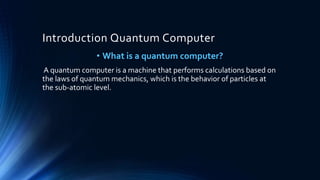
Introduction Quantum Computer
• What is a quantum computer?
A quantum computer is a machine that performs calculations based on
the laws of quantum mechanics, which is the behavior of particles at
the sub-atomic level.
Introduction
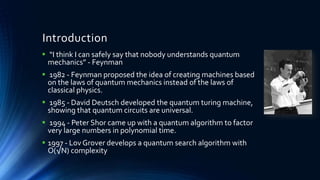
 “I think I can safely say that nobody understands quantum
mechanics” - Feynman
 1982 - Feynman proposed the idea of creating machines based
on the laws of quantum mechanics instead of the laws of
classical physics.
 1985 - David Deutsch developed the quantum turing machine,
showing that quantum circuits are universal.
 1994 - Peter Shor came up with a quantum algorithm to factor
very large numbers in polynomial time.
 1997 - Lov Grover develops a quantum search algorithm with
O(√N) complexity
Representation of Data - Qubits
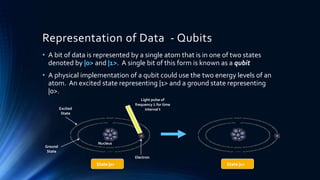
• A bit of data is represented by a single atom that is in one of two states
denoted by |0> and |1>. A single bit of this form is known as a qubit
• A physical implementation of a qubit could use the two energy levels of an
atom. An excited state representing |1> and a ground state representing
|0>.
Excited
State
Ground
State
Nucleus
Light pulse of
frequency  for time
interval t
Electron
State |0> State |1>
Representation of Data - Superposition
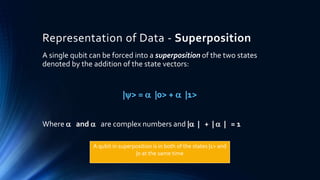
A single qubit can be forced into a superposition of the two states
denoted by the addition of the state vectors:
|> =  |0> +  |1>
Where  and  are complex numbers and | | + |  | = 1
A qubit in superposition is in both of the states |1> and
|0 at the same time
Representation of Data - Superposition
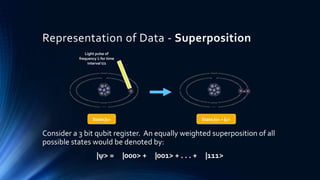
Consider a 3 bit qubit register. An equally weighted superposition of all
possible states would be denoted by:
|> = |000> + |001> + . . . + |111>
Light pulse of
frequency  for time
interval t/2
State |0> State |0> + |1>
Data Retrieval
In general, an n qubit register can represent the numbers 0 through
2^n-1 simultaneously.
Sound too good to be true?…It is!
If we attempt to retrieve the values represented within a superposition,
the superposition randomly collapses to represent just one of the
original values.
In our equation: |> =  |0> +  |1> ,  represents the probability of the
superposition collapsing to |0>. The ’s are called probability amplitudes. In a
balanced superposition,  = 1/√2 where n is the number of qubits.
Relationships among data - Entanglement
Entanglement is the ability of quantum systems to exhibit correlations
between states within a superposition.
Imagine two qubits, each in the state |0> + |1> (a superposition of the 0
and 1.) We can entangle the two qubits such that the measurement of
one qubit is always correlated to the measurement of the other qubit.
Conclusion
• Rather than store information as 0s or 1s as conventional computers do, a
quantum computer uses qubits – which can be a 1 or a 0 or both at the same
time.This “quantum superposition”
• Quantum particles can exist in two places at once, move forwards or
backwards in time, and even "teleport", by way of what physicists call
"quantum tunnelling."
• A set of two qubits in superposition represents four possible situations at
the same time – [0, 0]; [0, 1]; [1, 0]; or [1, 1].
• D-Wave systems are designed to be used in conjunction with classical
computers, as a "quantum co-processor".
• D-Wave’s flagship product, the 512-qubit D-WaveTwo quantum computer
Thanks for your precious time. 
Feel free and Ask?
“If quantum mechanics hasn’t profoundly shocked you, you haven’t
understood it yet.”
– Niels Bohr

Quantum Computing

  • 1.
  • 2.
    Introduction Quantum Computer •What is a quantum computer? A quantum computer is a machine that performs calculations based on the laws of quantum mechanics, which is the behavior of particles at the sub-atomic level.
  • 3.
    Introduction  “I thinkI can safely say that nobody understands quantum mechanics” - Feynman  1982 - Feynman proposed the idea of creating machines based on the laws of quantum mechanics instead of the laws of classical physics.  1985 - David Deutsch developed the quantum turing machine, showing that quantum circuits are universal.  1994 - Peter Shor came up with a quantum algorithm to factor very large numbers in polynomial time.  1997 - Lov Grover develops a quantum search algorithm with O(√N) complexity
  • 4.
    Representation of Data- Qubits • A bit of data is represented by a single atom that is in one of two states denoted by |0> and |1>. A single bit of this form is known as a qubit • A physical implementation of a qubit could use the two energy levels of an atom. An excited state representing |1> and a ground state representing |0>. Excited State Ground State Nucleus Light pulse of frequency  for time interval t Electron State |0> State |1>
  • 5.
    Representation of Data- Superposition A single qubit can be forced into a superposition of the two states denoted by the addition of the state vectors: |> =  |0> +  |1> Where  and  are complex numbers and | | + |  | = 1 A qubit in superposition is in both of the states |1> and |0 at the same time
  • 6.
    Representation of Data- Superposition Consider a 3 bit qubit register. An equally weighted superposition of all possible states would be denoted by: |> = |000> + |001> + . . . + |111> Light pulse of frequency  for time interval t/2 State |0> State |0> + |1>
  • 7.
    Data Retrieval In general,an n qubit register can represent the numbers 0 through 2^n-1 simultaneously. Sound too good to be true?…It is! If we attempt to retrieve the values represented within a superposition, the superposition randomly collapses to represent just one of the original values. In our equation: |> =  |0> +  |1> ,  represents the probability of the superposition collapsing to |0>. The ’s are called probability amplitudes. In a balanced superposition,  = 1/√2 where n is the number of qubits.
  • 8.
    Relationships among data- Entanglement Entanglement is the ability of quantum systems to exhibit correlations between states within a superposition. Imagine two qubits, each in the state |0> + |1> (a superposition of the 0 and 1.) We can entangle the two qubits such that the measurement of one qubit is always correlated to the measurement of the other qubit.
  • 9.
    Conclusion • Rather thanstore information as 0s or 1s as conventional computers do, a quantum computer uses qubits – which can be a 1 or a 0 or both at the same time.This “quantum superposition” • Quantum particles can exist in two places at once, move forwards or backwards in time, and even "teleport", by way of what physicists call "quantum tunnelling." • A set of two qubits in superposition represents four possible situations at the same time – [0, 0]; [0, 1]; [1, 0]; or [1, 1]. • D-Wave systems are designed to be used in conjunction with classical computers, as a "quantum co-processor". • D-Wave’s flagship product, the 512-qubit D-WaveTwo quantum computer
  • 10.
    Thanks for yourprecious time.  Feel free and Ask? “If quantum mechanics hasn’t profoundly shocked you, you haven’t understood it yet.” – Niels Bohr