Quantum ComputingA New Era of Future ComputingRushmila Islam
Overview19 April 20112Computing GenerationsQuantum ComputingQuantum Logics and RepresentationHow It WorksPresent Status Future ResearchConclusionOpen Discussion
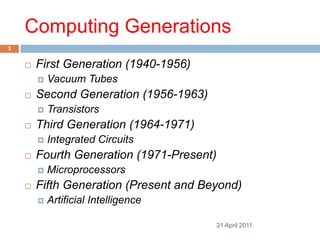
Computing Generations19 April 20113First Generation (1940-1956) Vacuum TubesSecond Generation (1956-1963) TransistorsThird Generation (1964-1971) Integrated CircuitsFourth Generation (1971-Present) MicroprocessorsFifth Generation (Present and Beyond) Artificial Intelligence
Why Quantum Computing19 April 20114"The number of transistors incorporated in a chip will approximately double every 24 months." -- Gordon Moore, Intel Co-Founder
Why Quantum Computing19 April 20115By 2020 to 2025, transistors will be so small and it will generate so much heat that standard silicon technology may eventually collapse.	Already Intel has implemented 32nm silicon technologyIf scale becomes too small, Electrons tunnel through micro-thin barriers between wires corrupting signals.
Quantum Computing19 April 20116A quantum computer is a machine that performs calculations based on the laws of quantum mechanics.A theoretical model is the Quantum Turing machine – Universal Quantum Computer.
Quantum Logics and Representation19 April 20117Quantum Computers use quantum mechanical phenomena-	EntanglementSuperposition  Quantum computational operations were executed on a very small number of Qubits (quantum bits)
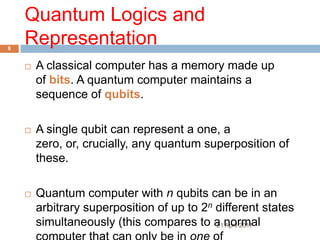
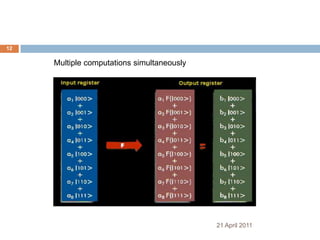
Quantum Logics and Representation19 April 20118A classical computer has a memory made up of bits. A quantum computer maintains a sequence of qubits. A single qubit can represent a one, a zero, or, crucially, any quantum superposition of these.Quantum computer with n qubits can be in an arbitrary superposition of up to 2n different states simultaneously (this compares to a normal computer that can only be in one of these 2n states at any one time).
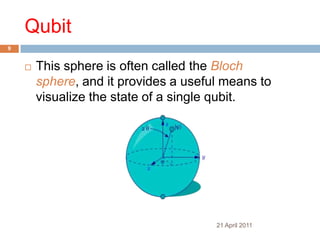
Qubit19 April 20119This sphere is often called the Bloch sphere, and it provides a useful means to visualize the state of a single qubit.
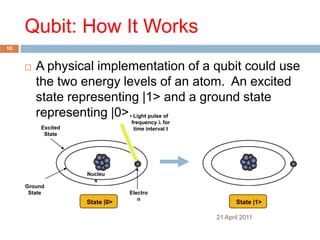
Qubit: How It Works10A physical implementation of a qubit could use the two energy levels of an atom.  An excited state representing |1> and a ground state representing |0>.	Light pulse of frequency  for time interval tExcited StateNucleusGround StateElectronState |0>State |1>19 April 2011
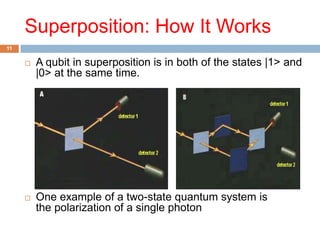
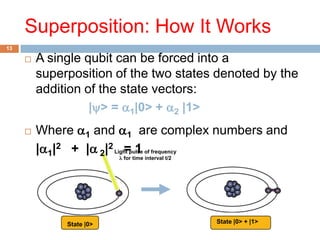
Superposition: How It Works11A qubit in superposition is in both of the states |1> and |0> at the same time.One example of a two-state quantum system is the polarization of a single photon
19 April 201112Multiple computations simultaneously
Superposition: How It Works13A single qubit can be forced into a superposition of the two states denoted by the addition of the state vectors: 			|> = 1|0> + 2 |1>Where 1and 1are complex numbers and |1|2   +  | 2|2   = 1Light pulse of frequency  for time interval t/2State |0> + |1>State |0>
Quantum Logic Gates19 April 201114Commonly used gatesHadamard gatePauli-X gatePauli-Y gatePauli-Z gatePhase shift gatesSwap gateControlled gates
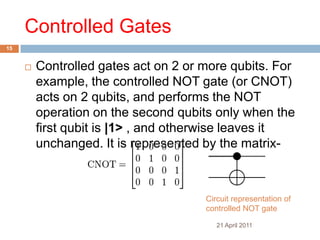
Controlled Gates19 April 201115Controlled gates act on 2 or more qubits. For example, the controlled NOT gate (or CNOT) acts on 2 qubits, and performs the NOT operation on the second qubits only when the first qubit is |1> , and otherwise leaves it unchanged. It is represented by the matrix-Circuit representation of controlled NOT gate
Present Status 19 April 201116Quantum physicists from the University of Innsbruck have set another world record: They have achieved controlled entanglement of 14 quantum bits (qubits) and, thus, realized the largest quantum register that has ever been produced. ScienceDaily (Apr 1, 2011) Researchers at Delft University of Technology have succeeded in carrying out calculations with two quantum bits. ScienceDaily (June.17, 2010) December 19, 2001 – IBM performs Shor’s Algorithm
Future Research19 April 201117If large-scale quantum computers can be built, they will be able to solve certain problems much faster than any classical computer using the best currently known algorithms (for example integer factorization using Shor's algorithm or the simulation of quantum many-body systems). Desktop Quantum computers expected by many within 10 years
Conclusion19 April 201118
References19 April 201119http://en.wikipedia.org/wiki/Quantum_computerhttp://bigthink.com/ideas/24289http://gizmodo.com/#!5335901/giz-explains-why-quantum-computing-is-the-future-but-a-distant-onehttp://www.bbc.co.uk/news/science-environment-12811199http://www.qubit.org/tutorials/25-quantum-computing.htmlhttp://www.sciencedaily.com/releases/2011/04/110401085103.htmhttp://plato.stanford.edu/entries/qt-quantcomp/
19 April 2011

Quantum computing - Introduction

  • 1.
    Quantum ComputingA NewEra of Future ComputingRushmila Islam
  • 2.
    Overview19 April 20112ComputingGenerationsQuantum ComputingQuantum Logics and RepresentationHow It WorksPresent Status Future ResearchConclusionOpen Discussion
  • 3.
    Computing Generations19 April20113First Generation (1940-1956) Vacuum TubesSecond Generation (1956-1963) TransistorsThird Generation (1964-1971) Integrated CircuitsFourth Generation (1971-Present) MicroprocessorsFifth Generation (Present and Beyond) Artificial Intelligence
  • 4.
    Why Quantum Computing19April 20114"The number of transistors incorporated in a chip will approximately double every 24 months." -- Gordon Moore, Intel Co-Founder
  • 5.
    Why Quantum Computing19April 20115By 2020 to 2025, transistors will be so small and it will generate so much heat that standard silicon technology may eventually collapse. Already Intel has implemented 32nm silicon technologyIf scale becomes too small, Electrons tunnel through micro-thin barriers between wires corrupting signals.
  • 6.
    Quantum Computing19 April20116A quantum computer is a machine that performs calculations based on the laws of quantum mechanics.A theoretical model is the Quantum Turing machine – Universal Quantum Computer.
  • 7.
    Quantum Logics andRepresentation19 April 20117Quantum Computers use quantum mechanical phenomena- EntanglementSuperposition  Quantum computational operations were executed on a very small number of Qubits (quantum bits)
  • 8.
    Quantum Logics andRepresentation19 April 20118A classical computer has a memory made up of bits. A quantum computer maintains a sequence of qubits. A single qubit can represent a one, a zero, or, crucially, any quantum superposition of these.Quantum computer with n qubits can be in an arbitrary superposition of up to 2n different states simultaneously (this compares to a normal computer that can only be in one of these 2n states at any one time).
  • 9.
    Qubit19 April 20119Thissphere is often called the Bloch sphere, and it provides a useful means to visualize the state of a single qubit.
  • 10.
    Qubit: How ItWorks10A physical implementation of a qubit could use the two energy levels of an atom. An excited state representing |1> and a ground state representing |0>. Light pulse of frequency  for time interval tExcited StateNucleusGround StateElectronState |0>State |1>19 April 2011
  • 11.
    Superposition: How ItWorks11A qubit in superposition is in both of the states |1> and |0> at the same time.One example of a two-state quantum system is the polarization of a single photon
  • 12.
    19 April 201112Multiplecomputations simultaneously
  • 13.
    Superposition: How ItWorks13A single qubit can be forced into a superposition of the two states denoted by the addition of the state vectors: |> = 1|0> + 2 |1>Where 1and 1are complex numbers and |1|2 + | 2|2 = 1Light pulse of frequency  for time interval t/2State |0> + |1>State |0>
  • 14.
    Quantum Logic Gates19April 201114Commonly used gatesHadamard gatePauli-X gatePauli-Y gatePauli-Z gatePhase shift gatesSwap gateControlled gates
  • 15.
    Controlled Gates19 April201115Controlled gates act on 2 or more qubits. For example, the controlled NOT gate (or CNOT) acts on 2 qubits, and performs the NOT operation on the second qubits only when the first qubit is |1> , and otherwise leaves it unchanged. It is represented by the matrix-Circuit representation of controlled NOT gate
  • 16.
    Present Status 19April 201116Quantum physicists from the University of Innsbruck have set another world record: They have achieved controlled entanglement of 14 quantum bits (qubits) and, thus, realized the largest quantum register that has ever been produced. ScienceDaily (Apr 1, 2011) Researchers at Delft University of Technology have succeeded in carrying out calculations with two quantum bits. ScienceDaily (June.17, 2010) December 19, 2001 – IBM performs Shor’s Algorithm
  • 17.
    Future Research19 April201117If large-scale quantum computers can be built, they will be able to solve certain problems much faster than any classical computer using the best currently known algorithms (for example integer factorization using Shor's algorithm or the simulation of quantum many-body systems). Desktop Quantum computers expected by many within 10 years
  • 18.
  • 19.
  • 20.