Quantum computer
Presentation by Jay Patel
BCA(sem-6)
Year 2016-17
DUIAS,VALSAD
What is quantum computer?
• A quantum computer is a machine that
performs calculations based on the laws of
quantum mechanics
Introduction
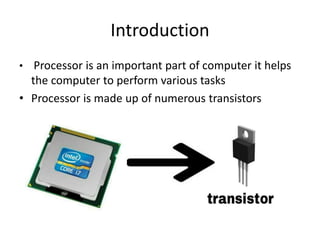
• Processor is an important part of computer it helps
the computer to perform various tasks
• Processor is made up of numerous transistors
Introduction
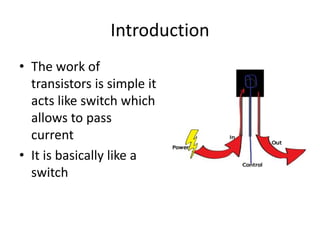
• The work of
transistors is simple it
acts like switch which
allows to pass
current
• It is basically like a
switch
Introduction
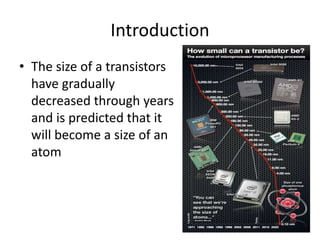
• The size of a transistors
have gradually
decreased through years
and is predicted that it
will become a size of an
atom
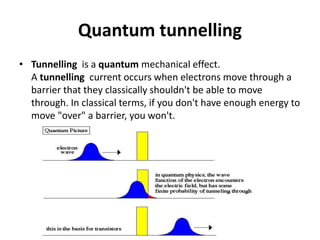
Quantum tunnelling
• Tunnelling is a quantum mechanical effect.
A tunnelling current occurs when electrons move through a
barrier that they classically shouldn't be able to move
through. In classical terms, if you don't have enough energy to
move "over" a barrier, you won't.
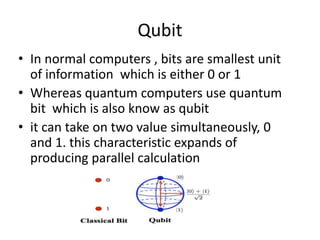
Qubit
• In normal computers , bits are smallest unit
of information which is either 0 or 1
• Whereas quantum computers use quantum
bit which is also know as qubit
• it can take on two value simultaneously, 0
and 1. this characteristic expands of
producing parallel calculation
Quantum superposition
• An electron has dual nature
• It can exhibit as a particle and also as wave
• Wave exhibits a phenomenon known as
superposition of waves
• This phenomenon allows the addition of waves
numerically
• Superposition occur all the time at the quantum
level
• i.e. any quantum object like a electron or photons
is in superposition.
Decoherence
• As the number of qubit the increases the
influence of external environment disturb the
system
• This cause the states in the computer to
change in a way that is completely unintended
and is unpredictable rendering the computer
useless
Quantum entanglement
• In quantum mechanics it sometimes occurs
that a measurement of one particle will effect
the state of another particle even though
classically there is no direct interactions
• When this happens the state of the two
particles is said to be entangled
Quantum parrellism
• It is a method in which a quantum computer
is able to perform two or more computations
simultaneously
• In classical computers parallel computing is
performed by having several processors linked
together
• In a quantum computer a single quantum
processor is able to perform computation on
its own
Quantum parrellism
• Parallelism allows a quantum computer to
work on many compulation at once
Quantum networking
• One possible use of quantum computers is
that of networking both intranet and internet
• Quantum teleportation using light beams may
be able to carry a great deal of information
• But the issue in this is creating large enough of
light in both locations sending and receiving to
send all the data in reasonable time
Encryption
• Current encryption methods work by factoring
small numbers which is easy
• Current encryption numbers use over 400
digits in size which today's computer will take
billions years to process
• A quantum computers will take seconds to
calculate these numbers
Need for quantum computers
• That is roughly 200 times smaller than Intel's
brand new architecture
• Would be very useful in research and
algorithm computation
• Database searching : to find something in a
database, a normal computer may have to test
every single one of its entries. Quantum
algorithms need only square root of that time
Future prospects
• When processor components reach atomic
scale Moore's law breaks down
• Quantum effects become important whether
we want them or not
• But huge obstacle in building a practical
quantum computer
Conclusion
• Quantum computing could provide a radical
change in the way computation is performed
• Classical computer will be larger than
quantum computers for the future
References
• https://en.wikipedia.org
• http://www.nova.org.au
• https://www.slideshare.net

Quantum computers

  • 1.
    Quantum computer Presentation byJay Patel BCA(sem-6) Year 2016-17 DUIAS,VALSAD
  • 2.
    What is quantumcomputer? • A quantum computer is a machine that performs calculations based on the laws of quantum mechanics
  • 3.
    Introduction • Processor isan important part of computer it helps the computer to perform various tasks • Processor is made up of numerous transistors
  • 4.
    Introduction • The workof transistors is simple it acts like switch which allows to pass current • It is basically like a switch
  • 5.
    Introduction • The sizeof a transistors have gradually decreased through years and is predicted that it will become a size of an atom
  • 6.
    Quantum tunnelling • Tunnellingis a quantum mechanical effect. A tunnelling current occurs when electrons move through a barrier that they classically shouldn't be able to move through. In classical terms, if you don't have enough energy to move "over" a barrier, you won't.
  • 7.
    Qubit • In normalcomputers , bits are smallest unit of information which is either 0 or 1 • Whereas quantum computers use quantum bit which is also know as qubit • it can take on two value simultaneously, 0 and 1. this characteristic expands of producing parallel calculation
  • 8.
    Quantum superposition • Anelectron has dual nature • It can exhibit as a particle and also as wave • Wave exhibits a phenomenon known as superposition of waves • This phenomenon allows the addition of waves numerically • Superposition occur all the time at the quantum level • i.e. any quantum object like a electron or photons is in superposition.
  • 9.
    Decoherence • As thenumber of qubit the increases the influence of external environment disturb the system • This cause the states in the computer to change in a way that is completely unintended and is unpredictable rendering the computer useless
  • 10.
    Quantum entanglement • Inquantum mechanics it sometimes occurs that a measurement of one particle will effect the state of another particle even though classically there is no direct interactions • When this happens the state of the two particles is said to be entangled
  • 11.
    Quantum parrellism • Itis a method in which a quantum computer is able to perform two or more computations simultaneously • In classical computers parallel computing is performed by having several processors linked together • In a quantum computer a single quantum processor is able to perform computation on its own
  • 12.
    Quantum parrellism • Parallelismallows a quantum computer to work on many compulation at once
  • 13.
    Quantum networking • Onepossible use of quantum computers is that of networking both intranet and internet • Quantum teleportation using light beams may be able to carry a great deal of information • But the issue in this is creating large enough of light in both locations sending and receiving to send all the data in reasonable time
  • 14.
    Encryption • Current encryptionmethods work by factoring small numbers which is easy • Current encryption numbers use over 400 digits in size which today's computer will take billions years to process • A quantum computers will take seconds to calculate these numbers
  • 15.
    Need for quantumcomputers • That is roughly 200 times smaller than Intel's brand new architecture • Would be very useful in research and algorithm computation • Database searching : to find something in a database, a normal computer may have to test every single one of its entries. Quantum algorithms need only square root of that time
  • 16.
    Future prospects • Whenprocessor components reach atomic scale Moore's law breaks down • Quantum effects become important whether we want them or not • But huge obstacle in building a practical quantum computer
  • 17.
    Conclusion • Quantum computingcould provide a radical change in the way computation is performed • Classical computer will be larger than quantum computers for the future
  • 18.