SHAIK NAGUR SHAREEF
B.Tech-CSE(161FA04195)
VIGNAN’S UNIVERSITY
QUANTUM COMPUTERS
Latest Technology for Bright Future
Areas of Discussion
o Classical Computers
o Quantum Computers
o History & Definition
o Basic principles
o Algorithms
o Abilities
o Applications
o Conclusion
11/10/2017 SHAIK NGUR SHAREEF 2
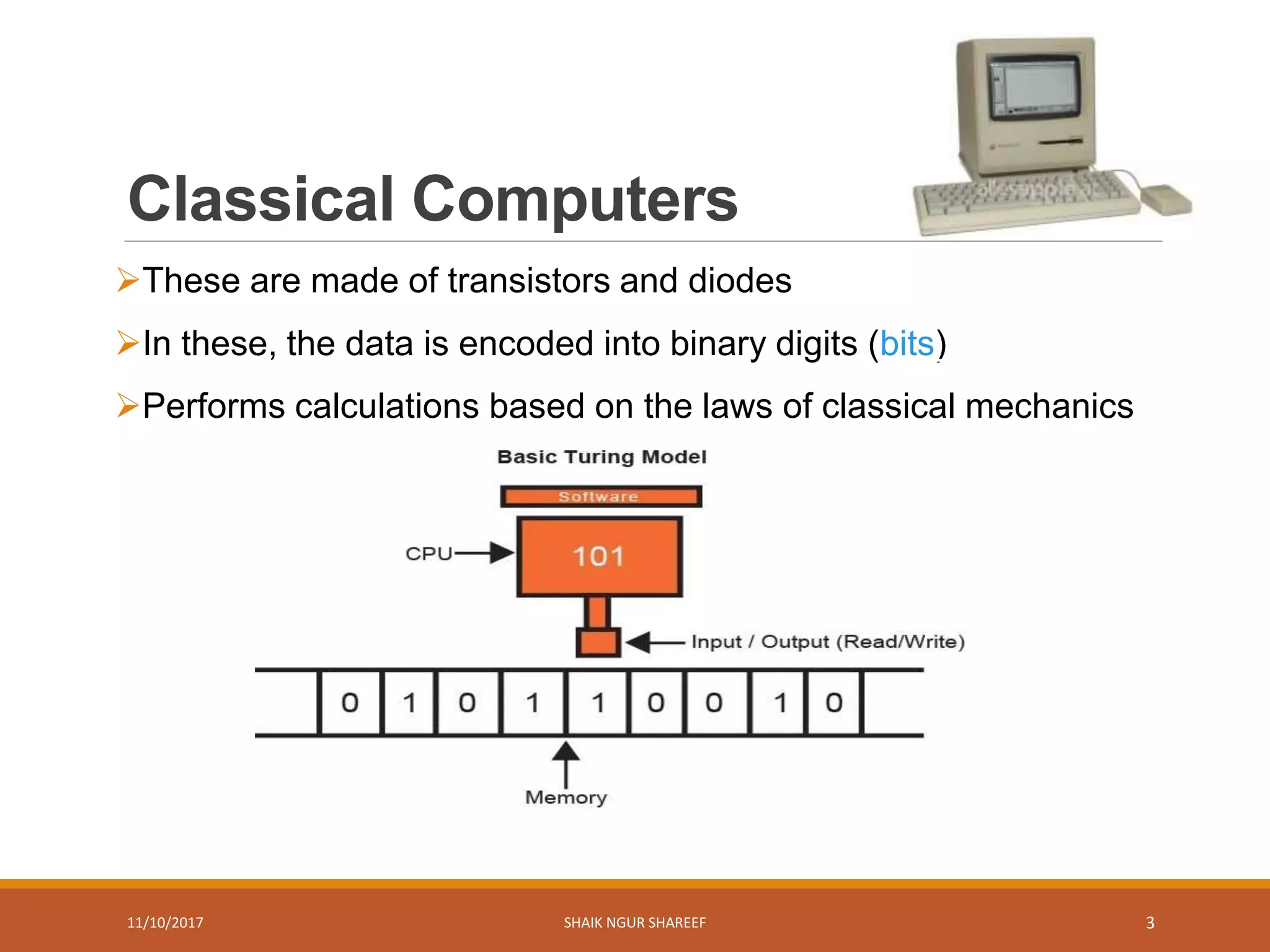
Classical Computers
These are made of transistors and diodes
In these, the data is encoded into binary digits (bits)
Performs calculations based on the laws of classical mechanics
11/10/2017 SHAIK NGUR SHAREEF 3
11/10/2017 SHAIK NGUR SHAREEF 4
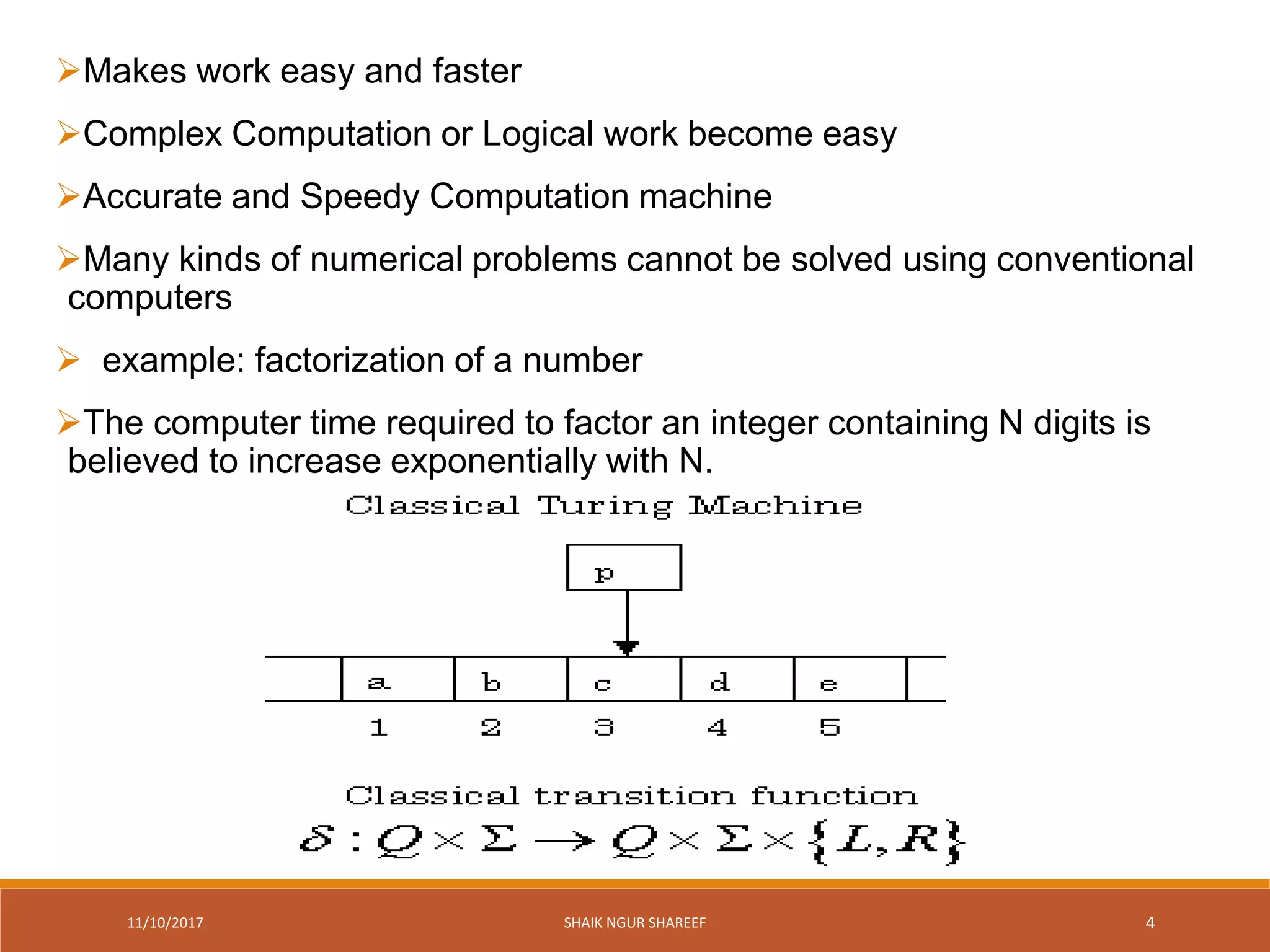
Makes work easy and faster
Complex Computation or Logical work become easy
Accurate and Speedy Computation machine
Many kinds of numerical problems cannot be solved using conventional
computers
 example: factorization of a number
The computer time required to factor an integer containing N digits is
believed to increase exponentially with N.
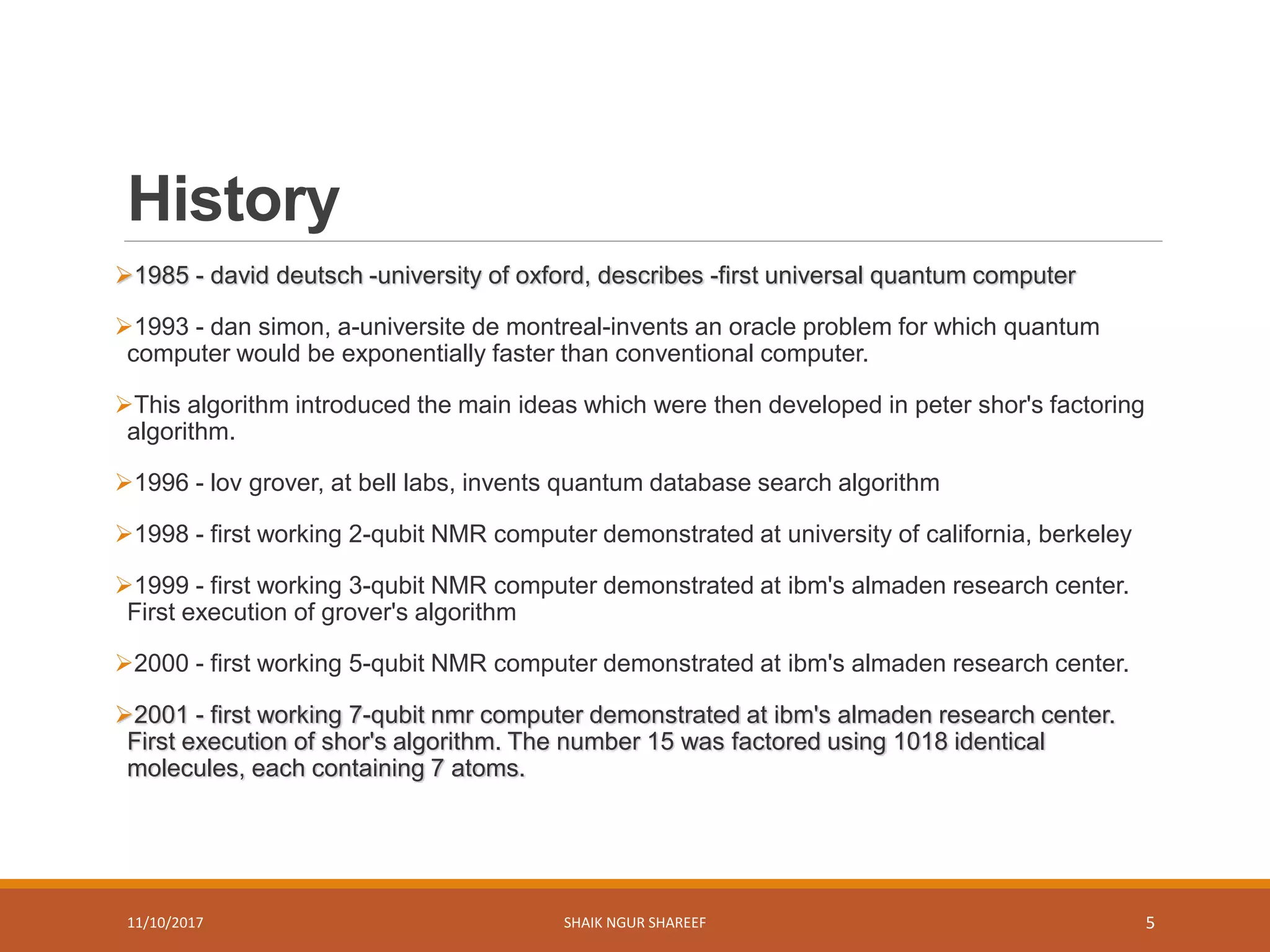
History
1985 - david deutsch -university of oxford, describes -first universal quantum computer
1993 - dan simon, a-universite de montreal-invents an oracle problem for which quantum
computer would be exponentially faster than conventional computer.
This algorithm introduced the main ideas which were then developed in peter shor's factoring
algorithm.
1996 - lov grover, at bell labs, invents quantum database search algorithm
1998 - first working 2-qubit NMR computer demonstrated at university of california, berkeley
1999 - first working 3-qubit NMR computer demonstrated at ibm's almaden research center.
First execution of grover's algorithm
2000 - first working 5-qubit NMR computer demonstrated at ibm's almaden research center.
2001 - first working 7-qubit nmr computer demonstrated at ibm's almaden research center.
First execution of shor's algorithm. The number 15 was factored using 1018 identical
molecules, each containing 7 atoms.
11/10/2017 SHAIK NGUR SHAREEF 5
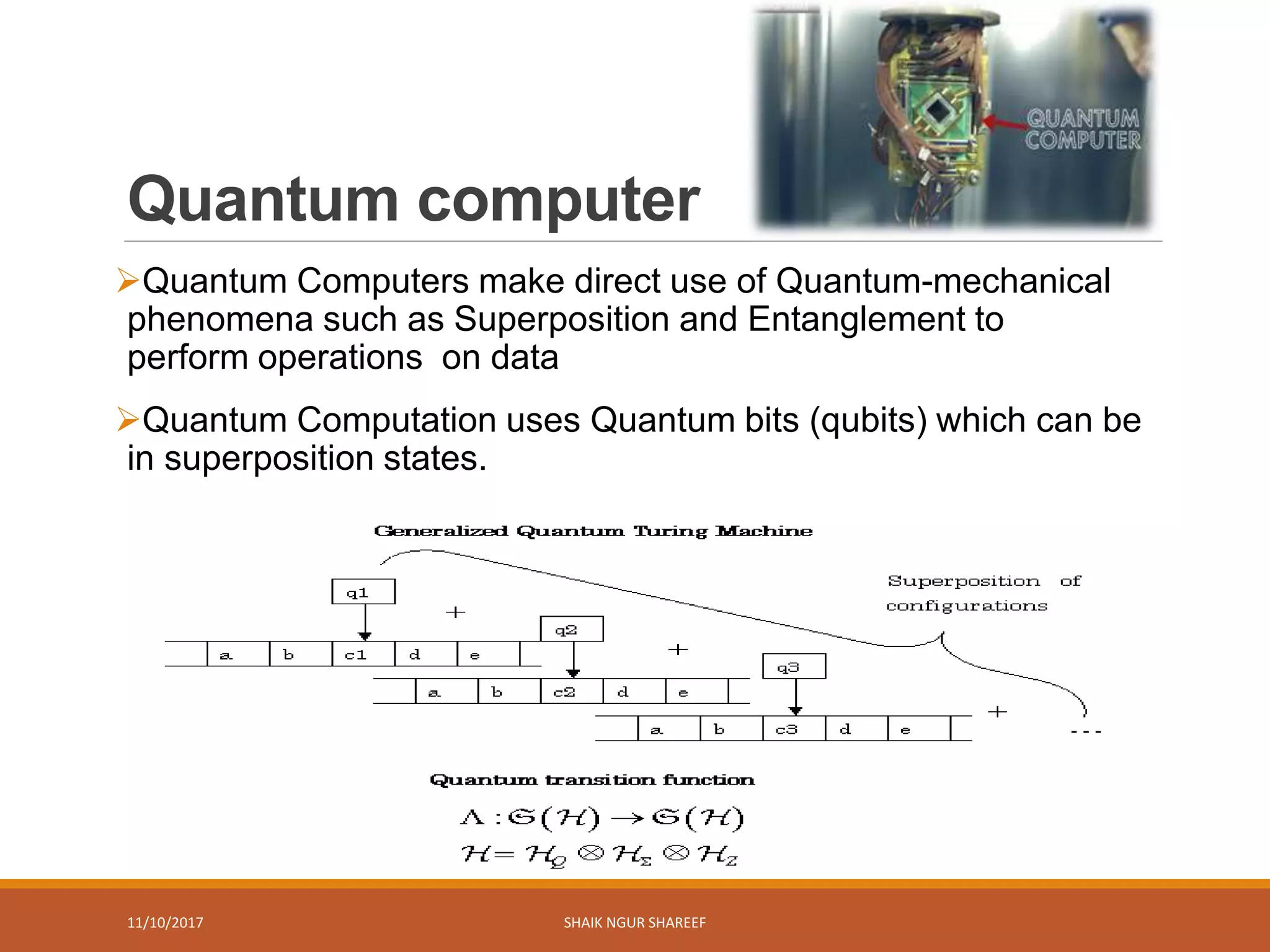
Quantum computer
Quantum Computers make direct use of Quantum-mechanical
phenomena such as Superposition and Entanglement to
perform operations on data
Quantum Computation uses Quantum bits (qubits) which can be
in superposition states.
11/10/2017 SHAIK NGUR SHAREEF
6
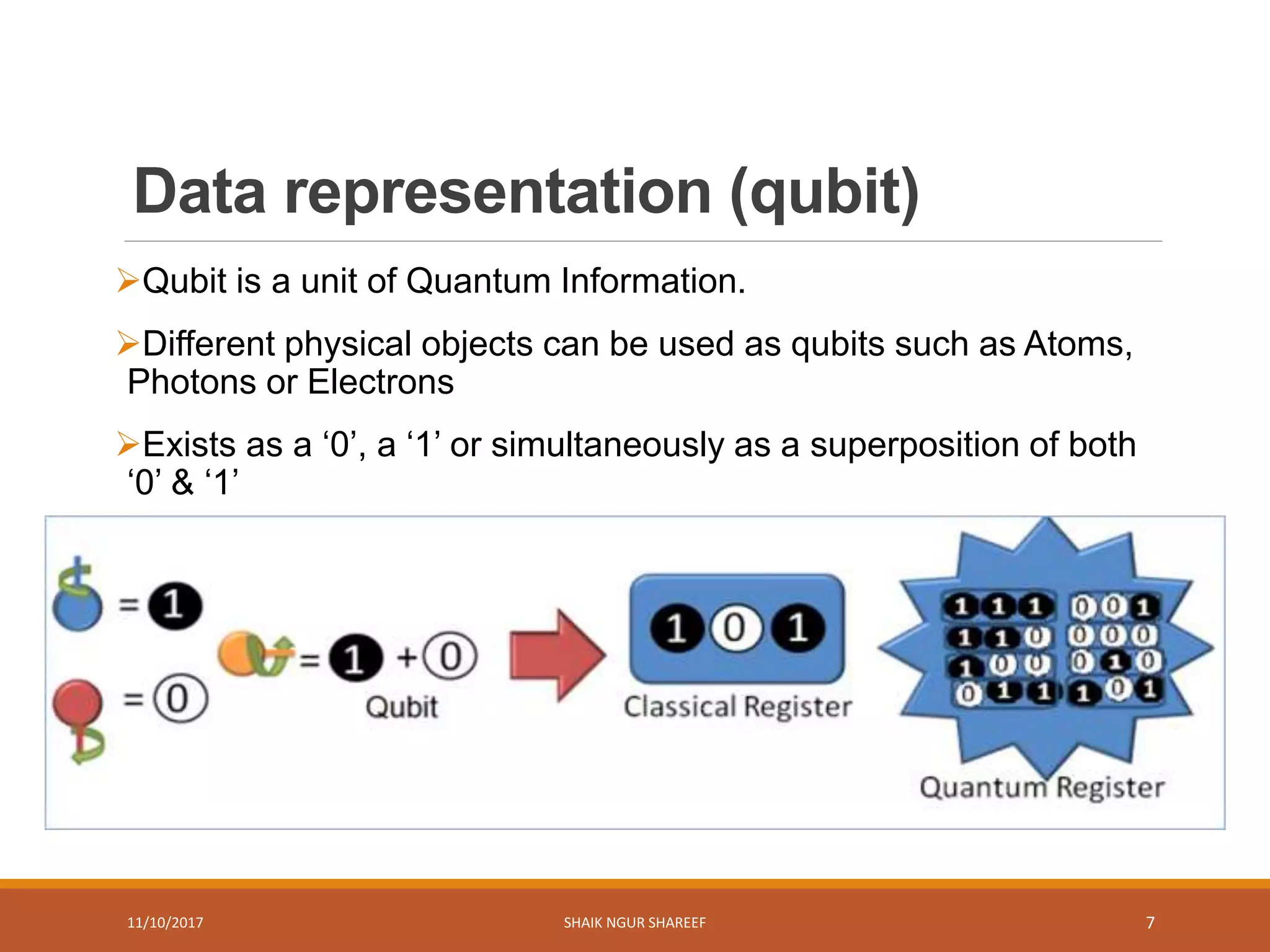
Data representation (qubit)
Qubit is a unit of Quantum Information.
Different physical objects can be used as qubits such as Atoms,
Photons or Electrons
Exists as a ‘0’, a ‘1’ or simultaneously as a superposition of both
‘0’ & ‘1’
11/10/2017 SHAIK NGUR SHAREEF 7
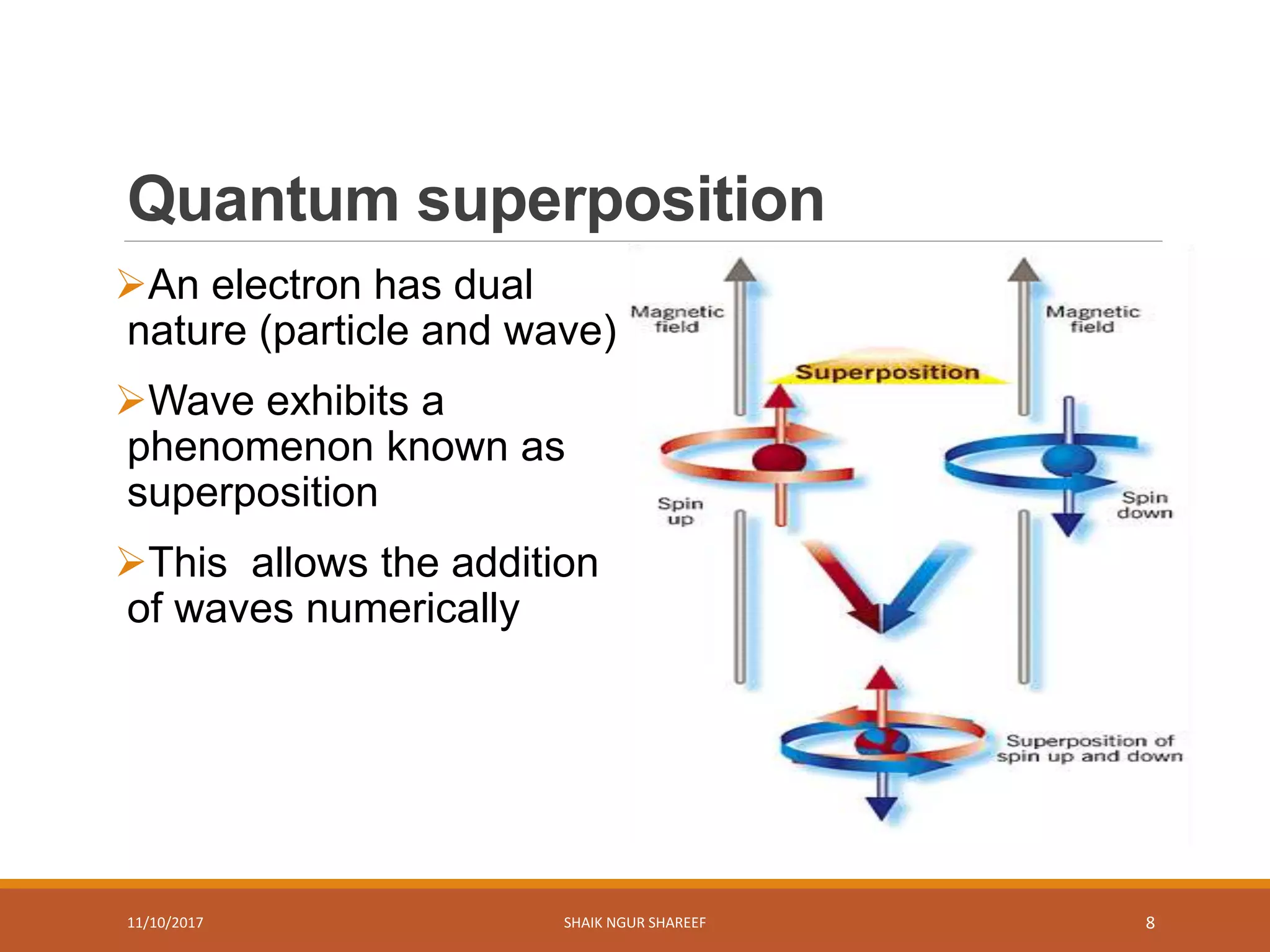
Quantum superposition
An electron has dual
nature (particle and wave)
Wave exhibits a
phenomenon known as
superposition
This allows the addition
of waves numerically
11/10/2017 SHAIK NGUR SHAREEF 8
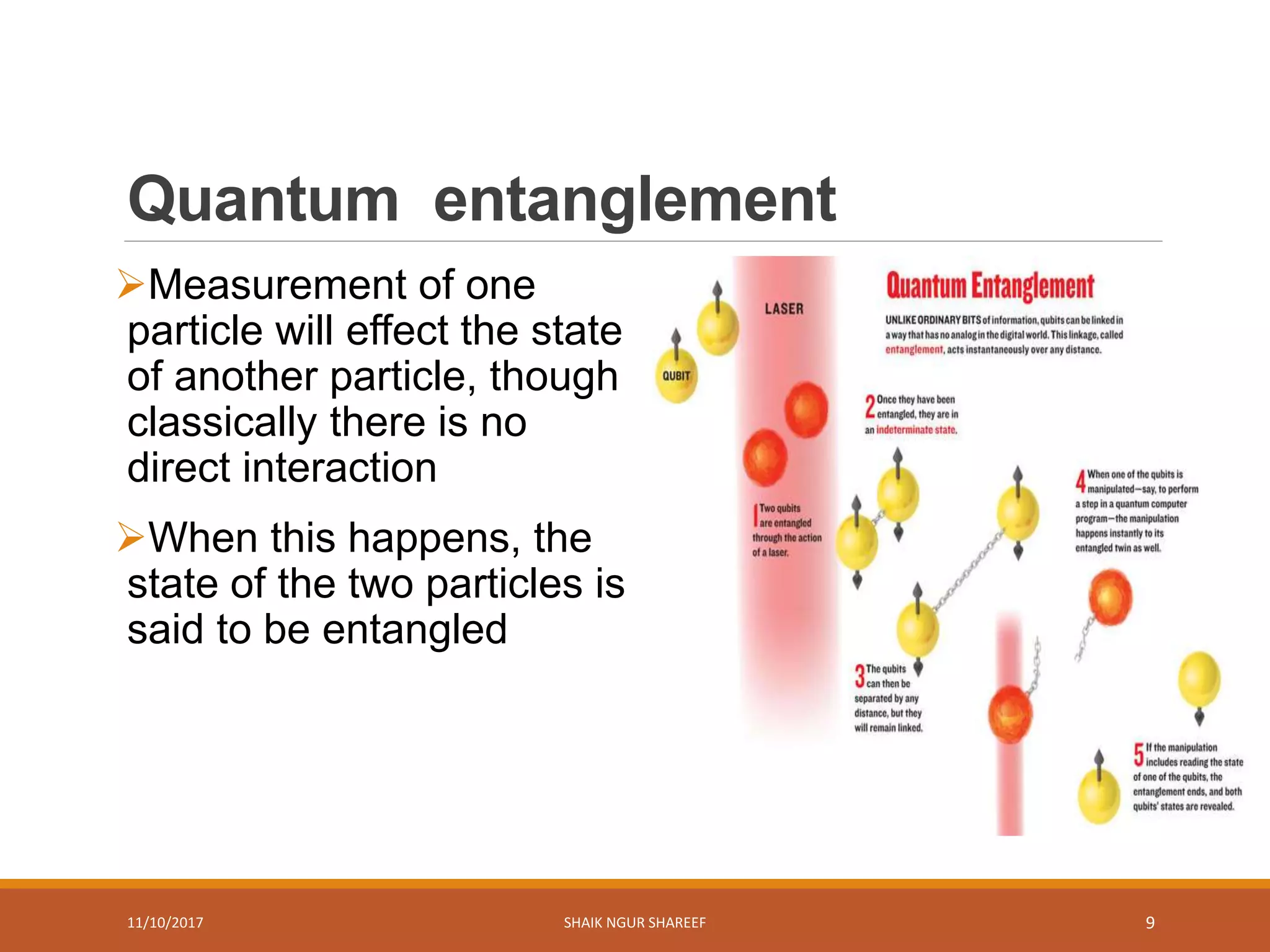
Quantum entanglement
Measurement of one
particle will effect the state
of another particle, though
classically there is no
direct interaction
When this happens, the
state of the two particles is
said to be entangled
11/10/2017 SHAIK NGUR SHAREEF 9
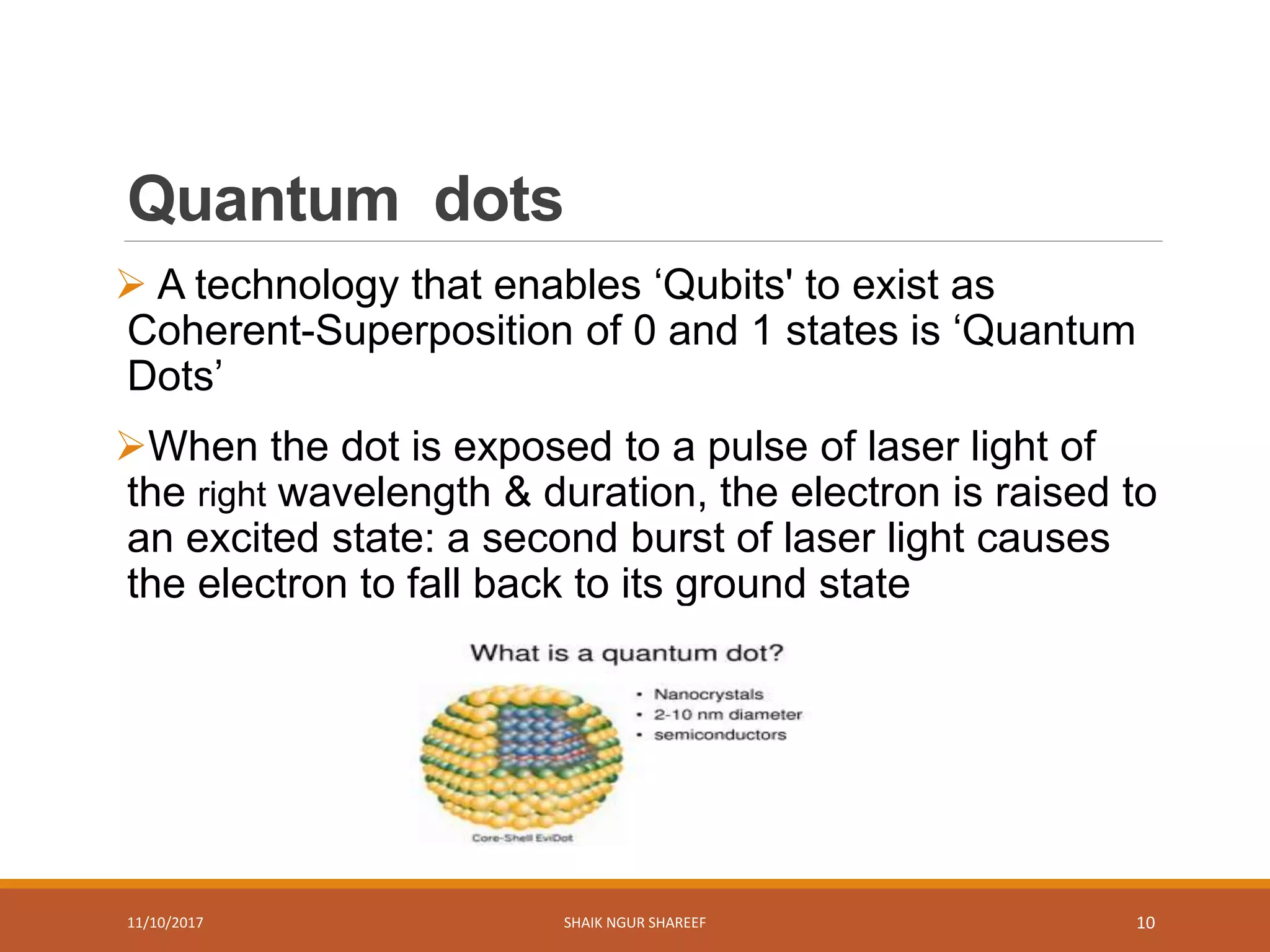
Quantum dots
 A technology that enables ‘Qubits' to exist as
Coherent-Superposition of 0 and 1 states is ‘Quantum
Dots’
When the dot is exposed to a pulse of laser light of
the right wavelength & duration, the electron is raised to
an excited state: a second burst of laser light causes
the electron to fall back to its ground state
11/10/2017 SHAIK NGUR SHAREEF 10
Quantum teleportation
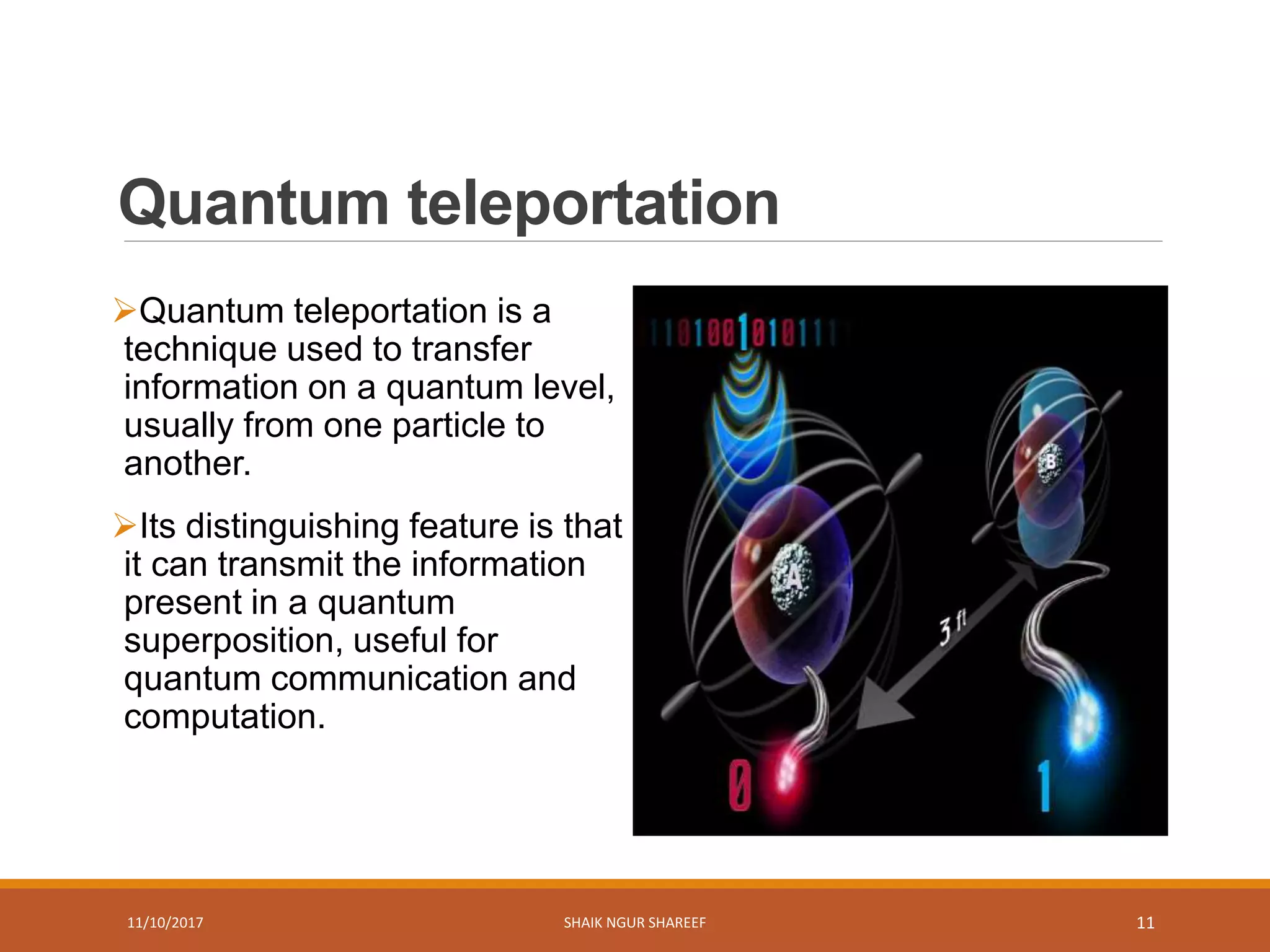
Quantum teleportation is a
technique used to transfer
information on a quantum level,
usually from one particle to
another.
Its distinguishing feature is that
it can transmit the information
present in a quantum
superposition, useful for
quantum communication and
computation.
11/10/2017 SHAIK NGUR SHAREEF 11
Quantum parallelism
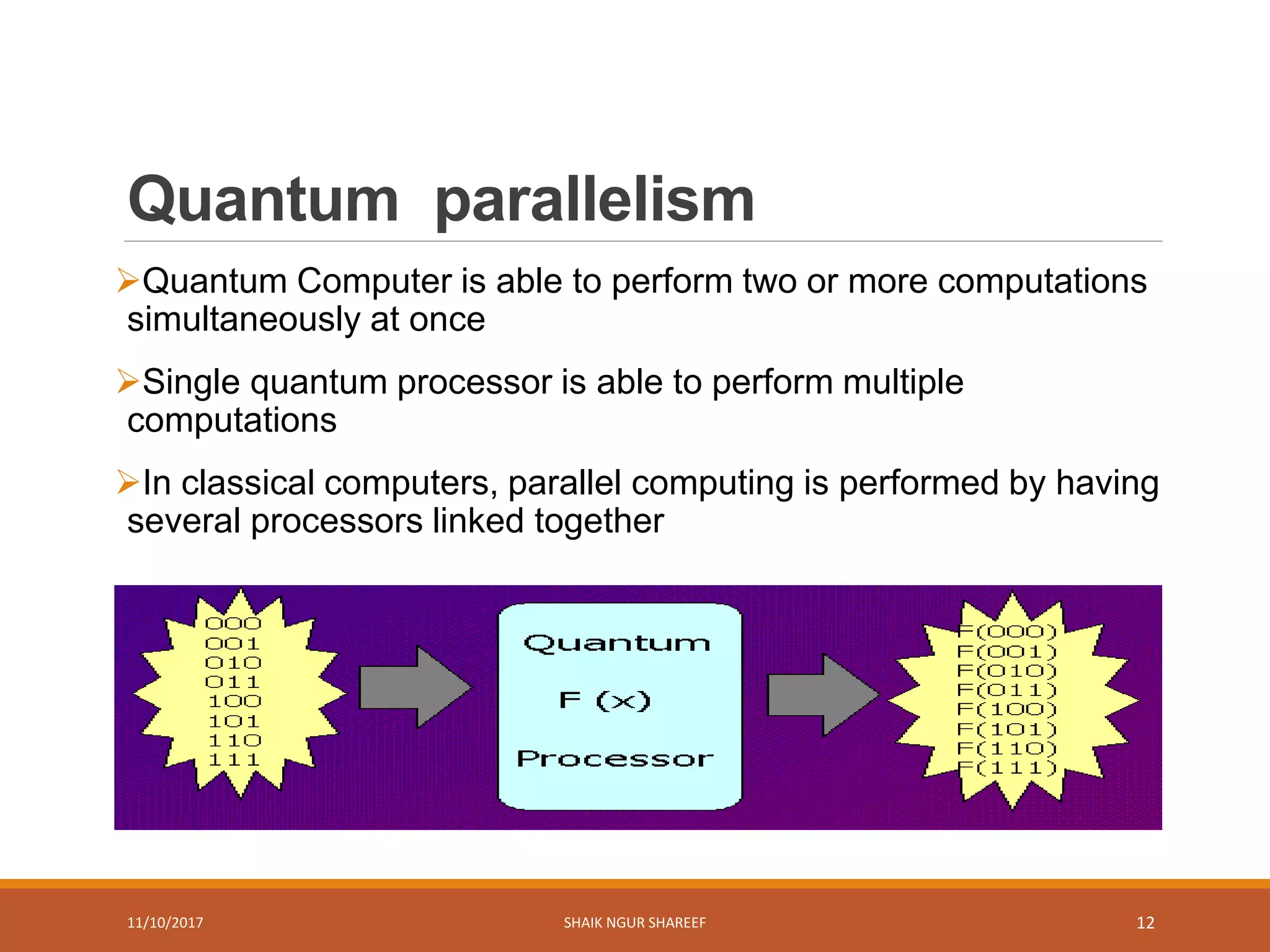
Quantum Computer is able to perform two or more computations
simultaneously at once
Single quantum processor is able to perform multiple
computations
In classical computers, parallel computing is performed by having
several processors linked together
11/10/2017 SHAIK NGUR SHAREEF 12
Algorithms
Shor’s algorithm (factorial if n digited number at polynomial time
‘F(a) = x mod N’)
Grover’s algorithm (search a name in unsorted database)
 Chaos SAT algorithm
Adaptive SAT algorithm
11/10/2017 SHAIK NGUR SHAREEF 13
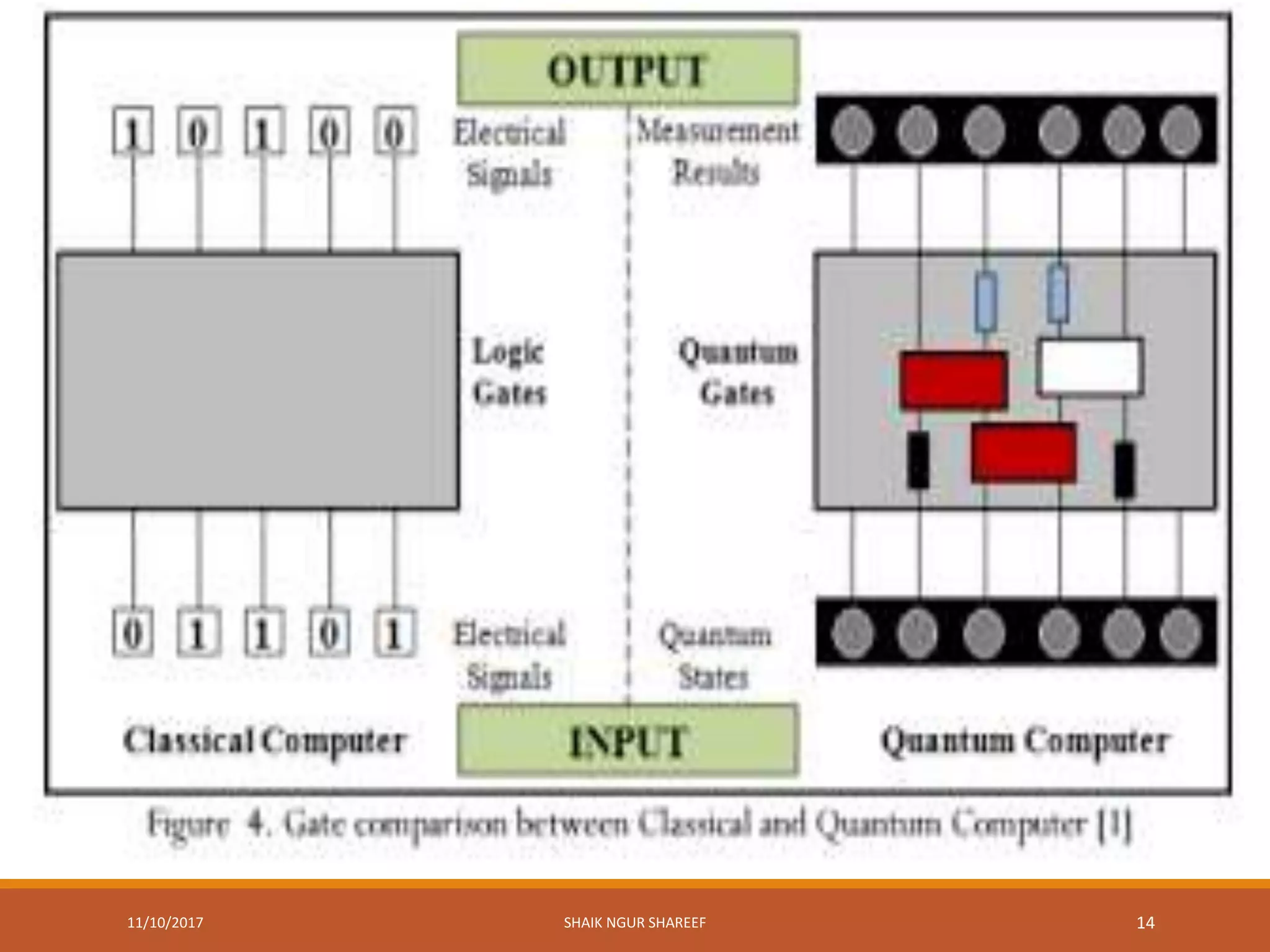
11/10/2017 SHAIK NGUR SHAREEF 14
Applications
Quantum networking
Encryption
Ultra-secure & Super-dense Communications
Molecular Simulations
True Randomness
11/10/2017 SHAIK NGUR SHAREEF 15
Conclusion
Quantum computing could provide a radical change in the way
computation is performed.
The advantages of quantum computing lie in the aspects of
quantum mechanics that are peculiar to it, most notably
entanglement.
 Classical computers will be significantly larger than quantum
computers for the foreseeable future
11/10/2017 SHAIK NGUR SHAREEF 16
11/10/2017 SHAIK NGUR SHAREEF 17

Quantum Computers

  • 1.
    SHAIK NAGUR SHAREEF B.Tech-CSE(161FA04195) VIGNAN’SUNIVERSITY QUANTUM COMPUTERS Latest Technology for Bright Future
  • 2.
    Areas of Discussion oClassical Computers o Quantum Computers o History & Definition o Basic principles o Algorithms o Abilities o Applications o Conclusion 11/10/2017 SHAIK NGUR SHAREEF 2
  • 3.
    Classical Computers These aremade of transistors and diodes In these, the data is encoded into binary digits (bits) Performs calculations based on the laws of classical mechanics 11/10/2017 SHAIK NGUR SHAREEF 3
  • 4.
    11/10/2017 SHAIK NGURSHAREEF 4 Makes work easy and faster Complex Computation or Logical work become easy Accurate and Speedy Computation machine Many kinds of numerical problems cannot be solved using conventional computers  example: factorization of a number The computer time required to factor an integer containing N digits is believed to increase exponentially with N.
  • 5.
    History 1985 - daviddeutsch -university of oxford, describes -first universal quantum computer 1993 - dan simon, a-universite de montreal-invents an oracle problem for which quantum computer would be exponentially faster than conventional computer. This algorithm introduced the main ideas which were then developed in peter shor's factoring algorithm. 1996 - lov grover, at bell labs, invents quantum database search algorithm 1998 - first working 2-qubit NMR computer demonstrated at university of california, berkeley 1999 - first working 3-qubit NMR computer demonstrated at ibm's almaden research center. First execution of grover's algorithm 2000 - first working 5-qubit NMR computer demonstrated at ibm's almaden research center. 2001 - first working 7-qubit nmr computer demonstrated at ibm's almaden research center. First execution of shor's algorithm. The number 15 was factored using 1018 identical molecules, each containing 7 atoms. 11/10/2017 SHAIK NGUR SHAREEF 5
  • 6.
    Quantum computer Quantum Computersmake direct use of Quantum-mechanical phenomena such as Superposition and Entanglement to perform operations on data Quantum Computation uses Quantum bits (qubits) which can be in superposition states. 11/10/2017 SHAIK NGUR SHAREEF 6
  • 7.
    Data representation (qubit) Qubitis a unit of Quantum Information. Different physical objects can be used as qubits such as Atoms, Photons or Electrons Exists as a ‘0’, a ‘1’ or simultaneously as a superposition of both ‘0’ & ‘1’ 11/10/2017 SHAIK NGUR SHAREEF 7
  • 8.
    Quantum superposition An electronhas dual nature (particle and wave) Wave exhibits a phenomenon known as superposition This allows the addition of waves numerically 11/10/2017 SHAIK NGUR SHAREEF 8
  • 9.
    Quantum entanglement Measurement ofone particle will effect the state of another particle, though classically there is no direct interaction When this happens, the state of the two particles is said to be entangled 11/10/2017 SHAIK NGUR SHAREEF 9
  • 10.
    Quantum dots  Atechnology that enables ‘Qubits' to exist as Coherent-Superposition of 0 and 1 states is ‘Quantum Dots’ When the dot is exposed to a pulse of laser light of the right wavelength & duration, the electron is raised to an excited state: a second burst of laser light causes the electron to fall back to its ground state 11/10/2017 SHAIK NGUR SHAREEF 10
  • 11.
    Quantum teleportation Quantum teleportationis a technique used to transfer information on a quantum level, usually from one particle to another. Its distinguishing feature is that it can transmit the information present in a quantum superposition, useful for quantum communication and computation. 11/10/2017 SHAIK NGUR SHAREEF 11
  • 12.
    Quantum parallelism Quantum Computeris able to perform two or more computations simultaneously at once Single quantum processor is able to perform multiple computations In classical computers, parallel computing is performed by having several processors linked together 11/10/2017 SHAIK NGUR SHAREEF 12
  • 13.
    Algorithms Shor’s algorithm (factorialif n digited number at polynomial time ‘F(a) = x mod N’) Grover’s algorithm (search a name in unsorted database)  Chaos SAT algorithm Adaptive SAT algorithm 11/10/2017 SHAIK NGUR SHAREEF 13
  • 14.
  • 15.
    Applications Quantum networking Encryption Ultra-secure &Super-dense Communications Molecular Simulations True Randomness 11/10/2017 SHAIK NGUR SHAREEF 15
  • 16.
    Conclusion Quantum computing couldprovide a radical change in the way computation is performed. The advantages of quantum computing lie in the aspects of quantum mechanics that are peculiar to it, most notably entanglement.  Classical computers will be significantly larger than quantum computers for the foreseeable future 11/10/2017 SHAIK NGUR SHAREEF 16
  • 17.

Editor's Notes