QUALITY STANDARDS
Quality is...
...about learning what you are doing well and striving to do
it better
...discovering what you need to change to make sure you
meet your users' needs
Quality is …
 Satisfaction of
stakeholders
 Added value for the
society
 Best value for price
 Cost effectivess
 Doing the right
things in a right way
 Meeting
specifications
 Meeting customer
expectations
 Transparency of service
delivery
 Process control
 Acheiving desired results
 Continous improvement
 Competitive advantage
 Best practice
Quality Assurance is...
 putting procedures in place to prevent
defects/mistakes/errors
 series of step to ensure that quality control has taken
place
Quality Management is ...
 when organization works to prevent
defects/mistakes/errors in every improvement
 taking a holistic view of all factors in producing the end
result
Quality Assurance System
is ...
... a formal management system that you can use to
strengthen your organisation.
... intended to raise standards of work and help you to do
everything consistently.
Quality Management
System ...
... helps improve improve your organization and its
outcomes with:
1. principles and a theoretical framework,
2. off-the-shelf quality management systems which can be
tailored to your needs,
3. learning from the experiences of other organizations,
4. a wide range of tools
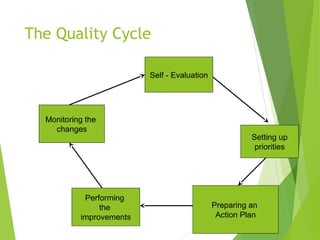
The Quality Cycle
Self - Evaluation
Setting up
priorities
Preparing an
Action Plan
Performing
the
improvements
Monitoring the
changes
Quality Systems
Standards
 ISO 9000
(http://www.iso.org/iso/home.html)
 ISO 14000
 Investors in
People
 Investing in
Volunteers
 Matrix Standard
TQM
 The
EFQM(http://www.efqm.org/)
 PQASSO (http://www.ces-
vol.org.uk/PQASSO)
PQASSO
Practical Quality Assurance System for Small Organisations
produced and owned by the
Charities Evaluation Service, is
designed for use by small and
medium-sized organizations
covers all aspects of an
organization, from governance
to service delivery and
monitoring outcomes
PQASSO's Flexibility
 it can be used by all types of third sector
organizations(charities, social enterprises, community
interest companies and community groups)
 allows an organization to work at its own pace as it is
self-assessed through the 12 quality areas
In the Philippines...
 Philippines Council for NGO Certification approves NGOs
to qualify for taxdeductible charity donations –12th
years this year (HAP, 2012)
Quality areas of PQASSO
1. Planning for
Quality
2. Governance
3. Management
4. User-centred
Service
5. Staff and
Volunteers
6. Training and
Development
7. Managing Money
8. Managing Resources
9. Managing Activities
10. Networking and
Partnership
11. Monitoring and
Evaluation
12. Results
"The quality of organisational processes have a direct bearing on the quality
of the results. PQASSO makes that direct link between management and
processes and the outcomes and impact produced, and evidence about
outcomes is part of the quality assessment. In PQASSO both processes and
outcomes are assessed. This is not the case for many quality systems."
(Survey respondent, VCO).
EFQM
European Foundation for Quality Management
 outlines the foundation for
achieving sustainable excellence
in any organization
 has beenreviewed to ensure it
reflects the worldwe operate in
 encourages organizations to
move from rigid corporate
structures to more agile ones
better suited to the rigours of
today’s global economic
environment
Quality concepts of EFQM
 Adding value to customers
 Creating a sustainable future
 Developing an organizational capability
 Harnessing creativity and innovation
Quality concepts of EFQM
 Leading with vision, inspiration and integrity
 Managing with agility
 Succeeding through the talent of people
 Sustaining outstanding results
EFQM awarded companies
 BMW
 Bosch
 Novaled
"I like EFQM as it is a framework in which other things can sit – it gives you
the common language I was looking for but means you can do HR ... I’m
not a fan of ISO but if we ever felt we had to go down that route, we’d
plug ISO in to EFQM. EFQM talks about continuous quality improvement.
... In the world of competitive tendering, there is a sense of having some
external accreditation it passports you through the tendering process."
(VCO, interview)
ISO
International Organization for Standardization
 provide practical tools for tackling many of today’s
global challenges
 can improve internal and external communication of
management procedures
 not be suitable for socially enterprising organizations
Quality areas of ISO
 Project, program, and portfolio management
 Outsourcing
 Human resources management
 Additive manufacturing
 Risk management
ISO 9000 family
 ISO 9001:2008 - sets out the requirements of a quality
management system
 ISO 9000:2005 - covers the basic concepts and language
ISO 9000 family
 ISO 9004:2009 - focuses on how to make a quality
management system more efficient and effective
 ISO 19011:2011 - sets out guidance on internal and
external audits of quality management systems.
ISO 9001:2008
 sets out the criteria for a quality management system
and is the only standard in the family that can be
certified to
 can be used by any organization, large or small,
regardless of its field of activity
ISO 9001:2008
 based on a number of quality management principles
including a strong customer focus, the motivation and
implication of top management, the process approach
and continual improvement
 helps ensure that customers get consistent, good quality
products and services, which in turn brings many
business benefits.
In the Philippines ...
Some of the Philippines ISO certification
requirements:
- monitoring processes to ensure they are
effective;
- keeping adequate records;
- checking output for defects, with
appropriate and corrective action where
necessary;
- regularly reviewing individual processes
and the quality system itself for
effectiveness; and
- facilitating continual improvement
In the Philippines ...
 Monterey
 Seaoil
 Gulf oil
 Dole Philippines
 Kraft Foods, Inc.
 Mekeni Food
Corporation
 Jollibee
 San Miguel
foods, inc.
 Prince Nikko
international
 Peter Paul Phils.
Corp.
 General Milling
Corp.
 SL Agritech
Corp.
In Iligan City...
 Adventist Medical Center
 HOLCIM
 SAN MIGUEL CORPORATION-ILIGAN COCONUT OIL MILL
(ICOM)
"I come from a private industry background – but ISO is like
using a sledgehammer:
there are lots of things with this that a small organisation
wouldn’t need to run a
grant – it’s more to do with manufacturing and is too in
depth." (Interview, Funder).
Quiz next meeting

QUALITY STANDARDS

  • 1.
  • 2.
    Quality is... ...about learningwhat you are doing well and striving to do it better ...discovering what you need to change to make sure you meet your users' needs
  • 3.
    Quality is … Satisfaction of stakeholders  Added value for the society  Best value for price  Cost effectivess  Doing the right things in a right way  Meeting specifications  Meeting customer expectations  Transparency of service delivery  Process control  Acheiving desired results  Continous improvement  Competitive advantage  Best practice
  • 4.
    Quality Assurance is... putting procedures in place to prevent defects/mistakes/errors  series of step to ensure that quality control has taken place
  • 5.
    Quality Management is...  when organization works to prevent defects/mistakes/errors in every improvement  taking a holistic view of all factors in producing the end result
  • 6.
    Quality Assurance System is... ... a formal management system that you can use to strengthen your organisation. ... intended to raise standards of work and help you to do everything consistently.
  • 7.
    Quality Management System ... ...helps improve improve your organization and its outcomes with: 1. principles and a theoretical framework, 2. off-the-shelf quality management systems which can be tailored to your needs, 3. learning from the experiences of other organizations, 4. a wide range of tools
  • 8.
    The Quality Cycle Self- Evaluation Setting up priorities Preparing an Action Plan Performing the improvements Monitoring the changes
  • 9.
    Quality Systems Standards  ISO9000 (http://www.iso.org/iso/home.html)  ISO 14000  Investors in People  Investing in Volunteers  Matrix Standard TQM  The EFQM(http://www.efqm.org/)  PQASSO (http://www.ces- vol.org.uk/PQASSO)
  • 11.
    PQASSO Practical Quality AssuranceSystem for Small Organisations produced and owned by the Charities Evaluation Service, is designed for use by small and medium-sized organizations covers all aspects of an organization, from governance to service delivery and monitoring outcomes
  • 12.
    PQASSO's Flexibility  itcan be used by all types of third sector organizations(charities, social enterprises, community interest companies and community groups)  allows an organization to work at its own pace as it is self-assessed through the 12 quality areas
  • 13.
    In the Philippines... Philippines Council for NGO Certification approves NGOs to qualify for taxdeductible charity donations –12th years this year (HAP, 2012)
  • 14.
    Quality areas ofPQASSO 1. Planning for Quality 2. Governance 3. Management 4. User-centred Service 5. Staff and Volunteers 6. Training and Development 7. Managing Money 8. Managing Resources 9. Managing Activities 10. Networking and Partnership 11. Monitoring and Evaluation 12. Results
  • 15.
    "The quality oforganisational processes have a direct bearing on the quality of the results. PQASSO makes that direct link between management and processes and the outcomes and impact produced, and evidence about outcomes is part of the quality assessment. In PQASSO both processes and outcomes are assessed. This is not the case for many quality systems." (Survey respondent, VCO).
  • 16.
    EFQM European Foundation forQuality Management  outlines the foundation for achieving sustainable excellence in any organization  has beenreviewed to ensure it reflects the worldwe operate in  encourages organizations to move from rigid corporate structures to more agile ones better suited to the rigours of today’s global economic environment
  • 17.
    Quality concepts ofEFQM  Adding value to customers  Creating a sustainable future  Developing an organizational capability  Harnessing creativity and innovation
  • 18.
    Quality concepts ofEFQM  Leading with vision, inspiration and integrity  Managing with agility  Succeeding through the talent of people  Sustaining outstanding results
  • 19.
    EFQM awarded companies BMW  Bosch  Novaled
  • 20.
    "I like EFQMas it is a framework in which other things can sit – it gives you the common language I was looking for but means you can do HR ... I’m not a fan of ISO but if we ever felt we had to go down that route, we’d plug ISO in to EFQM. EFQM talks about continuous quality improvement. ... In the world of competitive tendering, there is a sense of having some external accreditation it passports you through the tendering process." (VCO, interview)
  • 21.
    ISO International Organization forStandardization  provide practical tools for tackling many of today’s global challenges  can improve internal and external communication of management procedures  not be suitable for socially enterprising organizations
  • 22.
    Quality areas ofISO  Project, program, and portfolio management  Outsourcing  Human resources management  Additive manufacturing  Risk management
  • 23.
    ISO 9000 family ISO 9001:2008 - sets out the requirements of a quality management system  ISO 9000:2005 - covers the basic concepts and language
  • 24.
    ISO 9000 family ISO 9004:2009 - focuses on how to make a quality management system more efficient and effective  ISO 19011:2011 - sets out guidance on internal and external audits of quality management systems.
  • 25.
    ISO 9001:2008  setsout the criteria for a quality management system and is the only standard in the family that can be certified to  can be used by any organization, large or small, regardless of its field of activity
  • 26.
    ISO 9001:2008  basedon a number of quality management principles including a strong customer focus, the motivation and implication of top management, the process approach and continual improvement  helps ensure that customers get consistent, good quality products and services, which in turn brings many business benefits.
  • 27.
    In the Philippines... Some of the Philippines ISO certification requirements: - monitoring processes to ensure they are effective; - keeping adequate records; - checking output for defects, with appropriate and corrective action where necessary; - regularly reviewing individual processes and the quality system itself for effectiveness; and - facilitating continual improvement
  • 28.
    In the Philippines...  Monterey  Seaoil  Gulf oil  Dole Philippines  Kraft Foods, Inc.  Mekeni Food Corporation  Jollibee  San Miguel foods, inc.  Prince Nikko international  Peter Paul Phils. Corp.  General Milling Corp.  SL Agritech Corp.
  • 29.
    In Iligan City... Adventist Medical Center  HOLCIM  SAN MIGUEL CORPORATION-ILIGAN COCONUT OIL MILL (ICOM)
  • 30.
    "I come froma private industry background – but ISO is like using a sledgehammer: there are lots of things with this that a small organisation wouldn’t need to run a grant – it’s more to do with manufacturing and is too in depth." (Interview, Funder).
  • 31.