1
Š Prentice Hall, 2002
Chapter 14:Chapter 14:
Object-Oriented DataObject-Oriented Data
ModelingModeling
Modern Database Management
6th
Edition
Jeffrey A. Hoffer, Mary B. Prescott, Fred R.
McFadden
2Chapter 14 Š Prentice Hall,
What is Object Oriented Data Modeling?What is Object Oriented Data Modeling?
 Centers around objects and classes
 Involves inheritance
 Encapsulates both data and behavior
 Benefits of Object-Oriented Modeling
– Ability to tackle challenging problems
– Improved communication between users, analysts, designer,
and programmers
– Increased consistency in analysis and design
– Explicit representation of commonality among system
components
– System robustness
– Reusability of analysis, design, and programming results
3Chapter 14 Š Prentice Hall,
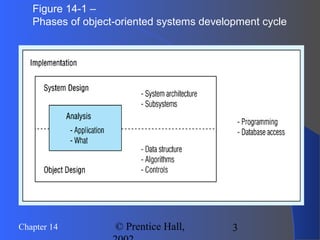
Figure 14-1 –
Phases of object-oriented systems development cycle
4Chapter 14 Š Prentice Hall,
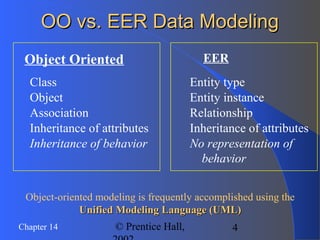
OO vs. EER Data ModelingOO vs. EER Data Modeling
Object Oriented EER
Class Entity type
Object Entity instance
Association Relationship
Inheritance of attributes Inheritance of attributes
Inheritance of behavior No representation of
behavior
Object-oriented modeling is frequently accomplished using the
Unified Modeling Language (UML)Unified Modeling Language (UML)
5Chapter 14 Š Prentice Hall,
ObjectObject
An entity that has a well-defined role in the
application domain, as well as state,
behavior, and identity
– Tangible: person, place or thing
– Concept or Event: department, performance,
marriage, registration
– Artifact of the Design Process: user interface,
controller, scheduler
ObjectsObjects exhibit BEHAVIOR as well as attributes
 Different from entitiesentities
6Chapter 14 Š Prentice Hall,
State, Behavior, IdentityState, Behavior, Identity
State: attribute types and values
Behavior: how an object acts and reacts
– Behavior is expressed through operations that
can be performed on it
Identity: every object has a unique identity,
even if all of its attribute values are the
same
7Chapter 14 Š Prentice Hall,
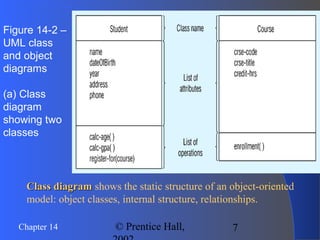
Figure 14-2 –
UML class
and object
diagrams
(a) Class
diagram
showing two
classes
Class diagramClass diagram shows the static structure of an object-oriented
model: object classes, internal structure, relationships.
8Chapter 14 Š Prentice Hall,
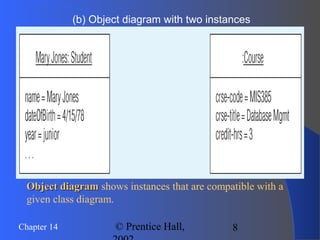
(b) Object diagram with two instances
Object diagramObject diagram shows instances that are compatible with a
given class diagram.
9Chapter 14 Š Prentice Hall,
OperationsOperations
 A function or service that is provided by all
instances of a class
 Types of operators:
– ConstructorConstructor: creates a new instance of a class
– QueryQuery: accesses the state of an object but does not alter
its state
– UpdateUpdate: alters the state of an object
– ScopeScope: operation applying to the class instead of an
instance
Operations implement the object’s behaviorbehavior
10Chapter 14 Š Prentice Hall,
AssociationsAssociations
AssociationAssociation:
– Relationship among object classes
Association RoleAssociation Role:
– Role of an object in an association
– The end of an association where it connects to a
class
MultiplicityMultiplicity:
– How many objects participate in an association.
Lower-bound..Upper bound (cardinality).
11Chapter 14 Š Prentice Hall,
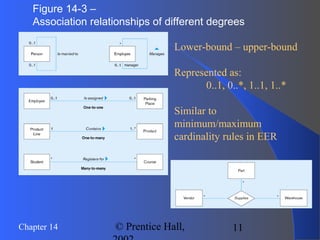
Figure 14-3 –
Association relationships of different degrees
Lower-bound – upper-bound
Represented as:
0..1, 0..*, 1..1, 1..*
Similar to
minimum/maximum
cardinality rules in EER
12Chapter 14 Š Prentice Hall,
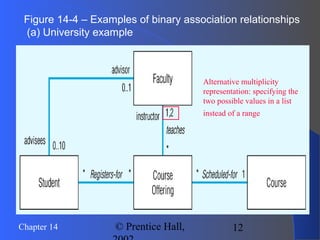
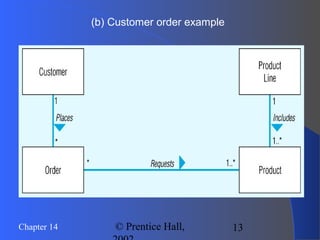
Figure 14-4 – Examples of binary association relationships
(a) University example
Alternative multiplicity
representation: specifying the
two possible values in a list
instead of a range
13Chapter 14 Š Prentice Hall,
(b) Customer order example
14Chapter 14 Š Prentice Hall,
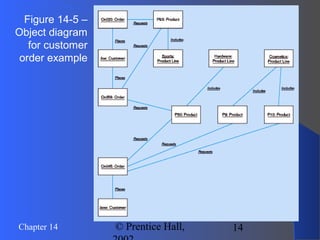
Figure 14-5 –
Object diagram
for customer
order example
15Chapter 14 Š Prentice Hall,
Association ClassAssociation Class
An association that has attributes or
operations of its own or that participates in
relationships with other classes
Like an associative entity in ER model
16Chapter 14 Š Prentice Hall,
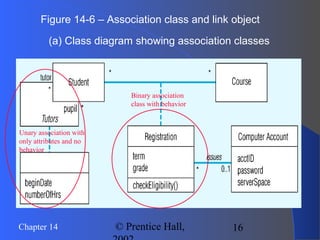
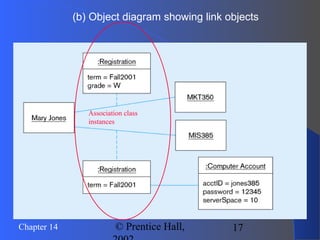
Figure 14-6 – Association class and link object
(a) Class diagram showing association classes
Binary association
class with behavior
Unary association with
only attributes and no
behavior
17Chapter 14 Š Prentice Hall,
(b) Object diagram showing link objects
Association class
instances
18Chapter 14 Š Prentice Hall,
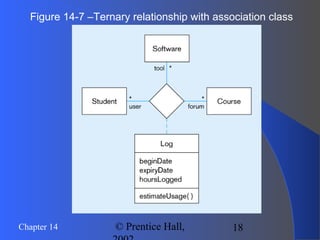
Figure 14-7 –Ternary relationship with association class
19Chapter 14 Š Prentice Hall,
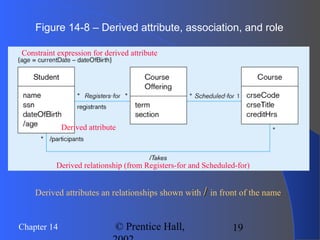
Figure 14-8 – Derived attribute, association, and role
Derived attributes an relationships shown with // in front of the name
Derived relationship (from Registers-for and Scheduled-for)
Constraint expression for derived attribute
Derived attribute
20Chapter 14 Š Prentice Hall,
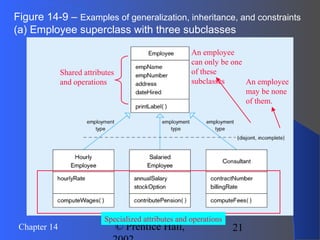
Generalization/SpecializationGeneralization/Specialization
 Subclass, superclass
– similar to subtype/supertype in EER
 Common attributes, relationships, AND
operations
 Disjoint vs. Overlapping
 Complete (total specialization) vs. incomplete
(partial specialization)
 Abstract Class: no direct instances
 Concrete Class: direct instances
21Chapter 14 Š Prentice Hall,
Figure 14-9 – Examples of generalization, inheritance, and constraints
(a) Employee superclass with three subclasses
Shared attributes
and operations
An employee
can only be one
of these
subclasses An employee
may be none
of them.
Specialized attributes and operations
22Chapter 14 Š Prentice Hall,
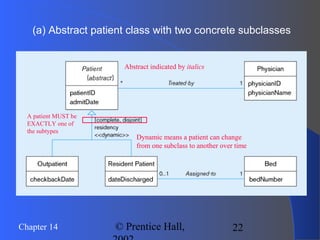
(a) Abstract patient class with two concrete subclasses
Abstract indicated by italics
Dynamic means a patient can change
from one subclass to another over time
A patient MUST be
EXACTLY one of
the subtypes
23Chapter 14 Š Prentice Hall,
Class-Level AttributeClass-Level Attribute
Specifies a value common to an entire class,
rather than a specific value for an instance.
Represented by underlining
“=“ is initial, default value.
24Chapter 14 Š Prentice Hall,
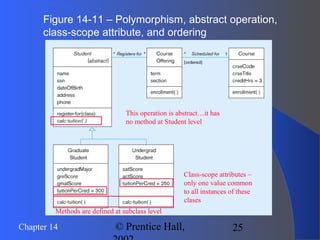
PolymorphismPolymorphism
Abstract Operation: Defines the form or
protocol of the operation, but not its
implementation.
Method: The implementation of an
operation.
Polymorphism: The same operation
may apply to two or more classes in
different ways
25Chapter 14 Š Prentice Hall,
Figure 14-11 – Polymorphism, abstract operation,
class-scope attribute, and ordering
Class-scope attributes –
only one value common
to all instances of these
clases
This operation is abstract…it has
no method at Student level
Methods are defined at subclass level
26Chapter 14 Š Prentice Hall,
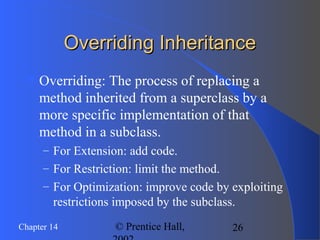
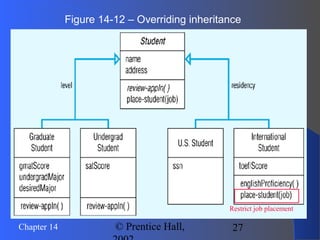
Overriding InheritanceOverriding Inheritance
Overriding: The process of replacing a
method inherited from a superclass by a
more specific implementation of that
method in a subclass.
– For Extension: add code.
– For Restriction: limit the method.
– For Optimization: improve code by exploiting
restrictions imposed by the subclass.
27Chapter 14 Š Prentice Hall,
Figure 14-12 – Overriding inheritance
Restrict job placement
28Chapter 14 Š Prentice Hall,
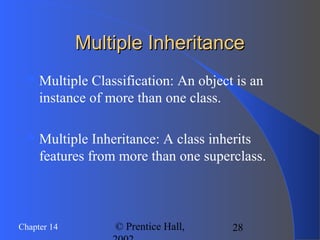
Multiple InheritanceMultiple Inheritance
Multiple Classification: An object is an
instance of more than one class.
Multiple Inheritance: A class inherits
features from more than one superclass.
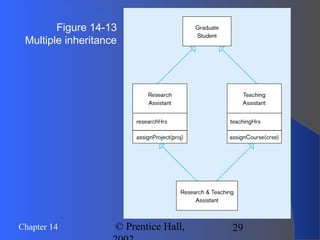
29Chapter 14 Š Prentice Hall,
Figure 14-13
Multiple inheritance
30Chapter 14 Š Prentice Hall,
AggregationAggregation
 Aggregation: A part-of relationship between a
component object and an aggregate object.
 Composition: A stronger form of aggregation in
which a part object belongs to only one whole
object and exists only as part of the whole object.
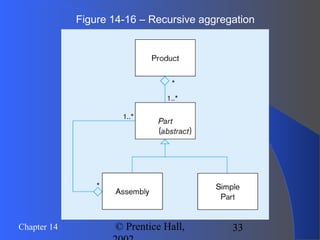
 Recursive Aggregation: composition where
component object is an instance of the same class
as the aggregate object.
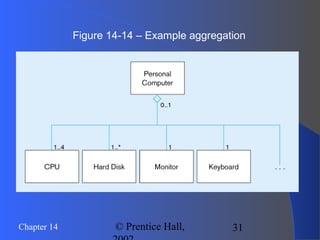
31Chapter 14 Š Prentice Hall,
Figure 14-14 – Example aggregation
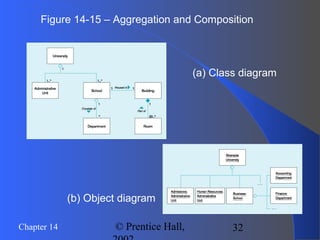
32Chapter 14 Š Prentice Hall,
Figure 14-15 – Aggregation and Composition
(a) Class diagram
(b) Object diagram
33Chapter 14 Š Prentice Hall,
Figure 14-16 – Recursive aggregation
34Chapter 14 Š Prentice Hall,
Business RulesBusiness Rules
 See chapters 3 and 4
 Implicit and explicit constraints on objects – for
example:
– cardinality constraints on association roles
– ordering constraints on association roles
 Business rules involving two graphical symbols:
– labeled dashed arrow from one to the other
 Business rules involving three or more graphical
symbols:
– note with dashed lines to each symbol
35Chapter 14 Š Prentice Hall,
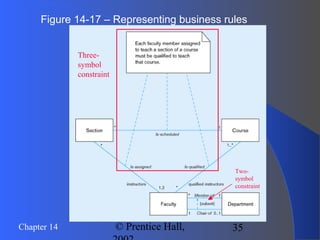
Figure 14-17 – Representing business rules
Three-
symbol
constraint
Two-
symbol
constraint
36Chapter 14 Š Prentice Hall,
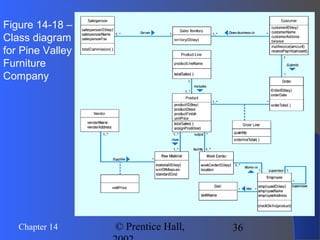
Figure 14-18 –
Class diagram
for Pine Valley
Furniture
Company

The Database Environment Chapter 14

  • 1.
    1 Š Prentice Hall,2002 Chapter 14:Chapter 14: Object-Oriented DataObject-Oriented Data ModelingModeling Modern Database Management 6th Edition Jeffrey A. Hoffer, Mary B. Prescott, Fred R. McFadden
  • 2.
    2Chapter 14 ©Prentice Hall, What is Object Oriented Data Modeling?What is Object Oriented Data Modeling?  Centers around objects and classes  Involves inheritance  Encapsulates both data and behavior  Benefits of Object-Oriented Modeling – Ability to tackle challenging problems – Improved communication between users, analysts, designer, and programmers – Increased consistency in analysis and design – Explicit representation of commonality among system components – System robustness – Reusability of analysis, design, and programming results
  • 3.
    3Chapter 14 ©Prentice Hall, Figure 14-1 – Phases of object-oriented systems development cycle
  • 4.
    4Chapter 14 ŠPrentice Hall, OO vs. EER Data ModelingOO vs. EER Data Modeling Object Oriented EER Class Entity type Object Entity instance Association Relationship Inheritance of attributes Inheritance of attributes Inheritance of behavior No representation of behavior Object-oriented modeling is frequently accomplished using the Unified Modeling Language (UML)Unified Modeling Language (UML)
  • 5.
    5Chapter 14 ©Prentice Hall, ObjectObject An entity that has a well-defined role in the application domain, as well as state, behavior, and identity – Tangible: person, place or thing – Concept or Event: department, performance, marriage, registration – Artifact of the Design Process: user interface, controller, scheduler ObjectsObjects exhibit BEHAVIOR as well as attributes  Different from entitiesentities
  • 6.
    6Chapter 14 ©Prentice Hall, State, Behavior, IdentityState, Behavior, Identity State: attribute types and values Behavior: how an object acts and reacts – Behavior is expressed through operations that can be performed on it Identity: every object has a unique identity, even if all of its attribute values are the same
  • 7.
    7Chapter 14 ©Prentice Hall, Figure 14-2 – UML class and object diagrams (a) Class diagram showing two classes Class diagramClass diagram shows the static structure of an object-oriented model: object classes, internal structure, relationships.
  • 8.
    8Chapter 14 ŠPrentice Hall, (b) Object diagram with two instances Object diagramObject diagram shows instances that are compatible with a given class diagram.
  • 9.
    9Chapter 14 ©Prentice Hall, OperationsOperations  A function or service that is provided by all instances of a class  Types of operators: – ConstructorConstructor: creates a new instance of a class – QueryQuery: accesses the state of an object but does not alter its state – UpdateUpdate: alters the state of an object – ScopeScope: operation applying to the class instead of an instance Operations implement the object’s behaviorbehavior
  • 10.
    10Chapter 14 ©Prentice Hall, AssociationsAssociations AssociationAssociation: – Relationship among object classes Association RoleAssociation Role: – Role of an object in an association – The end of an association where it connects to a class MultiplicityMultiplicity: – How many objects participate in an association. Lower-bound..Upper bound (cardinality).
  • 11.
    11Chapter 14 ©Prentice Hall, Figure 14-3 – Association relationships of different degrees Lower-bound – upper-bound Represented as: 0..1, 0..*, 1..1, 1..* Similar to minimum/maximum cardinality rules in EER
  • 12.
    12Chapter 14 ©Prentice Hall, Figure 14-4 – Examples of binary association relationships (a) University example Alternative multiplicity representation: specifying the two possible values in a list instead of a range
  • 13.
    13Chapter 14 ŠPrentice Hall, (b) Customer order example
  • 14.
    14Chapter 14 ©Prentice Hall, Figure 14-5 – Object diagram for customer order example
  • 15.
    15Chapter 14 ŠPrentice Hall, Association ClassAssociation Class An association that has attributes or operations of its own or that participates in relationships with other classes Like an associative entity in ER model
  • 16.
    16Chapter 14 ©Prentice Hall, Figure 14-6 – Association class and link object (a) Class diagram showing association classes Binary association class with behavior Unary association with only attributes and no behavior
  • 17.
    17Chapter 14 ŠPrentice Hall, (b) Object diagram showing link objects Association class instances
  • 18.
    18Chapter 14 ©Prentice Hall, Figure 14-7 –Ternary relationship with association class
  • 19.
    19Chapter 14 ©Prentice Hall, Figure 14-8 – Derived attribute, association, and role Derived attributes an relationships shown with // in front of the name Derived relationship (from Registers-for and Scheduled-for) Constraint expression for derived attribute Derived attribute
  • 20.
    20Chapter 14 ©Prentice Hall, Generalization/SpecializationGeneralization/Specialization  Subclass, superclass – similar to subtype/supertype in EER  Common attributes, relationships, AND operations  Disjoint vs. Overlapping  Complete (total specialization) vs. incomplete (partial specialization)  Abstract Class: no direct instances  Concrete Class: direct instances
  • 21.
    21Chapter 14 ©Prentice Hall, Figure 14-9 – Examples of generalization, inheritance, and constraints (a) Employee superclass with three subclasses Shared attributes and operations An employee can only be one of these subclasses An employee may be none of them. Specialized attributes and operations
  • 22.
    22Chapter 14 ŠPrentice Hall, (a) Abstract patient class with two concrete subclasses Abstract indicated by italics Dynamic means a patient can change from one subclass to another over time A patient MUST be EXACTLY one of the subtypes
  • 23.
    23Chapter 14 ©Prentice Hall, Class-Level AttributeClass-Level Attribute Specifies a value common to an entire class, rather than a specific value for an instance. Represented by underlining “=“ is initial, default value.
  • 24.
    24Chapter 14 ŠPrentice Hall, PolymorphismPolymorphism Abstract Operation: Defines the form or protocol of the operation, but not its implementation. Method: The implementation of an operation. Polymorphism: The same operation may apply to two or more classes in different ways
  • 25.
    25Chapter 14 ©Prentice Hall, Figure 14-11 – Polymorphism, abstract operation, class-scope attribute, and ordering Class-scope attributes – only one value common to all instances of these clases This operation is abstract…it has no method at Student level Methods are defined at subclass level
  • 26.
    26Chapter 14 ©Prentice Hall, Overriding InheritanceOverriding Inheritance Overriding: The process of replacing a method inherited from a superclass by a more specific implementation of that method in a subclass. – For Extension: add code. – For Restriction: limit the method. – For Optimization: improve code by exploiting restrictions imposed by the subclass.
  • 27.
    27Chapter 14 ©Prentice Hall, Figure 14-12 – Overriding inheritance Restrict job placement
  • 28.
    28Chapter 14 ŠPrentice Hall, Multiple InheritanceMultiple Inheritance Multiple Classification: An object is an instance of more than one class. Multiple Inheritance: A class inherits features from more than one superclass.
  • 29.
    29Chapter 14 ŠPrentice Hall, Figure 14-13 Multiple inheritance
  • 30.
    30Chapter 14 ŠPrentice Hall, AggregationAggregation  Aggregation: A part-of relationship between a component object and an aggregate object.  Composition: A stronger form of aggregation in which a part object belongs to only one whole object and exists only as part of the whole object.  Recursive Aggregation: composition where component object is an instance of the same class as the aggregate object.
  • 31.
    31Chapter 14 ©Prentice Hall, Figure 14-14 – Example aggregation
  • 32.
    32Chapter 14 ©Prentice Hall, Figure 14-15 – Aggregation and Composition (a) Class diagram (b) Object diagram
  • 33.
    33Chapter 14 ©Prentice Hall, Figure 14-16 – Recursive aggregation
  • 34.
    34Chapter 14 ©Prentice Hall, Business RulesBusiness Rules  See chapters 3 and 4  Implicit and explicit constraints on objects – for example: – cardinality constraints on association roles – ordering constraints on association roles  Business rules involving two graphical symbols: – labeled dashed arrow from one to the other  Business rules involving three or more graphical symbols: – note with dashed lines to each symbol
  • 35.
    35Chapter 14 ©Prentice Hall, Figure 14-17 – Representing business rules Three- symbol constraint Two- symbol constraint
  • 36.
    36Chapter 14 ©Prentice Hall, Figure 14-18 – Class diagram for Pine Valley Furniture Company