Overview of ISO 9001:2015
Awareness Program
Vinay Kumar Srivastava
Agenda
 What does the term ISO mean?
 What is ISO?
 Quality Management Principles
 PDCA Cycle
 Model of Process Based QMS
 ISO 9001: 2015 Clauses
What does the term ISO mean?
• “International Organization for
Standardization”.
• Word derived from the Greek “isos”,
meaning "equal".
• Whatever the country, whatever the
language, the short form of the
organization's name is always ISO.
Network of national standards institutes of
162 countries,
Is a non-governmental organization.
Based in Geneva, Switzerland.
BIS represents India.
Total no. of Standards over 21,000,
touching almost all aspects of life.
What is ISO
What is a standard?
A standard is a document that
provides requirements, specifications,
guidelines or characteristics that can
be used consistently to ensure that
materials, products, processes and
services are fit for their purpose.
Quality Management Principles
1. Customer Focus
• To meet customers’ requirements and strive
to exceed the expectations.
2. Leadership
• Leaders at all levels-direct and provide
conditions to all people to achieve quality
objectives of the organization.
3. Engagement of people
• People should be competent, empowered
and engaged to deliver and create values
4. Process Approach
• Activities must be understood to achieve
consistent and predictable results
Quality Management Principles
5. Improvement
• On going focus on improvement of
processes
6. Evidence- based Decision Making
• Decisions based on analysis and evaluation
of data and information produce desired
results
7. Relationship Management
• Manage good relationship with interested
parties.
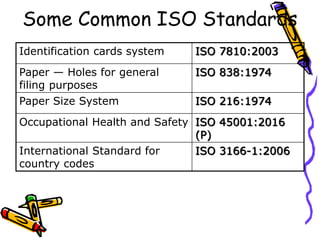
Some Common ISO Standards
Quality Management System ISO 9001:2015
Environment Mgmt. System ISO 14001:2015
Food Safety Mgmt. System ISO 22000:2005
Complaints Management ISO 10002:2004
Medical Device Manufacturing ISO 13485:2016
Information Security
management System
ISO 27001:2013
Some Common ISO Standards
Identification cards system ISO 7810:2003
Paper — Holes for general
filing purposes
ISO 838:1974
Paper Size System ISO 216:1974
Occupational Health and Safety ISO 45001:2016
(P)
International Standard for
country codes
ISO 3166-1:2006
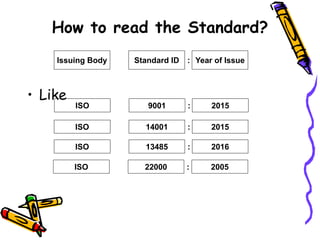
How to read the Standard?
• Like
Issuing Body Standard ID Year of Issue:
ISO 9001 2015:
ISO 14001 2015:
ISO 13485 2016:
ISO 22000 2005:
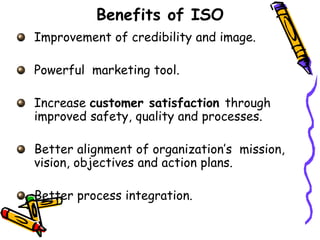
Benefits of ISO
Improvement of credibility and image.
Powerful marketing tool.
Increase customer satisfaction through
improved safety, quality and processes.
Better alignment of organization’s mission,
vision, objectives and action plans.
Better process integration.
…. Benefits
Consistent processes and evaluation tools to
demonstrate and increase effectiveness and
efficiency
Improve evidence based decision making.
Lesser repetition of errors/mistakes.
Widened participation of interested parties
Stimulation of excellence and innovation
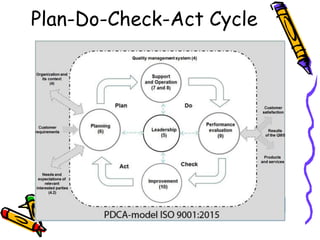
Process Approach
Plan-Do-Check-Act Cycle
The Plan Phase
• Includes-
– Understanding of context of the organization
– Defining Scope, and Quality Policy
– Addressing Risks and opportunities
– Setting Quality Objectives
– Planning control of processes
• Documenting he procedures –organizational control
• Implementing new technology or change in processes
– engineering control
• Training –HR related control, etc.
The Do Phase
• Includes
– Implementation of different processes
for fulfilling the QMS and achieving
quality objectives
– Implementation of control processes
The Check Phase
• Includes following-
– Regular monitoring and measuring
– Internal audits and management review
The Act Phase
• Includes-
– Corrective actions
– Implementation of improvement
initiatives.
ISO 9001: 2015 Clauses
0. Introduction
1. Scope
2. Normative references
3. Terms and Definitions
4. Context of the Organization
5. Leadership
6. Planning
7. Support
8. Operations
9. Performance Evaluation
10. Improvement
Introduction to ISO 9001
 Internationally recognized standard.
 Specifies the requirements for establishing,
implementing and maintaining QMS in an
organization.
 Comprises of 11 clauses.
 Clauses 0 to 3- describe standard itself
 Clauses 4 to 10- Set requirements for
QMS to for the compliant with the
standard.
 ISO 9001 a generic standard.
The Structure of ISO 9001
• Clause 0- Introduction- General view of
the standard, its purpose and
compatibility with other standards.
• Clause 1- Scope- defines the scope of
this standard as it is applicable in all
types of organizations
• Clause 2- Normative references
• Clause 3- Terms and definitions
The Structure of ISO 9001
Plan Phase
• Clause 4- Context of the organization
– To understand the external and internal
issues, interested parties, their
requirements, and scope of QMS
• Clause 5- Leadership-
– Management responsibilities, defining roles
and responsibilities, and content of
Quality Policy.
The Structure of ISO 9001
The Plan Phase
• Clause 6- Planning-
– Assessments of risks and opportunities,
Quality Objectives and achievement plans.
• Clause 7- Support-
– Requirements for availability of resources,
competence, awareness, communication and
control of documents & records.
The Do Phase
• Clause 8- Operation-
– Operational planning and control; design
and development; control of externally
provided processes, products and
services; production and service
provision; release of products and
services and nonconforming outputs.
The Check Phase
• Clause 9- Performance evaluation-
– Monitoring, measuring and evalution, analysis;
internal audit and management review.
The Act Phase
• Clause 10- Improvement-
Nonconformities, corrective action and
continual improvement.
Context of the organization
• External Context include-
– cultural, social, political, legal, regulatory,
financial, technological, economic, natural
and competitive environment, whether
international, national, regional or local;
– relationships with, and perceptions/values
of external stakeholders
Context of the organization
• Internal context includes-
– Organizational knowledge
– organization culture;
– governance, organizational structure, roles and
accountabilities;
– policies, objectives, and strategies
– resources (capital, time, people, processes, systems
technologies);
– information systems, information flows and
decision-making processes (both formal and
informal)
• Interested parties-
– Clients, partners, suppliers, local authorities,
employees
Documented information
• Scope, Quality Policy, Quality objectives and plans
to achieve them,
• records of training, skills, experience and
qualification
• Criteria for evaluation and selection of suppliers
• Monitoring and measuring equipments, calibration
records
• Product/service requirements, review records
• Records about design and development output
review
• Records about design and development inputs
• Records of design and development control
• Records of design and development output
Documented information
• design and development change records
• Characteristics of product to be produce and
services to be provided
• Customer property
• Production and service provision change control
records
• Records of conformity of product/service with
acceptance criteria
• Records of non conforming outputs
• Monitoring and measuring results
• Internal audit program
• Results of internal audits
• Results of Management review
• Results of the corrective actions
Q & A
For further information
& training
Vinay Kumar Srivastava
kvsrivastava@gmail.com
91+9044453244

ISO 9001:2015 awareness.

  • 1.
    Overview of ISO9001:2015 Awareness Program Vinay Kumar Srivastava
  • 2.
    Agenda  What doesthe term ISO mean?  What is ISO?  Quality Management Principles  PDCA Cycle  Model of Process Based QMS  ISO 9001: 2015 Clauses
  • 3.
    What does theterm ISO mean? • “International Organization for Standardization”. • Word derived from the Greek “isos”, meaning "equal". • Whatever the country, whatever the language, the short form of the organization's name is always ISO.
  • 4.
    Network of nationalstandards institutes of 162 countries, Is a non-governmental organization. Based in Geneva, Switzerland. BIS represents India. Total no. of Standards over 21,000, touching almost all aspects of life. What is ISO
  • 5.
    What is astandard? A standard is a document that provides requirements, specifications, guidelines or characteristics that can be used consistently to ensure that materials, products, processes and services are fit for their purpose.
  • 6.
    Quality Management Principles 1.Customer Focus • To meet customers’ requirements and strive to exceed the expectations. 2. Leadership • Leaders at all levels-direct and provide conditions to all people to achieve quality objectives of the organization. 3. Engagement of people • People should be competent, empowered and engaged to deliver and create values 4. Process Approach • Activities must be understood to achieve consistent and predictable results
  • 7.
    Quality Management Principles 5.Improvement • On going focus on improvement of processes 6. Evidence- based Decision Making • Decisions based on analysis and evaluation of data and information produce desired results 7. Relationship Management • Manage good relationship with interested parties.
  • 8.
    Some Common ISOStandards Quality Management System ISO 9001:2015 Environment Mgmt. System ISO 14001:2015 Food Safety Mgmt. System ISO 22000:2005 Complaints Management ISO 10002:2004 Medical Device Manufacturing ISO 13485:2016 Information Security management System ISO 27001:2013
  • 9.
    Some Common ISOStandards Identification cards system ISO 7810:2003 Paper — Holes for general filing purposes ISO 838:1974 Paper Size System ISO 216:1974 Occupational Health and Safety ISO 45001:2016 (P) International Standard for country codes ISO 3166-1:2006
  • 10.
    How to readthe Standard? • Like Issuing Body Standard ID Year of Issue: ISO 9001 2015: ISO 14001 2015: ISO 13485 2016: ISO 22000 2005:
  • 11.
    Benefits of ISO Improvementof credibility and image. Powerful marketing tool. Increase customer satisfaction through improved safety, quality and processes. Better alignment of organization’s mission, vision, objectives and action plans. Better process integration.
  • 12.
    …. Benefits Consistent processesand evaluation tools to demonstrate and increase effectiveness and efficiency Improve evidence based decision making. Lesser repetition of errors/mistakes. Widened participation of interested parties Stimulation of excellence and innovation
  • 13.
  • 14.
  • 15.
    The Plan Phase •Includes- – Understanding of context of the organization – Defining Scope, and Quality Policy – Addressing Risks and opportunities – Setting Quality Objectives – Planning control of processes • Documenting he procedures –organizational control • Implementing new technology or change in processes – engineering control • Training –HR related control, etc.
  • 16.
    The Do Phase •Includes – Implementation of different processes for fulfilling the QMS and achieving quality objectives – Implementation of control processes
  • 17.
    The Check Phase •Includes following- – Regular monitoring and measuring – Internal audits and management review
  • 18.
    The Act Phase •Includes- – Corrective actions – Implementation of improvement initiatives.
  • 19.
    ISO 9001: 2015Clauses 0. Introduction 1. Scope 2. Normative references 3. Terms and Definitions 4. Context of the Organization 5. Leadership 6. Planning 7. Support 8. Operations 9. Performance Evaluation 10. Improvement
  • 20.
    Introduction to ISO9001  Internationally recognized standard.  Specifies the requirements for establishing, implementing and maintaining QMS in an organization.  Comprises of 11 clauses.  Clauses 0 to 3- describe standard itself  Clauses 4 to 10- Set requirements for QMS to for the compliant with the standard.  ISO 9001 a generic standard.
  • 21.
    The Structure ofISO 9001 • Clause 0- Introduction- General view of the standard, its purpose and compatibility with other standards. • Clause 1- Scope- defines the scope of this standard as it is applicable in all types of organizations • Clause 2- Normative references • Clause 3- Terms and definitions
  • 22.
    The Structure ofISO 9001 Plan Phase • Clause 4- Context of the organization – To understand the external and internal issues, interested parties, their requirements, and scope of QMS • Clause 5- Leadership- – Management responsibilities, defining roles and responsibilities, and content of Quality Policy.
  • 23.
    The Structure ofISO 9001 The Plan Phase • Clause 6- Planning- – Assessments of risks and opportunities, Quality Objectives and achievement plans. • Clause 7- Support- – Requirements for availability of resources, competence, awareness, communication and control of documents & records.
  • 24.
    The Do Phase •Clause 8- Operation- – Operational planning and control; design and development; control of externally provided processes, products and services; production and service provision; release of products and services and nonconforming outputs.
  • 25.
    The Check Phase •Clause 9- Performance evaluation- – Monitoring, measuring and evalution, analysis; internal audit and management review.
  • 26.
    The Act Phase •Clause 10- Improvement- Nonconformities, corrective action and continual improvement.
  • 27.
    Context of theorganization • External Context include- – cultural, social, political, legal, regulatory, financial, technological, economic, natural and competitive environment, whether international, national, regional or local; – relationships with, and perceptions/values of external stakeholders
  • 28.
    Context of theorganization • Internal context includes- – Organizational knowledge – organization culture; – governance, organizational structure, roles and accountabilities; – policies, objectives, and strategies – resources (capital, time, people, processes, systems technologies); – information systems, information flows and decision-making processes (both formal and informal) • Interested parties- – Clients, partners, suppliers, local authorities, employees
  • 29.
    Documented information • Scope,Quality Policy, Quality objectives and plans to achieve them, • records of training, skills, experience and qualification • Criteria for evaluation and selection of suppliers • Monitoring and measuring equipments, calibration records • Product/service requirements, review records • Records about design and development output review • Records about design and development inputs • Records of design and development control • Records of design and development output
  • 30.
    Documented information • designand development change records • Characteristics of product to be produce and services to be provided • Customer property • Production and service provision change control records • Records of conformity of product/service with acceptance criteria • Records of non conforming outputs • Monitoring and measuring results • Internal audit program • Results of internal audits • Results of Management review • Results of the corrective actions
  • 31.
  • 32.
    For further information &training Vinay Kumar Srivastava kvsrivastava@gmail.com 91+9044453244