QMS-ISO9001:2008
QUALITY MANAGEMENT SYSTEM
Dr Kalpesh Parikh, Director
QMS-ISO9001:2008
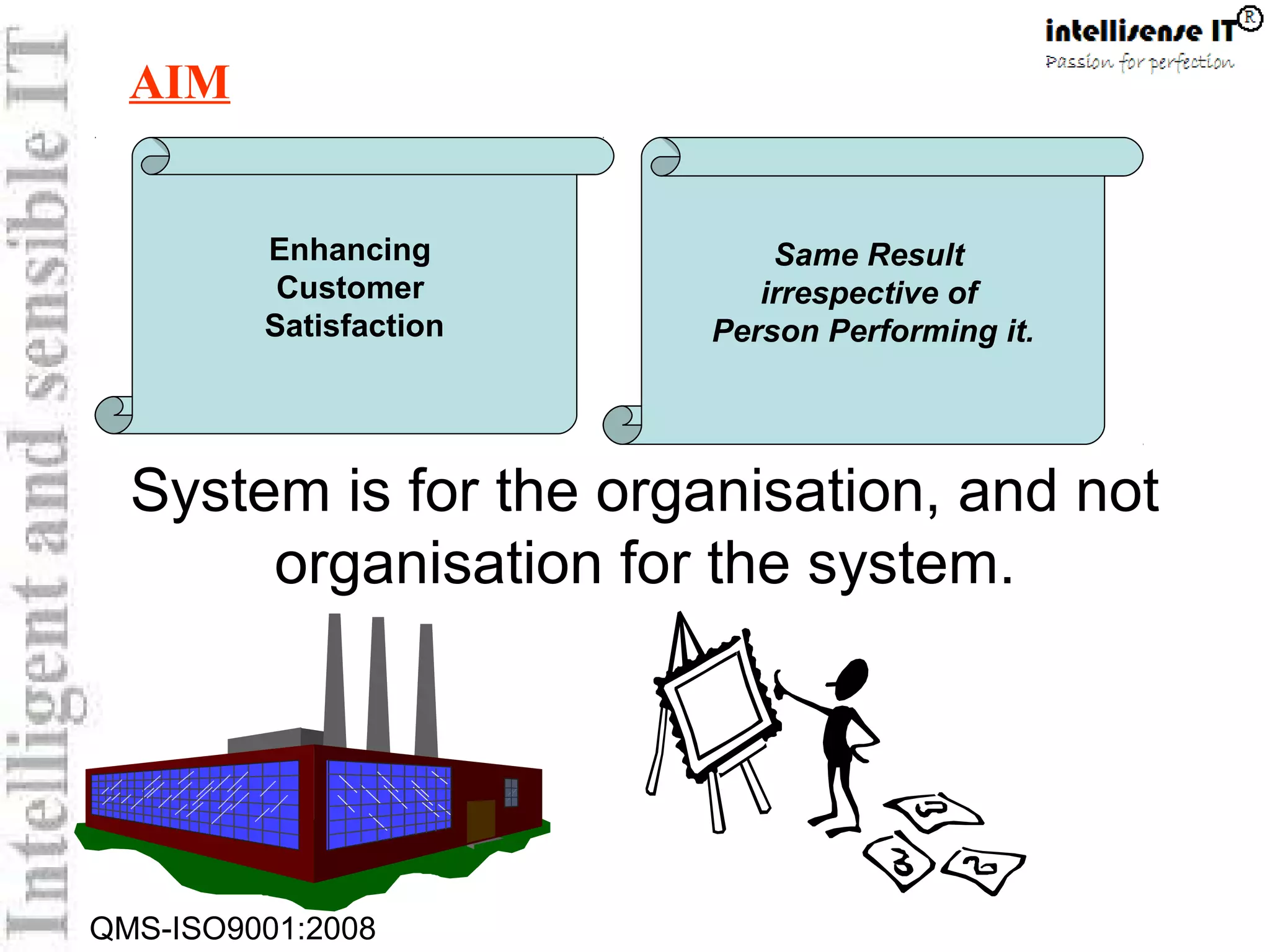
System is for the organisation, and not
organisation for the system.
AIM
Enhancing
Customer
Satisfaction
Same Result
irrespective of
Person Performing it.
QMS-ISO9001:2008
What is Quality?
“DEGREE TO WHICH A SET OF INHERENT
CHARACTERISTICS FULFILS REQUIREMENTS”
Quality of a product is denoted by its
• Market Acceptance
• Appearance
• Usage
• Consistency
• Lasting Value
QMS-ISO9001:2008
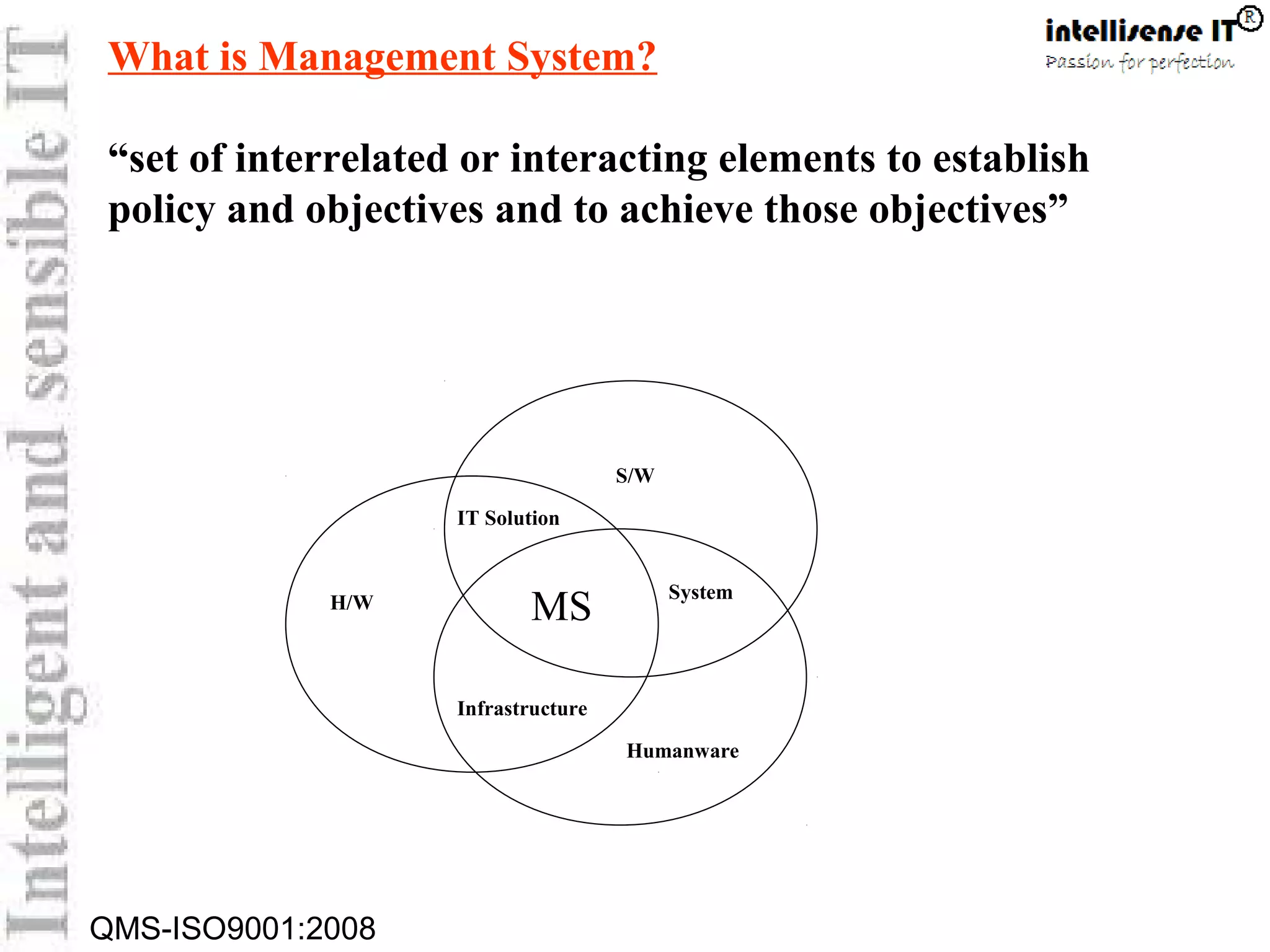
H/W
S/W
Humanware
MS
IT Solution
Infrastructure
System
What is Management System?
“set of interrelated or interacting elements to establish
policy and objectives and to achieve those objectives”
QMS-ISO9001:2008
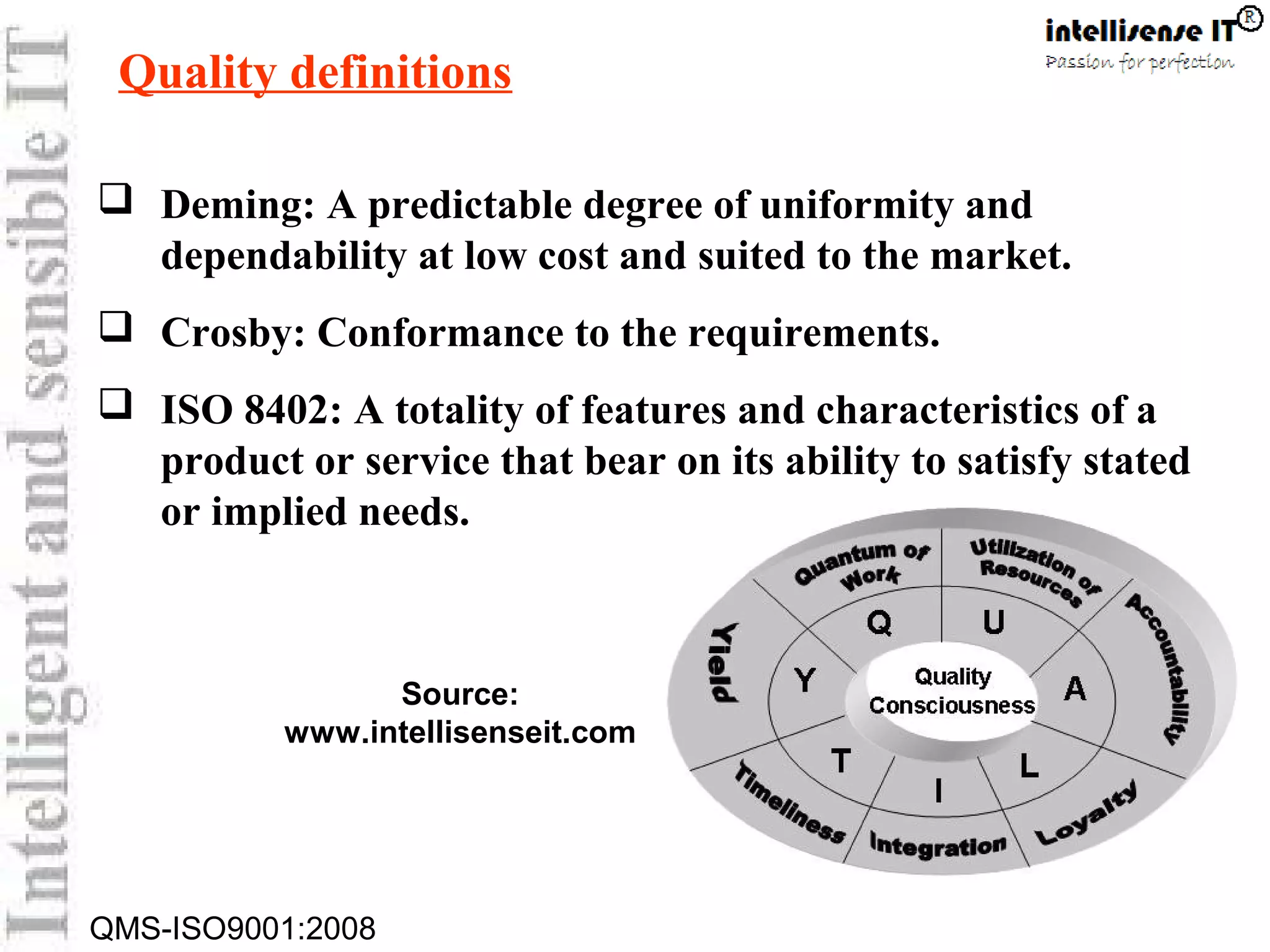
Quality definitions
 Deming: A predictable degree of uniformity and
dependability at low cost and suited to the market.
 Crosby: Conformance to the requirements.
 ISO 8402: A totality of features and characteristics of a
product or service that bear on its ability to satisfy stated
or implied needs.
Source:
www.intellisenseit.com
QMS-ISO9001:2008
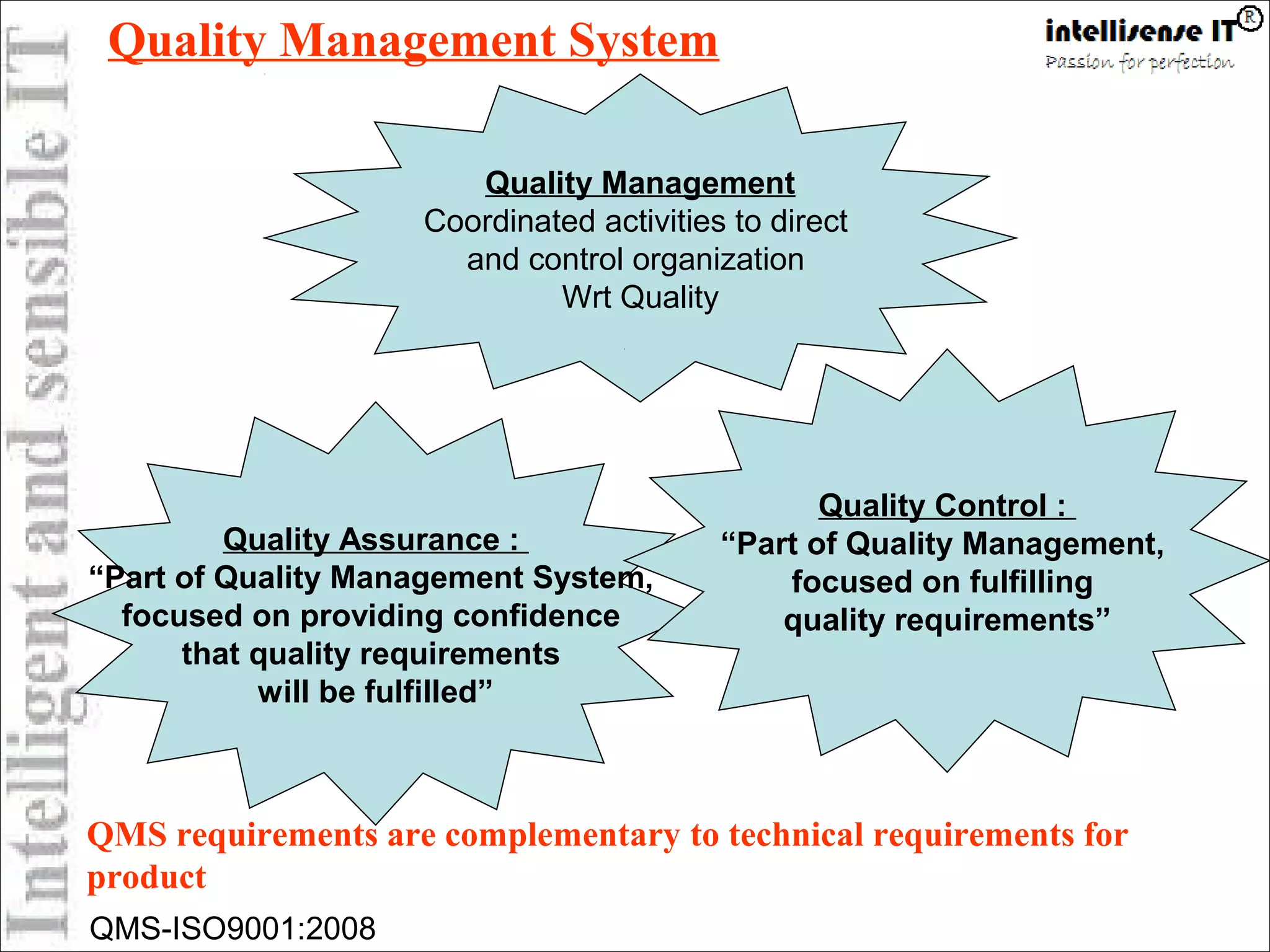
Quality Management System
Quality Assurance :
“Part of Quality Management System,
focused on providing confidence
that quality requirements
will be fulfilled”
Quality Management
Coordinated activities to direct
and control organization
Wrt Quality
Quality Control :
“Part of Quality Management,
focused on fulfilling
quality requirements”
QMS requirements are complementary to technical requirements for
product
QMS-ISO9001:2008
• System Approach
• Continual Improvement
• Factual Approach to Decision
Process
• Mutually beneficial Supplier
Relationship
• Process Approach
• Factual Approach
• Organization and Personal
Learning (Knowledge)
• Agility (To react Change)
• Creating Customer Value
• Focus on Social Value
• Visionary Leadership
• Understanding Core Competence
(profound knowledge of business)
• Involvement of People
• Collaboration with partners
• Total optimization of system
• Autonomy (Empowerment)
Quality Management Principles
QMS-ISO9001:2008
Introduction to ISO 9000
ISO : International Organization for Standardization
ISO 9000 : International Quality Management System Standard
: Applies to Quality Management System and
not to the Products
: They are generic and not specific to any Industry
• These are developed to effectively document the quality elements
to be implemented in order to maintain an efficient quality system in
company.
• Do not specify the technology to be used for implementing quality
system elements.
• They tell what you ought to consider doing when you manage your
organization, not how precisely you should do.
QMS-ISO9001:2008
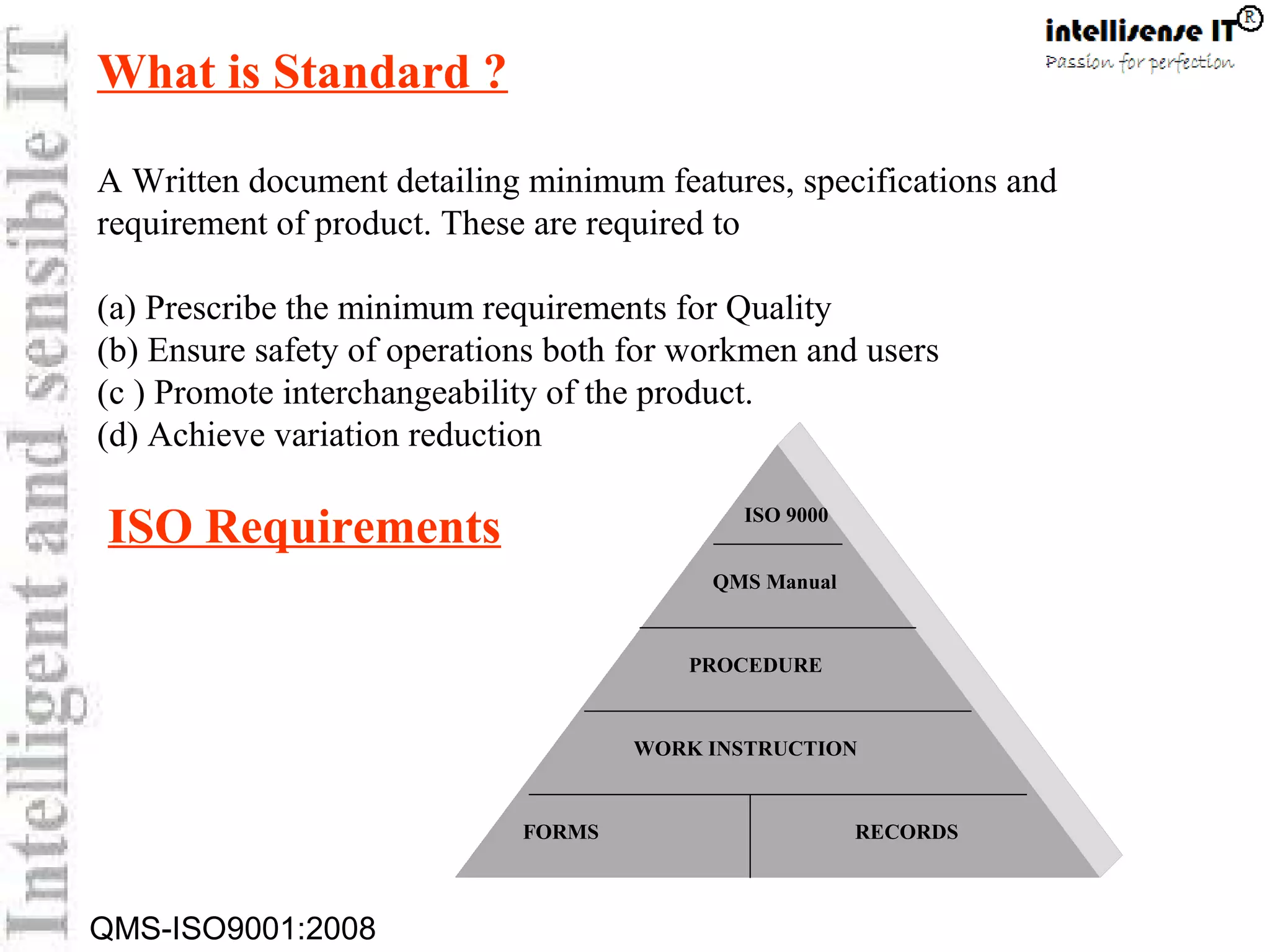
What is Standard ?
A Written document detailing minimum features, specifications and
requirement of product. These are required to
(a) Prescribe the minimum requirements for Quality
(b) Ensure safety of operations both for workmen and users
(c ) Promote interchangeability of the product.
(d) Achieve variation reduction
ISO 9000
QMS Manual
PROCEDURE
FORMS RECORDS
WORK INSTRUCTION
ISO Requirements
QMS-ISO9001:2008
C
U
S
T
O
M
E
R
C
U
S
T
O
M
E
R
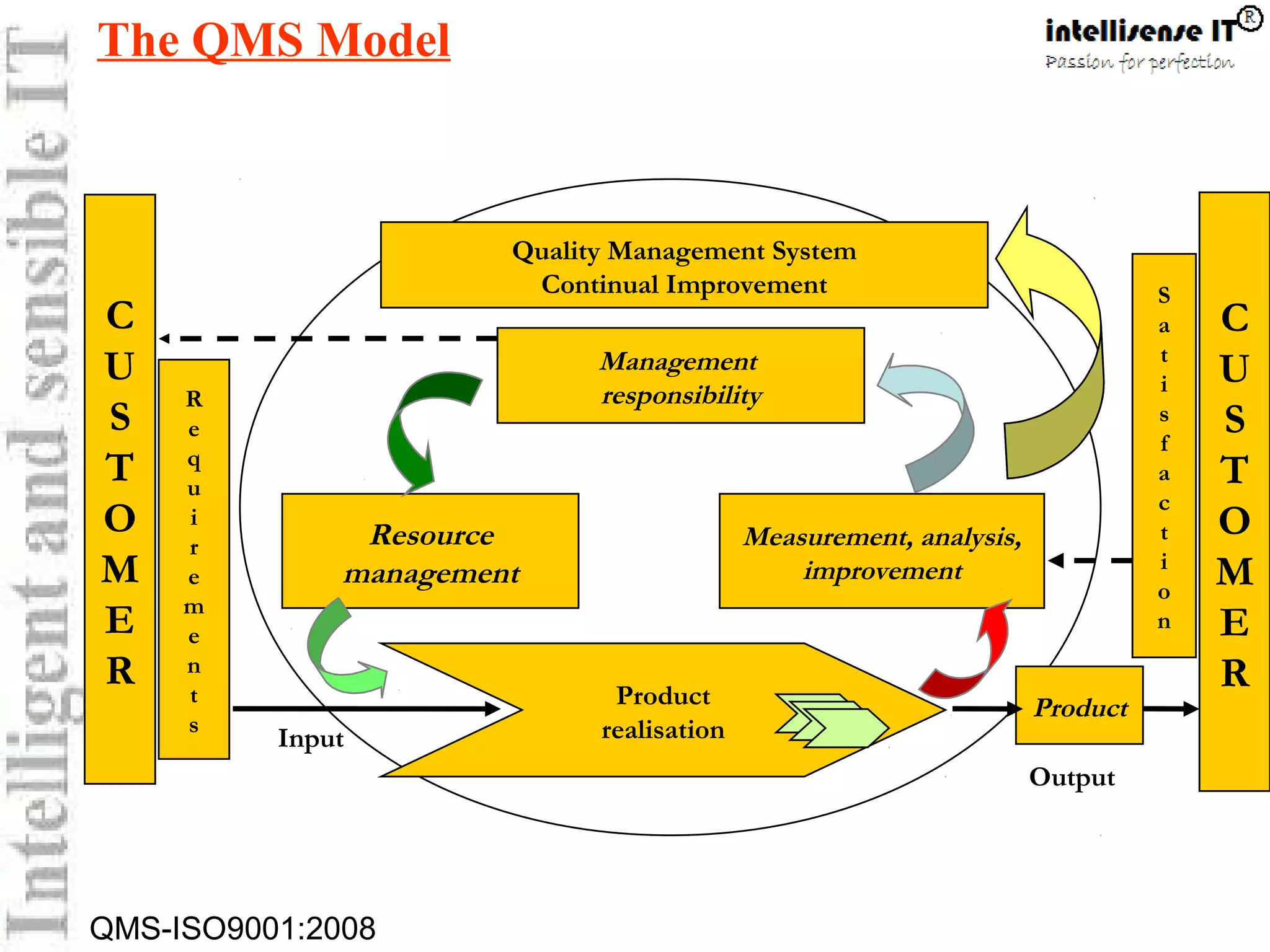
Management
responsibility
Resource
management
Measurement, analysis,
improvement
ProductProduct
realisation
Quality Management System
Continual Improvement
R
e
q
u
i
r
e
m
e
n
t
s
S
a
t
i
s
f
a
c
t
i
o
n
Input
Output
The QMS Model
QMS-ISO9001:2008
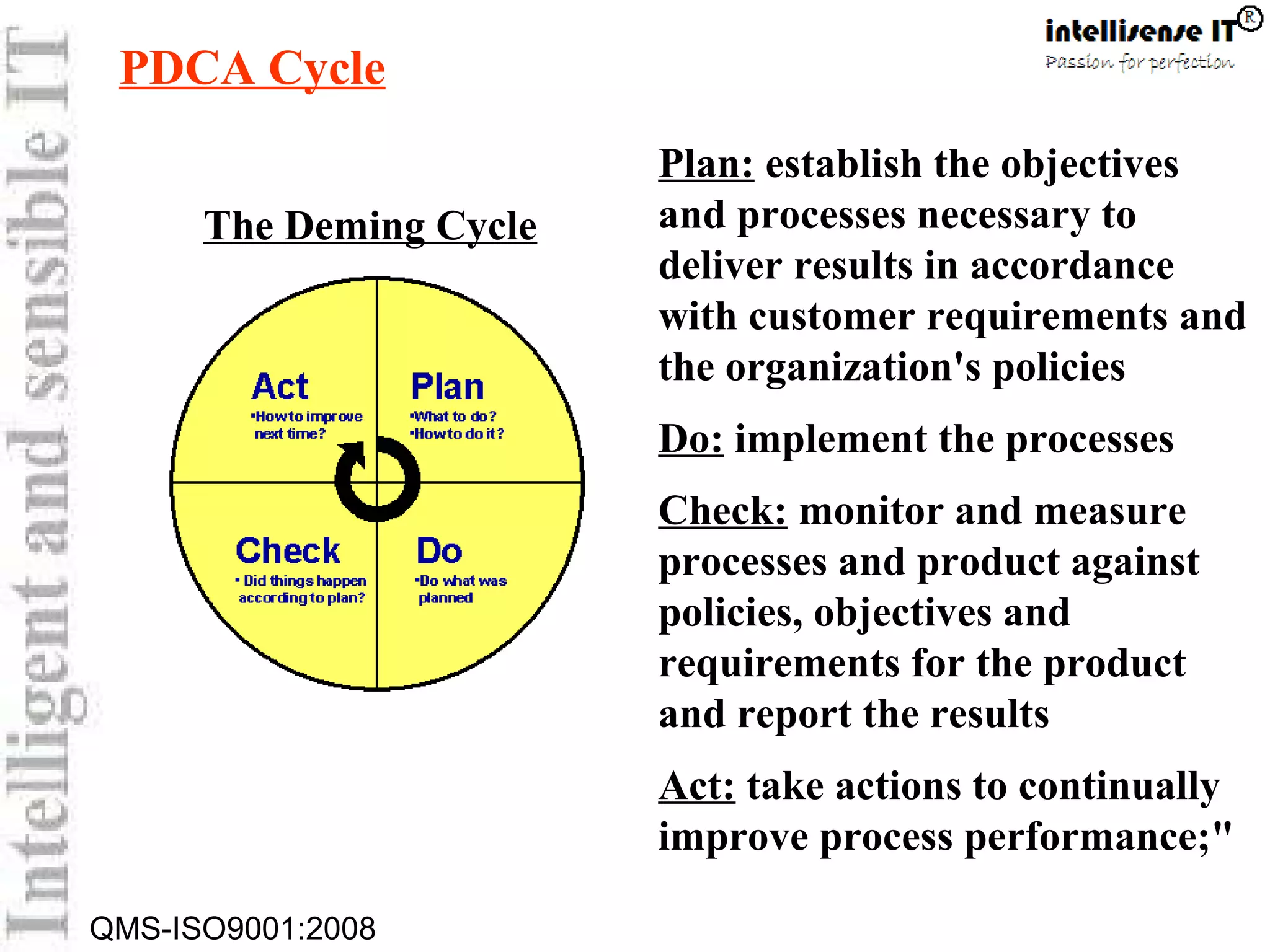
Plan: establish the objectives
and processes necessary to
deliver results in accordance
with customer requirements and
the organization's policies
Do: implement the processes
Check: monitor and measure
processes and product against
policies, objectives and
requirements for the product
and report the results
Act: take actions to continually
improve process performance;"
PDCA Cycle
The Deming Cycle
QMS-ISO9001:2008
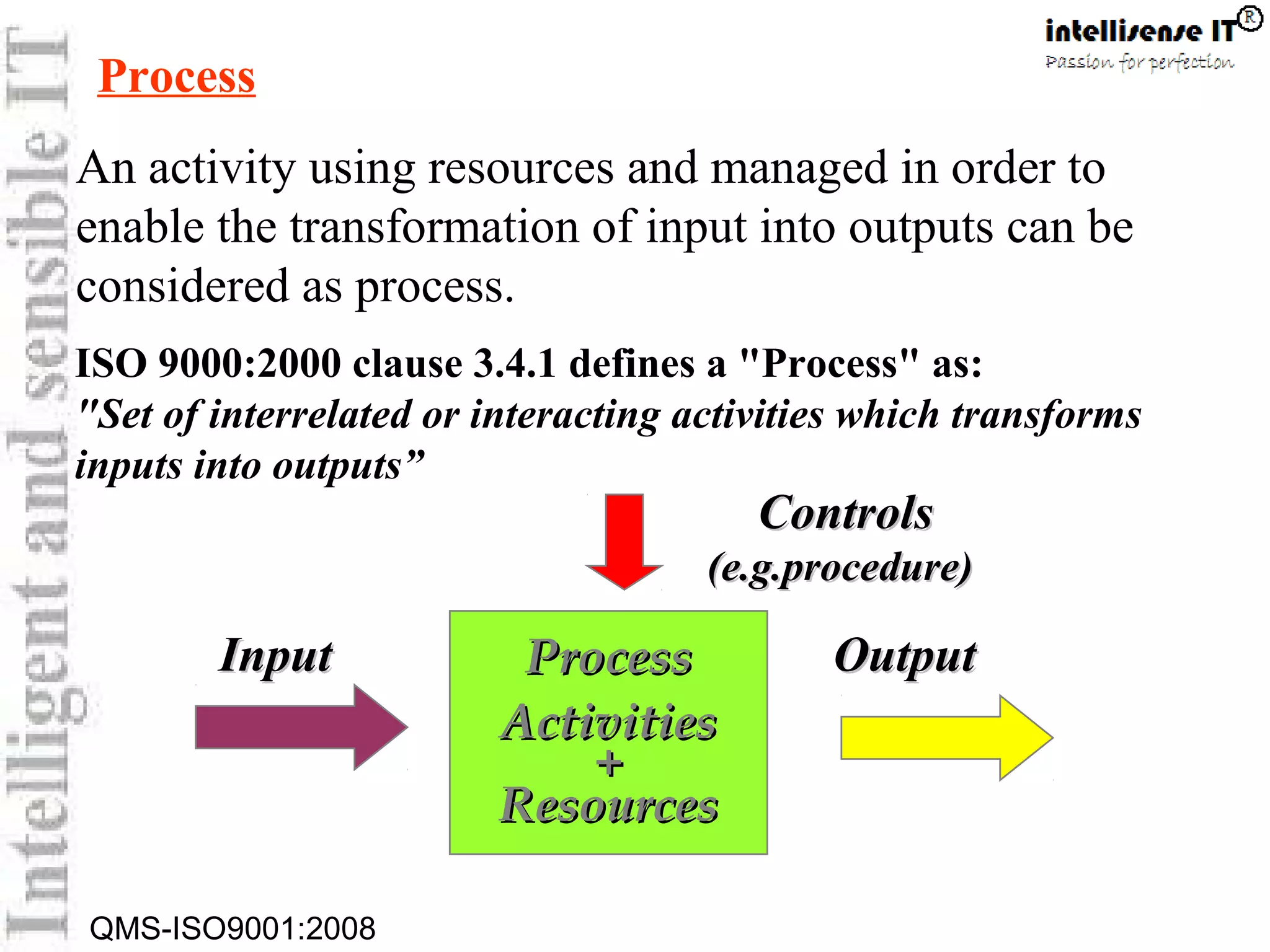
Process
ProcessProcess
ActivitiesActivities
++
ResourcesResources
InputInput OutputOutput
ControlsControls
(e.g.procedure)(e.g.procedure)
An activity using resources and managed in order to
enable the transformation of input into outputs can be
considered as process.
ISO 9000:2000 clause 3.4.1 defines a "Process" as:
"Set of interrelated or interacting activities which transforms
inputs into outputs”
QMS-ISO9001:2008
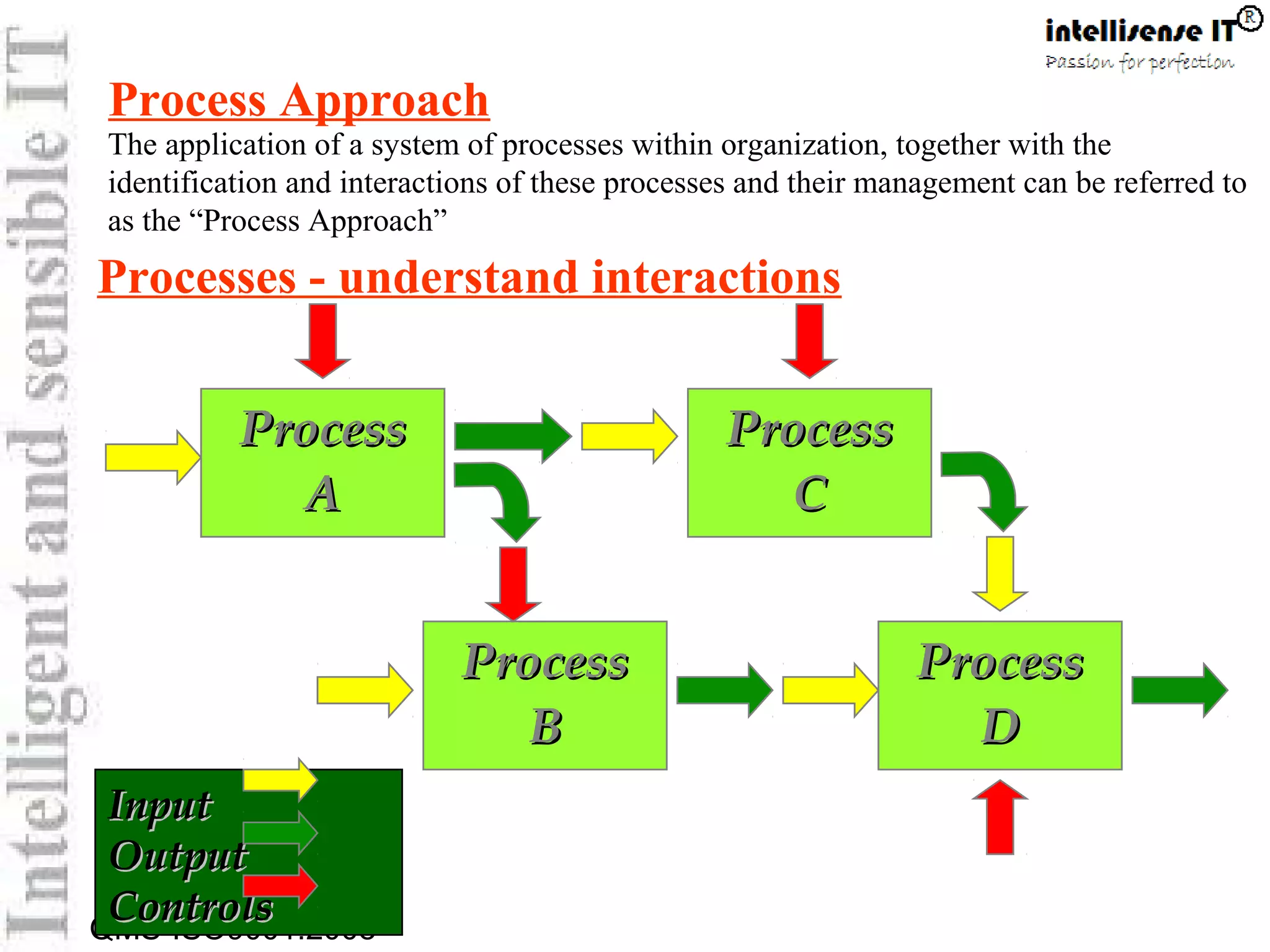
Process Approach
The application of a system of processes within organization, together with the
identification and interactions of these processes and their management can be referred to
as the “Process Approach”
Processes - understand interactions
ProcessProcess
AA
ProcessProcess
DD
ProcessProcess
BB
ProcessProcess
CC
InputInput
OutputOutput
ControlsControls
QMS-ISO9001:2008
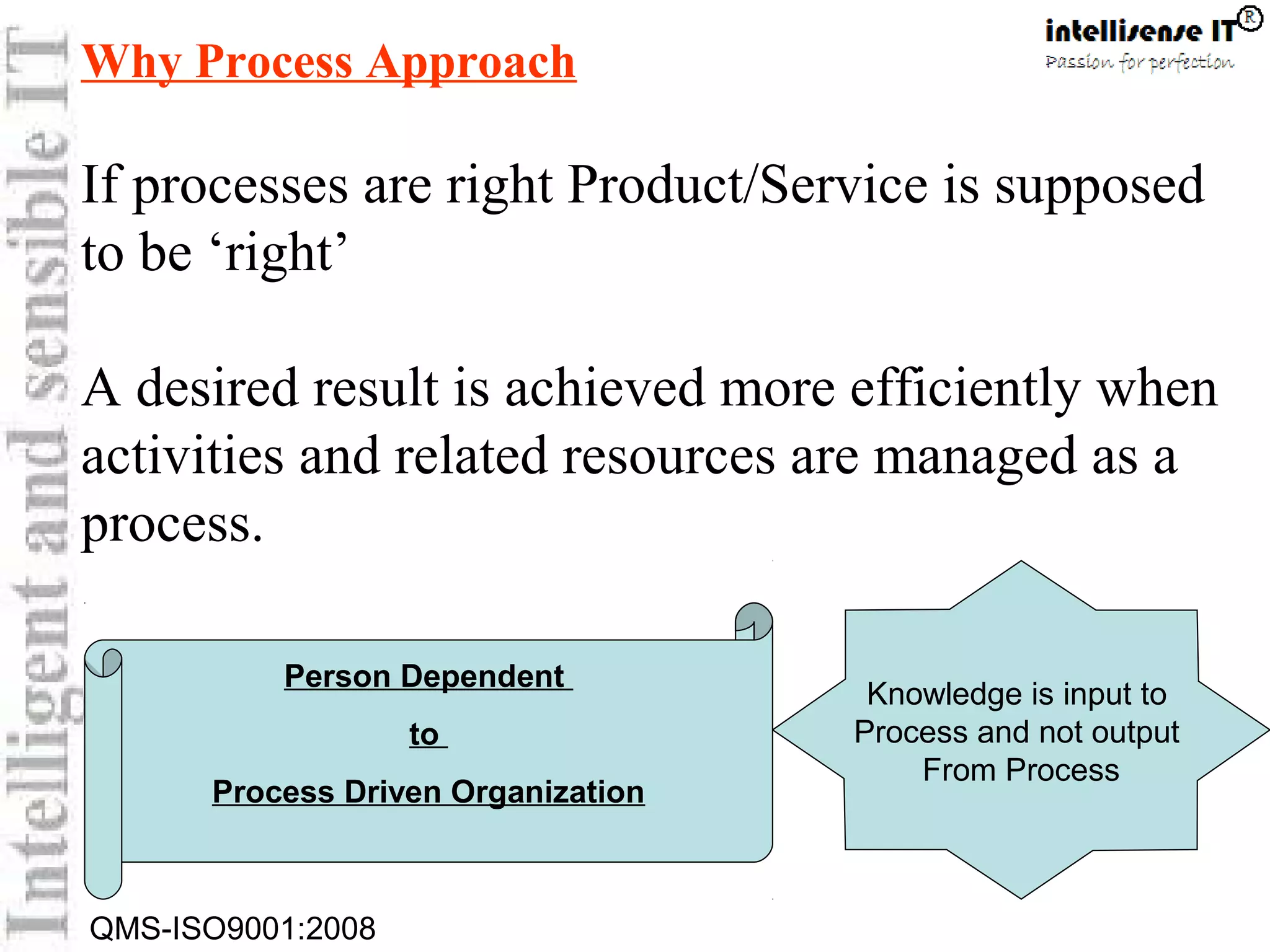
Why Process Approach
If processes are right Product/Service is supposed
to be ‘right’
A desired result is achieved more efficiently when
activities and related resources are managed as a
process.
Knowledge is input to
Process and not output
From Process
Person Dependent
to
Process Driven Organization
QMS-ISO9001:2008
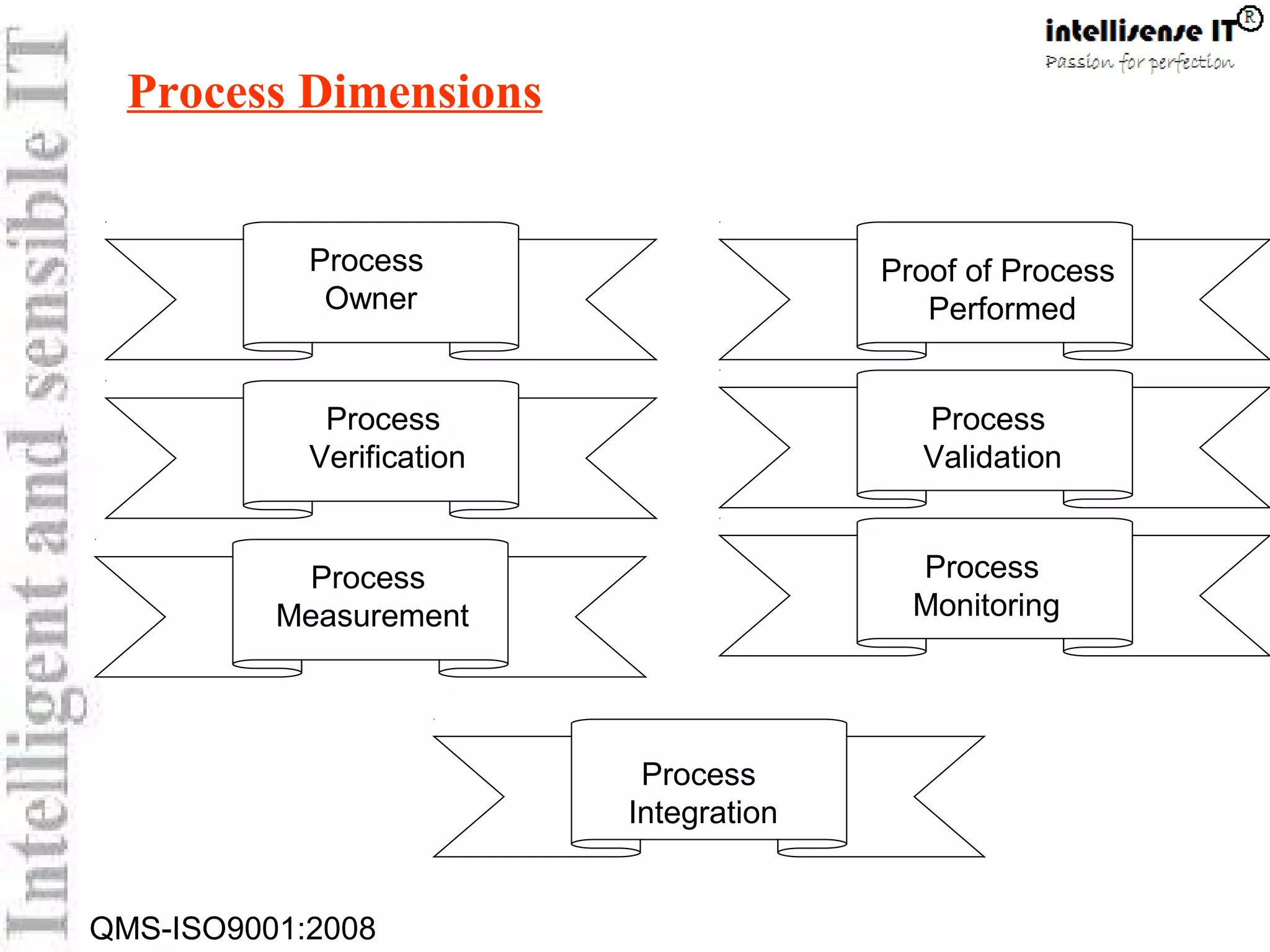
Process
Integration
Process Dimensions
Proof of Process
Performed
Process
Verification
Process
Validation
Process
Monitoring
Process
Owner
Process
Measurement
QMS-ISO9001:2008
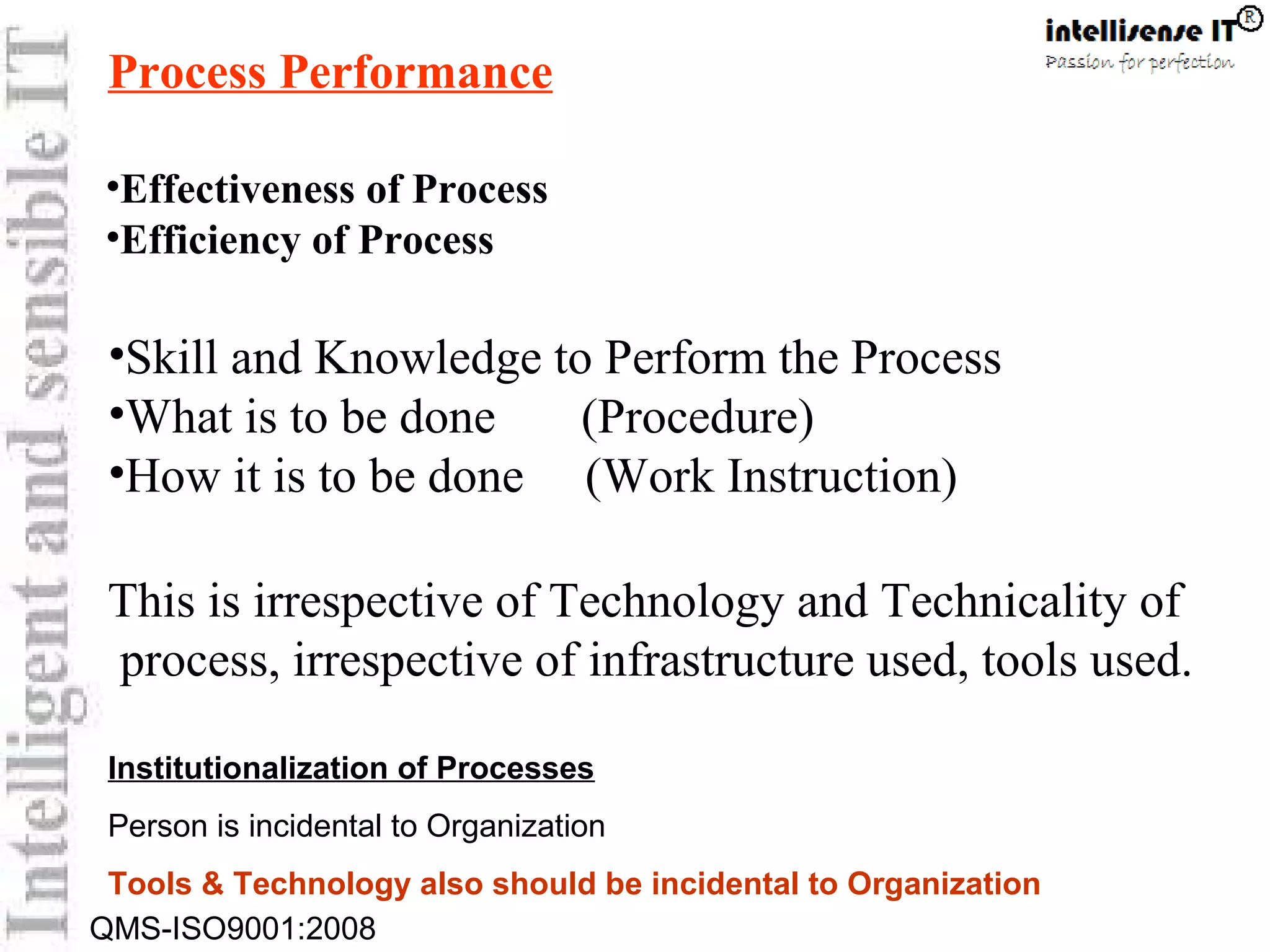
Process Performance
•Skill and Knowledge to Perform the Process
•What is to be done (Procedure)
•How it is to be done (Work Instruction)
This is irrespective of Technology and Technicality of
process, irrespective of infrastructure used, tools used.
•Effectiveness of Process
•Efficiency of Process
Institutionalization of Processes
Person is incidental to Organization
Tools & Technology also should be incidental to Organization
QMS-ISO9001:2008
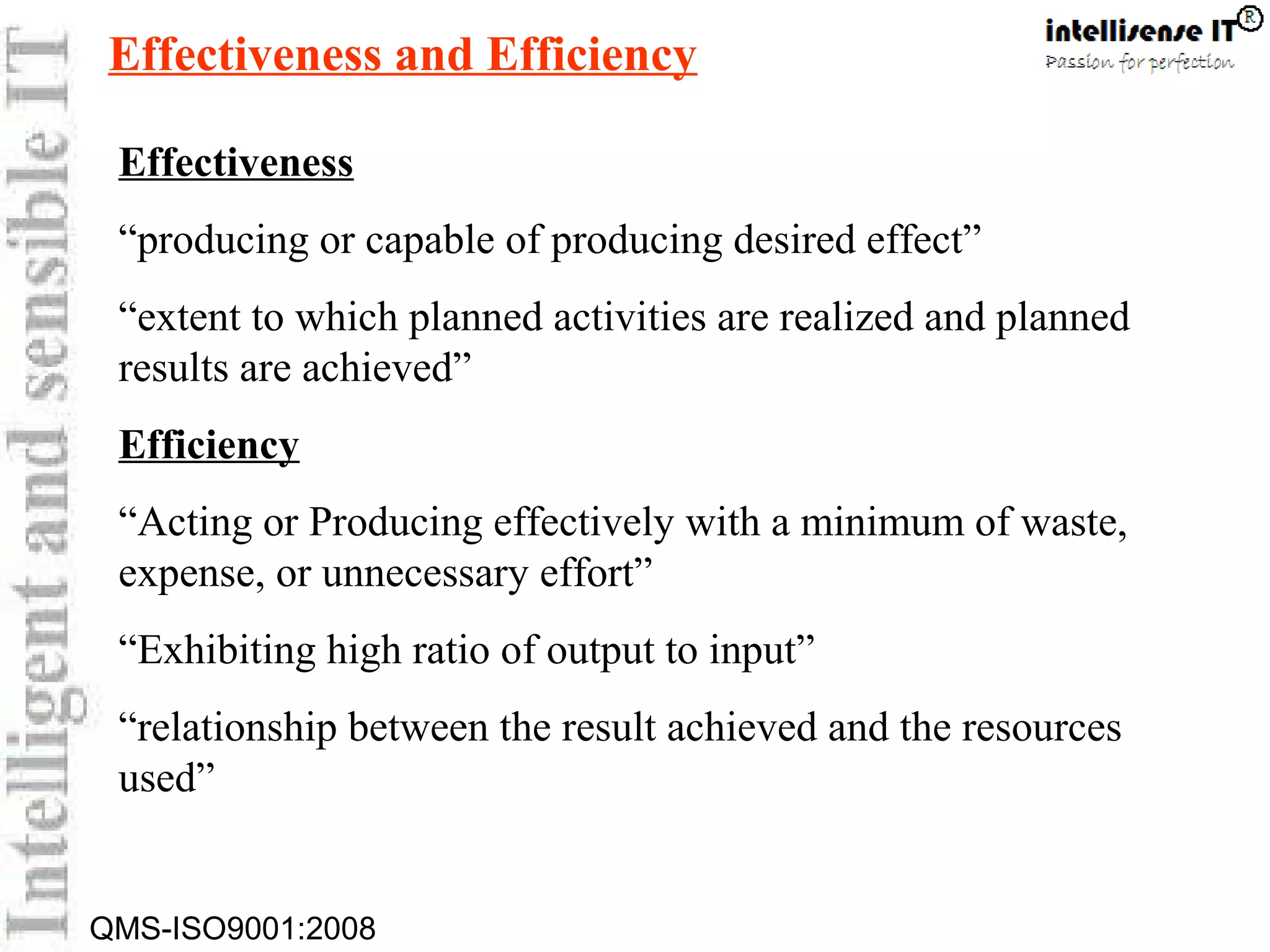
Effectiveness
“producing or capable of producing desired effect”
“extent to which planned activities are realized and planned
results are achieved”
Efficiency
“Acting or Producing effectively with a minimum of waste,
expense, or unnecessary effort”
“Exhibiting high ratio of output to input”
“relationship between the result achieved and the resources
used”
Effectiveness and Efficiency
QMS-ISO9001:2008
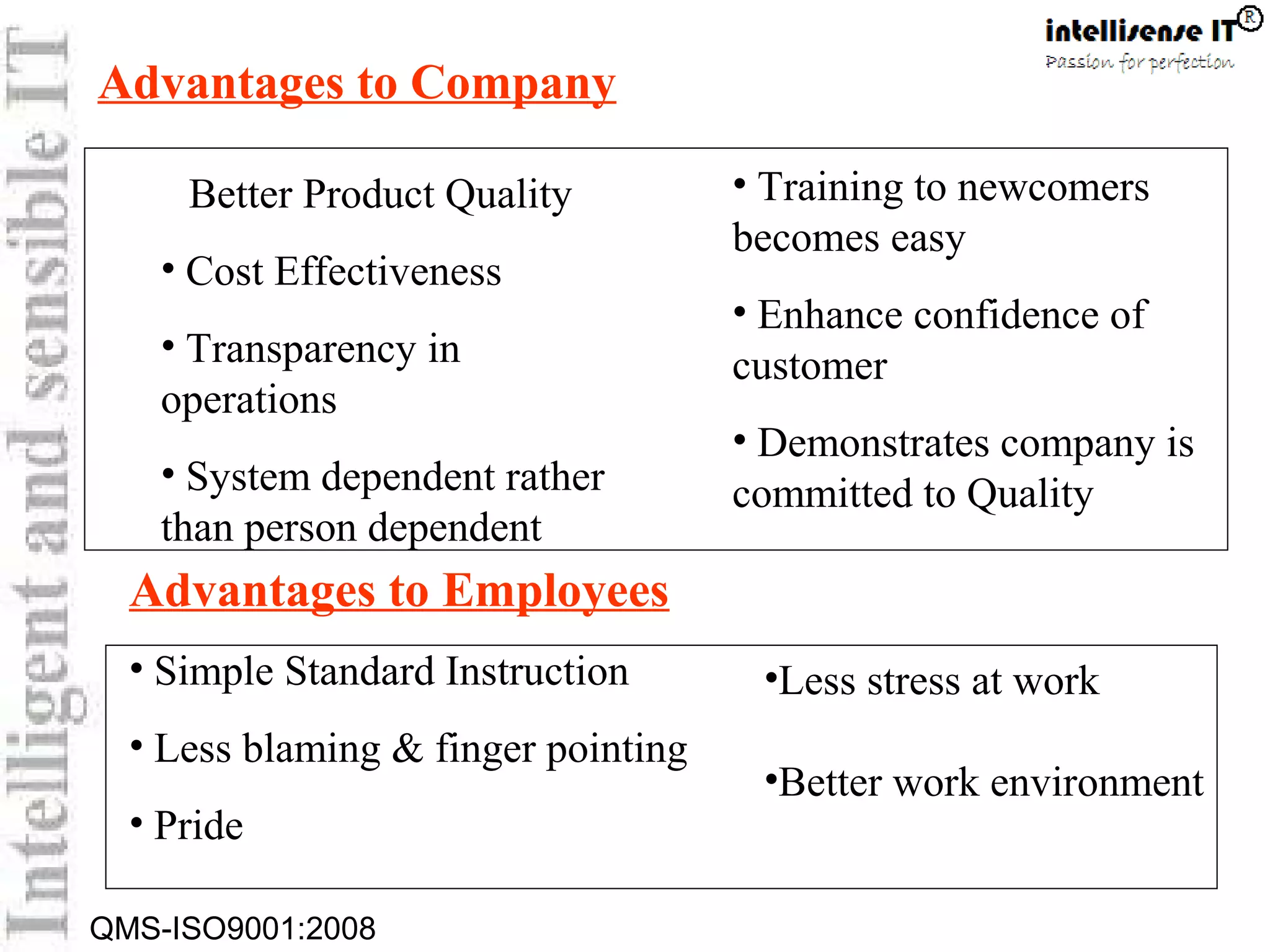
Better Product Quality
• Cost Effectiveness
• Transparency in
operations
• System dependent rather
than person dependent
Advantages to Employees
• Simple Standard Instruction
• Less blaming & finger pointing
• Pride
• Training to newcomers
becomes easy
• Enhance confidence of
customer
• Demonstrates company is
committed to Quality
•Less stress at work
•Better work environment
Advantages to Company
QMS-ISO9001:2008
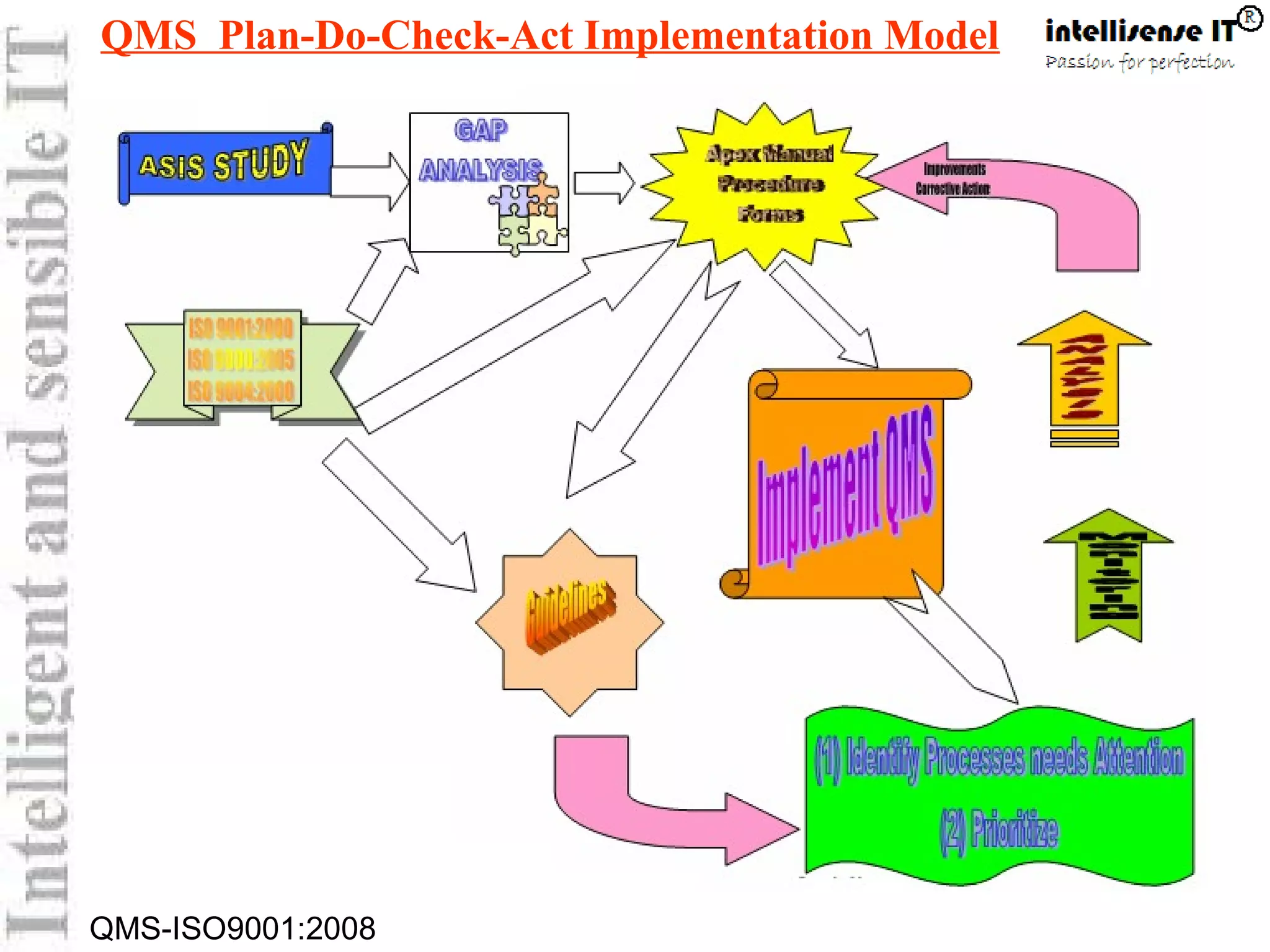
QMS Plan-Do-Check-Act Implementation Model
QMS-ISO9001:2008
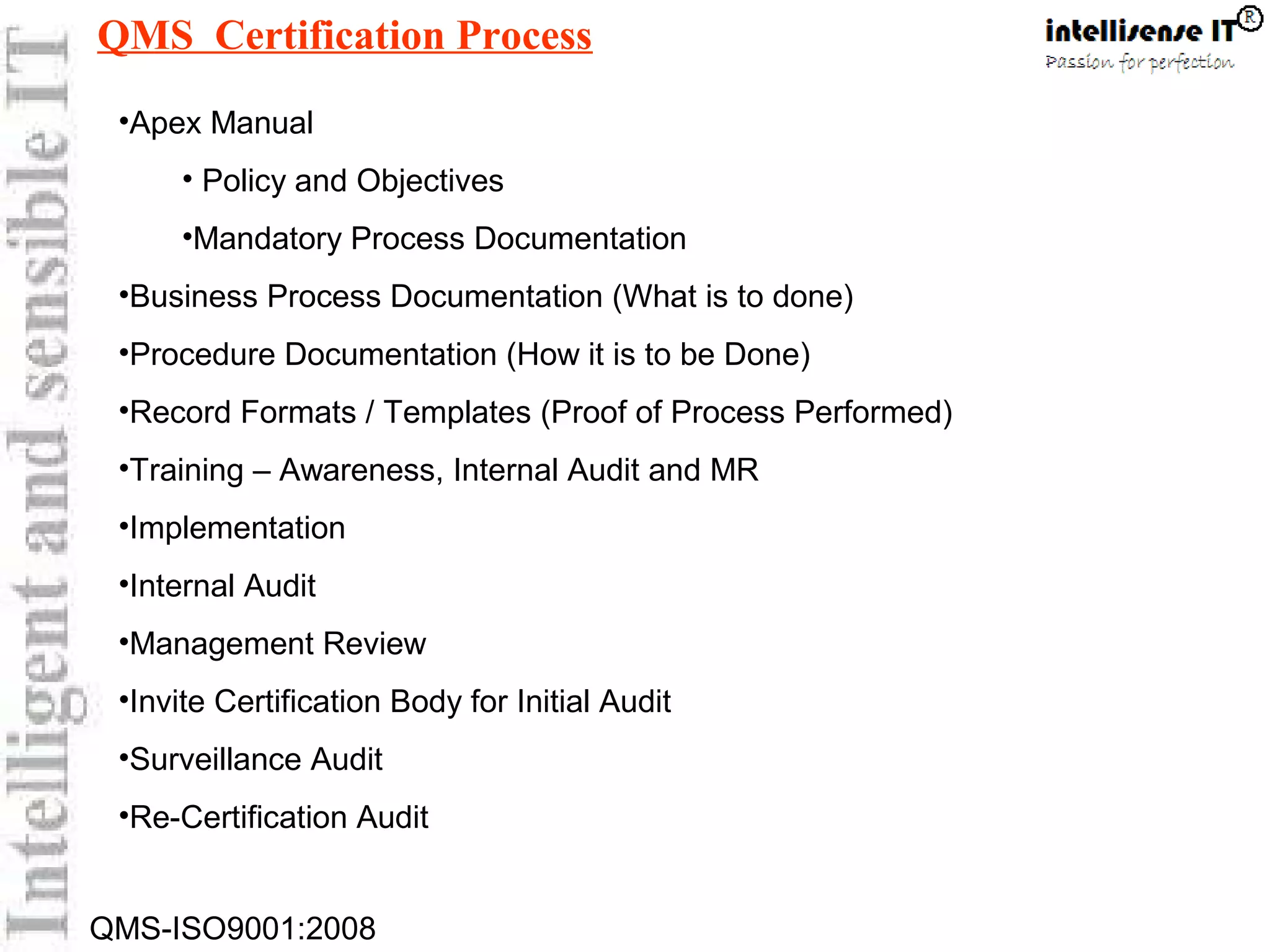
•Apex Manual
• Policy and Objectives
•Mandatory Process Documentation
•Business Process Documentation (What is to done)
•Procedure Documentation (How it is to be Done)
•Record Formats / Templates (Proof of Process Performed)
•Training – Awareness, Internal Audit and MR
•Implementation
•Internal Audit
•Management Review
•Invite Certification Body for Initial Audit
•Surveillance Audit
•Re-Certification Audit
QMS Certification Process
QMS-ISO9001:2008
SHANTIKRUPA
ESTATES PVT LTD
Icons Who Trusted us
Hashmukh
Shah
Group
Government Agencies
UGC-AICTE-INFLIBNET-AMC
Government Corporations
GSFC-GIIC-GAIC-GIDC
GHB
Gujarat
Housing
Board
QMS-ISO9001:2008
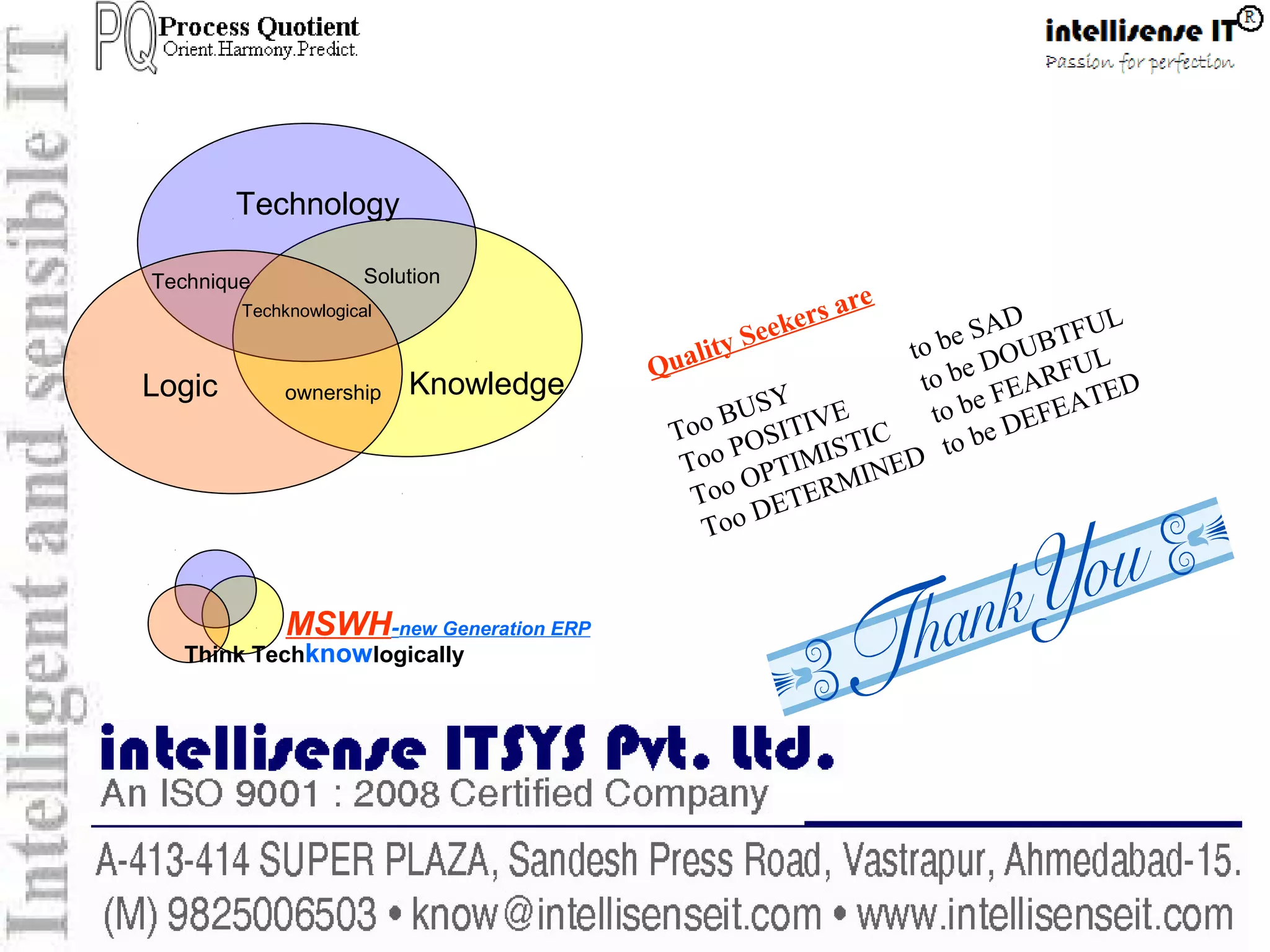
Think Techknowlogically
MSWH-new Generation ERP
Technology
KnowledgeLogic ownership
SolutionTechnique
Techknowlogical
Quality Seekers are
Too BUSY
to be SAD
Too POSITIVE
to be DOUBTFUL
Too OPTIMISTIC
to be FEARFUL
Too DETERMINED to be DEFEATED

Quality Management System

  • 1.
  • 2.
    QMS-ISO9001:2008 System is forthe organisation, and not organisation for the system. AIM Enhancing Customer Satisfaction Same Result irrespective of Person Performing it.
  • 3.
    QMS-ISO9001:2008 What is Quality? “DEGREETO WHICH A SET OF INHERENT CHARACTERISTICS FULFILS REQUIREMENTS” Quality of a product is denoted by its • Market Acceptance • Appearance • Usage • Consistency • Lasting Value
  • 4.
    QMS-ISO9001:2008 H/W S/W Humanware MS IT Solution Infrastructure System What isManagement System? “set of interrelated or interacting elements to establish policy and objectives and to achieve those objectives”
  • 5.
    QMS-ISO9001:2008 Quality definitions  Deming:A predictable degree of uniformity and dependability at low cost and suited to the market.  Crosby: Conformance to the requirements.  ISO 8402: A totality of features and characteristics of a product or service that bear on its ability to satisfy stated or implied needs. Source: www.intellisenseit.com
  • 6.
    QMS-ISO9001:2008 Quality Management System QualityAssurance : “Part of Quality Management System, focused on providing confidence that quality requirements will be fulfilled” Quality Management Coordinated activities to direct and control organization Wrt Quality Quality Control : “Part of Quality Management, focused on fulfilling quality requirements” QMS requirements are complementary to technical requirements for product
  • 7.
    QMS-ISO9001:2008 • System Approach •Continual Improvement • Factual Approach to Decision Process • Mutually beneficial Supplier Relationship • Process Approach • Factual Approach • Organization and Personal Learning (Knowledge) • Agility (To react Change) • Creating Customer Value • Focus on Social Value • Visionary Leadership • Understanding Core Competence (profound knowledge of business) • Involvement of People • Collaboration with partners • Total optimization of system • Autonomy (Empowerment) Quality Management Principles
  • 8.
    QMS-ISO9001:2008 Introduction to ISO9000 ISO : International Organization for Standardization ISO 9000 : International Quality Management System Standard : Applies to Quality Management System and not to the Products : They are generic and not specific to any Industry • These are developed to effectively document the quality elements to be implemented in order to maintain an efficient quality system in company. • Do not specify the technology to be used for implementing quality system elements. • They tell what you ought to consider doing when you manage your organization, not how precisely you should do.
  • 9.
    QMS-ISO9001:2008 What is Standard? A Written document detailing minimum features, specifications and requirement of product. These are required to (a) Prescribe the minimum requirements for Quality (b) Ensure safety of operations both for workmen and users (c ) Promote interchangeability of the product. (d) Achieve variation reduction ISO 9000 QMS Manual PROCEDURE FORMS RECORDS WORK INSTRUCTION ISO Requirements
  • 10.
  • 11.
    QMS-ISO9001:2008 Plan: establish theobjectives and processes necessary to deliver results in accordance with customer requirements and the organization's policies Do: implement the processes Check: monitor and measure processes and product against policies, objectives and requirements for the product and report the results Act: take actions to continually improve process performance;" PDCA Cycle The Deming Cycle
  • 12.
    QMS-ISO9001:2008 Process ProcessProcess ActivitiesActivities ++ ResourcesResources InputInput OutputOutput ControlsControls (e.g.procedure)(e.g.procedure) An activityusing resources and managed in order to enable the transformation of input into outputs can be considered as process. ISO 9000:2000 clause 3.4.1 defines a "Process" as: "Set of interrelated or interacting activities which transforms inputs into outputs”
  • 13.
    QMS-ISO9001:2008 Process Approach The applicationof a system of processes within organization, together with the identification and interactions of these processes and their management can be referred to as the “Process Approach” Processes - understand interactions ProcessProcess AA ProcessProcess DD ProcessProcess BB ProcessProcess CC InputInput OutputOutput ControlsControls
  • 14.
    QMS-ISO9001:2008 Why Process Approach Ifprocesses are right Product/Service is supposed to be ‘right’ A desired result is achieved more efficiently when activities and related resources are managed as a process. Knowledge is input to Process and not output From Process Person Dependent to Process Driven Organization
  • 15.
    QMS-ISO9001:2008 Process Integration Process Dimensions Proof ofProcess Performed Process Verification Process Validation Process Monitoring Process Owner Process Measurement
  • 16.
    QMS-ISO9001:2008 Process Performance •Skill andKnowledge to Perform the Process •What is to be done (Procedure) •How it is to be done (Work Instruction) This is irrespective of Technology and Technicality of process, irrespective of infrastructure used, tools used. •Effectiveness of Process •Efficiency of Process Institutionalization of Processes Person is incidental to Organization Tools & Technology also should be incidental to Organization
  • 17.
    QMS-ISO9001:2008 Effectiveness “producing or capableof producing desired effect” “extent to which planned activities are realized and planned results are achieved” Efficiency “Acting or Producing effectively with a minimum of waste, expense, or unnecessary effort” “Exhibiting high ratio of output to input” “relationship between the result achieved and the resources used” Effectiveness and Efficiency
  • 18.
    QMS-ISO9001:2008 Better Product Quality •Cost Effectiveness • Transparency in operations • System dependent rather than person dependent Advantages to Employees • Simple Standard Instruction • Less blaming & finger pointing • Pride • Training to newcomers becomes easy • Enhance confidence of customer • Demonstrates company is committed to Quality •Less stress at work •Better work environment Advantages to Company
  • 19.
  • 20.
    QMS-ISO9001:2008 •Apex Manual • Policyand Objectives •Mandatory Process Documentation •Business Process Documentation (What is to done) •Procedure Documentation (How it is to be Done) •Record Formats / Templates (Proof of Process Performed) •Training – Awareness, Internal Audit and MR •Implementation •Internal Audit •Management Review •Invite Certification Body for Initial Audit •Surveillance Audit •Re-Certification Audit QMS Certification Process
  • 21.
    QMS-ISO9001:2008 SHANTIKRUPA ESTATES PVT LTD IconsWho Trusted us Hashmukh Shah Group Government Agencies UGC-AICTE-INFLIBNET-AMC Government Corporations GSFC-GIIC-GAIC-GIDC GHB Gujarat Housing Board
  • 22.
    QMS-ISO9001:2008 Think Techknowlogically MSWH-new GenerationERP Technology KnowledgeLogic ownership SolutionTechnique Techknowlogical Quality Seekers are Too BUSY to be SAD Too POSITIVE to be DOUBTFUL Too OPTIMISTIC to be FEARFUL Too DETERMINED to be DEFEATED