Quality Standards-ISO 9001
By
Sunilkumarsingh Kumpawat
Master of Library and Information Science Sem-1
Dept. of Library and Information Science
Maharaja Sayajirao University of Baroda
Table of content
Introduction
Definitions
Uses & importance of quality standards
International Standards for Organisations (I.S.O.)
ISO-9001
History of ISO-9001
What does ISO-9001 do? & importance of ISO-9001
PDCA cycle
Seven Principles of QMS 2015:9001
Features & Benefits
Advantages
conclusion
Introduction
• A product is said to be of quality if it is free from any manufacturing defect
deficiency or significant variation in order to do so certain specific standards need
to be set so that uniformity is achieved in the entire set of products being
manufactured.
• A quality standard is a detail of the requirements, specifications, the various
guidelines and characteristics to be able to meet its quality by the product in order
to meet the purpose of the product, process or the service.
• ISO international standards are the most widely accepted set of quality standards
adopted by majority of firms across countries. In case if a company fails to meet
its quality standard, it may end up losing the trust of the customer and henceforth
its market share.
Definition
• Quality: it is the ability of a product or service to consistently meet or exceed the
customer expectation
• Standard: Something set up and established by authority as a rule for the
measure of quantity, weight, extent, value, or quality.
• Quality Standard: Quality standards are defined as documents that provide
requirements, specifications, guidelines, or characteristics that can be used
consistently to ensure that materials, products, processes, and services are fit for
their purpose.
Uses & importance of quality standards
• Satisfying their customers’ quality
requirements
• Ensuring their products and services
are safe
• Complying with regulations
• Meeting environmental objectives
• Protecting products against climatic or
other adverse conditions
• Ensuring that internal processes are
defined and controlled.
Quality isn’t just about profits and loss
or beating out a competitor.
 To ensuring safety and reliability of
products and services
 To meet the environmental objectives
 To reduce losses or costs of the
organization
 To improve competitiveness
 To gain market access across the
world
 To increase consumer loyalty
International Standards for Organization (I.S.O)
• Founded on 23 Feb, 1947. ISO is an independent, non-governmental
international organization with a membership of 162(as on 2016) national
standards bodies. It promotes worldwide proprietary, industrial and
commercial standard.
• Through its members, it brings together experts to share knowledge and
develop voluntary, consensus-based, market-relevant International Standards
that support innovation and provide solutions to global challenges.
• ISO has published more than 21000(as on 2016) International Standards and
related documents covering almost every industry, from technology to food
safety, to agriculture and healthcare.
ISO-9001
• ISO 9001 is an international standard that sets out requirements for companies to include
in a 'quality management system’.
• ISO 9001 focuses the organization to act on processes that affect the quality of products
and services they provide to ensure they are consistent and meet applicable
requirements.
• According to iso.org, “ISO 9001 is a standard that sets out the requirements for a quality
management system. It helps businesses and organizations to be more efficient and
improve customer satisfaction”.
• In the simplest of terms, QMS is a collection of business processes and functions aimed
at continuous improvement of quality to ensure customer expectations and requirements
are met or exceeded.
• Examples: Lean, Six Sigma, TQM.
• QMS are also methods by which companies can ensure responsibilities, schedules,
relationships, contracts, and agreements are on par with environmental, food, and
product safety standards
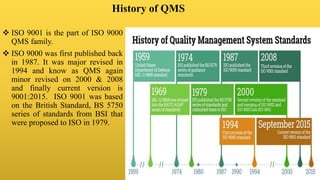
History of QMS
 ISO 9001 is the part of ISO 9000
QMS family.
 ISO 9000 was first published back
in 1987. It was major revised in
1994 and know as QMS again
minor revised on 2000 & 2008
and finally current version is
9001:2015. ISO 9001 was based
on the British Standard, BS 5750
series of standards from BSI that
were proposed to ISO in 1979.
What does ISO-9001 do? & importance of ISO-9001
• ISO 9001 provide with a framework to build
a quality management system that supports
your intention to continually improve.
• It follow PDCA principles
• It also let you to focuson the priority areas
first and foremost.
The ISO-9001 provides outlines the
importance of high-quality goods and services,
also when any person find an increased market
rate or high struggle in being differentiated,
the ISO is a key which help you to sustain and
nurture in the market.
The ISO-9001 certificate helps to improves
businesses credibility and authority as well as
overall efficiency of the business.
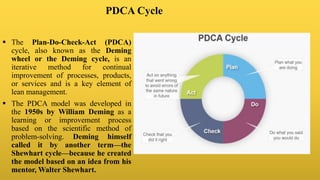
PDCA Cycle
 The Plan-Do-Check-Act (PDCA)
cycle, also known as the Deming
wheel or the Deming cycle, is an
iterative method for continual
improvement of processes, products,
or services and is a key element of
lean management.
 The PDCA model was developed in
the 1950s by William Deming as a
learning or improvement process
based on the scientific method of
problem-solving. Deming himself
called it by another term—the
Shewhart cycle—because he created
the model based on an idea from his
mentor, Walter Shewhart.
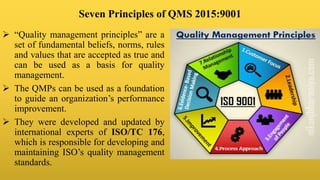
Seven Principles of QMS 2015:9001
 “Quality management principles” are a
set of fundamental beliefs, norms, rules
and values that are accepted as true and
can be used as a basis for quality
management.
 The QMPs can be used as a foundation
to guide an organization’s performance
improvement.
 They were developed and updated by
international experts of ISO/TC 176,
which is responsible for developing and
maintaining ISO’s quality management
standards.
Features & Benefits
• The requirements and belief of customers.
• The Quality policy & quality goal are very
clearly defined.
• Processes & responsibilities to obtain goal are
implemented and managed, within linkages or
“hand-offs” among processes.
• Strategy to consider processes and products
are defined and implemented.
• Strategy to consider processes and products
are defined and implemented.
• A process for regular increment is planned,
implemented and monitored to effectiveness.
• Management for verification of processes and
products is clearly defined and understood
within the business.
People in the organizations will benefit by
Better working condition
 Increased in job satisfaction
Owner and investors will be benefit by
Increased return on investment
Increased market share
 Increased profits
Suppliers and partners will benefit by
Stability
 Growth
Society will benefit by
Fulfilment of legal and regulatory requirements
Improved health and safety
Reduced environment impact
Increased security
Advantages
Identify risks and opportunities.
Prevent problems from reoccurring.
Boots your marketing and sales efforts.
Improve employee performance.
Improve your control over the business.
Conclusion
The quality Standards are the requirements or the guidelines in order
to meet the expectation of the clients.
ISO 9001 is a quality management standard used by all organizations
to meet the needs of the customers in order to meet the quality
standards of the product or service. ISO 9001 is also helpful for
supplier, society, and also to increase loyalty and brand name in the
market.
References
1) Team, M. S. (2020). Quality Standards Definition | Operations & Supply Chain Dictionary. MBA Skool-Study. Learn.Share.
https://www.mbaskool.com/business-concepts/operations-logistics-supply-chain-terms/8836-quality-standards.html, retrieved on 24th
Dec. 2020
2) What are Quality Standards? List of ISO Quality Management Standards | ASQ. (2020). Asq.Org. https://asq.org/quality-
resources/learn-about-standards#:%7E:text=Quality%20standards%20are%20defined%20as,are%20fit%20for%20their%20purpose.
Retrieved on 24th Dec. 2020
3) NI Business Info. (2020). What are quality management standards? | nibusinessinfo.co.uk.
https://www.nibusinessinfo.co.uk/content/what-are-quality-management-standards, retrieved on 24th Dec. 2020.
4) International Organization for Standardization. (2020, December 21). ISO. https://www.iso.org/home.html retrieved on 25th Dec. 2020
5) Nelson, R. (2018). What is ISO 9001 quality management. Spedan. https://spedan.co.uk/blog/iso-9001-quality/what-is-iso-9001-
quality-management. Retrieved on 25th Dec. 2020
6) International Organization for Standardization. (2020, December 21). ISO. https://www.iso.org/home.html retrieved on 25th Dec. 2020
7) Tramontana, D. (2020, September 28). The Beginner’s Guide to Quality Management Systems. QAD Blog.
https://www.qad.com/blog/2018/03/beginners-guide-to-quality-management-systems, retrieved on 25th Dec. 2020
Cont.
1) Fahmi, A. A.-R. (2000). Quality Management Systems (ISO 9001:2015). Journal of 9001, 1–66. https://doi.org/10.29011/978-1-951814-01-4-
002, retrieved from ResearchGate.net on 25th Dec. 2020.
2) ISO 9001:2015 revision – List of helpful materials. (2020). 9001Academy. https://advisera.com/9001academy/knowledgebase/iso-9001-2015-
revision/ photograph, retrieved on 25th Dec.2020
3) Lucidchart Content Team. (2020, April 24). How to Apply the Plan-Do-Check-Act (PDCA) Model. Lucidchart Blog.
https://www.lucidchart.com/blog/plan-do-check-act-cycle, retrieved on 26th Dec. 2020.
4) ISO. (2020). International Organization for Standardization- Quality Management Principle. ISO-
Https://Www.Iso.Org/Files/Live/Sites/Isoorg/Files/Store/En/PUB100080.Pdf. https://www.iso.org/home.html, retrieved on 26th Dec. 2020
5) Medium (2018, January 20). Features of Quality standard with ISO 9001 for company. Medium. https://medium.com/@ursindia2/features-of-
quality-standard-with-iso-9001-for-company-fc855574ddfd, retrieved on 26th Dec. 2020.
6) Hamid, G. A. (2015, August 8). ISO 9001. SlideShare.Net. https://www.slideshare.net/GamalAbdulHamid/iso-9001-51412745, retrieved on
26th Dec. 2020
7) ISO: Advantages of a quality management system. (2020, September 12). BDC.Ca. https://www.bdc.ca/en/articles-tools/operations/iso-other-
certifications/iso-advantages-quality-management, retrieved on 27th Dec. 2020
ISO- 9001

ISO- 9001

  • 1.
    Quality Standards-ISO 9001 By SunilkumarsinghKumpawat Master of Library and Information Science Sem-1 Dept. of Library and Information Science Maharaja Sayajirao University of Baroda
  • 2.
    Table of content Introduction Definitions Uses& importance of quality standards International Standards for Organisations (I.S.O.) ISO-9001 History of ISO-9001 What does ISO-9001 do? & importance of ISO-9001 PDCA cycle Seven Principles of QMS 2015:9001 Features & Benefits Advantages conclusion
  • 3.
    Introduction • A productis said to be of quality if it is free from any manufacturing defect deficiency or significant variation in order to do so certain specific standards need to be set so that uniformity is achieved in the entire set of products being manufactured. • A quality standard is a detail of the requirements, specifications, the various guidelines and characteristics to be able to meet its quality by the product in order to meet the purpose of the product, process or the service. • ISO international standards are the most widely accepted set of quality standards adopted by majority of firms across countries. In case if a company fails to meet its quality standard, it may end up losing the trust of the customer and henceforth its market share.
  • 4.
    Definition • Quality: itis the ability of a product or service to consistently meet or exceed the customer expectation • Standard: Something set up and established by authority as a rule for the measure of quantity, weight, extent, value, or quality. • Quality Standard: Quality standards are defined as documents that provide requirements, specifications, guidelines, or characteristics that can be used consistently to ensure that materials, products, processes, and services are fit for their purpose.
  • 5.
    Uses & importanceof quality standards • Satisfying their customers’ quality requirements • Ensuring their products and services are safe • Complying with regulations • Meeting environmental objectives • Protecting products against climatic or other adverse conditions • Ensuring that internal processes are defined and controlled. Quality isn’t just about profits and loss or beating out a competitor.  To ensuring safety and reliability of products and services  To meet the environmental objectives  To reduce losses or costs of the organization  To improve competitiveness  To gain market access across the world  To increase consumer loyalty
  • 6.
    International Standards forOrganization (I.S.O) • Founded on 23 Feb, 1947. ISO is an independent, non-governmental international organization with a membership of 162(as on 2016) national standards bodies. It promotes worldwide proprietary, industrial and commercial standard. • Through its members, it brings together experts to share knowledge and develop voluntary, consensus-based, market-relevant International Standards that support innovation and provide solutions to global challenges. • ISO has published more than 21000(as on 2016) International Standards and related documents covering almost every industry, from technology to food safety, to agriculture and healthcare.
  • 7.
    ISO-9001 • ISO 9001is an international standard that sets out requirements for companies to include in a 'quality management system’. • ISO 9001 focuses the organization to act on processes that affect the quality of products and services they provide to ensure they are consistent and meet applicable requirements. • According to iso.org, “ISO 9001 is a standard that sets out the requirements for a quality management system. It helps businesses and organizations to be more efficient and improve customer satisfaction”. • In the simplest of terms, QMS is a collection of business processes and functions aimed at continuous improvement of quality to ensure customer expectations and requirements are met or exceeded. • Examples: Lean, Six Sigma, TQM. • QMS are also methods by which companies can ensure responsibilities, schedules, relationships, contracts, and agreements are on par with environmental, food, and product safety standards
  • 8.
    History of QMS ISO 9001 is the part of ISO 9000 QMS family.  ISO 9000 was first published back in 1987. It was major revised in 1994 and know as QMS again minor revised on 2000 & 2008 and finally current version is 9001:2015. ISO 9001 was based on the British Standard, BS 5750 series of standards from BSI that were proposed to ISO in 1979.
  • 9.
    What does ISO-9001do? & importance of ISO-9001 • ISO 9001 provide with a framework to build a quality management system that supports your intention to continually improve. • It follow PDCA principles • It also let you to focuson the priority areas first and foremost. The ISO-9001 provides outlines the importance of high-quality goods and services, also when any person find an increased market rate or high struggle in being differentiated, the ISO is a key which help you to sustain and nurture in the market. The ISO-9001 certificate helps to improves businesses credibility and authority as well as overall efficiency of the business.
  • 10.
    PDCA Cycle  ThePlan-Do-Check-Act (PDCA) cycle, also known as the Deming wheel or the Deming cycle, is an iterative method for continual improvement of processes, products, or services and is a key element of lean management.  The PDCA model was developed in the 1950s by William Deming as a learning or improvement process based on the scientific method of problem-solving. Deming himself called it by another term—the Shewhart cycle—because he created the model based on an idea from his mentor, Walter Shewhart.
  • 11.
    Seven Principles ofQMS 2015:9001  “Quality management principles” are a set of fundamental beliefs, norms, rules and values that are accepted as true and can be used as a basis for quality management.  The QMPs can be used as a foundation to guide an organization’s performance improvement.  They were developed and updated by international experts of ISO/TC 176, which is responsible for developing and maintaining ISO’s quality management standards.
  • 12.
    Features & Benefits •The requirements and belief of customers. • The Quality policy & quality goal are very clearly defined. • Processes & responsibilities to obtain goal are implemented and managed, within linkages or “hand-offs” among processes. • Strategy to consider processes and products are defined and implemented. • Strategy to consider processes and products are defined and implemented. • A process for regular increment is planned, implemented and monitored to effectiveness. • Management for verification of processes and products is clearly defined and understood within the business. People in the organizations will benefit by Better working condition  Increased in job satisfaction Owner and investors will be benefit by Increased return on investment Increased market share  Increased profits Suppliers and partners will benefit by Stability  Growth Society will benefit by Fulfilment of legal and regulatory requirements Improved health and safety Reduced environment impact Increased security
  • 13.
    Advantages Identify risks andopportunities. Prevent problems from reoccurring. Boots your marketing and sales efforts. Improve employee performance. Improve your control over the business.
  • 14.
    Conclusion The quality Standardsare the requirements or the guidelines in order to meet the expectation of the clients. ISO 9001 is a quality management standard used by all organizations to meet the needs of the customers in order to meet the quality standards of the product or service. ISO 9001 is also helpful for supplier, society, and also to increase loyalty and brand name in the market.
  • 16.
    References 1) Team, M.S. (2020). Quality Standards Definition | Operations & Supply Chain Dictionary. MBA Skool-Study. Learn.Share. https://www.mbaskool.com/business-concepts/operations-logistics-supply-chain-terms/8836-quality-standards.html, retrieved on 24th Dec. 2020 2) What are Quality Standards? List of ISO Quality Management Standards | ASQ. (2020). Asq.Org. https://asq.org/quality- resources/learn-about-standards#:%7E:text=Quality%20standards%20are%20defined%20as,are%20fit%20for%20their%20purpose. Retrieved on 24th Dec. 2020 3) NI Business Info. (2020). What are quality management standards? | nibusinessinfo.co.uk. https://www.nibusinessinfo.co.uk/content/what-are-quality-management-standards, retrieved on 24th Dec. 2020. 4) International Organization for Standardization. (2020, December 21). ISO. https://www.iso.org/home.html retrieved on 25th Dec. 2020 5) Nelson, R. (2018). What is ISO 9001 quality management. Spedan. https://spedan.co.uk/blog/iso-9001-quality/what-is-iso-9001- quality-management. Retrieved on 25th Dec. 2020 6) International Organization for Standardization. (2020, December 21). ISO. https://www.iso.org/home.html retrieved on 25th Dec. 2020 7) Tramontana, D. (2020, September 28). The Beginner’s Guide to Quality Management Systems. QAD Blog. https://www.qad.com/blog/2018/03/beginners-guide-to-quality-management-systems, retrieved on 25th Dec. 2020
  • 17.
    Cont. 1) Fahmi, A.A.-R. (2000). Quality Management Systems (ISO 9001:2015). Journal of 9001, 1–66. https://doi.org/10.29011/978-1-951814-01-4- 002, retrieved from ResearchGate.net on 25th Dec. 2020. 2) ISO 9001:2015 revision – List of helpful materials. (2020). 9001Academy. https://advisera.com/9001academy/knowledgebase/iso-9001-2015- revision/ photograph, retrieved on 25th Dec.2020 3) Lucidchart Content Team. (2020, April 24). How to Apply the Plan-Do-Check-Act (PDCA) Model. Lucidchart Blog. https://www.lucidchart.com/blog/plan-do-check-act-cycle, retrieved on 26th Dec. 2020. 4) ISO. (2020). International Organization for Standardization- Quality Management Principle. ISO- Https://Www.Iso.Org/Files/Live/Sites/Isoorg/Files/Store/En/PUB100080.Pdf. https://www.iso.org/home.html, retrieved on 26th Dec. 2020 5) Medium (2018, January 20). Features of Quality standard with ISO 9001 for company. Medium. https://medium.com/@ursindia2/features-of- quality-standard-with-iso-9001-for-company-fc855574ddfd, retrieved on 26th Dec. 2020. 6) Hamid, G. A. (2015, August 8). ISO 9001. SlideShare.Net. https://www.slideshare.net/GamalAbdulHamid/iso-9001-51412745, retrieved on 26th Dec. 2020 7) ISO: Advantages of a quality management system. (2020, September 12). BDC.Ca. https://www.bdc.ca/en/articles-tools/operations/iso-other- certifications/iso-advantages-quality-management, retrieved on 27th Dec. 2020