 FST-607
 QUALITY MANAGEMENT
SYSTEM
Presentation
on
CONTENTS
Quality Assurance
Total Quality Management
GMP/GHP,GLP,GAP
Sanitary & Hygienic
Practices
1.
2.
3.
4.
WHAT IS QUALITY..?
 ISO 9000:2000 DEFINITION OF QUALITY-
 It is the degree to which a set of inherent characteristics
fulfills requirements.
 “Fitness for use”
 Quality is excellence that is better than a minimum
standard.
 “Conformance to requirements”
 The ability of your product or service to satisfy
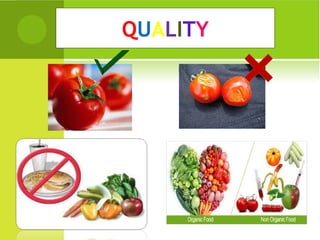
QUALITY
DEFINITION
“Planned and systematic activities implemented
within the quality system that can be
demonstrated to provide confidence that a
product or service will fulfill requirements for
quality”
 Quality Assurance is a system for evaluating
performance, service, of the quality of a product
against system, standard or specified
requirement for customers.
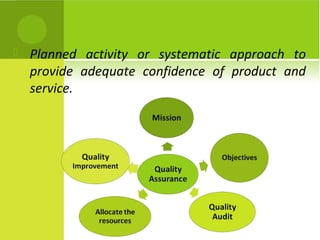
 Planned activity or systematic approach to
provide adequate confidence of product and
service.
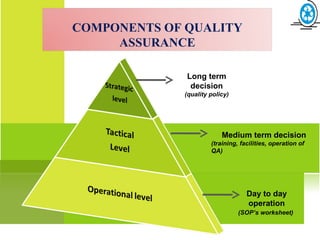
COMPONENTS OF QUALITY
ASSURANCE
Long term
decision
(quality policy)
Day to day
operation
(SOP’s worksheet)
Medium term decision
(training, facilities, operation of
QA)
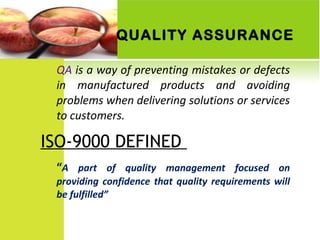
QA is a way of preventing mistakes or defects
in manufactured products and avoiding
problems when delivering solutions or services
to customers.
ISO-9000 DEFINED
“A part of quality management focused on
providing confidence that quality requirements will
be fulfilled”
QUALITY ASSURANCE
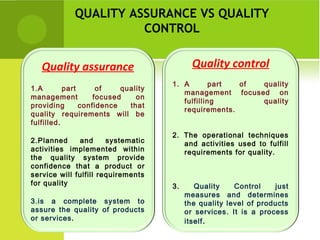
QUALITY ASSURANCE VS QUALITY
CONTROL
Quality assurance
1.A part of quality
management focused on
providing confidence that
quality requirements will be
fulfilled.
2.Planned and systematic
activities implemented within
the quality system provide
confidence that a product or
service will fulfill requirements
for quality
3.is a complete system to
assure the quality of products
or services.
Quality control
1. A part of quality
management focused on
fulfilling quality
requirements.
2. The operational techniques
and activities used to fulfill
requirements for quality.
3. Quality Control just
measures and determines
the quality level of products
or services. It is a process
itself.
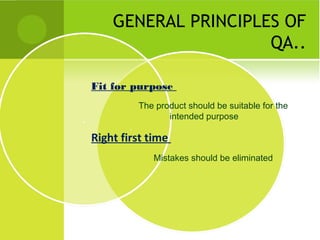
GENERAL PRINCIPLES OF
QA..
Fit for purpose
The product should be suitable for the
intended purpose
Right first time
Mistakes should be eliminated
FUNCTIONS OF QUALITY
ASSURANCE..
I. To maintain standards & specification for all raw
material & finished product.
II. To give service to company in all areas related to
product quality includes trouble shooting, visiting,
production, facilities, designing and training Quality
control panel.
III. To produce information that is accurate, reliable and
adequate for the intended purpose.
IV. Evaluating performance, service, of the quality of a
product against a system, standard or specified
requirement for customers
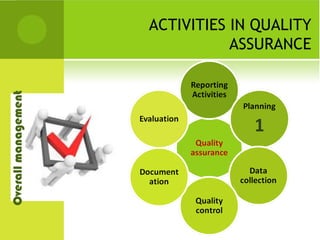
ACTIVITIES IN QUALITY
ASSURANCE
Overallmanagement
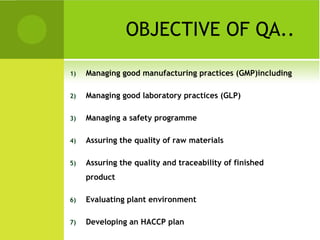
OBJECTIVE OF QA..
1) Managing good manufacturing practices (GMP)including
2) Managing good laboratory practices (GLP)
3) Managing a safety programme
4) Assuring the quality of raw materials
5) Assuring the quality and traceability of finished
product
6) Evaluating plant environment
7) Developing an HACCP plan
TOTAL QUALITY
MANAGEMENT
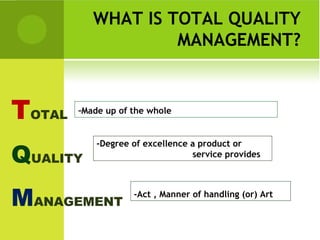
WHAT IS TOTAL QUALITY
MANAGEMENT?
TOTAL
QUALITY
MANAGEMENT
-Made up of the whole
-Act , Manner of handling (or) Art
-Degree of excellence a product or
service provides
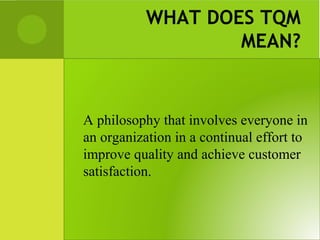
WHAT DOES TQM
MEAN?
A philosophy that involves everyone in
an organization in a continual effort to
improve quality and achieve customer
satisfaction.
WHAT’S THE GOAL OF
TQM?
“Do the right
things right
the first time,
every time.”
TOTAL QUALITY
MANAGEMENT..
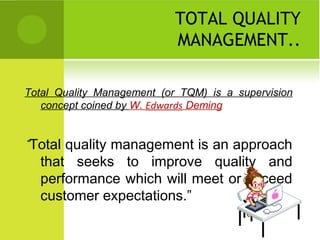
Total Quality Management (or TQM) is a supervision
concept coined by W. Edwards Deming
“Total quality management is an approach
that seeks to improve quality and
performance which will meet or exceed
customer expectations.”
TOTAL QUALITY
MANAGEMENT
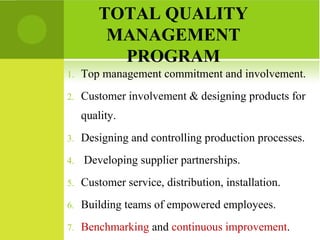
PROGRAM
1. Top management commitment and involvement.
2. Customer involvement & designing products for
quality.
3. Designing and controlling production processes.
4. Developing supplier partnerships.
5. Customer service, distribution, installation.
6. Building teams of empowered employees.
7. Benchmarking and continuous improvement.
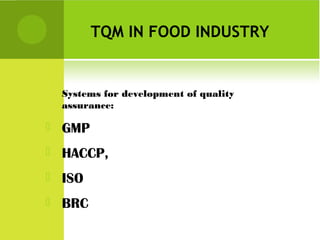
TQM IN FOOD INDUSTRY
Systems for development of quality
assurance:
 GMP
 HACCP,
 ISO
 BRC
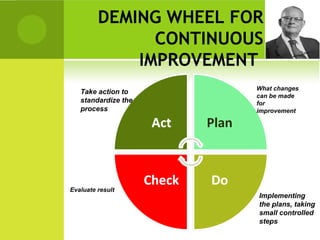
DEMING WHEEL FOR
CONTINUOUS
IMPROVEMENT
Evaluate result
Implementing
the plans, taking
small controlled
steps
Take action to
standardize the
process
What changes
can be made
for
improvement
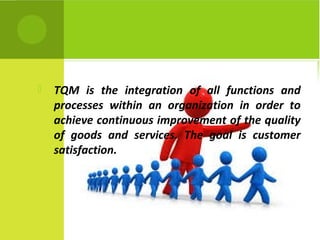
 TQM is the integration of all functions and
processes within an organization in order to
achieve continuous improvement of the quality
of goods and services. The goal is customer
satisfaction.
OBJECTIVES OF TQM..
 Process improvement
 Defect prevention
 Measuring system capacity
 Developing improvement checklist
 Helping teams make better decisions
 Developing operational definitions
 Observing behavior changes over a period of
time.
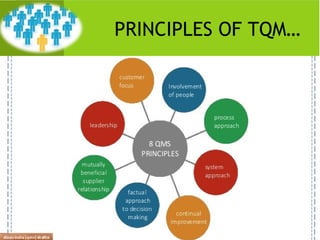
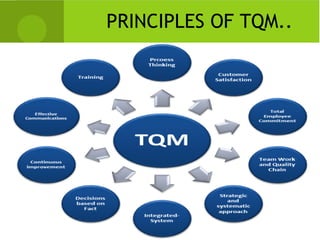
PRINCIPLES OF TQM…
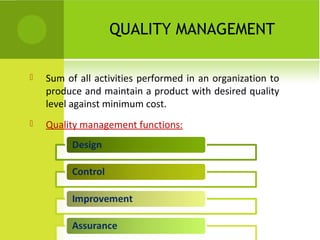
QUALITY MANAGEMENT
 Sum of all activities performed in an organization to
produce and maintain a product with desired quality
level against minimum cost.
 Quality management functions:
PRINCIPLES OF TQM..
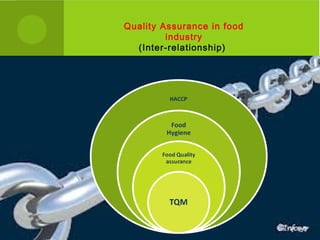
Quality Assurance in food
industry
(Inter-relationship)
GOOD MANUFACTURING
PRACTICES
 “Good manufacturing practice is that part of
quality assurance which ensures that products
are consistently produced and controlled to the
quality standards appropriate to their intended
use and as required by the marketing
authorization or product specification”.
DEFINITION..
 Good manufacturing practice guidelines
provide guidance for manufacturing, testing,
and quality assurance in order to ensure that
a food product is safe for human
consumption
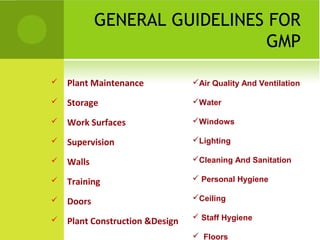
GENERAL GUIDELINES FOR
GMP
 Plant Maintenance
 Storage
 Work Surfaces
 Supervision
 Walls
 Training
 Doors
 Plant Construction &Design
Air Quality And Ventilation
Water
Windows
Lighting
Cleaning And Sanitation
 Personal Hygiene
Ceiling
 Staff Hygiene
 Floors
GOOD AGRICULTURAL
PRACTICES
“GAP are set of practices that address to
environment, eco and social sustainability for all
farm processes for safety & Quality produce”
 Good agricultural practices are a collection of
principle to apply for on farm production and post
production processes resulting in safe and
healthy food and non food agricultural products,
while taking into account economical ,social and
environmental sustainability.
OBJECTIVES OF GAP..
1. To ensure safety & Quality of Produce in food chain.
2. To capture new market advantage.
3. To improve use of natural resources.
4. To improve workers health and working condition.
5. To create new market opportunities to farmers and
exporters.
6. To export trade of Agricultural produce.
GOOD LABORATORY
PRACTICES
GLP is a set of principles that avoids a frame work
within which lab studies are planned, performed,
monitored, recorded, reported and achieved.
 “A quality system concerned with the organizational process and
the conditions under which non-clinical health and environmental
safety studies are planned, performed, monitored, recorded,
archived and reported.”
 GLP followed in labs to avoid accidents while handling
reagents.
 GLP has followed by every lab personnel.
 “A quality system concerned with the organizational
process and the conditions under which non-clinical
health and environmental safety studies are
planned, performed, monitored, recorded, archived
and reported.”
 GLP followed in labs to avoid accidents while handling
reagents.
 GLP has followed by every lab personnel.
PRACTICES FOLLOWED IN
LAB
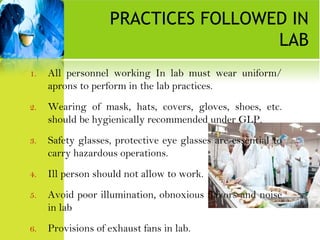
1. All personnel working In lab must wear uniform/
aprons to perform in the lab practices.
2. Wearing of mask, hats, covers, gloves, shoes, etc.
should be hygienically recommended under GLP.
3. Safety glasses, protective eye glasses are essential to
carry hazardous operations.
4. Ill person should not allow to work.
5. Avoid poor illumination, obnoxious flavors and noise
in lab
6. Provisions of exhaust fans in lab.
SANITARY & HYGIENIC
PRACTICES
 lighting and ventilation
 Location of premises
 Floors and walls
 Ceilings
 Insects
 Doors and windows
 Potable water supply
 equipment design
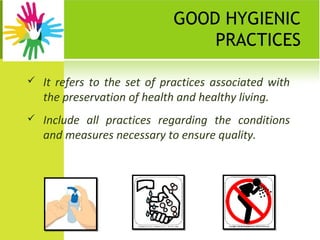
GOOD HYGIENIC
PRACTICES
 It refers to the set of practices associated with
the preservation of health and healthy living.
 Include all practices regarding the conditions
and measures necessary to ensure quality.
Areas examined under GHP
 1. Primary production
 2. Establishment: design and facilities
 3. Control of operation
 4. Establishment: maintenance and
sanitation
 5. Establishment: personal hygiene
 6. Transportation
 7. Product information and consumer
awareness
 8. Training
CONCLUSION
 Good Manufacturing Practices are the basis of the
production and preparation of safe food
 Good Hygienic Practices deal with safety and
suitability requirements to be followed world-wide
 Each food operation should adapt existing codes to
their specific set of conditions
 Food operations should also decide which practices
are critical for the safety of a product and thus have
to be included in the HACCP plan.
Any
Question….?

Quality assurance ppt

  • 2.
     FST-607  QUALITYMANAGEMENT SYSTEM Presentation on
  • 3.
    CONTENTS Quality Assurance Total QualityManagement GMP/GHP,GLP,GAP Sanitary & Hygienic Practices 1. 2. 3. 4.
  • 4.
    WHAT IS QUALITY..? ISO 9000:2000 DEFINITION OF QUALITY-  It is the degree to which a set of inherent characteristics fulfills requirements.  “Fitness for use”  Quality is excellence that is better than a minimum standard.  “Conformance to requirements”  The ability of your product or service to satisfy
  • 5.
  • 6.
    DEFINITION “Planned and systematicactivities implemented within the quality system that can be demonstrated to provide confidence that a product or service will fulfill requirements for quality”  Quality Assurance is a system for evaluating performance, service, of the quality of a product against system, standard or specified requirement for customers.
  • 7.
     Planned activityor systematic approach to provide adequate confidence of product and service.
  • 8.
    COMPONENTS OF QUALITY ASSURANCE Longterm decision (quality policy) Day to day operation (SOP’s worksheet) Medium term decision (training, facilities, operation of QA)
  • 9.
    QA is away of preventing mistakes or defects in manufactured products and avoiding problems when delivering solutions or services to customers. ISO-9000 DEFINED “A part of quality management focused on providing confidence that quality requirements will be fulfilled” QUALITY ASSURANCE
  • 10.
    QUALITY ASSURANCE VSQUALITY CONTROL Quality assurance 1.A part of quality management focused on providing confidence that quality requirements will be fulfilled. 2.Planned and systematic activities implemented within the quality system provide confidence that a product or service will fulfill requirements for quality 3.is a complete system to assure the quality of products or services. Quality control 1. A part of quality management focused on fulfilling quality requirements. 2. The operational techniques and activities used to fulfill requirements for quality. 3. Quality Control just measures and determines the quality level of products or services. It is a process itself.
  • 11.
    GENERAL PRINCIPLES OF QA.. Fitfor purpose The product should be suitable for the intended purpose Right first time Mistakes should be eliminated
  • 12.
    FUNCTIONS OF QUALITY ASSURANCE.. I.To maintain standards & specification for all raw material & finished product. II. To give service to company in all areas related to product quality includes trouble shooting, visiting, production, facilities, designing and training Quality control panel. III. To produce information that is accurate, reliable and adequate for the intended purpose. IV. Evaluating performance, service, of the quality of a product against a system, standard or specified requirement for customers
  • 13.
  • 14.
    OBJECTIVE OF QA.. 1)Managing good manufacturing practices (GMP)including 2) Managing good laboratory practices (GLP) 3) Managing a safety programme 4) Assuring the quality of raw materials 5) Assuring the quality and traceability of finished product 6) Evaluating plant environment 7) Developing an HACCP plan
  • 15.
  • 16.
    WHAT IS TOTALQUALITY MANAGEMENT? TOTAL QUALITY MANAGEMENT -Made up of the whole -Act , Manner of handling (or) Art -Degree of excellence a product or service provides
  • 17.
    WHAT DOES TQM MEAN? Aphilosophy that involves everyone in an organization in a continual effort to improve quality and achieve customer satisfaction.
  • 18.
    WHAT’S THE GOALOF TQM? “Do the right things right the first time, every time.”
  • 19.
    TOTAL QUALITY MANAGEMENT.. Total QualityManagement (or TQM) is a supervision concept coined by W. Edwards Deming “Total quality management is an approach that seeks to improve quality and performance which will meet or exceed customer expectations.”
  • 20.
    TOTAL QUALITY MANAGEMENT PROGRAM 1. Topmanagement commitment and involvement. 2. Customer involvement & designing products for quality. 3. Designing and controlling production processes. 4. Developing supplier partnerships. 5. Customer service, distribution, installation. 6. Building teams of empowered employees. 7. Benchmarking and continuous improvement.
  • 21.
    TQM IN FOODINDUSTRY Systems for development of quality assurance:  GMP  HACCP,  ISO  BRC
  • 22.
    DEMING WHEEL FOR CONTINUOUS IMPROVEMENT Evaluateresult Implementing the plans, taking small controlled steps Take action to standardize the process What changes can be made for improvement
  • 23.
     TQM isthe integration of all functions and processes within an organization in order to achieve continuous improvement of the quality of goods and services. The goal is customer satisfaction.
  • 24.
    OBJECTIVES OF TQM.. Process improvement  Defect prevention  Measuring system capacity  Developing improvement checklist  Helping teams make better decisions  Developing operational definitions  Observing behavior changes over a period of time.
  • 25.
  • 26.
    QUALITY MANAGEMENT  Sumof all activities performed in an organization to produce and maintain a product with desired quality level against minimum cost.  Quality management functions:
  • 27.
  • 28.
    Quality Assurance infood industry (Inter-relationship)
  • 29.
    GOOD MANUFACTURING PRACTICES  “Goodmanufacturing practice is that part of quality assurance which ensures that products are consistently produced and controlled to the quality standards appropriate to their intended use and as required by the marketing authorization or product specification”.
  • 30.
    DEFINITION..  Good manufacturingpractice guidelines provide guidance for manufacturing, testing, and quality assurance in order to ensure that a food product is safe for human consumption
  • 31.
    GENERAL GUIDELINES FOR GMP Plant Maintenance  Storage  Work Surfaces  Supervision  Walls  Training  Doors  Plant Construction &Design Air Quality And Ventilation Water Windows Lighting Cleaning And Sanitation  Personal Hygiene Ceiling  Staff Hygiene  Floors
  • 32.
    GOOD AGRICULTURAL PRACTICES “GAP areset of practices that address to environment, eco and social sustainability for all farm processes for safety & Quality produce”  Good agricultural practices are a collection of principle to apply for on farm production and post production processes resulting in safe and healthy food and non food agricultural products, while taking into account economical ,social and environmental sustainability.
  • 33.
    OBJECTIVES OF GAP.. 1.To ensure safety & Quality of Produce in food chain. 2. To capture new market advantage. 3. To improve use of natural resources. 4. To improve workers health and working condition. 5. To create new market opportunities to farmers and exporters. 6. To export trade of Agricultural produce.
  • 34.
    GOOD LABORATORY PRACTICES GLP isa set of principles that avoids a frame work within which lab studies are planned, performed, monitored, recorded, reported and achieved.  “A quality system concerned with the organizational process and the conditions under which non-clinical health and environmental safety studies are planned, performed, monitored, recorded, archived and reported.”  GLP followed in labs to avoid accidents while handling reagents.  GLP has followed by every lab personnel.
  • 35.
     “A qualitysystem concerned with the organizational process and the conditions under which non-clinical health and environmental safety studies are planned, performed, monitored, recorded, archived and reported.”  GLP followed in labs to avoid accidents while handling reagents.  GLP has followed by every lab personnel.
  • 36.
    PRACTICES FOLLOWED IN LAB 1.All personnel working In lab must wear uniform/ aprons to perform in the lab practices. 2. Wearing of mask, hats, covers, gloves, shoes, etc. should be hygienically recommended under GLP. 3. Safety glasses, protective eye glasses are essential to carry hazardous operations. 4. Ill person should not allow to work. 5. Avoid poor illumination, obnoxious flavors and noise in lab 6. Provisions of exhaust fans in lab.
  • 37.
    SANITARY & HYGIENIC PRACTICES lighting and ventilation  Location of premises  Floors and walls  Ceilings  Insects  Doors and windows  Potable water supply  equipment design
  • 38.
    GOOD HYGIENIC PRACTICES  Itrefers to the set of practices associated with the preservation of health and healthy living.  Include all practices regarding the conditions and measures necessary to ensure quality.
  • 39.
    Areas examined underGHP  1. Primary production  2. Establishment: design and facilities  3. Control of operation  4. Establishment: maintenance and sanitation  5. Establishment: personal hygiene  6. Transportation  7. Product information and consumer awareness  8. Training
  • 40.
    CONCLUSION  Good ManufacturingPractices are the basis of the production and preparation of safe food  Good Hygienic Practices deal with safety and suitability requirements to be followed world-wide  Each food operation should adapt existing codes to their specific set of conditions  Food operations should also decide which practices are critical for the safety of a product and thus have to be included in the HACCP plan.
  • 41.