1
© Prentice Hall, 2002
Chapter 4:Chapter 4:
The Enhanced E-R Model andThe Enhanced E-R Model and
Business RulesBusiness Rules
Modern Database Management
6th
Edition
Jeffrey A. Hoffer, Mary B. Prescott, Fred R.
McFadden
2Chapter 4
© Prentice Hall, 2002
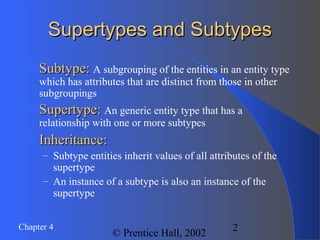
Supertypes and SubtypesSupertypes and Subtypes
Subtype:Subtype: A subgrouping of the entities in an entity type
which has attributes that are distinct from those in other
subgroupings
Supertype:Supertype: An generic entity type that has a
relationship with one or more subtypes
Inheritance:Inheritance:
– Subtype entities inherit values of all attributes of the
supertype
– An instance of a subtype is also an instance of the
supertype
3Chapter 4
© Prentice Hall, 2002
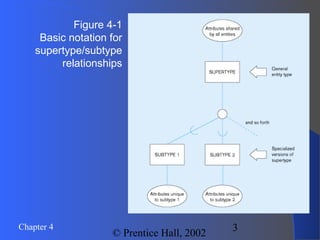
Figure 4-1
Basic notation for
supertype/subtype
relationships
4Chapter 4
© Prentice Hall, 2002
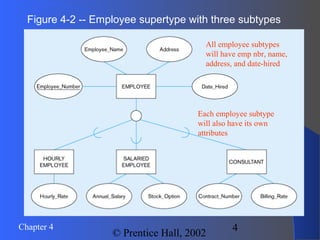
Figure 4-2 -- Employee supertype with three subtypes
All employee subtypes
will have emp nbr, name,
address, and date-hired
Each employee subtype
will also have its own
attributes
5Chapter 4
© Prentice Hall, 2002
Relationships and SubtypesRelationships and Subtypes
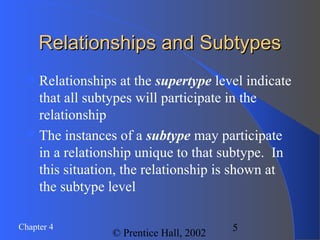
Relationships at the supertype level indicate
that all subtypes will participate in the
relationship
The instances of a subtype may participate
in a relationship unique to that subtype. In
this situation, the relationship is shown at
the subtype level
6Chapter 4
© Prentice Hall, 2002
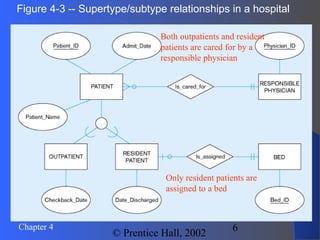
Figure 4-3 -- Supertype/subtype relationships in a hospital
Both outpatients and resident
patients are cared for by a
responsible physician
Only resident patients are
assigned to a bed
7Chapter 4
© Prentice Hall, 2002
Generalization andGeneralization and
SpecializationSpecialization
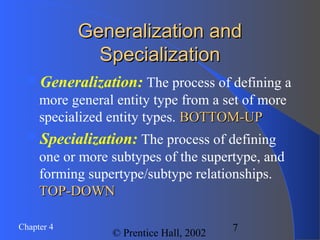
Generalization: The process of defining a
more general entity type from a set of more
specialized entity types. BOTTOM-UPBOTTOM-UP
Specialization: The process of defining
one or more subtypes of the supertype, and
forming supertype/subtype relationships.
TOP-DOWNTOP-DOWN
8Chapter 4
© Prentice Hall, 2002
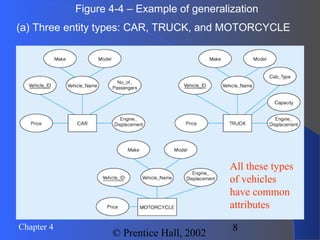
Figure 4-4 – Example of generalization
(a) Three entity types: CAR, TRUCK, and MOTORCYCLE
All these types
of vehicles
have common
attributes
9Chapter 4
© Prentice Hall, 2002
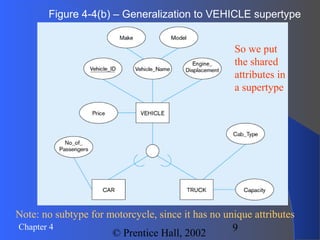
Figure 4-4(b) – Generalization to VEHICLE supertype
So we put
the shared
attributes in
a supertype
Note: no subtype for motorcycle, since it has no unique attributes
10Chapter 4
© Prentice Hall, 2002
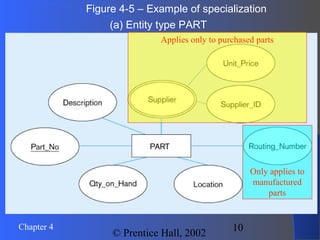
Figure 4-5 – Example of specialization
(a) Entity type PART
Only applies to
manufactured
parts
Applies only to purchased parts
11Chapter 4
© Prentice Hall, 2002
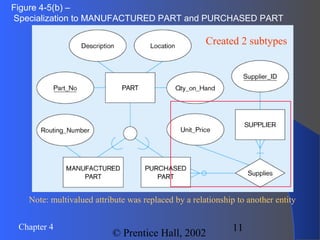
Figure 4-5(b) –
Specialization to MANUFACTURED PART and PURCHASED PART
Note: multivalued attribute was replaced by a relationship to another entity
Created 2 subtypes
12Chapter 4
© Prentice Hall, 2002
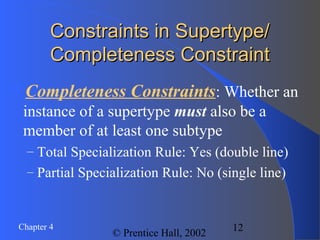
Constraints in Supertype/Constraints in Supertype/
Completeness ConstraintCompleteness Constraint
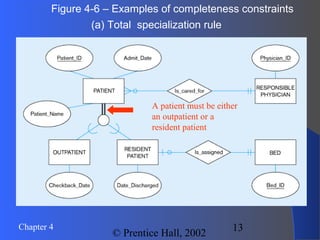
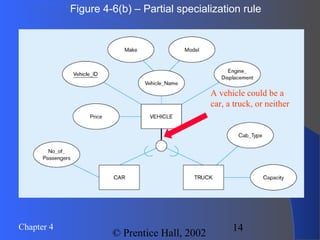
Completeness Constraints: Whether an
instance of a supertype must also be a
member of at least one subtype
– Total Specialization Rule: Yes (double line)
– Partial Specialization Rule: No (single line)
13Chapter 4
© Prentice Hall, 2002
Figure 4-6 – Examples of completeness constraints
(a) Total specialization rule
A patient must be either
an outpatient or a
resident patient
14Chapter 4
© Prentice Hall, 2002
Figure 4-6(b) – Partial specialization rule
A vehicle could be a
car, a truck, or neither
15Chapter 4
© Prentice Hall, 2002
Constraints in Supertype/Constraints in Supertype/
Disjointness constraintDisjointness constraint
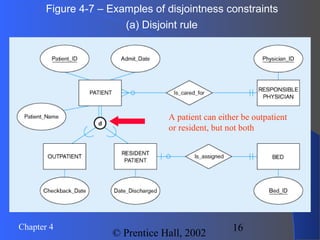
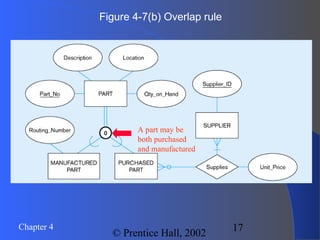
Disjointness Constraints: Whether an
instance of a supertype may simultaneously
be a member of two (or more) subtypes.
– Disjoint Rule: An instance of the supertype can
be only ONE of the subtypes
– Overlap Rule: An instance of the supertype
could be more than one of the subtypes
16Chapter 4
© Prentice Hall, 2002
(a) Disjoint rule
Figure 4-7 – Examples of disjointness constraints
A patient can either be outpatient
or resident, but not both
17Chapter 4
© Prentice Hall, 2002
Figure 4-7(b) Overlap rule
A part may be
both purchased
and manufactured
18Chapter 4
© Prentice Hall, 2002
Constraints in Supertype/Constraints in Supertype/
Subtype DiscriminatorsSubtype Discriminators
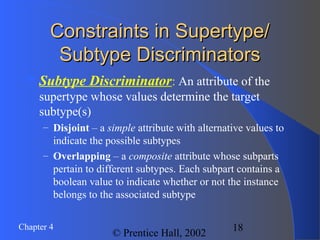
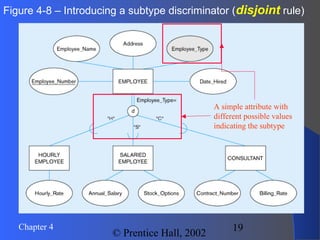
Subtype Discriminator: An attribute of the
supertype whose values determine the target
subtype(s)
– Disjoint – a simple attribute with alternative values to
indicate the possible subtypes
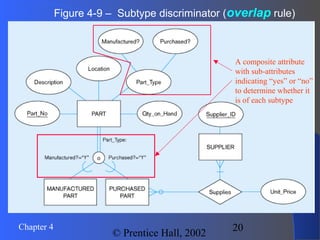
– Overlapping – a composite attribute whose subparts
pertain to different subtypes. Each subpart contains a
boolean value to indicate whether or not the instance
belongs to the associated subtype
19Chapter 4
© Prentice Hall, 2002
Figure 4-8 – Introducing a subtype discriminator (disjoint rule)
A simple attribute with
different possible values
indicating the subtype
20Chapter 4
© Prentice Hall, 2002
Figure 4-9 – Subtype discriminator (overlap rule)
A composite attribute
with sub-attributes
indicating “yes” or “no”
to determine whether it
is of each subtype
21Chapter 4
© Prentice Hall, 2002
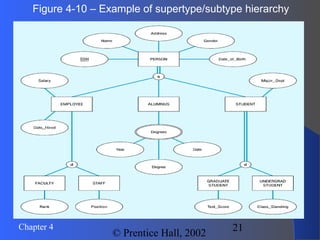
Figure 4-10 – Example of supertype/subtype hierarchy
22Chapter 4
© Prentice Hall, 2002
Entity ClustersEntity Clusters
EER diagrams are difficult to read when
there are too many entities and relationships
Solution: group entities and relationships
into entity clusters
Entity cluster: set of one or more entity
types and associated relationships grouped
into a single abstract entity type
23Chapter 4
© Prentice Hall, 2002
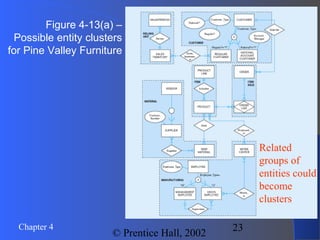
Figure 4-13(a) –
Possible entity clusters
for Pine Valley Furniture
Related
groups of
entities could
become
clusters
24Chapter 4
© Prentice Hall, 2002
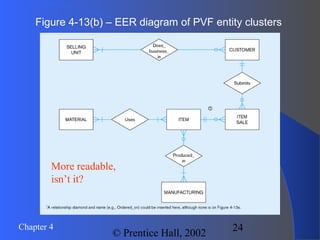
Figure 4-13(b) – EER diagram of PVF entity clusters
More readable,
isn’t it?
25Chapter 4
© Prentice Hall, 2002
Business rulesBusiness rules
 Statements that define or constrain some aspect of the
business.
 Constraints can impact:
– Structure (definition, domain, relationship)
– Behavior (operational constraints)
 Classification of business rules:
– Derivation – rule derived from other knowledge
– Structural assertion – rule expressing static structure
– Action assertion – rule expressing constraints/control of
organizational actions
26Chapter 4
© Prentice Hall, 2002
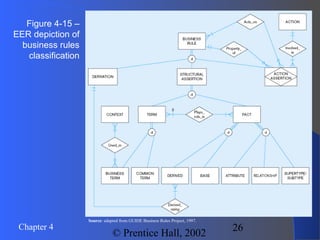
Figure 4-15 –
EER depiction of
business rules
classification
Source: adapted from GUIDE Business Rules Project, 1997.
27Chapter 4
© Prentice Hall, 2002
Action Assertion ClassificationsAction Assertion Classifications
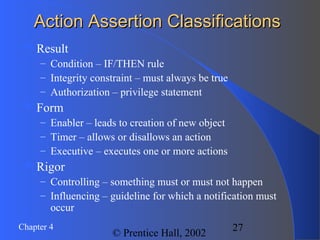
 Result
– Condition – IF/THEN rule
– Integrity constraint – must always be true
– Authorization – privilege statement
 Form
– Enabler – leads to creation of new object
– Timer – allows or disallows an action
– Executive – executes one or more actions
 Rigor
– Controlling – something must or must not happen
– Influencing – guideline for which a notification must
occur
28Chapter 4
© Prentice Hall, 2002
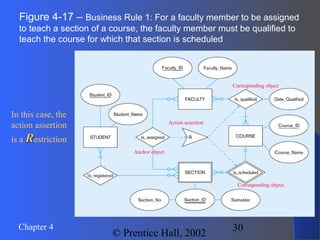
Stating an Action AssertionStating an Action Assertion
Anchor Object – an object on which actions
are limited
Action – creation, deletion, update, or read
Corresponding Objects – an object
influencing the ability to perform an action
on another business rule
Action assertion will identify corresponding objects thatAction assertion will identify corresponding objects that
constrain the ability to perform actions on anchor objectsconstrain the ability to perform actions on anchor objects
29Chapter 4
© Prentice Hall, 2002
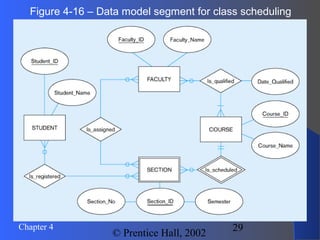
Figure 4-16 – Data model segment for class scheduling
30Chapter 4
© Prentice Hall, 2002
Figure 4-17 – Business Rule 1: For a faculty member to be assigned
to teach a section of a course, the faculty member must be qualified to
teach the course for which that section is scheduled
Action assertion
Anchor object
Corresponding object
In this case, the
action assertion
is a RRestriction
31Chapter 4
© Prentice Hall, 2002
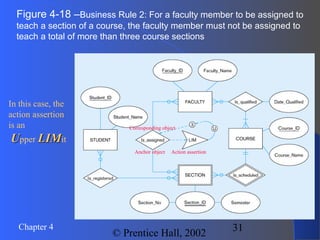
Figure 4-18 –Business Rule 2: For a faculty member to be assigned to
teach a section of a course, the faculty member must not be assigned to
teach a total of more than three course sections
Action assertionAnchor object
Corresponding object
In this case, the
action assertion
is an
UUpper LIMLIMit

The Database Environment Chapter 4

  • 1.
    1 © Prentice Hall,2002 Chapter 4:Chapter 4: The Enhanced E-R Model andThe Enhanced E-R Model and Business RulesBusiness Rules Modern Database Management 6th Edition Jeffrey A. Hoffer, Mary B. Prescott, Fred R. McFadden
  • 2.
    2Chapter 4 © PrenticeHall, 2002 Supertypes and SubtypesSupertypes and Subtypes Subtype:Subtype: A subgrouping of the entities in an entity type which has attributes that are distinct from those in other subgroupings Supertype:Supertype: An generic entity type that has a relationship with one or more subtypes Inheritance:Inheritance: – Subtype entities inherit values of all attributes of the supertype – An instance of a subtype is also an instance of the supertype
  • 3.
    3Chapter 4 © PrenticeHall, 2002 Figure 4-1 Basic notation for supertype/subtype relationships
  • 4.
    4Chapter 4 © PrenticeHall, 2002 Figure 4-2 -- Employee supertype with three subtypes All employee subtypes will have emp nbr, name, address, and date-hired Each employee subtype will also have its own attributes
  • 5.
    5Chapter 4 © PrenticeHall, 2002 Relationships and SubtypesRelationships and Subtypes Relationships at the supertype level indicate that all subtypes will participate in the relationship The instances of a subtype may participate in a relationship unique to that subtype. In this situation, the relationship is shown at the subtype level
  • 6.
    6Chapter 4 © PrenticeHall, 2002 Figure 4-3 -- Supertype/subtype relationships in a hospital Both outpatients and resident patients are cared for by a responsible physician Only resident patients are assigned to a bed
  • 7.
    7Chapter 4 © PrenticeHall, 2002 Generalization andGeneralization and SpecializationSpecialization Generalization: The process of defining a more general entity type from a set of more specialized entity types. BOTTOM-UPBOTTOM-UP Specialization: The process of defining one or more subtypes of the supertype, and forming supertype/subtype relationships. TOP-DOWNTOP-DOWN
  • 8.
    8Chapter 4 © PrenticeHall, 2002 Figure 4-4 – Example of generalization (a) Three entity types: CAR, TRUCK, and MOTORCYCLE All these types of vehicles have common attributes
  • 9.
    9Chapter 4 © PrenticeHall, 2002 Figure 4-4(b) – Generalization to VEHICLE supertype So we put the shared attributes in a supertype Note: no subtype for motorcycle, since it has no unique attributes
  • 10.
    10Chapter 4 © PrenticeHall, 2002 Figure 4-5 – Example of specialization (a) Entity type PART Only applies to manufactured parts Applies only to purchased parts
  • 11.
    11Chapter 4 © PrenticeHall, 2002 Figure 4-5(b) – Specialization to MANUFACTURED PART and PURCHASED PART Note: multivalued attribute was replaced by a relationship to another entity Created 2 subtypes
  • 12.
    12Chapter 4 © PrenticeHall, 2002 Constraints in Supertype/Constraints in Supertype/ Completeness ConstraintCompleteness Constraint Completeness Constraints: Whether an instance of a supertype must also be a member of at least one subtype – Total Specialization Rule: Yes (double line) – Partial Specialization Rule: No (single line)
  • 13.
    13Chapter 4 © PrenticeHall, 2002 Figure 4-6 – Examples of completeness constraints (a) Total specialization rule A patient must be either an outpatient or a resident patient
  • 14.
    14Chapter 4 © PrenticeHall, 2002 Figure 4-6(b) – Partial specialization rule A vehicle could be a car, a truck, or neither
  • 15.
    15Chapter 4 © PrenticeHall, 2002 Constraints in Supertype/Constraints in Supertype/ Disjointness constraintDisjointness constraint Disjointness Constraints: Whether an instance of a supertype may simultaneously be a member of two (or more) subtypes. – Disjoint Rule: An instance of the supertype can be only ONE of the subtypes – Overlap Rule: An instance of the supertype could be more than one of the subtypes
  • 16.
    16Chapter 4 © PrenticeHall, 2002 (a) Disjoint rule Figure 4-7 – Examples of disjointness constraints A patient can either be outpatient or resident, but not both
  • 17.
    17Chapter 4 © PrenticeHall, 2002 Figure 4-7(b) Overlap rule A part may be both purchased and manufactured
  • 18.
    18Chapter 4 © PrenticeHall, 2002 Constraints in Supertype/Constraints in Supertype/ Subtype DiscriminatorsSubtype Discriminators Subtype Discriminator: An attribute of the supertype whose values determine the target subtype(s) – Disjoint – a simple attribute with alternative values to indicate the possible subtypes – Overlapping – a composite attribute whose subparts pertain to different subtypes. Each subpart contains a boolean value to indicate whether or not the instance belongs to the associated subtype
  • 19.
    19Chapter 4 © PrenticeHall, 2002 Figure 4-8 – Introducing a subtype discriminator (disjoint rule) A simple attribute with different possible values indicating the subtype
  • 20.
    20Chapter 4 © PrenticeHall, 2002 Figure 4-9 – Subtype discriminator (overlap rule) A composite attribute with sub-attributes indicating “yes” or “no” to determine whether it is of each subtype
  • 21.
    21Chapter 4 © PrenticeHall, 2002 Figure 4-10 – Example of supertype/subtype hierarchy
  • 22.
    22Chapter 4 © PrenticeHall, 2002 Entity ClustersEntity Clusters EER diagrams are difficult to read when there are too many entities and relationships Solution: group entities and relationships into entity clusters Entity cluster: set of one or more entity types and associated relationships grouped into a single abstract entity type
  • 23.
    23Chapter 4 © PrenticeHall, 2002 Figure 4-13(a) – Possible entity clusters for Pine Valley Furniture Related groups of entities could become clusters
  • 24.
    24Chapter 4 © PrenticeHall, 2002 Figure 4-13(b) – EER diagram of PVF entity clusters More readable, isn’t it?
  • 25.
    25Chapter 4 © PrenticeHall, 2002 Business rulesBusiness rules  Statements that define or constrain some aspect of the business.  Constraints can impact: – Structure (definition, domain, relationship) – Behavior (operational constraints)  Classification of business rules: – Derivation – rule derived from other knowledge – Structural assertion – rule expressing static structure – Action assertion – rule expressing constraints/control of organizational actions
  • 26.
    26Chapter 4 © PrenticeHall, 2002 Figure 4-15 – EER depiction of business rules classification Source: adapted from GUIDE Business Rules Project, 1997.
  • 27.
    27Chapter 4 © PrenticeHall, 2002 Action Assertion ClassificationsAction Assertion Classifications  Result – Condition – IF/THEN rule – Integrity constraint – must always be true – Authorization – privilege statement  Form – Enabler – leads to creation of new object – Timer – allows or disallows an action – Executive – executes one or more actions  Rigor – Controlling – something must or must not happen – Influencing – guideline for which a notification must occur
  • 28.
    28Chapter 4 © PrenticeHall, 2002 Stating an Action AssertionStating an Action Assertion Anchor Object – an object on which actions are limited Action – creation, deletion, update, or read Corresponding Objects – an object influencing the ability to perform an action on another business rule Action assertion will identify corresponding objects thatAction assertion will identify corresponding objects that constrain the ability to perform actions on anchor objectsconstrain the ability to perform actions on anchor objects
  • 29.
    29Chapter 4 © PrenticeHall, 2002 Figure 4-16 – Data model segment for class scheduling
  • 30.
    30Chapter 4 © PrenticeHall, 2002 Figure 4-17 – Business Rule 1: For a faculty member to be assigned to teach a section of a course, the faculty member must be qualified to teach the course for which that section is scheduled Action assertion Anchor object Corresponding object Corresponding object In this case, the action assertion is a RRestriction
  • 31.
    31Chapter 4 © PrenticeHall, 2002 Figure 4-18 –Business Rule 2: For a faculty member to be assigned to teach a section of a course, the faculty member must not be assigned to teach a total of more than three course sections Action assertionAnchor object Corresponding object In this case, the action assertion is an UUpper LIMLIMit