Quality: The suitability of a
drug substance or a drug
product for its intended use;
customer satisfaction.
The concept of Quality by
design was summarized by a
well known quality expert
Joseph Moses Juran; he
believed that quality could be
planned and that most quality
associated problems have
their origin in the way which
quality was planned in the first
place.
Adapted from: QbD concept as
presented by U.S.F.D.A
The principles of QbD have been used to advance
the product and process quality in every industry.
Because of need of potent drug with safety
profile, pharmaceutical industries are investing
billions of money in the drug discovery and
development process with endeavour to design
quality product and that to with consistency in
manufacturing process to deliver the intended
performance of product.
The Juran Trilogy defines the word "quality"
as having two meanings: first, the presence of
features that create customer satisfaction;
second, the reliability of those features.
Failures in features create dissatisfactions, so
removing failures is the purpose of quality
improvement, while creating features is the
purpose of quality by design.
• During the drug development process, the
aspects like drug substances, excipients,
container closure systems, manufacturing
processes and quality control tests are critical
to product quality.
• QbD involves thorough understanding of
process; a goal or objective is defined before
actual start of process.
• FDA’s view of QbD is ‘‘QbD is a systematic
approach to product and process design and
development’’. This concept was accepted by
FDA in 2004 and detailed description was given
in ‘pharmaceutical cGMPs for 21st century – a
risk based approach’.
• ‘‘QbD does not necessarily mean less analytical
testing’’ rather, it means the right analysis at the
right time, and is based on science and risk
assessment.
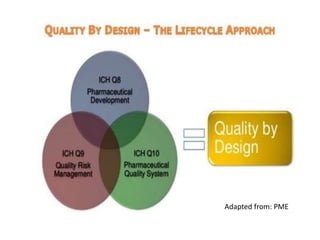
Regulatory Control Guidelines Emphasising QbD: The
QbD approach which is based on scientific and
methodical product development was included in the
quality guidelines of ICH from 2005 onwards.
This approach includes, ICH
Q8: Pharmaceutical Development,
Q9: Quality Risk Management, and
Q10: Pharmaceutical Quality System guidelines.
The pharmaceutical products quality was also emphasised
in Process Analytical Technology [PAT] guidelines for new
pharmaceutical product development and quality.
Adapted from: PME
Factors affecting properties of
products and processes:
Mixing speed
Pressure
Temperature
Moisture level
Raw material
Sterility
Dissolution
………so on
ICH Q8: Pharmaceutical
Development:
It discusses the various element of Quality by
Design.
• Define the Quality Target Product Profile
• Identify the Quality Attributes
• Perform a Risk [Assessment] Analysis
• Determine the Critical Quality Attributes and
Critical Process Parameter
• Determine the Design Space
• Identify a Control Strategy
1. Quality Target Product Profile [QTPP]:
QTPP is “Prospective summary of the quality
characteristics of a drug product that ideally will be
achieved to ensure the desired quality, taking into
account safety and efficacy of the drug product”.
It is the quality characteristics that the drug product
should possess in order to reproducibly deliver the
therapeutic benefit promised in the label.
2. Quality Attributes: Once QTPP has identified, the next
step is to identify the relevant CQAs. A critical quality
attribute as defined by ICH is a physical, chemical,
biological, or microbiological characteristic that should be
within an appropriate limit, range, or distribution to
ensure the desired product quality.
For Drug Substance [Chemical] For Drug Product [Tablet]
Appearance
Particle size
Morphic forms
Water content
Residual solvents
Organic impurities
Inorganic impurities
Heavy metals
Residue on ignition
Assay
Appearance
Identification
Hardness
Uniformity of dosage
Physical form
Dissolution
Degradation products
Water content
Assay
ICH Q9: Quality Risk Management
[QRM]
ICH Q10: Quality System
A control strategy normally include input
material controls, process controls and
monitoring, design space around individual or
multiple unit operations, and/or final product
specifications used to ensure consistent quality.
The finished drug products are tested for quality
by assessing if they meet specifications.
Advantages of QbD
Benefits for Industry:
• Better understanding of the process.
• Less batch failure.
• More efficient and effective control of change.
• Return on investment / cost savings.
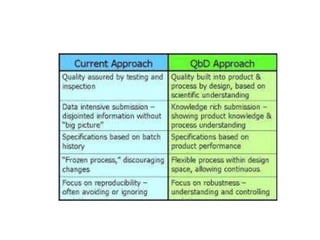
Advantages of QbD:
• Patient safety and product efficacy are focused.
• Scientific understanding of pharmaceutical process and methods is done.
• It involves product design and process development.
• Science based risk assessment is carried.
• Critical quality attributes are identified and their effect on final quality of product
is analysed.
• It offers robust method or process.
• Business benefits are also driving force to adopt QbD.
Conclusion
• Quality activities must try to detect quality
problems early enough to permit actions without
requiring compromise in cost, schedule or quality.
The emphasis must be on precaution rather than
on just correction of quality problems. Hence the
quality has to be built in the product as well as
services through proper planning, so that the
forth coming failure can be avoided.
• Quality cannot be tested into products but should
be built-in or should be by design.
References
“Quality by design approach: Regulatory need”,
AJC (2017) 10, S3412–S3425
“APPLICATION OF QUALITY BY DESIGN TO
DIFFERENT ASPECTS OF PHARMACEUTICAL
TECHNOLOGIES”, IJPSR, 2017; Vol. 8(9): 3649-
3662.

Quality by design (QbD)

  • 2.
    Quality: The suitabilityof a drug substance or a drug product for its intended use; customer satisfaction. The concept of Quality by design was summarized by a well known quality expert Joseph Moses Juran; he believed that quality could be planned and that most quality associated problems have their origin in the way which quality was planned in the first place. Adapted from: QbD concept as presented by U.S.F.D.A
  • 3.
    The principles ofQbD have been used to advance the product and process quality in every industry. Because of need of potent drug with safety profile, pharmaceutical industries are investing billions of money in the drug discovery and development process with endeavour to design quality product and that to with consistency in manufacturing process to deliver the intended performance of product.
  • 4.
    The Juran Trilogydefines the word "quality" as having two meanings: first, the presence of features that create customer satisfaction; second, the reliability of those features. Failures in features create dissatisfactions, so removing failures is the purpose of quality improvement, while creating features is the purpose of quality by design.
  • 6.
    • During thedrug development process, the aspects like drug substances, excipients, container closure systems, manufacturing processes and quality control tests are critical to product quality. • QbD involves thorough understanding of process; a goal or objective is defined before actual start of process.
  • 7.
    • FDA’s viewof QbD is ‘‘QbD is a systematic approach to product and process design and development’’. This concept was accepted by FDA in 2004 and detailed description was given in ‘pharmaceutical cGMPs for 21st century – a risk based approach’. • ‘‘QbD does not necessarily mean less analytical testing’’ rather, it means the right analysis at the right time, and is based on science and risk assessment.
  • 8.
    Regulatory Control GuidelinesEmphasising QbD: The QbD approach which is based on scientific and methodical product development was included in the quality guidelines of ICH from 2005 onwards. This approach includes, ICH Q8: Pharmaceutical Development, Q9: Quality Risk Management, and Q10: Pharmaceutical Quality System guidelines. The pharmaceutical products quality was also emphasised in Process Analytical Technology [PAT] guidelines for new pharmaceutical product development and quality.
  • 9.
  • 10.
    Factors affecting propertiesof products and processes: Mixing speed Pressure Temperature Moisture level Raw material Sterility Dissolution ………so on
  • 11.
    ICH Q8: Pharmaceutical Development: Itdiscusses the various element of Quality by Design. • Define the Quality Target Product Profile • Identify the Quality Attributes • Perform a Risk [Assessment] Analysis • Determine the Critical Quality Attributes and Critical Process Parameter • Determine the Design Space • Identify a Control Strategy
  • 12.
    1. Quality TargetProduct Profile [QTPP]: QTPP is “Prospective summary of the quality characteristics of a drug product that ideally will be achieved to ensure the desired quality, taking into account safety and efficacy of the drug product”. It is the quality characteristics that the drug product should possess in order to reproducibly deliver the therapeutic benefit promised in the label. 2. Quality Attributes: Once QTPP has identified, the next step is to identify the relevant CQAs. A critical quality attribute as defined by ICH is a physical, chemical, biological, or microbiological characteristic that should be within an appropriate limit, range, or distribution to ensure the desired product quality.
  • 13.
    For Drug Substance[Chemical] For Drug Product [Tablet] Appearance Particle size Morphic forms Water content Residual solvents Organic impurities Inorganic impurities Heavy metals Residue on ignition Assay Appearance Identification Hardness Uniformity of dosage Physical form Dissolution Degradation products Water content Assay
  • 14.
    ICH Q9: QualityRisk Management [QRM]
  • 16.
    ICH Q10: QualitySystem A control strategy normally include input material controls, process controls and monitoring, design space around individual or multiple unit operations, and/or final product specifications used to ensure consistent quality. The finished drug products are tested for quality by assessing if they meet specifications.
  • 18.
    Advantages of QbD Benefitsfor Industry: • Better understanding of the process. • Less batch failure. • More efficient and effective control of change. • Return on investment / cost savings. Advantages of QbD: • Patient safety and product efficacy are focused. • Scientific understanding of pharmaceutical process and methods is done. • It involves product design and process development. • Science based risk assessment is carried. • Critical quality attributes are identified and their effect on final quality of product is analysed. • It offers robust method or process. • Business benefits are also driving force to adopt QbD.
  • 20.
    Conclusion • Quality activitiesmust try to detect quality problems early enough to permit actions without requiring compromise in cost, schedule or quality. The emphasis must be on precaution rather than on just correction of quality problems. Hence the quality has to be built in the product as well as services through proper planning, so that the forth coming failure can be avoided. • Quality cannot be tested into products but should be built-in or should be by design.
  • 21.
    References “Quality by designapproach: Regulatory need”, AJC (2017) 10, S3412–S3425 “APPLICATION OF QUALITY BY DESIGN TO DIFFERENT ASPECTS OF PHARMACEUTICAL TECHNOLOGIES”, IJPSR, 2017; Vol. 8(9): 3649- 3662.