z
QUALITY BY DESIGN – A Modern Approach For
Development of Quality Pharmaceuticals
Presented by
Gaurav R.Rane
Final year B.pharm (VIIth
semester)
Guided by
Prof. S. S. Aher
KCT’s R. G. Sapkal College of Pharmacy
Anjaneri- nashik
z
ContenT
1. WHAT IS QUALITY ?
2. INTRODUCTION
3. CHARACTERISTICS OF QBD
4. OBJECTIVES OF QBD
5. ELEMENTS OF QBD
6. TOOLS OF QBD
7. ADVANTAGES OF QBD
8. APPLICATIONS OF QBD
9. CONCLUSION
What is quality ?
Quality :
Quality is commonly referred to a parameter which decides the
inferiority or superiority of product or service. It is a measure
of goodness to know how a product meets its specifications.
Merriam Webster defines quality as a “degree of excellence”.
Design:
Design is ,
Making a plan or drawing for something that will
later be made, particularly one that specifies what
the end product will do and look like.
Introduction
Definition:
A systematic approach in development that begins with the
predefined objective and emphasizes product and process
understanding and process control based on sound science and
quality risk management.
Quality by design was first introduced by well known quality
expert “Joshep Moses Juran” in 1992.
QBD and ICH Guidelines:
Q8(R2) : Pharmaceutical Development
Q9 : Quality Risk Management
Q10 : Pharmaceutical Quality System
Q11 : Development and Manufacture of Drug Substances
Characteristics of qbd
• An approach for evolution of efficient drug substance.
• It is relevant to both drug product and drug substance
development.
• It is also applicable to investigative methods.
• Can be used at any time in the life process of the drug.
OBJECTIVES of qbd
• To achieve purposeful product quality specifications
that is based on clinical activities.
• To increase pharmaceutical product development
and manufacturing efficiencies.
• To amplify root causes interpretation and post
approval change management.
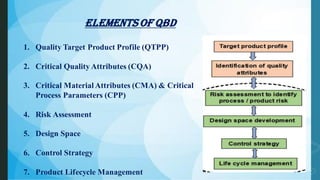
ELEMENTS OF QBD
1. Quality Target Product Profile (QTPP)
2. Critical Quality Attributes (CQA)
3. Critical Material Attributes (CMA) & Critical
Process Parameters (CPP)
4. Risk Assessment
5. Design Space
6. Control Strategy
7. Product Lifecycle Management
1. Quality Target Product Profile
A prospective summary of the quality characteristics of a drug
product that ideally will be achieved to ensure the desired quality,
taking into account safety and efficacy of the drug product.
Quality target product profile forms the basis for product in following
way
• Dosage form
• Route of administration
• Strength
• Release of delivery of the drug
• Pharmacokinetic characteristics
e.g., dissolution, aerodynamic performance
• Drug product quality characteristics for intended use
e.g., sterility, purity.
2. Critical Quality Attributes
Finding the relevent CQAs is the next step after identifying the
QTPP.
A CQA is a physical, chemical, biological, or
microbiological property or characteristic that should be within
an appropriate limit, range, or distribution to ensure the
desired product quality.
e.g. CQA for HPTLC method is TLC plate, mobile phase, injection
conc. And volume, plate developing time, reagent for colour
development and detection.
3. Critical Material Attributes & Critical Process
Parameters
Critical material attribute (CMA) and critical process parameters
(CPP) are defined as “A material or process whose variability has an
impact a critical quality attribute and therefore it should be
monitored or controlled to ensure desired drug product quality”.
CMA: e.g. include sterility, porosity, specific volume, and impurity
profile.
CPP: e.g. Temperature, addition rate, cooling rate, pH, agitation,
Homogenisation speed.
z
4. Risk Assessment
According to ICH Q9 guidelines risk assessment is a systematic
method for evaluating, controlling, communicating, and reviewing
risk to quality throughout the product life cycle.
Three steps are involved in risk assessment: risk identification, risk
analysis, and risk evaluation.
The risk assessment can be determined by various methods which are as
follows:
1. Failure Mode Effect Analysis
2. Failure Mode Effect And
Criticality Analysis
3. Fault tree Analysis
4. Hazards Analysis and Critical Control
Point
5. Hazards Operability Analysis
6. Preliminary Hazard Analysis
5. Design Space
The ICH Q8(R2) states that the design space is multi dimensional
combination and interaction of input variables (e.g., material
attributes) and process parameters that have been demonstrated to
provide assurance of quality.
Working within the design space is not considered as a change.
Movement out of the design space is considered to be a change and
would normally initiate a regulatory post approval change process.
Use of Design Space:
• Use for more than one-unit operations or upto complete process.
• Presented by Applicant.
• Working between the design space.
• Subject to regulatory approval and evaluation.
6. Control strategy
Control strategy is defined as "a planned set of controls, derived from
current product and process understanding that assures process
performance and product quality".
The ability to evaluate and ensure the quality of in- process and/or final
product based on process data which typically include a valid combination of
measured material attributes and process controls.
The control strategy can include the following elements:
1. Procedural Control
2. In-process Control
3. Batch release testing
4. Compatibility testing
5. Process Monitoring
7. Life cycle management
Product quality can be improved throughout the product lifecycle;
The QbD approach avails the continuous improvement throughout
product life cycle this is distinguish point from the conventional
method which must frozen process.
Tools of QbD
1. Design of Experiments:
is concerned with the planning and conduct of experiments to analyze the
resulting data so that we obtain valid and objective conclusions. Choosing
the process parameters for the study and choosing the right trial design are
the first steps in DOE.
2. Process Analytical Technology:
Process analytical technology (PAT) has been defined by the United
States Food and Drug Administration (FDA) "as a mechanism to design,
analyse, and control pharmaceutical manufacturing processes through the
measurement of Critical Process Parameters (CPP) which affect Critical
Quality Attributes (CQA)".
Advantages of qbd
• It provides a higher level of assurance of drug product quality.
• It offers cost savings and efficiency for the pharmaceutical industry.
• It makes the scale-up, validation and commercialization transparent,
rational and predictable
• It reduces potential compliance actions, costly penalties, and drug
recalls.
• It offers opportunities for continual improvement.
• It more focused post approval CGMP (Current Good Manufacturing
Practices) inspection
Applications of qbd
1. For Chromatographic techniques
2. For hyphenated techniques like LC-MS
3. In bioanalytical method development with precision and
accuracy
4. In dissolution studies for testing release of drug
5. For spectroscopic measurement
6. In modified release products
7. In tablet process
8. In compatibility study analysis of API and Excipients
9. In Biopharmaceuticals
10. For Biotechnological Products
11. In formulation and processing of protein liposomes.
Conclusion
QbD is the effective tool, should be implement from the
initial stage of the product development independent of
target market.
With DoE and risk assessment as its tools to better
understand the materials and processes, QbD is a cost- and
time-effective design and manufacturing approach. This
makes QbD available and practical for the pharmaceutical
industry.
References
1. Patel Hardik, Parmar Shraddha, Patel Bhavna,A ComprehensiveReviewon Qualityby Design
in Pharmaceuticals,Sardar Patel University,VallabhVidyanagar, Gujrat International
Journal of PharmaceuticalSciencesReviewand Research,2013.
2. T. Anusha,SharmaJ.V.C, QualityBy Design:Its Applications, World Journalof
Pharmaceuticaland LifeSciences, 2019.
3. KudandeKiran B., FartadeSachinJ., Gawand RavindraB., Reviewon QualityBy Design:A
Modern Approach For Development of QualityPharmaceuticals,Pune European JournalOf
PharmaceuticalAnd MedicalResearch, 2020.
4. MohurleShrikantM., Asnani AlpanaJ., ChapleDinesh R., Qualityby Design:An Emerging
Trend in ImprovingQuality& Developmentof Pharmaceuticals, Nagpur,Maharashtra,Saudi
Journal of Medicaland PharmaceuticalSciences,2019.
5. https://www.slideshare.net/chetanpawar2829/introduction-to-quality-by-design-qbd
Quality by Design

Quality by Design

  • 1.
    z QUALITY BY DESIGN– A Modern Approach For Development of Quality Pharmaceuticals Presented by Gaurav R.Rane Final year B.pharm (VIIth semester) Guided by Prof. S. S. Aher KCT’s R. G. Sapkal College of Pharmacy Anjaneri- nashik
  • 2.
    z ContenT 1. WHAT ISQUALITY ? 2. INTRODUCTION 3. CHARACTERISTICS OF QBD 4. OBJECTIVES OF QBD 5. ELEMENTS OF QBD 6. TOOLS OF QBD 7. ADVANTAGES OF QBD 8. APPLICATIONS OF QBD 9. CONCLUSION
  • 3.
    What is quality? Quality : Quality is commonly referred to a parameter which decides the inferiority or superiority of product or service. It is a measure of goodness to know how a product meets its specifications. Merriam Webster defines quality as a “degree of excellence”. Design: Design is , Making a plan or drawing for something that will later be made, particularly one that specifies what the end product will do and look like.
  • 4.
    Introduction Definition: A systematic approachin development that begins with the predefined objective and emphasizes product and process understanding and process control based on sound science and quality risk management. Quality by design was first introduced by well known quality expert “Joshep Moses Juran” in 1992. QBD and ICH Guidelines: Q8(R2) : Pharmaceutical Development Q9 : Quality Risk Management Q10 : Pharmaceutical Quality System Q11 : Development and Manufacture of Drug Substances
  • 5.
    Characteristics of qbd •An approach for evolution of efficient drug substance. • It is relevant to both drug product and drug substance development. • It is also applicable to investigative methods. • Can be used at any time in the life process of the drug.
  • 6.
    OBJECTIVES of qbd •To achieve purposeful product quality specifications that is based on clinical activities. • To increase pharmaceutical product development and manufacturing efficiencies. • To amplify root causes interpretation and post approval change management.
  • 7.
    ELEMENTS OF QBD 1.Quality Target Product Profile (QTPP) 2. Critical Quality Attributes (CQA) 3. Critical Material Attributes (CMA) & Critical Process Parameters (CPP) 4. Risk Assessment 5. Design Space 6. Control Strategy 7. Product Lifecycle Management
  • 8.
    1. Quality TargetProduct Profile A prospective summary of the quality characteristics of a drug product that ideally will be achieved to ensure the desired quality, taking into account safety and efficacy of the drug product. Quality target product profile forms the basis for product in following way • Dosage form • Route of administration • Strength • Release of delivery of the drug • Pharmacokinetic characteristics e.g., dissolution, aerodynamic performance • Drug product quality characteristics for intended use e.g., sterility, purity.
  • 9.
    2. Critical QualityAttributes Finding the relevent CQAs is the next step after identifying the QTPP. A CQA is a physical, chemical, biological, or microbiological property or characteristic that should be within an appropriate limit, range, or distribution to ensure the desired product quality. e.g. CQA for HPTLC method is TLC plate, mobile phase, injection conc. And volume, plate developing time, reagent for colour development and detection.
  • 10.
    3. Critical MaterialAttributes & Critical Process Parameters Critical material attribute (CMA) and critical process parameters (CPP) are defined as “A material or process whose variability has an impact a critical quality attribute and therefore it should be monitored or controlled to ensure desired drug product quality”. CMA: e.g. include sterility, porosity, specific volume, and impurity profile. CPP: e.g. Temperature, addition rate, cooling rate, pH, agitation, Homogenisation speed.
  • 11.
    z 4. Risk Assessment Accordingto ICH Q9 guidelines risk assessment is a systematic method for evaluating, controlling, communicating, and reviewing risk to quality throughout the product life cycle. Three steps are involved in risk assessment: risk identification, risk analysis, and risk evaluation. The risk assessment can be determined by various methods which are as follows: 1. Failure Mode Effect Analysis 2. Failure Mode Effect And Criticality Analysis 3. Fault tree Analysis 4. Hazards Analysis and Critical Control Point 5. Hazards Operability Analysis 6. Preliminary Hazard Analysis
  • 12.
    5. Design Space TheICH Q8(R2) states that the design space is multi dimensional combination and interaction of input variables (e.g., material attributes) and process parameters that have been demonstrated to provide assurance of quality. Working within the design space is not considered as a change. Movement out of the design space is considered to be a change and would normally initiate a regulatory post approval change process. Use of Design Space: • Use for more than one-unit operations or upto complete process. • Presented by Applicant. • Working between the design space. • Subject to regulatory approval and evaluation.
  • 13.
    6. Control strategy Controlstrategy is defined as "a planned set of controls, derived from current product and process understanding that assures process performance and product quality". The ability to evaluate and ensure the quality of in- process and/or final product based on process data which typically include a valid combination of measured material attributes and process controls. The control strategy can include the following elements: 1. Procedural Control 2. In-process Control 3. Batch release testing 4. Compatibility testing 5. Process Monitoring
  • 14.
    7. Life cyclemanagement Product quality can be improved throughout the product lifecycle; The QbD approach avails the continuous improvement throughout product life cycle this is distinguish point from the conventional method which must frozen process.
  • 15.
    Tools of QbD 1.Design of Experiments: is concerned with the planning and conduct of experiments to analyze the resulting data so that we obtain valid and objective conclusions. Choosing the process parameters for the study and choosing the right trial design are the first steps in DOE. 2. Process Analytical Technology: Process analytical technology (PAT) has been defined by the United States Food and Drug Administration (FDA) "as a mechanism to design, analyse, and control pharmaceutical manufacturing processes through the measurement of Critical Process Parameters (CPP) which affect Critical Quality Attributes (CQA)".
  • 16.
    Advantages of qbd •It provides a higher level of assurance of drug product quality. • It offers cost savings and efficiency for the pharmaceutical industry. • It makes the scale-up, validation and commercialization transparent, rational and predictable • It reduces potential compliance actions, costly penalties, and drug recalls. • It offers opportunities for continual improvement. • It more focused post approval CGMP (Current Good Manufacturing Practices) inspection
  • 17.
    Applications of qbd 1.For Chromatographic techniques 2. For hyphenated techniques like LC-MS 3. In bioanalytical method development with precision and accuracy 4. In dissolution studies for testing release of drug 5. For spectroscopic measurement 6. In modified release products 7. In tablet process 8. In compatibility study analysis of API and Excipients 9. In Biopharmaceuticals 10. For Biotechnological Products 11. In formulation and processing of protein liposomes.
  • 18.
    Conclusion QbD is theeffective tool, should be implement from the initial stage of the product development independent of target market. With DoE and risk assessment as its tools to better understand the materials and processes, QbD is a cost- and time-effective design and manufacturing approach. This makes QbD available and practical for the pharmaceutical industry.
  • 19.
    References 1. Patel Hardik,Parmar Shraddha, Patel Bhavna,A ComprehensiveReviewon Qualityby Design in Pharmaceuticals,Sardar Patel University,VallabhVidyanagar, Gujrat International Journal of PharmaceuticalSciencesReviewand Research,2013. 2. T. Anusha,SharmaJ.V.C, QualityBy Design:Its Applications, World Journalof Pharmaceuticaland LifeSciences, 2019. 3. KudandeKiran B., FartadeSachinJ., Gawand RavindraB., Reviewon QualityBy Design:A Modern Approach For Development of QualityPharmaceuticals,Pune European JournalOf PharmaceuticalAnd MedicalResearch, 2020. 4. MohurleShrikantM., Asnani AlpanaJ., ChapleDinesh R., Qualityby Design:An Emerging Trend in ImprovingQuality& Developmentof Pharmaceuticals, Nagpur,Maharashtra,Saudi Journal of Medicaland PharmaceuticalSciences,2019. 5. https://www.slideshare.net/chetanpawar2829/introduction-to-quality-by-design-qbd