Presentation
On
Bulk Active Chemicals &
Post Approval Changes
By
Machhi Dhruvi Anilkumar
From
1st sem M. Pharm
(P’ceutical Quality Assurance)
Course name & Code:
Product Development & Technology Transfer
MQA104T
Smt. B. N. B. Swaminarayan Pharmacy College, Salvav-vapi
4/6/2022
Dhruvi A Machhi 1
POST APPROVAL CHANGES :
• In recent years, FDA has undertaken an initiative to develop
guidance for Postapproval drug manufacturing changes.
• Several guidance for drug product manufacturing changes like
SUPAC has provided.
It include recommendation for following classes ;
1. Immediate release
2. Modified release
3. Non sterile semisolids
• While BACPAC is for Bulk Drug Substances and Intermediates.
4/6/2022
Dhruvi A Machhi 2
INTRODUCTION OF BACPAC:-
• BACPAC refers to Bulk Active Chemical & Post Approval Changes .
• It is an initiative aimed to develop guidance that allow post
approval changes in drug substance synthesis for site, scale &
equipment changes.
• Two guidelines comes under BACPAC : 1) BACPAC I
2) BACPAC II
3
4/6/2022
Dhruvi A Machhi 3
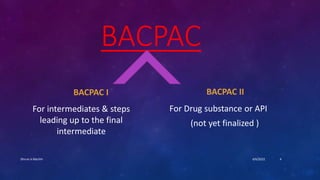
BACPAC
BACPAC I
For intermediates & steps
leading up to the final
intermediate
BACPAC II
For Drug substance or API
(not yet finalized )
4/6/2022
Dhruvi A Machhi 4
B
A
C
K
G
R
O
U
N
D
Under section 506A of the Federal Food, Drug, and Cosmetic Act (the Act),
the holder of an NADA or ANADA must notify FDA about each change in
each condition established in an approved application beyond the
variations already provided for in the application.
THE ACT PROVIDES 4 REPORTING CATEGORIES;
1. Prior Approval Supplement
2. Supplement – Changes Being Effected in 30 days
3. Supplement – Changes Being Effected, and
4. Annual Report
The reporting category for a change is based on the potential for the change to have an
adverse effect on the identity, strength, quality, purity, or potency of the drug product,
Because these actors may relate to the safety or effectiveness of the drug product
4/6/2022
Dhruvi A Machhi 5
INTRODUCTION:-
This guidance provides recommendations to
holders of
• New Animal Drug Applications (NADAs),
• Abbreviated New Animal Drug Applications
(ANADAs)
• Veterinary Master Files (VMFs)
4/6/2022
Dhruvi A Machhi 6
POST APPROVAL CHANGES INCLUDE:-
• site of manufacture
• scale of manufacture
• equipment
• specification
• manufacturing process of intermediates in the synthetic pathway leading to
the drug substance.
4/6/2022
Dhruvi A Machhi 7
POSTAPPROVAL CHANGES AFFECTING THE FOLLOWING ARE
NOT ADDRESSED IN THIS DOCUMENT:
• Synthetic peptides
• Oligonucleotides
• Radiopharmaceuticals
• Drug substances derived exclusively by isolation from natural sources or
produced by
• procedures involving biotechnology
• Nonsynthetic steps for semisynthetic drug substances
4/6/2022
Dhruvi A Machhi 8
ASSESSMENT OF CHANGE
• A holder of an approved application must assess the effects of the change before
distributing a drug product made with a manufacturing change (section 506A(b) of
the Act).
• A central tenet of this guidance is that a given change in the drug substance
manufacturing process can be adequately assessed by comparing pre- and
postchange materials and demonstrating that the postchange material is equivalent
to the prechange material (i.e., of the same or better quality).
• When equivalence cannot be demonstrated, applicants should submit a prior
approval supplement and should consider appropriate tests for qualification of
impurities, demonstration of bioequivalence, and assessment of stability
4/6/2022
Dhruvi A Machhi 9
TWO MAJOR FACTORS FOR DETERMINING EQUIVALENCE IN THE
DRUG SUBSTANCE ARE
1.impurity profile
2.physical properties.
4/6/2022
Dhruvi A Machhi 10
A. EQUIVALENCE OF IMPURITY PROFILES
• The impact of manufacturing modifications on the impurity profile is
evaluated by determining levels of existing impurities and new
impurities.
• It is important to determine the stage in the manufacturing process at
which impurities should be evaluated and to establish the adequacy of
the analytical procedures used for this purpose
• Ideally, impurities should be evaluated in isolated intermediates
immediately following the process step in which the manufacturing
modification is made.
4/6/2022
Dhruvi A Machhi 11
B. EQUIVALENCE OF PHYSICAL PROPERTIES
• Generally, only two physical properties of the drug substance,
1. morphic form and
2. particle size
are considered critical for evaluation of equivalence.
• The physical properties of the drug substance will be considered
equivalent after a given change if three consecutive postmodification
batches of the finished drug substance are compared to three or more
consecutive representative premodification batches and the test data
for each batch demonstrate
4/6/2022
Dhruvi A Machhi 12
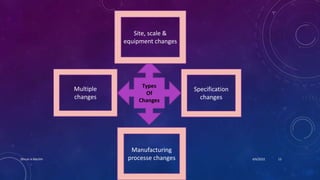
Types
Of
Changes
Site, scale &
equipment changes
Multiple
changes
Specification
changes
Manufacturing
processe changes 4/6/2022
Dhruvi A Machhi 13
The guidance covers:
(1)Site , scale, and equipment changes
involving the synthetic steps up to and including the step that produces the
final intermediate
(2) Specification changes
for raw materials, starting materials & intermediates, except the final
intermediate and
(3) Manufacturing process changes
involving the synthetic steps up to and including the final intermediate
(4) Multiple Changes
combination of all above changes
4/6/2022
Dhruvi A Machhi 14
(1) SITE, SCALE, AND EQUIPMENT CHANGES
The manufacturing site, scale of manufacture, and manufacturing
equipment changes discussed in this section do not include any
modifications to the synthetic pathway (i.e., the same starting
materials, intermediates, solvents, and reagents are involved).
4/6/2022
Dhruvi A Machhi 15
A. Site changes :
• Site changes include changes in location of the site of manufacture of intermediates, including the final
intermediate, for both company-owned and contract manufacturing faciities.
• It also involve the addition of new contract manufacturing facilities or the relocation of manufacturing
facilities.
Test documentation should include ;
• name and address of the new facility
• concise description of the manufacturing steps being transferred, a summary of any variation in
equipment or operating conditions & a statement that the synthetic pathway is identical at the new site
• Evaluation of the impurity profile and physical properties. This
• should include:
– A report on changes in impurities with a description of analytical procedures
– Data on three consecutive batches made at the new site
– Historical data for comparison
4/6/2022
Dhruvi A Machhi 16
Reporting category:
-Annual Report if the site change does not involve the final intermediate
- Supplement :Changes Being Effected if the site change involves the final
intermediate
4/6/2022
Dhruvi A Machhi 17
B. Scale changes
It include increases and decreases in the batch size of
intermediates, Including the final intermediate, beyond those
approved in the original application.
4/6/2022
Dhruvi A Machhi 18
C. Equipment Changes
A change to new equipment need not be submitted to the Agency,
even where equipment is specified in the approved application.
4/6/2022
Dhruvi A Machhi 19
2) specification changes :
• for raw materials, starting materials & intermediates, except
the final intermediate
• Specification changes for the final intermediate are not
included in this guidance, nor are certain specification
changes for raw materials, starting materials, and
intermediates derived from natural sources or biotechnology.
4/6/2022
Dhruvi A Machhi 20
1. Specification Changes Made to Comply with Compendial
Changes
• Test documentation should include:
- description of thechangee
-Updated specifications
• Reporting Category: Annual Report
4/6/2022
Dhruvi A Machhi 21
2. Specification Changes That Provide Greater Assurance of
Quality
Ex: -Tightening of acceptance criteria
-replacing an existing analytical procedure with an improved
pprocedure
• Test Documentation should include:
-Rationale for the proposed change and a brief description of any
new analytical procedures, including a discussion of improvements
over existing procedures.
-Updated specifications.
• Reporting Category: annual report
4/6/2022
Dhruvi A Machhi 22
3. Other Specification Changes
Examples:
• Relaxing acceptance criteria
• Deleting a test
• Test documentation should include:
- Rationale for the proposed change and a brief description of any new analytical
procedures
- Evaluation of the impurity profile and physical properties
• Reporting category :
- Annual Report if an evaluation of the effect of the change on impurity profile
and/or physical properties is not necessary
- Supplement: Changes Being Effected if the effect of the change on impurity
profile and/or physical properties should be demonstrated
4/6/2022
Dhruvi A Machhi 23
(3) Manufacturing Process Changes:
• This category encompasses a wide range of process-related
changes. New specifications may be called for when different
solvents, reagents, starting materials, or intermediates are
involved.
4/6/2022
Dhruvi A Machhi 24
A. Changes That Do Not Involve New Starting Materials or
Intermediates
Ex: made in one or more steps of the synthetic process, purification processes, etc
(1)Addition or deletion of raw materials (e.g., solvents, reagents) or ancillary materials (e.g.,
resins, processing aids)
(2)Operating conditions (e.g., temperature, pH, time)
• Test documentation should include
- Description of change
- Specifications for new reagents and solvents and Certificates of Analysis from suppliers, if
applicable
- Evaluation of the impurity profile and physical properties.
• Reporting Category:
- Annual Report : if equivalence is demonstrated prior to the final intermediate.
- Supplement: Changes Being Effected if equivalence is demonstrated at the final intermediate or
drug substance.
4/6/2022
Dhruvi A Machhi 25
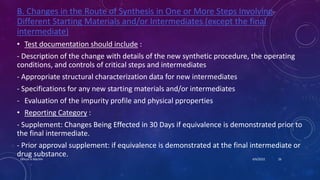
B. Changes in the Route of Synthesis in One or More Steps Involving
Different Starting Materials and/or Intermediates (except the final
intermediate)
• Test documentation should include :
- Description of the change with details of the new synthetic procedure, the operating
conditions, and controls of critical steps and intermediates
- Appropriate structural characterization data for new intermediates
- Specifications for any new starting materials and/or intermediates
- Evaluation of the impurity profile and physical pproperties
• Reporting Category :
- Supplement: Changes Being Effected in 30 Days if equivalence is demonstrated prior to
the final intermediate.
- Prior approval supplement: if equivalence is demonstrated at the final intermediate or
drug substance. 4/6/2022
Dhruvi A Machhi 26
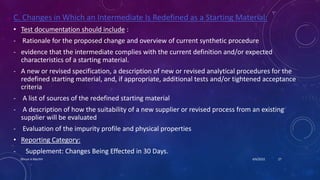
C. Changes in Which an Intermediate Is Redefined as a Starting Material:
• Test documentation should include :
- Rationale for the proposed change and overview of current synthetic procedure
- evidence that the intermediate complies with the current definition and/or expected
characteristics of a starting material.
- A new or revised specification, a description of new or revised analytical procedures for the
redefined starting material, and, if appropriate, additional tests and/or tightened acceptance
criteria
- A list of sources of the redefined starting material
- A description of how the suitability of a new supplier or revised process from an existing
supplier will be evaluated
- Evaluation of the impurity profile and physical properties
• Reporting Category:
- Supplement: Changes Being Effected in 30 Days.
4/6/2022
Dhruvi A Machhi 27
(4) Multiple Changes :
Multiple changes are those that involve various combinations of the
above changes.
4/6/2022
Dhruvi A Machhi 28
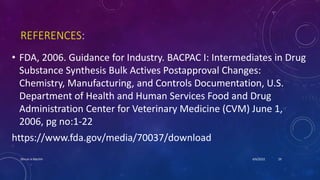
REFERENCES:
• FDA, 2006. Guidance for Industry. BACPAC I: Intermediates in Drug
Substance Synthesis Bulk Actives Postapproval Changes:
Chemistry, Manufacturing, and Controls Documentation, U.S.
Department of Health and Human Services Food and Drug
Administration Center for Veterinary Medicine (CVM) June 1,
2006, pg no:1-22
https://www.fda.gov/media/70037/download
4/6/2022
Dhruvi A Machhi 29
THANK YOU
4/6/2022
Dhruvi A Machhi 30

BACPAC

  • 1.
    Presentation On Bulk Active Chemicals& Post Approval Changes By Machhi Dhruvi Anilkumar From 1st sem M. Pharm (P’ceutical Quality Assurance) Course name & Code: Product Development & Technology Transfer MQA104T Smt. B. N. B. Swaminarayan Pharmacy College, Salvav-vapi 4/6/2022 Dhruvi A Machhi 1
  • 2.
    POST APPROVAL CHANGES: • In recent years, FDA has undertaken an initiative to develop guidance for Postapproval drug manufacturing changes. • Several guidance for drug product manufacturing changes like SUPAC has provided. It include recommendation for following classes ; 1. Immediate release 2. Modified release 3. Non sterile semisolids • While BACPAC is for Bulk Drug Substances and Intermediates. 4/6/2022 Dhruvi A Machhi 2
  • 3.
    INTRODUCTION OF BACPAC:- •BACPAC refers to Bulk Active Chemical & Post Approval Changes . • It is an initiative aimed to develop guidance that allow post approval changes in drug substance synthesis for site, scale & equipment changes. • Two guidelines comes under BACPAC : 1) BACPAC I 2) BACPAC II 3 4/6/2022 Dhruvi A Machhi 3
  • 4.
    BACPAC BACPAC I For intermediates& steps leading up to the final intermediate BACPAC II For Drug substance or API (not yet finalized ) 4/6/2022 Dhruvi A Machhi 4
  • 5.
    B A C K G R O U N D Under section 506Aof the Federal Food, Drug, and Cosmetic Act (the Act), the holder of an NADA or ANADA must notify FDA about each change in each condition established in an approved application beyond the variations already provided for in the application. THE ACT PROVIDES 4 REPORTING CATEGORIES; 1. Prior Approval Supplement 2. Supplement – Changes Being Effected in 30 days 3. Supplement – Changes Being Effected, and 4. Annual Report The reporting category for a change is based on the potential for the change to have an adverse effect on the identity, strength, quality, purity, or potency of the drug product, Because these actors may relate to the safety or effectiveness of the drug product 4/6/2022 Dhruvi A Machhi 5
  • 6.
    INTRODUCTION:- This guidance providesrecommendations to holders of • New Animal Drug Applications (NADAs), • Abbreviated New Animal Drug Applications (ANADAs) • Veterinary Master Files (VMFs) 4/6/2022 Dhruvi A Machhi 6
  • 7.
    POST APPROVAL CHANGESINCLUDE:- • site of manufacture • scale of manufacture • equipment • specification • manufacturing process of intermediates in the synthetic pathway leading to the drug substance. 4/6/2022 Dhruvi A Machhi 7
  • 8.
    POSTAPPROVAL CHANGES AFFECTINGTHE FOLLOWING ARE NOT ADDRESSED IN THIS DOCUMENT: • Synthetic peptides • Oligonucleotides • Radiopharmaceuticals • Drug substances derived exclusively by isolation from natural sources or produced by • procedures involving biotechnology • Nonsynthetic steps for semisynthetic drug substances 4/6/2022 Dhruvi A Machhi 8
  • 9.
    ASSESSMENT OF CHANGE •A holder of an approved application must assess the effects of the change before distributing a drug product made with a manufacturing change (section 506A(b) of the Act). • A central tenet of this guidance is that a given change in the drug substance manufacturing process can be adequately assessed by comparing pre- and postchange materials and demonstrating that the postchange material is equivalent to the prechange material (i.e., of the same or better quality). • When equivalence cannot be demonstrated, applicants should submit a prior approval supplement and should consider appropriate tests for qualification of impurities, demonstration of bioequivalence, and assessment of stability 4/6/2022 Dhruvi A Machhi 9
  • 10.
    TWO MAJOR FACTORSFOR DETERMINING EQUIVALENCE IN THE DRUG SUBSTANCE ARE 1.impurity profile 2.physical properties. 4/6/2022 Dhruvi A Machhi 10
  • 11.
    A. EQUIVALENCE OFIMPURITY PROFILES • The impact of manufacturing modifications on the impurity profile is evaluated by determining levels of existing impurities and new impurities. • It is important to determine the stage in the manufacturing process at which impurities should be evaluated and to establish the adequacy of the analytical procedures used for this purpose • Ideally, impurities should be evaluated in isolated intermediates immediately following the process step in which the manufacturing modification is made. 4/6/2022 Dhruvi A Machhi 11
  • 12.
    B. EQUIVALENCE OFPHYSICAL PROPERTIES • Generally, only two physical properties of the drug substance, 1. morphic form and 2. particle size are considered critical for evaluation of equivalence. • The physical properties of the drug substance will be considered equivalent after a given change if three consecutive postmodification batches of the finished drug substance are compared to three or more consecutive representative premodification batches and the test data for each batch demonstrate 4/6/2022 Dhruvi A Machhi 12
  • 13.
    Types Of Changes Site, scale & equipmentchanges Multiple changes Specification changes Manufacturing processe changes 4/6/2022 Dhruvi A Machhi 13
  • 14.
    The guidance covers: (1)Site, scale, and equipment changes involving the synthetic steps up to and including the step that produces the final intermediate (2) Specification changes for raw materials, starting materials & intermediates, except the final intermediate and (3) Manufacturing process changes involving the synthetic steps up to and including the final intermediate (4) Multiple Changes combination of all above changes 4/6/2022 Dhruvi A Machhi 14
  • 15.
    (1) SITE, SCALE,AND EQUIPMENT CHANGES The manufacturing site, scale of manufacture, and manufacturing equipment changes discussed in this section do not include any modifications to the synthetic pathway (i.e., the same starting materials, intermediates, solvents, and reagents are involved). 4/6/2022 Dhruvi A Machhi 15
  • 16.
    A. Site changes: • Site changes include changes in location of the site of manufacture of intermediates, including the final intermediate, for both company-owned and contract manufacturing faciities. • It also involve the addition of new contract manufacturing facilities or the relocation of manufacturing facilities. Test documentation should include ; • name and address of the new facility • concise description of the manufacturing steps being transferred, a summary of any variation in equipment or operating conditions & a statement that the synthetic pathway is identical at the new site • Evaluation of the impurity profile and physical properties. This • should include: – A report on changes in impurities with a description of analytical procedures – Data on three consecutive batches made at the new site – Historical data for comparison 4/6/2022 Dhruvi A Machhi 16
  • 17.
    Reporting category: -Annual Reportif the site change does not involve the final intermediate - Supplement :Changes Being Effected if the site change involves the final intermediate 4/6/2022 Dhruvi A Machhi 17
  • 18.
    B. Scale changes Itinclude increases and decreases in the batch size of intermediates, Including the final intermediate, beyond those approved in the original application. 4/6/2022 Dhruvi A Machhi 18
  • 19.
    C. Equipment Changes Achange to new equipment need not be submitted to the Agency, even where equipment is specified in the approved application. 4/6/2022 Dhruvi A Machhi 19
  • 20.
    2) specification changes: • for raw materials, starting materials & intermediates, except the final intermediate • Specification changes for the final intermediate are not included in this guidance, nor are certain specification changes for raw materials, starting materials, and intermediates derived from natural sources or biotechnology. 4/6/2022 Dhruvi A Machhi 20
  • 21.
    1. Specification ChangesMade to Comply with Compendial Changes • Test documentation should include: - description of thechangee -Updated specifications • Reporting Category: Annual Report 4/6/2022 Dhruvi A Machhi 21
  • 22.
    2. Specification ChangesThat Provide Greater Assurance of Quality Ex: -Tightening of acceptance criteria -replacing an existing analytical procedure with an improved pprocedure • Test Documentation should include: -Rationale for the proposed change and a brief description of any new analytical procedures, including a discussion of improvements over existing procedures. -Updated specifications. • Reporting Category: annual report 4/6/2022 Dhruvi A Machhi 22
  • 23.
    3. Other SpecificationChanges Examples: • Relaxing acceptance criteria • Deleting a test • Test documentation should include: - Rationale for the proposed change and a brief description of any new analytical procedures - Evaluation of the impurity profile and physical properties • Reporting category : - Annual Report if an evaluation of the effect of the change on impurity profile and/or physical properties is not necessary - Supplement: Changes Being Effected if the effect of the change on impurity profile and/or physical properties should be demonstrated 4/6/2022 Dhruvi A Machhi 23
  • 24.
    (3) Manufacturing ProcessChanges: • This category encompasses a wide range of process-related changes. New specifications may be called for when different solvents, reagents, starting materials, or intermediates are involved. 4/6/2022 Dhruvi A Machhi 24
  • 25.
    A. Changes ThatDo Not Involve New Starting Materials or Intermediates Ex: made in one or more steps of the synthetic process, purification processes, etc (1)Addition or deletion of raw materials (e.g., solvents, reagents) or ancillary materials (e.g., resins, processing aids) (2)Operating conditions (e.g., temperature, pH, time) • Test documentation should include - Description of change - Specifications for new reagents and solvents and Certificates of Analysis from suppliers, if applicable - Evaluation of the impurity profile and physical properties. • Reporting Category: - Annual Report : if equivalence is demonstrated prior to the final intermediate. - Supplement: Changes Being Effected if equivalence is demonstrated at the final intermediate or drug substance. 4/6/2022 Dhruvi A Machhi 25
  • 26.
    B. Changes inthe Route of Synthesis in One or More Steps Involving Different Starting Materials and/or Intermediates (except the final intermediate) • Test documentation should include : - Description of the change with details of the new synthetic procedure, the operating conditions, and controls of critical steps and intermediates - Appropriate structural characterization data for new intermediates - Specifications for any new starting materials and/or intermediates - Evaluation of the impurity profile and physical pproperties • Reporting Category : - Supplement: Changes Being Effected in 30 Days if equivalence is demonstrated prior to the final intermediate. - Prior approval supplement: if equivalence is demonstrated at the final intermediate or drug substance. 4/6/2022 Dhruvi A Machhi 26
  • 27.
    C. Changes inWhich an Intermediate Is Redefined as a Starting Material: • Test documentation should include : - Rationale for the proposed change and overview of current synthetic procedure - evidence that the intermediate complies with the current definition and/or expected characteristics of a starting material. - A new or revised specification, a description of new or revised analytical procedures for the redefined starting material, and, if appropriate, additional tests and/or tightened acceptance criteria - A list of sources of the redefined starting material - A description of how the suitability of a new supplier or revised process from an existing supplier will be evaluated - Evaluation of the impurity profile and physical properties • Reporting Category: - Supplement: Changes Being Effected in 30 Days. 4/6/2022 Dhruvi A Machhi 27
  • 28.
    (4) Multiple Changes: Multiple changes are those that involve various combinations of the above changes. 4/6/2022 Dhruvi A Machhi 28
  • 29.
    REFERENCES: • FDA, 2006.Guidance for Industry. BACPAC I: Intermediates in Drug Substance Synthesis Bulk Actives Postapproval Changes: Chemistry, Manufacturing, and Controls Documentation, U.S. Department of Health and Human Services Food and Drug Administration Center for Veterinary Medicine (CVM) June 1, 2006, pg no:1-22 https://www.fda.gov/media/70037/download 4/6/2022 Dhruvi A Machhi 29
  • 30.