PHARMACEUTICAL QUALITY
MANAGEMENT SYSTEM
MUHAMMAD DANISH
PHARMACEUTICAL QUALITY SYSTEM
A Pharmaceutical Quality System (PQS) is a management system to direct and control a
pharmaceutical company in terms of quality.
Quality Management is a wide-ranging concept, which covers all matters, which individually or
collectively influence the quality of a product.
Quality management is the overall intention and direction of an organization regarding quality, as
formally expressed and authorized by top management.
PHARMACEUTICAL QUALITY SYSTEM
PRINCIPLE
The holder of a Manufacturing Authorisation must manufacture medicinal products so as:
To ensure that they are fit for their intended use
Comply with the requirements of the Marketing Authorisation or Clinical Trial Authorisation
Do not place patients at risk due to inadequate safety, quality or efficacy.
RESPONSIBILITY
The attainment of this quality objective is the responsibility of senior management
Participation and commitment by staff in many different departments
Participation by the companyโ€™s suppliers and by its distributors.
PHARMACEUTICAL QUALITY SYSTEM
QUALITY MANAGEMENT โ€“ AN INTEGRATED APPROCH
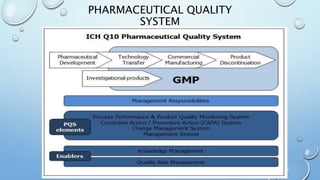
ICH Q10 describes comprehensive model for an effective
pharmaceutical quality system
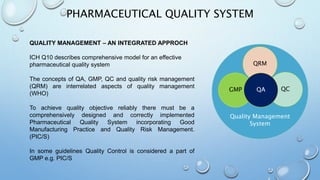
The concepts of QA, GMP, QC and quality risk management
(QRM) are interrelated aspects of quality management
(WHO)
To achieve quality objective reliably there must be a
comprehensively designed and correctly implemented
Pharmaceutical Quality System incorporating Good
Manufacturing Practice and Quality Risk Management.
(PIC/S)
In some guidelines Quality Control is considered a part of
GMP e.g. PIC/S
Quality Management
System
GMP
QRM
QC
QA
PHARMACEUTICAL QUALITY SYSTEM
International Council For Harmonization (ICH Q 10)
๏ฑ Regional GMP requirements, the ICH Q7 Guideline and ISO quality management system
guidelines form the foundation for ICH Q10.
๏ฑ Use of knowledge management and quality risk management will enable a company to
implement ICH Q10 effectively and successfully.
๏ฑ A Quality Manual or equivalent documentation approach should be established and should
contain the description of the pharmaceutical quality system.
PHARMACEUTICAL QUALITY SYSTEM
Objectives
Like every quality system there are three main objectives of Pharmaceutical QMS which
complement GMP requirements.
Achieve Product Realisation
To establish, implement and maintain a system that allows the delivery of products with the quality
attributes appropriate.
Establish and Maintain a State of Control
To develop and use effective monitoring and control systems for process performance and product
quality.
Facilitate Continual Improvement
To identify and implement appropriate product quality & process improvements thereby increasing
the ability to fulfil quality needs consistently.
International Council For Harmonization (ICH Q 10)
PHARMACEUTICAL QUALITY SYSTEM
To achieve this quality objective reliably there must be:
Comprehensively designed and correctly implemented Pharmaceutical Quality System incorporating Good
Manufacturing Practice and Quality Risk Management.
It should be fully documented and its effectiveness monitored.
All parts of the Pharmaceutical Quality System should be adequately resourced with competent personnel,
and suitable and sufficient premises, equipment and facilities.
There are additional legal responsibilities for the holder of the Manufacturing Authorization and for the
Qualified Person(s).
International Council For Harmonization (ICH Q 10)
PHARMACEUTICAL QUALITY SYSTEM
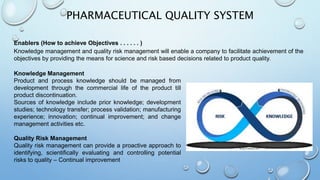
Enablers (How to achieve Objectives . . . . . . )
Knowledge management and quality risk management will enable a company to facilitate achievement of the
objectives by providing the means for science and risk based decisions related to product quality.
Knowledge Management
Product and process knowledge should be managed from
development through the commercial life of the product till
product discontinuation.
Sources of knowledge include prior knowledge; development
studies; technology transfer; process validation; manufacturing
experience; innovation; continual improvement; and change
management activities etc.
Quality Risk Management
Quality risk management can provide a proactive approach to
identifying, scientifically evaluating and controlling potential
risks to quality โ€“ Continual improvement
PHARMACEUTICAL QUALITY
SYSTEM
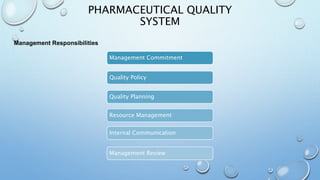
Management Responsibilities
Management Commitment
Quality Policy
Quality Planning
Resource Management
Internal Communication
Management Review
PHARMACEUTICAL QUALITY
SYSTEM
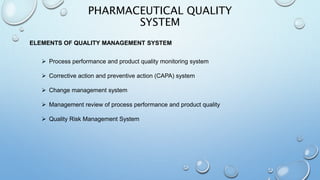
ELEMENTS OF QUALITY MANAGEMENT SYSTEM
๏ƒ˜ Process performance and product quality monitoring system
๏ƒ˜ Corrective action and preventive action (CAPA) system
๏ƒ˜ Change management system
๏ƒ˜ Management review of process performance and product quality
๏ƒ˜ Quality Risk Management System
PHARMACEUTICAL QUALITY
SYSTEM
THANK YOU

Pharmaceutical Quality Management System

  • 1.
  • 2.
    PHARMACEUTICAL QUALITY SYSTEM APharmaceutical Quality System (PQS) is a management system to direct and control a pharmaceutical company in terms of quality. Quality Management is a wide-ranging concept, which covers all matters, which individually or collectively influence the quality of a product. Quality management is the overall intention and direction of an organization regarding quality, as formally expressed and authorized by top management.
  • 3.
    PHARMACEUTICAL QUALITY SYSTEM PRINCIPLE Theholder of a Manufacturing Authorisation must manufacture medicinal products so as: To ensure that they are fit for their intended use Comply with the requirements of the Marketing Authorisation or Clinical Trial Authorisation Do not place patients at risk due to inadequate safety, quality or efficacy. RESPONSIBILITY The attainment of this quality objective is the responsibility of senior management Participation and commitment by staff in many different departments Participation by the companyโ€™s suppliers and by its distributors.
  • 4.
    PHARMACEUTICAL QUALITY SYSTEM QUALITYMANAGEMENT โ€“ AN INTEGRATED APPROCH ICH Q10 describes comprehensive model for an effective pharmaceutical quality system The concepts of QA, GMP, QC and quality risk management (QRM) are interrelated aspects of quality management (WHO) To achieve quality objective reliably there must be a comprehensively designed and correctly implemented Pharmaceutical Quality System incorporating Good Manufacturing Practice and Quality Risk Management. (PIC/S) In some guidelines Quality Control is considered a part of GMP e.g. PIC/S Quality Management System GMP QRM QC QA
  • 5.
    PHARMACEUTICAL QUALITY SYSTEM InternationalCouncil For Harmonization (ICH Q 10) ๏ฑ Regional GMP requirements, the ICH Q7 Guideline and ISO quality management system guidelines form the foundation for ICH Q10. ๏ฑ Use of knowledge management and quality risk management will enable a company to implement ICH Q10 effectively and successfully. ๏ฑ A Quality Manual or equivalent documentation approach should be established and should contain the description of the pharmaceutical quality system.
  • 6.
    PHARMACEUTICAL QUALITY SYSTEM Objectives Likeevery quality system there are three main objectives of Pharmaceutical QMS which complement GMP requirements. Achieve Product Realisation To establish, implement and maintain a system that allows the delivery of products with the quality attributes appropriate. Establish and Maintain a State of Control To develop and use effective monitoring and control systems for process performance and product quality. Facilitate Continual Improvement To identify and implement appropriate product quality & process improvements thereby increasing the ability to fulfil quality needs consistently. International Council For Harmonization (ICH Q 10)
  • 7.
    PHARMACEUTICAL QUALITY SYSTEM Toachieve this quality objective reliably there must be: Comprehensively designed and correctly implemented Pharmaceutical Quality System incorporating Good Manufacturing Practice and Quality Risk Management. It should be fully documented and its effectiveness monitored. All parts of the Pharmaceutical Quality System should be adequately resourced with competent personnel, and suitable and sufficient premises, equipment and facilities. There are additional legal responsibilities for the holder of the Manufacturing Authorization and for the Qualified Person(s). International Council For Harmonization (ICH Q 10)
  • 8.
    PHARMACEUTICAL QUALITY SYSTEM Enablers(How to achieve Objectives . . . . . . ) Knowledge management and quality risk management will enable a company to facilitate achievement of the objectives by providing the means for science and risk based decisions related to product quality. Knowledge Management Product and process knowledge should be managed from development through the commercial life of the product till product discontinuation. Sources of knowledge include prior knowledge; development studies; technology transfer; process validation; manufacturing experience; innovation; continual improvement; and change management activities etc. Quality Risk Management Quality risk management can provide a proactive approach to identifying, scientifically evaluating and controlling potential risks to quality โ€“ Continual improvement
  • 9.
    PHARMACEUTICAL QUALITY SYSTEM Management Responsibilities ManagementCommitment Quality Policy Quality Planning Resource Management Internal Communication Management Review
  • 10.
    PHARMACEUTICAL QUALITY SYSTEM ELEMENTS OFQUALITY MANAGEMENT SYSTEM ๏ƒ˜ Process performance and product quality monitoring system ๏ƒ˜ Corrective action and preventive action (CAPA) system ๏ƒ˜ Change management system ๏ƒ˜ Management review of process performance and product quality ๏ƒ˜ Quality Risk Management System
  • 11.
  • 12.