DESIGNING RESEARCH
INSTRUMENTS, INTERVIEW
GUIDES AND SKILLS
Mengistu Meskele (PhD; Associate Professor)
1
Introduction
The validity of results and quality of research depends to a large extent on the quality of the
data collection instruments/tools/questionnaire.
Much of the data in medical research is collected using Interviews and administering
questionnaires.
Therefore designing a good ‘questionnaire’ is an important part in the development of a
research proposal.
There are various types of questions used to collect the data; some of them are as follows:
2
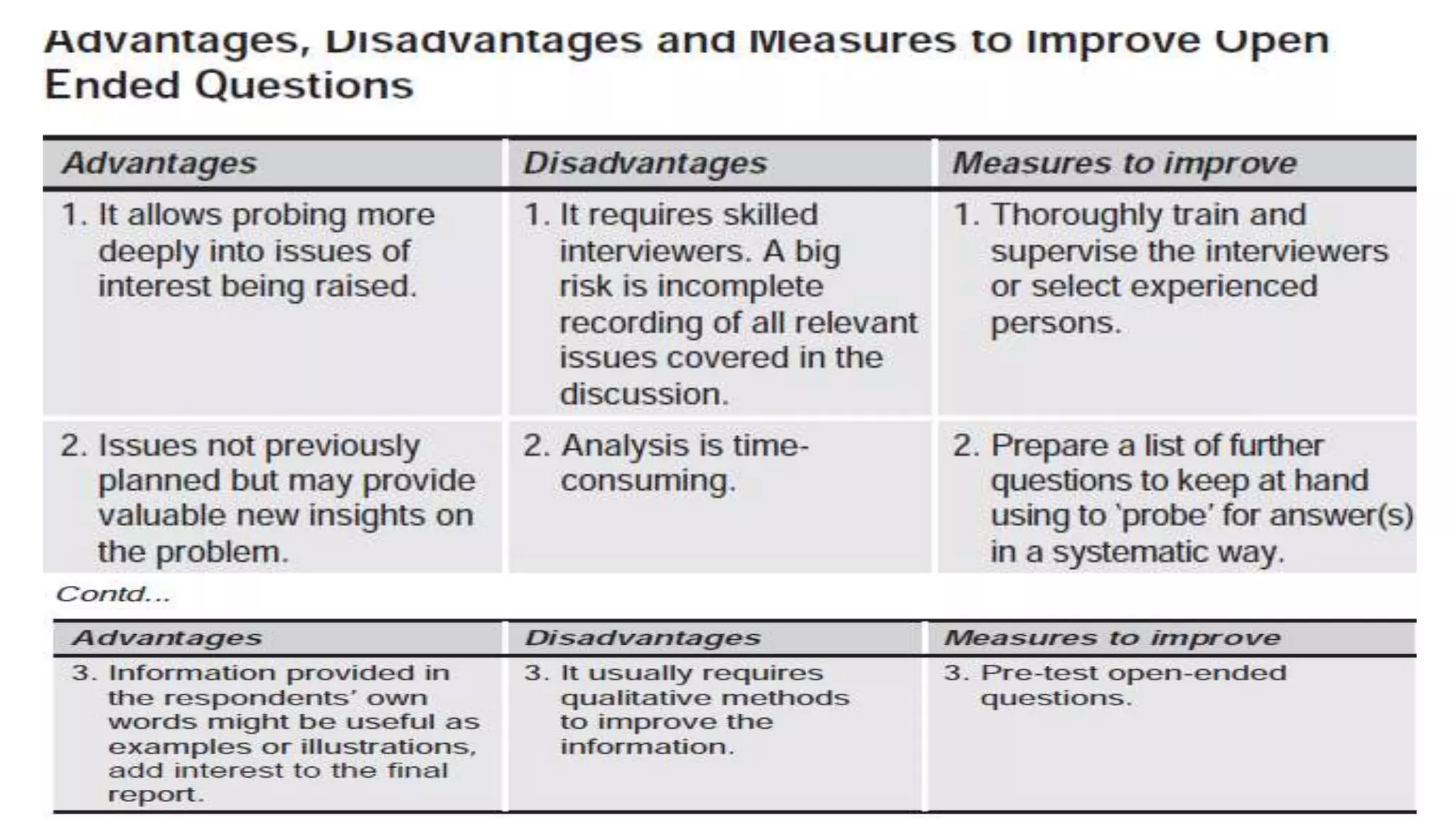
Open Ended Questions
Open-ended questions give the respondent freedom to answer and the responses are recorded in the
respondents’ own words.
Such questions are useful for obtaining in-depth information on: facts with which the researcher is not
very familiar, opinions, attitudes and suggestions of informants, or sensitive issues.
Examples - What were the reasons to stop alcohol?
What did you do when you came to know that you have HIV infection?
What habits do you believe increase chances of coronary heart disease?
What is your opinion on the Janani Suraksha Yojana (JSY)/ Maternity Benefit Scheme in India?
3
4
Experiencing (Through Observation and Field Notes)
Observation is a technique that involves
Systematically selecting, watching and recording behavior and characteristics of living beings,
objects or phenomena.
Scientific inquiry using observational methods requires disciplined, trained and skilled
observer.
5
Qualities of a good observer
include:
Paying attention, seeing what to see, and hearing what to hear as per the objectives of the
research question
Good practice in writing descriptively
•Acquired expertise in recording field notes
 Knowledge of how to separate detail from trivia without being overwhelmed by the latter
Use of rigorous methods to validate and triangulate observations
 Report the strengths and limitations of one’s own perspective, which requires both self-
knowledge and disclosure.
6
The Purpose of Direct Observation
 Describe the setting in order to understand the context.
 Find out things that would normally be taken for granted by someone who is routinely
exposed to the setting.
 Observe what people may be unwilling to talk about in the interview.
 Confirm the perceptions reported by interviewees.
 Provide the researcher with first-hand knowledge of the setting during the analysis and
interpretation stage.
The impressions and feelings of the observer become part of the data.
7
Observational Methods
Participatory
Non-participatory, i.e. emic vs. etic perspectives
Solo vs. Team observations (participatory vs. collaborative approaches
Overt vs. covert observations(the argument goes, covert observations are more likely to find
out what is really happening than overt observations where people in the setting are aware that
they are being studied)
Variations in the duration of observations(1 hour, months)
Variations in the observational focus of the study
8
Observation–Sources of Data
Physical setting
Social environment
Historical information
Planned program activities
Informal interactions and unplanned activities
Local or “Native” language of the program(include the exact language used by participants)
Nonverbal communication
9
Observation–Sources of Data
Unobtrusive observations(Unobtrusive measures are those made without the knowledge of the
people being observed and without affecting what is observed.)
Documents review/using available information
Observing what does not happen
Observing oneself(conscious of the cultural, political, linguistic, ideological origins of his/her
own perspective and voice)
10
Enquiry
Interviewing
An interview is a data collection technique that involves oral questioning of respondents,
either individually or as a group.
Answers to the questions posed during an interview can be recorded by writing them down or
by tape-recording the responses, or the combination of both.
11
Wording of questions
How a question is worded affects the interviewee response
Asking questions is an art
They should be genuinely open-ended, neutral, singular and clear.
A genuinely open-ended question minimizes the possibility of imposing predetermined responses, e.g. “How do
you feel about... ?” is open-ended whereas “How satisfied are you with ...?” already presupposes an answer
about satisfaction
Avoid questions that will lead to Yes/No answers, e.g., “Are you satisfied with ...?” Neutral questions refer to the
non judgementalism adopted by the interviewer.
Singular questions ensure that not more than one idea is contained in any given question.
12
Wording of questions…
“How well do you know and like the staff in this clinic?” contains two ideas?
The clarity of questions is enhanced by asking simple, understandable, unambiguous
questions, using language and terminology that is familiar to the respondent.
13
Wording of questions…
Why questions: One should take care about asking ‘why questions’. They imply causal
relationships, which may be complex to unravel and may make respondents feel defensive.
Think of other ways of asking what you want to know.
The final or closing question:
It provides the interviewee with the opportunity to have the final say, e.g. “That covers all I
wanted to ask. Anything you would like to add?”
14
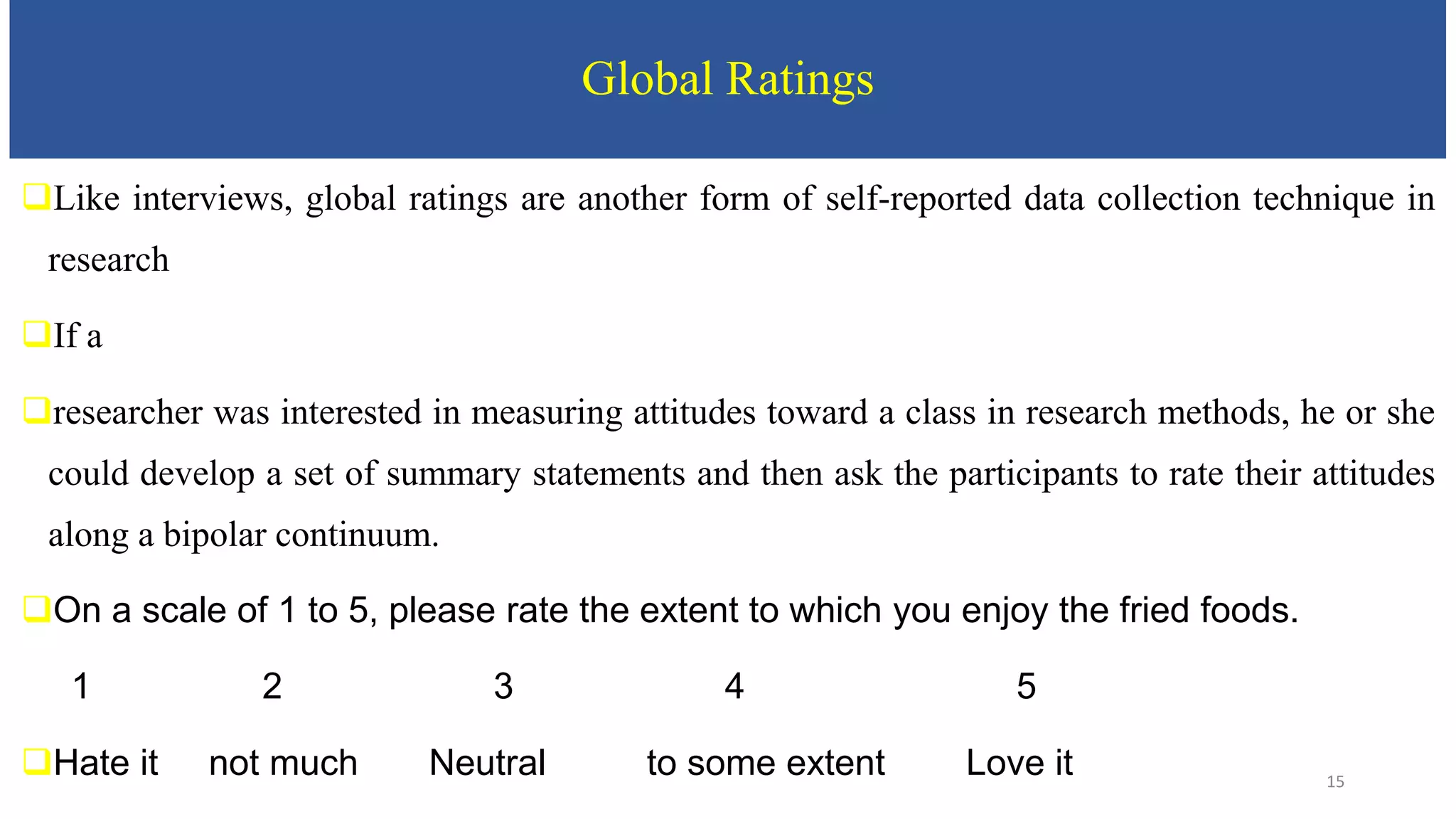
Global Ratings
Like interviews, global ratings are another form of self-reported data collection technique in
research
If a
researcher was interested in measuring attitudes toward a class in research methods, he or she
could develop a set of summary statements and then ask the participants to rate their attitudes
along a bipolar continuum.
On a scale of 1 to 5, please rate the extent to which you enjoy the fried foods.
1 2 3 4 5
Hate it not much Neutral to some extent Love it 15
Focus Group Discussion (FGD)
Qualitative research methods with a small group of people (6–10) with similar backgrounds
who participate in the discussion for 1–2 hours.
The objective is to get high quality data in a social context where people can consider their
own views in the context of the views of others.
16
FGD…
Two people need to conduct the focus group discussion–one who concentrates on
moderating/facilitating the discussion, and the other who concentrates on taking detailed notes,
and who also deals with mechanics, e.g. video cameras, tape recorders, and with any special
needs that arise, e.g. someone leaving early, or becoming distraught during the discussion.
17
The advantages of focus group discussions
 Cost effective: In an hour, one can gather information from eight people as opposed to just one person.
 Interactions between participants enhance the quality of the data.
Participants tend to provide checks and balance for each other which reject false or extreme views.
The extent to which there is a relatively consistent, shared view or great diversity of views can quickly
be assessed.
They tend to be enjoyable for participants, drawing on their natural social tendencies.
18
The limitations of focus group discussions are:
 The number of questions that can be asked is greatly restricted in th group setting. The available response time for each individual is
constrained by
 having to hear from everyone. A rule of thumb: “With eight people
 and one hour for the focus group discussion aim to ask no more than
 10 major questions”.
 • Facilitating a focus group requires considerable group process skill
 beyond simply asking questions. The moderator must manage the
 discussion so that one or two people do not dominate it, and enable
 those that are less verbal to share their views.
 • Those who realize that their view is a minority perspective may not be
 inclined to speak up and risk negative reactions.
19
The limitations of focus group discussions are
 Focus groups work best when people in the group, though sharing
 similar background, are strangers to each other. The dynamics are
 quite different and more complex when participants have prior
 established relationships.
 • Controversial and highly personal issues are poor topics for focus
 groups.
 • Confidentiality cannot be assured in focus groups.
 • The focus group is beneficial for identification of major themes, but
 not so much for the micro-analysis of subtle differences.
 • Focus groups have the disadvantage of taking place outside the natural
 setting where social interactions normally occur.
20
21
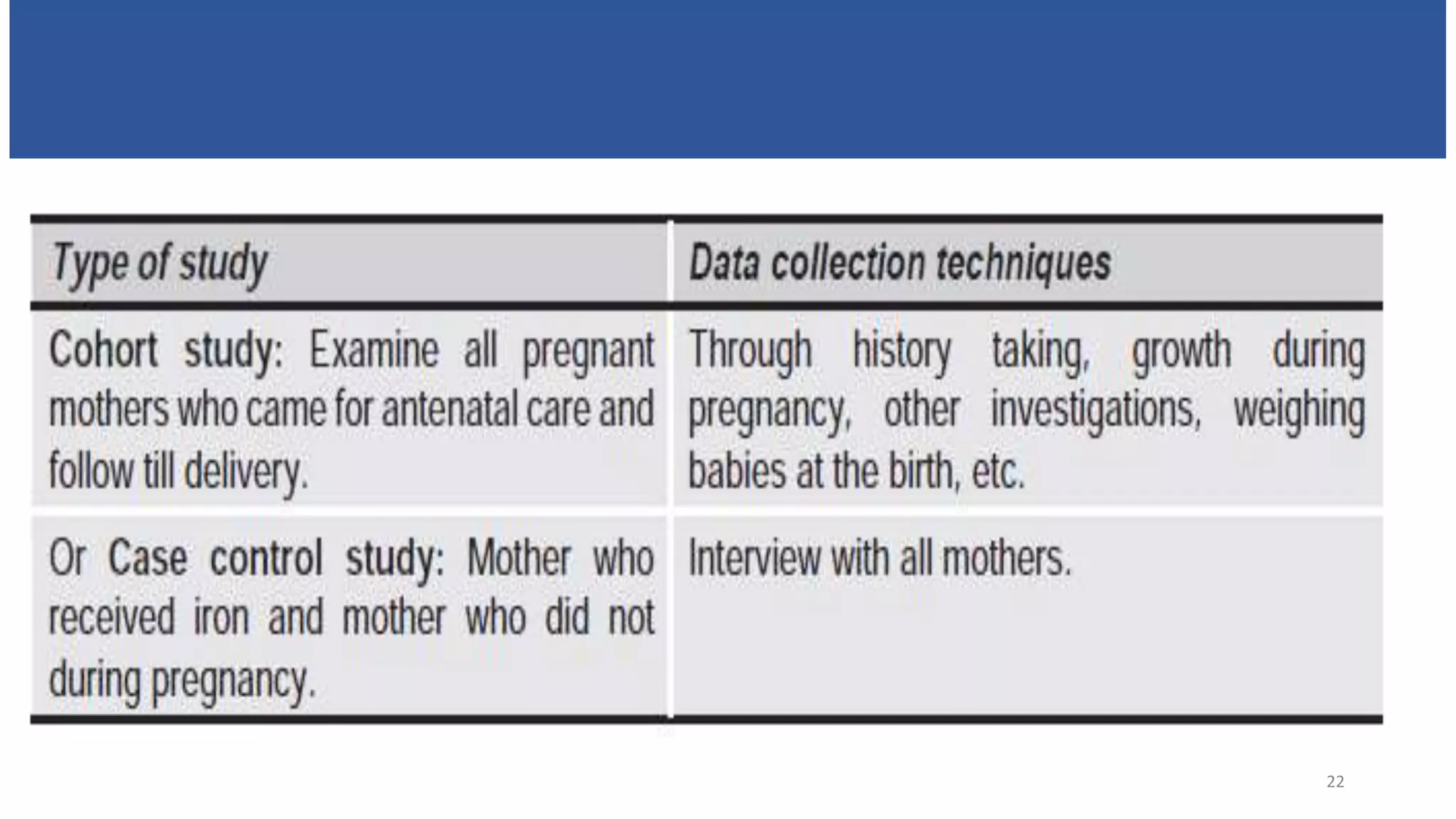
22
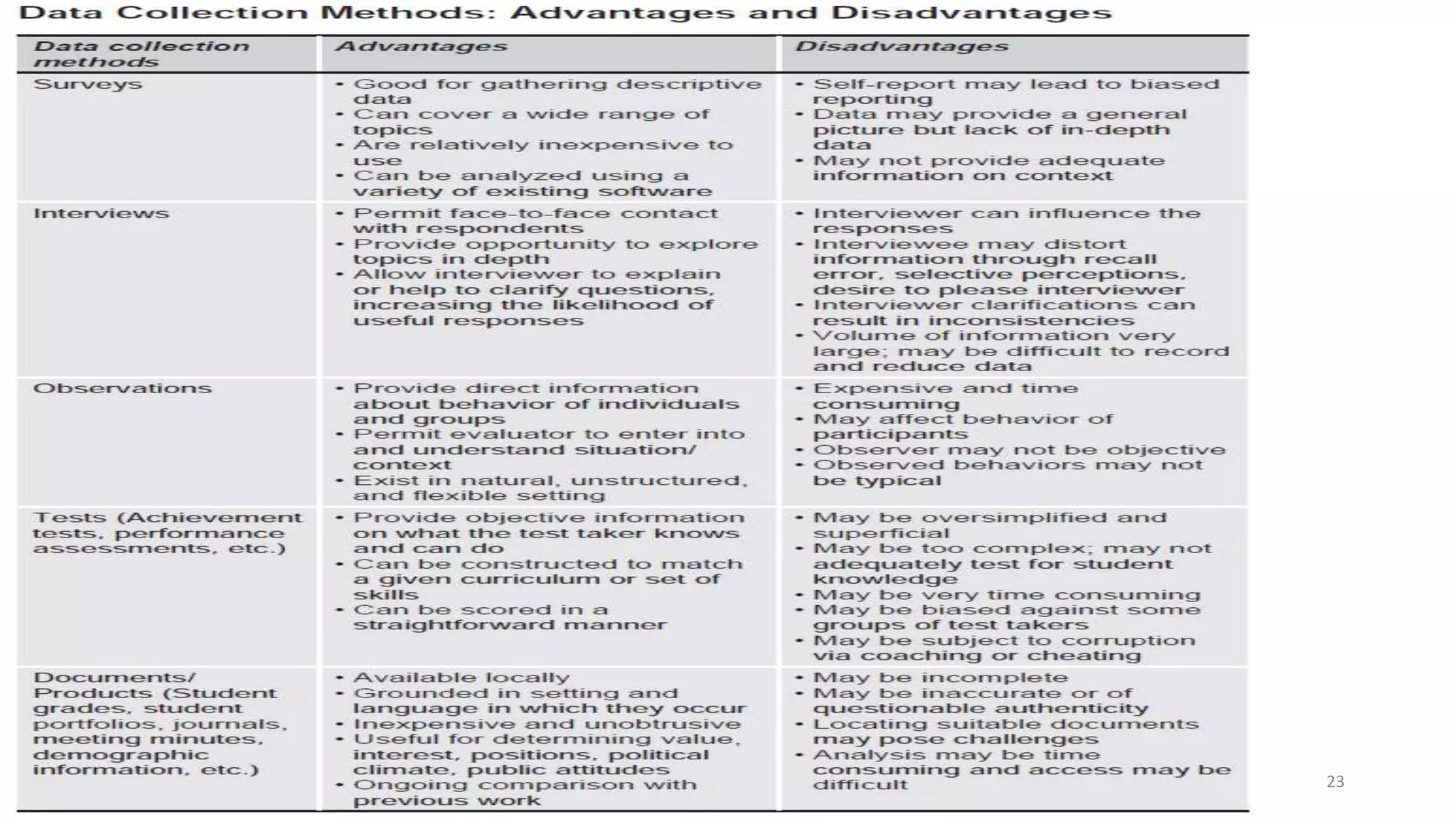
23
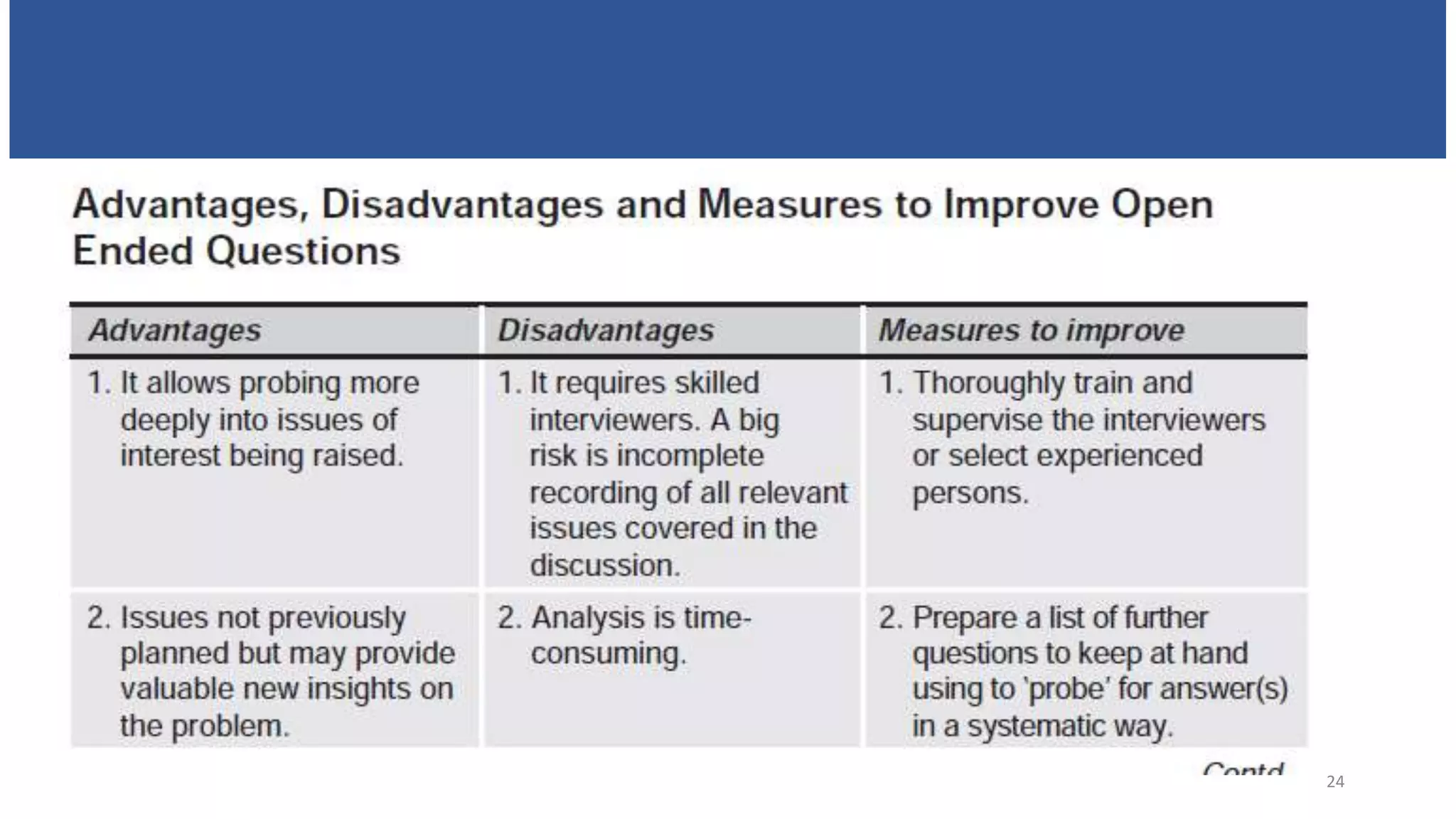
24
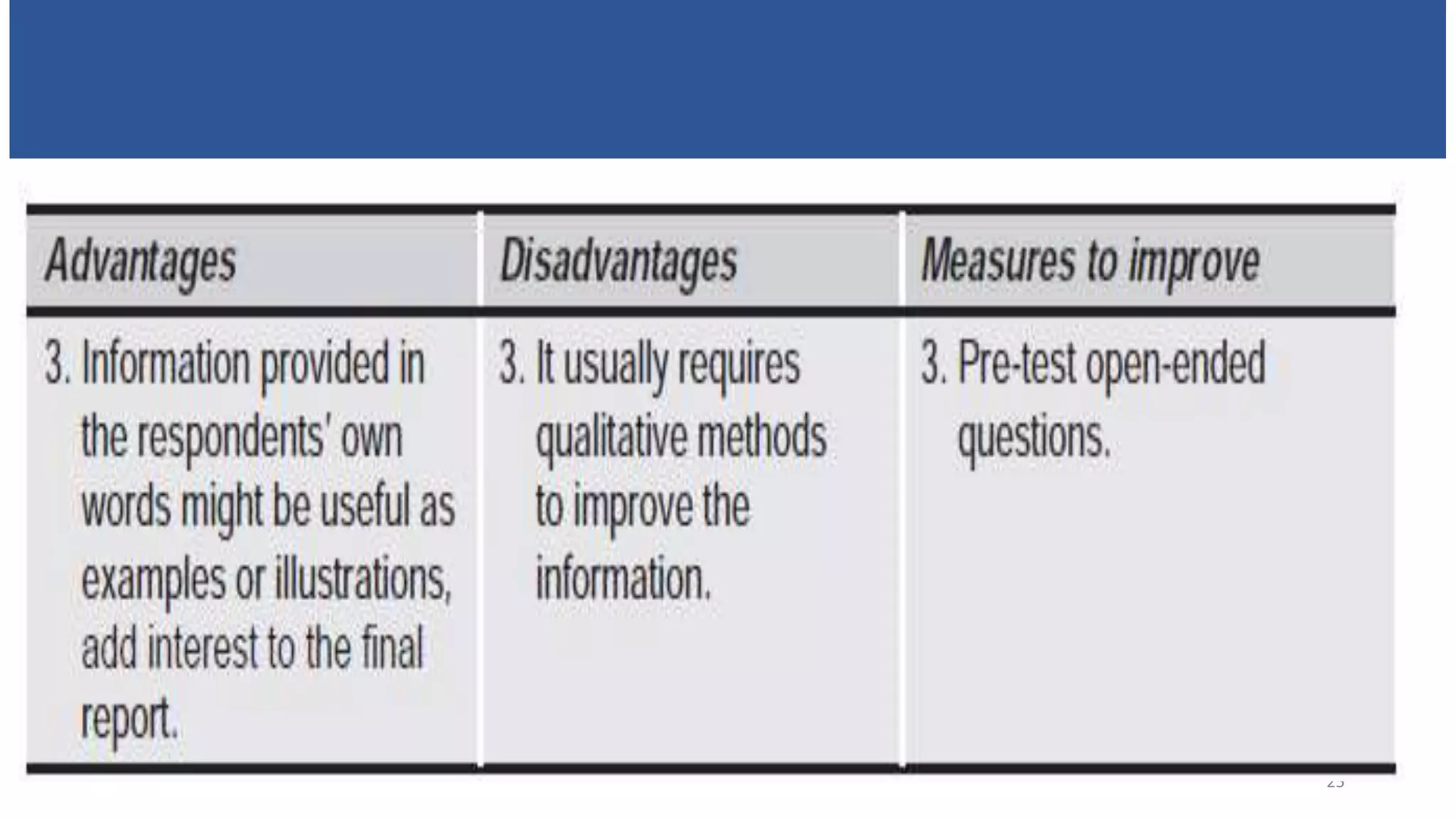
25
Closed Ended Questions
Some of the closed ended questions are as follows:
a. Dichotomous questions:
Example: Have you ever had an accident? 1. Yes 2. No
 Do you eat an egg everyday? 1. Yes 2. NO
b. Multiple-Choice Questions:
Example: How important is it to you to attend a lecture?
i. Extremely important
ii. Very important
iii. Somewhat important
iv. Not at all important 26
Cafeteria questions:
Example: People have different opinions about the use of estrogen replacement therapy for
women in menopause. Which of the following statements best represents your point of view?
i. Estrogen replacement is dangerous and should be totally banned.
ii. Estrogen replacement may have some undesirable side effects and needs caution in use.
iii. I am undecided about the use of estrogen replacement.
iv. Estrogen replacement has beneficial effect and needs to be promoted.
v. Estrogen replacement therapy is wonder cure that should be administered routinely to
menopausal women.
27
Rank order Questions:
Example: Please indicate the priority of your life by putting the number in decreasing order (1 being the first, 2 being
the next and so on.
1. Wealth
2. Health
3. Friendship
4. Family
5. Relationship
6. Success
7. Promotions
8. Religion
28
Force Choice questions
Example: Which statement more closely represents your view point?
1. I am meticulous in my planning.
2. I think, I don’t have good communication skills
29
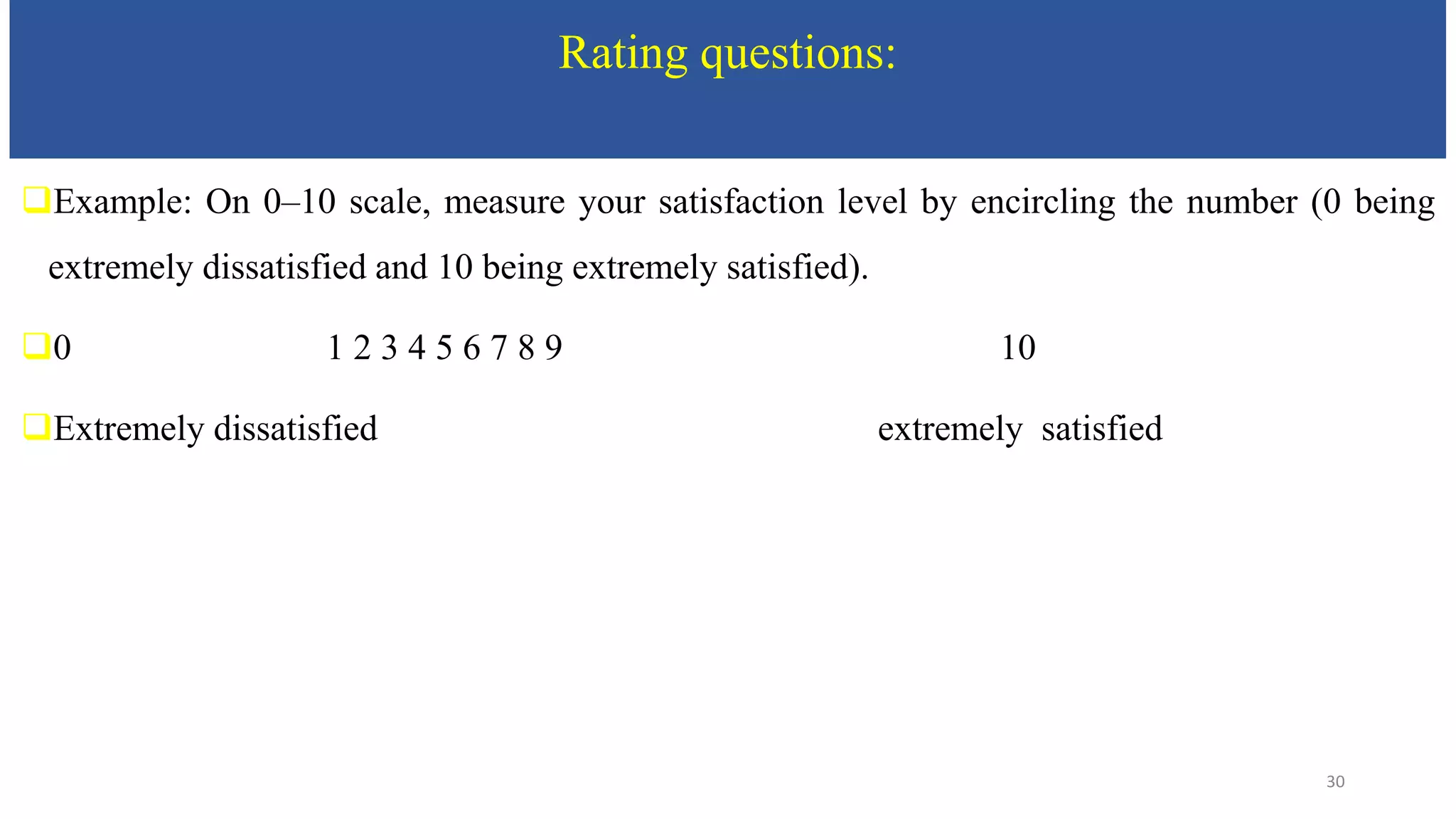
Rating questions:
Example: On 0–10 scale, measure your satisfaction level by encircling the number (0 being
extremely dissatisfied and 10 being extremely satisfied).
0 1 2 3 4 5 6 7 8 9 10
Extremely dissatisfied extremely satisfied
30
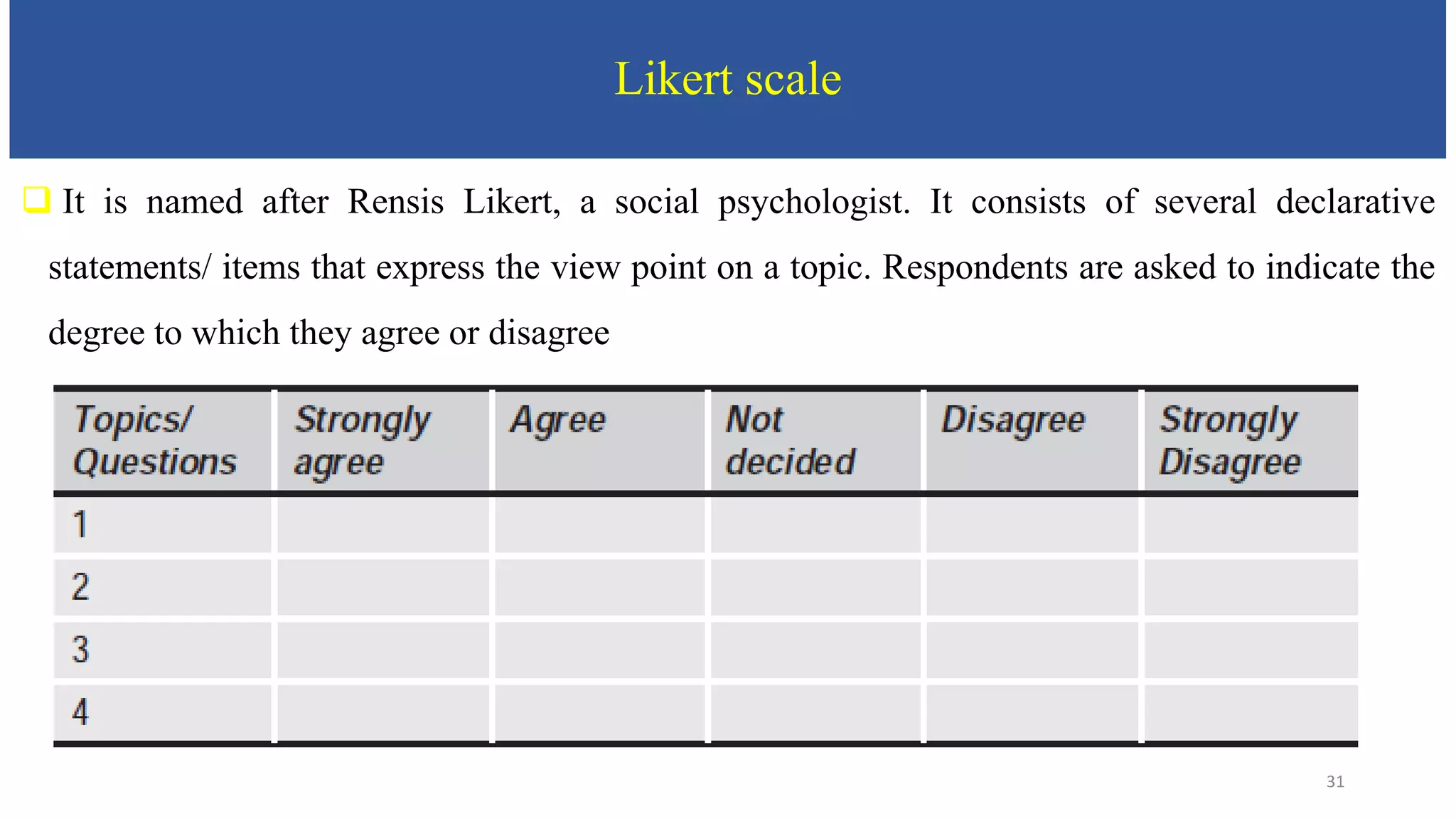
Likert scale
 It is named after Rensis Likert, a social psychologist. It consists of several declarative
statements/ items that express the view point on a topic. Respondents are asked to indicate the
degree to which they agree or disagree
31
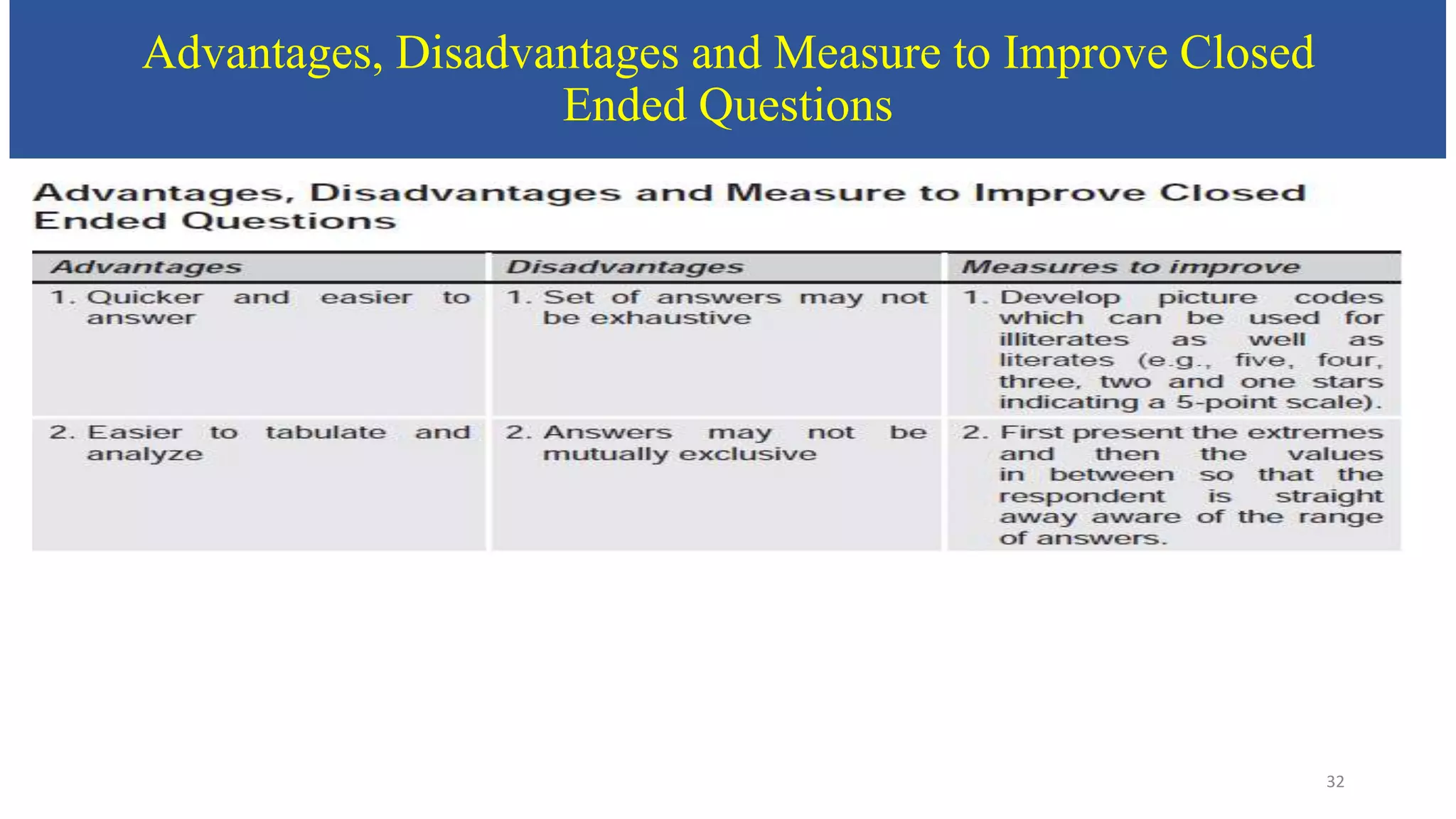
Advantages, Disadvantages and Measure to Improve Closed
Ended Questions
32
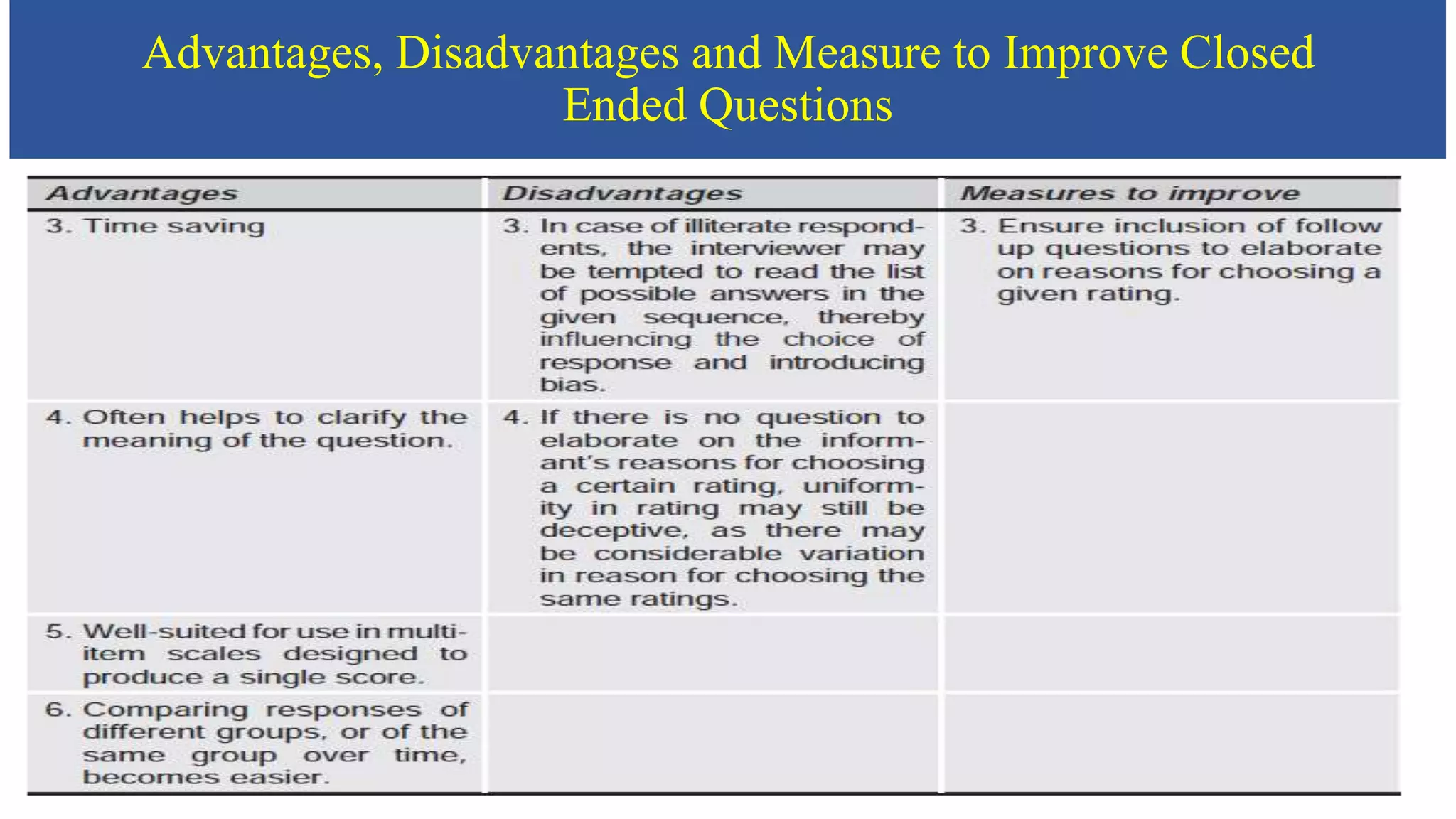
Advantages, Disadvantages and Measure to Improve Closed
Ended Questions
33
Designing the Questionnaire/Interview Tool
State objectives and variables of the research study.
Formulate one or more questions that will provide the information needed for each variable.
Check whether each question measures one thing at a time.
Avoid leading questions.
 Use proper wordings.
Ask sensitive questions in a socially acceptable way.
Design your interview schedule or questionnaire to be ‘informant friendly’.
34
Designing the Questionnaire/Interview Tool…
Translation is needed if interviews are to be conducted in one or more local languages. The
questionnaire should be translated in order to standardize the way questions will be asked.
After having it translated, it should be retranslated into the original language by a different
person. One can then compare the two versions
for differences and make decisions concerning the final phrasing of
difficult questions.

35
Avoid Pitfalls
• Double barreled questions:
Each question should contain only one concept. Use of words like “and/or” sometimes lead to
undesirable response.
Example: How many cups of coffee or tea do you drink per day? (it is better to break this
question in two, asking separately for coffee and tea).
Hidden assumptions: There should not be any preconceived assumptions for getting the
answer to a question.
The question and answer options do not match. It is important that the question matches the
options provided for the answer, a task that seems simple but is often done incorrectly
36
 Thank you!
37

Questionnaire Design _MM.pptx

  • 1.
    DESIGNING RESEARCH INSTRUMENTS, INTERVIEW GUIDESAND SKILLS Mengistu Meskele (PhD; Associate Professor) 1
  • 2.
    Introduction The validity ofresults and quality of research depends to a large extent on the quality of the data collection instruments/tools/questionnaire. Much of the data in medical research is collected using Interviews and administering questionnaires. Therefore designing a good ‘questionnaire’ is an important part in the development of a research proposal. There are various types of questions used to collect the data; some of them are as follows: 2
  • 3.
    Open Ended Questions Open-endedquestions give the respondent freedom to answer and the responses are recorded in the respondents’ own words. Such questions are useful for obtaining in-depth information on: facts with which the researcher is not very familiar, opinions, attitudes and suggestions of informants, or sensitive issues. Examples - What were the reasons to stop alcohol? What did you do when you came to know that you have HIV infection? What habits do you believe increase chances of coronary heart disease? What is your opinion on the Janani Suraksha Yojana (JSY)/ Maternity Benefit Scheme in India? 3
  • 4.
  • 5.
    Experiencing (Through Observationand Field Notes) Observation is a technique that involves Systematically selecting, watching and recording behavior and characteristics of living beings, objects or phenomena. Scientific inquiry using observational methods requires disciplined, trained and skilled observer. 5
  • 6.
    Qualities of agood observer include: Paying attention, seeing what to see, and hearing what to hear as per the objectives of the research question Good practice in writing descriptively •Acquired expertise in recording field notes  Knowledge of how to separate detail from trivia without being overwhelmed by the latter Use of rigorous methods to validate and triangulate observations  Report the strengths and limitations of one’s own perspective, which requires both self- knowledge and disclosure. 6
  • 7.
    The Purpose ofDirect Observation  Describe the setting in order to understand the context.  Find out things that would normally be taken for granted by someone who is routinely exposed to the setting.  Observe what people may be unwilling to talk about in the interview.  Confirm the perceptions reported by interviewees.  Provide the researcher with first-hand knowledge of the setting during the analysis and interpretation stage. The impressions and feelings of the observer become part of the data. 7
  • 8.
    Observational Methods Participatory Non-participatory, i.e.emic vs. etic perspectives Solo vs. Team observations (participatory vs. collaborative approaches Overt vs. covert observations(the argument goes, covert observations are more likely to find out what is really happening than overt observations where people in the setting are aware that they are being studied) Variations in the duration of observations(1 hour, months) Variations in the observational focus of the study 8
  • 9.
    Observation–Sources of Data Physicalsetting Social environment Historical information Planned program activities Informal interactions and unplanned activities Local or “Native” language of the program(include the exact language used by participants) Nonverbal communication 9
  • 10.
    Observation–Sources of Data Unobtrusiveobservations(Unobtrusive measures are those made without the knowledge of the people being observed and without affecting what is observed.) Documents review/using available information Observing what does not happen Observing oneself(conscious of the cultural, political, linguistic, ideological origins of his/her own perspective and voice) 10
  • 11.
    Enquiry Interviewing An interview isa data collection technique that involves oral questioning of respondents, either individually or as a group. Answers to the questions posed during an interview can be recorded by writing them down or by tape-recording the responses, or the combination of both. 11
  • 12.
    Wording of questions Howa question is worded affects the interviewee response Asking questions is an art They should be genuinely open-ended, neutral, singular and clear. A genuinely open-ended question minimizes the possibility of imposing predetermined responses, e.g. “How do you feel about... ?” is open-ended whereas “How satisfied are you with ...?” already presupposes an answer about satisfaction Avoid questions that will lead to Yes/No answers, e.g., “Are you satisfied with ...?” Neutral questions refer to the non judgementalism adopted by the interviewer. Singular questions ensure that not more than one idea is contained in any given question. 12
  • 13.
    Wording of questions… “Howwell do you know and like the staff in this clinic?” contains two ideas? The clarity of questions is enhanced by asking simple, understandable, unambiguous questions, using language and terminology that is familiar to the respondent. 13
  • 14.
    Wording of questions… Whyquestions: One should take care about asking ‘why questions’. They imply causal relationships, which may be complex to unravel and may make respondents feel defensive. Think of other ways of asking what you want to know. The final or closing question: It provides the interviewee with the opportunity to have the final say, e.g. “That covers all I wanted to ask. Anything you would like to add?” 14
  • 15.
    Global Ratings Like interviews,global ratings are another form of self-reported data collection technique in research If a researcher was interested in measuring attitudes toward a class in research methods, he or she could develop a set of summary statements and then ask the participants to rate their attitudes along a bipolar continuum. On a scale of 1 to 5, please rate the extent to which you enjoy the fried foods. 1 2 3 4 5 Hate it not much Neutral to some extent Love it 15
  • 16.
    Focus Group Discussion(FGD) Qualitative research methods with a small group of people (6–10) with similar backgrounds who participate in the discussion for 1–2 hours. The objective is to get high quality data in a social context where people can consider their own views in the context of the views of others. 16
  • 17.
    FGD… Two people needto conduct the focus group discussion–one who concentrates on moderating/facilitating the discussion, and the other who concentrates on taking detailed notes, and who also deals with mechanics, e.g. video cameras, tape recorders, and with any special needs that arise, e.g. someone leaving early, or becoming distraught during the discussion. 17
  • 18.
    The advantages offocus group discussions  Cost effective: In an hour, one can gather information from eight people as opposed to just one person.  Interactions between participants enhance the quality of the data. Participants tend to provide checks and balance for each other which reject false or extreme views. The extent to which there is a relatively consistent, shared view or great diversity of views can quickly be assessed. They tend to be enjoyable for participants, drawing on their natural social tendencies. 18
  • 19.
    The limitations offocus group discussions are:  The number of questions that can be asked is greatly restricted in th group setting. The available response time for each individual is constrained by  having to hear from everyone. A rule of thumb: “With eight people  and one hour for the focus group discussion aim to ask no more than  10 major questions”.  • Facilitating a focus group requires considerable group process skill  beyond simply asking questions. The moderator must manage the  discussion so that one or two people do not dominate it, and enable  those that are less verbal to share their views.  • Those who realize that their view is a minority perspective may not be  inclined to speak up and risk negative reactions. 19
  • 20.
    The limitations offocus group discussions are  Focus groups work best when people in the group, though sharing  similar background, are strangers to each other. The dynamics are  quite different and more complex when participants have prior  established relationships.  • Controversial and highly personal issues are poor topics for focus  groups.  • Confidentiality cannot be assured in focus groups.  • The focus group is beneficial for identification of major themes, but  not so much for the micro-analysis of subtle differences.  • Focus groups have the disadvantage of taking place outside the natural  setting where social interactions normally occur. 20
  • 21.
  • 22.
  • 23.
  • 24.
  • 25.
  • 26.
    Closed Ended Questions Someof the closed ended questions are as follows: a. Dichotomous questions: Example: Have you ever had an accident? 1. Yes 2. No  Do you eat an egg everyday? 1. Yes 2. NO b. Multiple-Choice Questions: Example: How important is it to you to attend a lecture? i. Extremely important ii. Very important iii. Somewhat important iv. Not at all important 26
  • 27.
    Cafeteria questions: Example: Peoplehave different opinions about the use of estrogen replacement therapy for women in menopause. Which of the following statements best represents your point of view? i. Estrogen replacement is dangerous and should be totally banned. ii. Estrogen replacement may have some undesirable side effects and needs caution in use. iii. I am undecided about the use of estrogen replacement. iv. Estrogen replacement has beneficial effect and needs to be promoted. v. Estrogen replacement therapy is wonder cure that should be administered routinely to menopausal women. 27
  • 28.
    Rank order Questions: Example:Please indicate the priority of your life by putting the number in decreasing order (1 being the first, 2 being the next and so on. 1. Wealth 2. Health 3. Friendship 4. Family 5. Relationship 6. Success 7. Promotions 8. Religion 28
  • 29.
    Force Choice questions Example:Which statement more closely represents your view point? 1. I am meticulous in my planning. 2. I think, I don’t have good communication skills 29
  • 30.
    Rating questions: Example: On0–10 scale, measure your satisfaction level by encircling the number (0 being extremely dissatisfied and 10 being extremely satisfied). 0 1 2 3 4 5 6 7 8 9 10 Extremely dissatisfied extremely satisfied 30
  • 31.
    Likert scale  Itis named after Rensis Likert, a social psychologist. It consists of several declarative statements/ items that express the view point on a topic. Respondents are asked to indicate the degree to which they agree or disagree 31
  • 32.
    Advantages, Disadvantages andMeasure to Improve Closed Ended Questions 32
  • 33.
    Advantages, Disadvantages andMeasure to Improve Closed Ended Questions 33
  • 34.
    Designing the Questionnaire/InterviewTool State objectives and variables of the research study. Formulate one or more questions that will provide the information needed for each variable. Check whether each question measures one thing at a time. Avoid leading questions.  Use proper wordings. Ask sensitive questions in a socially acceptable way. Design your interview schedule or questionnaire to be ‘informant friendly’. 34
  • 35.
    Designing the Questionnaire/InterviewTool… Translation is needed if interviews are to be conducted in one or more local languages. The questionnaire should be translated in order to standardize the way questions will be asked. After having it translated, it should be retranslated into the original language by a different person. One can then compare the two versions for differences and make decisions concerning the final phrasing of difficult questions. 35
  • 36.
    Avoid Pitfalls • Doublebarreled questions: Each question should contain only one concept. Use of words like “and/or” sometimes lead to undesirable response. Example: How many cups of coffee or tea do you drink per day? (it is better to break this question in two, asking separately for coffee and tea). Hidden assumptions: There should not be any preconceived assumptions for getting the answer to a question. The question and answer options do not match. It is important that the question matches the options provided for the answer, a task that seems simple but is often done incorrectly 36
  • 37.