Muhammad Sheroz
M.A. ELTL (2013-928)
IER, University of the Punjab
Lahore
Qualitative Research
 An approach to research that relies on general and
narrative descriptions. It attempts to measure the
full complexity of social phenomena to capture
the perceived meanings of those studies.
 Bryman (1988a:172) states that ‘qualitative
research is associated with the generation of
theories’. However, Hammersley (1992) said that it
can also be used for theory verification.
Why qualitative research?
For analyzing and researching concepts
and abstractions, qualitative research is
required.
Its purpose is to enhance our general
knowledge about complex events and
processes.
Characteristics of Qualitative
Research
 Open inquiry
 Inductive
 Naturalistic
 Descriptive and interpretive
 Multiple perspectives
 Cyclic
 Attention to context
 Focus on particular
Tools of qualitative research
Commonly used tools:
Interviews
Focus groups
Observations
Less commonly used tools:
Case study
Narratives
Observation
 Observation is the recording of the behavior
of the sample.
 Researcher relies on his or her own powers
of observation what he or she has witnessed
rather than communicating with people in
order to obtain information what they say or
think about issues.
Types of observation:
oParticipant versus Non-participant
oDirect versus indirect
oDisguised versus undisguised
oStructured versus unstructured
oHuman versus mechanical
Participant versus Non-participant
 Participant observation: the
researcher/observer joins a group and
observes their activities, while at the same
time taking care to observe what is going on
 Non-participant observation: the
researcher/observer simply observes the
activities, but doesn’t take part in them
Direct versus Indirect
Direct observation: observing
behavior as it occurs
Indirect observation: observing the
effects or results of the behavior
rather than the behavior itself
Disguised versus Undisguised
Disguised observation: subject is
unaware that he or she is being
observed
Undisguised observation:
respondent is aware of observation
Structured versus Unstructured
 Structured observation: researcher
identifies beforehand which behaviors are to
be observed and recorded
 Unstructured observation: no restriction is
placed on what the observer would note: all
behavior in the episode under study is
monitored
Human versus Mechanical
 Human observation: observer is a person
hired by the researcher, or, perhaps the
observer is the researcher
 Mechanical observation: human observer is
replaced with some form of static observing
device
Advantages of Observation
 Collect data where and when an event or
activity is occurring
 Does not rely on people’s willingness to
provide information
 Directly see what people do rather than
relying on what they say they do
Disadvantages of Observation
 Susceptible to observer bias
 Observer’s paradox: people usually perform
better when they know they are being
observed
 Does not increase understanding of why
people behave the way they do
Advantages of Observational Data
Insight into actual, not reported,
behaviors
No chance for recall error
Better accuracy
Less cost
Limitations of Observational Data
Small number of subjects
Subjective interpretations
Inability to pry beneath the behavior
observed
Motivations, attitudes, and other
internal conditions are unobserved…
Observational Checklist
 Observation checklist is used to record the behavior of the
participants
 Based on rating scales and the coding systems
 Different forms of rating scales are present in observation
checklists
 There can be different techniques for preparing the
observation checklist according to the requirement of the
topic and the perception of the observer
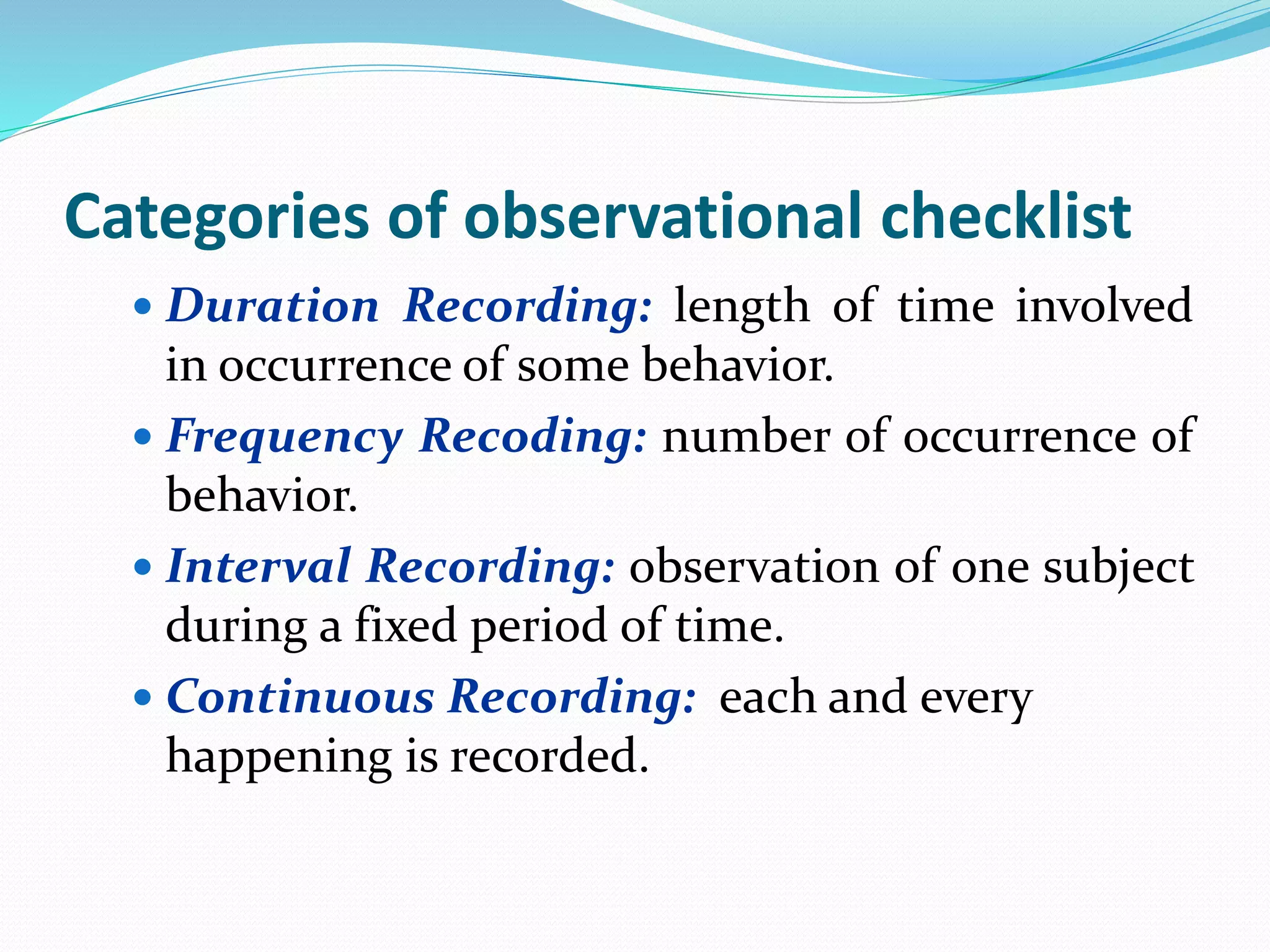
Categories of observational checklist
 Duration Recording: length of time involved
in occurrence of some behavior.
 Frequency Recoding: number of occurrence of
behavior.
 Interval Recording: observation of one subject
during a fixed period of time.
 Continuous Recording: each and every
happening is recorded.
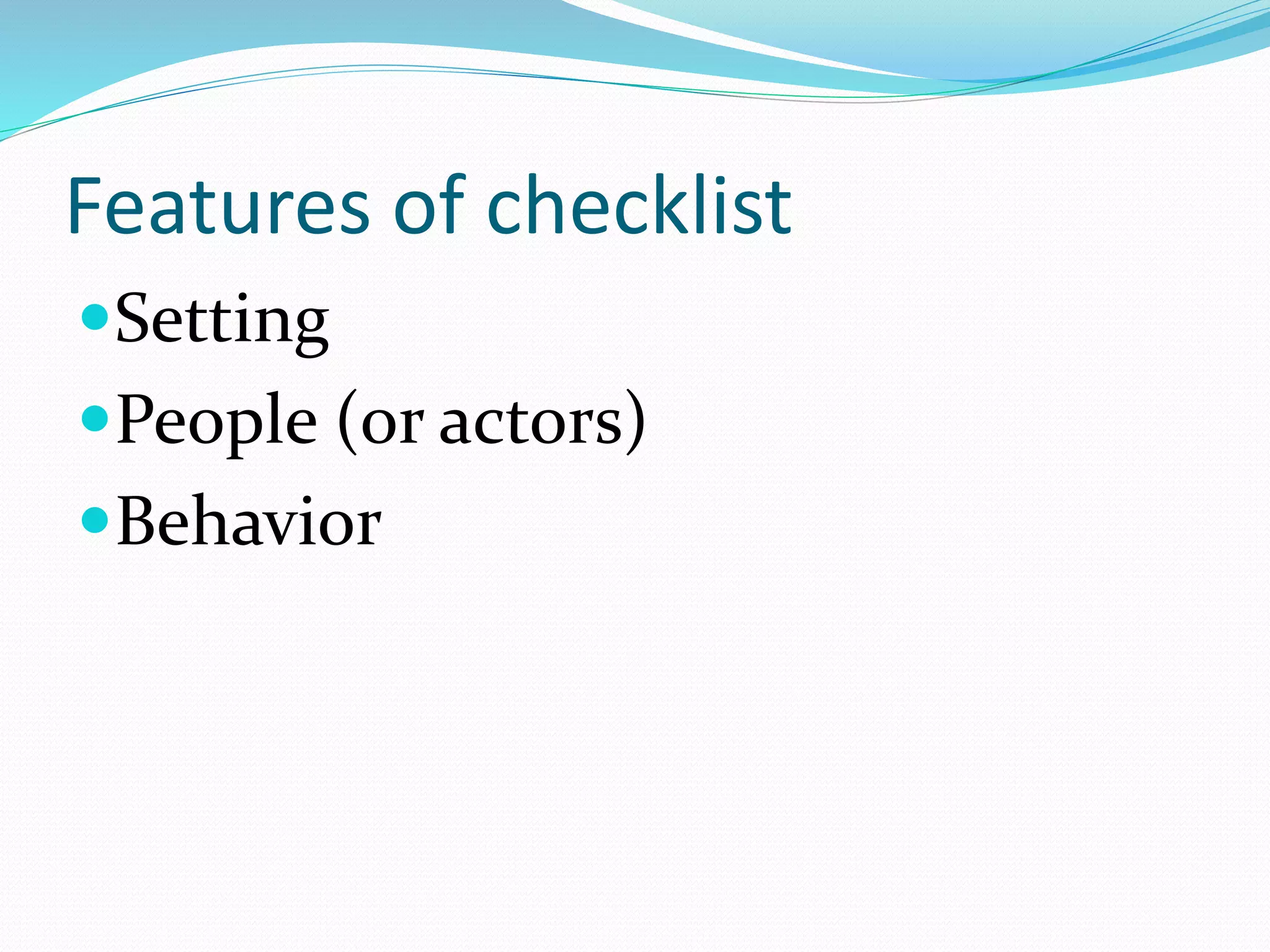
Features of checklist
Setting
People (or actors)
Behavior
Thank You

Observation in Qualitative Research

  • 1.
    Muhammad Sheroz M.A. ELTL(2013-928) IER, University of the Punjab Lahore
  • 2.
    Qualitative Research  Anapproach to research that relies on general and narrative descriptions. It attempts to measure the full complexity of social phenomena to capture the perceived meanings of those studies.  Bryman (1988a:172) states that ‘qualitative research is associated with the generation of theories’. However, Hammersley (1992) said that it can also be used for theory verification.
  • 3.
    Why qualitative research? Foranalyzing and researching concepts and abstractions, qualitative research is required. Its purpose is to enhance our general knowledge about complex events and processes.
  • 4.
    Characteristics of Qualitative Research Open inquiry  Inductive  Naturalistic  Descriptive and interpretive  Multiple perspectives  Cyclic  Attention to context  Focus on particular
  • 5.
    Tools of qualitativeresearch Commonly used tools: Interviews Focus groups Observations Less commonly used tools: Case study Narratives
  • 6.
    Observation  Observation isthe recording of the behavior of the sample.  Researcher relies on his or her own powers of observation what he or she has witnessed rather than communicating with people in order to obtain information what they say or think about issues.
  • 7.
    Types of observation: oParticipantversus Non-participant oDirect versus indirect oDisguised versus undisguised oStructured versus unstructured oHuman versus mechanical
  • 8.
    Participant versus Non-participant Participant observation: the researcher/observer joins a group and observes their activities, while at the same time taking care to observe what is going on  Non-participant observation: the researcher/observer simply observes the activities, but doesn’t take part in them
  • 9.
    Direct versus Indirect Directobservation: observing behavior as it occurs Indirect observation: observing the effects or results of the behavior rather than the behavior itself
  • 10.
    Disguised versus Undisguised Disguisedobservation: subject is unaware that he or she is being observed Undisguised observation: respondent is aware of observation
  • 11.
    Structured versus Unstructured Structured observation: researcher identifies beforehand which behaviors are to be observed and recorded  Unstructured observation: no restriction is placed on what the observer would note: all behavior in the episode under study is monitored
  • 12.
    Human versus Mechanical Human observation: observer is a person hired by the researcher, or, perhaps the observer is the researcher  Mechanical observation: human observer is replaced with some form of static observing device
  • 13.
    Advantages of Observation Collect data where and when an event or activity is occurring  Does not rely on people’s willingness to provide information  Directly see what people do rather than relying on what they say they do
  • 14.
    Disadvantages of Observation Susceptible to observer bias  Observer’s paradox: people usually perform better when they know they are being observed  Does not increase understanding of why people behave the way they do
  • 15.
    Advantages of ObservationalData Insight into actual, not reported, behaviors No chance for recall error Better accuracy Less cost
  • 16.
    Limitations of ObservationalData Small number of subjects Subjective interpretations Inability to pry beneath the behavior observed Motivations, attitudes, and other internal conditions are unobserved…
  • 17.
    Observational Checklist  Observationchecklist is used to record the behavior of the participants  Based on rating scales and the coding systems  Different forms of rating scales are present in observation checklists  There can be different techniques for preparing the observation checklist according to the requirement of the topic and the perception of the observer
  • 18.
    Categories of observationalchecklist  Duration Recording: length of time involved in occurrence of some behavior.  Frequency Recoding: number of occurrence of behavior.  Interval Recording: observation of one subject during a fixed period of time.  Continuous Recording: each and every happening is recorded.
  • 19.
  • 20.