Quality
noun
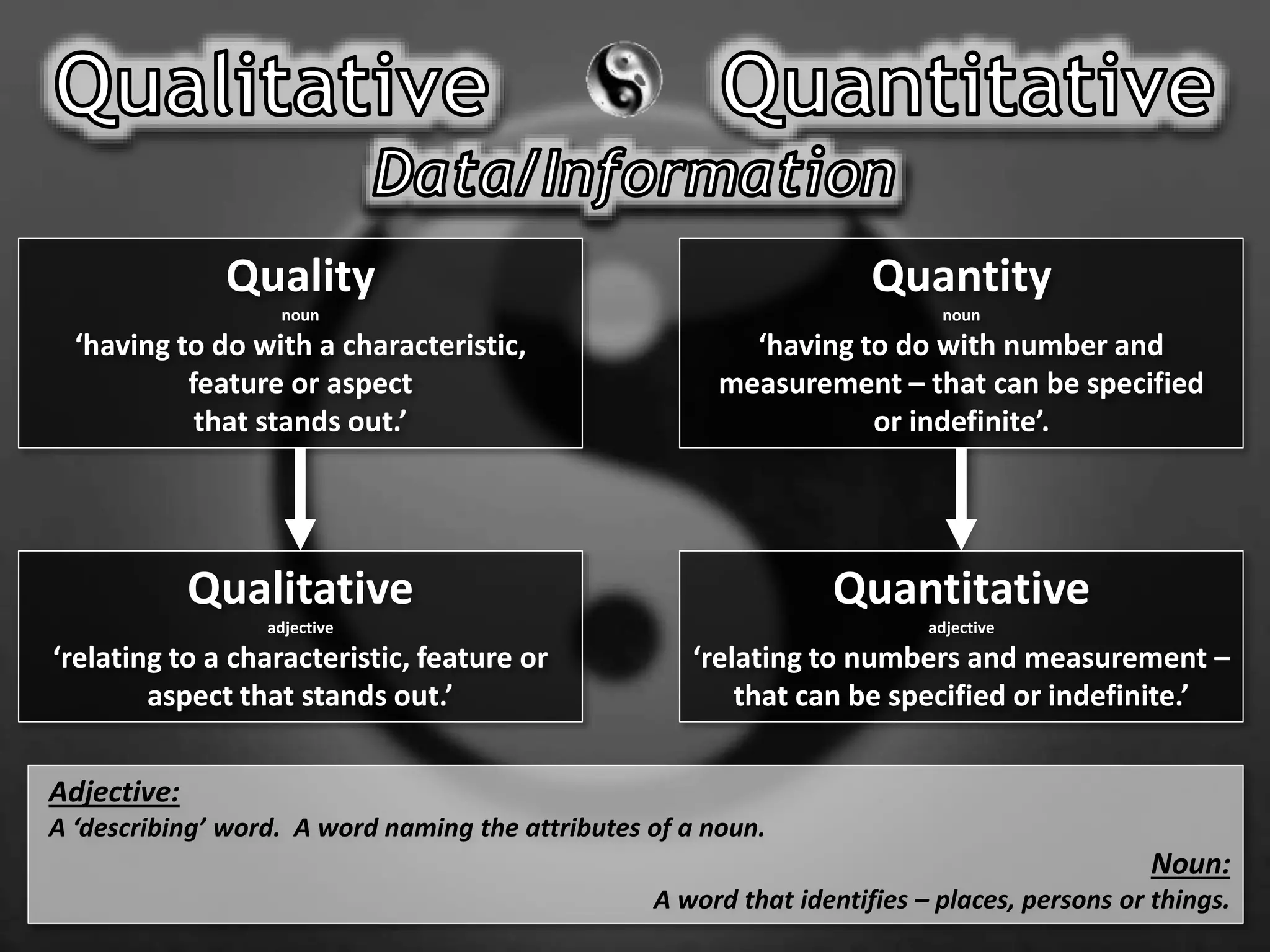
‘having to do with a characteristic,
feature or aspect
that stands out.’
Quantity
noun
‘having to do with number and
measurement – that can be specified
or indefinite’.
Qualitative
adjective
‘relating to a characteristic, feature or
aspect that stands out.’
Quantitative
adjective
‘relating to numbers and measurement –
that can be specified or indefinite.’
Adjective:
A ‘describing’ word. A word naming the attributes of a noun.
Noun:
A word that identifies – places, persons or things.
Qualitative:
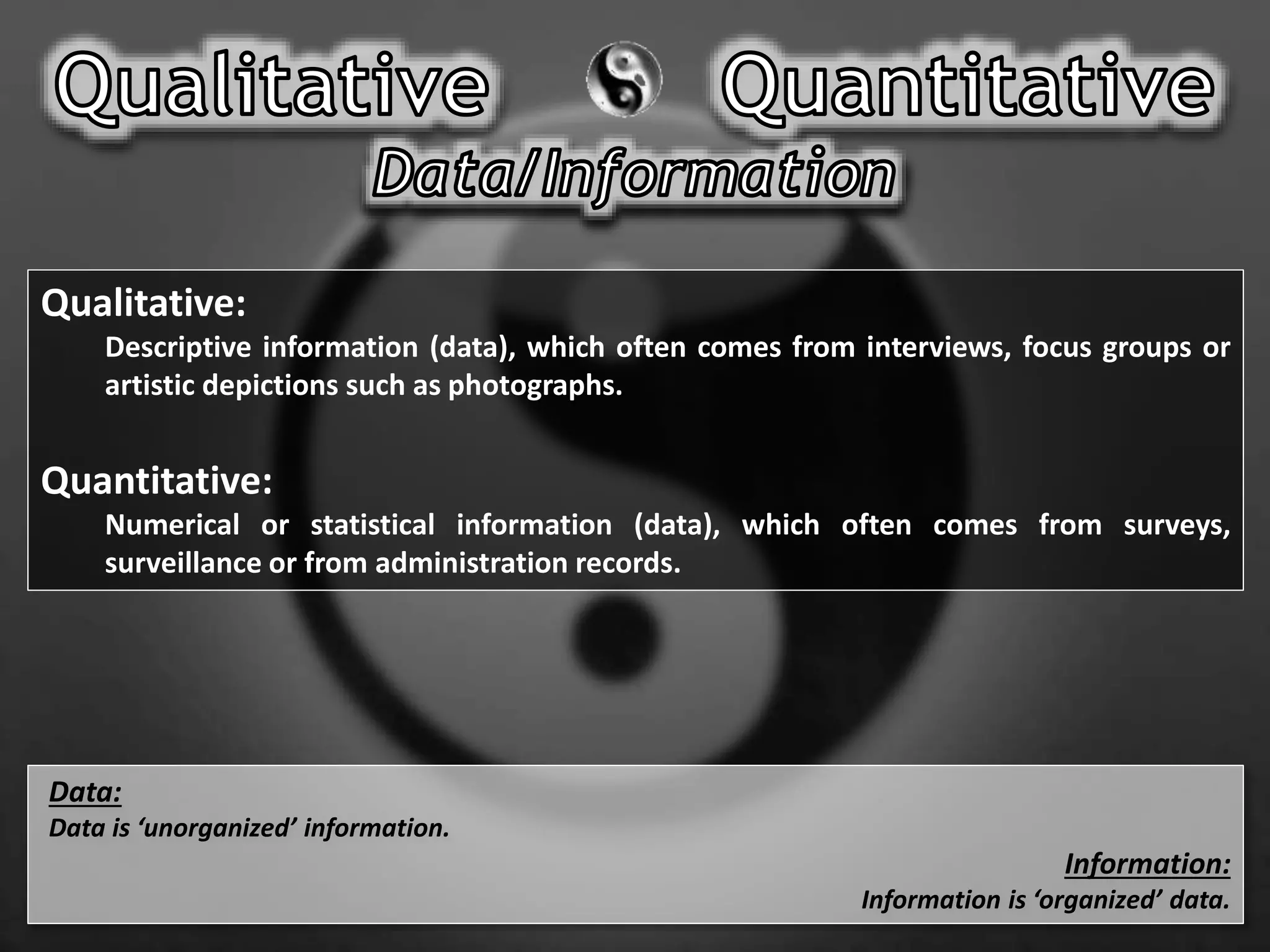
Descriptive information (data), which often comes from interviews, focus groups or
artistic depictions such as photographs.
Quantitative:
Numerical or statistical information (data), which often comes from surveys,
surveillance or from administration records.
Data:
Data is ‘unorganized’ information.
Information:
Information is ‘organized’ data.
Qualitative Evidence:
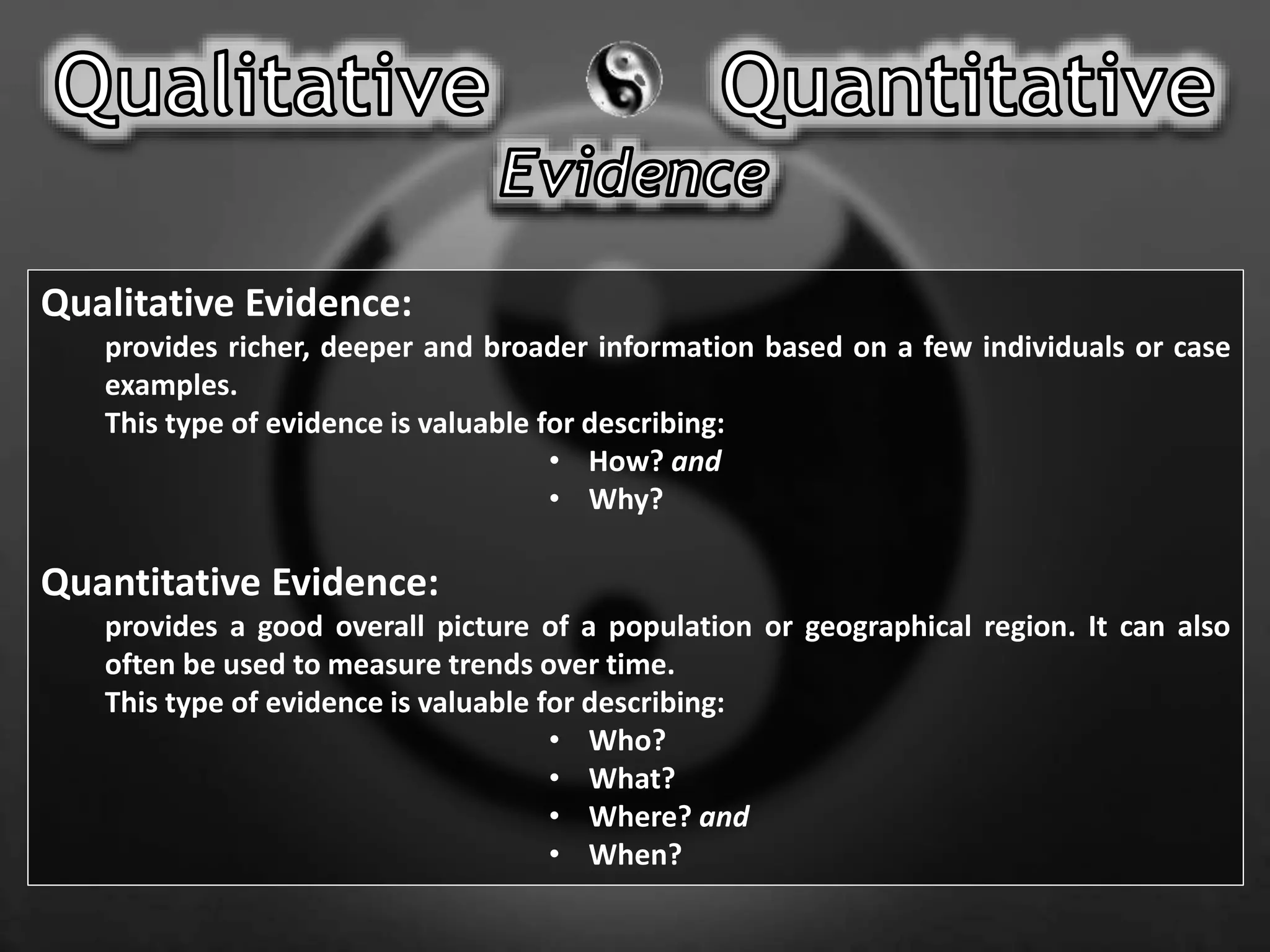
provides richer, deeper and broader information based on a few individuals or case
examples.
This type of evidence is valuable for describing:
• How? and
• Why?
Quantitative Evidence:
provides a good overall picture of a population or geographical region. It can also
often be used to measure trends over time.
This type of evidence is valuable for describing:
• Who?
• What?
• Where? and
• When?
Qualitative
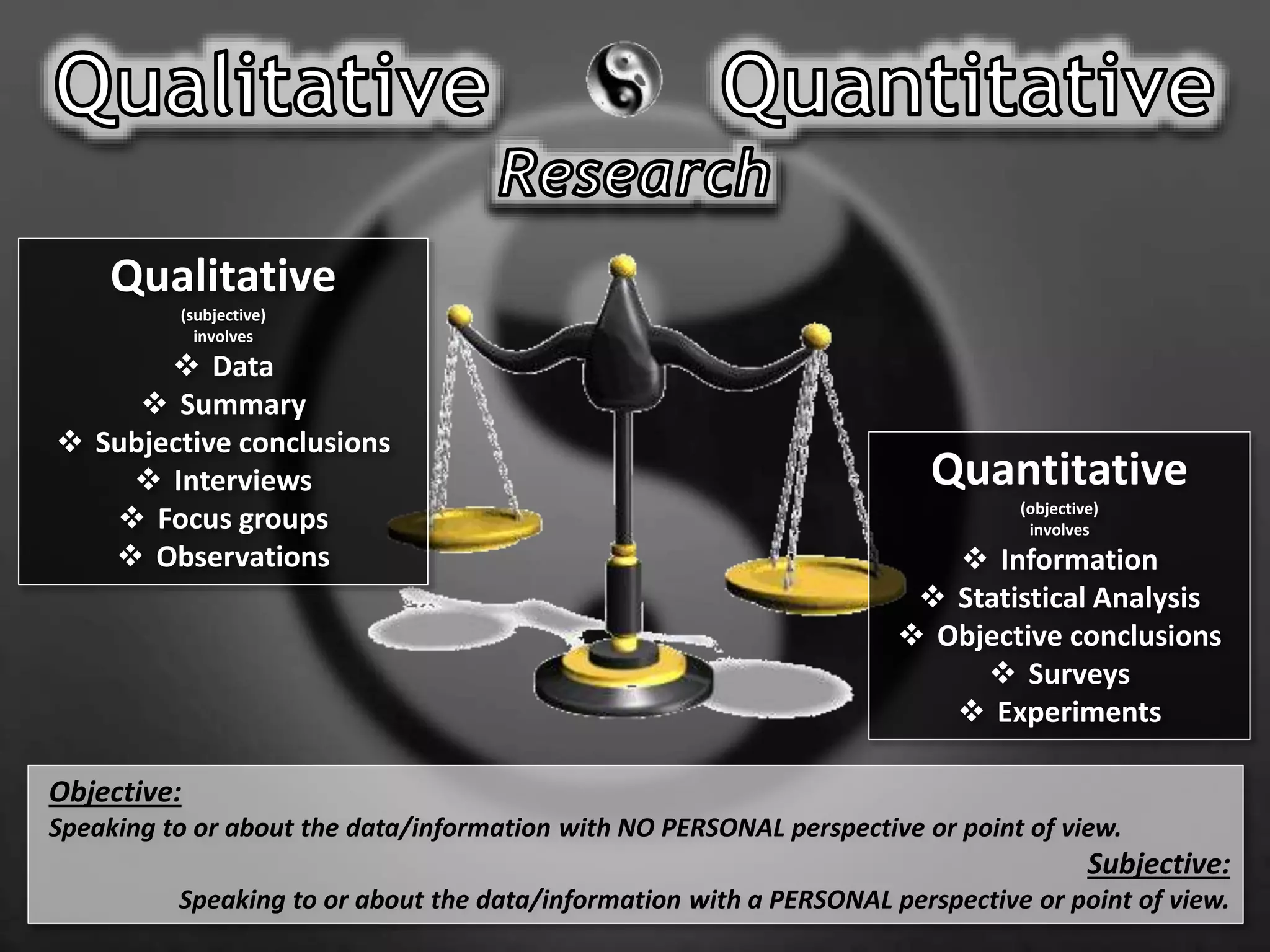
(subjective)
involves
 Data
 Summary
 Subjective conclusions
 Interviews
 Focus groups
 Observations
Quantitative
(objective)
involves
 Information
 Statistical Analysis
 Objective conclusions
 Surveys
 Experiments
Objective:
Speaking to or about the data/information with NO PERSONAL perspective or point of view.
Subjective:
Speaking to or about the data/information with a PERSONAL perspective or point of view.
Qualitative:
Colours and shapes provide
information about the ice cream
treats sold by this truck.
Qualitative data like this provides
descriptive information that cannot
be communicated with numbers.
Photograph by Varun Gupta
Qualitative:
Girls advertise a garage sale by
promising low prices. Without providing
a specific price, the information that
prices are low is a piece of qualitative
data.
The actual prices would be quantitative,
or numeric, data.
Photograph by Charlene Banta, MyShot
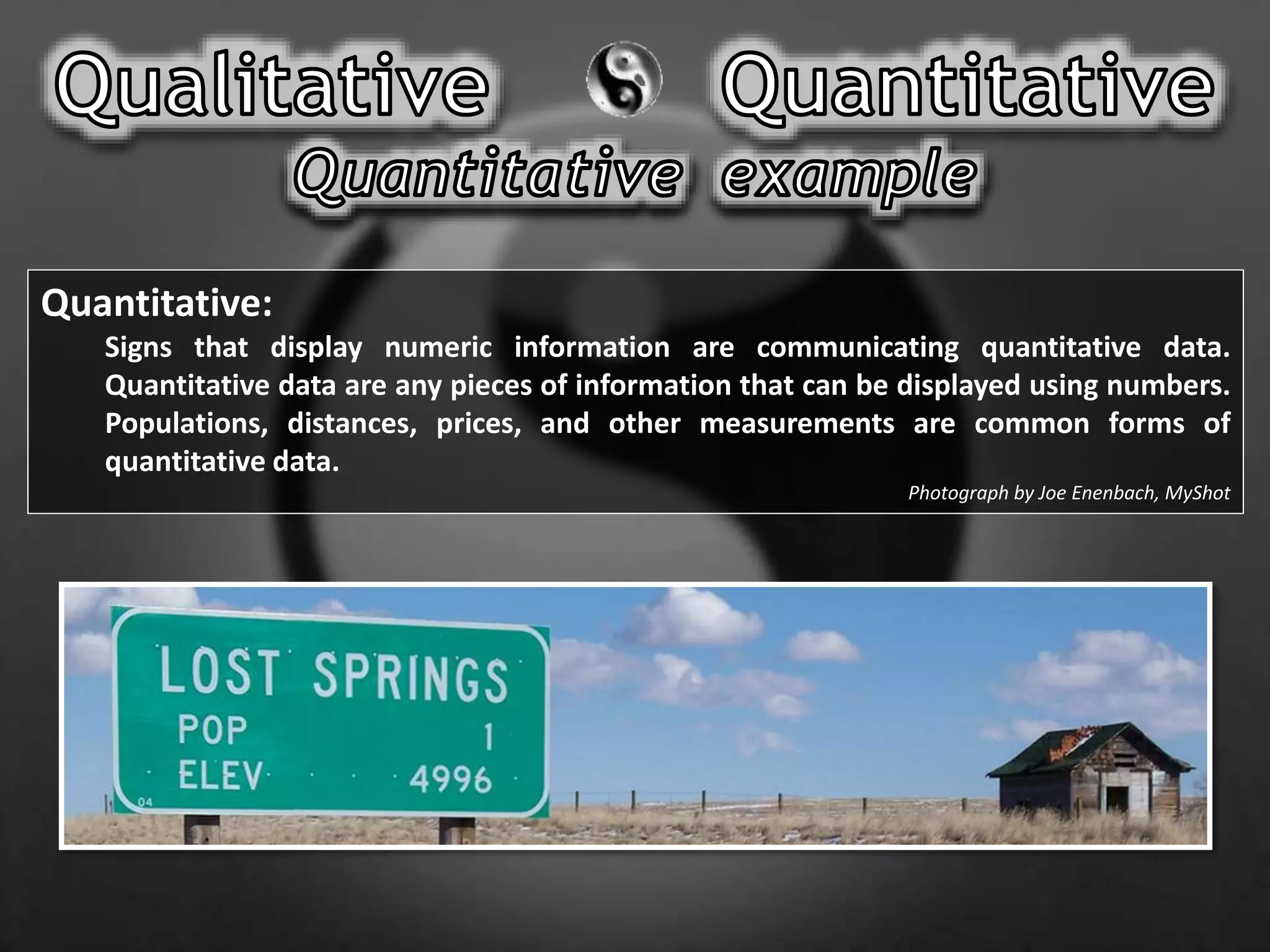
Quantitative:
Signs that display numeric information are communicating quantitative data.
Quantitative data are any pieces of information that can be displayed using numbers.
Populations, distances, prices, and other measurements are common forms of
quantitative data.
Photograph by Joe Enenbach, MyShot
Quantitative:
A roadside sign advertises prices, a
common form of quantitative data,
for fruit in a rural area of New
Zealand.
Rockmelon is another name for
cantaloupe.
Photograph by Shelley Daber, MyShot
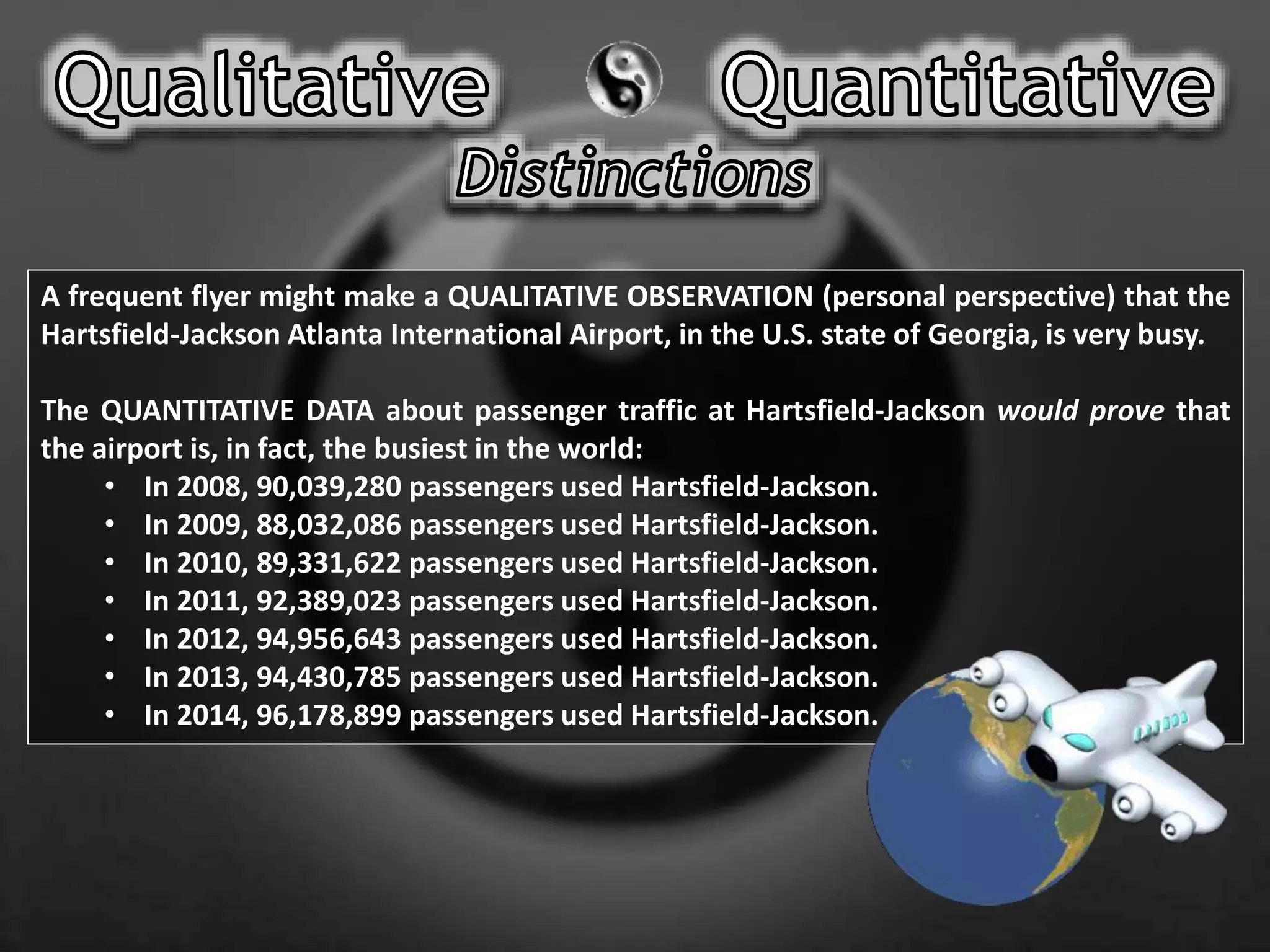
A frequent flyer might make a QUALITATIVE OBSERVATION (personal perspective) that the
Hartsfield-Jackson Atlanta International Airport, in the U.S. state of Georgia, is very busy.
The QUANTITATIVE DATA about passenger traffic at Hartsfield-Jackson would prove that
the airport is, in fact, the busiest in the world:
• In 2008, 90,039,280 passengers used Hartsfield-Jackson.
• In 2009, 88,032,086 passengers used Hartsfield-Jackson.
• In 2010, 89,331,622 passengers used Hartsfield-Jackson.
• In 2011, 92,389,023 passengers used Hartsfield-Jackson.
• In 2012, 94,956,643 passengers used Hartsfield-Jackson.
• In 2013, 94,430,785 passengers used Hartsfield-Jackson.
• In 2014, 96,178,899 passengers used Hartsfield-Jackson.
An avid hot chocolate drinker may make a QUALTITATIVE statement by stating his personal
opinion, that his hot chocolate is hotter than your hot chocolate.
But that personal opinion is not as informative when the two hot chocolates are tested
and QUANTITATIVE DATA is produced to state that:
“His hot chocolate is 100 degrees Fahrenheit; therefore, it is 30 degrees hotter than yours,
which is 70 degrees Fahrenheit.”
Qualitative:
Qualitative evidence is often gathered in small studies and based on the experiences
of a very few individuals, which means that one of its limitations is that an entire
population may not be well represented.
Quantitative:
One of the limitations of quantitative evidence is that it is typically “cleaned up” or
“smoothed out”. This is done to reduce the influence of outstanding cases, as well as
to compare evidence to other places or populations.
Unfortunately, this practice can result in unusual cases being hidden.
• National Geographic: Qualitative Data
• National Geographic: Quantitative Data
• Define Quantitative and Qualitative Evidence

Qualitative, Quantitative (PowerPoint)

  • 2.
    Quality noun ‘having to dowith a characteristic, feature or aspect that stands out.’ Quantity noun ‘having to do with number and measurement – that can be specified or indefinite’. Qualitative adjective ‘relating to a characteristic, feature or aspect that stands out.’ Quantitative adjective ‘relating to numbers and measurement – that can be specified or indefinite.’ Adjective: A ‘describing’ word. A word naming the attributes of a noun. Noun: A word that identifies – places, persons or things.
  • 3.
    Qualitative: Descriptive information (data),which often comes from interviews, focus groups or artistic depictions such as photographs. Quantitative: Numerical or statistical information (data), which often comes from surveys, surveillance or from administration records. Data: Data is ‘unorganized’ information. Information: Information is ‘organized’ data.
  • 4.
    Qualitative Evidence: provides richer,deeper and broader information based on a few individuals or case examples. This type of evidence is valuable for describing: • How? and • Why? Quantitative Evidence: provides a good overall picture of a population or geographical region. It can also often be used to measure trends over time. This type of evidence is valuable for describing: • Who? • What? • Where? and • When?
  • 5.
    Qualitative (subjective) involves  Data  Summary Subjective conclusions  Interviews  Focus groups  Observations Quantitative (objective) involves  Information  Statistical Analysis  Objective conclusions  Surveys  Experiments Objective: Speaking to or about the data/information with NO PERSONAL perspective or point of view. Subjective: Speaking to or about the data/information with a PERSONAL perspective or point of view.
  • 6.
    Qualitative: Colours and shapesprovide information about the ice cream treats sold by this truck. Qualitative data like this provides descriptive information that cannot be communicated with numbers. Photograph by Varun Gupta
  • 7.
    Qualitative: Girls advertise agarage sale by promising low prices. Without providing a specific price, the information that prices are low is a piece of qualitative data. The actual prices would be quantitative, or numeric, data. Photograph by Charlene Banta, MyShot
  • 8.
    Quantitative: Signs that displaynumeric information are communicating quantitative data. Quantitative data are any pieces of information that can be displayed using numbers. Populations, distances, prices, and other measurements are common forms of quantitative data. Photograph by Joe Enenbach, MyShot
  • 9.
    Quantitative: A roadside signadvertises prices, a common form of quantitative data, for fruit in a rural area of New Zealand. Rockmelon is another name for cantaloupe. Photograph by Shelley Daber, MyShot
  • 10.
    A frequent flyermight make a QUALITATIVE OBSERVATION (personal perspective) that the Hartsfield-Jackson Atlanta International Airport, in the U.S. state of Georgia, is very busy. The QUANTITATIVE DATA about passenger traffic at Hartsfield-Jackson would prove that the airport is, in fact, the busiest in the world: • In 2008, 90,039,280 passengers used Hartsfield-Jackson. • In 2009, 88,032,086 passengers used Hartsfield-Jackson. • In 2010, 89,331,622 passengers used Hartsfield-Jackson. • In 2011, 92,389,023 passengers used Hartsfield-Jackson. • In 2012, 94,956,643 passengers used Hartsfield-Jackson. • In 2013, 94,430,785 passengers used Hartsfield-Jackson. • In 2014, 96,178,899 passengers used Hartsfield-Jackson.
  • 11.
    An avid hotchocolate drinker may make a QUALTITATIVE statement by stating his personal opinion, that his hot chocolate is hotter than your hot chocolate. But that personal opinion is not as informative when the two hot chocolates are tested and QUANTITATIVE DATA is produced to state that: “His hot chocolate is 100 degrees Fahrenheit; therefore, it is 30 degrees hotter than yours, which is 70 degrees Fahrenheit.”
  • 12.
    Qualitative: Qualitative evidence isoften gathered in small studies and based on the experiences of a very few individuals, which means that one of its limitations is that an entire population may not be well represented. Quantitative: One of the limitations of quantitative evidence is that it is typically “cleaned up” or “smoothed out”. This is done to reduce the influence of outstanding cases, as well as to compare evidence to other places or populations. Unfortunately, this practice can result in unusual cases being hidden.
  • 13.
    • National Geographic:Qualitative Data • National Geographic: Quantitative Data • Define Quantitative and Qualitative Evidence