





In the name of Allah Kareem,
Most Beneficent, Most Gracious,
the Most Merciful !
Quantitative Research
Quantitative research is "a formal, objective, systematic process in
which numerical data are utilised to obtain information about the
world" (Burns and Grove cited by Cormack 1991). Quantitative
research is inclined to be deductive. In other words it tests theory.
General aims of quantitative research

  •To generalize
  •To be objective
  •To test theories


                          SUPERIOR GROUP OF COLLEGES
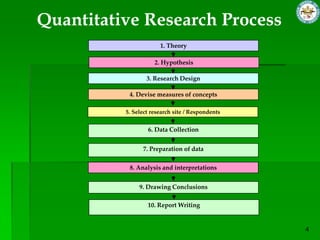
Quantitative Research Process
                       1. Theory

                     2. Hypothesis

                  3. Research Design

           4. Devise measures of concepts

          5. Select research site / Respondents


                  6. Data Collection


                7. Preparation of data

           8. Analysis and interpretations


               9. Drawing Conclusions

                  10. Report Writing
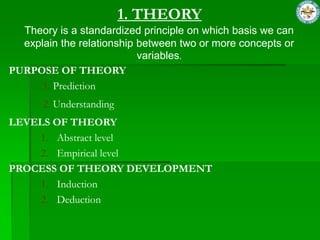
1. THEORY
  Theory is a standardized principle on which basis we can
  explain the relationship between two or more concepts or
                           variables.
PURPOSE OF THEORY
      1. Prediction
      2. Understanding
LEVELS OF THEORY
    1. Abstract level
    2. Empirical level
PROCESS OF THEORY DEVELOPMENT
    1. Induction
    2. Deduction
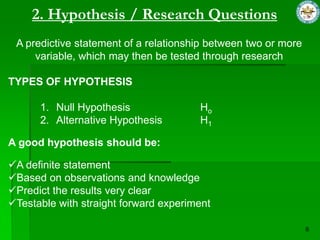
2. Hypothesis / Research Questions
 A predictive statement of a relationship between two or more
     variable, which may then be tested through research

TYPES OF HYPOTHESIS

      1. Null Hypothesis               Ho
      2. Alternative Hypothesis        H1

A good hypothesis should be:

A definite statement
Based on observations and knowledge
Predict the results very clear
Testable with straight forward experiment
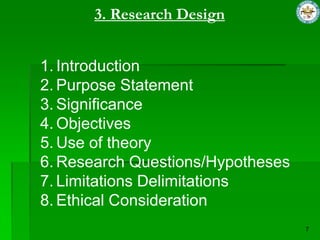
3. Research Design


1. Introduction
2. Purpose Statement
3. Significance
4. Objectives
5. Use of theory
6. Research Questions/Hypotheses
7. Limitations Delimitations
8. Ethical Consideration
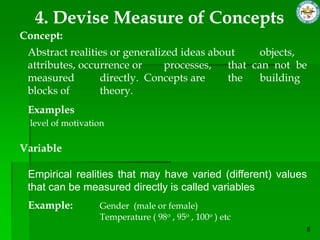
4. Devise Measure of Concepts
Concept:
 Abstract realities or generalized ideas about     objects,
 attributes, occurrence or      processes,  that can not be
 measured        directly. Concepts are     the    building
 blocks of       theory.
 Examples
 level of motivation

Variable

 Empirical realities that may have varied (different) values
 that can be measured directly is called variables
 Example:         Gender (male or female)
                  Temperature ( 98o , 95o , 100o ) etc
Cont…..
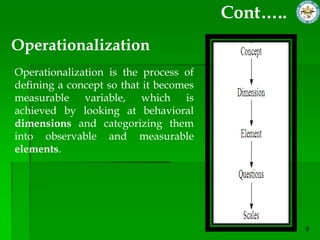
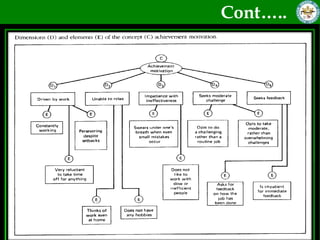
Operationalization
Operationalization is the process of
defining a concept so that it becomes
measurable variable, which is
achieved by looking at behavioral
dimensions and categorizing them
into observable and measurable
elements.
Cont…..
Cont…..


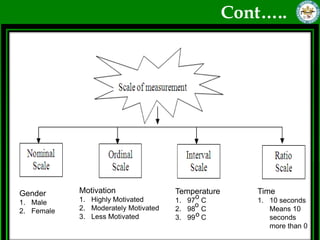
Gender      Motivation                Temperature      Time
            1. Highly Motivated            o
1. Male                               1. 97 C          1. 10 seconds
            2. Moderately Motivated        o
2. Female                             2. 98 C             Means 10
            3. Less Motivated         3. 99 o C           seconds
                                                          more than 0
Cont…..

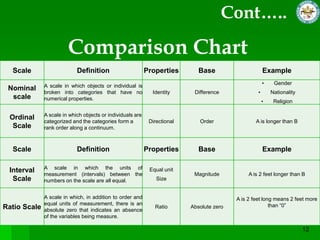
                        Comparison Chart
  Scale                     Definition                      Properties        Base                      Example
                                                                                                        •    Gender
              A scale in which objects or individual is
 Nominal
              broken into categories that have no             Identity      Difference              •       Nationality
  scale       numerical properties.                                                                     •    Religion

              A scale in which objects or individuals are
 Ordinal
              categorized and the categories form a          Directional      Order                A is longer than B
  Scale       rank order along a continuum.


  Scale                     Definition                      Properties        Base                      Example

              A scale in which the units of
 Interval                                                    Equal unit
              measurement (intervals) between the                           Magnitude           A is 2 feet longer than B
  Scale       numbers on the scale are all equal.               Size


              A scale in which, in addition to order and                                   A is 2 feet long means 2 feet more
              equal units of measurement, there is an                                                     than “0”
Ratio Scale   absolute zero that indicates an absence
                                                               Ratio       Absolute zero
              of the variables being measure.
Cont…..
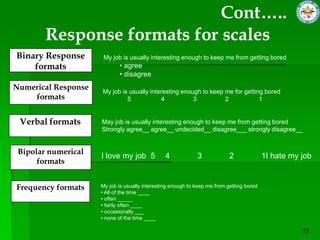
        Response formats for scales
Binary Response       My job is usually interesting enough to keep me from getting bored
    formats                 • agree
                            • disagree
Numerical Response   My job is usually interesting enough to keep me for getting bored
    formats                   5            4           3          2            1


 Verbal formats      May job is usually interesting enough to keep me from getting bored
                     Strongly agree__ agree__ undecided__ disagree___ strongly disagree__


 Bipolar numerical
                     I love my job 5            4            3             2              1I hate my job
      formats


Frequency formats    My job is usually interesting enough to keep me from getting bored
                     • All of the time ____
                     • often _____
                     • fairly often ____
                     • occasionally ___
                     • none of the time ____
Cont…..
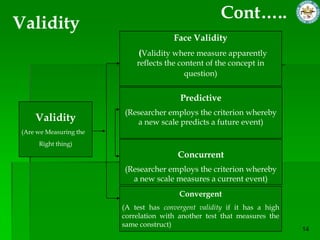
Validity
                                        Face Validity
                              (Validity where measure apparently
                             reflects the content of the concept in
                                            question)


                                          Predictive
                         (Researcher employs the criterion whereby
     Validity               a new scale predicts a future event)
 (Are we Measuring the
      Right thing)
                                          Concurrent
                         (Researcher employs the criterion whereby
                           a new scale measures a current event)
                                          Convergent
                         (A test has convergent validity if it has a high
                         correlation with another test that measures the
                         same construct)
Cont…..
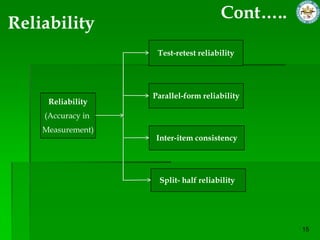
Reliability
                    Test-retest reliability


                   Parallel-form reliability
     Reliability
    (Accuracy in
    Measurement)
                    Inter-item consistency


                    Split- half reliability
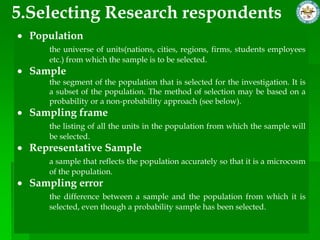
5.Selecting Research respondents
  Population
     the universe of units(nations, cities, regions, firms, students employees
     etc.) from which the sample is to be selected.
  Sample
     the segment of the population that is selected for the investigation. It is
     a subset of the population. The method of selection may be based on a
     probability or a non-probability approach (see below).
  Sampling frame
     the listing of all the units in the population from which the sample will
     be selected.
  Representative Sample
     a sample that reflects the population accurately so that it is a microcosm
     of the population.
  Sampling error
     the difference between a sample and the population from which it is
     selected, even though a probability sample has been selected.
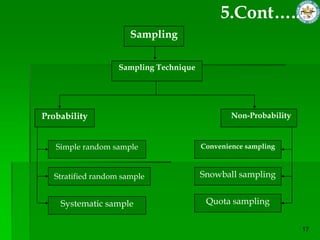
5.Cont…..
                       Sampling


                    Sampling Technique


Probability                                      Non-Probability


   Simple random sample                  Convenience sampling


   Stratified random sample              Snowball sampling


    Systematic sample                     Quota sampling
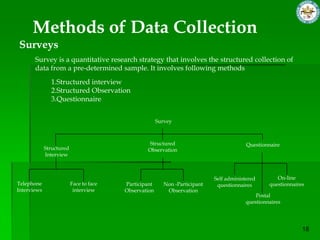
Methods of Data Collection
Surveys
       Survey is a quantitative research strategy that involves the structured collection of
       data from a pre-determined sample. It involves following methods
               1.Structured interview
               2.Structured Observation
               3.Questionnaire


                                                       Survey


                                                 Structured                              Questionnaire
             Structured                          Observation
             Interview


                                                                            Self administered        On-line
Telephone                 Face to face   Participant     Non -Participant    questionnaires       questionnaires
Interviews                 interview     Observation      Observation
                                                                                             Postal
                                                                                         questionnaires
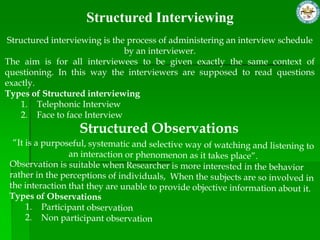
Structured Interviewing
 Structured interviewing is the process of administering an interview schedule
                               by an interviewer.
The aim is for all interviewees to be given exactly the same context of
questioning. In this way the interviewers are supposed to read questions
exactly.
Types of Structured interviewing
     1. Telephonic Interview
     2. Face to face Interview
                  Structured Observations
QUESTIONNAIRES

“Questionnaire is pre-formulated written set of questions to which
respondents record their answers”.


 Questionnaires can be:

       On-line questionnaires
       Postal questionnaires
       Self administered questionnaire
Variety of factors influence questionnaire


The choice of questionnaire will be influenced by a variety of factors related
to your


        Research question (s)
        Research objective
        Characteristics of respondents
        Size of sample
        Dimensions of the concept to be measured
        And availability of required resources.
DESIGNING A QUESTIONNAIRE
Designing a questionnaire is based on following principles

 1- Principle of wording
i.    The nature of the variable will determine what kind and number of questions
      will be asked i.e. ranking, rating or dichotomous

ii.   The wording should be simple, easy and appropriate
iii. Closed ended questions will be used with the intention to have ease, and
     enhanced comparability.
iv. Add both positively as well as negatively worded questions

 v. Always avoid double barreled, ambiguous, recall dependent, leading or loaded
     questions

 vi. The sequence of questions in the questionnaire should be from general to
     specific, and easy to more difficult. It is also called funnel approach.
2- Principle of Measurement:
i.   Interval and Ratio scales should be used in preference to nominal or ordinal
     scales
ii. The measure must be assessed through tests of validity and reliability


3- General Getup:
1. Start with good Introduction

2. Questions should be well organized with instructions and guidance

3. Only relevant personal information should be demanded that is not sensitive,

4. End with a courteous note.
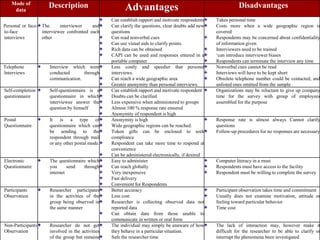
Mode of           Description                                                                               Disadvantages
    data                                                Advantages
                                                  Can establish rapport and motivate respondents    Takes personal time
Personal or face- The      interviewer    and     Can clarify the questions, clear doubts add new   Costs more when a wide geographic region is
to-face           interviewee confronted each     questions                                         covered
interviews        other                           Can read nonverbal cues                           Respondents may be concerned about confidentiality
                                                  Can use visual aids to clarify points.            of information given
                                                  Rich data can be obtained                         Interviewers need to be trained
                                                  CAPI can be used and responses entered in a       ‘can introduce interviewer biases
                                                  portable computer                                 Respondents can terminate the interview any time
Telephone            Interview which were         Less costly and speedier that personal            Nonverbal cues cannot be read
Interviews           conducted      through       interviews.                                       Interviews will have to be kept short
                     communication.               Can reach a wide geographic area                  Obsolete telephone number could be contacted, and
                                                  Greater anonymity than personal interviews.       unlisted ones omitted from the sample
Self-completion      Self-questionnaire is a      Can establish rapport and motivate respondent     Organizations may be reluctant to give up company
questionnaire        questionnaire in which       Doubts can be clarified                           time for the survey with group of employees
                     interviewee answer the       Less expensive when administered to groups        assembled for the purpose
                     question by himself          Almost 100 % response rate ensured
                                                  Anonymity of respondent is high
Postal               It is a type of              Anonymity is high                                 Response rate is almost always Cannot clarify
Questionnaire        questionnaire which can      Wide geographic regions can be reached.           questions
                     be sending to the            Token gifts can be enclosed to seek               Follow-up procedures for no responses are necessary
                     respondent through mail      compliance
                     or any other postal mode.    Respondent can take more time to respond at
                                                  convenience
                                                  Can be administered electronically, if desired
Electronic           The questionnaire which      Easy to administer                                Computer literacy in a must
Questionnaire        you      send   through      Can reach globally                                Respondents must have access to the facility
                     internet                     Very inexpensive                                  Respondent must be willing to complete the survey
                                                  Fast delivery
                                                  Convenient for Respondents
Participants         Researcher participates      Better accuracy                                   Participant observation takes time and commitment
Observation          in the activities of the     Less cost                                         Usually does not examine motivation, attitude or
                     group being observed in      Researcher is collecting observed data not        feeling toward particular behavior
                     the same manner              reported data                                     Time cost
                                                  Can obtain data from those unable to
                                                  communicate in written or oral form
Non-Participants     Researcher do not get        The individual may simply be unaware of how       The lack of interaction may, however make it
Observation          involved in the activities   they behave in a particular situation.            difficult for the researcher to be able to clarify or
                     of the group but remains     Safe the researcher time                          interrupt the phenomena been investigated
Mystery Shopping

Mystery shopping is a popular technique used in consumer research
that involves sending people (mystery shoppers) into a shop to buy
products with the intention to evaluate the effectiveness of retail staff.
After the interaction, the shoppers typically fill out rating sheet
detailing the nature of the interaction and service they receive. It’s a
type of field stimulation.
SUPERIOR GROUP OF COLLEGES   26

Quantitative Research Process

  • 1.
    In the nameof Allah Kareem, Most Beneficent, Most Gracious, the Most Merciful !
  • 3.
    Quantitative Research Quantitative researchis "a formal, objective, systematic process in which numerical data are utilised to obtain information about the world" (Burns and Grove cited by Cormack 1991). Quantitative research is inclined to be deductive. In other words it tests theory. General aims of quantitative research •To generalize •To be objective •To test theories SUPERIOR GROUP OF COLLEGES
  • 4.
    Quantitative Research Process 1. Theory 2. Hypothesis 3. Research Design 4. Devise measures of concepts 5. Select research site / Respondents 6. Data Collection 7. Preparation of data 8. Analysis and interpretations 9. Drawing Conclusions 10. Report Writing
  • 5.
    1. THEORY Theory is a standardized principle on which basis we can explain the relationship between two or more concepts or variables. PURPOSE OF THEORY 1. Prediction 2. Understanding LEVELS OF THEORY 1. Abstract level 2. Empirical level PROCESS OF THEORY DEVELOPMENT 1. Induction 2. Deduction
  • 6.
    2. Hypothesis /Research Questions A predictive statement of a relationship between two or more variable, which may then be tested through research TYPES OF HYPOTHESIS 1. Null Hypothesis Ho 2. Alternative Hypothesis H1 A good hypothesis should be: A definite statement Based on observations and knowledge Predict the results very clear Testable with straight forward experiment
  • 7.
    3. Research Design 1.Introduction 2. Purpose Statement 3. Significance 4. Objectives 5. Use of theory 6. Research Questions/Hypotheses 7. Limitations Delimitations 8. Ethical Consideration
  • 8.
    4. Devise Measureof Concepts Concept: Abstract realities or generalized ideas about objects, attributes, occurrence or processes, that can not be measured directly. Concepts are the building blocks of theory. Examples level of motivation Variable Empirical realities that may have varied (different) values that can be measured directly is called variables Example: Gender (male or female) Temperature ( 98o , 95o , 100o ) etc
  • 9.
    Cont….. Operationalization Operationalization is theprocess of defining a concept so that it becomes measurable variable, which is achieved by looking at behavioral dimensions and categorizing them into observable and measurable elements.
  • 10.
  • 11.
    Cont….. Gender Motivation Temperature Time 1. Highly Motivated o 1. Male 1. 97 C 1. 10 seconds 2. Moderately Motivated o 2. Female 2. 98 C Means 10 3. Less Motivated 3. 99 o C seconds more than 0
  • 12.
    Cont….. Comparison Chart Scale Definition Properties Base Example • Gender A scale in which objects or individual is Nominal broken into categories that have no Identity Difference • Nationality scale numerical properties. • Religion A scale in which objects or individuals are Ordinal categorized and the categories form a Directional Order A is longer than B Scale rank order along a continuum. Scale Definition Properties Base Example A scale in which the units of Interval Equal unit measurement (intervals) between the Magnitude A is 2 feet longer than B Scale numbers on the scale are all equal. Size A scale in which, in addition to order and A is 2 feet long means 2 feet more equal units of measurement, there is an than “0” Ratio Scale absolute zero that indicates an absence Ratio Absolute zero of the variables being measure.
  • 13.
    Cont….. Response formats for scales Binary Response My job is usually interesting enough to keep me from getting bored formats • agree • disagree Numerical Response My job is usually interesting enough to keep me for getting bored formats 5 4 3 2 1 Verbal formats May job is usually interesting enough to keep me from getting bored Strongly agree__ agree__ undecided__ disagree___ strongly disagree__ Bipolar numerical I love my job 5 4 3 2 1I hate my job formats Frequency formats My job is usually interesting enough to keep me from getting bored • All of the time ____ • often _____ • fairly often ____ • occasionally ___ • none of the time ____
  • 14.
    Cont….. Validity Face Validity (Validity where measure apparently reflects the content of the concept in question) Predictive (Researcher employs the criterion whereby Validity a new scale predicts a future event) (Are we Measuring the Right thing) Concurrent (Researcher employs the criterion whereby a new scale measures a current event) Convergent (A test has convergent validity if it has a high correlation with another test that measures the same construct)
  • 15.
    Cont….. Reliability Test-retest reliability Parallel-form reliability Reliability (Accuracy in Measurement) Inter-item consistency Split- half reliability
  • 16.
    5.Selecting Research respondents Population the universe of units(nations, cities, regions, firms, students employees etc.) from which the sample is to be selected. Sample the segment of the population that is selected for the investigation. It is a subset of the population. The method of selection may be based on a probability or a non-probability approach (see below). Sampling frame the listing of all the units in the population from which the sample will be selected. Representative Sample a sample that reflects the population accurately so that it is a microcosm of the population. Sampling error the difference between a sample and the population from which it is selected, even though a probability sample has been selected.
  • 17.
    5.Cont….. Sampling Sampling Technique Probability Non-Probability Simple random sample Convenience sampling Stratified random sample Snowball sampling Systematic sample Quota sampling
  • 18.
    Methods of DataCollection Surveys Survey is a quantitative research strategy that involves the structured collection of data from a pre-determined sample. It involves following methods 1.Structured interview 2.Structured Observation 3.Questionnaire Survey Structured Questionnaire Structured Observation Interview Self administered On-line Telephone Face to face Participant Non -Participant questionnaires questionnaires Interviews interview Observation Observation Postal questionnaires
  • 19.
    Structured Interviewing Structuredinterviewing is the process of administering an interview schedule by an interviewer. The aim is for all interviewees to be given exactly the same context of questioning. In this way the interviewers are supposed to read questions exactly. Types of Structured interviewing 1. Telephonic Interview 2. Face to face Interview Structured Observations
  • 20.
    QUESTIONNAIRES “Questionnaire is pre-formulatedwritten set of questions to which respondents record their answers”. Questionnaires can be:  On-line questionnaires  Postal questionnaires  Self administered questionnaire
  • 21.
    Variety of factorsinfluence questionnaire The choice of questionnaire will be influenced by a variety of factors related to your  Research question (s)  Research objective  Characteristics of respondents  Size of sample  Dimensions of the concept to be measured  And availability of required resources.
  • 22.
    DESIGNING A QUESTIONNAIRE Designinga questionnaire is based on following principles 1- Principle of wording i. The nature of the variable will determine what kind and number of questions will be asked i.e. ranking, rating or dichotomous ii. The wording should be simple, easy and appropriate iii. Closed ended questions will be used with the intention to have ease, and enhanced comparability. iv. Add both positively as well as negatively worded questions v. Always avoid double barreled, ambiguous, recall dependent, leading or loaded questions vi. The sequence of questions in the questionnaire should be from general to specific, and easy to more difficult. It is also called funnel approach.
  • 23.
    2- Principle ofMeasurement: i. Interval and Ratio scales should be used in preference to nominal or ordinal scales ii. The measure must be assessed through tests of validity and reliability 3- General Getup: 1. Start with good Introduction 2. Questions should be well organized with instructions and guidance 3. Only relevant personal information should be demanded that is not sensitive, 4. End with a courteous note.
  • 24.
    Mode of Description Disadvantages data Advantages Can establish rapport and motivate respondents Takes personal time Personal or face- The interviewer and Can clarify the questions, clear doubts add new Costs more when a wide geographic region is to-face interviewee confronted each questions covered interviews other Can read nonverbal cues Respondents may be concerned about confidentiality Can use visual aids to clarify points. of information given Rich data can be obtained Interviewers need to be trained CAPI can be used and responses entered in a ‘can introduce interviewer biases portable computer Respondents can terminate the interview any time Telephone Interview which were Less costly and speedier that personal Nonverbal cues cannot be read Interviews conducted through interviews. Interviews will have to be kept short communication. Can reach a wide geographic area Obsolete telephone number could be contacted, and Greater anonymity than personal interviews. unlisted ones omitted from the sample Self-completion Self-questionnaire is a Can establish rapport and motivate respondent Organizations may be reluctant to give up company questionnaire questionnaire in which Doubts can be clarified time for the survey with group of employees interviewee answer the Less expensive when administered to groups assembled for the purpose question by himself Almost 100 % response rate ensured Anonymity of respondent is high Postal It is a type of Anonymity is high Response rate is almost always Cannot clarify Questionnaire questionnaire which can Wide geographic regions can be reached. questions be sending to the Token gifts can be enclosed to seek Follow-up procedures for no responses are necessary respondent through mail compliance or any other postal mode. Respondent can take more time to respond at convenience Can be administered electronically, if desired Electronic The questionnaire which Easy to administer Computer literacy in a must Questionnaire you send through Can reach globally Respondents must have access to the facility internet Very inexpensive Respondent must be willing to complete the survey Fast delivery Convenient for Respondents Participants Researcher participates Better accuracy Participant observation takes time and commitment Observation in the activities of the Less cost Usually does not examine motivation, attitude or group being observed in Researcher is collecting observed data not feeling toward particular behavior the same manner reported data Time cost Can obtain data from those unable to communicate in written or oral form Non-Participants Researcher do not get The individual may simply be unaware of how The lack of interaction may, however make it Observation involved in the activities they behave in a particular situation. difficult for the researcher to be able to clarify or of the group but remains Safe the researcher time interrupt the phenomena been investigated
  • 25.
    Mystery Shopping Mystery shoppingis a popular technique used in consumer research that involves sending people (mystery shoppers) into a shop to buy products with the intention to evaluate the effectiveness of retail staff. After the interaction, the shoppers typically fill out rating sheet detailing the nature of the interaction and service they receive. It’s a type of field stimulation.
  • 26.
    SUPERIOR GROUP OFCOLLEGES 26

Editor's Notes

  • #7 A good hypothesis should be:A definite statementBased on observations and knowledgePredict the results very clearTestable with straight forward experiment