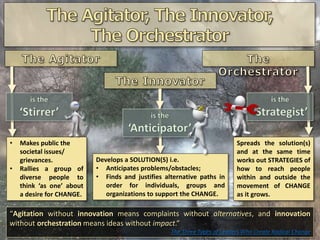
• Makes public the
societal issues/
grievances.
• Rallies a group of
diverse people to
think ‘as one’ about
a desire for CHANGE.
Develops a SOLUTION(S) i.e.
• Anticipates problems/obstacles;
• Finds and justifies alternative paths in
order for individuals, groups and
organizations to support the CHANGE.
Spreads the solution(s)
and at the same time
works out STRATEGIES of
how to reach people
within and outside the
movement of CHANGE
as it grows.
“Agitation without innovation means complaints without alternatives, and innovation
without orchestration means ideas without impact.”
The Three Types of Leaders Who Create Radical Change
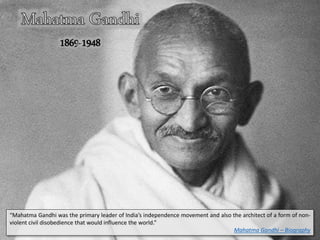
“Mahatma Gandhi was the primary leader of India’s independence movement and also the architect of a form of non-
violent civil disobedience that would influence the world.”
Mahatma Gandhi – Biography
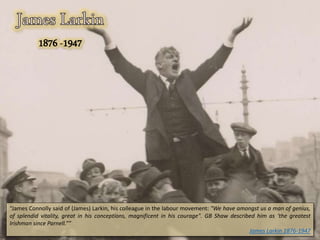
“James Connolly said of (James) Larkin, his colleague in the labour movement: "We have amongst us a man of genius,
of splendid vitality, great in his conceptions, magnificent in his courage". GB Shaw described him as ‘the greatest
Irishman since Parnell.””
James Larkin 1876-1947
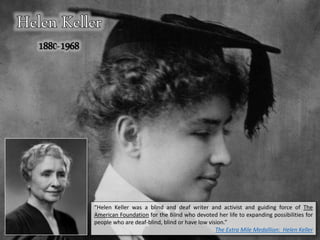
“Helen Keller was a blind and deaf writer and activist and guiding force of The
American Foundation for the Blind who devoted her life to expanding possibilities for
people who are deaf-blind, blind or have low vision.”
The Extra Mile Medallion: Helen Keller
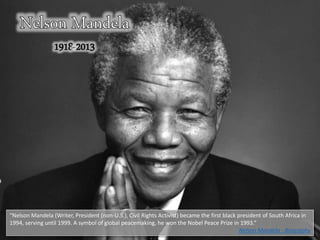
“Nelson Mandela (Writer, President (non-U.S.), Civil Rights Activist) became the first black president of South Africa in
1994, serving until 1999. A symbol of global peacemaking, he won the Nobel Peace Prize in 1993.”
Nelson Mandela - Biography
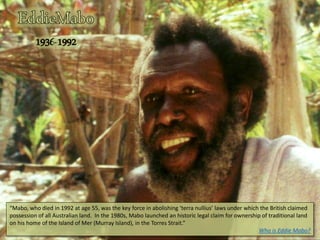
“Mabo, who died in 1992 at age 55, was the key force in abolishing ‘terra nullius’ laws under which the British claimed
possession of all Australian land. In the 1980s, Mabo launched an historic legal claim for ownership of traditional land
on his home of the Island of Mer (Murray Island), in the Torres Strait.”
Who is Eddie Mabo?
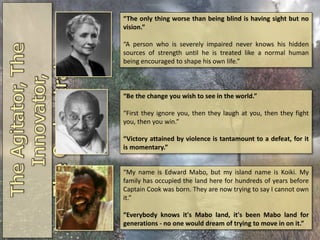
“The only thing worse than being blind is having sight but no
vision.”
“A person who is severely impaired never knows his hidden
sources of strength until he is treated like a normal human
being encouraged to shape his own life.”
“Be the change you wish to see in the world.”
“First they ignore you, then they laugh at you, then they fight
you, then you win.”
“Victory attained by violence is tantamount to a defeat, for it
is momentary.”
“My name is Edward Mabo, but my island name is Koiki. My
family has occupied the land here for hundreds of years before
Captain Cook was born. They are now trying to say I cannot own
it.”
“Everybody knows it's Mabo land, it's been Mabo land for
generations - no one would dream of trying to move in on it.”
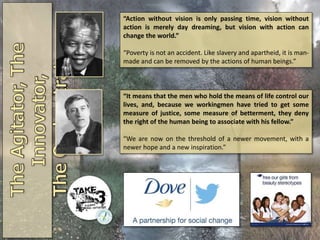
“Action without vision is only passing time, vision without
action is merely day dreaming, but vision with action can
change the world.”
“Poverty is not an accident. Like slavery and apartheid, it is man-
made and can be removed by the actions of human beings.”
“It means that the men who hold the means of life control our
lives, and, because we workingmen have tried to get some
measure of justice, some measure of betterment, they deny
the right of the human being to associate with his fellow.”
“We are now on the threshold of a newer movement, with a
newer hope and a new inspiration.”
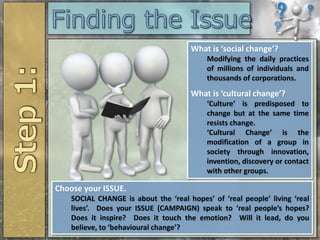
What is ‘social change’?
Modifying the daily practices
of millions of individuals and
thousands of corporations.
What is ‘cultural change’?
‘Culture’ is predisposed to
change but at the same time
resists change.
‘Cultural Change’ is the
modification of a group in
society through innovation,
invention, discovery or contact
with other groups.
Choose your ISSUE.
SOCIAL CHANGE is about the ‘real hopes’ of ‘real people’ living ‘real
lives’. Does your ISSUE (CAMPAIGN) speak to ‘real people’s hopes?
Does it inspire? Does it touch the emotion? Will it lead, do you
believe, to ‘behavioural change’?
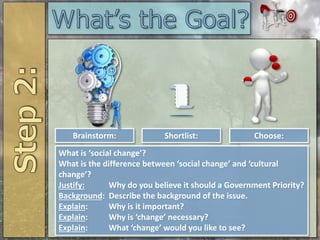
Brainstorm: Shortlist:
What is ‘social change’?
What is the difference between ‘social change’ and ‘cultural
change’?
Justify: Why do you believe it should a Government Priority?
Background: Describe the background of the issue.
Explain: Why is it important?
Explain: Why is ‘change’ necessary?
Explain: What ‘change’ would you like to see?
Choose:
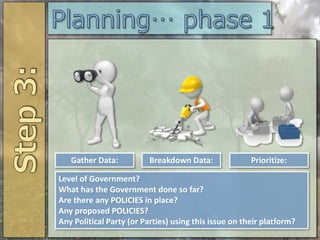
Gather Data: Breakdown Data: Prioritize:
Level of Government?
What has the Government done so far?
Are there any POLICIES in place?
Any proposed POLICIES?
Any Political Party (or Parties) using this issue on their platform?
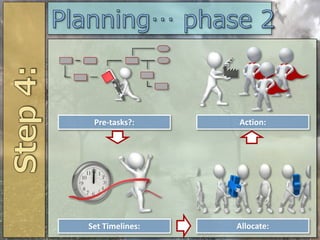
Pre-tasks?:
Set Timelines:
Action:
Allocate:
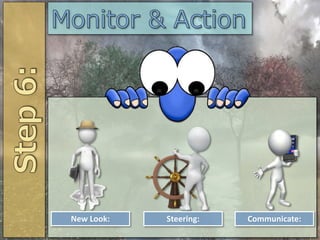
New Look: Steering: Communicate:
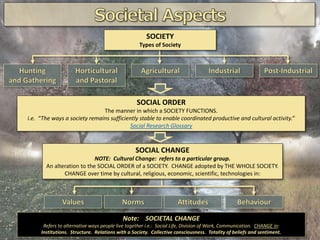
SOCIAL ORDER
The manner in which a SOCIETY FUNCTIONS.
i.e. “The ways a society remains sufficiently stable to enable coordinated productive and cultural activity.”
Social Research Glossary
Note: SOCIETAL CHANGE
Refers to alternative ways people live together i.e.: Social Life, Division of Work, Communication. CHANGE in:
Institutions. Structure. Relations with a Society. Collective consciousness. Totality of beliefs and sentiment.
SOCIAL CHANGE
NOTE: Cultural Change: refers to a particular group.
An alteration to the SOCIAL ORDER of a SOCIETY. CHANGE adopted by THE WHOLE SOCIETY.
CHANGE over time by cultural, religious, economic, scientific, technologies in:
SOCIETY
Types of Society
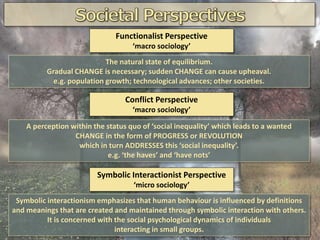
The natural state of equilibrium.
Gradual CHANGE is necessary; sudden CHANGE can cause upheaval.
e.g. population growth; technological advances; other societies.
Functionalist Perspective
‘macro sociology’
A perception within the status quo of ‘social inequality’ which leads to a wanted
CHANGE in the form of PROGRESS or REVOLUTION
which in turn ADDRESSES this ‘social inequality’.
e.g. ‘the haves’ and ‘have nots’
Conflict Perspective
‘macro sociology’
Symbolic interactionism emphasizes that human behaviour is influenced by definitions
and meanings that are created and maintained through symbolic interaction with others.
It is concerned with the social psychological dynamics of individuals
interacting in small groups.
Symbolic Interactionist Perspective
‘micro sociology’
Social Change Project

Social Change Project

  • 2.
    • Makes publicthe societal issues/ grievances. • Rallies a group of diverse people to think ‘as one’ about a desire for CHANGE. Develops a SOLUTION(S) i.e. • Anticipates problems/obstacles; • Finds and justifies alternative paths in order for individuals, groups and organizations to support the CHANGE. Spreads the solution(s) and at the same time works out STRATEGIES of how to reach people within and outside the movement of CHANGE as it grows. “Agitation without innovation means complaints without alternatives, and innovation without orchestration means ideas without impact.” The Three Types of Leaders Who Create Radical Change
  • 3.
    “Mahatma Gandhi wasthe primary leader of India’s independence movement and also the architect of a form of non- violent civil disobedience that would influence the world.” Mahatma Gandhi – Biography
  • 4.
    “James Connolly saidof (James) Larkin, his colleague in the labour movement: "We have amongst us a man of genius, of splendid vitality, great in his conceptions, magnificent in his courage". GB Shaw described him as ‘the greatest Irishman since Parnell.”” James Larkin 1876-1947
  • 5.
    “Helen Keller wasa blind and deaf writer and activist and guiding force of The American Foundation for the Blind who devoted her life to expanding possibilities for people who are deaf-blind, blind or have low vision.” The Extra Mile Medallion: Helen Keller
  • 6.
    “Nelson Mandela (Writer,President (non-U.S.), Civil Rights Activist) became the first black president of South Africa in 1994, serving until 1999. A symbol of global peacemaking, he won the Nobel Peace Prize in 1993.” Nelson Mandela - Biography
  • 7.
    “Mabo, who diedin 1992 at age 55, was the key force in abolishing ‘terra nullius’ laws under which the British claimed possession of all Australian land. In the 1980s, Mabo launched an historic legal claim for ownership of traditional land on his home of the Island of Mer (Murray Island), in the Torres Strait.” Who is Eddie Mabo?
  • 10.
    “The only thingworse than being blind is having sight but no vision.” “A person who is severely impaired never knows his hidden sources of strength until he is treated like a normal human being encouraged to shape his own life.” “Be the change you wish to see in the world.” “First they ignore you, then they laugh at you, then they fight you, then you win.” “Victory attained by violence is tantamount to a defeat, for it is momentary.” “My name is Edward Mabo, but my island name is Koiki. My family has occupied the land here for hundreds of years before Captain Cook was born. They are now trying to say I cannot own it.” “Everybody knows it's Mabo land, it's been Mabo land for generations - no one would dream of trying to move in on it.”
  • 11.
    “Action without visionis only passing time, vision without action is merely day dreaming, but vision with action can change the world.” “Poverty is not an accident. Like slavery and apartheid, it is man- made and can be removed by the actions of human beings.” “It means that the men who hold the means of life control our lives, and, because we workingmen have tried to get some measure of justice, some measure of betterment, they deny the right of the human being to associate with his fellow.” “We are now on the threshold of a newer movement, with a newer hope and a new inspiration.”
  • 12.
    What is ‘socialchange’? Modifying the daily practices of millions of individuals and thousands of corporations. What is ‘cultural change’? ‘Culture’ is predisposed to change but at the same time resists change. ‘Cultural Change’ is the modification of a group in society through innovation, invention, discovery or contact with other groups. Choose your ISSUE. SOCIAL CHANGE is about the ‘real hopes’ of ‘real people’ living ‘real lives’. Does your ISSUE (CAMPAIGN) speak to ‘real people’s hopes? Does it inspire? Does it touch the emotion? Will it lead, do you believe, to ‘behavioural change’?
  • 13.
    Brainstorm: Shortlist: What is‘social change’? What is the difference between ‘social change’ and ‘cultural change’? Justify: Why do you believe it should a Government Priority? Background: Describe the background of the issue. Explain: Why is it important? Explain: Why is ‘change’ necessary? Explain: What ‘change’ would you like to see? Choose:
  • 14.
    Gather Data: BreakdownData: Prioritize: Level of Government? What has the Government done so far? Are there any POLICIES in place? Any proposed POLICIES? Any Political Party (or Parties) using this issue on their platform?
  • 15.
  • 17.
    New Look: Steering:Communicate:
  • 18.
    SOCIAL ORDER The mannerin which a SOCIETY FUNCTIONS. i.e. “The ways a society remains sufficiently stable to enable coordinated productive and cultural activity.” Social Research Glossary Note: SOCIETAL CHANGE Refers to alternative ways people live together i.e.: Social Life, Division of Work, Communication. CHANGE in: Institutions. Structure. Relations with a Society. Collective consciousness. Totality of beliefs and sentiment. SOCIAL CHANGE NOTE: Cultural Change: refers to a particular group. An alteration to the SOCIAL ORDER of a SOCIETY. CHANGE adopted by THE WHOLE SOCIETY. CHANGE over time by cultural, religious, economic, scientific, technologies in: SOCIETY Types of Society
  • 19.
    The natural stateof equilibrium. Gradual CHANGE is necessary; sudden CHANGE can cause upheaval. e.g. population growth; technological advances; other societies. Functionalist Perspective ‘macro sociology’ A perception within the status quo of ‘social inequality’ which leads to a wanted CHANGE in the form of PROGRESS or REVOLUTION which in turn ADDRESSES this ‘social inequality’. e.g. ‘the haves’ and ‘have nots’ Conflict Perspective ‘macro sociology’ Symbolic interactionism emphasizes that human behaviour is influenced by definitions and meanings that are created and maintained through symbolic interaction with others. It is concerned with the social psychological dynamics of individuals interacting in small groups. Symbolic Interactionist Perspective ‘micro sociology’