Interpretation of Data
DATA REVIEW AND CONCLUSION MAKING
Prepared By:
Tahoor Qadeer
Department of Chemical Engineering
University of Karachi
What is data interpretation
 Data interpretation refers to the process of using diverse analytical methods to
review data and arrive at relevant conclusions. The interpretation of data helps
researchers to categorize, manipulate, and summarize the information in order to
answer critical questions.
How To Interpret Data
 When interpreting data, an analyst must try to discern the differences between
correlation, causation, and coincidences, as well as much other bias.
 There are two methods of data interpretation.
1. Qualitative Data Interpretation.
2. Quantitative Data Interpretation.
Qualitative Data Interpretation
 Qualitative data analysis can be summed up in one word – categorical.
 data is not described through numerical values or patterns, but through the use of
descriptive context.
 data is gathered by employing a wide variety of person-to-person techniques.
These techniques include:
 Observations: detailing behavioral patterns that occur within an observation
group. These patterns could be the amount of time spent in an activity, the type of
activity, and the method of communication employed.
 Focus groups: Group people and ask them relevant questions to generate a
collaborative discussion about a research topic.
 Secondary Research: much like how patterns of behavior can be observed,
different types of documentation resources can be coded and divided based on
the type of material they contain.
 Interviews: one of the best collection methods for narrative data. Inquiry
responses can be grouped by theme, topic, or category. The interview approach
allows for highly-focused data segmentation.
Quantitative Data Interpretation
 If quantitative data interpretation could be summed up in one word that word
would be “numerical.”
 Quantitative analysis refers to a set of processes by which numerical data is
analyzed.
 it involves the use of statistical modeling such as standard deviation, mean and
median.
 Mean: A mean represents a numerical average for a set of responses. When
dealing with a data set (or multiple data sets), a mean will represent a central
value of a specific set of numbers. It is the sum of the values divided by the
number of values within the data set.
 Standard deviation: This is another statistical term commonly appearing in
quantitative analysis. Standard deviation reveals the distribution of the responses
around the mean. It describes the degree of consistency within the responses;
together with the mean, it provides insight into data sets.
 Frequency distribution: This is a measurement gauging the rate of a response
appearance within a data set. When using a survey, for example, frequency
distribution has the capability of determining the number of times a specific
ordinal scale response appears (i.e., agree, strongly agree, disagree, etc.).
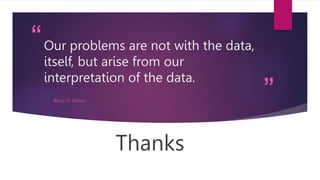
“
”
Our problems are not with the data,
itself, but arise from our
interpretation of the data.
BRUCE H. LIPTON
Thanks

Interpretation of Data.pptx

  • 1.
    Interpretation of Data DATAREVIEW AND CONCLUSION MAKING Prepared By: Tahoor Qadeer Department of Chemical Engineering University of Karachi
  • 2.
    What is datainterpretation  Data interpretation refers to the process of using diverse analytical methods to review data and arrive at relevant conclusions. The interpretation of data helps researchers to categorize, manipulate, and summarize the information in order to answer critical questions.
  • 3.
    How To InterpretData  When interpreting data, an analyst must try to discern the differences between correlation, causation, and coincidences, as well as much other bias.  There are two methods of data interpretation. 1. Qualitative Data Interpretation. 2. Quantitative Data Interpretation.
  • 4.
    Qualitative Data Interpretation Qualitative data analysis can be summed up in one word – categorical.  data is not described through numerical values or patterns, but through the use of descriptive context.  data is gathered by employing a wide variety of person-to-person techniques. These techniques include:
  • 5.
     Observations: detailingbehavioral patterns that occur within an observation group. These patterns could be the amount of time spent in an activity, the type of activity, and the method of communication employed.  Focus groups: Group people and ask them relevant questions to generate a collaborative discussion about a research topic.
  • 6.
     Secondary Research:much like how patterns of behavior can be observed, different types of documentation resources can be coded and divided based on the type of material they contain.  Interviews: one of the best collection methods for narrative data. Inquiry responses can be grouped by theme, topic, or category. The interview approach allows for highly-focused data segmentation.
  • 7.
    Quantitative Data Interpretation If quantitative data interpretation could be summed up in one word that word would be “numerical.”  Quantitative analysis refers to a set of processes by which numerical data is analyzed.  it involves the use of statistical modeling such as standard deviation, mean and median.
  • 8.
     Mean: Amean represents a numerical average for a set of responses. When dealing with a data set (or multiple data sets), a mean will represent a central value of a specific set of numbers. It is the sum of the values divided by the number of values within the data set.  Standard deviation: This is another statistical term commonly appearing in quantitative analysis. Standard deviation reveals the distribution of the responses around the mean. It describes the degree of consistency within the responses; together with the mean, it provides insight into data sets.
  • 9.
     Frequency distribution:This is a measurement gauging the rate of a response appearance within a data set. When using a survey, for example, frequency distribution has the capability of determining the number of times a specific ordinal scale response appears (i.e., agree, strongly agree, disagree, etc.).
  • 10.
    “ ” Our problems arenot with the data, itself, but arise from our interpretation of the data. BRUCE H. LIPTON Thanks