Review Time
Talkie Time: Research worth Sharing
Lesson 2, Objectives : The learner
4. differentiates quantitative from qualitative
research
5. provide examples of research in areas of
interest (arts, humanities, sports, science,
business, agriculture and fisheries, information
and communication technology, and social
inquiry)
Tell whether the following is an IP topic or not:
1. Effects of Typhoon
2. Digestion process due to exercise
3. sleeping patterns of birds
4. skipping rope
5. perception of Mandaya tribe
6. pin pricking effects
7. ticking of the clock
8. flying kites
9. wild berries ink
10. behavioral patterns
11. breast walking with music
12. breast walking in park
13. moon and behavior
14. bread and butter
15. grades and teaching
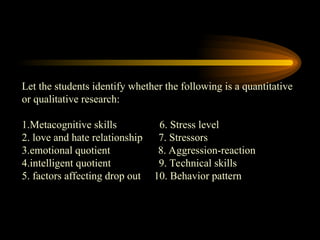
Let the students identify whether the following is a quantitative
or qualitative research:
1.Metacognitive skills 6. Stress level
2. love and hate relationship 7. Stressors
3.emotional quotient 8. Aggression-reaction
4.intelligent quotient 9. Technical skills
5. factors affecting drop out 10. Behavior pattern
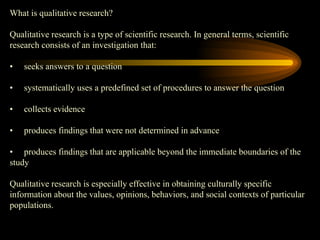
What is qualitative research?
Qualitative research is a type of scientific research. In general terms, scientific
research consists of an investigation that:
• seeks answers to a question
• systematically uses a predefined set of procedures to answer the question
• collects evidence
• produces findings that were not determined in advance
• produces findings that are applicable beyond the immediate boundaries of the
study
Qualitative research is especially effective in obtaining culturally specific
information about the values, opinions, behaviors, and social contexts of particular
populations.
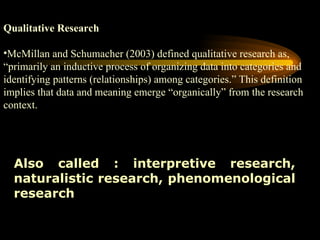
Qualitative Research
•McMillan and Schumacher (2003) defined qualitative research as,
“primarily an inductive process of organizing data into categories and
identifying patterns (relationships) among categories.” This definition
implies that data and meaning emerge “organically” from the research
context.
Also called : interpretive research,
naturalistic research, phenomenological
research
QUALITATIVE RESEARCH
• ‘Qualitative Research…involves finding out
what people think, and how they feel - or at
any rate, what they say they think and how
they say they feel. This kind of information is
subjective. It involves feelings and
impressions, rather than numbers’
• Bellenger, Bernhardt and Goldstucker, Qualitative Research in
Marketing, American Marketing Association
Comparing Quantitative and Qualitative Research
What are the basic differences between quantitative and
qualitative research methods?
Quantitative and qualitative research methods differ primarily
in:
• their analytical objectives
• the types of questions they pose
• the types of data collection instruments they use
• the forms of data they produce
• the degree of flexibility built into study design
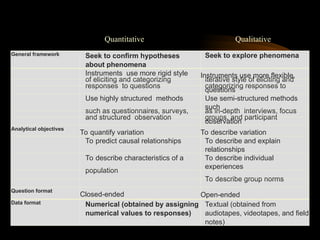
General framework Seek to confirm hypotheses
about phenomena
Seek to explore phenomena
Instruments use more rigid style Instruments use more flexible,
of eliciting and categorizing iterative style of eliciting and
responses to questions categorizing responses to
questions
Use highly structured methods Use semi-structured methods
such
such as questionnaires, surveys, as in-depth interviews, focus
and structured observation groups, and participant
observation
Analytical objectives
To quantify variation To describe variation
To predict causal relationships To describe and explain
relationships
To describe characteristics of a To describe individual
experiences
population
To describe group norms
Question format
Closed-ended Open-ended
Data format Numerical (obtained by assigning
numerical values to responses)
Textual (obtained from
audiotapes, videotapes, and field
notes)
Quantitative Qualitative
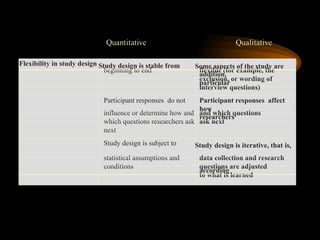
Flexibility in study design Study design is stable from Some aspects of the study are
beginning to end flexible (for example, the
addition,
exclusion, or wording of
particular
interview questions)
Participant responses do not Participant responses affect
how
influence or determine how and and which questions
researchers
which questions researchers ask ask next
next
Study design is subject to Study design is iterative, that is,
statistical assumptions and data collection and research
conditions questions are adjusted
according
to what is learned
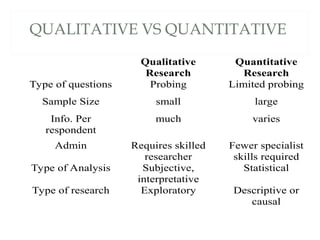
QUALITATIVE VS QUANTITATIVE
Qualitative
Research
Quantitative
Research
Type of questions Probing Limited probing
Sample Size small large
Info. Per
respondent
much varies
Admin Requires skilled
researcher
Fewer specialist
skills required
Type of Analysis Subjective,
interpretative
Statistical
Type of research Exploratory Descriptive or
causal
How do you apply The Research Thrusts of 21st
century
Health and Welfare Conservation and
Environment Safety
Food Production and
Sustainability
Culture and Arts
Social Awareness
Technology and
Development

Qualitative Research (Senior High School Practical Reseach 2)

  • 2.
    Review Time Talkie Time:Research worth Sharing
  • 3.
    Lesson 2, Objectives: The learner 4. differentiates quantitative from qualitative research 5. provide examples of research in areas of interest (arts, humanities, sports, science, business, agriculture and fisheries, information and communication technology, and social inquiry)
  • 4.
    Tell whether thefollowing is an IP topic or not: 1. Effects of Typhoon 2. Digestion process due to exercise 3. sleeping patterns of birds 4. skipping rope 5. perception of Mandaya tribe 6. pin pricking effects 7. ticking of the clock 8. flying kites 9. wild berries ink 10. behavioral patterns 11. breast walking with music 12. breast walking in park 13. moon and behavior 14. bread and butter 15. grades and teaching
  • 5.
    Let the studentsidentify whether the following is a quantitative or qualitative research: 1.Metacognitive skills 6. Stress level 2. love and hate relationship 7. Stressors 3.emotional quotient 8. Aggression-reaction 4.intelligent quotient 9. Technical skills 5. factors affecting drop out 10. Behavior pattern
  • 6.
    What is qualitativeresearch? Qualitative research is a type of scientific research. In general terms, scientific research consists of an investigation that: • seeks answers to a question • systematically uses a predefined set of procedures to answer the question • collects evidence • produces findings that were not determined in advance • produces findings that are applicable beyond the immediate boundaries of the study Qualitative research is especially effective in obtaining culturally specific information about the values, opinions, behaviors, and social contexts of particular populations.
  • 7.
    Qualitative Research •McMillan andSchumacher (2003) defined qualitative research as, “primarily an inductive process of organizing data into categories and identifying patterns (relationships) among categories.” This definition implies that data and meaning emerge “organically” from the research context. Also called : interpretive research, naturalistic research, phenomenological research
  • 8.
    QUALITATIVE RESEARCH • ‘QualitativeResearch…involves finding out what people think, and how they feel - or at any rate, what they say they think and how they say they feel. This kind of information is subjective. It involves feelings and impressions, rather than numbers’ • Bellenger, Bernhardt and Goldstucker, Qualitative Research in Marketing, American Marketing Association
  • 9.
    Comparing Quantitative andQualitative Research What are the basic differences between quantitative and qualitative research methods? Quantitative and qualitative research methods differ primarily in: • their analytical objectives • the types of questions they pose • the types of data collection instruments they use • the forms of data they produce • the degree of flexibility built into study design
  • 10.
    General framework Seekto confirm hypotheses about phenomena Seek to explore phenomena Instruments use more rigid style Instruments use more flexible, of eliciting and categorizing iterative style of eliciting and responses to questions categorizing responses to questions Use highly structured methods Use semi-structured methods such such as questionnaires, surveys, as in-depth interviews, focus and structured observation groups, and participant observation Analytical objectives To quantify variation To describe variation To predict causal relationships To describe and explain relationships To describe characteristics of a To describe individual experiences population To describe group norms Question format Closed-ended Open-ended Data format Numerical (obtained by assigning numerical values to responses) Textual (obtained from audiotapes, videotapes, and field notes) Quantitative Qualitative
  • 11.
    Flexibility in studydesign Study design is stable from Some aspects of the study are beginning to end flexible (for example, the addition, exclusion, or wording of particular interview questions) Participant responses do not Participant responses affect how influence or determine how and and which questions researchers which questions researchers ask ask next next Study design is subject to Study design is iterative, that is, statistical assumptions and data collection and research conditions questions are adjusted according to what is learned
  • 12.
    QUALITATIVE VS QUANTITATIVE Qualitative Research Quantitative Research Typeof questions Probing Limited probing Sample Size small large Info. Per respondent much varies Admin Requires skilled researcher Fewer specialist skills required Type of Analysis Subjective, interpretative Statistical Type of research Exploratory Descriptive or causal
  • 13.
    How do youapply The Research Thrusts of 21st century Health and Welfare Conservation and Environment Safety Food Production and Sustainability Culture and Arts Social Awareness Technology and Development