Qualitative Methods in Psychology
Theory and Practice
Chinchu C
Psychologist, Trainer & Research Consultant
Association for Social Change, Evolution and
Transformation(ASCENT)
How do we know truth?
Nimmy, the lady
claims that Misha,
their cat loves her ‘The
Most’ than anybody
else in the world
And John, her
boyfriend, claims
Misha loves him more
How do we know what is True ?
Image Courtesy: https://laughingsquid.com,
Concept and Content Courtesy: ANNEMARIE ZAND SCHOLTEN, University of Amsterdam
 Idealism: Reality exists only in our minds.
 Realism: External reality exists; Universal concepts like ‘Love’ and
‘Gravity’ exist too.
 Objectivism: Applies Realism. External Psychological and Social
Phenomena (Intelligence, Social Cohesion…) exist.
 Constructivism: Social Phenomena are mental constructions.
Meaning of ‘Happiness’ or ‘Femininity/Masculinity’ depend on
culture and contexts
 Interpretivism: Applies Constructivism: The observer’s
experience can be different from the participant’s experience
 Hermeneutics(വ്യാഖ്യാനം), Phenomenology(How people
experience the world) and Verstehen (Empathic Understanding)
Does a ‘Truth’ exist?
 Qualitative Research generally applies a Constructivist-
Interpretivist view
 Unstructured Interview, Participant Observation etc.
 Quantitative Research generally applies an Objectivist-
Positivist approach
 Focuses on counting, measuring and generalizing.
 None of these should be taken as water tight
compartments.
 What we need is Mixed Methods where both methods
complement each other, especially in fields like
Psychology
The Fundamental Approaches
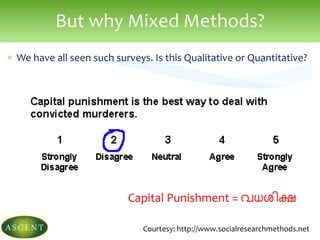
But why Mixed Methods?
 We have all seen such surveys. Is this Qualitative or Quantitative?
Courtesy: http://www.socialresearchmethods.net
Capital Punishment = വ്ധശിക്ഷ
 Did the respondent understand the term "capital punishment"?
 Does the respondent have any idea about alternatives to capital
punishment (otherwise how can they judge what's "best")?
 Did the respondent read carefully enough to determine that the
statement was limited only to convicted murderers (for instance,
rapists were not included)?
 Does the respondent care or were they just circling anything
arbitrarily?
 Was the respondent mentally alert (especially if this is late in a
long survey or the respondent had other things going on earlier
in the day)?
 What was the setting for the survey (e.g., lighting, noise and
other distractions)?
 Was the survey anonymous? Was it confidential?
 In the respondent's mind, is the difference between a "1" and a
"2" the same as between a "2" and a "3" (i.e., is this an interval
scale?)?
 Data needs to be as naturalistic as possible (ഒട്ടം രൂപമാറ്റം
വ്രാതെ)
 Researcher is the tool
 Validation is done during the earlier stages itself.
 Real-life data collection can also enhance validity
 Reflexivity is incorporated for continuous scrutiny.
 Personal Reflexivity : How your own values, expectations, beliefs,
interests etc. have shaped this research
 Epistemological Reflexivity: How is the design constructed, How was
the research question formed; What were the other possible
questions, their consequences…..
 The issue of Reliability. How dependable the data is ? Is
replication really possible?
Some General Principles
“I am frequently reminded of the old joke about the
individual who explained that he was looking for his
missing keys under the street lamp because ‘the
light is better there’ . . . The ‘street lamp’ draws us
to it by its apparent capacity to facilitate our
search”
Lorion, R.P. (1990) Evaluating HIV risk reduction efforts: ten
lessons from psychotherapy and prevention outcome strategies,
Journal of Community Psychology, 18: 325–36
Framing your Research Question
Semi-Structured Interview is an effective
tool for data collection
Used in
Phenomenology,
Grounded Theory,
Thematic Analysis…
Interview as a Data Collection Tool
 FGD can be more productive than personal interviews
because of its collaborative nature
 The researcher should be aware of group dynamics at
play
 Less artificial than interviews
 Researcher plays the role of moderator
 6 to 8 participants
 Interactions should be similar to normal, real-life
discourse
FGD as Data Collection Tool
 Done in Natural settings
 Can be Structured or Unstructured
 Used heavily in Ethnography and Action Research
 Involves Participation, Documentation, Informal
Interviewing, and Reflection
 Substantive, Methodological and Analytical notes need
to be taken
 Participation is of utmost importance in Participant
Observation. Mere Observation won’t suffice
 Observation Schedules may come in handy
Observation
 Interpretation has a long history, beginning from classical
hermeneutics to the data science and social media analysis
 Realist interpretation: A straight forward description of events
 Phenomenological Interpretation : Mapping the experiences of
the actors
 Social Constructionist Interpretation: Deconstructing the
narration/event, with assuming different perspectives
 Interpretations can be based on Suspicion or Empathy
 Suspicion: To reveal a hidden truth; working like a detective.
Remember Freud. Involves some assumptions
 Empathy : Trying to get close to the experience of the subject.
No underlying assumptions. Not necessarily tied to theories
The role of Interpretation
 Thematic Analysis
 Case Studies
 Phenomenology
 Grounded Theory
 Discursive Psychology (Discourse Analysis)
 Narrative Analysis
 Visual Methods
Some Methods
 A form of pattern-seeking in data.
 Can be used to address Realist, Phenomenological or
Constructionist questions
 What do I want to know & What data do I collect: Both questions
answered by the Research Question
 Coding – Inductive ( Coding frame emerges from data) or
Deductive ( pre-existing coding frame)
 Second level of coding (Categorization) can be done before
theme identification
 Mere listing of themes is not the goal. You should make sense of
the themes, their possible inner meanings, implications, an
overall story that connects the identified themes … etc.
Thematic Analysis
 Focus on the particular, not general (Idiographic approach)
 Attention to Contexts
 Triangulation is used
 Temporal element ( Describes changes over time)
 Concerned with Theory
 Intrinsic V/s Instrumental
 Single V/s Multiple
 Descriptive V/s Explanatory
 Naturalist V/s Pragmatic
Case Studies
 Study of Subjective Experiences; Draws largely from Husserl
 Interpretative Phenomenological Analysis (IPA) is used widely in
Psychology
 It attempts to describe the experiences through their
interpretation by the subject
 Open-ended and non-directive interviewing
 Analysis should record both experience and interpretation
 Reading  Identifying and labeling emergent themes
Clustering themes Labeling Clusters Summarizing with
tables and quotes.
 Integration of cases and layered Interpretation are optional
 Writing Up
Phenomenology
 Introduced by Barney Glaser and Anselm Strauss (1967); they
wanted to move away from theory.
 Categories: Start as descriptive labels and move on to abstract
analytic categories
 Category names are in vivo
 Coding: The layered process to define categories
 Constant Comparative Analysis: Moving back and forth between
similarities among and differences between categories; building
up sub categories and linking categories
 Negative Case Analysis: Instances that do not fit a category
 Theoretical Sensitivity: Revisiting the data based on new
understanding
Grounded Theory
 Theoretical Sampling: Collecting further data based on emerging
categories
 Theoretical Saturation: A point where no new categories emerge
 Memo writing: A written record of theory development; An
important part of the process
A Process for Grounded Theory
Research Question
Data Collection (Full Version/Abbreviated Version)
Data Analysis (Coding and Categorizing)
The Report (Introduction, Method, Results, Discussion, Reference)
Grounded Theory
 Fit of data and categories – Explain the Why of each
category
 Theory Integration /Coherence– Relationship between units
should be clear and apparent
 Reflexivity - The role and position of researcher to be
acknowledged
 Proper and Comprehensive Documentation
 Theoretical Sampling and Negative Case Analysis
 Transferability : The extent of Generalization possible
 Credibility: Ways to verify the findings/data
Ensuring Quality
 Always be careful and never jump into conclusions
 Criticize and question your own convictions and
 Coming of Age in Samoa, Margaret Mead and Fa’apua’a Fa’amu
and Fofoa
 How a single interview shook the whole field of Anthropology,
and still remains a hot topic
A word of Caution
 Elliott, R., Fischer, C.T. and Rennie, D.L. (1999) Evolving guidelines
for publication of qualitative research studies in psychology and
related fields, British Journal for Clinical Psychology, 38: 215–29
 Henwood, K. and Pidgeon, N.F. (1992) Qualitative research and
psychological theorising, British Journal of Psychology, 83(1): 97–
112
 Willig, C. (2008). Introducing qualitative research in psychology:
Adventures in theory and method (2nd edition ed.). Berkshire, UK:
Open University Press
References

Qualitative methods in Psychology Research

  • 1.
    Qualitative Methods inPsychology Theory and Practice Chinchu C Psychologist, Trainer & Research Consultant Association for Social Change, Evolution and Transformation(ASCENT)
  • 2.
    How do weknow truth? Nimmy, the lady claims that Misha, their cat loves her ‘The Most’ than anybody else in the world And John, her boyfriend, claims Misha loves him more How do we know what is True ? Image Courtesy: https://laughingsquid.com, Concept and Content Courtesy: ANNEMARIE ZAND SCHOLTEN, University of Amsterdam
  • 3.
     Idealism: Realityexists only in our minds.  Realism: External reality exists; Universal concepts like ‘Love’ and ‘Gravity’ exist too.  Objectivism: Applies Realism. External Psychological and Social Phenomena (Intelligence, Social Cohesion…) exist.  Constructivism: Social Phenomena are mental constructions. Meaning of ‘Happiness’ or ‘Femininity/Masculinity’ depend on culture and contexts  Interpretivism: Applies Constructivism: The observer’s experience can be different from the participant’s experience  Hermeneutics(വ്യാഖ്യാനം), Phenomenology(How people experience the world) and Verstehen (Empathic Understanding) Does a ‘Truth’ exist?
  • 4.
     Qualitative Researchgenerally applies a Constructivist- Interpretivist view  Unstructured Interview, Participant Observation etc.  Quantitative Research generally applies an Objectivist- Positivist approach  Focuses on counting, measuring and generalizing.  None of these should be taken as water tight compartments.  What we need is Mixed Methods where both methods complement each other, especially in fields like Psychology The Fundamental Approaches
  • 5.
    But why MixedMethods?  We have all seen such surveys. Is this Qualitative or Quantitative? Courtesy: http://www.socialresearchmethods.net Capital Punishment = വ്ധശിക്ഷ
  • 6.
     Did therespondent understand the term "capital punishment"?  Does the respondent have any idea about alternatives to capital punishment (otherwise how can they judge what's "best")?  Did the respondent read carefully enough to determine that the statement was limited only to convicted murderers (for instance, rapists were not included)?  Does the respondent care or were they just circling anything arbitrarily?  Was the respondent mentally alert (especially if this is late in a long survey or the respondent had other things going on earlier in the day)?  What was the setting for the survey (e.g., lighting, noise and other distractions)?  Was the survey anonymous? Was it confidential?  In the respondent's mind, is the difference between a "1" and a "2" the same as between a "2" and a "3" (i.e., is this an interval scale?)?
  • 7.
     Data needsto be as naturalistic as possible (ഒട്ടം രൂപമാറ്റം വ്രാതെ)  Researcher is the tool  Validation is done during the earlier stages itself.  Real-life data collection can also enhance validity  Reflexivity is incorporated for continuous scrutiny.  Personal Reflexivity : How your own values, expectations, beliefs, interests etc. have shaped this research  Epistemological Reflexivity: How is the design constructed, How was the research question formed; What were the other possible questions, their consequences…..  The issue of Reliability. How dependable the data is ? Is replication really possible? Some General Principles
  • 8.
    “I am frequentlyreminded of the old joke about the individual who explained that he was looking for his missing keys under the street lamp because ‘the light is better there’ . . . The ‘street lamp’ draws us to it by its apparent capacity to facilitate our search” Lorion, R.P. (1990) Evaluating HIV risk reduction efforts: ten lessons from psychotherapy and prevention outcome strategies, Journal of Community Psychology, 18: 325–36 Framing your Research Question
  • 9.
    Semi-Structured Interview isan effective tool for data collection Used in Phenomenology, Grounded Theory, Thematic Analysis… Interview as a Data Collection Tool
  • 10.
     FGD canbe more productive than personal interviews because of its collaborative nature  The researcher should be aware of group dynamics at play  Less artificial than interviews  Researcher plays the role of moderator  6 to 8 participants  Interactions should be similar to normal, real-life discourse FGD as Data Collection Tool
  • 11.
     Done inNatural settings  Can be Structured or Unstructured  Used heavily in Ethnography and Action Research  Involves Participation, Documentation, Informal Interviewing, and Reflection  Substantive, Methodological and Analytical notes need to be taken  Participation is of utmost importance in Participant Observation. Mere Observation won’t suffice  Observation Schedules may come in handy Observation
  • 12.
     Interpretation hasa long history, beginning from classical hermeneutics to the data science and social media analysis  Realist interpretation: A straight forward description of events  Phenomenological Interpretation : Mapping the experiences of the actors  Social Constructionist Interpretation: Deconstructing the narration/event, with assuming different perspectives  Interpretations can be based on Suspicion or Empathy  Suspicion: To reveal a hidden truth; working like a detective. Remember Freud. Involves some assumptions  Empathy : Trying to get close to the experience of the subject. No underlying assumptions. Not necessarily tied to theories The role of Interpretation
  • 13.
     Thematic Analysis Case Studies  Phenomenology  Grounded Theory  Discursive Psychology (Discourse Analysis)  Narrative Analysis  Visual Methods Some Methods
  • 14.
     A formof pattern-seeking in data.  Can be used to address Realist, Phenomenological or Constructionist questions  What do I want to know & What data do I collect: Both questions answered by the Research Question  Coding – Inductive ( Coding frame emerges from data) or Deductive ( pre-existing coding frame)  Second level of coding (Categorization) can be done before theme identification  Mere listing of themes is not the goal. You should make sense of the themes, their possible inner meanings, implications, an overall story that connects the identified themes … etc. Thematic Analysis
  • 15.
     Focus onthe particular, not general (Idiographic approach)  Attention to Contexts  Triangulation is used  Temporal element ( Describes changes over time)  Concerned with Theory  Intrinsic V/s Instrumental  Single V/s Multiple  Descriptive V/s Explanatory  Naturalist V/s Pragmatic Case Studies
  • 16.
     Study ofSubjective Experiences; Draws largely from Husserl  Interpretative Phenomenological Analysis (IPA) is used widely in Psychology  It attempts to describe the experiences through their interpretation by the subject  Open-ended and non-directive interviewing  Analysis should record both experience and interpretation  Reading  Identifying and labeling emergent themes Clustering themes Labeling Clusters Summarizing with tables and quotes.  Integration of cases and layered Interpretation are optional  Writing Up Phenomenology
  • 17.
     Introduced byBarney Glaser and Anselm Strauss (1967); they wanted to move away from theory.  Categories: Start as descriptive labels and move on to abstract analytic categories  Category names are in vivo  Coding: The layered process to define categories  Constant Comparative Analysis: Moving back and forth between similarities among and differences between categories; building up sub categories and linking categories  Negative Case Analysis: Instances that do not fit a category  Theoretical Sensitivity: Revisiting the data based on new understanding Grounded Theory
  • 18.
     Theoretical Sampling:Collecting further data based on emerging categories  Theoretical Saturation: A point where no new categories emerge  Memo writing: A written record of theory development; An important part of the process A Process for Grounded Theory Research Question Data Collection (Full Version/Abbreviated Version) Data Analysis (Coding and Categorizing) The Report (Introduction, Method, Results, Discussion, Reference) Grounded Theory
  • 19.
     Fit ofdata and categories – Explain the Why of each category  Theory Integration /Coherence– Relationship between units should be clear and apparent  Reflexivity - The role and position of researcher to be acknowledged  Proper and Comprehensive Documentation  Theoretical Sampling and Negative Case Analysis  Transferability : The extent of Generalization possible  Credibility: Ways to verify the findings/data Ensuring Quality
  • 20.
     Always becareful and never jump into conclusions  Criticize and question your own convictions and  Coming of Age in Samoa, Margaret Mead and Fa’apua’a Fa’amu and Fofoa  How a single interview shook the whole field of Anthropology, and still remains a hot topic A word of Caution
  • 21.
     Elliott, R.,Fischer, C.T. and Rennie, D.L. (1999) Evolving guidelines for publication of qualitative research studies in psychology and related fields, British Journal for Clinical Psychology, 38: 215–29  Henwood, K. and Pidgeon, N.F. (1992) Qualitative research and psychological theorising, British Journal of Psychology, 83(1): 97– 112  Willig, C. (2008). Introducing qualitative research in psychology: Adventures in theory and method (2nd edition ed.). Berkshire, UK: Open University Press References