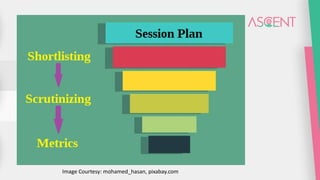
Identifying Journals for Publication
Search Tools, Indexes, and Metrics
Dr. Chinchu C.
Image Courtesy: mohamed_hasan, pixabay.com
Why Do We Publish?
• Because UGC asks us to…
and/or because…
• We want our work to be useful
• It is nice to be read and cited by others
• It may decide our career prospects
When To Start Journal-Searching?
• Earlier the better
• At least at the beginning of writing
– Can save a lot of time by way of article size, referencing,
overall focus etc.
• Always have a back-up list of journals
General and Specialized Journals
• *General or Wide Scope Journals may have
higher visibility and get more citations
– But usually have low acceptance rate
• *Specialized (field-specific) journals may have
higher acceptance rates
– But limited scope and themes, and visibility
* - Not to be taken as a General Rule
General Specialized
Approx. Acceptance Rates - General
7% 8%
Approx. Acceptance Rates - Specialized
66% 64%
Some Terms: Who does What
• Publishers: Taylor&Francis (Part of Informa), RELX (Formerly
Reed Elsevier), Wiley-Blackwell, Springer etc.
• Databases: Scopus (Elsevier), Web of Science (Clarivate
Analytics), Medline, PMC. ERIC (Education Research), JSTOR
etc.
• Indexing: Web of Science, Scopus, PMC, DOAJ etc.
• Search Engines/Aggregators: PubMed, Google Scholar,
Microsoft Academic, Semantic Scholar, Connected Papers,
Crossref, PubPsych, Paperity (Has Mobile App) etc.
• Service Providers: EBSCOhost, Proquestetc.
– Not Databases or Publishers
• Preprint Servers: Arxiv, SSRN, PsyArXiv, WikiJournal Preprints
etc.
• Most Indexing Services provide search facilities too
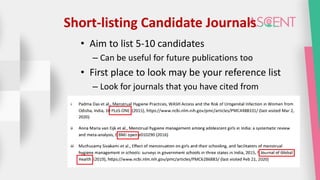
Short-listing Candidate Journals
• Aim to list 5-10 candidates
– Can be useful for future publications too
• First place to look may be your reference list
– Look for journals that you have cited from
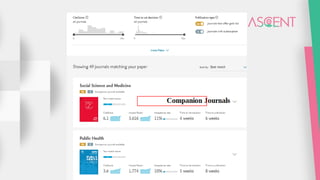
• Companion Journals can also be looked for
Journal Selection (Short-listing) Tools
• Generic Tools
– JANE
– Edanz
– Journal Guide
• Publisher Tools
– Elsevier Journal Finder
– Springer Journal Suggester
– SAGE Journal Recommender
Generic Tools
JANE: Journal/Author Name Estimator
Title/Abstract Here
Search for Journals/Authors/Articles
Journal Search Result
Article Search Result
Edanz Journal Selector
Results
Journal Guide
Search for Papers/Journals/Publishers with
Title/Abstract/Keywords
https://www.journalguide.com/
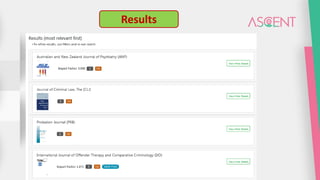
Results
Tools by Publishers
Elsevier JournalFinder
Springer Journal Suggester
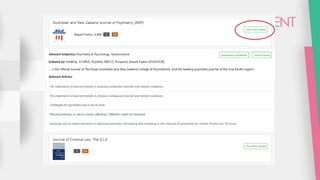
Results
SAGE Journal Recommender
Manuscript Title
Keywords
Results
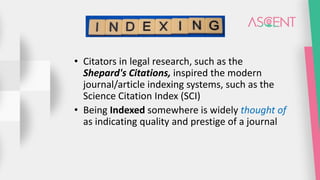
• Citators in legal research, such as the
Shepard's Citations, inspired the modern
journal/article indexing systems, such as the
Science Citation Index (SCI)
• Being Indexed somewhere is widely thought of
as indicating quality and prestige of a journal
Reminder: Who does What
• Publishers: Taylor&Francis (Part of Informa), RELX (Formerly
Reed Elsevier), Wiley-Blackwell, Springer etc.
• Databases: Scopus (Elsevier), Web of Science (Clarivate
Analytics), Medline, PMC. ERIC (Education Research), JSTOR
etc.
• Indexing: Web of Science, Scopus, PMC, DOAJ etc.
• Search Engines/Aggregators: PubMed, Google Scholar,
Microsoft Academic, Semantic Scholar, Connected Papers,
Crossref, PubPsych, Paperity (Has Mobile App) etc.
• Service Providers: EBSCOhost, Proquestetc.
– Not Databases or Publishers
• Preprint Servers: Arxiv, SSRN, PsyArXiv, WikiJournal Preprints
etc.
• Most Indexing Services provide search facilities too
Major Indexing Services
• Web of Science
• Scopus
• PubMed Central
– PubMed*/Medline*
• Directory of Open Access Journals (DOAJ)
• Washington and Lee Law Journal Rankings
• UGC CARE*
Web of Science
• Previously Web of Knowledge
• Originally by Institute for Scientific Information
(ISI), then a part of Thomson Reuters, and
presently owned by Clarivate Analytics
• Database and Indexing services
• Has a Core Collection and regional Databases
• Subscription based access to databases
• Core Collection
– Science Citation Index Expanded (SCIE)
• >9,200 journals across 150 disciplines; 1,900 onwards
– Science Citation Index (SCI)
• Merged with SCIE in 2020
– Social Sciences Citation Index (SSCI)
• >3,000 journals; 1900 onwards
– Arts & Humanities Citation Index (A&HCI)
• >1,950 journals; 1975 onwards
– Emerging Sources Citation Index (ESCI)
• >5,000 journals across fields
– Book Citation Index
– Conference Proceedings Citation Index (CPCI)
• >1,60,000 Conference titles
WoS Regional Databases
• Chinese Science Citation Database (in partnership
with the Chinese Academy of Sciences)
• SciELO Citation Index (Brazil, Spain, Portugal, the
Caribbeans, South Africa, and Latin America)
• Korea Citation Index (KCI) with South Korean
National Research Foundation
• Russian Science Citation Index
• Arabic Regional Citation Index (ARCI)
Global Coverage: Web of Science, 2011
Source: JISC-ADAT, 2011
Scopus
• By Elsevier
• >36,000 titles from >11,000 publishers
• Includes books, conference papers, and patents.
• Database and Indexing
• Covers all Medline content
• Some researchers have pointed out a European
bias
• SCImago Journal and Country rankings are made
from Scopus list
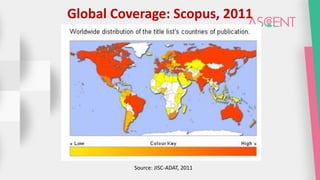
Global Coverage: Scopus, 2011
Source: JISC-ADAT, 2011
WoS and Scopus Coverage Overlap
Source: JISC-ADAT, 2011.
No longer available in the original website
Medline, PubMed, and PMC
• All have content mostly from biomedical and life
sciences journals
• Medline (Medical Literature Analysis and
Retrieval System Online) is compiled by National
Library of Medicine (NLM) under NIH of USA.
• PubMed by NLM enables searching for content
from Medline and other content such as books
and archives
– >30 million abstracts and citations; 7.5 million free
• PubMed Central (PMC) offers free full text articles
– >5.2 million articles
– Some overlap with PubMed content
Directory of Open Access Journals
(DOAJ)
• Indexing
• Community-curated list of open access journals
• More than 15,500 open access journals and 5
Crore articles
• Science, Technology, Medicine, Social Sciences
and Humanities
W&L Law Journal Rankings
• By Washington & Lee Law Library
• Released Annually
• 2019 rankings released in June 2020
• Filtered searching available
Indian Citation Index
• Launched as a private initiative in 2009
• Covered more than 1100 journals
• Scientific, Technical, Medical, and Social Sciences
including Arts and Humanities
• Indexes
– Indian Science Citation Index (ISCI),
– Indian Social Science and Humanities Citation Index
(ISSHCI),
– Indian Journals Citation Reports (IJCR),
– Indian Science and Technology Abstracts (ISTA)
– Directory of Indian Journals (DOIJ)
• Defunct since 2018
Others - Law
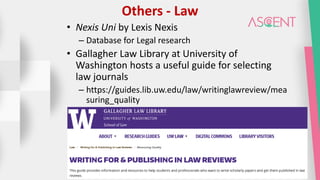
• Nexis Uni by Lexis Nexis
– Database for Legal research
• Gallagher Law Library at University of
Washington hosts a useful guide for selecting
law journals
– https://guides.lib.uw.edu/law/writinglawreview/mea
suring_quality
Other Sources
• PsycInfo by APA
• Google Scholar
– Not an indexing service; no vetting for inclusion
– Limited functionality in identifying quality content
• AGRIS
– Agricultural database
• Civil engineering database
UGC Consortium for Academic Research and Ethics (CARE)
• Established by UGC in 2018
• Two Groups (I and II)
– Group I: Journals found through UGC-CARE protocols
– Group II:
• Web of Science
–Arts & Humanities Citation Index (AHCI)
–Science Citation Index Expanded (SCIE)
–Social Sciences Citation Index (SSCI)
–ESCI Not Included
• Scopus List
• Modern Language Association (MLA)
• Usually updated every 3 months
• Headquartered at Savitribai Phule Pune University
Analysis Protocol: CARE Group I
• Part I: Basic information
– Journal title
– Journal broad discipline and focus subject
– Name of publisher
– Country of origin and registered address
– Journal language/s
– Publishing frequency
– Editor name, editorial office address, phone, email and website
– Current status (date of last publication) (print/ online/ both)
– ISSN/ eISSN
– Other registrations/ memberships such as RNI/ COPE/ CARE
• Part II: Primary Criteria
• Part III: Secondary Criteria
• Part II & III supposed to be based on “due diligence, verification
process and critical appraisal using sequential algorithmic
elimination process and weightage-based metrics”
– Further details not available in public domain
Searching Group I Journals
Title/ISSN/Publisher/Subject/Language
Scrutinizing Journals Using Metrics
and Other Indicators
Journal Metrics
• Journal Impact Factor (JIF)
• Immediacy Index
• Eigenfactor
• Article Influence
• h-index
• CiteScore
• SCImago Journal Rank (SJR)
• Source Normalized Impact per Paper (SNIP)
• Others
Journal Impact Factor (JIF)W
• initially intended to assist librarians for deciding
which journals to purchase for their institution
• The average number of times articles from a
journal, published in the past two years, have been
cited in a Journal Citations Report (JCR) year
• Data taken from SCIE, SSCI, AHCI, CPCIs (WoS)
• Varies highly across disciplines
• Comparisons are meaningful only within
disciplines
– or within fields inside each discipline
*W- Based on Web of Science
Journal Immediacy IndexW
• Average number of times an article in a given
journal is cited in the year it is published
• A same-year variant/equivalent of JIF
EigenfactorW
• Based on the number of times articles from the
journal published in the past five years have been
cited in the JCR year (similar to JIF) but also
considers which journals have contributed these
citations so that highly cited journals will influence
the score more than lesser cited journals
– Similar to Google’s Algorithm
• Considers ‘prestige of the journals’ along with
citation counts
• Comparisons across disciplines are not useful
Article Influence (AI)W
• Average influence of a journal’s articles over the
first five years after publication
• Calculated by dividing the Eigenfactor by the
number of articles published in the journal
Journal h-index
• h-index was originally an author-level metric
• Can be calculated using Google Scholar metrics,
WoS, or Scopus
• Expresses a journal's number of articles (h) that
have received at least h citations
CiteScoreS
• Scopus’s equivalent of JIF
• Calculated every year
• Seeks to be a more transparent and reproducible
metric
• *S- Based on Scopus
SCImago Journal Rank (SJR)S
• Calculation based on citations during the previous
three years
• Considers ‘prestige of journals’ along with citations
• Similar to Eigenfactor by WoS
• SCImago also ranks Institutions and Journals
Source Normalized Impact per Paper (SNIP)S
• Tries to account for field-specific differences in
citation practices
• Comparing each journal’s citations per publication
with a calculated “citation potential of its field”
• Based on another metric called IPP- Impact Per
Publication
• Calculated annually
Some Other Metrics
• i10-index
– Author level metric - number of publications by an
author that have been cited by at least ten sources
• g-index
– The h-index for an averaged citations count
• Cited Half-life and Median Impact Factor
– Based on JIF
• Citation Performance Per Paper Online (C3PO)
• Z-influence
– Measures the number of papers in a journal that have
never been cited
• No need to look for all these metrics together
• Decide on the ones that are important for your
field and work
• Also, never use these metrics as The Only
Criterion for selection
While Deciding on a Journal
Factors Other Than Metrics
A Checklist for Journal Selection
• Aim & Scope
– Do they align to your study/manuscript?
– Desk rejections happen mostly here
• Open Access policy
• Type of Submissions Accepted
• Article Size/Word Count/Table/Figure Count
• What kind of articles are being published recently?
• Acceptance/Rejection rates
• Article Processing Charges
• Turnaround Time and Frequency
• Do they have Online First Policy?
• Editorial Board
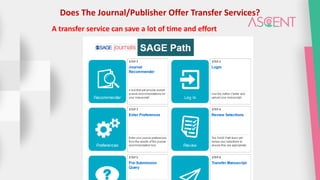
Does The Journal/Publisher Offer Transfer Services?
A transfer service can save a lot of time and effort
Pitfalls to Look Out For
• Predatory Journals
– Journals with difficult-to-believe Aim & Scope
– Emails you with unusual respect and care
• “Dear Esteemed Author/Dr”
• And usually has many typos and errors
– A flashy website which targets authors, not readers
– A promise to publish fast, at ‘affordable rates’
– A warning about fast-approaching deadline
– Over-emphasizes having an ISSN
– Claims to conduct peer review, yet promises to
publish within days
Pitfalls to Look Out For
• Predatory Journals
– Inflated and/or misleading metrics and indexing
information, such as “indexed in Google Scholar”
– No clear author instructions
– Journal name/email/website that resembles a well-
known journal
– Declares to be ‘Open Access’ but does not feature in
• Directory of Open Access Journals (DOAJ),
• Open Access Scholarly Publishers Association
(OASPA),
• Committee on Publication Ethics (COPE) etc.
While Good Journals are Made for Readers, and
Provide Pertinent Information…
Some Predatory Journals can be easily identified
Many fraudulent shopping websites do a better job than this
Some Questionable Journals Can Look Really Legitimate
• An almost Professional looking website
• Have published ‘Call For Papers’ in respectable law portals
• ‘Submit Online’ button asks you to email the manuscript (and gives
different email Ids in different pages)
• Several language errors on the website
• More than one editors have published articles in the many issues
• Shoddy editorial process; No formatting; Even Capitalization of
article titles are not uniform
• Publishing Company has a non-existent website. Facebook page
suggests they run other journals too.
• Publisher’s postal address belongs to a one-person company, which
is under process of Striking Off.
• Meanwhile the Director now runs a Fruit Juice and Beverages
Company.
• Refer sources such as the Beall’s list
(https://beallslist.net/) ,
https://predatoryjournals.com/, Cabells'
Predatory Reports (proprietary) etc. to identify
potential predatory journals/publishers
• Predatory publishing itself is a grey area
– Some features that we ascribed to predatory
publishers may apply to some genuine ones too
• Use discretion while deciding; check multiple
sources
Be Extra Careful
Cloned/Hijacked Journals
• Hijacking the name/credentials/website of a
legitimate publication
• Using fraudulent websites
• Taking over expired domains
• Creating websites for print-only journals
• UGC CARE website lists many Cloned Journals
Exact-Looking Names
Misleading/Similar
Using English Translation of a French Journal Name
The Art of Hijacking/Cloning
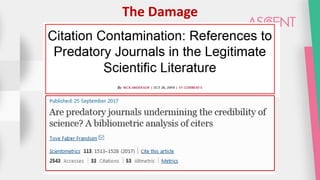
The Damage
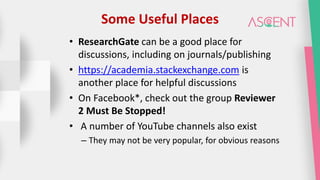
Some Useful Places
• ResearchGate can be a good place for
discussions, including on journals/publishing
• https://academia.stackexchange.com is
another place for helpful discussions
• On Facebook*, check out the group Reviewer
2 Must Be Stopped!
• A number of YouTube channels also exist
– They may not be very popular, for obvious reasons
A Recap
• Shortlist 5-10 journals, just in case…
• Use indexing information for selection
• Do not limit the criteria to metrics alone
• Beware of Predatory and Hijacked Journals
• Engage with the Research Community
Before Concluding
• Do read about movements such as Plan S and
cOAlition S
• Do watch the lecture “Science Publishing: Greed,
Vanity And The Decline Of Scholarship​“ by Prof. P.
Balaram (Former Director, IISc)
http://tiny.cc/balaram
• Do follow the Elsevier Ltd and Ors. v.
Alexandra Elbakyan and Ors. aka the “Sci-
Hub Case” in Delhi High Court: CS(COMM)
572/2020
• An article in Malayalam: https://luca.co.in/sci-hub-case/
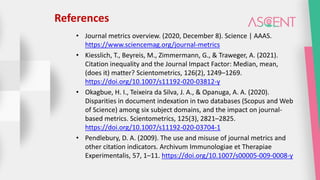
References
• Anderson, R. (2019). Citation Contamination: Citations to Predatory Journals
in the Mainstream Scientific Literature [University of Utah].
https://collections.lib.utah.edu/details?id=1476212
• Delgado-López-Cózar, E., & Cabezas-Clavijo, Á. (2013). Ranking journals:
Could Google Scholar Metrics be an alternative to Journal Citation Reports
and Scimago Journal Rank? Learned Publishing, 26(2), 101–114.
https://doi.org/10.1087/20130206
• Frandsen, T. F. (2017). Are predatory journals undermining the credibility of
science? A bibliometric analysis of citers. Scientometrics, 113(3), 1513–
1528. https://doi.org/10.1007/s11192-017-2520-x
• Herbert, R. (2019). Accept me, accept me not: What do journal acceptance
rates really mean? ICSR Perspectives.
https://digitalcommons.unl.edu/scholcom/147
• How are SCIE-Indexed Journals Different From SCI-Indexed Journals? (2020,
September 28). Enago Academy. https://www.enago.com/academy/science-
citation-index-merges-into-science-citation-index-expanded/
References
• Journal metrics overview. (2020, December 8). Science | AAAS.
https://www.sciencemag.org/journal-metrics
• Kiesslich, T., Beyreis, M., Zimmermann, G., & Traweger, A. (2021).
Citation inequality and the Journal Impact Factor: Median, mean,
(does it) matter? Scientometrics, 126(2), 1249–1269.
https://doi.org/10.1007/s11192-020-03812-y
• Okagbue, H. I., Teixeira da Silva, J. A., & Opanuga, A. A. (2020).
Disparities in document indexation in two databases (Scopus and Web
of Science) among six subject domains, and the impact on journal-
based metrics. Scientometrics, 125(3), 2821–2825.
https://doi.org/10.1007/s11192-020-03704-1
• Pendlebury, D. A. (2009). The use and misuse of journal metrics and
other citation indicators. Archivum Immunologiae et Therapiae
Experimentalis, 57, 1–11. https://doi.org/10.1007/s00005-009-0008-y

Identifying journals for publication

  • 1.
    Identifying Journals forPublication Search Tools, Indexes, and Metrics Dr. Chinchu C.
  • 2.
  • 3.
    Why Do WePublish?
  • 4.
    • Because UGCasks us to… and/or because… • We want our work to be useful • It is nice to be read and cited by others • It may decide our career prospects
  • 5.
    When To StartJournal-Searching? • Earlier the better • At least at the beginning of writing – Can save a lot of time by way of article size, referencing, overall focus etc. • Always have a back-up list of journals
  • 6.
    General and SpecializedJournals • *General or Wide Scope Journals may have higher visibility and get more citations – But usually have low acceptance rate • *Specialized (field-specific) journals may have higher acceptance rates – But limited scope and themes, and visibility * - Not to be taken as a General Rule
  • 7.
  • 8.
    Approx. Acceptance Rates- General 7% 8%
  • 9.
    Approx. Acceptance Rates- Specialized 66% 64%
  • 10.
    Some Terms: Whodoes What • Publishers: Taylor&Francis (Part of Informa), RELX (Formerly Reed Elsevier), Wiley-Blackwell, Springer etc. • Databases: Scopus (Elsevier), Web of Science (Clarivate Analytics), Medline, PMC. ERIC (Education Research), JSTOR etc. • Indexing: Web of Science, Scopus, PMC, DOAJ etc. • Search Engines/Aggregators: PubMed, Google Scholar, Microsoft Academic, Semantic Scholar, Connected Papers, Crossref, PubPsych, Paperity (Has Mobile App) etc. • Service Providers: EBSCOhost, Proquestetc. – Not Databases or Publishers • Preprint Servers: Arxiv, SSRN, PsyArXiv, WikiJournal Preprints etc. • Most Indexing Services provide search facilities too
  • 11.
  • 12.
    Short-listing Candidate Journals •Aim to list 5-10 candidates – Can be useful for future publications too • First place to look may be your reference list – Look for journals that you have cited from • Companion Journals can also be looked for
  • 13.
    Journal Selection (Short-listing)Tools • Generic Tools – JANE – Edanz – Journal Guide • Publisher Tools – Elsevier Journal Finder – Springer Journal Suggester – SAGE Journal Recommender
  • 14.
  • 15.
    JANE: Journal/Author NameEstimator Title/Abstract Here Search for Journals/Authors/Articles
  • 16.
  • 17.
  • 18.
  • 19.
  • 20.
    Journal Guide Search forPapers/Journals/Publishers with Title/Abstract/Keywords https://www.journalguide.com/
  • 21.
  • 22.
  • 23.
  • 25.
  • 27.
  • 28.
  • 29.
  • 32.
    • Citators inlegal research, such as the Shepard's Citations, inspired the modern journal/article indexing systems, such as the Science Citation Index (SCI) • Being Indexed somewhere is widely thought of as indicating quality and prestige of a journal
  • 33.
    Reminder: Who doesWhat • Publishers: Taylor&Francis (Part of Informa), RELX (Formerly Reed Elsevier), Wiley-Blackwell, Springer etc. • Databases: Scopus (Elsevier), Web of Science (Clarivate Analytics), Medline, PMC. ERIC (Education Research), JSTOR etc. • Indexing: Web of Science, Scopus, PMC, DOAJ etc. • Search Engines/Aggregators: PubMed, Google Scholar, Microsoft Academic, Semantic Scholar, Connected Papers, Crossref, PubPsych, Paperity (Has Mobile App) etc. • Service Providers: EBSCOhost, Proquestetc. – Not Databases or Publishers • Preprint Servers: Arxiv, SSRN, PsyArXiv, WikiJournal Preprints etc. • Most Indexing Services provide search facilities too
  • 34.
    Major Indexing Services •Web of Science • Scopus • PubMed Central – PubMed*/Medline* • Directory of Open Access Journals (DOAJ) • Washington and Lee Law Journal Rankings • UGC CARE*
  • 35.
    Web of Science •Previously Web of Knowledge • Originally by Institute for Scientific Information (ISI), then a part of Thomson Reuters, and presently owned by Clarivate Analytics • Database and Indexing services • Has a Core Collection and regional Databases • Subscription based access to databases
  • 36.
    • Core Collection –Science Citation Index Expanded (SCIE) • >9,200 journals across 150 disciplines; 1,900 onwards – Science Citation Index (SCI) • Merged with SCIE in 2020 – Social Sciences Citation Index (SSCI) • >3,000 journals; 1900 onwards – Arts & Humanities Citation Index (A&HCI) • >1,950 journals; 1975 onwards – Emerging Sources Citation Index (ESCI) • >5,000 journals across fields – Book Citation Index – Conference Proceedings Citation Index (CPCI) • >1,60,000 Conference titles
  • 37.
    WoS Regional Databases •Chinese Science Citation Database (in partnership with the Chinese Academy of Sciences) • SciELO Citation Index (Brazil, Spain, Portugal, the Caribbeans, South Africa, and Latin America) • Korea Citation Index (KCI) with South Korean National Research Foundation • Russian Science Citation Index • Arabic Regional Citation Index (ARCI)
  • 38.
    Global Coverage: Webof Science, 2011 Source: JISC-ADAT, 2011
  • 39.
    Scopus • By Elsevier •>36,000 titles from >11,000 publishers • Includes books, conference papers, and patents. • Database and Indexing • Covers all Medline content • Some researchers have pointed out a European bias • SCImago Journal and Country rankings are made from Scopus list
  • 40.
    Global Coverage: Scopus,2011 Source: JISC-ADAT, 2011
  • 41.
    WoS and ScopusCoverage Overlap Source: JISC-ADAT, 2011. No longer available in the original website
  • 42.
    Medline, PubMed, andPMC • All have content mostly from biomedical and life sciences journals • Medline (Medical Literature Analysis and Retrieval System Online) is compiled by National Library of Medicine (NLM) under NIH of USA. • PubMed by NLM enables searching for content from Medline and other content such as books and archives – >30 million abstracts and citations; 7.5 million free • PubMed Central (PMC) offers free full text articles – >5.2 million articles – Some overlap with PubMed content
  • 43.
    Directory of OpenAccess Journals (DOAJ) • Indexing • Community-curated list of open access journals • More than 15,500 open access journals and 5 Crore articles • Science, Technology, Medicine, Social Sciences and Humanities
  • 44.
    W&L Law JournalRankings • By Washington & Lee Law Library • Released Annually • 2019 rankings released in June 2020 • Filtered searching available
  • 45.
    Indian Citation Index •Launched as a private initiative in 2009 • Covered more than 1100 journals • Scientific, Technical, Medical, and Social Sciences including Arts and Humanities • Indexes – Indian Science Citation Index (ISCI), – Indian Social Science and Humanities Citation Index (ISSHCI), – Indian Journals Citation Reports (IJCR), – Indian Science and Technology Abstracts (ISTA) – Directory of Indian Journals (DOIJ) • Defunct since 2018
  • 46.
    Others - Law •Nexis Uni by Lexis Nexis – Database for Legal research • Gallagher Law Library at University of Washington hosts a useful guide for selecting law journals – https://guides.lib.uw.edu/law/writinglawreview/mea suring_quality
  • 47.
    Other Sources • PsycInfoby APA • Google Scholar – Not an indexing service; no vetting for inclusion – Limited functionality in identifying quality content • AGRIS – Agricultural database • Civil engineering database
  • 48.
    UGC Consortium forAcademic Research and Ethics (CARE) • Established by UGC in 2018 • Two Groups (I and II) – Group I: Journals found through UGC-CARE protocols – Group II: • Web of Science –Arts & Humanities Citation Index (AHCI) –Science Citation Index Expanded (SCIE) –Social Sciences Citation Index (SSCI) –ESCI Not Included • Scopus List • Modern Language Association (MLA) • Usually updated every 3 months • Headquartered at Savitribai Phule Pune University
  • 49.
    Analysis Protocol: CAREGroup I • Part I: Basic information – Journal title – Journal broad discipline and focus subject – Name of publisher – Country of origin and registered address – Journal language/s – Publishing frequency – Editor name, editorial office address, phone, email and website – Current status (date of last publication) (print/ online/ both) – ISSN/ eISSN – Other registrations/ memberships such as RNI/ COPE/ CARE • Part II: Primary Criteria • Part III: Secondary Criteria • Part II & III supposed to be based on “due diligence, verification process and critical appraisal using sequential algorithmic elimination process and weightage-based metrics” – Further details not available in public domain
  • 50.
    Searching Group IJournals Title/ISSN/Publisher/Subject/Language
  • 51.
    Scrutinizing Journals UsingMetrics and Other Indicators
  • 52.
    Journal Metrics • JournalImpact Factor (JIF) • Immediacy Index • Eigenfactor • Article Influence • h-index • CiteScore • SCImago Journal Rank (SJR) • Source Normalized Impact per Paper (SNIP) • Others
  • 53.
    Journal Impact Factor(JIF)W • initially intended to assist librarians for deciding which journals to purchase for their institution • The average number of times articles from a journal, published in the past two years, have been cited in a Journal Citations Report (JCR) year • Data taken from SCIE, SSCI, AHCI, CPCIs (WoS) • Varies highly across disciplines • Comparisons are meaningful only within disciplines – or within fields inside each discipline *W- Based on Web of Science
  • 54.
    Journal Immediacy IndexW •Average number of times an article in a given journal is cited in the year it is published • A same-year variant/equivalent of JIF
  • 55.
    EigenfactorW • Based onthe number of times articles from the journal published in the past five years have been cited in the JCR year (similar to JIF) but also considers which journals have contributed these citations so that highly cited journals will influence the score more than lesser cited journals – Similar to Google’s Algorithm • Considers ‘prestige of the journals’ along with citation counts • Comparisons across disciplines are not useful
  • 56.
    Article Influence (AI)W •Average influence of a journal’s articles over the first five years after publication • Calculated by dividing the Eigenfactor by the number of articles published in the journal
  • 57.
    Journal h-index • h-indexwas originally an author-level metric • Can be calculated using Google Scholar metrics, WoS, or Scopus • Expresses a journal's number of articles (h) that have received at least h citations
  • 58.
    CiteScoreS • Scopus’s equivalentof JIF • Calculated every year • Seeks to be a more transparent and reproducible metric • *S- Based on Scopus
  • 59.
    SCImago Journal Rank(SJR)S • Calculation based on citations during the previous three years • Considers ‘prestige of journals’ along with citations • Similar to Eigenfactor by WoS • SCImago also ranks Institutions and Journals
  • 60.
    Source Normalized Impactper Paper (SNIP)S • Tries to account for field-specific differences in citation practices • Comparing each journal’s citations per publication with a calculated “citation potential of its field” • Based on another metric called IPP- Impact Per Publication • Calculated annually
  • 61.
    Some Other Metrics •i10-index – Author level metric - number of publications by an author that have been cited by at least ten sources • g-index – The h-index for an averaged citations count • Cited Half-life and Median Impact Factor – Based on JIF • Citation Performance Per Paper Online (C3PO) • Z-influence – Measures the number of papers in a journal that have never been cited
  • 62.
    • No needto look for all these metrics together • Decide on the ones that are important for your field and work • Also, never use these metrics as The Only Criterion for selection While Deciding on a Journal
  • 63.
  • 64.
    A Checklist forJournal Selection • Aim & Scope – Do they align to your study/manuscript? – Desk rejections happen mostly here • Open Access policy • Type of Submissions Accepted • Article Size/Word Count/Table/Figure Count • What kind of articles are being published recently? • Acceptance/Rejection rates • Article Processing Charges • Turnaround Time and Frequency • Do they have Online First Policy? • Editorial Board
  • 65.
    Does The Journal/PublisherOffer Transfer Services? A transfer service can save a lot of time and effort
  • 66.
  • 67.
    Pitfalls to LookOut For • Predatory Journals – Journals with difficult-to-believe Aim & Scope – Emails you with unusual respect and care • “Dear Esteemed Author/Dr” • And usually has many typos and errors – A flashy website which targets authors, not readers – A promise to publish fast, at ‘affordable rates’ – A warning about fast-approaching deadline – Over-emphasizes having an ISSN – Claims to conduct peer review, yet promises to publish within days
  • 68.
    Pitfalls to LookOut For • Predatory Journals – Inflated and/or misleading metrics and indexing information, such as “indexed in Google Scholar” – No clear author instructions – Journal name/email/website that resembles a well- known journal – Declares to be ‘Open Access’ but does not feature in • Directory of Open Access Journals (DOAJ), • Open Access Scholarly Publishers Association (OASPA), • Committee on Publication Ethics (COPE) etc.
  • 71.
    While Good Journalsare Made for Readers, and Provide Pertinent Information…
  • 72.
    Some Predatory Journalscan be easily identified Many fraudulent shopping websites do a better job than this
  • 74.
    Some Questionable JournalsCan Look Really Legitimate
  • 75.
    • An almostProfessional looking website • Have published ‘Call For Papers’ in respectable law portals • ‘Submit Online’ button asks you to email the manuscript (and gives different email Ids in different pages) • Several language errors on the website • More than one editors have published articles in the many issues • Shoddy editorial process; No formatting; Even Capitalization of article titles are not uniform • Publishing Company has a non-existent website. Facebook page suggests they run other journals too. • Publisher’s postal address belongs to a one-person company, which is under process of Striking Off. • Meanwhile the Director now runs a Fruit Juice and Beverages Company.
  • 76.
    • Refer sourcessuch as the Beall’s list (https://beallslist.net/) , https://predatoryjournals.com/, Cabells' Predatory Reports (proprietary) etc. to identify potential predatory journals/publishers • Predatory publishing itself is a grey area – Some features that we ascribed to predatory publishers may apply to some genuine ones too • Use discretion while deciding; check multiple sources Be Extra Careful
  • 77.
    Cloned/Hijacked Journals • Hijackingthe name/credentials/website of a legitimate publication • Using fraudulent websites • Taking over expired domains • Creating websites for print-only journals • UGC CARE website lists many Cloned Journals
  • 78.
    Exact-Looking Names Misleading/Similar Using EnglishTranslation of a French Journal Name The Art of Hijacking/Cloning
  • 79.
  • 80.
    Some Useful Places •ResearchGate can be a good place for discussions, including on journals/publishing • https://academia.stackexchange.com is another place for helpful discussions • On Facebook*, check out the group Reviewer 2 Must Be Stopped! • A number of YouTube channels also exist – They may not be very popular, for obvious reasons
  • 81.
    A Recap • Shortlist5-10 journals, just in case… • Use indexing information for selection • Do not limit the criteria to metrics alone • Beware of Predatory and Hijacked Journals • Engage with the Research Community
  • 82.
    Before Concluding • Doread about movements such as Plan S and cOAlition S • Do watch the lecture “Science Publishing: Greed, Vanity And The Decline Of Scholarship​“ by Prof. P. Balaram (Former Director, IISc) http://tiny.cc/balaram • Do follow the Elsevier Ltd and Ors. v. Alexandra Elbakyan and Ors. aka the “Sci- Hub Case” in Delhi High Court: CS(COMM) 572/2020 • An article in Malayalam: https://luca.co.in/sci-hub-case/
  • 83.
    References • Anderson, R.(2019). Citation Contamination: Citations to Predatory Journals in the Mainstream Scientific Literature [University of Utah]. https://collections.lib.utah.edu/details?id=1476212 • Delgado-López-Cózar, E., & Cabezas-Clavijo, Á. (2013). Ranking journals: Could Google Scholar Metrics be an alternative to Journal Citation Reports and Scimago Journal Rank? Learned Publishing, 26(2), 101–114. https://doi.org/10.1087/20130206 • Frandsen, T. F. (2017). Are predatory journals undermining the credibility of science? A bibliometric analysis of citers. Scientometrics, 113(3), 1513– 1528. https://doi.org/10.1007/s11192-017-2520-x • Herbert, R. (2019). Accept me, accept me not: What do journal acceptance rates really mean? ICSR Perspectives. https://digitalcommons.unl.edu/scholcom/147 • How are SCIE-Indexed Journals Different From SCI-Indexed Journals? (2020, September 28). Enago Academy. https://www.enago.com/academy/science- citation-index-merges-into-science-citation-index-expanded/
  • 84.
    References • Journal metricsoverview. (2020, December 8). Science | AAAS. https://www.sciencemag.org/journal-metrics • Kiesslich, T., Beyreis, M., Zimmermann, G., & Traweger, A. (2021). Citation inequality and the Journal Impact Factor: Median, mean, (does it) matter? Scientometrics, 126(2), 1249–1269. https://doi.org/10.1007/s11192-020-03812-y • Okagbue, H. I., Teixeira da Silva, J. A., & Opanuga, A. A. (2020). Disparities in document indexation in two databases (Scopus and Web of Science) among six subject domains, and the impact on journal- based metrics. Scientometrics, 125(3), 2821–2825. https://doi.org/10.1007/s11192-020-03704-1 • Pendlebury, D. A. (2009). The use and misuse of journal metrics and other citation indicators. Archivum Immunologiae et Therapiae Experimentalis, 57, 1–11. https://doi.org/10.1007/s00005-009-0008-y