What is a Theory?
Desmond Ayim-Aboagye, Ph.D.
-Theory helps us to understand many aspects
of our environment
-It is used to help make decisions, i.e.
Hospitals to unearth symptoms of a disease
-Fundamental to research work
-To explain behaviour (i.e., aggressive
behaviour, delinquency)
Theories: Control theory, Relativity theory,
Supply and Demand theory, etc.
Four Components of a theory
 Concepts
 Thinking contruction
 Connections/Associations
 Hypotheses
Concept
 This is defined as ”the building blocks in
models, theories, and hypotheses” (Lantz
1993)
 Concepts are words that are used as
symbolic representations of experiences
and observations (DePoy & Gitlin 1999)
 Examples: prejudice,social class,
authoritarian, etc. How do we measure
them?
Thinking Contruction
 To represent a model between two or
several concepts
 It means to look for relationships between
concepts and variables to see whether
there is an association between them or
not
Hypothesis
 A statement which is possible to prove
concerning what a researcher is expecting
to find association between them
 ”There is an association between work
satisfaction and productivity” or ”Work
satisfaction influences productivity in work
places”
Definition of a Theory
 ”A system of concepts which build internal
relationships that explain connections and
make some patterns more
comprehensible” Theory makes it possible
to formulate hypotheses which can be
proved in empirical manner (Lantz 1993).
Kerlinger’s definition (1986)
 ”A number of internal related concepts,
definitions, meaningful ideas which
present systematic view of a phenomenon
through the specification of association
between variables with the purpose to
explain and predict a phenomenon”
Variable: What is it?
 ”An operational definition of a concept
that is given numerical basis”.
 Usually it has to do with causality
between variables: Violence on TV and
aggressive behaviour.
Dependent vrs Independent
 Independent variable (violence on TV)
 Dependent variable (aggressive behviour)
 F (x) = y
 Here y is violence, that is, independent
variable
 X is dependant variable
Variables
 Examples: Ethnic groups, sex, income,
age, violence, aggresive behaviour, etc.
Deductive method
 All humans beings shall die
 I am a human being
 Therefore I shall die
 (Conclusion is usually based on the
premise)
Inductive method
 I am a human being
 Uptill now all human beings die after
some years on earth
 Therefore I shall die after some years on
earth
 (Conclusion is based on something that
shall happen in the future, not yet )
Abduction
 A kind of conclusion which results from an
unexpected knowledge. A phenomenon
that is being studied provides a new
manner of seeing something in a new
perspective
Experimental Researcher
 PREDICT & VERIFY (Characteritics)
 Logic-deductive process
 Primarily proving of a theory
 Go from theory to abstraction level
 Statement of reality aspect that can be
measured
 Move from from knowledge that is based on
existing concepts
 Focuses on measuring aspects of a
phenomenon
Experiment
 1. THEORY
 2. HYPOTHESIS
 3. OPERATIONAL DEFINITION OF
CONCEPTS (Measure)
 4. ANALYSIS
 5. RESULTS
 6. OBSERVATION
 7. DISCUSSION & CONCLUSION
Qualitative Researcher (Inductive)
 GENERATE THEORY (Characteristics)
 Primarily inductive
 Primarily theory generation
 Common experiences to higher level
 Multiple subjective understanding of
experience
 The informant owns the knowledge
 Focus to understand complexity
Qualitative
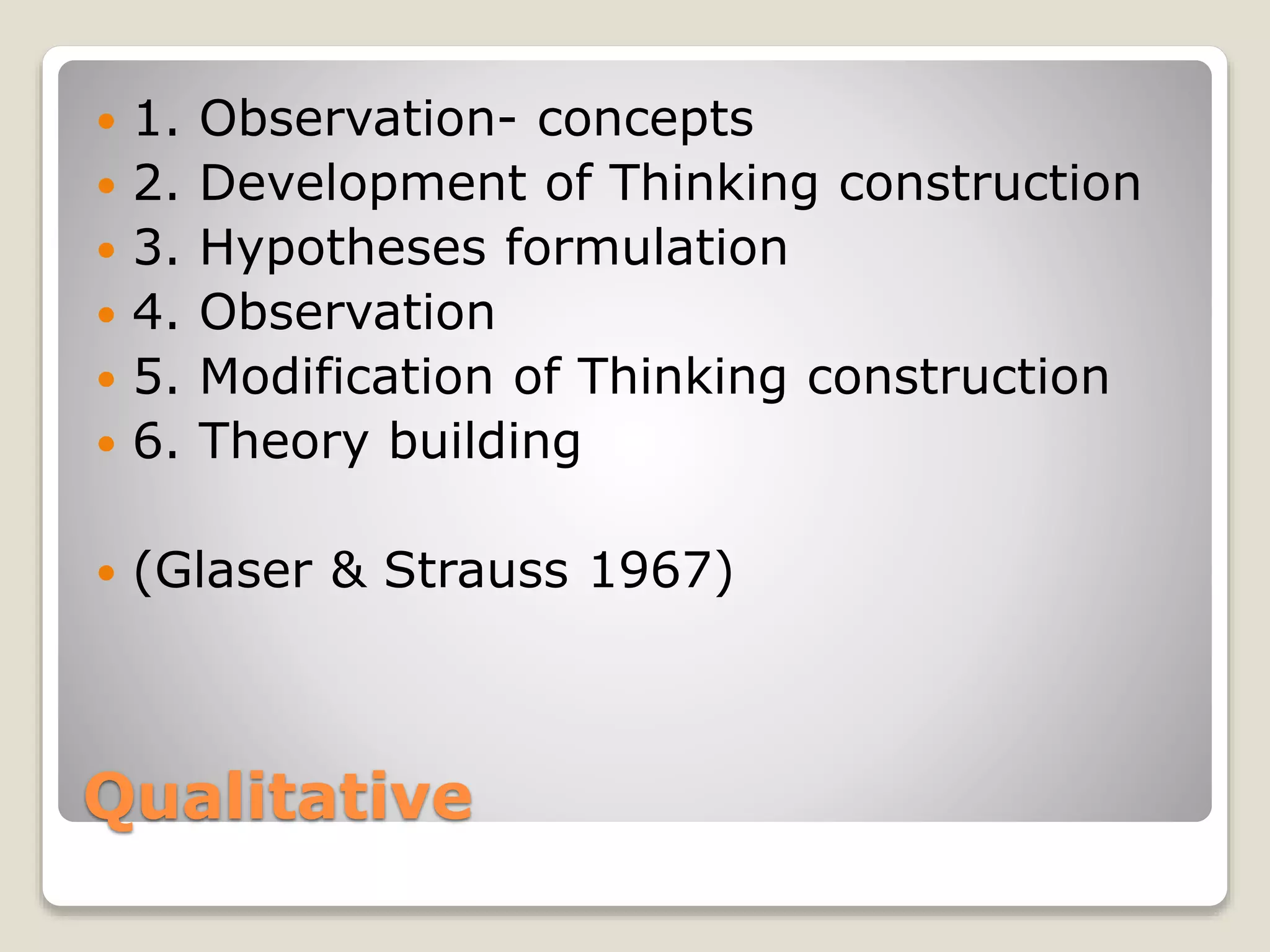
 1. Observation- concepts
 2. Development of Thinking construction
 3. Hypotheses formulation
 4. Observation
 5. Modification of Thinking construction
 6. Theory building
 (Glaser & Strauss 1967)
Thinking about Research
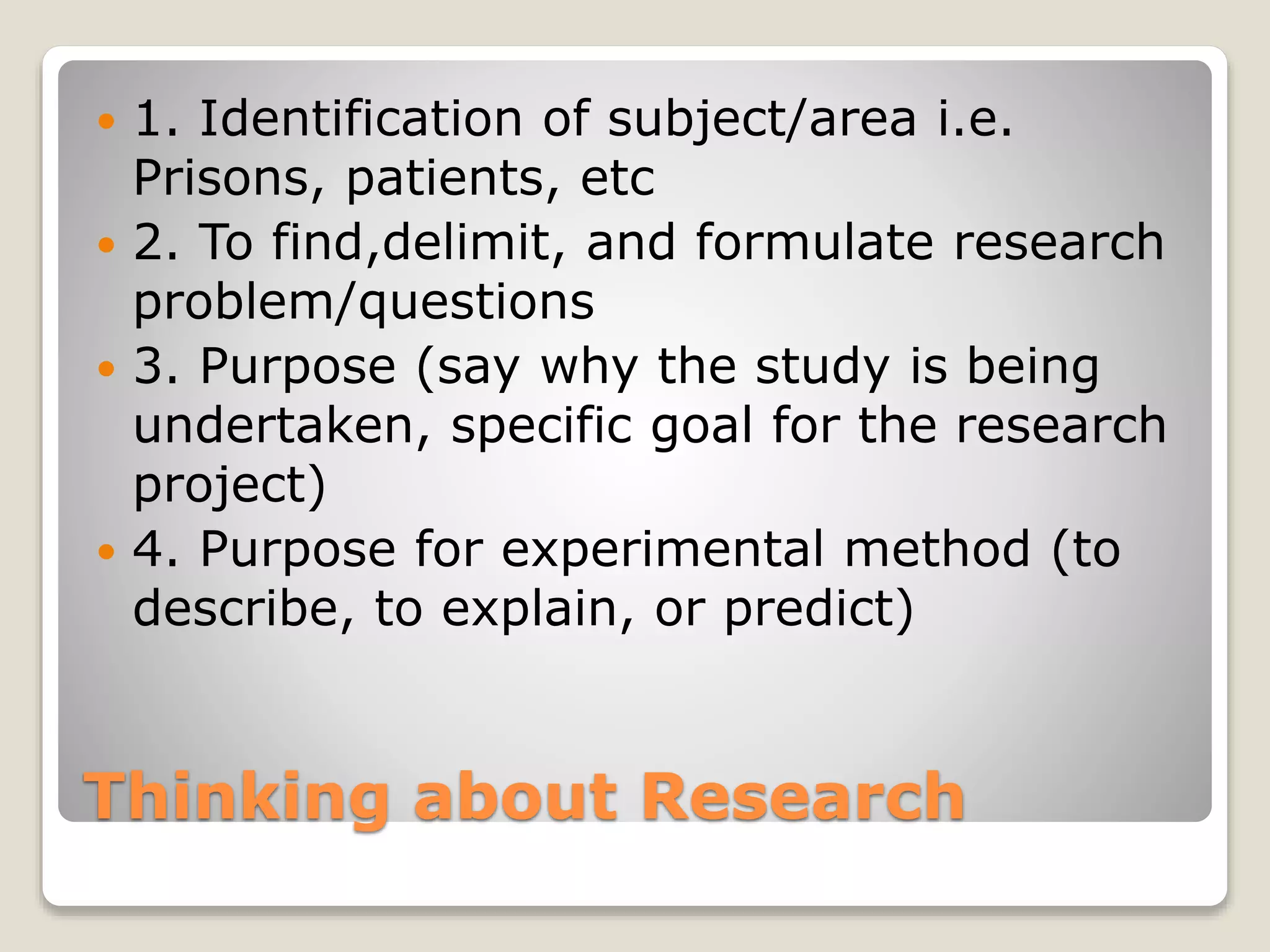
 1. Identification of subject/area i.e.
Prisons, patients, etc
 2. To find,delimit, and formulate research
problem/questions
 3. Purpose (say why the study is being
undertaken, specific goal for the research
project)
 4. Purpose for experimental method (to
describe, to explain, or predict)
Thinking about Research
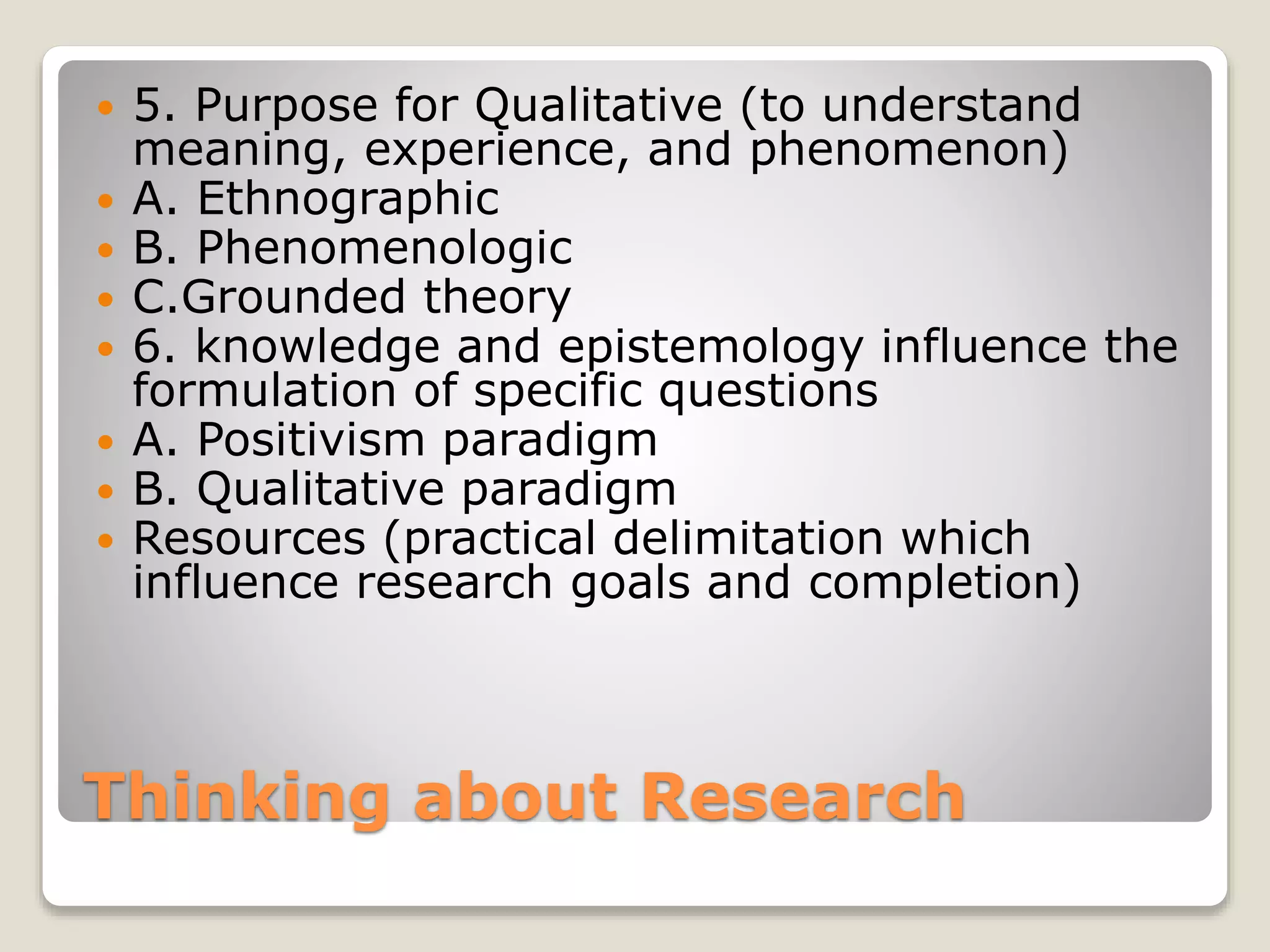
 5. Purpose for Qualitative (to understand
meaning, experience, and phenomenon)
 A. Ethnographic
 B. Phenomenologic
 C.Grounded theory
 6. knowledge and epistemology influence the
formulation of specific questions
 A. Positivism paradigm
 B. Qualitative paradigm
 Resources (practical delimitation which
influence research goals and completion)
Experimental Questions
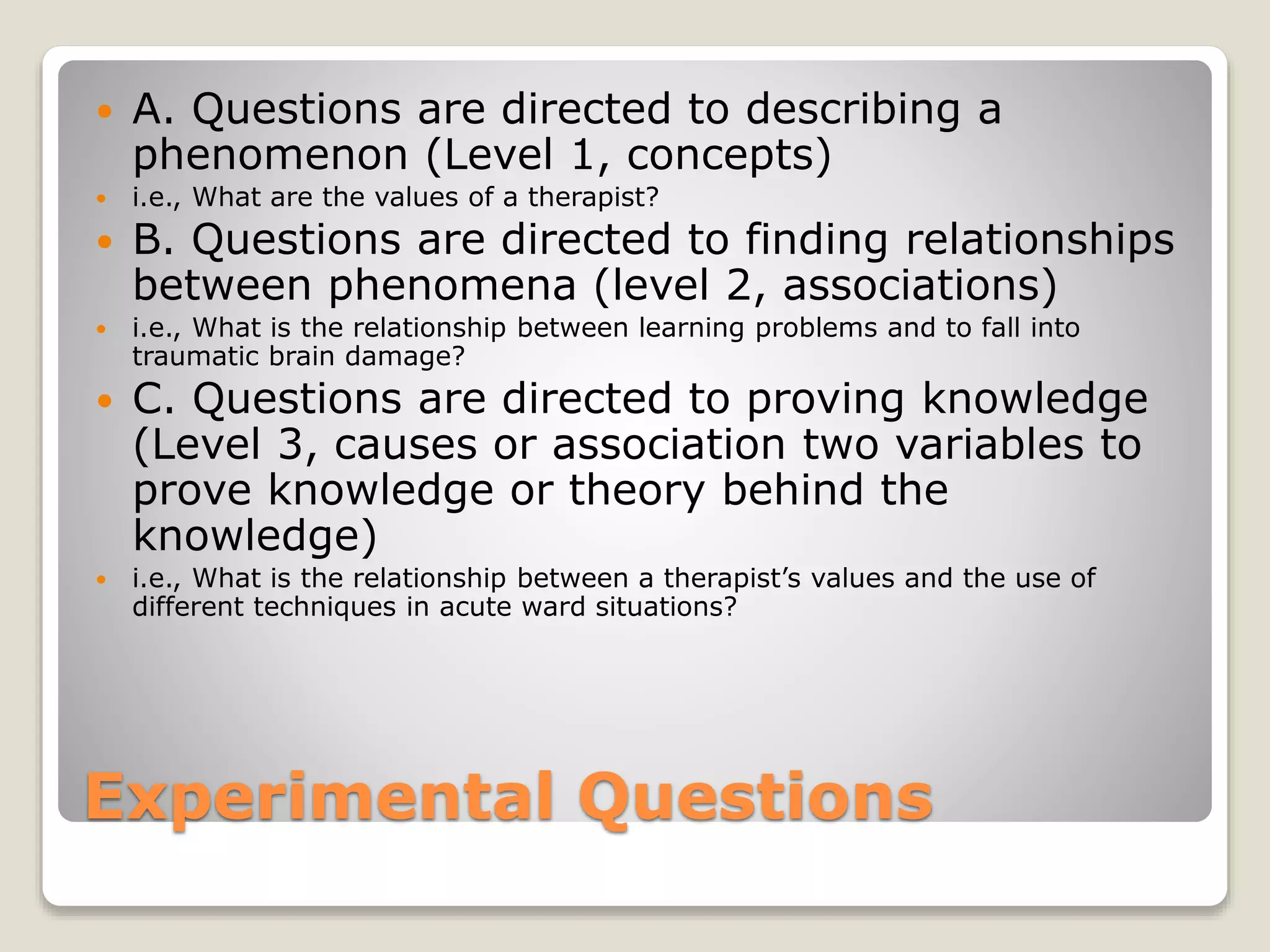
 A. Questions are directed to describing a
phenomenon (Level 1, concepts)
 i.e., What are the values of a therapist?
 B. Questions are directed to finding relationships
between phenomena (level 2, associations)
 i.e., What is the relationship between learning problems and to fall into
traumatic brain damage?
 C. Questions are directed to proving knowledge
(Level 3, causes or association two variables to
prove knowledge or theory behind the
knowledge)
 i.e., What is the relationship between a therapist’s values and the use of
different techniques in acute ward situations?
Qualitative questions
 A. Formulation and reformulation
 i.e. Questions that have already been formulated can be
reformulated before the analysis of data
 B. Questions following usually comes from
or are gained in the course of gathering
information from the field
Ethnographic questions
 Questions are directed to describing and
interpretation of cultural paterns in
different groups
 Purpose is to understand cultural
meanings people go from to organise and
interpret their experiences
 ”Why do these groups exist, and what do
they do?”
Phenomenologic questions
 Questions are directed to comprehending
how people experience their phenomena
 ”How do individuals experience their
traumatic brain damage?”
Grounded theory method
 A broad question is presented within a
given area such as: ”Which theoretical
principles characterise women
experiences of becoming homeless?”
Literature Review
 Four Principles
 1. Which research have been conducted in
relation to this topic/subject?
 2. Level of knowledge and theory
development within the problem area
 3. Relevance of the knowledge
background of the area
 4. A logical base for the choice of research
strategy
How to Carry out Literature review
 1. Decide when the search/investigation is
to be made
 2. Delimitation on what is to be searched
 3. Create access to articles,books, and
documents
 4. Organise these information
 5. Evaluate the critical literature or
sources
 6. Write out literature overview
To Write Literature Review
 1. Introduction
 2. Discuss concerning concepts, thinking
contruction,principle,theory or model in
the literature
 3. Brief overview of designs, results, from
related studies
 4. Critical evaluation of the current and
related researches or knowledge
 5.Integration of different works that have
come to pass
To write literature review
 6. Niche which the researcher’s
investigation is going to fill in the
gathered knowledge which exist and the
subject that is to be investigated
 7. Overview and the arguments
concerning the design of the current
studies
Qualitative
designs
Endogen Research
Critical Theory
Phenomenology
Heuristic Research
Life history Method
Ethnographic Method
Grounded Theory method
 To observe
 To understand
 To describe
 To explain and
develop a theory
Differences between them
 1. Purpose
 2. Literature investigation and
presentation
 3. The involvement that comes from the
researcher’s side
Phenomenology
 To study everyday experiences and the interpretation of meaning in these
experiences
 Meaning of experiences can only be understood by them that had the experiences
 The method often used is biography
 Primary interpretation and analysis of experiences are made by the informants
during the interview
Life-history method
 Focus on individuals’ lives in a social miliux
 Information from infromant are gathered and meaning are sought concerning their
experiences
 Purpose is to discover the core genre of individuals’ lives lived during a long period
 Usually one individual is focused and studied in an intensive manner
 One looks for the universal characteristic that characterises human experience
 Others also concentrate on the core of a private person’s life
 Literature studies: 1. literature are used as organisational framework when one uses
theories analysis in order to explain the complexities in life 2. If one is after
theoretical and unique insights, he must use literature in a critical manner to make
the research more interesting
 Unique characteristics: Sequence of life experiences and their meanings developed
through the informants perspective . The studies reveal and characterise critical
experiences or turning points in a person’s life.
 Use unstructured interview, for example, ”please tell me about your life
history/experiences” (direct it to his life experiences and meanings he gives to these
experences). Collection of data: Participant & not participant observation will do.
Ethnography
 More employed in the field of anthropology
 It is a qualitative method that is geared to comprehending the underlying pattern a
particular culture and it different way of living
 One focuses on a person’s culture which consist of rules,symbols, rituals, and human
beings manner in living as a group.
 Ethnographer is an ”outsider” in the cultural scene and attempts to reach an
insider’s perspective
 Through considerable period of observation, physical presence, and active
participation in the culture, the ethnographer seeks to systematically gather and
understand the rules/laws that steer their behaviours
 Method: 1. Interview and observe those informants who are willing to inform the
researcher about cultural norms and their meanings, 2. the researcher’s own
participant and observation, 3. study the cultural patterns, symbols and their
meanings
 Aids: use field documentation, tape recording or videofilming to gather data
 Research Results: specific for the culture studied and general theory on human
behviour
 Data analysis: continuous description, explanation, and the unearthing of meanings
which lead directly to theory building
Grounded Theory
 The systematic approach of building up a theory through the data gathered from a
social setting
 It is more structured and the researcher strictly steers the research in comparison to
others where informants play enormous role
 PURPOSE: To develop and verify a theory, that is, to build one
 Glaser & Strauss (1967), the originators, combined both qualitative and quantitative
manner of reasoning in order to gather and reach their goals concerning research
 Common with others: To reason from inductive manner in order to build concepts,
thinking contruction, associations, and the principles to understand and explain a
phenomenon.
 Different from others: The use of structured data collection and data analysis
method known as continous comparison method. That is to say that, the researcher
compares every information with others to secure differences and similarities.
Qualitative Data Gathering
 Purpose: To discover and build different perspectives and also patterns which
structure experiences in the field.
 The researcher:
 1. describes
 2. catalogues by way of elevating
 3. explains
 Everyday experiences with the environment and the associations with the
environment in which these investigations are carried out.
Data Gathering: Observation
 To choose the field and learn about the situations there and other characteristics
 Specific expectations and meanings
 Keep relationships in order and comport oneself in order to give good impressions
 To observe means you learn about many things as well as try to understand in order
to create intimacy in the environments and its people
 Are you there as a passive observer or participant observer?
 Participant observation is described by an author as the process whereby a
researcher establishes himself in a human environment within a long period of time
in order to learn from a group in their natural environment with the purpose to
develop scientific understanding of these people.

Interview method
 1. Unstructured open interview method
(informal conversation)
 2. Semi-structured interview method
(limit oneself within voluminous data)
 3. The structured interview method
Four components: Field work
 A) Access (build up contacts)
 B) Description (ability to describe)
 C) Focus (ask in a focus manner and
indepth)
 D) Verification (continuous verification of
impression, description, and
understanding)
Important in qualitative!
--jotting down things
--Journals informations
--letters
--other types of informations such hospital informations
Description information are asked to illuminate on answers: ”What,”
”where,” and ”when”
The gathering of information focuses on questions such as: ”Why” and
”How”
In ethnography, one uses these with the purpose to unearth meanings
Registering Information
 Two fundamental component to register
information
 1. Register occurences, observe their
developments
 2. Register impressions of these
experiences
Qualitative Data Gathering
 FOUR PRINCIPLES
 1. Reseacher Engagement: active learning process in order to observe, participate,
interview, investigate, which in one way disturbs individual’s personal lives
 2. Interactive process and analysis:
 - information gathering means continuous analysis
 - one evaluate information as a part of being indepth
 - active observation, gathering interview, participation of activities with the group
 - the analysis makes one think about who, what, when,where, that steer
 - data gathering, analysis, and more data gathering can be regarded as a spiral
process
 3. Prolonged fieldwork: long fieldwork is needed to guarantee deep understanding
and critical meaning to the investigation. Problem formulation, access to resources,
and the researcher’s own time influence the time spent on the research environment
 4. Multiple data gathering strategies: for rich description and deep understanding,
decision about whom to oberve originates from the data gathering one has made,
integrated data gathering strategy in the analysis process
Different forms of Registration of
Data (Qualitative)
 A) Matriss design to see interaction between
individuals, places, etc.
 B) Documentation of description, eg,
stenogramme block, researcher comments,
thinking, impressions, questions
 C) Tape recording of these information
 D) Photographing
 E) Videofilming to supplement daily book and
jotting down of information.
Two points (Detail gathering)
 1. Several researchers involve in the
gathering of data and analysis process of
them. It augment reliability.
 2. Triangulation of the method of
gathering data, e.g., using interview
together with observation
Interview Method
 The commonly used method in
qualittative design.
 Definition
 A situation of interaction between two
persons or groups with different roles that
are not equal. While one asks the
question, the other only answers.
Characteristics of Interview
 Interaction is voluntary
 It is the communication which is the focus and will be analysed
 Focus is on respondent’s verbal answers
 It is a dialogue between two persons or groups
 Purpose is to gather information
 It has intention/aim
 Interviewer and respondent have different responsibilities and roles in the interview
situation
 The interviewer is the one that controls the situation
 The interviewer is the one seeking information and he also has to limit himself
concerning what to be asked
 The interviewer steers the development of the interview situation and has already a
decided direction where it should lead. This can be compared with conversation that
do not have a decided direction
Reliability & Validity
 Special Requirement of Good Interview
 1. Reliability- this method should give
reliable result
 2. Validity- the result must be valid,
correct, exact
 3. Other researchers should be able to
critically examine the results and come to
the same conclusions.
Different Forms of Interview
 1. Completely/fully open (can develop
thinking around)
 2. Directed open
 3. Semi-structured
 4. Completely/fully structured
Open Interview
 Ask question concerning what a
phenomenon consists of
 What something is and what meaning it
gives
 It makes it possible to capture the
understanding of the respondent and his
experience of this phenomenon in
accurate manner
 Respondent defines and delimits the
phenomenon
Structured Interview
 It goes from what is known
 Questions are formulated to capture
respondents’ understanding and
experience of a decided subject or
phenomenon
 Alternative and fixed answers for all
respondents
 Give possibility to describe many things
about subject or phenomenon
Two Research Traditions
 1. Positivism:
 A) free from subjectivity and speculation
 B) differentiate between belief and
knowledge
 C) use objective manner and laws to
describe reality
 D) natural science and later to social
science
 E) Comte used the name to mean exact
and accurate description of reality
Anti-Positivism
 2. Anti-Positivism (Hermanuetic)
 A) Originates from interpretation of Bible
texts (theology)
 B) Give meaning through interpretation
 C) Human world is filled with meanings
and these meanings must be sought
Positivism and research
 1. Use in social science and natural sciences
 2. Describe similarities between physical and social phenomena
 Purpose to seek general laws in the world of things or objective world.
 Found in experimental psychology studies and personality studies where
the focus is on description of individuals and what characterises all human
beings from one another
 To discover causal laws and moreover, patterns in variables and how they
variates from one another. Explanation on what are the causes of the
phenomenon
 To measure what is considered as objective which they see as ideal
 Seldom is interview used in this approach
Hermaneutic/Anti
Positivism,Qualitative Research
 The emotional aspects and their meaning making become the object of investigation
 A phenomenon cannot be understood if one divorces it from those aspects that give
meaning
 Interview is the proper manner of acquiring reality when one wants to have
connections and associations of reality
 The open interview and open directed interview characterises these aspects:
 A. Aims at comprehending the meaning of the phenomenon in relations with the
respondent’s worldview/values
 B. Descriptive
 C. Focus on specific themes
 D. Open
 E. Clear, concise, and changes
Problem formulation & choice of
interview form
 1. Background knowledge and current
development perspective
 Earlier knowledge accummulated in that area to be investigated
 2. The importance and value of the
studies

 Who will benefit from the results of these studies
Observation Technique
 Chicago school (1920,1930) Social
anthropologists
 Research area: criminality, deviance
behaviour, urbanisation, ethnic groups
 Differentiate from positivism
 Central themes:
 1. Observe
 2. Listen
 3. understand
Two Traditions
 1. Pragmatism
 William James, Charles Pierce, John
Dewey & George Herbert Mead
 2. Formalism
 Gorg Simmel
Pragmatism
 Social life is not static but dynamic and
changes
 Social life expands and is progressive
 If human life continuously changes then we
must be part of their lives in order to
comprehend how these changes
 We must be part of their lives in order to
register our experiences of these changes
and how they influence human beings and
how they themselves interpret it.
Formalism
 If social relations change continuously,
they still reveal some similarities
 Investigations should show or pay
attention to group similarities
 Social research should focus on
interaction between persons and their
social mileux
 Naturalistic principle: the social reality
ought to be studied in its natural condition
without interferance by the researcher
Participant Observation
 Definition:
 Where a researcher in a considerable
amount of time establishes a relationship
with a group of people in their natural
mileux in order to deveop a scientific
understanding of this group
 Lofland & Lofland 1984
Positive Aspects (P. Observation)
 1. Researcher does not project his reality
on the group
 2. Concentration on understanding on
why and how people change
 Registration of real observation, which can
be interpreted and explained in a
theoretical frame of reference
Researcher’s role (P. Observ)
 1. Move closer to people
 2. Live among them and observe their day
to day activities (Indepth interview & life
history)
 3. One can utilise different methods
(Person1993)
Researcher’s role (P. Observation)
 Gold’s (1969) four ways
 1. The total participator
 Full engagement by the researcher within the group
 2. Participator as an observator
 The investigator declares open his role among the group
 3. Observer as a participator
 Long establishment in order to comprehend, which is far from
participating
 4. No participating role at all

Characteristics
 Be on the field
 Be flexible
 Take field notes
 Subjective adequance: which is aimed to depeen the researcher’s understanding and
also to give validity to the investigation.
 Time: the more time devoted to observation the greater adeqance gained
 Place: One must concentrate on the place (not only in the observation and
interaction) to understand how the physical surrounding influences the workings.
 Social circumstances: this is the third parameter. The more vaiation the researcher
has for the group, (concerning status, role, and activities) the deeper his
understanding.
 Language: To speak and understand the social cultural language is an advantage. It
will help one to be exact in his interpretation.
 Intimate trust: Personal engagement will give proper understanding which is
because he has gained trust from the people. Private lives issues could be unearthed
easily. Backstage issues, for example.
 Social consensus: how meaning is created and shared by the people in the culture.
”Verification principle” which increase the reliability of the investigation.
ANALYSIS OF QUALITATIVE DATA
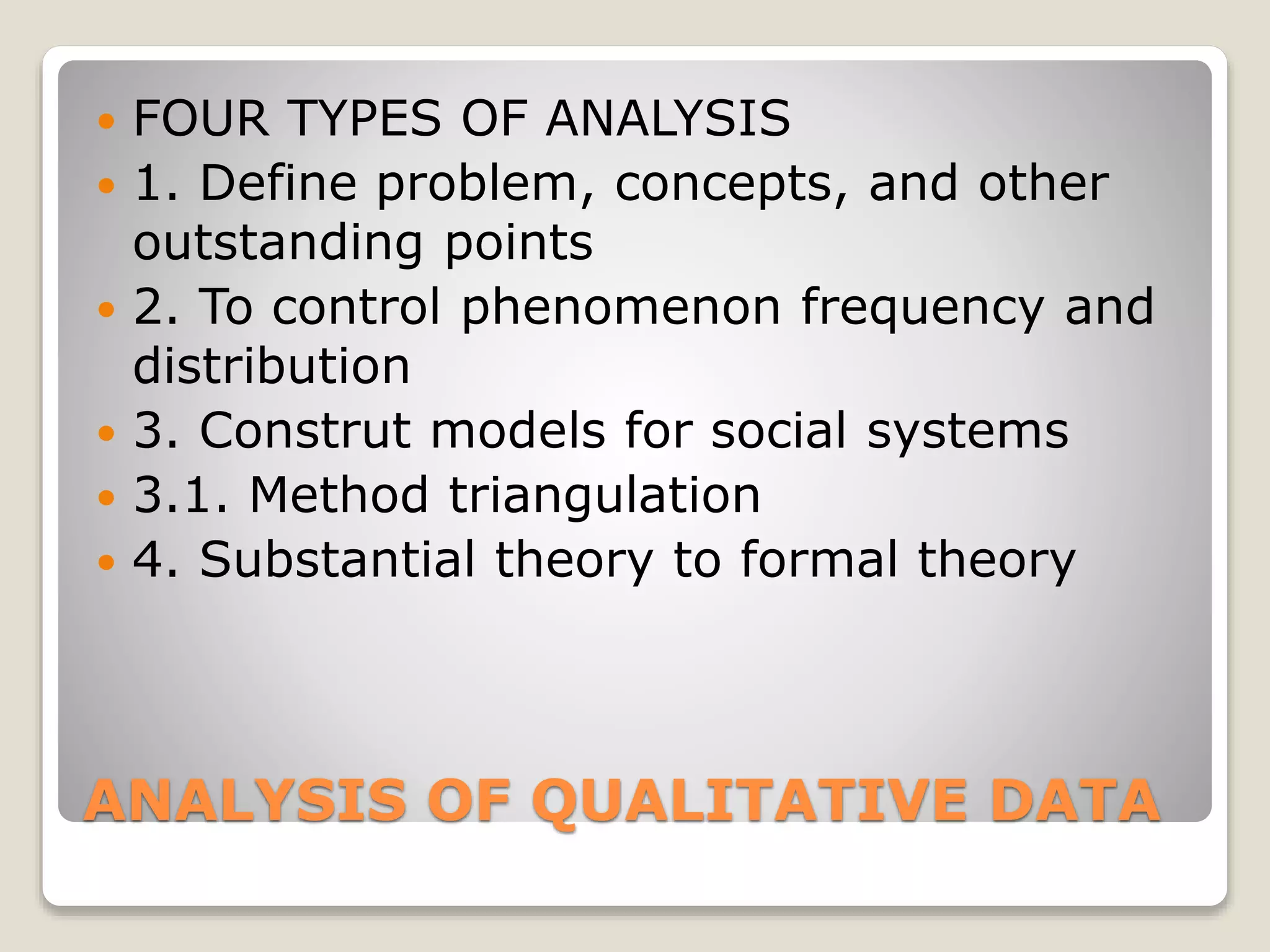
 FOUR TYPES OF ANALYSIS
 1. Define problem, concepts, and other
outstanding points
 2. To control phenomenon frequency and
distribution
 3. Construt models for social systems
 3.1. Method triangulation
 4. Substantial theory to formal theory
Analysis domain/Unit
 A tool used to analyse or examine data
 1 Meanings: cultural norms, people’s definition of situations and those
different rules that concern the social scence.
 2. Cultural patterns: conversations topics that rise up, which is
analytically useful
 3. Occurrences: sudden deaths, etc.
 4. Social meeting: encounters
 5. Roles:
 6. Relations
 7. Groups
 8. Organisations
 9. Settlements
 10. Social world
 11. Life styles
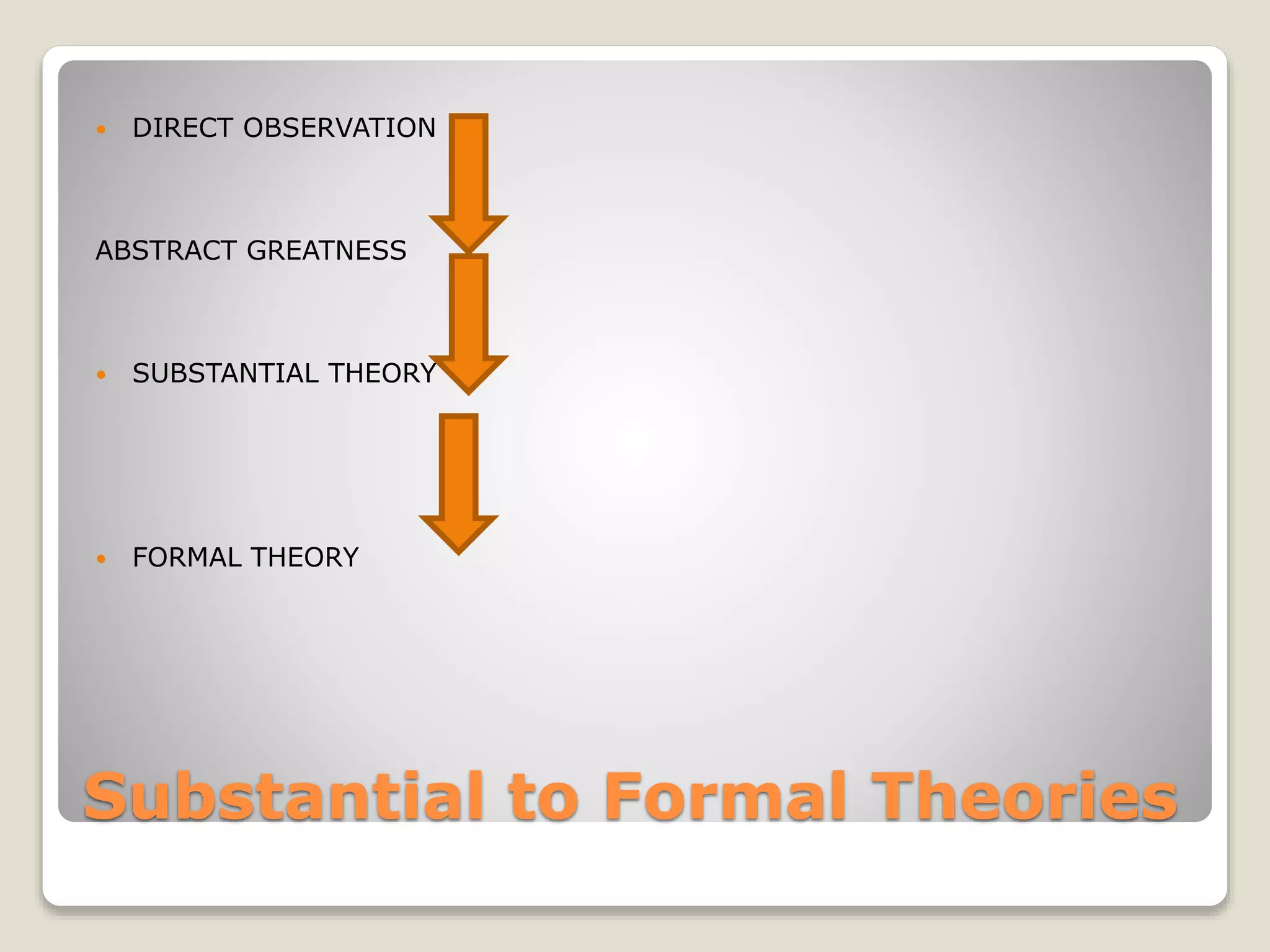
Substantial to Formal Theories
 DIRECT OBSERVATION
ABSTRACT GREATNESS
 SUBSTANTIAL THEORY
 FORMAL THEORY
Required Readings:
1. Dunn, D. S. 2001. Statistics and Data Analysis
for the Behavioural Sciences. Toronto: McGraw
Hill.
1. Babbie, E. 2007. The Practice of Social
Research. Eleventh Edition. Thomsom:
Wadsworth.
1. Creswell, J. W. 2003. Research Design:
Qualitative, Quantitative, and Mixed Methods.
Second Edition. Thousand Oaks: Sage
Publications.
1. Healey J. F. 2009. Statistics: A Tool for Social
Research. Eighth Ed. Cengage Learning.
1. Morgan, S. E., Reichert, T., & Harrison, T. R.
(2002). From numbers to words: Reporting
statistical results for the social sciences.
Boston, MA: Allyn and Bacon. [ISBN:
9780801332807].
1. Frankfort-Nachmias, C. & Leon-Guerrero, A.
2006. Social Statistics for a Diverse Society. 4th
Edition. Thousand Oaks: Pine Forge Press.
1. Howitt, Dennis, & Cramer, Duncan (2011)
Introduction to Research Methods in
Psychology, 3 rd Ed. London: Pearson, Prentice
Hall
1. Cramer, Duncan (1998) Fundamental Statistics

What is a theory

  • 1.
    What is aTheory? Desmond Ayim-Aboagye, Ph.D. -Theory helps us to understand many aspects of our environment -It is used to help make decisions, i.e. Hospitals to unearth symptoms of a disease -Fundamental to research work -To explain behaviour (i.e., aggressive behaviour, delinquency) Theories: Control theory, Relativity theory, Supply and Demand theory, etc.
  • 2.
    Four Components ofa theory  Concepts  Thinking contruction  Connections/Associations  Hypotheses
  • 3.
    Concept  This isdefined as ”the building blocks in models, theories, and hypotheses” (Lantz 1993)  Concepts are words that are used as symbolic representations of experiences and observations (DePoy & Gitlin 1999)  Examples: prejudice,social class, authoritarian, etc. How do we measure them?
  • 4.
    Thinking Contruction  Torepresent a model between two or several concepts  It means to look for relationships between concepts and variables to see whether there is an association between them or not
  • 5.
    Hypothesis  A statementwhich is possible to prove concerning what a researcher is expecting to find association between them  ”There is an association between work satisfaction and productivity” or ”Work satisfaction influences productivity in work places”
  • 6.
    Definition of aTheory  ”A system of concepts which build internal relationships that explain connections and make some patterns more comprehensible” Theory makes it possible to formulate hypotheses which can be proved in empirical manner (Lantz 1993).
  • 7.
    Kerlinger’s definition (1986) ”A number of internal related concepts, definitions, meaningful ideas which present systematic view of a phenomenon through the specification of association between variables with the purpose to explain and predict a phenomenon”
  • 8.
    Variable: What isit?  ”An operational definition of a concept that is given numerical basis”.  Usually it has to do with causality between variables: Violence on TV and aggressive behaviour.
  • 9.
    Dependent vrs Independent Independent variable (violence on TV)  Dependent variable (aggressive behviour)  F (x) = y  Here y is violence, that is, independent variable  X is dependant variable
  • 10.
    Variables  Examples: Ethnicgroups, sex, income, age, violence, aggresive behaviour, etc.
  • 11.
    Deductive method  Allhumans beings shall die  I am a human being  Therefore I shall die  (Conclusion is usually based on the premise)
  • 12.
    Inductive method  Iam a human being  Uptill now all human beings die after some years on earth  Therefore I shall die after some years on earth  (Conclusion is based on something that shall happen in the future, not yet )
  • 13.
    Abduction  A kindof conclusion which results from an unexpected knowledge. A phenomenon that is being studied provides a new manner of seeing something in a new perspective
  • 14.
    Experimental Researcher  PREDICT& VERIFY (Characteritics)  Logic-deductive process  Primarily proving of a theory  Go from theory to abstraction level  Statement of reality aspect that can be measured  Move from from knowledge that is based on existing concepts  Focuses on measuring aspects of a phenomenon
  • 15.
    Experiment  1. THEORY 2. HYPOTHESIS  3. OPERATIONAL DEFINITION OF CONCEPTS (Measure)  4. ANALYSIS  5. RESULTS  6. OBSERVATION  7. DISCUSSION & CONCLUSION
  • 16.
    Qualitative Researcher (Inductive) GENERATE THEORY (Characteristics)  Primarily inductive  Primarily theory generation  Common experiences to higher level  Multiple subjective understanding of experience  The informant owns the knowledge  Focus to understand complexity
  • 17.
    Qualitative  1. Observation-concepts  2. Development of Thinking construction  3. Hypotheses formulation  4. Observation  5. Modification of Thinking construction  6. Theory building  (Glaser & Strauss 1967)
  • 18.
    Thinking about Research 1. Identification of subject/area i.e. Prisons, patients, etc  2. To find,delimit, and formulate research problem/questions  3. Purpose (say why the study is being undertaken, specific goal for the research project)  4. Purpose for experimental method (to describe, to explain, or predict)
  • 19.
    Thinking about Research 5. Purpose for Qualitative (to understand meaning, experience, and phenomenon)  A. Ethnographic  B. Phenomenologic  C.Grounded theory  6. knowledge and epistemology influence the formulation of specific questions  A. Positivism paradigm  B. Qualitative paradigm  Resources (practical delimitation which influence research goals and completion)
  • 20.
    Experimental Questions  A.Questions are directed to describing a phenomenon (Level 1, concepts)  i.e., What are the values of a therapist?  B. Questions are directed to finding relationships between phenomena (level 2, associations)  i.e., What is the relationship between learning problems and to fall into traumatic brain damage?  C. Questions are directed to proving knowledge (Level 3, causes or association two variables to prove knowledge or theory behind the knowledge)  i.e., What is the relationship between a therapist’s values and the use of different techniques in acute ward situations?
  • 21.
    Qualitative questions  A.Formulation and reformulation  i.e. Questions that have already been formulated can be reformulated before the analysis of data  B. Questions following usually comes from or are gained in the course of gathering information from the field
  • 22.
    Ethnographic questions  Questionsare directed to describing and interpretation of cultural paterns in different groups  Purpose is to understand cultural meanings people go from to organise and interpret their experiences  ”Why do these groups exist, and what do they do?”
  • 23.
    Phenomenologic questions  Questionsare directed to comprehending how people experience their phenomena  ”How do individuals experience their traumatic brain damage?”
  • 24.
    Grounded theory method A broad question is presented within a given area such as: ”Which theoretical principles characterise women experiences of becoming homeless?”
  • 25.
    Literature Review  FourPrinciples  1. Which research have been conducted in relation to this topic/subject?  2. Level of knowledge and theory development within the problem area  3. Relevance of the knowledge background of the area  4. A logical base for the choice of research strategy
  • 26.
    How to Carryout Literature review  1. Decide when the search/investigation is to be made  2. Delimitation on what is to be searched  3. Create access to articles,books, and documents  4. Organise these information  5. Evaluate the critical literature or sources  6. Write out literature overview
  • 27.
    To Write LiteratureReview  1. Introduction  2. Discuss concerning concepts, thinking contruction,principle,theory or model in the literature  3. Brief overview of designs, results, from related studies  4. Critical evaluation of the current and related researches or knowledge  5.Integration of different works that have come to pass
  • 28.
    To write literaturereview  6. Niche which the researcher’s investigation is going to fill in the gathered knowledge which exist and the subject that is to be investigated  7. Overview and the arguments concerning the design of the current studies
  • 29.
    Qualitative designs Endogen Research Critical Theory Phenomenology HeuristicResearch Life history Method Ethnographic Method Grounded Theory method  To observe  To understand  To describe  To explain and develop a theory
  • 30.
    Differences between them 1. Purpose  2. Literature investigation and presentation  3. The involvement that comes from the researcher’s side
  • 31.
    Phenomenology  To studyeveryday experiences and the interpretation of meaning in these experiences  Meaning of experiences can only be understood by them that had the experiences  The method often used is biography  Primary interpretation and analysis of experiences are made by the informants during the interview
  • 32.
    Life-history method  Focuson individuals’ lives in a social miliux  Information from infromant are gathered and meaning are sought concerning their experiences  Purpose is to discover the core genre of individuals’ lives lived during a long period  Usually one individual is focused and studied in an intensive manner  One looks for the universal characteristic that characterises human experience  Others also concentrate on the core of a private person’s life  Literature studies: 1. literature are used as organisational framework when one uses theories analysis in order to explain the complexities in life 2. If one is after theoretical and unique insights, he must use literature in a critical manner to make the research more interesting  Unique characteristics: Sequence of life experiences and their meanings developed through the informants perspective . The studies reveal and characterise critical experiences or turning points in a person’s life.  Use unstructured interview, for example, ”please tell me about your life history/experiences” (direct it to his life experiences and meanings he gives to these experences). Collection of data: Participant & not participant observation will do.
  • 33.
    Ethnography  More employedin the field of anthropology  It is a qualitative method that is geared to comprehending the underlying pattern a particular culture and it different way of living  One focuses on a person’s culture which consist of rules,symbols, rituals, and human beings manner in living as a group.  Ethnographer is an ”outsider” in the cultural scene and attempts to reach an insider’s perspective  Through considerable period of observation, physical presence, and active participation in the culture, the ethnographer seeks to systematically gather and understand the rules/laws that steer their behaviours  Method: 1. Interview and observe those informants who are willing to inform the researcher about cultural norms and their meanings, 2. the researcher’s own participant and observation, 3. study the cultural patterns, symbols and their meanings  Aids: use field documentation, tape recording or videofilming to gather data  Research Results: specific for the culture studied and general theory on human behviour  Data analysis: continuous description, explanation, and the unearthing of meanings which lead directly to theory building
  • 34.
    Grounded Theory  Thesystematic approach of building up a theory through the data gathered from a social setting  It is more structured and the researcher strictly steers the research in comparison to others where informants play enormous role  PURPOSE: To develop and verify a theory, that is, to build one  Glaser & Strauss (1967), the originators, combined both qualitative and quantitative manner of reasoning in order to gather and reach their goals concerning research  Common with others: To reason from inductive manner in order to build concepts, thinking contruction, associations, and the principles to understand and explain a phenomenon.  Different from others: The use of structured data collection and data analysis method known as continous comparison method. That is to say that, the researcher compares every information with others to secure differences and similarities.
  • 35.
    Qualitative Data Gathering Purpose: To discover and build different perspectives and also patterns which structure experiences in the field.  The researcher:  1. describes  2. catalogues by way of elevating  3. explains  Everyday experiences with the environment and the associations with the environment in which these investigations are carried out.
  • 36.
    Data Gathering: Observation To choose the field and learn about the situations there and other characteristics  Specific expectations and meanings  Keep relationships in order and comport oneself in order to give good impressions  To observe means you learn about many things as well as try to understand in order to create intimacy in the environments and its people  Are you there as a passive observer or participant observer?  Participant observation is described by an author as the process whereby a researcher establishes himself in a human environment within a long period of time in order to learn from a group in their natural environment with the purpose to develop scientific understanding of these people. 
  • 37.
    Interview method  1.Unstructured open interview method (informal conversation)  2. Semi-structured interview method (limit oneself within voluminous data)  3. The structured interview method
  • 38.
    Four components: Fieldwork  A) Access (build up contacts)  B) Description (ability to describe)  C) Focus (ask in a focus manner and indepth)  D) Verification (continuous verification of impression, description, and understanding)
  • 39.
    Important in qualitative! --jottingdown things --Journals informations --letters --other types of informations such hospital informations Description information are asked to illuminate on answers: ”What,” ”where,” and ”when” The gathering of information focuses on questions such as: ”Why” and ”How” In ethnography, one uses these with the purpose to unearth meanings
  • 40.
    Registering Information  Twofundamental component to register information  1. Register occurences, observe their developments  2. Register impressions of these experiences
  • 41.
    Qualitative Data Gathering FOUR PRINCIPLES  1. Reseacher Engagement: active learning process in order to observe, participate, interview, investigate, which in one way disturbs individual’s personal lives  2. Interactive process and analysis:  - information gathering means continuous analysis  - one evaluate information as a part of being indepth  - active observation, gathering interview, participation of activities with the group  - the analysis makes one think about who, what, when,where, that steer  - data gathering, analysis, and more data gathering can be regarded as a spiral process  3. Prolonged fieldwork: long fieldwork is needed to guarantee deep understanding and critical meaning to the investigation. Problem formulation, access to resources, and the researcher’s own time influence the time spent on the research environment  4. Multiple data gathering strategies: for rich description and deep understanding, decision about whom to oberve originates from the data gathering one has made, integrated data gathering strategy in the analysis process
  • 42.
    Different forms ofRegistration of Data (Qualitative)  A) Matriss design to see interaction between individuals, places, etc.  B) Documentation of description, eg, stenogramme block, researcher comments, thinking, impressions, questions  C) Tape recording of these information  D) Photographing  E) Videofilming to supplement daily book and jotting down of information.
  • 43.
    Two points (Detailgathering)  1. Several researchers involve in the gathering of data and analysis process of them. It augment reliability.  2. Triangulation of the method of gathering data, e.g., using interview together with observation
  • 44.
    Interview Method  Thecommonly used method in qualittative design.  Definition  A situation of interaction between two persons or groups with different roles that are not equal. While one asks the question, the other only answers.
  • 45.
    Characteristics of Interview Interaction is voluntary  It is the communication which is the focus and will be analysed  Focus is on respondent’s verbal answers  It is a dialogue between two persons or groups  Purpose is to gather information  It has intention/aim  Interviewer and respondent have different responsibilities and roles in the interview situation  The interviewer is the one that controls the situation  The interviewer is the one seeking information and he also has to limit himself concerning what to be asked  The interviewer steers the development of the interview situation and has already a decided direction where it should lead. This can be compared with conversation that do not have a decided direction
  • 46.
    Reliability & Validity Special Requirement of Good Interview  1. Reliability- this method should give reliable result  2. Validity- the result must be valid, correct, exact  3. Other researchers should be able to critically examine the results and come to the same conclusions.
  • 47.
    Different Forms ofInterview  1. Completely/fully open (can develop thinking around)  2. Directed open  3. Semi-structured  4. Completely/fully structured
  • 48.
    Open Interview  Askquestion concerning what a phenomenon consists of  What something is and what meaning it gives  It makes it possible to capture the understanding of the respondent and his experience of this phenomenon in accurate manner  Respondent defines and delimits the phenomenon
  • 49.
    Structured Interview  Itgoes from what is known  Questions are formulated to capture respondents’ understanding and experience of a decided subject or phenomenon  Alternative and fixed answers for all respondents  Give possibility to describe many things about subject or phenomenon
  • 50.
    Two Research Traditions 1. Positivism:  A) free from subjectivity and speculation  B) differentiate between belief and knowledge  C) use objective manner and laws to describe reality  D) natural science and later to social science  E) Comte used the name to mean exact and accurate description of reality
  • 51.
    Anti-Positivism  2. Anti-Positivism(Hermanuetic)  A) Originates from interpretation of Bible texts (theology)  B) Give meaning through interpretation  C) Human world is filled with meanings and these meanings must be sought
  • 52.
    Positivism and research 1. Use in social science and natural sciences  2. Describe similarities between physical and social phenomena  Purpose to seek general laws in the world of things or objective world.  Found in experimental psychology studies and personality studies where the focus is on description of individuals and what characterises all human beings from one another  To discover causal laws and moreover, patterns in variables and how they variates from one another. Explanation on what are the causes of the phenomenon  To measure what is considered as objective which they see as ideal  Seldom is interview used in this approach
  • 53.
    Hermaneutic/Anti Positivism,Qualitative Research  Theemotional aspects and their meaning making become the object of investigation  A phenomenon cannot be understood if one divorces it from those aspects that give meaning  Interview is the proper manner of acquiring reality when one wants to have connections and associations of reality  The open interview and open directed interview characterises these aspects:  A. Aims at comprehending the meaning of the phenomenon in relations with the respondent’s worldview/values  B. Descriptive  C. Focus on specific themes  D. Open  E. Clear, concise, and changes
  • 54.
    Problem formulation &choice of interview form  1. Background knowledge and current development perspective  Earlier knowledge accummulated in that area to be investigated  2. The importance and value of the studies   Who will benefit from the results of these studies
  • 55.
    Observation Technique  Chicagoschool (1920,1930) Social anthropologists  Research area: criminality, deviance behaviour, urbanisation, ethnic groups  Differentiate from positivism  Central themes:  1. Observe  2. Listen  3. understand
  • 56.
    Two Traditions  1.Pragmatism  William James, Charles Pierce, John Dewey & George Herbert Mead  2. Formalism  Gorg Simmel
  • 57.
    Pragmatism  Social lifeis not static but dynamic and changes  Social life expands and is progressive  If human life continuously changes then we must be part of their lives in order to comprehend how these changes  We must be part of their lives in order to register our experiences of these changes and how they influence human beings and how they themselves interpret it.
  • 58.
    Formalism  If socialrelations change continuously, they still reveal some similarities  Investigations should show or pay attention to group similarities  Social research should focus on interaction between persons and their social mileux  Naturalistic principle: the social reality ought to be studied in its natural condition without interferance by the researcher
  • 59.
    Participant Observation  Definition: Where a researcher in a considerable amount of time establishes a relationship with a group of people in their natural mileux in order to deveop a scientific understanding of this group  Lofland & Lofland 1984
  • 60.
    Positive Aspects (P.Observation)  1. Researcher does not project his reality on the group  2. Concentration on understanding on why and how people change  Registration of real observation, which can be interpreted and explained in a theoretical frame of reference
  • 61.
    Researcher’s role (P.Observ)  1. Move closer to people  2. Live among them and observe their day to day activities (Indepth interview & life history)  3. One can utilise different methods (Person1993)
  • 62.
    Researcher’s role (P.Observation)  Gold’s (1969) four ways  1. The total participator  Full engagement by the researcher within the group  2. Participator as an observator  The investigator declares open his role among the group  3. Observer as a participator  Long establishment in order to comprehend, which is far from participating  4. No participating role at all 
  • 63.
    Characteristics  Be onthe field  Be flexible  Take field notes  Subjective adequance: which is aimed to depeen the researcher’s understanding and also to give validity to the investigation.  Time: the more time devoted to observation the greater adeqance gained  Place: One must concentrate on the place (not only in the observation and interaction) to understand how the physical surrounding influences the workings.  Social circumstances: this is the third parameter. The more vaiation the researcher has for the group, (concerning status, role, and activities) the deeper his understanding.  Language: To speak and understand the social cultural language is an advantage. It will help one to be exact in his interpretation.  Intimate trust: Personal engagement will give proper understanding which is because he has gained trust from the people. Private lives issues could be unearthed easily. Backstage issues, for example.  Social consensus: how meaning is created and shared by the people in the culture. ”Verification principle” which increase the reliability of the investigation.
  • 64.
    ANALYSIS OF QUALITATIVEDATA  FOUR TYPES OF ANALYSIS  1. Define problem, concepts, and other outstanding points  2. To control phenomenon frequency and distribution  3. Construt models for social systems  3.1. Method triangulation  4. Substantial theory to formal theory
  • 65.
    Analysis domain/Unit  Atool used to analyse or examine data  1 Meanings: cultural norms, people’s definition of situations and those different rules that concern the social scence.  2. Cultural patterns: conversations topics that rise up, which is analytically useful  3. Occurrences: sudden deaths, etc.  4. Social meeting: encounters  5. Roles:  6. Relations  7. Groups  8. Organisations  9. Settlements  10. Social world  11. Life styles
  • 66.
    Substantial to FormalTheories  DIRECT OBSERVATION ABSTRACT GREATNESS  SUBSTANTIAL THEORY  FORMAL THEORY
  • 67.
    Required Readings: 1. Dunn,D. S. 2001. Statistics and Data Analysis for the Behavioural Sciences. Toronto: McGraw Hill. 1. Babbie, E. 2007. The Practice of Social Research. Eleventh Edition. Thomsom: Wadsworth. 1. Creswell, J. W. 2003. Research Design: Qualitative, Quantitative, and Mixed Methods. Second Edition. Thousand Oaks: Sage Publications. 1. Healey J. F. 2009. Statistics: A Tool for Social Research. Eighth Ed. Cengage Learning. 1. Morgan, S. E., Reichert, T., & Harrison, T. R. (2002). From numbers to words: Reporting statistical results for the social sciences. Boston, MA: Allyn and Bacon. [ISBN: 9780801332807]. 1. Frankfort-Nachmias, C. & Leon-Guerrero, A. 2006. Social Statistics for a Diverse Society. 4th Edition. Thousand Oaks: Pine Forge Press. 1. Howitt, Dennis, & Cramer, Duncan (2011) Introduction to Research Methods in Psychology, 3 rd Ed. London: Pearson, Prentice Hall 1. Cramer, Duncan (1998) Fundamental Statistics