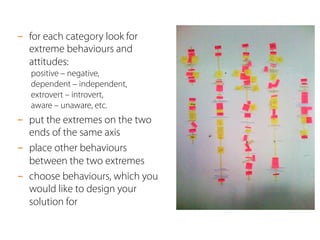
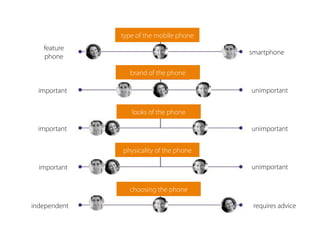
qualitative data analysis:
many ways
to understand
user insights
aga szóstek(at)gmail.com
the interpretation
of the data is
at least as important
as the data itself
qualitative research
Development of concepts
which help to understand
social phenomena
in natural (rather than experimental) settings,
giving due emphasis
to the meanings, experiences
and views of the participants.
Pope & Mays
BMJ 1995; 311:42-45
key features of qualitative research
-  relatively open-ended, exploratory research design
key features of qualitative research
-  relatively open-ended, exploratory research design
-  collection of unstructured forms of data
-  transcripts from interviews
-  field-notes from observations
-  audio- or video-recordings
-  written documents of various kinds
-  photographs, drawings
-  electronic data from virtual interactions
key features of qualitative research
-  relatively open-ended, exploratory research design
-  collection of unstructured forms of data
-  transcripts from interviews
-  field-notes from observations
-  audio- or video-recordings
-  written documents of various kinds
-  photographs, drawings
-  electronic data from virtual interactions
-  plans for data collection and analysis, and even research
questions themselves, may change during the course of inquiry
principles of qualitative research
-  people differ in their experience and understanding of
reality
principles of qualitative research
-  people differ in their experience and understanding of
reality
-  social phenomenon cannot be understood outside its
own context
principles of qualitative research
-  people differ in their experience and understanding of
reality
-  social phenomenon cannot be understood outside its
own context
-  qualitative research is used to describe a given
phenomenon or generate theory grounded in data
principles of qualitative research
-  people differ in their experience and understanding of
reality
-  social phenomenon cannot be understood outside its
own context
-  qualitative research is used to describe a given
phenomenon or generate theory grounded in data
-  understanding human behaviour emerges slowly and
non-linearly
principles of qualitative research
-  people differ in their experience and understanding of
reality
-  social phenomenon cannot be understood outside its
own context
-  qualitative research is used to describe a given
phenomenon or generate theory grounded in data
-  understanding human behaviour emerges slowly and
non-linearly
-  some cases may yield insights in to a problem or new
idea for further inquiry
types of
qualitative analysis
Case studies are attempts
to shed light on a phenomenon
by studying in depth
a single case example of that phenomenon. 
The case can be an individual person,
an event, a group or an institution.
Ethnographic research focuses on
the sociology of meaning
through close field observation
of sociocultural phenomena.
Typically, the ethnographer
focuses on a community.
Grounded theory is
an analytic induction method
where an examination of the data starts
with a single case from a‘pre-defined’population
with the goal to formulate
a general statement about a population,
a concept or a hypothesis.
Then all subsequent cases are compared
to see if they fit the initial hypothesis.
Phenomenological analysis describes
the structures of experience
as they present themselves to consciousness,
without recourse to theory, deduction,
or assumptions from other disciplines.
.
Content analysis is a procedure
for the categorization of
verbal or behavioural data
for the purpose of classification,
summarization and tabulation.
Narrative analysis focuses on narratives as
transcribed experiences.
The researcher aims to sort out
and reflect upon these narratives,
enhance them
and present them in a revised shape.
Discourse analysis is a method of analyzing
a naturally spoken interaction
and all types of written texts.
It focuses on how people produce
and make sense of everyday social life.
Historic analysis is a systematic collection
and objective evaluation of data
related to past occurrences
in order to test hypotheses
concerning causes, effects or trends
of these events that may help to explain
present events and anticipate future events.
Framework analysis is a method
of finding patterns and interrelations
in the collected data
in order to develop, expand,
confirm or reject an initial research hypothesis,
or to find a systematic answer
to a given research question.
so, we have data
– what now?
Qualitative Data Analysis (QDA)
is the range of processes and procedures
whereby we move from the qualitative data
that have been collected
into some form of explanation, understanding
or interpretation
of the people and situations we are investigating.
http://onlineqda.hud.ac.uk/Intro_QDA/what_is_qda.php
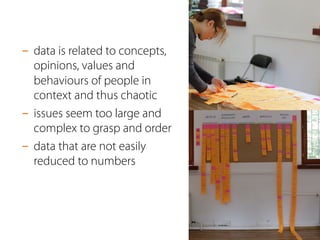
-  data is related to concepts,
opinions, values and
behaviours of people in
context and thus chaotic
-  issues seem too large and
complex to grasp and order
-  data that are not easily
reduced to numbers
characteristics of qualitative data analysis
-  circular and not linear
-  iterative and progressive
-  close interaction with the data
-  different levels of analysis
-  different ways of sorting data
answering research questions
-  descriptions of people and their attitudes,
dispositions, patterns of behaviour, and of places
and activities that take place in the context of the
study
-  explanations for the identified patterns along with
evidence showing the presence of the causal factors
and their effects for the studied contexts
data analysis
-  iterative process of data exploration
-  art of finding patterns
-  beginning with general open-ended questions, moving toward
greater precision as more information emerges
-  pre-defined variables are not identified in advance
-  checking reliability of assumptions, interpretations and
conclusions
-  integrating data of multiple kinds (from observations,
interviews, photographs, etc).
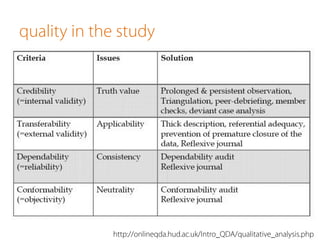
quality in the study
http://onlineqda.hud.ac.uk/Intro_QDA/qualitative_analysis.php
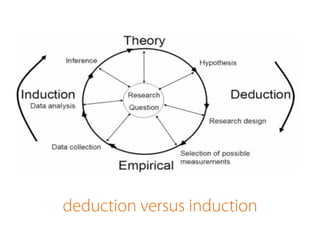
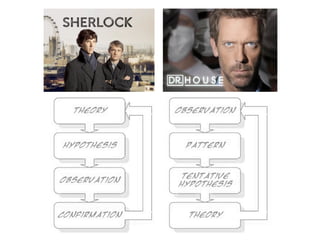
deduction versus induction
stages of data analysis
-  coding the data: generating categories from the data by
finding what is‘in’the data with regards to the research
questions posed
stages of data analysis
-  coding the data: generating categories from the data by
finding what is‘in’the data with regards to the research
questions posed
-  identifying framework: determining categories and
subcategories, and sorting data into the framework
stages of data analysis
-  coding the data: generating categories from the data by
finding what is‘in’the data with regards to the research
questions posed
-  identifying framework: determining categories and
subcategories, and sorting data into the framework
-  using the framework for descriptive analysis: comparing data
placed in the same conceptual category to clarify and
develop ideas about each category and its interrelations with
other categories
stages of data analysis
-  coding the data: generating categories from the data by
finding what is‘in’the data with regards to the research
questions posed
-  identifying framework: determining categories and
subcategories, and sorting data into the framework
-  using the framework for descriptive analysis: comparing data
placed in the same conceptual category to clarify and
develop ideas about each category and its interrelations with
other categories
-  second order analysis: validating the importance and the
dominance of the discovered phenomena
strategies for analyzing qualitative data
-  chronology
-  key events
-  different settings
-  different people
-  types of processes
-  types of issues
terms used in qualitative data analysis
-  theory: set of interrelated concepts, definitions and
propositions presenting a systematic view of the data
-  themes: categories emerging from grouping of lower-level data
-  characteristic: a single item or event, the smallest unit of
analysis
-  coding: the process of attaching labels to lines of text so that
the researcher can group and compare related pieces of
information
-  coding sorts: compilation of similarly coded elements from
different sources in to a single file
-  indexing: generating a word list comprising all substantive
words and their location within the texts
computer assisted qualitative data
analysis (CAQDAS)
-  facilitates the coding, storage, and retrieval of data
-  worthwhile if dealing with a large amount of data
-  popular programs:
-  Atlas ti 6.0 (www.atlasti.com)
-  HyperRESEARCH 2.8 (www.researchware.com)
-  Max QDA (www.maxqda.com)
-  The Ethnograph 5.08
-  QSR N6 (www.qsrinternational.com)
-  QSR Nvivo (www.qsrinternational.com)
-  Weft QDA (www.pressure.to/qda)
-  Open code 3.4 (www8.umu.se)
reporting
qualitative research
Qualitative research
generates rich information -
thus deciding
where to focus
and the level of sharing
is very challenging.
http://www.psy.dmu.ac.uk/michael/qual_writing.htm
data interpretation
-  identifying and explaining the
meaning of the data
-  generalizing
-  ensuring credibility
-  choose a format: research report, scientific article, field report,
evaluation report, inspiration report
-  determine your focus:
-  academic: conceptual frameworks and theories,
methodology and interpretation
-  practical: concrete suggestions and recommendations
-  general public: describing the problem, suggesting
appropriate practices
-  use quotes from the data: illustrative, representing a range of
issues, presenting opposing views
-  list the discovered issues in a rank or a sequence order
-  describe types: of behaviour, strategies, experiences
-  report proportions
-  add flow diagrams: decision-making, event sequencing
traditional research format
-  introduction
-  literature review
-  goal and motivation of the study
-  brief description of the study
-  description of study context
-  methodology
-  results
-  discussion and conclusions
-  implications
-  acknowledgements
-  references
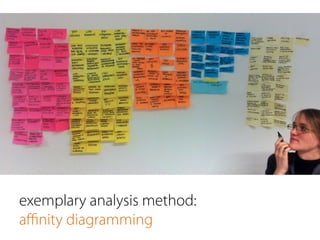
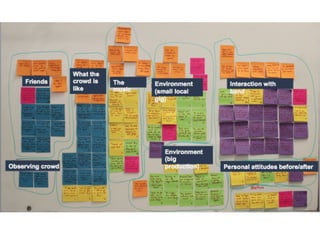
exemplary analysis method:
affinity diagramming
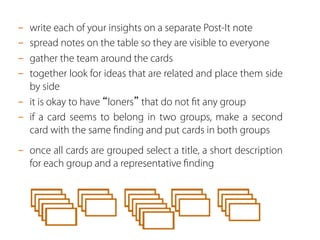
-  write each of your insights on a separate Post-It note
-  spread notes on the table so they are visible to everyone
-  gather the team around the cards
-  together look for ideas that are related and place them side
by side
-  it is okay to have “loners” that do not fit any group
-  if a card seems to belong in two groups, make a second
card with the same finding and put cards in both groups
-  once all cards are grouped select a title, a short description
for each group and a representative finding
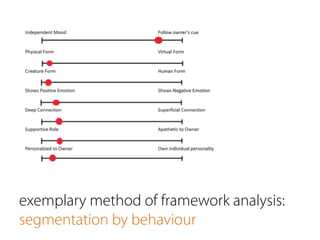
exemplary method of framework analysis:
segmentation by behaviour
-  for each category look for
extreme behaviours and
attitudes:
positive – negative,
dependent – independent,
extrovert – introvert,
aware – unaware, etc.
-  put the extremes on the two
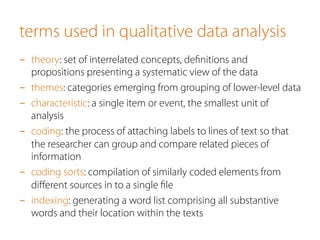
ends of the same axis
-  place other behaviours
between the two extremes

-  choose behaviours, which you
would like to design your
solution for
personas

type of the mobile phone
brand of the phone
looks of the phone
physicality of the phone
choosing the phone
smartphone
feature
phone
important unimportant
important
important unimportant
unimportant
independent requires advice
Qualitative data analysis: many approaches to understand user insights

Qualitative data analysis: many approaches to understand user insights

  • 1.
    qualitative data analysis: manyways to understand user insights aga szóstek(at)gmail.com
  • 2.
    the interpretation of thedata is at least as important as the data itself
  • 3.
    qualitative research Development ofconcepts which help to understand social phenomena in natural (rather than experimental) settings, giving due emphasis to the meanings, experiences and views of the participants. Pope & Mays BMJ 1995; 311:42-45
  • 4.
    key features ofqualitative research -  relatively open-ended, exploratory research design
  • 5.
    key features ofqualitative research -  relatively open-ended, exploratory research design -  collection of unstructured forms of data -  transcripts from interviews -  field-notes from observations -  audio- or video-recordings -  written documents of various kinds -  photographs, drawings -  electronic data from virtual interactions
  • 6.
    key features ofqualitative research -  relatively open-ended, exploratory research design -  collection of unstructured forms of data -  transcripts from interviews -  field-notes from observations -  audio- or video-recordings -  written documents of various kinds -  photographs, drawings -  electronic data from virtual interactions -  plans for data collection and analysis, and even research questions themselves, may change during the course of inquiry
  • 7.
    principles of qualitativeresearch -  people differ in their experience and understanding of reality
  • 8.
    principles of qualitativeresearch -  people differ in their experience and understanding of reality -  social phenomenon cannot be understood outside its own context
  • 9.
    principles of qualitativeresearch -  people differ in their experience and understanding of reality -  social phenomenon cannot be understood outside its own context -  qualitative research is used to describe a given phenomenon or generate theory grounded in data
  • 10.
    principles of qualitativeresearch -  people differ in their experience and understanding of reality -  social phenomenon cannot be understood outside its own context -  qualitative research is used to describe a given phenomenon or generate theory grounded in data -  understanding human behaviour emerges slowly and non-linearly
  • 11.
    principles of qualitativeresearch -  people differ in their experience and understanding of reality -  social phenomenon cannot be understood outside its own context -  qualitative research is used to describe a given phenomenon or generate theory grounded in data -  understanding human behaviour emerges slowly and non-linearly -  some cases may yield insights in to a problem or new idea for further inquiry
  • 12.
  • 13.
    Case studies areattempts to shed light on a phenomenon by studying in depth a single case example of that phenomenon.  The case can be an individual person, an event, a group or an institution.
  • 14.
    Ethnographic research focuseson the sociology of meaning through close field observation of sociocultural phenomena. Typically, the ethnographer focuses on a community.
  • 15.
    Grounded theory is ananalytic induction method where an examination of the data starts with a single case from a‘pre-defined’population with the goal to formulate a general statement about a population, a concept or a hypothesis. Then all subsequent cases are compared to see if they fit the initial hypothesis.
  • 16.
    Phenomenological analysis describes thestructures of experience as they present themselves to consciousness, without recourse to theory, deduction, or assumptions from other disciplines. .
  • 17.
    Content analysis isa procedure for the categorization of verbal or behavioural data for the purpose of classification, summarization and tabulation.
  • 18.
    Narrative analysis focuseson narratives as transcribed experiences. The researcher aims to sort out and reflect upon these narratives, enhance them and present them in a revised shape.
  • 19.
    Discourse analysis isa method of analyzing a naturally spoken interaction and all types of written texts. It focuses on how people produce and make sense of everyday social life.
  • 20.
    Historic analysis isa systematic collection and objective evaluation of data related to past occurrences in order to test hypotheses concerning causes, effects or trends of these events that may help to explain present events and anticipate future events.
  • 21.
    Framework analysis isa method of finding patterns and interrelations in the collected data in order to develop, expand, confirm or reject an initial research hypothesis, or to find a systematic answer to a given research question.
  • 22.
    so, we havedata – what now?
  • 23.
    Qualitative Data Analysis(QDA) is the range of processes and procedures whereby we move from the qualitative data that have been collected into some form of explanation, understanding or interpretation of the people and situations we are investigating. http://onlineqda.hud.ac.uk/Intro_QDA/what_is_qda.php
  • 24.
    -  data isrelated to concepts, opinions, values and behaviours of people in context and thus chaotic -  issues seem too large and complex to grasp and order -  data that are not easily reduced to numbers
  • 25.
    characteristics of qualitativedata analysis -  circular and not linear -  iterative and progressive -  close interaction with the data -  different levels of analysis -  different ways of sorting data
  • 26.
    answering research questions - descriptions of people and their attitudes, dispositions, patterns of behaviour, and of places and activities that take place in the context of the study -  explanations for the identified patterns along with evidence showing the presence of the causal factors and their effects for the studied contexts
  • 27.
    data analysis -  iterativeprocess of data exploration -  art of finding patterns -  beginning with general open-ended questions, moving toward greater precision as more information emerges -  pre-defined variables are not identified in advance -  checking reliability of assumptions, interpretations and conclusions -  integrating data of multiple kinds (from observations, interviews, photographs, etc).
  • 28.
    quality in thestudy http://onlineqda.hud.ac.uk/Intro_QDA/qualitative_analysis.php
  • 29.
  • 31.
    stages of dataanalysis -  coding the data: generating categories from the data by finding what is‘in’the data with regards to the research questions posed
  • 32.
    stages of dataanalysis -  coding the data: generating categories from the data by finding what is‘in’the data with regards to the research questions posed -  identifying framework: determining categories and subcategories, and sorting data into the framework
  • 33.
    stages of dataanalysis -  coding the data: generating categories from the data by finding what is‘in’the data with regards to the research questions posed -  identifying framework: determining categories and subcategories, and sorting data into the framework -  using the framework for descriptive analysis: comparing data placed in the same conceptual category to clarify and develop ideas about each category and its interrelations with other categories
  • 34.
    stages of dataanalysis -  coding the data: generating categories from the data by finding what is‘in’the data with regards to the research questions posed -  identifying framework: determining categories and subcategories, and sorting data into the framework -  using the framework for descriptive analysis: comparing data placed in the same conceptual category to clarify and develop ideas about each category and its interrelations with other categories -  second order analysis: validating the importance and the dominance of the discovered phenomena
  • 35.
    strategies for analyzingqualitative data -  chronology -  key events -  different settings -  different people -  types of processes -  types of issues
  • 36.
    terms used inqualitative data analysis -  theory: set of interrelated concepts, definitions and propositions presenting a systematic view of the data -  themes: categories emerging from grouping of lower-level data -  characteristic: a single item or event, the smallest unit of analysis -  coding: the process of attaching labels to lines of text so that the researcher can group and compare related pieces of information -  coding sorts: compilation of similarly coded elements from different sources in to a single file -  indexing: generating a word list comprising all substantive words and their location within the texts
  • 37.
    computer assisted qualitativedata analysis (CAQDAS) -  facilitates the coding, storage, and retrieval of data -  worthwhile if dealing with a large amount of data -  popular programs: -  Atlas ti 6.0 (www.atlasti.com) -  HyperRESEARCH 2.8 (www.researchware.com) -  Max QDA (www.maxqda.com) -  The Ethnograph 5.08 -  QSR N6 (www.qsrinternational.com) -  QSR Nvivo (www.qsrinternational.com) -  Weft QDA (www.pressure.to/qda) -  Open code 3.4 (www8.umu.se)
  • 38.
  • 39.
    Qualitative research generates richinformation - thus deciding where to focus and the level of sharing is very challenging. http://www.psy.dmu.ac.uk/michael/qual_writing.htm
  • 40.
    data interpretation -  identifyingand explaining the meaning of the data -  generalizing -  ensuring credibility
  • 41.
    -  choose aformat: research report, scientific article, field report, evaluation report, inspiration report -  determine your focus: -  academic: conceptual frameworks and theories, methodology and interpretation -  practical: concrete suggestions and recommendations -  general public: describing the problem, suggesting appropriate practices -  use quotes from the data: illustrative, representing a range of issues, presenting opposing views -  list the discovered issues in a rank or a sequence order -  describe types: of behaviour, strategies, experiences -  report proportions -  add flow diagrams: decision-making, event sequencing
  • 42.
    traditional research format - introduction -  literature review -  goal and motivation of the study -  brief description of the study -  description of study context -  methodology -  results -  discussion and conclusions -  implications -  acknowledgements -  references
  • 43.
  • 44.
    -  write eachof your insights on a separate Post-It note -  spread notes on the table so they are visible to everyone -  gather the team around the cards -  together look for ideas that are related and place them side by side -  it is okay to have “loners” that do not fit any group -  if a card seems to belong in two groups, make a second card with the same finding and put cards in both groups -  once all cards are grouped select a title, a short description for each group and a representative finding
  • 46.
    exemplary method offramework analysis: segmentation by behaviour
  • 47.
    -  for eachcategory look for extreme behaviours and attitudes: positive – negative, dependent – independent, extrovert – introvert, aware – unaware, etc. -  put the extremes on the two ends of the same axis -  place other behaviours between the two extremes -  choose behaviours, which you would like to design your solution for
  • 48.
    personas type of themobile phone brand of the phone looks of the phone physicality of the phone choosing the phone smartphone feature phone important unimportant important important unimportant unimportant independent requires advice