Qualitative Data Analysis: Thematic Analysis
Imran Ghaffar Sulehri
Senior Librarian, PIFD
&
PhD Scholar
Institute of Information Management, PU
Table to Content
 What is Qualitative Research
 Why Qualitative Research
 What is Qualitative Data Analysis (QDA)
 Various Types of Qualitative Research
 Types of Data in Qualitative Research
 Types of Data Analysis in Qualitative Research
 Preliminary Steps before Qualitative Analysis
 Ethical Considerations before Doing Data Analysis
 Six Basic Components of Qualitative Data Analysis
 Common Practices of Analyzing Qualitative Data (Thematic Analysis)
 Presenting/ Displaying Data
What is Qualitative Research
 It is a process of inquiry that draws data in form context for explaining
the phenomenon. It is flexible approach iterative in nature.
 It give values and depth to experiences, meanings and views of
subjects that helps in developing understanding about the
phenomenon under study.
 It talks about the ascribed meanings of subjects about any situation,
circumstances, people, objects etc.
 On the whole, qualitative analysis has fewer set customs to follow
than quantitative analysis
Why Qualitative Research
 To understand in depth
 It is best suited where variables are unknown
 To expose realities rather truth
In fact, the qualitative research intends to comprehend as;
Diagnosis: A Deep understanding about the situation, why things are the way they are?
Prognosis: Providing guidance, on likely responses for making sense
Creativity: Using respondents in qualitative research as source of ideas, innovation
and inspiration and build creative artifact(s) on the basis of obtained data
What is Qualitative Data Analysis (QDA)
Data analysis is a process of breaking down
data into smaller units, determining their
importance, and putting pertinent units
together in a more general form to
understand phenomena
Various Types of Qualitative Research
 Historical Research
 Phenomenography
 Grounded Theory
 Ethnography
 Case Study
 Critical Incident Technique (CIT)
 Delphi
 Photovoice
 Action Research
Types of Data in Qualitative Research
 Interview’s Data
 Focus Group
 Observational Data
 Document based Data
 Pictorial Data
 Audio/ Video Data
 Open Ended Questionnaire Data
 Emails
 Websites
 Pictures
 Artifacts
Types of Data Analysis in Qualitative Research
 Thematic Analysis
 Content Analysis
 Synthesis
 Narrative
 Discourse Analysis
Preliminary Steps before Qualitative Analysis
1- Be patient while starting Qualitative Analysis, because it is complex and time consuming
2- Read/ listen your data again and again
3- Recall your Memos
4- Organize Data (according to question)
5- Think about possible codes , themes
6- Compare data with your research questions
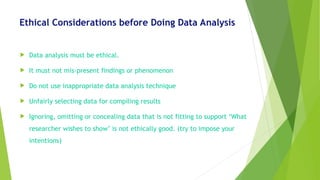
Ethical Considerations before Doing Data Analysis
 Data analysis must be ethical.
 It must not mis-present findings or phenomenon
 Do not use inappropriate data analysis technique
 Unfairly selecting data for compiling results
 Ignoring, omitting or concealing data that is not fitting to support ‘What
researcher wishes to show’ is not ethically good. (try to impose your
intentions)
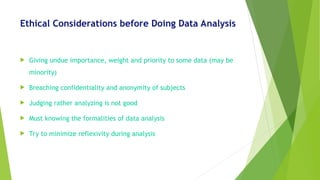
Ethical Considerations before Doing Data Analysis
 Giving undue importance, weight and priority to some data (may be
minority)
 Breaching confidentiality and anonymity of subjects
 Judging rather analyzing is not good
 Must knowing the formalities of data analysis
 Try to minimize reflexivity during analysis
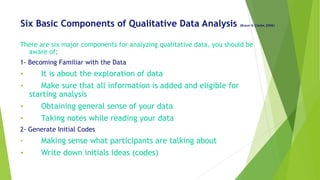
Six Basic Components of Qualitative Data Analysis (Braun & Clarke,2006)
There are six major components for analyzing qualitative data, you should be
aware of;
1- Becoming Familiar with the Data
• It is about the exploration of data
• Make sure that all information is added and eligible for
starting analysis
• Obtaining general sense of your data
• Taking notes while reading your data
2- Generate Initial Codes
• Making sense what participants are talking about
• Write down initials ideas (codes)
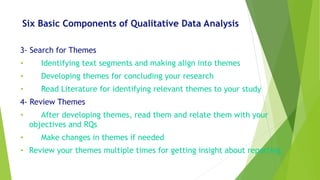
Six Basic Components of Qualitative Data Analysis
3- Search for Themes
• Identifying text segments and making align into themes
• Developing themes for concluding your research
• Read Literature for identifying relevant themes to your study
4- Review Themes
• After developing themes, read them and relate them with your
objectives and RQs
• Make changes in themes if needed
• Review your themes multiple times for getting insight about reporting
Six Basic Components of Qualitative Data Analysis
5- Define Themes
• Samarize themes that are emerged from your data
• Give specified comprehensiveness to themes
6- Write-up (Reporting)
Synthesize your data for reporting in accordance to types
of data sources
Report findings based on themes
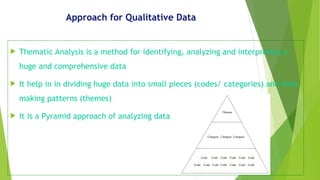
Approach for Qualitative Data
 Thematic Analysis is a method for identifying, analyzing and interpreting a
huge and comprehensive data
 It help in in dividing huge data into small pieces (codes/ categories) and then
making patterns (themes)
 It is a Pyramid approach of analyzing data
Common Practices of Analyzing Qualitative Data:
Thematic Analysis
Transcription:
 Transcription is a process of writing your data by using sources of data
 Often researchers avoid proper transcribing their data which can harm results
 Transcription is, your raw data used for analysis or making it useable by
developing codes
 Transcribe all respondents data according to your research questions
 Use separate sheets/ files for transcription of data in accordance to your
requirements
Common Practices of Analyzing Qualitative Data:
Thematic Analysis
Transcription:
 There are many ways of Transcribing (organizing your data)
 1- By Group of people
 2- By individuals
 3- By By Themes
 4- By Research questions
 5- By Data Collection Tool
 6- By Case Study
 7- By events
 8- BY Sequence and Time Frame
 10- By Theoretical Perspective
Common Practices of Analyzing Qualitative Data:
Thematic Analysis
 Coding:
 Coding is a process of reducing data into smaller meaningful
concept(s) so that the data can be managed.
 For Coding first, you should read , read and again read your
data
 After reading the raw data you will be able to generate initial
codes
Common Practices of Analyzing Qualitative Data:
Thematic Analysis
 Coding:
Assign codes to your respondents to maintain anonymity
 For coding highlight, underline, write codes on data sources of
separately
 Coding can be based on frequencies or hierarchically (mostly used upper to lower)
 Coding is a process of data reduction and management
Common Practices of Analyzing Qualitative Data:
Thematic Analysis
 Categories (sub-themes):
 It is a process of compilation of coded data into compiled (aggregated) form.
 Categories are generated with the help of similar/ likely ideas (codes) expressed
by the participants
Common Practices of Analyzing Qualitative Data:
Thematic Analysis
 Themes (major themes)
 A word or phrase directly taken from data which make sense and able to address your
research question
 It is a process of synthesizing categories into a comprehensive meaningful Theme
 While finalizing themes ask following questions from yourself for validation of research
 1- Is the data in each theme name sense? 4-What the theme is about..
 2- Is data supporting themes 5-How categories relate to each other
 3- Are there such themes which are overlapping 6- How the themes relate each other
Common Practices of Analyzing Qualitative Data:
Thematic Analysis
 Reporting
 Reporting is little bit difficult task which needs art of interpretation
 For reporting you need practice, consultations with experts, critically
observing nature of data and themes
 Consult your Memos/ Field notes while writing findings
 Use arguments and references while reporting your findings
 Explain your themes in narrative way under specific research question
Common Practices of Analyzing Qualitative Data:
Thematic Analysis
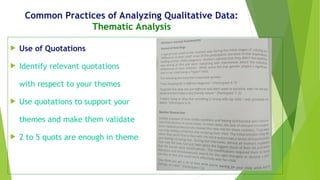
 Use of Quotations
 Identify relevant quotations
with respect to your themes
 Use quotations to support your
themes and make them validate
 2 to 5 quots are enough in theme
Presenting/ Displaying Data
 You can display/ present your data in different ways
 In your research project you can use more than single ways of displaying
 Data display can be in quantitative or quantitative way
 Your display of data should reflect the patterns of your study
 Diagrams, flow charts, tables, and visuals can be used for displaying data
Presenting/ Displaying Data (Example)
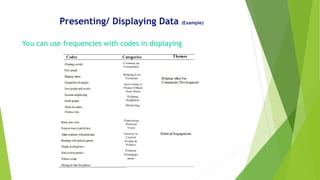
You can use frequencies with codes in displaying
References
 Akhai, N. A., Aziz, M., & Anjum, G. (2022). Walking with the spectrum: A phenomenological study on the experiences of mothers raising an Autistic child. JISR
management and social sciences & economics, 20(1), 43-63.
 Biddix, J. P. (2018). Research methods and applications for student affairs. John Wiley & Sons.
 Cohen, L., Manion, L., & Morrison, K. (2017). Research methods in education. routledge.
 Creswell, J. W., & Creswell, J. D. (2017). Research design: Qualitative, quantitative, and mixed methods approaches. Sage publications.
 Douglas, E. (2002). Qualitative analysis: practice and innovation. Taylor & Francis.
 Ereaut, G. (2002). Analysis and interpretation in qualitative market research (Vol. 4). Sage.
 Leavy, P. (2022). Research design: Quantitative, qualitative, mixed methods, arts-based, and community-based participatory research approaches. Guilford
Publications.
 Maguire, M., & Delahunt, B. (2017). Doing a thematic analysis: A practical, step-by-step guide for learning and teaching scholars. All Ireland Journal of Higher
Education, 9(3).
 Shkedi, A. (2019). Introduction to data analysis in qualitative research: practical and theoretical methodologies with optional use of a software tool. The
Author.
 Willis, G. B. (2015). Analysis of the cognitive interview in questionnaire design. Oxford University Press.
Thank You

Thematic Qualitative Data Analysis By IGS.ppt

  • 1.
    Qualitative Data Analysis:Thematic Analysis Imran Ghaffar Sulehri Senior Librarian, PIFD & PhD Scholar Institute of Information Management, PU
  • 2.
    Table to Content What is Qualitative Research  Why Qualitative Research  What is Qualitative Data Analysis (QDA)  Various Types of Qualitative Research  Types of Data in Qualitative Research  Types of Data Analysis in Qualitative Research  Preliminary Steps before Qualitative Analysis  Ethical Considerations before Doing Data Analysis  Six Basic Components of Qualitative Data Analysis  Common Practices of Analyzing Qualitative Data (Thematic Analysis)  Presenting/ Displaying Data
  • 3.
    What is QualitativeResearch  It is a process of inquiry that draws data in form context for explaining the phenomenon. It is flexible approach iterative in nature.  It give values and depth to experiences, meanings and views of subjects that helps in developing understanding about the phenomenon under study.  It talks about the ascribed meanings of subjects about any situation, circumstances, people, objects etc.  On the whole, qualitative analysis has fewer set customs to follow than quantitative analysis
  • 4.
    Why Qualitative Research To understand in depth  It is best suited where variables are unknown  To expose realities rather truth In fact, the qualitative research intends to comprehend as; Diagnosis: A Deep understanding about the situation, why things are the way they are? Prognosis: Providing guidance, on likely responses for making sense Creativity: Using respondents in qualitative research as source of ideas, innovation and inspiration and build creative artifact(s) on the basis of obtained data
  • 5.
    What is QualitativeData Analysis (QDA) Data analysis is a process of breaking down data into smaller units, determining their importance, and putting pertinent units together in a more general form to understand phenomena
  • 6.
    Various Types ofQualitative Research  Historical Research  Phenomenography  Grounded Theory  Ethnography  Case Study  Critical Incident Technique (CIT)  Delphi  Photovoice  Action Research
  • 7.
    Types of Datain Qualitative Research  Interview’s Data  Focus Group  Observational Data  Document based Data  Pictorial Data  Audio/ Video Data  Open Ended Questionnaire Data  Emails  Websites  Pictures  Artifacts
  • 8.
    Types of DataAnalysis in Qualitative Research  Thematic Analysis  Content Analysis  Synthesis  Narrative  Discourse Analysis
  • 9.
    Preliminary Steps beforeQualitative Analysis 1- Be patient while starting Qualitative Analysis, because it is complex and time consuming 2- Read/ listen your data again and again 3- Recall your Memos 4- Organize Data (according to question) 5- Think about possible codes , themes 6- Compare data with your research questions
  • 10.
    Ethical Considerations beforeDoing Data Analysis  Data analysis must be ethical.  It must not mis-present findings or phenomenon  Do not use inappropriate data analysis technique  Unfairly selecting data for compiling results  Ignoring, omitting or concealing data that is not fitting to support ‘What researcher wishes to show’ is not ethically good. (try to impose your intentions)
  • 11.
    Ethical Considerations beforeDoing Data Analysis  Giving undue importance, weight and priority to some data (may be minority)  Breaching confidentiality and anonymity of subjects  Judging rather analyzing is not good  Must knowing the formalities of data analysis  Try to minimize reflexivity during analysis
  • 12.
    Six Basic Componentsof Qualitative Data Analysis (Braun & Clarke,2006) There are six major components for analyzing qualitative data, you should be aware of; 1- Becoming Familiar with the Data • It is about the exploration of data • Make sure that all information is added and eligible for starting analysis • Obtaining general sense of your data • Taking notes while reading your data 2- Generate Initial Codes • Making sense what participants are talking about • Write down initials ideas (codes)
  • 13.
    Six Basic Componentsof Qualitative Data Analysis 3- Search for Themes • Identifying text segments and making align into themes • Developing themes for concluding your research • Read Literature for identifying relevant themes to your study 4- Review Themes • After developing themes, read them and relate them with your objectives and RQs • Make changes in themes if needed • Review your themes multiple times for getting insight about reporting
  • 14.
    Six Basic Componentsof Qualitative Data Analysis 5- Define Themes • Samarize themes that are emerged from your data • Give specified comprehensiveness to themes 6- Write-up (Reporting) Synthesize your data for reporting in accordance to types of data sources Report findings based on themes
  • 15.
    Approach for QualitativeData  Thematic Analysis is a method for identifying, analyzing and interpreting a huge and comprehensive data  It help in in dividing huge data into small pieces (codes/ categories) and then making patterns (themes)  It is a Pyramid approach of analyzing data
  • 16.
    Common Practices ofAnalyzing Qualitative Data: Thematic Analysis Transcription:  Transcription is a process of writing your data by using sources of data  Often researchers avoid proper transcribing their data which can harm results  Transcription is, your raw data used for analysis or making it useable by developing codes  Transcribe all respondents data according to your research questions  Use separate sheets/ files for transcription of data in accordance to your requirements
  • 17.
    Common Practices ofAnalyzing Qualitative Data: Thematic Analysis Transcription:  There are many ways of Transcribing (organizing your data)  1- By Group of people  2- By individuals  3- By By Themes  4- By Research questions  5- By Data Collection Tool  6- By Case Study  7- By events  8- BY Sequence and Time Frame  10- By Theoretical Perspective
  • 18.
    Common Practices ofAnalyzing Qualitative Data: Thematic Analysis  Coding:  Coding is a process of reducing data into smaller meaningful concept(s) so that the data can be managed.  For Coding first, you should read , read and again read your data  After reading the raw data you will be able to generate initial codes
  • 19.
    Common Practices ofAnalyzing Qualitative Data: Thematic Analysis  Coding: Assign codes to your respondents to maintain anonymity  For coding highlight, underline, write codes on data sources of separately  Coding can be based on frequencies or hierarchically (mostly used upper to lower)  Coding is a process of data reduction and management
  • 20.
    Common Practices ofAnalyzing Qualitative Data: Thematic Analysis  Categories (sub-themes):  It is a process of compilation of coded data into compiled (aggregated) form.  Categories are generated with the help of similar/ likely ideas (codes) expressed by the participants
  • 21.
    Common Practices ofAnalyzing Qualitative Data: Thematic Analysis  Themes (major themes)  A word or phrase directly taken from data which make sense and able to address your research question  It is a process of synthesizing categories into a comprehensive meaningful Theme  While finalizing themes ask following questions from yourself for validation of research  1- Is the data in each theme name sense? 4-What the theme is about..  2- Is data supporting themes 5-How categories relate to each other  3- Are there such themes which are overlapping 6- How the themes relate each other
  • 22.
    Common Practices ofAnalyzing Qualitative Data: Thematic Analysis  Reporting  Reporting is little bit difficult task which needs art of interpretation  For reporting you need practice, consultations with experts, critically observing nature of data and themes  Consult your Memos/ Field notes while writing findings  Use arguments and references while reporting your findings  Explain your themes in narrative way under specific research question
  • 23.
    Common Practices ofAnalyzing Qualitative Data: Thematic Analysis  Use of Quotations  Identify relevant quotations with respect to your themes  Use quotations to support your themes and make them validate  2 to 5 quots are enough in theme
  • 24.
    Presenting/ Displaying Data You can display/ present your data in different ways  In your research project you can use more than single ways of displaying  Data display can be in quantitative or quantitative way  Your display of data should reflect the patterns of your study  Diagrams, flow charts, tables, and visuals can be used for displaying data
  • 25.
    Presenting/ Displaying Data(Example) You can use frequencies with codes in displaying
  • 26.
    References  Akhai, N.A., Aziz, M., & Anjum, G. (2022). Walking with the spectrum: A phenomenological study on the experiences of mothers raising an Autistic child. JISR management and social sciences & economics, 20(1), 43-63.  Biddix, J. P. (2018). Research methods and applications for student affairs. John Wiley & Sons.  Cohen, L., Manion, L., & Morrison, K. (2017). Research methods in education. routledge.  Creswell, J. W., & Creswell, J. D. (2017). Research design: Qualitative, quantitative, and mixed methods approaches. Sage publications.  Douglas, E. (2002). Qualitative analysis: practice and innovation. Taylor & Francis.  Ereaut, G. (2002). Analysis and interpretation in qualitative market research (Vol. 4). Sage.  Leavy, P. (2022). Research design: Quantitative, qualitative, mixed methods, arts-based, and community-based participatory research approaches. Guilford Publications.  Maguire, M., & Delahunt, B. (2017). Doing a thematic analysis: A practical, step-by-step guide for learning and teaching scholars. All Ireland Journal of Higher Education, 9(3).  Shkedi, A. (2019). Introduction to data analysis in qualitative research: practical and theoretical methodologies with optional use of a software tool. The Author.  Willis, G. B. (2015). Analysis of the cognitive interview in questionnaire design. Oxford University Press.
  • 27.