Qualitative Data Analysis
Tilahun Nigatu (MPH)
M&E and Research Manager
African Medical & Research
Foundation
March 2009
+251911486661
tilahunn@gmail.com
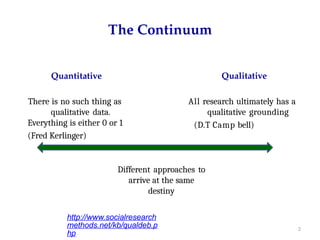
The Continuum
Quantitative
There is no such thing as
qualitative data.
Everything is either 0 or 1
(Fred Kerlinger)
Qualitative
All research ultimately has a
qualitative grounding
(D.T Camp bell)
Different approaches to
arrive at the same
destiny
http://www.socialresearch
methods.net/kb/qualdeb.p
hp
2
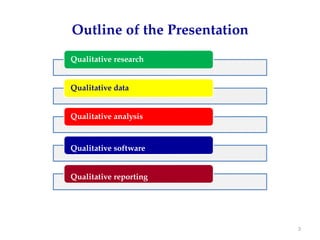
Outline of the Presentation
Qualitative research
Qualitative data
Qualitative analysis
Qualitative software
Qualitative reporting
3
4
Qualitative Research
5
What is qualitative research?
“Development of concepts which help us to
understand social phenomena in natural (rather
than experimental) settings, giving due
emphasis to the meanings, experiences and views
of the participants.”
Pope & Mays
BMJ 1995;311:42-45
6
Dimensions of qualitative methods
Understanding context
• How economic, political, social, cultural, environmental
and organizational factors influence health
Understanding people
• How people make sense of their experiences of health
and disease
Understanding interaction
• How the various actors involved in different
public health activities interact each other
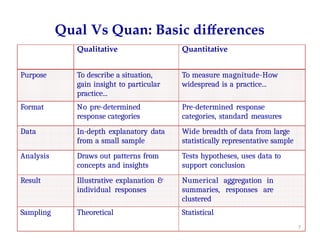
Qual Vs Quan: Basic differences
Qualitative Quantitative
Purpose To describe a situation,
gain insight to particular
practice...
To measure magnitude-How
widespread is a practice...
Format No pre-determined
response categories
Pre-determined response
categories, standard measures
Data In-depth explanatory data
from a small sample
Wide breadth of data from large
statistically representative sample
Analysis Draws out patterns from
concepts and insights
Tests hypotheses, uses data to
support conclusion
Result Illustrative explanation &
individual responses
Numerical aggregation in
summaries, responses are
clustered
Sampling Theoretical Statistical
7
Qual Vs Quan: Analytic approaches
Quantitative Qualitative
Research question Fixed/Focused Broader, contextual, flexible
Expected outcome Identified in
advance
Usually not predefined,
emergent research question
Hierarchy of phases Linearity Circular
Confounding factors Controlled during
design & analysis
Searched in the field
Time dimension Slower Rapid to slower
8
Qual Vs Quan: Data collection method
Quantitative Qualitative
Sampling Random sampling Open ended and less structured
protocols (Flexible)
Tools Structured data
collection instruments
Depend on interactive
interviews
Results Produce results that
generalize, compare and
summarize
Produce results that give
meaning, experience and views
9
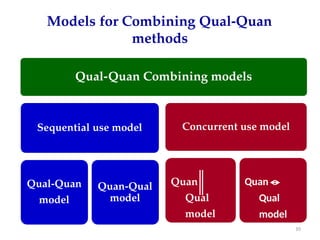
Models for Combining Qual-Quan
methods
Qual-Quan Combining models
Sequential use model
Qual-Quan
model
Quan-Qual
model
Concurrent use model
Quan
Qual
model
Quan
Qual
model
10
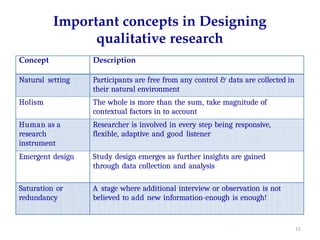
Important concepts in Designing
qualitative research
Concept Description
Natural setting Participants are free from any control & data are collected in
their natural environment
Holism The whole is more than the sum, take magnitude of
contextual factors in to account
Human as a
research
instrument
Researcher is involved in every step being responsive,
flexible, adaptive and good listener
Emergent design Study design emerges as further insights are gained
through data collection and analysis
Saturation or
redundancy
A stage where additional interview or observation is not
believed to add new information-enough is enough!
11
Common qualitative study designs
Study design Description
Ethnography Portrait of people- study of the story and culture of a
group usually to develop cultural awareness &
sensitivity
Phenomenology Study of individual’s lived experiences of events-e.g. the
experience of AIDS care
Grounded theory Going beyond adding to the existing body of
knowledge-developing a new theory about a
phenomenon-theory grounded on data
Participatory action
research
Individuals & groups researching their own personal
beings, socio-cultural settings and experiences
Case study In-depth investigation of a single or small number of units
at a point (over a period) in time. E.g. Evaluation of s
service
12
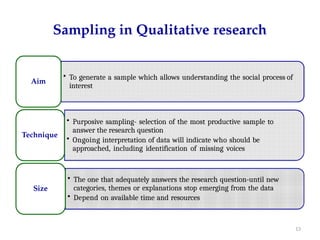
Sampling in Qualitative research
• To generate a sample which allows understanding the social process of
interest
Aim
• Purposive sampling- selection of the most productive sample to
answer the research question
• Ongoing interpretation of data will indicate who should be
approached, including identification of missing voices
Technique
• The one that adequately answers the research question-until new
categories, themes or explanations stop emerging from the data
• Depend on available time and resources
Size
13
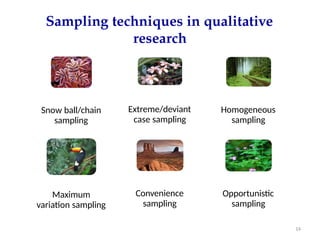
Sampling techniques in qualitative
research
Snow ball/chain
sampling
Extreme/deviant
case sampling
Homogeneous
sampling
Maximum
variation sampling
Convenience
sampling
Opportunistic
sampling
14
Qualitative Data
15
16
What is qualitative data?
• Data that are not easily reduced to numbers
• Data that are related to concepts, opinions, values and
behaviours of people in social context
• Transcripts of individual interviews and focus groups,
field notes from observation of certain activities, copies of
documents, audio/video recordings...
www.socialresearchmethods.net/kb/qualdata
.php
Types of Qualitative Data
Structured text, (writings, stories, survey comments,
news articles, books etc)
Unstructured text (transcription, interviews, focus
groups, conversation)
Audio recordings, music
Video recordings (graphics, art, pictures, visuals)
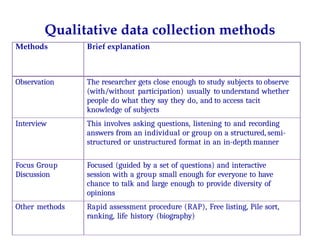
Qualitative data collection methods
18
Methods Brief explanation
Observation The researcher gets close enough to study subjects to observe
(with/without participation) usually to understand whether
people do what they say they do, and to access tacit
knowledge of subjects
Interview This involves asking questions, listening to and recording
answers from an individual or group on a structured, semi-
structured or unstructured format in an in-depth manner
Focus Group
Discussion
Focused (guided by a set of questions) and interactive
session with a group small enough for everyone to have
chance to talk and large enough to provide diversity of
opinions
Other methods Rapid assessment procedure (RAP), Free listing, Pile sort,
ranking, life history (biography)
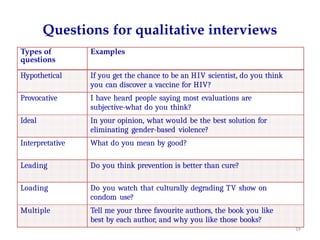
Questions for qualitative interviews
Types of
questions
Examples
Hypothetical If you get the chance to be an HIV scientist, do you think
you can discover a vaccine for HIV?
Provocative I have heard people saying most evaluations are
subjective-what do you think?
Ideal In your opinion, what would be the best solution for
eliminating gender-based violence?
Interpretative What do you mean by good?
Leading Do you think prevention is better than cure?
Loading Do you watch that culturally degrading TV show on
condom use?
Multiple Tell me your three favourite authors, the book you like
best by each author, and why you like those books?
19
20
Focus of Qualitative questions
• Experience: When you told your manager that
the project has failed, what happened?
• Opinion: What do you think about the role of evaluation
for program improvement?
• Feelings: When you got to know that the project was a
success, how did you feel?
• Knowledge: Tell me about the different ways
of promoting PME?
• Input: When you have lectures on
evaluability assessment, what does the instructor tell you?
21
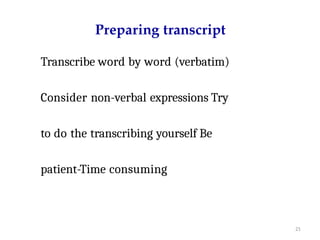
Preparing transcript
Transcribe word by word (verbatim)
Consider non-verbal expressions Try
to do the transcribing yourself Be
patient-Time consuming
22
Preparing Metadata(Log)
Project/research title
Date of data collection
Place of data collection
ID-code of informant(s)
Research team
Method of data
collection
Documentation type: Tape recorder, notes
and observations
23
Qualitative Analysis
24
What is Qualitative Data Analysis?
Qualitative Data Analysis (QDA) is the range of
processes and procedures whereby we move from the
qualitative data that have been collected into some form of
explanation, understanding or interpretation of the
people and situations we are investigating.
QDA is usually based on an interpretative philosophy.
The idea is to examine the meaningful and symbolic
content of qualitative data
http://onlineqda.hud.ac.uk/Intro_QDA/what_is_qda.php
25
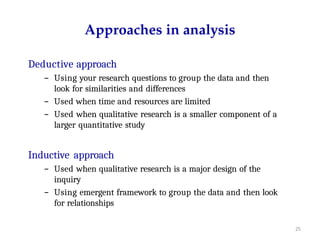
Approaches in analysis
Deductive approach
– Using your research questions to group the data and then
look for similarities and differences
– Used when time and resources are limited
– Used when qualitative research is a smaller component of a
larger quantitative study
Inductive approach
– Used when qualitative research is a major design of the
inquiry
– Using emergent framework to group the data and then look
for relationships
26
Points of focus in analyzing text data
• The primary message content
• The evaluative attitude of the speaker toward the
message
• Whether the content of the message is meant to
represent individual or group-shared ideas
• The degree to which the speaker is representing
actual Vs hypothetical experience
http://qualitativeresearch.ratcliffs.net/15methods.pdf
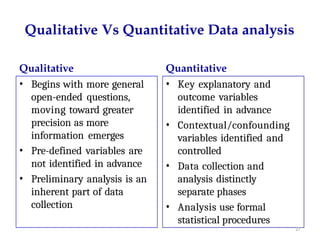
Qualitative Vs Quantitative Data analysis
Qualitative
• Begins with more general
open-ended questions,
moving toward greater
precision as more
information emerges
• Pre-defined variables are
not identified in advance
• Preliminary analysis is an
inherent part of data
collection
Quantitative
• Key explanatory and
outcome variables
identified in advance
• Contextual/confounding
variables identified and
controlled
• Data collection and
analysis distinctly
separate phases
• Analysis use formal
statistical procedures
27
Tools for helping the Analytical Process
Summaries: Should contain the key points that
emerge from undertaking the specific activity
Self Memos: Allow you to make a record of the
ideas which occur to you about any aspect of your
research, as you think of them
Researcher Diary
29
Terms used in Qualitative data analysis
Theory: A set of interrelated concepts, definitions and propositions
that presents a systematic view of events or situations by specifying
relations among variables
Themes: idea categories that emerge from grouping of lower-level
data points
Characteristic: a single item or event in a text, similar to an
individual response to a variable or indicator in a quantitative
research. It is the smallest unit of analysis
Coding: the process of attaching labels to lines of text so that the
researcher can group and compare similar or related pieces of
information
Coding sorts: compilation of similarly coded blocks of text from
different sources in to a single file or report
Indexing: process that generates a word list comprising all the
substantive words and their location within the texts entered in to a
program
30
Principles of Qualitative data analysis
1. People differ in their experience and understanding of
reality (constructivist-many meanings)
2. A social phenomenon can’t be understood outside its
own context (Context-bound i.e. book is in the pen)
3. Qualitative research can be used to describe
phenomenon or generate theory grounded on data
4. Understanding human behaviour emerges slowly and
non-linearly
5. Exceptional cases may yield insights in to a problem or
new idea for further inquiry
31
Features of Qualitative data analysis
• Analysis is circular and non-linear
• Iterative and progressive
• Close interaction with the data
• Data collection and analysis is simultaneous
• Level of analysis varies
• Uses inflection i.e. “this was good”
• Can be sorted in many ways
• Qualitative data by itself has meaning, i.e. “apple”
Noticing, Collecting and Thinking Model
Collect
things
Notice things
Think
about
things
32
33
The Process of Qualitative data analysis
Step 1: Organize the data
Step 2: Identify framework
Step 3: Sort data in to framework
Step 4: Use the framework for descriptive analysis
Step 5: Second order analysis
34
Step 1: Organize the data
• Transcribe the data (you can use
hyperTRANSCRBE software)
• Translate the data (You can use language
translation software like SYSTRAN)
• Data cleaning
• Label the data
– Structuring
– Familiarizing
www.researchware.com/ht
35
Step 2: Identify a Framework
• Read, Read, Read...
• Identify a Framework
– Explanatory – Guided by the research question
– Exploratory-Guided by the data
• Framework will structure, label and define data
• Framework=Coding plan
36
Step 3: Sort data in to Framework
• Code the data
• Modify the Framework
• Data entry if use computer packages
http://onlineqda.hud.ac.uk/Intro_QDA/how_what_to_code.php
37
Step 4: Use Framework in descriptive
analysis
• Descriptive analysis
– Range of responses in categories
– Identify recurrent themes
Stop here if exploratory research
38
Step 5: Second order analysis
• Identify recurrent themes
• Notice patterns in the data
• Identify respondent clusters
– Search for causality
– Identify related themes
• Build sequence of events
• Search data to answer research questions
• Develop hypothesis and test
39
Types of qualitative analysis
• Content analysis
• Narrative analysis
• Discourse analysis
• Framework analysis
• Grounded theory
http://onlineqda.hud.ac.uk/methodologies.php
40
Content analysis
• Content analysis is the procedure for the
categorization of verbal or behavioural data for the
purpose of classification, summarization and
tabulation
• The content can be analyzed on two levels
– Descriptive: What is the data?
– Interpretative: what was meant by the data?
http://writing.colostate.edu/guides/research/content/pop2a.cfm
http://faculty.chass.ncsu.edu/garson/PA765/narrativ.htm
41
Narrative analysis
• Narratives are transcribed experiences
• Every interview/observation has narrative aspect-the
researcher has to sort-out and reflect up on them,
enhance them, and present them in a revised shape to
the reader
• The core activity in narrative analysis is to reformulate
stories presented by people in different contexts and
based on their different experiences
42
Discourse analysis
• A method of analyzing a naturally occurring talk
(spoken interaction) and all types of written texts
• Focus on ordinary people method of producing and
making sense of everyday social life: How language is
used in everyday situations?
– Sometimes people express themselves in a simple and
straightforward way
– Sometimes people express themselves vaguely and
indirectly
– Analyst must refer to the context when interpreting the message as
the same phenomenon can be described in a number of different
ways depending on context
http://www.bmj.com/cgi/content/extract/337/aug07_3/a879
43
Framework Analysis
• Familiarization: Transcribing & reading the data
• Identifying a thematic framework: Initial coding
framework which is developed both from a priori issues
and from emergent issues
• Coding: Using numerical or textual codes to identify
specific piece of data which correspond to different
themes
• Charting: Charts created using headings from thematic
framework (can be thematic or by case)
• Mapping and interpretation: Searching for patterns,
associations, concepts and explanations in the data
http://www.bmj.com/cgi/content/full/320/72
27/114
44
Grounded
Theory
• Analytic induction
– Starts with an examination of a single case from a ‘pre-defined’
population in order to formulate a general statement about a
population, a concept or a hypothesis
– Then the analyst examines another case to see whether it fits the
statement
– If it does, a further case is selected
– If it doesn’t fit there are two options
• Either the statement is changed to fit both cases or the definition of the
population is changed in such a way that the case is no longer a member of the
newly defined population
– Then another case is selected and the process continues
– In such a way one should be able to arrive at a statement that fits all
cases of a population-as-defined
– This method is only for limited set of analytic problems: those
that can be solved with some general overall statement
http://www.bmj.com/cgi/content/extract/337/aug07_3/a5
67
45
Strategies for analyzing observations
• Chronology: describe what was observed chronologically
overtime, to tell the story from the beginning to the end
• Key events: describing critical incidents or major events,
not necessarily in order of occurrence but in order of importance
• Various settings: describe various places, sites, settings, or
locations in which events/behaviours of interest happen
• People: describing individuals or groups involved in the
events
• Process: describing important processes (e.g. Control,
recruitment, decision-making, socialization, communication)
• Issues: Illuminating key issues – how did participants change
Quality in Qualitative studies
Criteria Issues Solution
Credibility
(=internal validity)
Truth value Prolonged & persistent observation,
Triangulation, peer-debriefing, member
checks, deviant case analysis
Transferability
(=external validity)
Applicability Thick description, referential adequacy,
prevention of premature closure of the
data, Reflexive journal
Dependability
(=reliability)
Consistency Dependability audit
Reflexive journal
Conformability
(=objectivity)
Neutrality Conformability audit
Reflexive journal
46
http://onlineqda.hud.ac.uk/Intro_QDA/qualitative_analysis.php
47
Qualitative Software
48
Choosing and Using Computer software
• It is possible to conduct qualitative analysis without a
computer
• Concerns: relying too much on computers shortcuts will
impede the process by distancing the researcher from the
text
• Advantages: ease the burden of cutting and pasting by
hand, and produce more powerful analysis by creation and
insertion of codes in to text files, indexing, construction of
hyperlinks, and selective retrieval of text segments
49
Traditional Method of Qualitative analysis
Traditional Qualitative data analysis is labor-intensive.
After gathering data researchers
– Transcribe the source material with a word processor,
– Make multiple photocopies of the text,
– Painstakingly read through and assign codes to the material,
– Cut the pages up in to coded passages, and then
– Manually sort the coded text in order to analyze the patterns
they find
http://gsociology.icaap.org/methods/qual
.htm
50
Qualitative analysis with softwares
• With qualitative softwares, your workflow will be
similar, but each step will be made easier by the
computer’s capability for data storage, automated
searching and display.
• You can use text, picture, audio and video source files
directly
• You can assign codes manually (autocode) to any section of
text, audio or video or part of a picture
• Analysis is easy with the report feature, where you can
select a subset of cases and codes to work with, choose
what data to use, and sort your reports automatically
http://caqdas.soc.surrey.ac.
uk/
Uses of computer software in Qualitative
Studies
1) Transcribing data
2) Writing/editing the data
3) Storage of data
4) Coding data (keywords or tags)
5) Search and retrieval of data
6) Data linking of related text
7) Writing/editing memos about the data
8) Display of selected reduced data
9) Graphic mapping
10) Preparing reports
http://onlineqda.hud.ac.uk/Intro_CAQDAS/What_the_sw_can_do.php
How to choose software - Key Questions
Type and amount of data Theoretical
approach to analysis Time to learn Vs
time to analyze Level of analysis
(Simple or detailed) Desired
“closeness” to the data
Any desired quantification of results
Individual or working as a team Peer
software support available
Any cost constraints
(Weitzman and Miles 1995;
Lewins and Silver 2005)
Common qualitative softwares
Atlas ti 6.0 (www.atlasti.com ) HyperRESEARCH
2.8 (www.researchware.com ) Max QDA (
www.maxqda.com )
The Ethnograph 5.08
QSR N6 (www.qsrinternational.com ) QSR
Nvivo (www.qsrinternational.com ) Weft
QDA (www.pressure.to/qda ) Open code
3.4 (www8.umu.se)
54
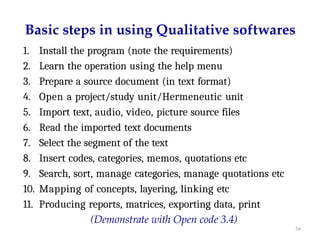
Basic steps in using Qualitative softwares
1. Install the program (note the requirements)
2. Learn the operation using the help menu
3. Prepare a source document (in text format)
4. Open a project/study unit/Hermeneutic unit
5. Import text, audio, video, picture source files
6. Read the imported text documents
7. Select the segment of the text
8. Insert codes, categories, memos, quotations etc
9. Search, sort, manage categories, manage quotations etc
10. Mapping of concepts, layering, linking etc
11. Producing reports, matrices, exporting data, print
(Demonstrate with Open code 3.4)
55
Writing a Qualitative report
56
Writing qualitative report
Qualitative research generates rich information-
thus deciding where to focus and the level of
sharing is very challenging.
http://www.psy.dmu.ac.uk/michael/qual_writing.htm
57
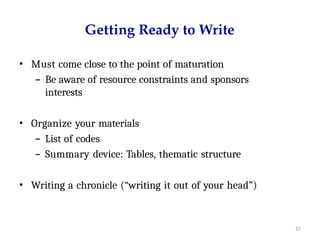
Getting Ready to Write
• Must come close to the point of maturation
– Be aware of resource constraints and sponsors
interests
• Organize your materials
– List of codes
– Summary device: Tables, thematic structure
• Writing a chronicle (“writing it out of your head”)
58
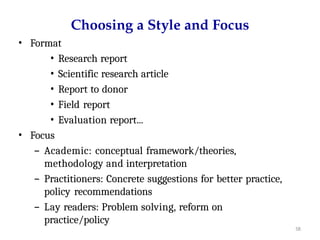
Choosing a Style and Focus
• Format
• Research report
• Scientific research article
• Report to donor
• Field report
• Evaluation report...
• Focus
– Academic: conceptual framework/theories,
methodology and interpretation
– Practitioners: Concrete suggestions for better practice,
policy recommendations
– Lay readers: Problem solving, reform on
practice/policy
59
Variations in the Report Format
• Problem-solving approach (problem-based)
• Narrative approach (chronological)
• Policy approach (evidence-based)
• Analytic approach (Theory/conceptual
framework based)
60
Reporting Qualitative Research
• Typically use quotes from data
– Descriptive
– Direct link with data
– Credibility
• Ways to use quotes
– Illustrative
– Range of issues
– Opposing views
61
Reporting without Quotes
• List range of issues
• Rank or sequence issues
• Describe types of behaviour, strategies, experiences
• Report proportions (most, many, the majority)
• Flow diagrams: decision-making, event sequencing etc
62
Interpretation
• Interpretation is the act of identifying and explaining the
core meaning of the data
• Organizing and connecting emerging themes, sub-themes
and contradictions to get the bigger picture-what it all means
– Think how best to integrate data from multiple sources
and methods
• Make generalization-providing answers to questions of
social and theoretical significance
• Ensuring credible or trustworthy interpretations
63
Standard Report Format
1. Introduction
– Literature review
– Purpose of the study
– Brief description of the study
• Who did the study, where and when
• Description of relevant cultural and contextual information
2. Methods: study design, sampling method, data collection
method, data analysis methods
3. Results: Presentation, interpretation, relate to relevant conceptual
framework, discuss methodological difficulties affecting your results
4. Conclusion: Key findings, logical next step, implication of findings
5. Recommendations: Relate to policy or practice
6. Acknowledgement
7. References
64
The
End

qualitativedataanalysis-120306182822-phpapp02.pptx

  • 1.
    Qualitative Data Analysis TilahunNigatu (MPH) M&E and Research Manager African Medical & Research Foundation March 2009 +251911486661 tilahunn@gmail.com
  • 2.
    The Continuum Quantitative There isno such thing as qualitative data. Everything is either 0 or 1 (Fred Kerlinger) Qualitative All research ultimately has a qualitative grounding (D.T Camp bell) Different approaches to arrive at the same destiny http://www.socialresearch methods.net/kb/qualdeb.p hp 2
  • 3.
    Outline of thePresentation Qualitative research Qualitative data Qualitative analysis Qualitative software Qualitative reporting 3
  • 4.
  • 5.
    5 What is qualitativeresearch? “Development of concepts which help us to understand social phenomena in natural (rather than experimental) settings, giving due emphasis to the meanings, experiences and views of the participants.” Pope & Mays BMJ 1995;311:42-45
  • 6.
    6 Dimensions of qualitativemethods Understanding context • How economic, political, social, cultural, environmental and organizational factors influence health Understanding people • How people make sense of their experiences of health and disease Understanding interaction • How the various actors involved in different public health activities interact each other
  • 7.
    Qual Vs Quan:Basic differences Qualitative Quantitative Purpose To describe a situation, gain insight to particular practice... To measure magnitude-How widespread is a practice... Format No pre-determined response categories Pre-determined response categories, standard measures Data In-depth explanatory data from a small sample Wide breadth of data from large statistically representative sample Analysis Draws out patterns from concepts and insights Tests hypotheses, uses data to support conclusion Result Illustrative explanation & individual responses Numerical aggregation in summaries, responses are clustered Sampling Theoretical Statistical 7
  • 8.
    Qual Vs Quan:Analytic approaches Quantitative Qualitative Research question Fixed/Focused Broader, contextual, flexible Expected outcome Identified in advance Usually not predefined, emergent research question Hierarchy of phases Linearity Circular Confounding factors Controlled during design & analysis Searched in the field Time dimension Slower Rapid to slower 8
  • 9.
    Qual Vs Quan:Data collection method Quantitative Qualitative Sampling Random sampling Open ended and less structured protocols (Flexible) Tools Structured data collection instruments Depend on interactive interviews Results Produce results that generalize, compare and summarize Produce results that give meaning, experience and views 9
  • 10.
    Models for CombiningQual-Quan methods Qual-Quan Combining models Sequential use model Qual-Quan model Quan-Qual model Concurrent use model Quan Qual model Quan Qual model 10
  • 11.
    Important concepts inDesigning qualitative research Concept Description Natural setting Participants are free from any control & data are collected in their natural environment Holism The whole is more than the sum, take magnitude of contextual factors in to account Human as a research instrument Researcher is involved in every step being responsive, flexible, adaptive and good listener Emergent design Study design emerges as further insights are gained through data collection and analysis Saturation or redundancy A stage where additional interview or observation is not believed to add new information-enough is enough! 11
  • 12.
    Common qualitative studydesigns Study design Description Ethnography Portrait of people- study of the story and culture of a group usually to develop cultural awareness & sensitivity Phenomenology Study of individual’s lived experiences of events-e.g. the experience of AIDS care Grounded theory Going beyond adding to the existing body of knowledge-developing a new theory about a phenomenon-theory grounded on data Participatory action research Individuals & groups researching their own personal beings, socio-cultural settings and experiences Case study In-depth investigation of a single or small number of units at a point (over a period) in time. E.g. Evaluation of s service 12
  • 13.
    Sampling in Qualitativeresearch • To generate a sample which allows understanding the social process of interest Aim • Purposive sampling- selection of the most productive sample to answer the research question • Ongoing interpretation of data will indicate who should be approached, including identification of missing voices Technique • The one that adequately answers the research question-until new categories, themes or explanations stop emerging from the data • Depend on available time and resources Size 13
  • 14.
    Sampling techniques inqualitative research Snow ball/chain sampling Extreme/deviant case sampling Homogeneous sampling Maximum variation sampling Convenience sampling Opportunistic sampling 14
  • 15.
  • 16.
    16 What is qualitativedata? • Data that are not easily reduced to numbers • Data that are related to concepts, opinions, values and behaviours of people in social context • Transcripts of individual interviews and focus groups, field notes from observation of certain activities, copies of documents, audio/video recordings... www.socialresearchmethods.net/kb/qualdata .php
  • 17.
    Types of QualitativeData Structured text, (writings, stories, survey comments, news articles, books etc) Unstructured text (transcription, interviews, focus groups, conversation) Audio recordings, music Video recordings (graphics, art, pictures, visuals)
  • 18.
    Qualitative data collectionmethods 18 Methods Brief explanation Observation The researcher gets close enough to study subjects to observe (with/without participation) usually to understand whether people do what they say they do, and to access tacit knowledge of subjects Interview This involves asking questions, listening to and recording answers from an individual or group on a structured, semi- structured or unstructured format in an in-depth manner Focus Group Discussion Focused (guided by a set of questions) and interactive session with a group small enough for everyone to have chance to talk and large enough to provide diversity of opinions Other methods Rapid assessment procedure (RAP), Free listing, Pile sort, ranking, life history (biography)
  • 19.
    Questions for qualitativeinterviews Types of questions Examples Hypothetical If you get the chance to be an HIV scientist, do you think you can discover a vaccine for HIV? Provocative I have heard people saying most evaluations are subjective-what do you think? Ideal In your opinion, what would be the best solution for eliminating gender-based violence? Interpretative What do you mean by good? Leading Do you think prevention is better than cure? Loading Do you watch that culturally degrading TV show on condom use? Multiple Tell me your three favourite authors, the book you like best by each author, and why you like those books? 19
  • 20.
    20 Focus of Qualitativequestions • Experience: When you told your manager that the project has failed, what happened? • Opinion: What do you think about the role of evaluation for program improvement? • Feelings: When you got to know that the project was a success, how did you feel? • Knowledge: Tell me about the different ways of promoting PME? • Input: When you have lectures on evaluability assessment, what does the instructor tell you?
  • 21.
    21 Preparing transcript Transcribe wordby word (verbatim) Consider non-verbal expressions Try to do the transcribing yourself Be patient-Time consuming
  • 22.
    22 Preparing Metadata(Log) Project/research title Dateof data collection Place of data collection ID-code of informant(s) Research team Method of data collection Documentation type: Tape recorder, notes and observations
  • 23.
  • 24.
    24 What is QualitativeData Analysis? Qualitative Data Analysis (QDA) is the range of processes and procedures whereby we move from the qualitative data that have been collected into some form of explanation, understanding or interpretation of the people and situations we are investigating. QDA is usually based on an interpretative philosophy. The idea is to examine the meaningful and symbolic content of qualitative data http://onlineqda.hud.ac.uk/Intro_QDA/what_is_qda.php
  • 25.
    25 Approaches in analysis Deductiveapproach – Using your research questions to group the data and then look for similarities and differences – Used when time and resources are limited – Used when qualitative research is a smaller component of a larger quantitative study Inductive approach – Used when qualitative research is a major design of the inquiry – Using emergent framework to group the data and then look for relationships
  • 26.
    26 Points of focusin analyzing text data • The primary message content • The evaluative attitude of the speaker toward the message • Whether the content of the message is meant to represent individual or group-shared ideas • The degree to which the speaker is representing actual Vs hypothetical experience http://qualitativeresearch.ratcliffs.net/15methods.pdf
  • 27.
    Qualitative Vs QuantitativeData analysis Qualitative • Begins with more general open-ended questions, moving toward greater precision as more information emerges • Pre-defined variables are not identified in advance • Preliminary analysis is an inherent part of data collection Quantitative • Key explanatory and outcome variables identified in advance • Contextual/confounding variables identified and controlled • Data collection and analysis distinctly separate phases • Analysis use formal statistical procedures 27
  • 28.
    Tools for helpingthe Analytical Process Summaries: Should contain the key points that emerge from undertaking the specific activity Self Memos: Allow you to make a record of the ideas which occur to you about any aspect of your research, as you think of them Researcher Diary
  • 29.
    29 Terms used inQualitative data analysis Theory: A set of interrelated concepts, definitions and propositions that presents a systematic view of events or situations by specifying relations among variables Themes: idea categories that emerge from grouping of lower-level data points Characteristic: a single item or event in a text, similar to an individual response to a variable or indicator in a quantitative research. It is the smallest unit of analysis Coding: the process of attaching labels to lines of text so that the researcher can group and compare similar or related pieces of information Coding sorts: compilation of similarly coded blocks of text from different sources in to a single file or report Indexing: process that generates a word list comprising all the substantive words and their location within the texts entered in to a program
  • 30.
    30 Principles of Qualitativedata analysis 1. People differ in their experience and understanding of reality (constructivist-many meanings) 2. A social phenomenon can’t be understood outside its own context (Context-bound i.e. book is in the pen) 3. Qualitative research can be used to describe phenomenon or generate theory grounded on data 4. Understanding human behaviour emerges slowly and non-linearly 5. Exceptional cases may yield insights in to a problem or new idea for further inquiry
  • 31.
    31 Features of Qualitativedata analysis • Analysis is circular and non-linear • Iterative and progressive • Close interaction with the data • Data collection and analysis is simultaneous • Level of analysis varies • Uses inflection i.e. “this was good” • Can be sorted in many ways • Qualitative data by itself has meaning, i.e. “apple”
  • 32.
    Noticing, Collecting andThinking Model Collect things Notice things Think about things 32
  • 33.
    33 The Process ofQualitative data analysis Step 1: Organize the data Step 2: Identify framework Step 3: Sort data in to framework Step 4: Use the framework for descriptive analysis Step 5: Second order analysis
  • 34.
    34 Step 1: Organizethe data • Transcribe the data (you can use hyperTRANSCRBE software) • Translate the data (You can use language translation software like SYSTRAN) • Data cleaning • Label the data – Structuring – Familiarizing www.researchware.com/ht
  • 35.
    35 Step 2: Identifya Framework • Read, Read, Read... • Identify a Framework – Explanatory – Guided by the research question – Exploratory-Guided by the data • Framework will structure, label and define data • Framework=Coding plan
  • 36.
    36 Step 3: Sortdata in to Framework • Code the data • Modify the Framework • Data entry if use computer packages http://onlineqda.hud.ac.uk/Intro_QDA/how_what_to_code.php
  • 37.
    37 Step 4: UseFramework in descriptive analysis • Descriptive analysis – Range of responses in categories – Identify recurrent themes Stop here if exploratory research
  • 38.
    38 Step 5: Secondorder analysis • Identify recurrent themes • Notice patterns in the data • Identify respondent clusters – Search for causality – Identify related themes • Build sequence of events • Search data to answer research questions • Develop hypothesis and test
  • 39.
    39 Types of qualitativeanalysis • Content analysis • Narrative analysis • Discourse analysis • Framework analysis • Grounded theory http://onlineqda.hud.ac.uk/methodologies.php
  • 40.
    40 Content analysis • Contentanalysis is the procedure for the categorization of verbal or behavioural data for the purpose of classification, summarization and tabulation • The content can be analyzed on two levels – Descriptive: What is the data? – Interpretative: what was meant by the data? http://writing.colostate.edu/guides/research/content/pop2a.cfm
  • 41.
    http://faculty.chass.ncsu.edu/garson/PA765/narrativ.htm 41 Narrative analysis • Narrativesare transcribed experiences • Every interview/observation has narrative aspect-the researcher has to sort-out and reflect up on them, enhance them, and present them in a revised shape to the reader • The core activity in narrative analysis is to reformulate stories presented by people in different contexts and based on their different experiences
  • 42.
    42 Discourse analysis • Amethod of analyzing a naturally occurring talk (spoken interaction) and all types of written texts • Focus on ordinary people method of producing and making sense of everyday social life: How language is used in everyday situations? – Sometimes people express themselves in a simple and straightforward way – Sometimes people express themselves vaguely and indirectly – Analyst must refer to the context when interpreting the message as the same phenomenon can be described in a number of different ways depending on context http://www.bmj.com/cgi/content/extract/337/aug07_3/a879
  • 43.
    43 Framework Analysis • Familiarization:Transcribing & reading the data • Identifying a thematic framework: Initial coding framework which is developed both from a priori issues and from emergent issues • Coding: Using numerical or textual codes to identify specific piece of data which correspond to different themes • Charting: Charts created using headings from thematic framework (can be thematic or by case) • Mapping and interpretation: Searching for patterns, associations, concepts and explanations in the data http://www.bmj.com/cgi/content/full/320/72 27/114
  • 44.
    44 Grounded Theory • Analytic induction –Starts with an examination of a single case from a ‘pre-defined’ population in order to formulate a general statement about a population, a concept or a hypothesis – Then the analyst examines another case to see whether it fits the statement – If it does, a further case is selected – If it doesn’t fit there are two options • Either the statement is changed to fit both cases or the definition of the population is changed in such a way that the case is no longer a member of the newly defined population – Then another case is selected and the process continues – In such a way one should be able to arrive at a statement that fits all cases of a population-as-defined – This method is only for limited set of analytic problems: those that can be solved with some general overall statement http://www.bmj.com/cgi/content/extract/337/aug07_3/a5 67
  • 45.
    45 Strategies for analyzingobservations • Chronology: describe what was observed chronologically overtime, to tell the story from the beginning to the end • Key events: describing critical incidents or major events, not necessarily in order of occurrence but in order of importance • Various settings: describe various places, sites, settings, or locations in which events/behaviours of interest happen • People: describing individuals or groups involved in the events • Process: describing important processes (e.g. Control, recruitment, decision-making, socialization, communication) • Issues: Illuminating key issues – how did participants change
  • 46.
    Quality in Qualitativestudies Criteria Issues Solution Credibility (=internal validity) Truth value Prolonged & persistent observation, Triangulation, peer-debriefing, member checks, deviant case analysis Transferability (=external validity) Applicability Thick description, referential adequacy, prevention of premature closure of the data, Reflexive journal Dependability (=reliability) Consistency Dependability audit Reflexive journal Conformability (=objectivity) Neutrality Conformability audit Reflexive journal 46 http://onlineqda.hud.ac.uk/Intro_QDA/qualitative_analysis.php
  • 47.
  • 48.
    48 Choosing and UsingComputer software • It is possible to conduct qualitative analysis without a computer • Concerns: relying too much on computers shortcuts will impede the process by distancing the researcher from the text • Advantages: ease the burden of cutting and pasting by hand, and produce more powerful analysis by creation and insertion of codes in to text files, indexing, construction of hyperlinks, and selective retrieval of text segments
  • 49.
    49 Traditional Method ofQualitative analysis Traditional Qualitative data analysis is labor-intensive. After gathering data researchers – Transcribe the source material with a word processor, – Make multiple photocopies of the text, – Painstakingly read through and assign codes to the material, – Cut the pages up in to coded passages, and then – Manually sort the coded text in order to analyze the patterns they find http://gsociology.icaap.org/methods/qual .htm
  • 50.
    50 Qualitative analysis withsoftwares • With qualitative softwares, your workflow will be similar, but each step will be made easier by the computer’s capability for data storage, automated searching and display. • You can use text, picture, audio and video source files directly • You can assign codes manually (autocode) to any section of text, audio or video or part of a picture • Analysis is easy with the report feature, where you can select a subset of cases and codes to work with, choose what data to use, and sort your reports automatically http://caqdas.soc.surrey.ac. uk/
  • 51.
    Uses of computersoftware in Qualitative Studies 1) Transcribing data 2) Writing/editing the data 3) Storage of data 4) Coding data (keywords or tags) 5) Search and retrieval of data 6) Data linking of related text 7) Writing/editing memos about the data 8) Display of selected reduced data 9) Graphic mapping 10) Preparing reports http://onlineqda.hud.ac.uk/Intro_CAQDAS/What_the_sw_can_do.php
  • 52.
    How to choosesoftware - Key Questions Type and amount of data Theoretical approach to analysis Time to learn Vs time to analyze Level of analysis (Simple or detailed) Desired “closeness” to the data Any desired quantification of results Individual or working as a team Peer software support available Any cost constraints (Weitzman and Miles 1995; Lewins and Silver 2005)
  • 53.
    Common qualitative softwares Atlasti 6.0 (www.atlasti.com ) HyperRESEARCH 2.8 (www.researchware.com ) Max QDA ( www.maxqda.com ) The Ethnograph 5.08 QSR N6 (www.qsrinternational.com ) QSR Nvivo (www.qsrinternational.com ) Weft QDA (www.pressure.to/qda ) Open code 3.4 (www8.umu.se)
  • 54.
    54 Basic steps inusing Qualitative softwares 1. Install the program (note the requirements) 2. Learn the operation using the help menu 3. Prepare a source document (in text format) 4. Open a project/study unit/Hermeneutic unit 5. Import text, audio, video, picture source files 6. Read the imported text documents 7. Select the segment of the text 8. Insert codes, categories, memos, quotations etc 9. Search, sort, manage categories, manage quotations etc 10. Mapping of concepts, layering, linking etc 11. Producing reports, matrices, exporting data, print (Demonstrate with Open code 3.4)
  • 55.
  • 56.
    56 Writing qualitative report Qualitativeresearch generates rich information- thus deciding where to focus and the level of sharing is very challenging. http://www.psy.dmu.ac.uk/michael/qual_writing.htm
  • 57.
    57 Getting Ready toWrite • Must come close to the point of maturation – Be aware of resource constraints and sponsors interests • Organize your materials – List of codes – Summary device: Tables, thematic structure • Writing a chronicle (“writing it out of your head”)
  • 58.
    58 Choosing a Styleand Focus • Format • Research report • Scientific research article • Report to donor • Field report • Evaluation report... • Focus – Academic: conceptual framework/theories, methodology and interpretation – Practitioners: Concrete suggestions for better practice, policy recommendations – Lay readers: Problem solving, reform on practice/policy
  • 59.
    59 Variations in theReport Format • Problem-solving approach (problem-based) • Narrative approach (chronological) • Policy approach (evidence-based) • Analytic approach (Theory/conceptual framework based)
  • 60.
    60 Reporting Qualitative Research •Typically use quotes from data – Descriptive – Direct link with data – Credibility • Ways to use quotes – Illustrative – Range of issues – Opposing views
  • 61.
    61 Reporting without Quotes •List range of issues • Rank or sequence issues • Describe types of behaviour, strategies, experiences • Report proportions (most, many, the majority) • Flow diagrams: decision-making, event sequencing etc
  • 62.
    62 Interpretation • Interpretation isthe act of identifying and explaining the core meaning of the data • Organizing and connecting emerging themes, sub-themes and contradictions to get the bigger picture-what it all means – Think how best to integrate data from multiple sources and methods • Make generalization-providing answers to questions of social and theoretical significance • Ensuring credible or trustworthy interpretations
  • 63.
    63 Standard Report Format 1.Introduction – Literature review – Purpose of the study – Brief description of the study • Who did the study, where and when • Description of relevant cultural and contextual information 2. Methods: study design, sampling method, data collection method, data analysis methods 3. Results: Presentation, interpretation, relate to relevant conceptual framework, discuss methodological difficulties affecting your results 4. Conclusion: Key findings, logical next step, implication of findings 5. Recommendations: Relate to policy or practice 6. Acknowledgement 7. References
  • 64.