Q U A L I T A T I V E
D A T A
A N A L Y S I S
Dr. Vikramjit Singh
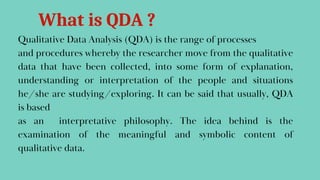
Qualitative Data Analysis (QDA) is the range of processes
and procedures whereby the researcher move from the qualitative
data that have been collected, into some form of explanation,
understanding or interpretation of the people and situations
he/she are studying/exploring. It can be said that usually, QDA
is based
as an interpretative philosophy. The idea behind is the
examination of the meaningful and symbolic content of
qualitative data.
What is QDA ?
To describe a phenomenon in some or greater detail. And also to
compare sevral cases (individuals or groups) and on which
dimension or aspects they common nature and differences.
To identify the conditions on which such differences or
similarities are based by giving proper explanations.
- To develop a theory of the phenomenon under investigation.
Aim of QDA
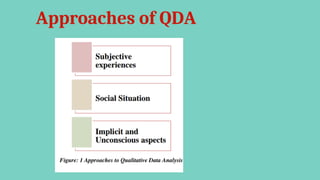
Approaches of QDA
Principles of QDA
-People differ in their experience and understanding of reality
- A social phenomenon can’t be understood outside its own context
- Qualitative research can be used to describe phenomenon or generate theory
grounded on data
- Understanding human behaviour emerges slowly and non-linearly
- Exceptional cases may yield insights into a problem or new idea for further
inquiry.
Features of QDA
i- Analysis is circular and non-linear.
ii- It is interactive and progressive.
iii- It should have close interaction with the data.
iv- Data collection and analysis are simultaneous.
v- Level of analysis varies based on many conditions.
vi- Uses inflection in data analysis, i.e. “this was good”.
vii- Can be sorted in many ways.
viii- Qualitative data by itself has meaning.
Different Measures and Forms of QDA
i- Analytic Approaches: What does it mean analytical? The analytic
approaches such as conversation analysis and discourse analysis are
also used. To analyse qualitative data, it is required to have two
strategies- one is to reducing big sets of data or the complexity in the
data. For the same, coding of the data has to be done by finding out
labels that allows the grouping of several elements under one concept,
so that we have a more or less limited number of codes or
categories.Content Analysis, Grounded Theory Coding etc.
Different Measures and Forms of QDA
ii- Deductive Approach: In this approach, the researcher uses the
research questions to group the data and then look for similarities and
differences. It is commonly used when time and resources are limited,
and when qualitative research is a smaller component of a larger
quantitative study.
Different Measures and Forms of QDA
iii- Inductive Approach: Inductive is with an opposite direction of
deductive approach which has been used by the researchers when
qualitative research is a major design of the inquiry, and when an
emergent framework is used to group the data and then look for
relationships from within.
Various activities involved in QDA. Creswell (2007), and
Rossman and Rallis (1998)
It is an ongoing process involving continual reflection about the data,
asking analytic questions, and writing memos. It is in progress along
with gathering data, and proceeds as making interpretations, and
writing reports.
Data analysis involves collecting open-ended data, based on asking
general questions and developing an analysis from the available
responses given by participants.
Various activities involved in QDA. Creswell (2007), and
Rossman and Rallis (1998)
Theme identification is another process in qualitative data analysis which is considered
by Creswell (2009) as basic qualitative analysis. It may vary from method to method. In
grounded theory method, for example, the systematic steps, as given by Corbin and
Strauss (2007), are generating categories of information (open coding), Selecting one of
the categories and positioning it within a theoretical model (axial coding), and then
explicating a story from the interconnection of these categories (selective coding).
Likewise, case study and ethnomethodology follows the steps viz. detailed description
of the setting or case, analysis of the data as themes or concerns, and interpretation
(Stake, 1995).
Steps of Qualitative Data Analysis:
Step 1. Organization of Data and getting ready: This step
involves transcribing interviews, optically scanning material,
recording field notes, and sorting/ arranging the data into
different categories/ sub-themes. This step consists of
transcribing the data, translating the data into required
forms, data cleaning, and labelling the data.
Steps of Qualitative Data Analysis:
Step 2. Skimming onto the entire data. This is a stage in
which the entire data set is being searched/ read to get an
idea of the information and to reflect on. Notes can also be
mentioned in the margin of pages where the data is given/
printed.
Steps of Qualitative Data Analysis:
Step 3: Assigning Codes. Coding is the process of organizing the material
into various chunks of text before bringing meaning to information
(Rossman and Rallis, 1998). It involves generally the labeling and
categorization based on the actual language of the participants. The
researcher should know the basic possible categories as per the theory/
framework. Similarly, the inclusion and exclusion criteria have also be
specified in the analysis plan. In this step a framework will be identified
to structure, label and define data.
Steps of Qualitative Data Analysis:
Step 4: Use the coding process to generate a description: it involves a
detailed description about people and setting. Then use coding to
generate categories, ideally 5 to seven (Creswell, 2009). Based on the
identified framework the responses will be arranged into various
categories and recurrent themes will be identified in this stage.
Generally this stage is the end of exploratory kind of qualitative
research.
Steps of Qualitative Data Analysis:
Step 5: Decide on how the description and themes will be represented:
This might be in the chronological order, the detailed description of the
themes. Second order analysis can be accommodated in this stage. The
researcher will identify recurrent themes, notice patterns in the data,
identify respondent clusters, build the sequence of events, search data
to answer research questions, and develop hypothesis and its testing.
Step 6: Interpretation of the Results: Meaningful interpretation of the
collected data is a real skill and is of great significance.
Coding and labelling:
1. Have a look at the whole data. Read all the transcription with care in this step.
2. Pick one response or input from the participants: The selected ones should be
the most interesting one, the shortest, the one on the top of the pile. Read and
look into it carefully, asking yourself, “what is this about “? Do not thing about the
substance of the information but its underlying meaning. Write your thoughts in
the margin for further analysis.
3. Prepare a list of all topics: When the responses of many have been completed,
prepare a list of all topics and then cluster together the similar ideas. Accordingly
you can arrange the scores from these topics in a columns- major topics, unique
topic, and leftovers.
Coding and labelling:
4. Go back to your data with the prepared list: Abbreviate the topics as
codes and write codes next to the appropriate segments of the text. Try
this preliminary organizing scheme to see if new categories and codes
emerge.
5. Find the most descriptive wording: This is the stage of naming or
labeling of the data. Look for ways of reduce your total list of categories
by grouping topics that relate to each other.
Coding and labelling:
6. Decide abbreviations: In this stage you may take a final decision
on the abbreviation for each category and alphabetize these codes.
7. Categorization: at this stage you can assemble the data material
belonging to each category in one place and perform a preliminary
analysis.
8. Recode of data set: If required you can recode the existing data to
have more clear variables.
Few tips of QDA as Creswell (2009)
-Triangulate different data sources of information
- Use member checking to determine the accuracy
- Use rich, thick description
- Clarify the biases
- Present the negative or discrepant information that runs counter to
the theme
- Spend prolonged time in the field
- Use peer debriefing to enhance the accuracy of the account
- Use an external auditor to review the entire work
Common terms used in QDA
1- Theory: A set of interrelated concepts, definitions and
propositions that presents a systematic view of events or
situations by specifying relations among variables.
2- Themes: categorical ideas that emerge from grouping of lower-
level data points.
3- Characteristic: a single item or event in a text, similar to an
individual response to a variable or indicator in a quantitative
research. It is the smallest unit of analysis in qualitative research.
Common terms used in QDA
4- Coding: the process of attaching labels to lines of text which helps
the researcher in grouping and comparing similar or related pieces of
information.
5- Coding sorts: compilation of similarly coded blocks of text from
different sources in to a single file.
6- Indexing: process that generates a word list comprising all the
substantive words and their location within the texts entered in to
program.
Types of Qualitative Analysis
1) Content Analysis: Content analysis or textual analysis is the
procedure for the categorization of verbal or behavioural data for the
purpose of classification, summarization and tabulation. This can be
done on two levels: Descriptive: which explains what the data is, and
Interpretative: which gives the meaning of the data.
Types of Qualitative Analysis
2) Narrative Analysis: Narratives are transcribed experiences in qualitative
researches like interview and observation. The researcher has to sort-out
and reflects up on them, enhance them and present them in a revised
shape to the reader. The purpose of narrative analysis is to reformulate
stories presented by participants in different contexts based on their
experiences.
Types of Qualitative Analysis
3) Discourse Analysis: This is a method of analyzing a naturally occurring
talk, i.e., spoken interaction, and all types of written texts. It focuses on
how people express themselves verbally in their everyday social life. The
expressions may vary from person to person like simple and direct
expressions, vague and indirect representation, and symbolic
representation. It is concerned with the way in which texts themselves
have been constructed in terms of their social and historical situatedness
(Cheek, 2004)
Types of Qualitative Analysis
4) Framework Analysis: The steps of framework analysis are the following.
i- Familiarization: Transcribing & reading the data based on the pre-planned framework
ii- Identifying a thematic framework: Initial coding framework which is developed a
concern.
iii- Coding: This is a process of assigning numerical or textual codes to identify specific
piece of data having different features.
iv- Charting: Charts are created using headings from thematic framework.
v- Mapping and interpretation: The mapping and interpretation includes searching for
patterns, associations, concepts and explanations in the data.
Types of Qualitative Analysis
5) Grounded Theory: This theory starts with an examination of a single case from a
‘pre-defined’ population in order to formulate a general statement (concept or a
hypothesis) about a population. Afterwards the analyst examines another case to see
whether the hypothesis fits the statement. Grounded theory method is used only for
limited set of analytic problems: those that can be solved with some general overall
statement. Grounded theory has three systematic steps (Corbin & Strauss, 2007;
Strauss and Corbin, 1990, 1998) as open coding (generating categories of
information), axial coding (selecting one of the categories and positioning it within a
theoretical model), and selective coding (explicating a story from the
interconnection of these categories)
Types of Qualitative Analysis
6) Constant-comparative method: It is associated with grounded theory its steps
includes open coding, axial coding, and selective coding. Codes are developed and
organized around concepts.
7) Qualitative Comparative Analysis: QCA was developed by Ragin (1987). Its purpose
is to preserve the complexity of a single case while making comparisons across cases
(Greckhamer, et al., 2008).
8) Relational Data Analysis: it is a multidimensional framework for unifying data
analytic strategies across dimensions and phases and is very much used in mixed-
method researches (Kurtines, et al., 2008).
Types of Qualitative Analysis
9) Analytic Induction: Znaniecki (1934) introduced analytic induction which
explicitly starts from a specific case. According to Buhler-Niederberger it
can be characterized as follows:
 Analytic induction is a method of systematic interpretation of events,
 Which includes the process of generating hypotheses as well as testing
them,
 Its decisive instrument is to analyze the exception, the case, and
 Which is deviant to the hypothesis
Types of Qualitative Analysis
Steps of Analytic Induction: 1 A rough definition of the phenomenon to be
explained, 2 A hypothetical explanation of the phenomenon, 3 A case is
studied in the light of this hypothesis, 4 If the hypothesis is not correct,
either the hypothesis is reformulated or the phenomenon to be explained
is redefined in a way that excludes this case, 5 Practical certainty can be
obtained after a small number of cases have been studied, 6 Further cases
are studied, the phenomenon is redefined, and the hypotheses are
reformulated until a universal relation is established.
Software Analysis of Qualitative Data
 Transcribing data
 Writing/editing the data
 Storage
 Coding data
 Search and retrieval of data
 Data linking of related text
 Writing/editing memos about the data
 Display of selected reduced data
 Graphic mapping, and
 Preparing reports.
Atlas.ti
HyperRESEARCH
MAX QDA
Open code 3.4
QSR NVivo
The Ethnography 5.08
Weft QDA
Ethical Issues in Qualitative Analysis
- The new forms of data raise issues of data protection and more generally of keeping
the privacy of research participants.
- They also raise questions of how comprehensive the knowledge about the
participants and the circumstances has to be for answering the specific research
question of a project.
- How can the analysis do justice to the participants and their perspective?
- How does the presentation of the research and its findings maintain their privacy as
much as possible?
- How can feedback on insights from the analysis take the participants’ perspective
into account and do justice to their expectations and feelings
Summarising Qualitative Data Analysis
Qualitative data analysis is the classification and interpretation of linguistic
(or visual) material to make statements about implicit and explicit dimensions
and structures of meaning-making in the material and what is represented in
it. Meaning-making can refer to subjective or social meanings. Qualitative
data analysis also is applied to discover and describe issues in the field or
structures and processes in routines and practices.The final aim is often to
arrive at generalizable statements by comparing various materials or various
texts or several cases. In this module we have discussed the steps and
strategies of qualitative data analysis.
References
T H A N K
Y O U

Qualitative Data Analysis by Dr. Vikramjit Singh

  • 1.
    Q U AL I T A T I V E D A T A A N A L Y S I S Dr. Vikramjit Singh
  • 2.
    Qualitative Data Analysis(QDA) is the range of processes and procedures whereby the researcher move from the qualitative data that have been collected, into some form of explanation, understanding or interpretation of the people and situations he/she are studying/exploring. It can be said that usually, QDA is based as an interpretative philosophy. The idea behind is the examination of the meaningful and symbolic content of qualitative data. What is QDA ?
  • 3.
    To describe aphenomenon in some or greater detail. And also to compare sevral cases (individuals or groups) and on which dimension or aspects they common nature and differences. To identify the conditions on which such differences or similarities are based by giving proper explanations. - To develop a theory of the phenomenon under investigation. Aim of QDA
  • 4.
  • 5.
    Principles of QDA -Peoplediffer in their experience and understanding of reality - A social phenomenon can’t be understood outside its own context - Qualitative research can be used to describe phenomenon or generate theory grounded on data - Understanding human behaviour emerges slowly and non-linearly - Exceptional cases may yield insights into a problem or new idea for further inquiry.
  • 6.
    Features of QDA i-Analysis is circular and non-linear. ii- It is interactive and progressive. iii- It should have close interaction with the data. iv- Data collection and analysis are simultaneous. v- Level of analysis varies based on many conditions. vi- Uses inflection in data analysis, i.e. “this was good”. vii- Can be sorted in many ways. viii- Qualitative data by itself has meaning.
  • 7.
    Different Measures andForms of QDA i- Analytic Approaches: What does it mean analytical? The analytic approaches such as conversation analysis and discourse analysis are also used. To analyse qualitative data, it is required to have two strategies- one is to reducing big sets of data or the complexity in the data. For the same, coding of the data has to be done by finding out labels that allows the grouping of several elements under one concept, so that we have a more or less limited number of codes or categories.Content Analysis, Grounded Theory Coding etc.
  • 8.
    Different Measures andForms of QDA ii- Deductive Approach: In this approach, the researcher uses the research questions to group the data and then look for similarities and differences. It is commonly used when time and resources are limited, and when qualitative research is a smaller component of a larger quantitative study.
  • 9.
    Different Measures andForms of QDA iii- Inductive Approach: Inductive is with an opposite direction of deductive approach which has been used by the researchers when qualitative research is a major design of the inquiry, and when an emergent framework is used to group the data and then look for relationships from within.
  • 10.
    Various activities involvedin QDA. Creswell (2007), and Rossman and Rallis (1998) It is an ongoing process involving continual reflection about the data, asking analytic questions, and writing memos. It is in progress along with gathering data, and proceeds as making interpretations, and writing reports. Data analysis involves collecting open-ended data, based on asking general questions and developing an analysis from the available responses given by participants.
  • 11.
    Various activities involvedin QDA. Creswell (2007), and Rossman and Rallis (1998) Theme identification is another process in qualitative data analysis which is considered by Creswell (2009) as basic qualitative analysis. It may vary from method to method. In grounded theory method, for example, the systematic steps, as given by Corbin and Strauss (2007), are generating categories of information (open coding), Selecting one of the categories and positioning it within a theoretical model (axial coding), and then explicating a story from the interconnection of these categories (selective coding). Likewise, case study and ethnomethodology follows the steps viz. detailed description of the setting or case, analysis of the data as themes or concerns, and interpretation (Stake, 1995).
  • 12.
    Steps of QualitativeData Analysis: Step 1. Organization of Data and getting ready: This step involves transcribing interviews, optically scanning material, recording field notes, and sorting/ arranging the data into different categories/ sub-themes. This step consists of transcribing the data, translating the data into required forms, data cleaning, and labelling the data.
  • 13.
    Steps of QualitativeData Analysis: Step 2. Skimming onto the entire data. This is a stage in which the entire data set is being searched/ read to get an idea of the information and to reflect on. Notes can also be mentioned in the margin of pages where the data is given/ printed.
  • 14.
    Steps of QualitativeData Analysis: Step 3: Assigning Codes. Coding is the process of organizing the material into various chunks of text before bringing meaning to information (Rossman and Rallis, 1998). It involves generally the labeling and categorization based on the actual language of the participants. The researcher should know the basic possible categories as per the theory/ framework. Similarly, the inclusion and exclusion criteria have also be specified in the analysis plan. In this step a framework will be identified to structure, label and define data.
  • 15.
    Steps of QualitativeData Analysis: Step 4: Use the coding process to generate a description: it involves a detailed description about people and setting. Then use coding to generate categories, ideally 5 to seven (Creswell, 2009). Based on the identified framework the responses will be arranged into various categories and recurrent themes will be identified in this stage. Generally this stage is the end of exploratory kind of qualitative research.
  • 16.
    Steps of QualitativeData Analysis: Step 5: Decide on how the description and themes will be represented: This might be in the chronological order, the detailed description of the themes. Second order analysis can be accommodated in this stage. The researcher will identify recurrent themes, notice patterns in the data, identify respondent clusters, build the sequence of events, search data to answer research questions, and develop hypothesis and its testing. Step 6: Interpretation of the Results: Meaningful interpretation of the collected data is a real skill and is of great significance.
  • 17.
    Coding and labelling: 1.Have a look at the whole data. Read all the transcription with care in this step. 2. Pick one response or input from the participants: The selected ones should be the most interesting one, the shortest, the one on the top of the pile. Read and look into it carefully, asking yourself, “what is this about “? Do not thing about the substance of the information but its underlying meaning. Write your thoughts in the margin for further analysis. 3. Prepare a list of all topics: When the responses of many have been completed, prepare a list of all topics and then cluster together the similar ideas. Accordingly you can arrange the scores from these topics in a columns- major topics, unique topic, and leftovers.
  • 18.
    Coding and labelling: 4.Go back to your data with the prepared list: Abbreviate the topics as codes and write codes next to the appropriate segments of the text. Try this preliminary organizing scheme to see if new categories and codes emerge. 5. Find the most descriptive wording: This is the stage of naming or labeling of the data. Look for ways of reduce your total list of categories by grouping topics that relate to each other.
  • 19.
    Coding and labelling: 6.Decide abbreviations: In this stage you may take a final decision on the abbreviation for each category and alphabetize these codes. 7. Categorization: at this stage you can assemble the data material belonging to each category in one place and perform a preliminary analysis. 8. Recode of data set: If required you can recode the existing data to have more clear variables.
  • 20.
    Few tips ofQDA as Creswell (2009) -Triangulate different data sources of information - Use member checking to determine the accuracy - Use rich, thick description - Clarify the biases - Present the negative or discrepant information that runs counter to the theme - Spend prolonged time in the field - Use peer debriefing to enhance the accuracy of the account - Use an external auditor to review the entire work
  • 22.
    Common terms usedin QDA 1- Theory: A set of interrelated concepts, definitions and propositions that presents a systematic view of events or situations by specifying relations among variables. 2- Themes: categorical ideas that emerge from grouping of lower- level data points. 3- Characteristic: a single item or event in a text, similar to an individual response to a variable or indicator in a quantitative research. It is the smallest unit of analysis in qualitative research.
  • 23.
    Common terms usedin QDA 4- Coding: the process of attaching labels to lines of text which helps the researcher in grouping and comparing similar or related pieces of information. 5- Coding sorts: compilation of similarly coded blocks of text from different sources in to a single file. 6- Indexing: process that generates a word list comprising all the substantive words and their location within the texts entered in to program.
  • 24.
    Types of QualitativeAnalysis 1) Content Analysis: Content analysis or textual analysis is the procedure for the categorization of verbal or behavioural data for the purpose of classification, summarization and tabulation. This can be done on two levels: Descriptive: which explains what the data is, and Interpretative: which gives the meaning of the data.
  • 25.
    Types of QualitativeAnalysis 2) Narrative Analysis: Narratives are transcribed experiences in qualitative researches like interview and observation. The researcher has to sort-out and reflects up on them, enhance them and present them in a revised shape to the reader. The purpose of narrative analysis is to reformulate stories presented by participants in different contexts based on their experiences.
  • 26.
    Types of QualitativeAnalysis 3) Discourse Analysis: This is a method of analyzing a naturally occurring talk, i.e., spoken interaction, and all types of written texts. It focuses on how people express themselves verbally in their everyday social life. The expressions may vary from person to person like simple and direct expressions, vague and indirect representation, and symbolic representation. It is concerned with the way in which texts themselves have been constructed in terms of their social and historical situatedness (Cheek, 2004)
  • 27.
    Types of QualitativeAnalysis 4) Framework Analysis: The steps of framework analysis are the following. i- Familiarization: Transcribing & reading the data based on the pre-planned framework ii- Identifying a thematic framework: Initial coding framework which is developed a concern. iii- Coding: This is a process of assigning numerical or textual codes to identify specific piece of data having different features. iv- Charting: Charts are created using headings from thematic framework. v- Mapping and interpretation: The mapping and interpretation includes searching for patterns, associations, concepts and explanations in the data.
  • 28.
    Types of QualitativeAnalysis 5) Grounded Theory: This theory starts with an examination of a single case from a ‘pre-defined’ population in order to formulate a general statement (concept or a hypothesis) about a population. Afterwards the analyst examines another case to see whether the hypothesis fits the statement. Grounded theory method is used only for limited set of analytic problems: those that can be solved with some general overall statement. Grounded theory has three systematic steps (Corbin & Strauss, 2007; Strauss and Corbin, 1990, 1998) as open coding (generating categories of information), axial coding (selecting one of the categories and positioning it within a theoretical model), and selective coding (explicating a story from the interconnection of these categories)
  • 29.
    Types of QualitativeAnalysis 6) Constant-comparative method: It is associated with grounded theory its steps includes open coding, axial coding, and selective coding. Codes are developed and organized around concepts. 7) Qualitative Comparative Analysis: QCA was developed by Ragin (1987). Its purpose is to preserve the complexity of a single case while making comparisons across cases (Greckhamer, et al., 2008). 8) Relational Data Analysis: it is a multidimensional framework for unifying data analytic strategies across dimensions and phases and is very much used in mixed- method researches (Kurtines, et al., 2008).
  • 30.
    Types of QualitativeAnalysis 9) Analytic Induction: Znaniecki (1934) introduced analytic induction which explicitly starts from a specific case. According to Buhler-Niederberger it can be characterized as follows:  Analytic induction is a method of systematic interpretation of events,  Which includes the process of generating hypotheses as well as testing them,  Its decisive instrument is to analyze the exception, the case, and  Which is deviant to the hypothesis
  • 31.
    Types of QualitativeAnalysis Steps of Analytic Induction: 1 A rough definition of the phenomenon to be explained, 2 A hypothetical explanation of the phenomenon, 3 A case is studied in the light of this hypothesis, 4 If the hypothesis is not correct, either the hypothesis is reformulated or the phenomenon to be explained is redefined in a way that excludes this case, 5 Practical certainty can be obtained after a small number of cases have been studied, 6 Further cases are studied, the phenomenon is redefined, and the hypotheses are reformulated until a universal relation is established.
  • 32.
    Software Analysis ofQualitative Data  Transcribing data  Writing/editing the data  Storage  Coding data  Search and retrieval of data  Data linking of related text  Writing/editing memos about the data  Display of selected reduced data  Graphic mapping, and  Preparing reports. Atlas.ti HyperRESEARCH MAX QDA Open code 3.4 QSR NVivo The Ethnography 5.08 Weft QDA
  • 33.
    Ethical Issues inQualitative Analysis - The new forms of data raise issues of data protection and more generally of keeping the privacy of research participants. - They also raise questions of how comprehensive the knowledge about the participants and the circumstances has to be for answering the specific research question of a project. - How can the analysis do justice to the participants and their perspective? - How does the presentation of the research and its findings maintain their privacy as much as possible? - How can feedback on insights from the analysis take the participants’ perspective into account and do justice to their expectations and feelings
  • 34.
    Summarising Qualitative DataAnalysis Qualitative data analysis is the classification and interpretation of linguistic (or visual) material to make statements about implicit and explicit dimensions and structures of meaning-making in the material and what is represented in it. Meaning-making can refer to subjective or social meanings. Qualitative data analysis also is applied to discover and describe issues in the field or structures and processes in routines and practices.The final aim is often to arrive at generalizable statements by comparing various materials or various texts or several cases. In this module we have discussed the steps and strategies of qualitative data analysis. References
  • 35.
    T H AN K Y O U