Finoteselam College of Teachers Education
Department of General science
Practical Analytical chemistry (ChEd 2352)
address:- men4112@gmail.com
QUALITATIVE ANALYSIS OF METAL IONS IN SALT
 Qualitative analysis can be done using specific chemical reaction
with certain reagent to bring observeable product.
 Precicitation reaction (major one among them), acid base reaction,
oxidation reduction reaction and formation of complex ions are
ways to separate ions from salt and determinig the presence of
specific ions.
General schemes
Add reagent that exploit the more general properties of ions to
separate major groups of ions
Separate major groups into subgroups with reaction that will
distinguish less general properties
Add reagent that will specifically confirm the presence of
individual ions
Group I Cation
Includes Pb2+
, Hg2
2+
and Ag +
cations
Forms insoluble chloride salts
Group II Cation
Includes Hg+2
, Bi+2
, Cu+2
, Cd+2
, As+3
, Sb+3
and Sn+4
Forms insoluble salphide salt (ksp value less than 10-30
)
Precipitated relatively low amount of sulphide ions and acchieved
by adding acidic solution of H2S
Group III Cation
Includes Al+3
, Co+2
, Cr+3
, Fe+3
, Mn+2
, Ni+2
and Zn+2
Forms slightly soluble sulphide salt (ksp value less than 10-20
)
Precipitated relatively high amount of sulphide ions and
acchieved by adding basic solution of H2S
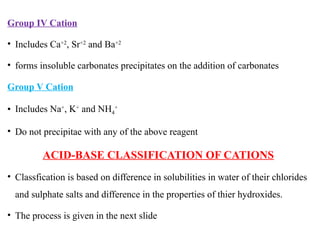
Group IV Cation
• Includes Ca+2
, Sr+2
and Ba+2
• forms insoluble carbonates precipitates on the addition of carbonates
Group V Cation
• Includes Na+
, K+
and NH4
+
• Do not precipitae with any of the above reagent
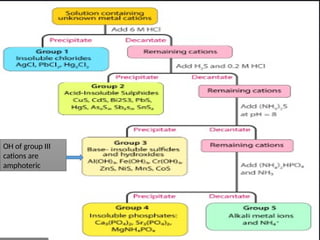
ACID-BASE CLASSIFICATION OF CATIONS
• Classfication is based on difference in solubilities in water of their chlorides
and sulphate salts and difference in the properties of thier hydroxides.
• The process is given in the next slide
OH of group III
cations are
amphoteric
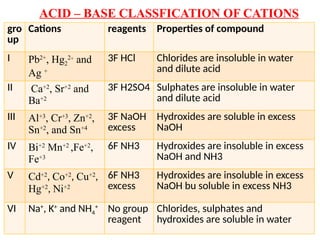
ACID – BASE CLASSFICATION OF CATIONS
gro
up
Cations reagents Properties of compound
I Pb2+
, Hg2
2+
and
Ag +
3F HCl Chlorides are insoluble in water
and dilute acid
II Ca+2
, Sr+2
and
Ba+2
3F H2SO4 Sulphates are insoluble in water
and dilute acid
III Al+3
, Cr+3
, Zn+2
,
Sn+2
, and Sn+4
3F NaOH
excess
Hydroxides are soluble in excess
NaOH
IV Bi+2
Mn+2
,Fe+2
,
Fe+3
6F NH3 Hydroxides are insoluble in excess
NaOH and NH3
V Cd+2
, Co+2
, Cu+2
,
Hg+2
, Ni+2
6F NH3
excess
Hydroxides are insoluble in excess
NaOH bu soluble in excess NH3
VI Na+
, K+
and NH4
+
No group
reagent
Chlorides, sulphates and
hydroxides are soluble in water
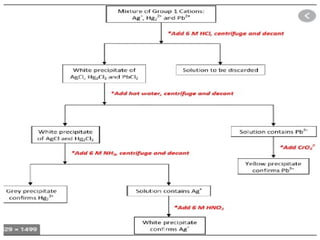
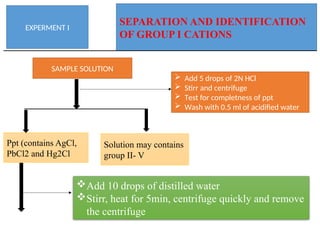
EXPERMENT I
SEPARATION AND IDENTIFICATION
OF GROUP I CATIONS
SAMPLE SOLUTION
 Add 5 drops of 2N HCl
 Stirr and centrifuge
 Test for completness of ppt
 Wash with 0.5 ml of acidified water
Solution may contains
group II- V
Ppt (contains AgCl,
PbCl2 and Hg2Cl
Add 10 drops of distilled water
Stirr, heat for 5min, centrifuge quickly and remove
the centrifuge
Solution (may contains Pb2+
)
Add K2Cro4, yellow ppt
PbCrO4 the presence of Pb2+
Ppt (may contain AgCl and Hg2Cl2
 Solution( may ontain [Ag(NH3)2]+
)
 Add drops of 6N HNO3
 Repreciptation of AgCl confirms Ag+
 Add 10 drops of 2N NH3
 Stirr and centrifuge
 Precipitate (contains Hg(NH2)Cl + Hg
 Black or gray ppt of Hg(NH2)Cl + Hg
Confirms the presence of Hg
REACTION OF GROUP I CATIONS
colorless aqueous solution of group I catain forms chloride salt
which are slightly soluble in water, dilute nitric and sulphuric acid.
Whe dilute HCl is added to solution of salt containing Pb2+
, Hg2
2+
and Ag +
cations white ppts of PbCl2 , Hg2Cl2 and AgCl is formed.
Solubility of PbCl2 , Hg2Cl2 and AgCl can be decreased by a slight
excess HCl or Cl-
(common ion effect).
Large amount of Cl-
causes dissociation of PbCl2 , Hg2Cl2 and AgCl
due to formation of soluble [AgCl3]2-
, [PbCl4]2-
and 2[HgCl2
]-
Complexes
Ag +
+ Cl-
AgCl Ksp=1.5610-10
Almost Completely ppt
Hg2
2+
+ Cl-
Hg2Cl2 Ksp=210-18
Almost Completely ppt
Pb2+
+ Cl-
PbCl2 Ksp=110-4
Relatively soluble ( no more ppt is
formed)
 Separation of PbCl2 from Hg2Cl2 and AgCl is based on solubility in
water. PbCl2 Is completely dissolved in hot water.
Separation of AgCl from Hg2Cl2 and PbCl2is based on solubility in
aqueous NH3.
AgCl + 2NH3 [Ag(NH3)2]+
+ Cl-
The complex is stable in excess NH3. if the solution containing
[Ag(NH3)2]+
and Cl-
is acidified with nitric acid or with any acid
which does not form ppt with Ag+
ion the complex is destroyed and
white AgCl is re-precipitated.
[Ag(NH3)2]+
+ Cl-
+ 2H3O+
AgCl + 2NH4
+
+2H2O
Hg2Cl2Is not soluble in queous NH3 but forms unstable and rapidly
decomposable [NH2Hg2]Cl (amido complex).
Hg2Cl2 + 2NH3 [NH2Hg2]Cl + Cl-
+ NH4
+
[NH2Hg2]Cl [NH2Hg]Cl + Hg (black ppt)
Blackening of ppt occurs due to the formation of metallic mercury.
Some reaction of group I cations
reagent Cations
Ag+
Pb2+
Hg2
2+
3F HCl or soluble
chlorides (slight
excess)
White pp AgCl White ppt PbCl2 White ppt Hg2Cl2
3F H2SO4 or
soluble sulphates
No ppt is formed White ppt PbSO4 White ppt Hg2SO4
Aqueous NH3
(excess)
Colorless solution
[Ag(NH3)2]+
White ppt
Pb(OH)2
Black or gray ppt
[NH2Hg]X (white) +
Hg (black)
NaOH (no
excess)
brown ppt Ag2O White ppt
Pb(OH)2
brown ppt Hg2O
NaOH (excess) brown ppt Ag2O Colorless solution
[Pb(OH)4]2-
brown ppt Hg2O
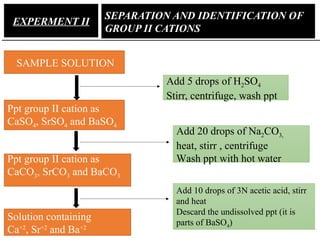
EXPERMENT II
SEPARATION AND IDENTIFICATION OF
GROUP II CATIONS
SAMPLE SOLUTION
Add 5 drops of H2SO4
Stirr, centrifuge, wash ppt
Ppt group II cation as
CaCO3, SrCO3 and BaCO3
Add 20 drops of Na2CO3,
heat, stirr , centrifuge
Wash ppt with hot water
Ppt group II cation as
CaSO4, SrSO4 and BaSO4
Solution containing
Ca+2
, Sr+2
and Ba+2
Add 10 drops of 3N acetic acid, stirr
and heat
Descard the undissolved ppt (it is
parts of BaSO4)
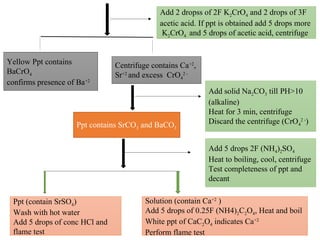
Yellow Ppt contains
BaCrO4
confirms presence of Ba+2
Centrifuge contains Ca+2
,
Sr+2
and excess CrO4
2 -
Add 2 dropss of 2F K2CrO4 and 2 drops of 3F
acetic acid. If ppt is obtained add 5 drops more
K2CrO4 and 5 drops of acetic acid, centrifuge
Ppt contains SrCO3 and BaCO3
Solution (contain Ca+2
)
Add 5 drops of 0.25F (NH4)2C2O4, Heat and boil
White ppt of CaC2O4 indicates Ca+2
Perform flame test
Ppt (contain SrSO4)
Wash with hot water
Add 5 drops of conc HCl and
flame test
Add 5 drops 2F (NH4)2SO4
Heat to boiling, cool, centrifuge
Test completeness of ppt and
decant
Add solid Na2CO3 till PH>10
(alkaline)
Heat for 3 min, centrifuge
Discard the centrifuge (CrO4
2 -
)
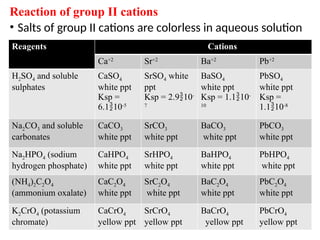
Reaction of group II cations
• Salts of group II cations are colorless in aqueous solution
Reagents Cations
Ca+2
Sr+2
Ba+2
Pb+2
H2SO4 and soluble
sulphates
CaSO4
white ppt
Ksp =
6.110-5
SrSO4 white
ppt
Ksp = 2.910-
7
BaSO4
white ppt
Ksp = 1.110-
10
PbSO4
white ppt
Ksp =
1.110-8
Na2CO3 and soluble
carbonates
CaCO3
white ppt
SrCO3
white ppt
BaCO3
white ppt
PbCO3
white ppt
Na2HPO4 (sodium
hydrogen phosphate)
CaHPO4
white ppt
SrHPO4
white ppt
BaHPO4
white ppt
PbHPO4
white ppt
(NH4)2C2O4
(ammonium oxalate)
CaC2O4
white ppt
SrC2O4
white ppt
BaC2O4
white ppt
PbC2O4
white ppt
K2CrO4 (potassium
chromate)
CaCrO4
yellow ppt
SrCrO4
yellow ppt
BaCrO4
yellow ppt
PbCrO4
yellow ppt
• Pb is precipitated as chloride in group I and as sulphate in
group II
• Solubility of lead sulphate in hot alkaline solution is used
to separate lead ion fromg roup II cation.
PbSO4 + 4OH-
[Pb(OH)4]2-
+ SO4
2-
• Flame tests of some group II cations
Brick red (Ca) Crimson red Yellow green
SEPARATION AND IDENTIFICATION OF
GROUP III CATIONS
Experment
III
Sample solution
Add 2N NaOH excess,
add 3%H2O2 while
stirring Heat for 5min,
centrifuge
Solution containing
[Zn(OH)4]2-
,[Al(OH)4]-
,
[Sn(OH)6]2-
and CrO4
2-
The ppt contains group IV and V
Add solid NH4Cl and stirr till you get the
characterstics of smells of ammonia heat
and centrifug

practical analytical chemistry (ChEd 2352) power point presentation

  • 1.
    Finoteselam College ofTeachers Education Department of General science Practical Analytical chemistry (ChEd 2352) address:- men4112@gmail.com
  • 2.
    QUALITATIVE ANALYSIS OFMETAL IONS IN SALT  Qualitative analysis can be done using specific chemical reaction with certain reagent to bring observeable product.  Precicitation reaction (major one among them), acid base reaction, oxidation reduction reaction and formation of complex ions are ways to separate ions from salt and determinig the presence of specific ions.
  • 3.
    General schemes Add reagentthat exploit the more general properties of ions to separate major groups of ions Separate major groups into subgroups with reaction that will distinguish less general properties Add reagent that will specifically confirm the presence of individual ions Group I Cation Includes Pb2+ , Hg2 2+ and Ag + cations Forms insoluble chloride salts
  • 4.
    Group II Cation IncludesHg+2 , Bi+2 , Cu+2 , Cd+2 , As+3 , Sb+3 and Sn+4 Forms insoluble salphide salt (ksp value less than 10-30 ) Precipitated relatively low amount of sulphide ions and acchieved by adding acidic solution of H2S Group III Cation Includes Al+3 , Co+2 , Cr+3 , Fe+3 , Mn+2 , Ni+2 and Zn+2 Forms slightly soluble sulphide salt (ksp value less than 10-20 ) Precipitated relatively high amount of sulphide ions and acchieved by adding basic solution of H2S
  • 5.
    Group IV Cation •Includes Ca+2 , Sr+2 and Ba+2 • forms insoluble carbonates precipitates on the addition of carbonates Group V Cation • Includes Na+ , K+ and NH4 + • Do not precipitae with any of the above reagent ACID-BASE CLASSIFICATION OF CATIONS • Classfication is based on difference in solubilities in water of their chlorides and sulphate salts and difference in the properties of thier hydroxides. • The process is given in the next slide
  • 6.
    OH of groupIII cations are amphoteric
  • 8.
    ACID – BASECLASSFICATION OF CATIONS gro up Cations reagents Properties of compound I Pb2+ , Hg2 2+ and Ag + 3F HCl Chlorides are insoluble in water and dilute acid II Ca+2 , Sr+2 and Ba+2 3F H2SO4 Sulphates are insoluble in water and dilute acid III Al+3 , Cr+3 , Zn+2 , Sn+2 , and Sn+4 3F NaOH excess Hydroxides are soluble in excess NaOH IV Bi+2 Mn+2 ,Fe+2 , Fe+3 6F NH3 Hydroxides are insoluble in excess NaOH and NH3 V Cd+2 , Co+2 , Cu+2 , Hg+2 , Ni+2 6F NH3 excess Hydroxides are insoluble in excess NaOH bu soluble in excess NH3 VI Na+ , K+ and NH4 + No group reagent Chlorides, sulphates and hydroxides are soluble in water
  • 9.
    EXPERMENT I SEPARATION ANDIDENTIFICATION OF GROUP I CATIONS SAMPLE SOLUTION  Add 5 drops of 2N HCl  Stirr and centrifuge  Test for completness of ppt  Wash with 0.5 ml of acidified water Solution may contains group II- V Ppt (contains AgCl, PbCl2 and Hg2Cl Add 10 drops of distilled water Stirr, heat for 5min, centrifuge quickly and remove the centrifuge
  • 10.
    Solution (may containsPb2+ ) Add K2Cro4, yellow ppt PbCrO4 the presence of Pb2+ Ppt (may contain AgCl and Hg2Cl2  Solution( may ontain [Ag(NH3)2]+ )  Add drops of 6N HNO3  Repreciptation of AgCl confirms Ag+  Add 10 drops of 2N NH3  Stirr and centrifuge  Precipitate (contains Hg(NH2)Cl + Hg  Black or gray ppt of Hg(NH2)Cl + Hg Confirms the presence of Hg
  • 11.
    REACTION OF GROUPI CATIONS colorless aqueous solution of group I catain forms chloride salt which are slightly soluble in water, dilute nitric and sulphuric acid. Whe dilute HCl is added to solution of salt containing Pb2+ , Hg2 2+ and Ag + cations white ppts of PbCl2 , Hg2Cl2 and AgCl is formed. Solubility of PbCl2 , Hg2Cl2 and AgCl can be decreased by a slight excess HCl or Cl- (common ion effect). Large amount of Cl- causes dissociation of PbCl2 , Hg2Cl2 and AgCl due to formation of soluble [AgCl3]2- , [PbCl4]2- and 2[HgCl2 ]- Complexes Ag + + Cl- AgCl Ksp=1.5610-10 Almost Completely ppt Hg2 2+ + Cl- Hg2Cl2 Ksp=210-18 Almost Completely ppt Pb2+ + Cl- PbCl2 Ksp=110-4 Relatively soluble ( no more ppt is formed)
  • 12.
     Separation ofPbCl2 from Hg2Cl2 and AgCl is based on solubility in water. PbCl2 Is completely dissolved in hot water. Separation of AgCl from Hg2Cl2 and PbCl2is based on solubility in aqueous NH3. AgCl + 2NH3 [Ag(NH3)2]+ + Cl- The complex is stable in excess NH3. if the solution containing [Ag(NH3)2]+ and Cl- is acidified with nitric acid or with any acid which does not form ppt with Ag+ ion the complex is destroyed and white AgCl is re-precipitated. [Ag(NH3)2]+ + Cl- + 2H3O+ AgCl + 2NH4 + +2H2O Hg2Cl2Is not soluble in queous NH3 but forms unstable and rapidly decomposable [NH2Hg2]Cl (amido complex). Hg2Cl2 + 2NH3 [NH2Hg2]Cl + Cl- + NH4 + [NH2Hg2]Cl [NH2Hg]Cl + Hg (black ppt) Blackening of ppt occurs due to the formation of metallic mercury.
  • 13.
    Some reaction ofgroup I cations reagent Cations Ag+ Pb2+ Hg2 2+ 3F HCl or soluble chlorides (slight excess) White pp AgCl White ppt PbCl2 White ppt Hg2Cl2 3F H2SO4 or soluble sulphates No ppt is formed White ppt PbSO4 White ppt Hg2SO4 Aqueous NH3 (excess) Colorless solution [Ag(NH3)2]+ White ppt Pb(OH)2 Black or gray ppt [NH2Hg]X (white) + Hg (black) NaOH (no excess) brown ppt Ag2O White ppt Pb(OH)2 brown ppt Hg2O NaOH (excess) brown ppt Ag2O Colorless solution [Pb(OH)4]2- brown ppt Hg2O
  • 14.
    EXPERMENT II SEPARATION ANDIDENTIFICATION OF GROUP II CATIONS SAMPLE SOLUTION Add 5 drops of H2SO4 Stirr, centrifuge, wash ppt Ppt group II cation as CaCO3, SrCO3 and BaCO3 Add 20 drops of Na2CO3, heat, stirr , centrifuge Wash ppt with hot water Ppt group II cation as CaSO4, SrSO4 and BaSO4 Solution containing Ca+2 , Sr+2 and Ba+2 Add 10 drops of 3N acetic acid, stirr and heat Descard the undissolved ppt (it is parts of BaSO4)
  • 15.
    Yellow Ppt contains BaCrO4 confirmspresence of Ba+2 Centrifuge contains Ca+2 , Sr+2 and excess CrO4 2 - Add 2 dropss of 2F K2CrO4 and 2 drops of 3F acetic acid. If ppt is obtained add 5 drops more K2CrO4 and 5 drops of acetic acid, centrifuge Ppt contains SrCO3 and BaCO3 Solution (contain Ca+2 ) Add 5 drops of 0.25F (NH4)2C2O4, Heat and boil White ppt of CaC2O4 indicates Ca+2 Perform flame test Ppt (contain SrSO4) Wash with hot water Add 5 drops of conc HCl and flame test Add 5 drops 2F (NH4)2SO4 Heat to boiling, cool, centrifuge Test completeness of ppt and decant Add solid Na2CO3 till PH>10 (alkaline) Heat for 3 min, centrifuge Discard the centrifuge (CrO4 2 - )
  • 16.
    Reaction of groupII cations • Salts of group II cations are colorless in aqueous solution Reagents Cations Ca+2 Sr+2 Ba+2 Pb+2 H2SO4 and soluble sulphates CaSO4 white ppt Ksp = 6.110-5 SrSO4 white ppt Ksp = 2.910- 7 BaSO4 white ppt Ksp = 1.110- 10 PbSO4 white ppt Ksp = 1.110-8 Na2CO3 and soluble carbonates CaCO3 white ppt SrCO3 white ppt BaCO3 white ppt PbCO3 white ppt Na2HPO4 (sodium hydrogen phosphate) CaHPO4 white ppt SrHPO4 white ppt BaHPO4 white ppt PbHPO4 white ppt (NH4)2C2O4 (ammonium oxalate) CaC2O4 white ppt SrC2O4 white ppt BaC2O4 white ppt PbC2O4 white ppt K2CrO4 (potassium chromate) CaCrO4 yellow ppt SrCrO4 yellow ppt BaCrO4 yellow ppt PbCrO4 yellow ppt
  • 17.
    • Pb isprecipitated as chloride in group I and as sulphate in group II • Solubility of lead sulphate in hot alkaline solution is used to separate lead ion fromg roup II cation. PbSO4 + 4OH- [Pb(OH)4]2- + SO4 2- • Flame tests of some group II cations Brick red (Ca) Crimson red Yellow green
  • 18.
    SEPARATION AND IDENTIFICATIONOF GROUP III CATIONS Experment III Sample solution Add 2N NaOH excess, add 3%H2O2 while stirring Heat for 5min, centrifuge Solution containing [Zn(OH)4]2- ,[Al(OH)4]- , [Sn(OH)6]2- and CrO4 2- The ppt contains group IV and V Add solid NH4Cl and stirr till you get the characterstics of smells of ammonia heat and centrifug