Salt Analysis
S.no Experiment Observation Inference
1. Preliminary Tests
1) Colour:
Blue or Bluish green, Light Green, Light
pink, Greenish, Pink.
May be Cu+2, Fe+2, Mn+2,
Ni+2, Co+2 Salts.
Colourless Absence of the above salts.
2) Physical state: Crystalline / Amorphous -
3)
Action of heat:
A pinch of salt is taken in a dry
test tube & heated strongly.
White sublimate is formed. May be NH4
+ salt.
Reddish brown vapours are evolved. May be NO3
- salt.
Crackling sound is observed. May be Pb+2 salt.
Characteristic vinegar like smell. May be CH3COO- salt.
Yellow when hot & white when cold. May be Zn+2 salt.
Water drops are formed along the inner
walls of the test tube.
May be hydrated salt.
4)
Flame test:
A paste of salt with Con.HCl is
prepared & put on top of the
flame.
i) Brick red flame May be Ca+2 salt.
ii) Apple green flame May be Ba+2 salt.
iii) Crimson red flame May be Sr+2 salt.
iv) Green flashes May be Zn+2 salt.
v) Dull Bluish White May be Pb+2 salt.
No characteristic flame is observed. Absence of the above salts.
2. Identification of Anion
1)
Test with dil.HCl:
A pinch of salt is taken in a dry test
tube & dil.HCl is added to it.
i) Colourless & Odourless gas of CO2 is
evolved with brisk effervescence which
puts out flame & turns lime water milky.
CO3
-2 may be present.
ii) Colourless vapours of CH3COOH with
vinegar smell are evolved, which turns
blue litmus red.
CH3COO- may be present.
No characteristic reaction was observed. CO3
-2 & CH3COO- (Absent)
2)
Test with Con.H2SO4:
Take a small quantity of salt in a
dry test tube & add Con.H2SO4.
i) Colourless gas with pungent smell (HCl)
is evolved. It produced white dense fumes
when a glass rod dipped in NH4OH is
placed at the mouth of the test tube.
Cl- may be present.
ii) Reddish brown vapours with pungent
smell (Br2) are evolved.
Br- may be present.
No characteristic reaction is observed. Cl- & Br- are absent.
3)
Test with BaCl2:
To the salt solution add BaCl2
solution.
White crystalline precipitate (BaSO4) is
formed.
SO4
-2 may be present.
No precipitate is formed. SO4
-2 is absent.
4)
Test with Con.H2SO4 [Hot Condition]:
Take a small quantity of the salt in a
test tube, add Con.H2SO4 & heat it.
Reddish brown vapours of NO2 are
evolved.
NO3
- may be present.
Reddish brown vapours of NO2 are not
evolved.
NO3
- is absent.
Test with Copper turnings &
Con H2SO4:
Take a small quantity of the salt in
a test tube, add Copper turnings,
Con. H2SO4 & heat it strongly.
Deep reddish brown vapours of NO2 are
evolved & the solution turns pale blue.
NO3
- may be present.
No reddish brown vapours are evolved. NO3
- is absent.
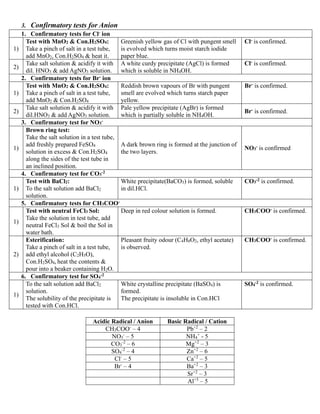
3. Confirmatory tests for Anion
1. Confirmatory tests for Cl- ion
1)
Test with MnO2 & Con.H2SO4:
Take a pinch of salt in a test tube,
add MnO2, Con.H2SO4 & heat it.
Greenish yellow gas of Cl with pungent smell
is evolved which turns moist starch iodide
paper blue.
Cl- is confirmed.
2)
Take salt solution & acidify it with
dil. HNO3 & add AgNO3 solution.
A white curdy precipitate (AgCl) is formed
which is soluble in NH4OH.
Cl- is confirmed.
2. Confirmatory tests for Br- ion
1)
Test with MnO2 & Con.H2SO4:
Take a pinch of salt in a test tube,
add MnO2 & Con.H2SO4
Reddish brown vapours of Br with pungent
smell are evolved which turns starch paper
yellow.
Br- is confirmed.
2)
Take salt solution & acidify it with
dil.HNO3 & add AgNO3 solution.
Pale yellow precipitate (AgBr) is formed
which is partially soluble in NH4OH.
Br- is confirmed.
3. Confirmatory test for NO3
-
1)
Brown ring test:
Take the salt solution in a test tube,
add freshly prepared FeSO4
solution in excess & Con.H2SO4
along the sides of the test tube in
an inclined position.
A dark brown ring is formed at the junction of
the two layers.
NO3
- is confirmed
4. Confirmatory test for CO3
-2
1)
Test with BaCl2:
To the salt solution add BaCl2
solution.
White precipitate(BaCO3) is formed, soluble
in dil.HCl.
CO3
-2 is confirmed.
5. Confirmatory tests for CH3COO-
1)
Test with neutral FeCl3 Sol:
Take the solution in test tube, add
neutral FeCl3 Sol & boil the Sol in
water bath.
Deep in red colour solution is formed. CH3COO- is confirmed.
2)
Esterification:
Take a pinch of salt in a test tube,
add ethyl alcohol (C2H5O),
Con.H2SO4, heat the contents &
pour into a beaker containing H2O.
Pleasant fruity odour (C4H8O2, ethyl acetate)
is observed.
CH3COO- is confirmed.
6. Confirmatory test for SO4
-2
1)
To the salt solution add BaCl2
solution.
The solubility of the precipitate is
tested with Con.HCl.
White crystalline precipitate (BaSO4) is
formed.
The precipitate is insoluble in Con.HCl
SO4
-2 is confirmed.
Acidic Radical / Anion Basic Radical / Cation
CH3COO-
– 4 Pb+2
– 2
NO3
-
– 5 NH4
+
- 5
CO3
-2
– 6 Mg+2
– 3
SO4
-2
– 4 Zn+2
– 6
Cl-
– 5 Ca+2
– 5
Br-
– 4 Ba+2
– 3
Sr+2
– 3
Al+3
– 5
4. Identification of Cation
1)
Analysis of NH4
+
:
Take a small quantity of salt in a test tube,
add NaOH & heat it.
Colourless gas with characteristic NH4
+
smell
is evolved, which gives dense white fumes
when a glass rod dipped in Con.HCl is
brought near the mouth of the test tube.
NH4
+
may be present.
❖ Preparation of Original solution
1) The salt is dissolved in H2O or dil.HCl solvent. Clear & transparent solution is formed. It is Original solution(O.S).
❖ Analysis of Cation groups
1. Analysis of Group – I
1) To the O.S add dil.HCl. White precipitate is formed. Group-I (Pb+2
) is present
2. Analysis of Group – II
1) To the O.S add dil.HCl and pass H2S gas. Black precipitate is formed. Group-II (Cu+2
) is present
3. Analysis of Group – III
1) To the O.S add solid NH4Cl, excess of NH4OH.
White gelatinous precipitate is formed. Group-III (Al+3
) is present.
Light green precipitate is formed. Group-III (Fe+3
) is present.
4. Analysis of Group – IV
1)
To the O.S add solid NH4Cl, excess of NH4OH
and pass H2S gas.
Flesh Coloured precipitate is formed. Group-IV (Mn+2
) is present.
Black precipitate is formed. Group-IV (Ni+2
) is present.
Dull White precipitate is formed. Group-IV (Zn+2
) is present.
5. Analysis of Group – V
1)
To the O.S add solid NH4Cl, excess of NH4OH
& (NH4)2CO3 solution.
White precipitate is formed.
Group - V (Ba+2
, Ca+2
, Sr+2
) is
present.
5. Confirmatory tests for Cation
1. Confirmatory test for NH4
+
1)
To the salt solution add Nessler’s reagent
(K2[HgI4] /Potassium mercuric iodide).
Reddish brown precipitate (NH2HgOHgI, Iodide of
Millon’s base) is formed.
NH4
+
is confirmed.
2. Confirmatory tests for Pb+2
[Group-I]
1)
Dissolve the white precipitate in hot water
& divide it into two parts.
2)
i) To the 1st
part add K2CrO4 solution.
Yellow precipitate is formed which dissolves in
NaOH solution.
Pb+2
is confirmed.
ii) To the 2nd
part add KI solution.
Yellow precipitate is formed which dissolves in hot
water & on cooling the solution forms golden
spangles.
Pb+2
is confirmed.
3. Confirmatory test for Al+3
[Group –III]
1) To the O.S add NaOH solution.
White gelatinous precipitate is formed, which is
soluble in excess of NaOH.
Al+3
is confirmed.
4. Confirmatory test for Zn+2
[Group –IV]
1) To the O.S add NaOH solution.
White precipitate is formed, which is soluble in
excess of NaOH.
Zn+2
is confirmed.
5. Confirmatory tests for Ba+2
, Ca+2
& Sr+2
[Group -V]
1) To the O.S add K2CrO4 solution.
Yellow precipitate (BaClO4) is formed, which is
soluble in Con.HCl.
Ba+2
is confirmed.
Yellow colour is formed. Ca+2
is confirmed.
2)
To the O.S add (NH4)2SO4 solution & warm
it. Scratch the inner sides of the test tube
with a glass rod.
White precipitate is formed. Sr+2
is confirmed.
6. Confirmatory test for Mg+2
[Group –VI]
1) To the O.S add NH4Cl, NH4OH & Na2PO4. White precipitate is formed. Mg+2
is confirmed.
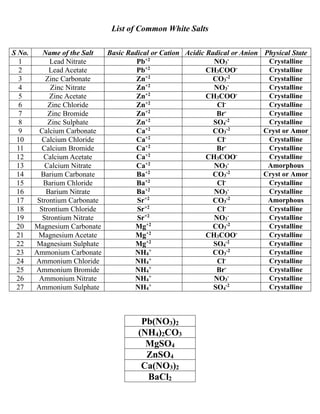
List of Common White Salts
S No. Name of the Salt Basic Radical or Cation Acidic Radical or Anion Physical State
1 Lead Nitrate Pb+2
NO3
-
Crystalline
2 Lead Acetate Pb+2
CH3COO-
Crystalline
3 Zinc Carbonate Zn+2
CO3
-2
Crystalline
4 Zinc Nitrate Zn+2
NO3
-
Crystalline
5 Zinc Acetate Zn+2
CH3COO-
Crystalline
6 Zinc Chloride Zn+2
Cl-
Crystalline
7 Zinc Bromide Zn+2
Br-
Crystalline
8 Zinc Sulphate Zn+2
SO4
-2
Crystalline
9 Calcium Carbonate Ca+2
CO3
-2
Cryst or Amor
10 Calcium Chloride Ca+2
Cl-
Crystalline
11 Calcium Bromide Ca+2
Br-
Crystalline
12 Calcium Acetate Ca+2
CH3COO-
Crystalline
13 Calcium Nitrate Ca+2
NO3
-
Amorphous
14 Barium Carbonate Ba+2
CO3
-2
Cryst or Amor
15 Barium Chloride Ba+2
Cl-
Crystalline
16 Barium Nitrate Ba+2
NO3
-
Crystalline
17 Strontium Carbonate Sr+2
CO3
-2
Amorphous
18 Strontium Chloride Sr+2
Cl-
Crystalline
19 Strontium Nitrate Sr+2
NO3
-
Crystalline
20 Magnesium Carbonate Mg+2
CO3
-2
Crystalline
21 Magnesium Acetate Mg+2
CH3COO-
Crystalline
22 Magnesium Sulphate Mg+2
SO4
-2
Crystalline
23 Ammonium Carbonate NH4
+
CO3
-2
Crystalline
24 Ammonium Chloride NH4
+
Cl-
Crystalline
25 Ammonium Bromide NH4
+
Br-
Crystalline
26 Ammonium Nitrate NH4
+
NO3
-
Crystalline
27 Ammonium Sulphate NH4
+
SO4
-2
Crystalline
Pb(NO3)2
(NH4)2CO3
MgSO4
ZnSO4
Ca(NO3)2
BaCl2

Salt Analysis 2.0.pdf

  • 1.
    Salt Analysis S.no ExperimentObservation Inference 1. Preliminary Tests 1) Colour: Blue or Bluish green, Light Green, Light pink, Greenish, Pink. May be Cu+2, Fe+2, Mn+2, Ni+2, Co+2 Salts. Colourless Absence of the above salts. 2) Physical state: Crystalline / Amorphous - 3) Action of heat: A pinch of salt is taken in a dry test tube & heated strongly. White sublimate is formed. May be NH4 + salt. Reddish brown vapours are evolved. May be NO3 - salt. Crackling sound is observed. May be Pb+2 salt. Characteristic vinegar like smell. May be CH3COO- salt. Yellow when hot & white when cold. May be Zn+2 salt. Water drops are formed along the inner walls of the test tube. May be hydrated salt. 4) Flame test: A paste of salt with Con.HCl is prepared & put on top of the flame. i) Brick red flame May be Ca+2 salt. ii) Apple green flame May be Ba+2 salt. iii) Crimson red flame May be Sr+2 salt. iv) Green flashes May be Zn+2 salt. v) Dull Bluish White May be Pb+2 salt. No characteristic flame is observed. Absence of the above salts. 2. Identification of Anion 1) Test with dil.HCl: A pinch of salt is taken in a dry test tube & dil.HCl is added to it. i) Colourless & Odourless gas of CO2 is evolved with brisk effervescence which puts out flame & turns lime water milky. CO3 -2 may be present. ii) Colourless vapours of CH3COOH with vinegar smell are evolved, which turns blue litmus red. CH3COO- may be present. No characteristic reaction was observed. CO3 -2 & CH3COO- (Absent) 2) Test with Con.H2SO4: Take a small quantity of salt in a dry test tube & add Con.H2SO4. i) Colourless gas with pungent smell (HCl) is evolved. It produced white dense fumes when a glass rod dipped in NH4OH is placed at the mouth of the test tube. Cl- may be present. ii) Reddish brown vapours with pungent smell (Br2) are evolved. Br- may be present. No characteristic reaction is observed. Cl- & Br- are absent. 3) Test with BaCl2: To the salt solution add BaCl2 solution. White crystalline precipitate (BaSO4) is formed. SO4 -2 may be present. No precipitate is formed. SO4 -2 is absent. 4) Test with Con.H2SO4 [Hot Condition]: Take a small quantity of the salt in a test tube, add Con.H2SO4 & heat it. Reddish brown vapours of NO2 are evolved. NO3 - may be present. Reddish brown vapours of NO2 are not evolved. NO3 - is absent. Test with Copper turnings & Con H2SO4: Take a small quantity of the salt in a test tube, add Copper turnings, Con. H2SO4 & heat it strongly. Deep reddish brown vapours of NO2 are evolved & the solution turns pale blue. NO3 - may be present. No reddish brown vapours are evolved. NO3 - is absent.
  • 2.
    3. Confirmatory testsfor Anion 1. Confirmatory tests for Cl- ion 1) Test with MnO2 & Con.H2SO4: Take a pinch of salt in a test tube, add MnO2, Con.H2SO4 & heat it. Greenish yellow gas of Cl with pungent smell is evolved which turns moist starch iodide paper blue. Cl- is confirmed. 2) Take salt solution & acidify it with dil. HNO3 & add AgNO3 solution. A white curdy precipitate (AgCl) is formed which is soluble in NH4OH. Cl- is confirmed. 2. Confirmatory tests for Br- ion 1) Test with MnO2 & Con.H2SO4: Take a pinch of salt in a test tube, add MnO2 & Con.H2SO4 Reddish brown vapours of Br with pungent smell are evolved which turns starch paper yellow. Br- is confirmed. 2) Take salt solution & acidify it with dil.HNO3 & add AgNO3 solution. Pale yellow precipitate (AgBr) is formed which is partially soluble in NH4OH. Br- is confirmed. 3. Confirmatory test for NO3 - 1) Brown ring test: Take the salt solution in a test tube, add freshly prepared FeSO4 solution in excess & Con.H2SO4 along the sides of the test tube in an inclined position. A dark brown ring is formed at the junction of the two layers. NO3 - is confirmed 4. Confirmatory test for CO3 -2 1) Test with BaCl2: To the salt solution add BaCl2 solution. White precipitate(BaCO3) is formed, soluble in dil.HCl. CO3 -2 is confirmed. 5. Confirmatory tests for CH3COO- 1) Test with neutral FeCl3 Sol: Take the solution in test tube, add neutral FeCl3 Sol & boil the Sol in water bath. Deep in red colour solution is formed. CH3COO- is confirmed. 2) Esterification: Take a pinch of salt in a test tube, add ethyl alcohol (C2H5O), Con.H2SO4, heat the contents & pour into a beaker containing H2O. Pleasant fruity odour (C4H8O2, ethyl acetate) is observed. CH3COO- is confirmed. 6. Confirmatory test for SO4 -2 1) To the salt solution add BaCl2 solution. The solubility of the precipitate is tested with Con.HCl. White crystalline precipitate (BaSO4) is formed. The precipitate is insoluble in Con.HCl SO4 -2 is confirmed. Acidic Radical / Anion Basic Radical / Cation CH3COO- – 4 Pb+2 – 2 NO3 - – 5 NH4 + - 5 CO3 -2 – 6 Mg+2 – 3 SO4 -2 – 4 Zn+2 – 6 Cl- – 5 Ca+2 – 5 Br- – 4 Ba+2 – 3 Sr+2 – 3 Al+3 – 5
  • 3.
    4. Identification ofCation 1) Analysis of NH4 + : Take a small quantity of salt in a test tube, add NaOH & heat it. Colourless gas with characteristic NH4 + smell is evolved, which gives dense white fumes when a glass rod dipped in Con.HCl is brought near the mouth of the test tube. NH4 + may be present. ❖ Preparation of Original solution 1) The salt is dissolved in H2O or dil.HCl solvent. Clear & transparent solution is formed. It is Original solution(O.S). ❖ Analysis of Cation groups 1. Analysis of Group – I 1) To the O.S add dil.HCl. White precipitate is formed. Group-I (Pb+2 ) is present 2. Analysis of Group – II 1) To the O.S add dil.HCl and pass H2S gas. Black precipitate is formed. Group-II (Cu+2 ) is present 3. Analysis of Group – III 1) To the O.S add solid NH4Cl, excess of NH4OH. White gelatinous precipitate is formed. Group-III (Al+3 ) is present. Light green precipitate is formed. Group-III (Fe+3 ) is present. 4. Analysis of Group – IV 1) To the O.S add solid NH4Cl, excess of NH4OH and pass H2S gas. Flesh Coloured precipitate is formed. Group-IV (Mn+2 ) is present. Black precipitate is formed. Group-IV (Ni+2 ) is present. Dull White precipitate is formed. Group-IV (Zn+2 ) is present. 5. Analysis of Group – V 1) To the O.S add solid NH4Cl, excess of NH4OH & (NH4)2CO3 solution. White precipitate is formed. Group - V (Ba+2 , Ca+2 , Sr+2 ) is present. 5. Confirmatory tests for Cation 1. Confirmatory test for NH4 + 1) To the salt solution add Nessler’s reagent (K2[HgI4] /Potassium mercuric iodide). Reddish brown precipitate (NH2HgOHgI, Iodide of Millon’s base) is formed. NH4 + is confirmed. 2. Confirmatory tests for Pb+2 [Group-I] 1) Dissolve the white precipitate in hot water & divide it into two parts. 2) i) To the 1st part add K2CrO4 solution. Yellow precipitate is formed which dissolves in NaOH solution. Pb+2 is confirmed. ii) To the 2nd part add KI solution. Yellow precipitate is formed which dissolves in hot water & on cooling the solution forms golden spangles. Pb+2 is confirmed. 3. Confirmatory test for Al+3 [Group –III] 1) To the O.S add NaOH solution. White gelatinous precipitate is formed, which is soluble in excess of NaOH. Al+3 is confirmed. 4. Confirmatory test for Zn+2 [Group –IV] 1) To the O.S add NaOH solution. White precipitate is formed, which is soluble in excess of NaOH. Zn+2 is confirmed. 5. Confirmatory tests for Ba+2 , Ca+2 & Sr+2 [Group -V] 1) To the O.S add K2CrO4 solution. Yellow precipitate (BaClO4) is formed, which is soluble in Con.HCl. Ba+2 is confirmed. Yellow colour is formed. Ca+2 is confirmed. 2) To the O.S add (NH4)2SO4 solution & warm it. Scratch the inner sides of the test tube with a glass rod. White precipitate is formed. Sr+2 is confirmed. 6. Confirmatory test for Mg+2 [Group –VI] 1) To the O.S add NH4Cl, NH4OH & Na2PO4. White precipitate is formed. Mg+2 is confirmed.
  • 4.
    List of CommonWhite Salts S No. Name of the Salt Basic Radical or Cation Acidic Radical or Anion Physical State 1 Lead Nitrate Pb+2 NO3 - Crystalline 2 Lead Acetate Pb+2 CH3COO- Crystalline 3 Zinc Carbonate Zn+2 CO3 -2 Crystalline 4 Zinc Nitrate Zn+2 NO3 - Crystalline 5 Zinc Acetate Zn+2 CH3COO- Crystalline 6 Zinc Chloride Zn+2 Cl- Crystalline 7 Zinc Bromide Zn+2 Br- Crystalline 8 Zinc Sulphate Zn+2 SO4 -2 Crystalline 9 Calcium Carbonate Ca+2 CO3 -2 Cryst or Amor 10 Calcium Chloride Ca+2 Cl- Crystalline 11 Calcium Bromide Ca+2 Br- Crystalline 12 Calcium Acetate Ca+2 CH3COO- Crystalline 13 Calcium Nitrate Ca+2 NO3 - Amorphous 14 Barium Carbonate Ba+2 CO3 -2 Cryst or Amor 15 Barium Chloride Ba+2 Cl- Crystalline 16 Barium Nitrate Ba+2 NO3 - Crystalline 17 Strontium Carbonate Sr+2 CO3 -2 Amorphous 18 Strontium Chloride Sr+2 Cl- Crystalline 19 Strontium Nitrate Sr+2 NO3 - Crystalline 20 Magnesium Carbonate Mg+2 CO3 -2 Crystalline 21 Magnesium Acetate Mg+2 CH3COO- Crystalline 22 Magnesium Sulphate Mg+2 SO4 -2 Crystalline 23 Ammonium Carbonate NH4 + CO3 -2 Crystalline 24 Ammonium Chloride NH4 + Cl- Crystalline 25 Ammonium Bromide NH4 + Br- Crystalline 26 Ammonium Nitrate NH4 + NO3 - Crystalline 27 Ammonium Sulphate NH4 + SO4 -2 Crystalline Pb(NO3)2 (NH4)2CO3 MgSO4 ZnSO4 Ca(NO3)2 BaCl2