GURU GOBIND SINGH COLLEGE OPF PHARMACY
Quality By Design
Presented To: Presented By:
Dr. Rameshwar Prabhjot Kaur
Associate Professor M. Pharmacy
(2nd semester)
M-507
TABLE OF CONTENT
• Introduction
• ICH Q8 Guidlines
• Regulatory and industry
veiws on QbD
• Scientifically based QbD
and Applications
• References
The concept of QbD was mentioned in the ICH Q8 guideline, which
states that “quality cannot be tested into products, i.e., quality should be
built in by design”.
According to ICH Q8 QbD is defined as A systematic approach to
development that begins with predefined objectives and emphasizes
product and process understanding and process control, based on sound
science and quality risk management.
QbD encompasses designing and developing formulations and
manufacturing processes which ensures predefined product
specifications.
Introduction
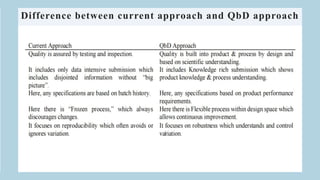
Difference between current approach and QbD approach
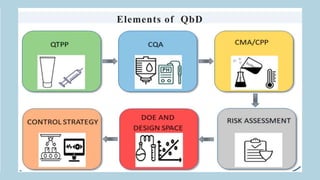
Elements of QbD
• Harmonisation : It is the act of making something consistent.
• The International Conference on Harmonisation of Technical Requirements
for Registration of Pharmaceuticals for Human Use is a joint initiative
established in 1990 involving both regulatory agencies and research -
based industry representatives of the European Union, Japan, and the
United States.
• ICH operates through the ICH Steering Committee with administrative
support from the ICH Secretariat and ICH Coordinators.
• The topics identified for harmonisation by the ICH Steering Committee are
elected from Safety, Quality, Efficacy, and Multidisciplinary matters of a
pharmaceutical drug product
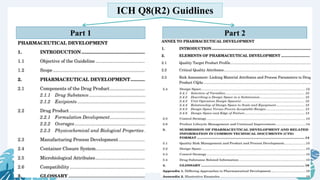
ICH Q8(R2) Guidlines
• ICH Q8 guidelines represent Good Practices for Pharmaceutical Product
Development.
• These guidlines describes the principles of QbD, outlines the key elements,
and provides illustrative examples for pharmaceutical drug products.
• It is often emphasized that the QUALITY of a pharmaceutical product
should be BUILT IN BY DESIGN RATHER THAN BY TESTING ALONE.
• These guidlines suggests that the aspects of drug substances, excipients,
container closure systems, and manufacturing processes that are critical to
product quality, should be DETERMINED AND CONTROL STRATEGIES
justified.
• Current Step 4 version; dated August 2009
• Some of the tools that should be applied during the design space
appointment include experimental designs, PAT,prior knowledge, quality
risk management principles,etc.
• PAT(Process Analytical Technology) is a system for designing, analyzing,
and controlling manufacturing through timely measurements (i.e. during
processing) of critical quality and performance attributes of raw and in-
process materials and processes with the goal of ensuring final product
quality.
• Pfizer was one of the first companies to implement QbD and PAT
concepts.
History of ICH Q8(R2) Guidlines
ICH Q8(R2) Guidlines
Part 1 Part 2
Contents for 3.2.P.2 of CTD Quality Module 38
1.Components of drug product (drug substance/ excipients)
2. Formulation Development
3. Manufacturing Process Development
4. Container Closure System
5. MicrobiologicalAttributes
6. Compatibility
COMPONENTS OF DRUG PRODUCT GIVEN BY ICH Q8
A. DRUG SUBSTANCES
“The physicochemical and biological properties of the drug substance that
can influence the performance of the drug product and its
manufacturability.” Examples of physicochemical and biological properties
that might need to be examined include- Solubility,Water content,Particle
size,Crystal properties,Biological activity,Permeability.
B. EXCIPIENTS
The excipients chosen, their concentration, and the characteristics that can
influence the drug product performance or manufacturability should be
discussed relative to the respective function of each excipients. The
compatibility of the drug substance with excipients should be evaluated. For
products that contain more than one drug substance, the compatibility of the
drug substances with each other should also be evaluated.
C. FORMULATION DEVELOPMENT
•A summary should be provided describing the development of the
formulation, including identification of those attributes that are critical to
the quality of thedrug product and also highlight the evolution of the
formulation design from initial concept up to the final design.
•Information from comparative in vitro studies (e.g., dissolution) or
comparative in vivo studies (e.g., BE) that links clinical formulations to the
proposed commercial formulation.
•A successful correlation can assist in the selection of appropriate
dissolution acceptance criteria, and can potentially reduce the need for
further bioequivalence studies following changes to the product or its
manufacturing process.
D. CONTAINER AND CLOSURE SYSTEM
• The choice for selection of the container closure system for the
commercial product should be discussed.
• The choice of materials for primary packaging and secondary packaging
should be justified.
• A possible interaction between product and container or label should be
considered.
E. MICROBIOLOGICAL ATTRIBUTES
• The selection and effectiveness of preservative systems in products
containing antimicrobial preservative or the antimicrobial effectiveness of
products that are inherently antimicrobial.
• For sterile products, the integrity of the container closure system as it
relatesto preventing microbial contamination.
• The lowest specified concentration of antimicrobial preservative should be
justified in terms of efficacy and safety, such that the minimum
concentration of preservative that gives the required level of efficacy
throughout the intended shelf life of the product is used.
F. COMPATIBILITY
• The compatibility of the drug product with reconstitution diluents (e.g.,
precipitation, stability) should be addressed to provide appropriate and
supportive information for the labelling.
• This information should cover the recommended in-use shelf life, at the
recommended storage temperature and at the likely extremes of
concentration. Similarly, admixture or dilution of products prior to
administration (e.g.,product added to large volume infusion containers)
might need to be addressed.
• Quality by Design (QbD) is one of the most important initiatives by US
FDA. “Pharmaceutical Quality for the 21st Century: A Risk- Based
Approach in 2002 by FDA was the first step towards this goal of QbD
compliance.
• Since the introduction of Quality-by-Design (QbD) concepts, it has been
accepted that quality of pharmaceutical products should be designed and
built during the manufacturing process.
• Most of quality problems are related to the way in which a pharmaceutical
product was designed
Regulatory and industry veiws on QbD
• A poor-designed pharmaceutical product will show poor safety and
efficacy, no matter how many tests or analyses have been done to verify its
quality.
• Thus, QbD begins with the recognition that quality will not be improved
by merely increasing testing of pharmaceutical products. In other words,
quality must be built into the product.
• QbD concept can lead to cost savings and efficiency improvements for
both industry and regulators.
• Advantages of QbD to the Generic Industry
• Better understanding of the process and the product.
• Minimum batch failures.
• Better understanding of risks involved & mitigation.
• Minimising variations to achieve consistency in manufacturing quality.
• Regulatory Agencies like EMA also initiated the QbD concepts
implementation.
• EU has also released a document for “Real Time Release”. The European
Medicines Agency (EMA) welcomes applications that include quality by
design.
• Quality by design is an approach that aims to ensure the quality of
medicines by employing statistical, analytical and risk-management
methodology in the design, development and manufacturing of medicines.
• EMA, FDA, and ICH working groups have appointed the ICH quality
implementation working group (Q-IWG), which prepared various
templates, workshop training materials, questions and answers, as well as a
points- to- consider document (issued in 2011) that covers ICH Q8(R2),
ICH Q9, and ICH Q10 guidelines.
• In a QbD context, the model is defined as a simplified representation of a
system using mathematical terms. Models are expected to enhance
scientific understanding and possibly predict the behavior of a system
under a set of conditions. ICH QIWG document classifies the models
according to their relative contribution in assuring the quality of a product
and the following is an example of such a categorization:
• Low-Impact Models: These models are typically used to support product
and/or process development (e.g., formulation optimization).
• Medium-Impact Models: Such models can be useful in assuring quality of
the product but are not the sole indicators of product quality (e.g., most
design space models, many in-process controls).
• High-Impact Models: A model can be considered high impact if
prediction from the model is a significant indicator of quality of the
product (e.g., a chemometric model for product assay, a surrogate model
for dissolution).
• Development and implementation of models include definition of the
model purpose, decision on the type of modeling approach (e.g.
mechanistic or empirical), selection of variables for the model,
understanding of the model assumptions limitations, collection of
experimental data, development of model equations and parameters
estimation, model validation, and documentation of the outcome of the
model development.
• The ICH Q-IWG document also suggests that a design space can be
updated over the product lifecycle, as additional knowledge is gained. It
also notes that in development of design spaces for existing products,
multivariate models can be used for retrospective evaluation of the
production data.
• Joint efforts of EMA and FDA resulted in a pilot program for parallel
assessment of QbD applications in 2011 and discussed the following topic
such as
• Level of detail in QbD containing applications
• ⇒ Verification of models for real time release testing (RTRT) and in-
process Near Infrared (NIR) spectroscopy analytical methods
• ⇒ Strategies for scale-up and verification of design space
• ⇒ Post approval change protocols
• ⇒ Large sample size acceptance criteria
• The services of the QbD concept for both industry and regulatory bodies
are summarized as below.
Industry
• Development of scientific understanding of critical process and product
attributes.
• Controls and testing are designed based on limits of scientific
understanding at development stage.
• Utilization of knowledge gained over the product’s lifecycle for
continuous improvement.
Regulatory agency
• Scientifically based assessment of product and manufacturing process
design and development.
• Evaluation and approval of product quality specifications in light of
established standards (e.g. purity, stability, content uniformity, etc.).
• Evaluation of post- approval changes based on risk and science.
• Different elements of pharmaceutical development include:
1. Defining Quality target product profile (QTPP)
2. Determination of critical quality attributes (CQA)
3. Risk assessment
4. Development of experimental design
5. Designing and implementing control strategy
6. Continuous improvement.
Scientifically based QbD and Applications
• Different elements of pharmaceutical development include:
1. Defining Quality target product profile (QTPP)
2. Determination of critical quality attributes (CQA)
3. Risk assessment
4. Development of experimental design
5. Designing and implementing control strategy
6. Continuous improvement
Scientifically based QbD and Applications
• Some of the issues encountered by the regulatory agencies during the assessment
of a QbD based registration dossier are lack of relevant explanations of the
conclusions reached, insufficient graphical presentations of the factor
interactions, no information on statistical validity of models, and not enough
structure in the presented data.
• Collaboration between scientists in industry, academia, and regulatory bodies
experts is necessary to overcome the above mentioned issues.
• Many scientific projects are devoted to design experimental space, in-line
process monitoring, and modeling of products and processes.
• This knowledge should serve to provide a foundation for the scientifically based
QbD concept application.
Scientifically based QbD and Applications
• The QbD approach was used to establish a relationship between the CPPs,
CQAs, and clinical performance of the drug.
1. Extended release theophylline tablets were analyzed, showing that some of the
compendial tests are insufficient to communicate the therapeutic consequences of
product variability. A combined QbD and Discrete Element Model (DEM)
simulation approach was used to characterize a blending unit operation, by
evaluating the impact of formulation parameters and process variables on the
blending quality and blending end point. QbD was used to establish content
uniformity as CQA and homogeneity, to identify potential critical factors that affect
blending operation quality.
2. Experimental design was used to establish the design space, resulting in a robust
liposome preparation process. QbD principles were applied to an existing industrial
fluidized bed granulation process. Process analytical technology (PAT) monitoring
tools were implemented at the industrial scale process to increase the process
knowledge. Scaled- down designed experiments were conducted at a pilot scale to
investigate the process under changes in CPPs. Finally, design space was defined,
linking CPPs to CQAs within which product quality is ensured by design, and after
scale- up, enabling its use at the industrial process scale.
3. The QbD approach was used in the formulation of dispersible tablets.
rcise.
4. QbD principles were used to investigate the spray drying process of insulin
intended for pulmonary administration. The effects of process and formulation
parameters on particle characteristics and insulin integrity were investigated.
5. A multiparticulate system, designed for colon- specific delivery of celecoxib for
both systemic and local therapy, was developed using QbD principles. Statistical
experimental design (Doehlert design) was employed to investigate the combined
effect of four formulation variables on drug loading and release rate.
6.A QbD approach was also used to study the process of a nanosuspension
preparation, to establish appropriate specifications for highly correlated active
substance properties, to develop analytical methods, and its usage in lead drug
candidates optimization is proposed to address productivity in drug discovery.
Application Description QbD Principles Applied
Virtual Screening Designing virtual screening workflows with well-defined methods and
parameters.
Robustness, Risk Assessment
Molecular Docking Optimizing molecular docking protocols for target-ligand interactions. Parameter Design, Risk
Assessment
Pharmacophore Modeling Developing pharmacophore models with defined key features for ligand
binding.
Design Space, Robustness
QSAR Modeling Optimizing QSAR model development, including feature selection and
validation.
Design Space, Risk
Assessment
Machine Learning in
Drug Discovery
Optimizing machine learning models for drug discovery applications. Parameter Design, Robustness
Lead Optimization Applying QbD principles to optimize lead compounds for improved potency,
selectivity, and pharmacokinetic properties.
Design Space, Risk
Assessment
ADME-Tox Prediction Using QbD to develop models for predicting ADME-Tox properties. Parameter Design, Robustness
Fragment-Based Drug
Design
Applying QbD to fragment-based drug design approaches for efficient
identification of lead compounds.
Parameter Design, Design
Space
Structure-Based Drug
Design
Using QbD to guide structure-based drug design, ensuring that the structure-
activity relationships are well-understood and optimized.
Risk Assessment, Robustness
Chemical Synthesis
Optimization
Optimizing chemical synthesis routes using QbD principles to ensure
efficiency, scalability, and product quality.
Design Space, Parameter
Design
——
Thank you

Quality-by-Design In Pharmaceutical Development

  • 1.
    GURU GOBIND SINGHCOLLEGE OPF PHARMACY Quality By Design Presented To: Presented By: Dr. Rameshwar Prabhjot Kaur Associate Professor M. Pharmacy (2nd semester) M-507
  • 2.
    TABLE OF CONTENT •Introduction • ICH Q8 Guidlines • Regulatory and industry veiws on QbD • Scientifically based QbD and Applications • References
  • 3.
    The concept ofQbD was mentioned in the ICH Q8 guideline, which states that “quality cannot be tested into products, i.e., quality should be built in by design”. According to ICH Q8 QbD is defined as A systematic approach to development that begins with predefined objectives and emphasizes product and process understanding and process control, based on sound science and quality risk management. QbD encompasses designing and developing formulations and manufacturing processes which ensures predefined product specifications. Introduction
  • 4.
    Difference between currentapproach and QbD approach
  • 5.
  • 6.
    • Harmonisation :It is the act of making something consistent. • The International Conference on Harmonisation of Technical Requirements for Registration of Pharmaceuticals for Human Use is a joint initiative established in 1990 involving both regulatory agencies and research - based industry representatives of the European Union, Japan, and the United States. • ICH operates through the ICH Steering Committee with administrative support from the ICH Secretariat and ICH Coordinators. • The topics identified for harmonisation by the ICH Steering Committee are elected from Safety, Quality, Efficacy, and Multidisciplinary matters of a pharmaceutical drug product ICH Q8(R2) Guidlines
  • 7.
    • ICH Q8guidelines represent Good Practices for Pharmaceutical Product Development. • These guidlines describes the principles of QbD, outlines the key elements, and provides illustrative examples for pharmaceutical drug products. • It is often emphasized that the QUALITY of a pharmaceutical product should be BUILT IN BY DESIGN RATHER THAN BY TESTING ALONE. • These guidlines suggests that the aspects of drug substances, excipients, container closure systems, and manufacturing processes that are critical to product quality, should be DETERMINED AND CONTROL STRATEGIES justified. • Current Step 4 version; dated August 2009
  • 8.
    • Some ofthe tools that should be applied during the design space appointment include experimental designs, PAT,prior knowledge, quality risk management principles,etc. • PAT(Process Analytical Technology) is a system for designing, analyzing, and controlling manufacturing through timely measurements (i.e. during processing) of critical quality and performance attributes of raw and in- process materials and processes with the goal of ensuring final product quality. • Pfizer was one of the first companies to implement QbD and PAT concepts.
  • 9.
    History of ICHQ8(R2) Guidlines
  • 11.
  • 12.
    Contents for 3.2.P.2of CTD Quality Module 38 1.Components of drug product (drug substance/ excipients) 2. Formulation Development 3. Manufacturing Process Development 4. Container Closure System 5. MicrobiologicalAttributes 6. Compatibility
  • 13.
    COMPONENTS OF DRUGPRODUCT GIVEN BY ICH Q8 A. DRUG SUBSTANCES “The physicochemical and biological properties of the drug substance that can influence the performance of the drug product and its manufacturability.” Examples of physicochemical and biological properties that might need to be examined include- Solubility,Water content,Particle size,Crystal properties,Biological activity,Permeability. B. EXCIPIENTS The excipients chosen, their concentration, and the characteristics that can influence the drug product performance or manufacturability should be discussed relative to the respective function of each excipients. The compatibility of the drug substance with excipients should be evaluated. For products that contain more than one drug substance, the compatibility of the drug substances with each other should also be evaluated.
  • 14.
    C. FORMULATION DEVELOPMENT •Asummary should be provided describing the development of the formulation, including identification of those attributes that are critical to the quality of thedrug product and also highlight the evolution of the formulation design from initial concept up to the final design. •Information from comparative in vitro studies (e.g., dissolution) or comparative in vivo studies (e.g., BE) that links clinical formulations to the proposed commercial formulation. •A successful correlation can assist in the selection of appropriate dissolution acceptance criteria, and can potentially reduce the need for further bioequivalence studies following changes to the product or its manufacturing process.
  • 15.
    D. CONTAINER ANDCLOSURE SYSTEM • The choice for selection of the container closure system for the commercial product should be discussed. • The choice of materials for primary packaging and secondary packaging should be justified. • A possible interaction between product and container or label should be considered.
  • 16.
    E. MICROBIOLOGICAL ATTRIBUTES •The selection and effectiveness of preservative systems in products containing antimicrobial preservative or the antimicrobial effectiveness of products that are inherently antimicrobial. • For sterile products, the integrity of the container closure system as it relatesto preventing microbial contamination. • The lowest specified concentration of antimicrobial preservative should be justified in terms of efficacy and safety, such that the minimum concentration of preservative that gives the required level of efficacy throughout the intended shelf life of the product is used.
  • 17.
    F. COMPATIBILITY • Thecompatibility of the drug product with reconstitution diluents (e.g., precipitation, stability) should be addressed to provide appropriate and supportive information for the labelling. • This information should cover the recommended in-use shelf life, at the recommended storage temperature and at the likely extremes of concentration. Similarly, admixture or dilution of products prior to administration (e.g.,product added to large volume infusion containers) might need to be addressed.
  • 18.
    • Quality byDesign (QbD) is one of the most important initiatives by US FDA. “Pharmaceutical Quality for the 21st Century: A Risk- Based Approach in 2002 by FDA was the first step towards this goal of QbD compliance. • Since the introduction of Quality-by-Design (QbD) concepts, it has been accepted that quality of pharmaceutical products should be designed and built during the manufacturing process. • Most of quality problems are related to the way in which a pharmaceutical product was designed Regulatory and industry veiws on QbD
  • 19.
    • A poor-designedpharmaceutical product will show poor safety and efficacy, no matter how many tests or analyses have been done to verify its quality. • Thus, QbD begins with the recognition that quality will not be improved by merely increasing testing of pharmaceutical products. In other words, quality must be built into the product. • QbD concept can lead to cost savings and efficiency improvements for both industry and regulators. • Advantages of QbD to the Generic Industry • Better understanding of the process and the product. • Minimum batch failures. • Better understanding of risks involved & mitigation. • Minimising variations to achieve consistency in manufacturing quality.
  • 20.
    • Regulatory Agencieslike EMA also initiated the QbD concepts implementation. • EU has also released a document for “Real Time Release”. The European Medicines Agency (EMA) welcomes applications that include quality by design. • Quality by design is an approach that aims to ensure the quality of medicines by employing statistical, analytical and risk-management methodology in the design, development and manufacturing of medicines. • EMA, FDA, and ICH working groups have appointed the ICH quality implementation working group (Q-IWG), which prepared various templates, workshop training materials, questions and answers, as well as a points- to- consider document (issued in 2011) that covers ICH Q8(R2), ICH Q9, and ICH Q10 guidelines.
  • 21.
    • In aQbD context, the model is defined as a simplified representation of a system using mathematical terms. Models are expected to enhance scientific understanding and possibly predict the behavior of a system under a set of conditions. ICH QIWG document classifies the models according to their relative contribution in assuring the quality of a product and the following is an example of such a categorization: • Low-Impact Models: These models are typically used to support product and/or process development (e.g., formulation optimization). • Medium-Impact Models: Such models can be useful in assuring quality of the product but are not the sole indicators of product quality (e.g., most design space models, many in-process controls). • High-Impact Models: A model can be considered high impact if prediction from the model is a significant indicator of quality of the product (e.g., a chemometric model for product assay, a surrogate model for dissolution).
  • 22.
    • Development andimplementation of models include definition of the model purpose, decision on the type of modeling approach (e.g. mechanistic or empirical), selection of variables for the model, understanding of the model assumptions limitations, collection of experimental data, development of model equations and parameters estimation, model validation, and documentation of the outcome of the model development. • The ICH Q-IWG document also suggests that a design space can be updated over the product lifecycle, as additional knowledge is gained. It also notes that in development of design spaces for existing products, multivariate models can be used for retrospective evaluation of the production data.
  • 23.
    • Joint effortsof EMA and FDA resulted in a pilot program for parallel assessment of QbD applications in 2011 and discussed the following topic such as • Level of detail in QbD containing applications • ⇒ Verification of models for real time release testing (RTRT) and in- process Near Infrared (NIR) spectroscopy analytical methods • ⇒ Strategies for scale-up and verification of design space • ⇒ Post approval change protocols • ⇒ Large sample size acceptance criteria
  • 24.
    • The servicesof the QbD concept for both industry and regulatory bodies are summarized as below. Industry • Development of scientific understanding of critical process and product attributes. • Controls and testing are designed based on limits of scientific understanding at development stage. • Utilization of knowledge gained over the product’s lifecycle for continuous improvement. Regulatory agency • Scientifically based assessment of product and manufacturing process design and development. • Evaluation and approval of product quality specifications in light of established standards (e.g. purity, stability, content uniformity, etc.). • Evaluation of post- approval changes based on risk and science.
  • 25.
    • Different elementsof pharmaceutical development include: 1. Defining Quality target product profile (QTPP) 2. Determination of critical quality attributes (CQA) 3. Risk assessment 4. Development of experimental design 5. Designing and implementing control strategy 6. Continuous improvement. Scientifically based QbD and Applications
  • 26.
    • Different elementsof pharmaceutical development include: 1. Defining Quality target product profile (QTPP) 2. Determination of critical quality attributes (CQA) 3. Risk assessment 4. Development of experimental design 5. Designing and implementing control strategy 6. Continuous improvement Scientifically based QbD and Applications
  • 27.
    Scientifically based QbDand Applications • Some of the issues encountered by the regulatory agencies during the assessment of a QbD based registration dossier are lack of relevant explanations of the conclusions reached, insufficient graphical presentations of the factor interactions, no information on statistical validity of models, and not enough structure in the presented data. • Collaboration between scientists in industry, academia, and regulatory bodies experts is necessary to overcome the above mentioned issues. • Many scientific projects are devoted to design experimental space, in-line process monitoring, and modeling of products and processes. • This knowledge should serve to provide a foundation for the scientifically based QbD concept application.
  • 28.
    Scientifically based QbDand Applications • The QbD approach was used to establish a relationship between the CPPs, CQAs, and clinical performance of the drug. 1. Extended release theophylline tablets were analyzed, showing that some of the compendial tests are insufficient to communicate the therapeutic consequences of product variability. A combined QbD and Discrete Element Model (DEM) simulation approach was used to characterize a blending unit operation, by evaluating the impact of formulation parameters and process variables on the blending quality and blending end point. QbD was used to establish content uniformity as CQA and homogeneity, to identify potential critical factors that affect blending operation quality.
  • 29.
    2. Experimental designwas used to establish the design space, resulting in a robust liposome preparation process. QbD principles were applied to an existing industrial fluidized bed granulation process. Process analytical technology (PAT) monitoring tools were implemented at the industrial scale process to increase the process knowledge. Scaled- down designed experiments were conducted at a pilot scale to investigate the process under changes in CPPs. Finally, design space was defined, linking CPPs to CQAs within which product quality is ensured by design, and after scale- up, enabling its use at the industrial process scale. 3. The QbD approach was used in the formulation of dispersible tablets. rcise. 4. QbD principles were used to investigate the spray drying process of insulin intended for pulmonary administration. The effects of process and formulation parameters on particle characteristics and insulin integrity were investigated.
  • 30.
    5. A multiparticulatesystem, designed for colon- specific delivery of celecoxib for both systemic and local therapy, was developed using QbD principles. Statistical experimental design (Doehlert design) was employed to investigate the combined effect of four formulation variables on drug loading and release rate. 6.A QbD approach was also used to study the process of a nanosuspension preparation, to establish appropriate specifications for highly correlated active substance properties, to develop analytical methods, and its usage in lead drug candidates optimization is proposed to address productivity in drug discovery.
  • 31.
    Application Description QbDPrinciples Applied Virtual Screening Designing virtual screening workflows with well-defined methods and parameters. Robustness, Risk Assessment Molecular Docking Optimizing molecular docking protocols for target-ligand interactions. Parameter Design, Risk Assessment Pharmacophore Modeling Developing pharmacophore models with defined key features for ligand binding. Design Space, Robustness QSAR Modeling Optimizing QSAR model development, including feature selection and validation. Design Space, Risk Assessment Machine Learning in Drug Discovery Optimizing machine learning models for drug discovery applications. Parameter Design, Robustness Lead Optimization Applying QbD principles to optimize lead compounds for improved potency, selectivity, and pharmacokinetic properties. Design Space, Risk Assessment ADME-Tox Prediction Using QbD to develop models for predicting ADME-Tox properties. Parameter Design, Robustness Fragment-Based Drug Design Applying QbD to fragment-based drug design approaches for efficient identification of lead compounds. Parameter Design, Design Space Structure-Based Drug Design Using QbD to guide structure-based drug design, ensuring that the structure- activity relationships are well-understood and optimized. Risk Assessment, Robustness Chemical Synthesis Optimization Optimizing chemical synthesis routes using QbD principles to ensure efficiency, scalability, and product quality. Design Space, Parameter Design
  • 32.