CHB-401: Heterocyclic
Compounds (Section B)
PYRIDINE
Organic Chemistry III
Dr. Ashish Kumar Tewari
Associate Professor
Department of Chemistry, Institute of
p y,
Science
Banaras Hindu University, Varanasi
INTRODUCTION
Pyridine is a basic heterocyclic organic compound with the chemical
INTRODUCTION
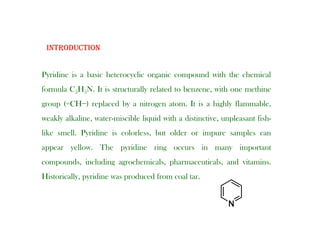
Pyridine is a basic heterocyclic organic compound with the chemical
formula C5H5N. It is structurally related to benzene, with one methine
group (=CH−) replaced by a nitrogen atom. It is a highly flammable,
weakly alkaline, water-miscible liquid with a distinctive, unpleasant fish-
like smell. Pyridine is colorless, but older or impure samples can
appear yellow. The pyridine ring occurs in many important
compounds, including agrochemicals, pharmaceuticals, and vitamins.
Historically, pyridine was produced from coal tar.
AROMATICITY
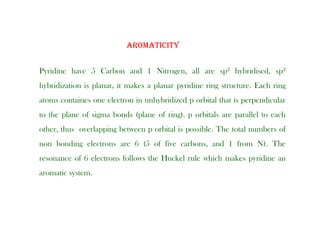
Pyridine have 5 Carbon and 1 Nitrogen, all are sp2 hybridised, sp2
AROMATICITY
hybridization is planar, it makes a planar pyridine ring structure. Each ring
atoms containes one electron in unhybridized p orbital that is perpendicular
to the plane of sigma bonds (plane of ring). p orbitals are parallel to each
other, thus overlapping between p orbital is possible. The total numbers of
non bonding electrons are 6 (5 of five carbons, and 1 from N). The
resonance of 6 electrons follows the Huckel rule which makes pyridine an
i
aromatic system.
BASICITY
BASICITY
Pyridine is more basic than pyrrole because in Pyridine the non bonding
electrons on N atom is in the same plane of pyridine hybridized orbitals
plane, so it is not participating in resonance phenomenon, due to this the
lone pair of electrons on Nitrogen are readily available for acid-base
reaction.
Nitrogen atom of pyrrole has lone pair of electrons perpendicular to
pyrrole hybridized orbitals plane, here the lone pair of electron participate
in resonance phenomenon, due to this the lone pair of electron on N is not
readily available for acid-base reaction. Pyridine is less basic than aliphatic
amines
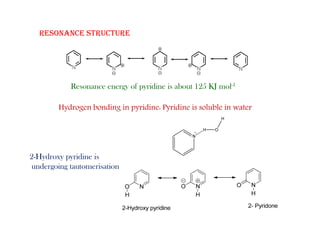
RESONANCE STRUCTURE
Resonance energy of pyridine is about 125 KJ mol-1
Hydrogen bonding in pyridine Pyridine is soluble in water
Hydrogen bonding in pyridine: Pyridine is soluble in water
2-Hydroxy pyridine is
undergoing tautomerisation
g g
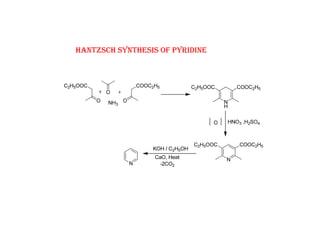
HANTZSCH SYNTHESIS OF PYRIDINE
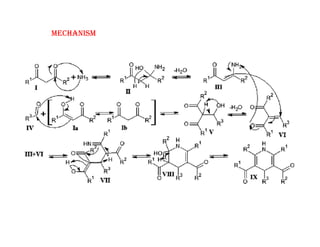
MECHANISM
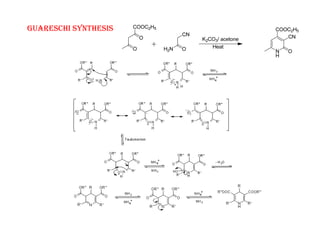
GUARESCHI SYNTHESIS
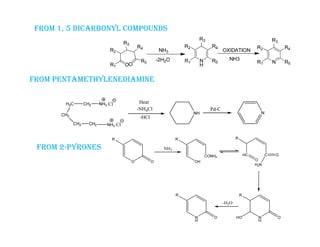
FROM 1, 5 DICARBONYL COMPOUNDS
FROM PENTAMETHYLENEDIAMINE
FROM 2-PYRONES
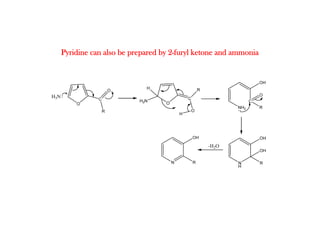
Pyridine can also be prepared by 2-furyl ketone and ammonia
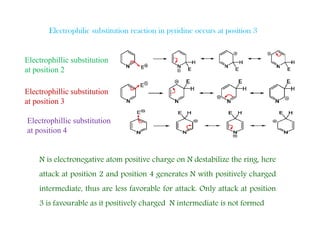
Electrophilic substitution reaction in pyridine occurs at position 3
Electrophillic substitution
at position 2
Electrophillic substitution
at position 3
Electrophillic substitution
at position 4
N is electronegative atom positive charge on N destabilize the ring, here
attack at position 2 and position 4 generates N with positively charged
intermediate, thus are less favorable for attack. Only attack at position
3 i f bl it iti l h d N i t di t i t f d
3 is favourable as it positively charged N intermediate is not formed
REACTIVITY
Pyridine has a high resonance energy and its structure resembles that of
benzene quite closely. The presence of the nitrogen atom in the ring does,
q y p g g ,
of course, represent a major pertubation of the benzene structure. The lone
pair orthogonal to the π- system provides a site for alkylation and
protonation which has no analogy in benzene. Many of the properties of
pyridine are thus those of a tertiary amine and the aromatic sextet is not
involved in these reactions. The other major influence of the nitrogen atom
is to distort the electron distribution both in the π-system and in the sigma-
bonds (by an inductive effect). This confers on the system some of the
properties which are associated with conjugated imines or conjugated
carbonyl compounds .
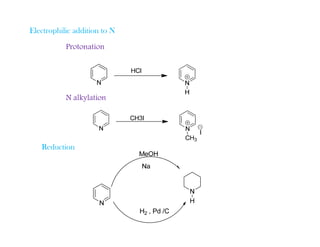
Electrophilic addition to N
Protonation
Protonation
N alkylation
Reduction
idi f l h h d i h lk l h lid idi
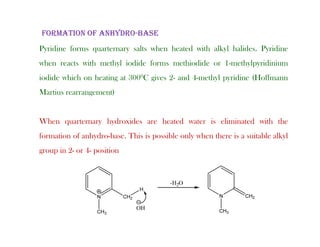
FORMATION OF ANHYDRO-BASE
Pyridine forms quarternary salts when heated with alkyl halides. Pyridine
when reacts with methyl iodide forms methiodide or 1-methylpyridinium
iodide hich on heating at 3000C gi es 2 and 4 meth l p ridine (Hoffmann
iodide which on heating at 3000C gives 2- and 4-methyl pyridine (Hoffmann
Martius rearrangement)
When quarternary hydroxides are heated water is eliminated with the
formation of anhydro-base. This is possible only when there is a suitable alkyl
y p y y
group in 2- or 4- position
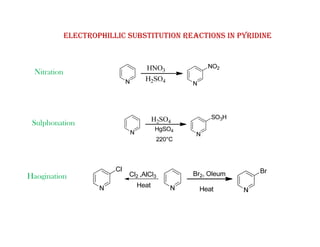
ELECTROPHILLIC SUBSTITUTION REACTIONS IN PYRIDINE
Nitration
Sulphonation
Haogination
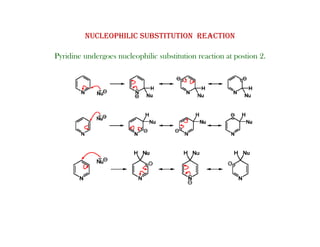
NUCLEOPHILIC SUBSTITUTION REACTION
Pyridine undergoes nucleophilic substitution reaction at postion 2.
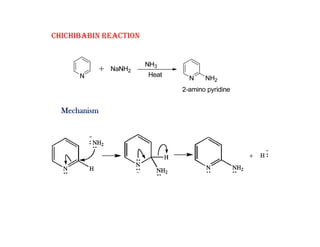
CHICHIBABIN REACTION
M h i
Mechanism
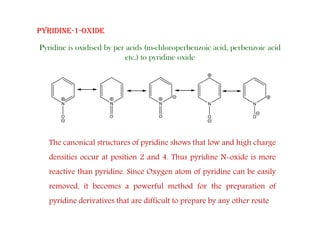
PYRIDINE-1-OXIDE
P idi i idi d b id ( hl b i id b i id
Pyridine is oxidised by per acids (m-chloroperbenzoic acid, perbenzoic acid
etc.) to pyridine oxide
N N N N N
O O O O O
The canonical structures of pyridine shows that low and high charge
densities occur at position 2 and 4. Thus pyridine N-oxide is more
ti th idi Si O t f idi b il
reactive than pyridine. Since Oxygen atom of pyridine can be easily
removed, it becomes a powerful method for the preparation of
pyridine derivatives that are difficult to prepare by any other route
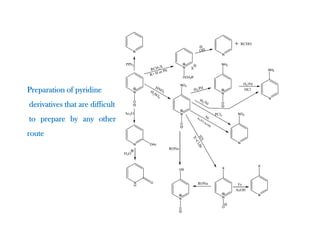
Preparation of pyridine
derivatives that are difficult
to prepare by any other
route
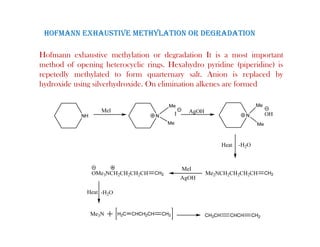
HOFMANN EXHAUSTIVE METHYLATION OR DEGRADATION
Hofmann exhaustive methylation or degradation It is a most important
method of opening heterocyclic rings. Hexahydro pyridine (piperidine) is
repetedly methylated to form quarternary salt. Anion is replaced by
epeted y et y ated to o qua te a y sa t. o s ep aced by
hydroxide using silverhydroxide. On elimination alkenes are formed

Syllabus_3006312720200506092720.pdf

  • 1.
    CHB-401: Heterocyclic CHB-401: Heterocyclic Compounds(Section B) PYRIDINE Organic Chemistry III Dr. Ashish Kumar Tewari Associate Professor Department of Chemistry, Institute of p y, Science Banaras Hindu University, Varanasi
  • 2.
    INTRODUCTION Pyridine is abasic heterocyclic organic compound with the chemical INTRODUCTION Pyridine is a basic heterocyclic organic compound with the chemical formula C5H5N. It is structurally related to benzene, with one methine group (=CH−) replaced by a nitrogen atom. It is a highly flammable, weakly alkaline, water-miscible liquid with a distinctive, unpleasant fish- like smell. Pyridine is colorless, but older or impure samples can appear yellow. The pyridine ring occurs in many important compounds, including agrochemicals, pharmaceuticals, and vitamins. Historically, pyridine was produced from coal tar.
  • 3.
    AROMATICITY Pyridine have 5Carbon and 1 Nitrogen, all are sp2 hybridised, sp2 AROMATICITY hybridization is planar, it makes a planar pyridine ring structure. Each ring atoms containes one electron in unhybridized p orbital that is perpendicular to the plane of sigma bonds (plane of ring). p orbitals are parallel to each other, thus overlapping between p orbital is possible. The total numbers of non bonding electrons are 6 (5 of five carbons, and 1 from N). The resonance of 6 electrons follows the Huckel rule which makes pyridine an i aromatic system.
  • 4.
    BASICITY BASICITY Pyridine is morebasic than pyrrole because in Pyridine the non bonding electrons on N atom is in the same plane of pyridine hybridized orbitals plane, so it is not participating in resonance phenomenon, due to this the lone pair of electrons on Nitrogen are readily available for acid-base reaction. Nitrogen atom of pyrrole has lone pair of electrons perpendicular to pyrrole hybridized orbitals plane, here the lone pair of electron participate in resonance phenomenon, due to this the lone pair of electron on N is not readily available for acid-base reaction. Pyridine is less basic than aliphatic amines
  • 5.
    RESONANCE STRUCTURE Resonance energyof pyridine is about 125 KJ mol-1 Hydrogen bonding in pyridine Pyridine is soluble in water Hydrogen bonding in pyridine: Pyridine is soluble in water 2-Hydroxy pyridine is undergoing tautomerisation g g
  • 6.
  • 7.
  • 8.
  • 9.
    FROM 1, 5DICARBONYL COMPOUNDS FROM PENTAMETHYLENEDIAMINE FROM PENTAMETHYLENEDIAMINE FROM 2-PYRONES
  • 10.
    Pyridine can alsobe prepared by 2-furyl ketone and ammonia
  • 11.
    Electrophilic substitution reactionin pyridine occurs at position 3 Electrophillic substitution at position 2 Electrophillic substitution at position 3 Electrophillic substitution at position 4 N is electronegative atom positive charge on N destabilize the ring, here attack at position 2 and position 4 generates N with positively charged intermediate, thus are less favorable for attack. Only attack at position 3 i f bl it iti l h d N i t di t i t f d 3 is favourable as it positively charged N intermediate is not formed
  • 12.
    REACTIVITY Pyridine has ahigh resonance energy and its structure resembles that of benzene quite closely. The presence of the nitrogen atom in the ring does, q y p g g , of course, represent a major pertubation of the benzene structure. The lone pair orthogonal to the π- system provides a site for alkylation and protonation which has no analogy in benzene. Many of the properties of pyridine are thus those of a tertiary amine and the aromatic sextet is not involved in these reactions. The other major influence of the nitrogen atom is to distort the electron distribution both in the π-system and in the sigma- bonds (by an inductive effect). This confers on the system some of the properties which are associated with conjugated imines or conjugated carbonyl compounds .
  • 13.
    Electrophilic addition toN Protonation Protonation N alkylation Reduction
  • 14.
    idi f lh h d i h lk l h lid idi FORMATION OF ANHYDRO-BASE Pyridine forms quarternary salts when heated with alkyl halides. Pyridine when reacts with methyl iodide forms methiodide or 1-methylpyridinium iodide hich on heating at 3000C gi es 2 and 4 meth l p ridine (Hoffmann iodide which on heating at 3000C gives 2- and 4-methyl pyridine (Hoffmann Martius rearrangement) When quarternary hydroxides are heated water is eliminated with the formation of anhydro-base. This is possible only when there is a suitable alkyl y p y y group in 2- or 4- position
  • 15.
    ELECTROPHILLIC SUBSTITUTION REACTIONSIN PYRIDINE Nitration Sulphonation Haogination
  • 16.
    NUCLEOPHILIC SUBSTITUTION REACTION Pyridineundergoes nucleophilic substitution reaction at postion 2.
  • 17.
  • 18.
    PYRIDINE-1-OXIDE P idi iidi d b id ( hl b i id b i id Pyridine is oxidised by per acids (m-chloroperbenzoic acid, perbenzoic acid etc.) to pyridine oxide N N N N N O O O O O The canonical structures of pyridine shows that low and high charge densities occur at position 2 and 4. Thus pyridine N-oxide is more ti th idi Si O t f idi b il reactive than pyridine. Since Oxygen atom of pyridine can be easily removed, it becomes a powerful method for the preparation of pyridine derivatives that are difficult to prepare by any other route pyridine derivatives that are difficult to prepare by any other route
  • 19.
    Preparation of pyridine derivativesthat are difficult to prepare by any other route
  • 20.
    HOFMANN EXHAUSTIVE METHYLATIONOR DEGRADATION Hofmann exhaustive methylation or degradation It is a most important method of opening heterocyclic rings. Hexahydro pyridine (piperidine) is repetedly methylated to form quarternary salt. Anion is replaced by epeted y et y ated to o qua te a y sa t. o s ep aced by hydroxide using silverhydroxide. On elimination alkenes are formed